The Great Eternal Life Scam

Heathens like me, and you dear reader, are gambling how we’ll spend eternity by rejecting Jesus. We’re turning down everlasting life to live in the mire of our own sin. Or so we’re told by evangelicals and other religious zealots.

So convinced am I that the claims of Christianity are wrong in every respect that I know I’m not gambling anything. Like everyone else who has ever lived, I will not survive my death. This is the nature of death – extinction, obliteration, oblivion. It is absurd to believe it is anything other when we know it is not.

I would not be averse to existence, particularly my own, continuing after death. I’d definitely go for it if that were available; I like being around, all sentient and self-aware and such. This is the sentiment to which Christianity appeals; most people do not want to think their existence is finite and that this often challenging life is really all there is. But life patently does not continue post mortem, except in works of fiction: fantasy, science fiction, the gospels.

Everlasting life is not the only promise Christianity makes, of course. There’s the whole ‘getting right with God’ shtick, forgiveness of sins and Life in all its fullness. Eternal life is the big one though, Christianity’s most miraculous, death-defying special offer.

Those doing the gambling are not atheists or sceptics. It’s Christians themselves doing that, succumbing to the false, utterly worthless promise of life after death. Those fully committed to Christianity spend their lives enslaved to its cultish demands, desperately trying to convince others they should surrender to its preposterous claims.

I value this life too much to squander any more of it on such nonsense. Yes, I did once, but I saw the light and stepped into it. Life is what you make it and needs to be lived before you die. There is zero chance you’ll be able to once it’s over.

Burst the bubble, those of you trapped within it. Your one and only life awaits you here on Earth. The clock is ticking.

No God and the Domino Effect

This a response to Don Camp’s comment on my post The Evil of Christianity, in which he tries to isolate ‘the crux’ of our disagreement about the Faith.

You start, Don, from the assumption that there is a God. I, on the other hand, have considered the evidence and concluded that in all probability there isn’t one. Certainly not the Christian God. There may be a god out there somewhere that has no interest in human beings and their affairs, though I doubt it. As far as we humans are concerned such a deity is as good as non-existent, being entirely hypothetical. If it is out there, it certainly won’t be offended at my saying so.

Once I realised some years ago that a personal God did not exist a number of other things followed (or rather, collapsed):

No God means no Son of God or God Incarnate, no Saviour or Christ.

No God means no resurrection (which Paul makes clear was a work of God).

No God means no Holy Spirit.

No Holy Spirit means no regeneration of individuals to become new creations in God (you only have to look at Christians today to see this is the case.)

No God means no grand Salvation plan.

No God means no Heaven, no Final Judgement, no Kingdom of Heaven of Earth, no Eternal Life.

No God means the universe can’t have been created by him.

No God means no manipulation of evolution, no intervention in human history and no prophecy of things to come.

No God means that the world would be just as we find it: messy, beautiful, dangerous, turbulent, indifferent.

No God means prophecy is man-made and comes to pass at no greater rate than chance allows (i.e. practically zero.)

No God means conversations with ‘him’, revelations from him and visions of him are all imagined, generated by and within the human brain, which works in mysterious ways.

No God means no God-given morality. Morality is, as you say, culturally determined and so may and does change over time. (You can see this in the Bible itself where morality supposedly handed down by God for all time evolves throughout the Old Testament and into the new.)

No God means there is neither Sin nor Righteousness. These are religious concepts. The whole spectrum of human behaviour, from destructive to altruistic, is demonstrated by believers and non-believers alike.

No God means assertions like ‘the issue turns on what I perceive as good for me versus what God declares is good for me’ are illusory. What is good for you is what you have worked out, even if you think God had a hand in it. A supernatural being who doesn’t exist cannot be responsible for your well-being, though your church and the bible undoubtedly contributed to your conditioning.

No God means individuals must work out their own meaning and purpose. Some do, some don’t, as you observe, Don. This is as true of believers as it is for non-believers. Many atheists have managed it, or not, without having it imposed by religion. And despite what you say, Christianity is a religion. It is the epitome of religion.

No God means none of the Abrahamic religions are true and therefore Christianity and its ‘holy’ book, being based on an invalid premise, must be false. Most of the posts on this here blog are about demonstrating this fact.

No God means all gods are man-made, not all gods except one.

The crux of the matter is you believe in God while I see how unlikely it is that there is one. I’d agree with you if I could, Don, but then we’d both be wrong.

The Bible as Metaphor (again)

A few days ago, Dennis and I visited Penrith, a small market town a short distance from the city where we live. What a delight it was to discover that the street preacher who plagues our city – the humourless Dale McAlpine – also inflicts himself on this smaller place. We so enjoyed hearing him bellow out, as we manoeuvered past his confederates handing out poorly written tracts, that we were all sinners – ye, everyone of us – bound for hell.

As we stopped at an ATM we heard Dale announce how Jesus healed lepers and cured leprosy, which patently he did not. He said Jesus’ healing of lepers was a metaphor for what he could do for us all, by removing our sin and making us whole again. His metaphor schtick – an sophisticated one for a simple street preacher – put me in mind of our very own Camp commenter. As Sunday school teacher Don frequently reminds us, the Bible is a) literature and b) largely metaphorical.

In case he’s forgotten and is arguing this week that we should view the bible’s stories as historical accounts (his other favourite tack), here’s what he actually said:

Much of scripture is the kind of literature in which metaphor and other kinds of figurative language is common… you are out of touch with the literary character of ancient literature.

I hope you all feel thoroughly chastised by this. I know I do. Don was taking exception to my post in which I itemised the Bible’s mythical creatures, talking animals and impossible events. So, I’m going to take him, and Dale at their word and take a fresh look at the Bible’s use of ‘metaphor and other kinds of figurative language’

First though, let’s understand that metaphor and figurative language are distinctly literary techniques. In literature and sometimes in speech, metaphors make subtle comparisons and bring to mind a host of associations that the author does not then have to explain. Outside of fiction, they don’t have much of a function. We don’t, for example, attribute metaphorical meaning to human events and interactions in the real world. The present war in the middle east is not a metaphor for something else, like, for example, the warfare that Christians believe rages in the Spirit world. Sleepy Joe Biden’s activity, or lack of it, is not a metaphor for the present condition of the USA (let’s hope not anyway). Our personal relationships are not metaphors for something grander. There is no metaphor embedded in actual events or real world interactions.

No. Metaphor exists almost entirely in literature. While the occasional non-fiction author might add a metaphor for flourish, strictly speaking, metaphor exists in and for fiction and poetry. More than this, when, in fiction, ideas are expressed metaphorically, it signals that the surface meaning is of lesser significance. It is the underlying or hidden meaning that matters. The fiction is the vehicle by which the metaphorical truth is conveyed. Don admits as much in his comment.

Let’s try some illustrations. The underlying metaphor of The Great Gatsby, its truth, is the dark underside of the American dream. Its surface story isn’t real; it is fiction. The metaphor conveyed through Moby Dick – the fictional whale as well as the novel as a whole – is the destructive nature of obsession. Again, as powerful as this is, none of the story that conveys it actually happened. Frankenstein’s central metaphor is the danger that uncontrolled science represents to humankind. The story that carries this message is, however, pure invention. In All The Light We Cannot See, Light is the metaphor, as it frequently is. The characters’ insights into truth are what the author seeks to convey. The fiction is the vehicle of that truth. Choose your own example: fiction embodies metaphor, the ‘truth’ of the story. But the story itself is rarely an actual event. Even when it’s based on one, as the movies say, the narrative is extensively fictionalised.

So, let’s go back to Dale’s leprosy metaphor. In several gospel stories, the authors have Jesus cure lepers precisely to illustrate how he can heal people of their inner leprosy: their sinful nature. Jesus almost certainly did not heal any lepers; this is the fiction. The creators of the gospels designed the story to carry metaphorical meaning, which, in this case, is that Jesus can heal us from sin.

Likewise the stories in which he heals the blind; the blindness is metaphorical. The saviour opens people’s eyes to spiritual truth. He didn’t really cure blind people; that is the fictional vehicle for the metaphor.

He didn’t turn water into wine; the writers of the fourth gospel wanted to convey the spiritual ‘truth’ that the new cult’s beliefs were superseding old Jewish ones; a metaphor was a memorable way to do it.

Lazarus was not raised from the dead; the story is a metaphor to illustrate how God will raise believers at the last day.

The Romans did not execute Jesus; it was the spiritual rulers of the age who, according to Paul in 1 Corinthians 2:8, put the saviour to death. The Romans are the metaphor for the wickedness of these supernatural beings.

Jesus did not rise from the dead. This too is a metaphorical fiction.

How did I do, Don? I’ve interpreted isolated periscopes from the gospels metaphorically. I’ve borne in mind that metaphor and other figurative devices are purely literary, techniques in fiction. I’ve channelled the literary character of ancient literature as defined by you (except of course you never actually do define it.)

You are invited to respond. I offer to post your comment, if it is as lengthy as I expect it to be. You must, however, keep to the point and resist making personal jibes. Choose any of the miracles, healings or pericopes from the gospels and demonstrate that they are real historical events.

It matters to you and to other Christians that the events of Jesus’ life did happen. That they’re not just the invention of clever writers who, taking inspiration from Jewish scriptures, created metaphorical events to convey higher ‘truths’. So persuade us that at least one miracle, healing or episode is more than a literary device, a metaphor for some fanciful theological ‘truth’. Provide the evidence that it really happened. Claiming the disciples witnessed the miracles or healing won’t cut it, when the disciples are themselves characters in the stories, and metaphorical at that.


Jesus Is Cool With It

I was handed a sticker the other day that read ‘Jesus is cool with it’. Just what the hip Jesus of the sticker was cool with was explained by an accompanying leaflet, and the fact I was at a Pride event at the time.

I worked out from the leaflet and his rainbow flag, that what Jesus is cool with is homosexuality and all that goes with it. He might also be cool with transgenderism and other variations in human sexuality, but who knows; the leaflet didn’t say so directly. It did, however, have a list of websites that support those who are religiously afflicted and gay, transgendered or of unorthodox sexuality. It suggested that through these sites it might be possible to find a gay affirming church in the local area.

I was at first pleased to see that Jesus had had a change of heart. That he had in fact made a complete u-turn from his previous position, which evangelicals have long assured me, is that homosexuality is a heinous sin and a ‘violation of God’s design for human sexual behaviour’.

Eagerly, I logged into my favourite – I use the word loosely – Christian sites to see how they were celebrating this new revelation from the Lord. Unfortunately, they had yet to be updated and so weren’t conveying the news that Jesus was now ‘cool’ with gayness and the like.

That was over a week ago. I’ve just checked again only to find that they’re still not proclaiming this particular piece of good news. In fact, some have published even more rants well considered pieces about the evils of homosexuality, drag acts, people who are changing sex and the rest. They are so uncool about it that they’re still quoting the Bible: the Old Testament verses where it says that for a man to lie with another man is an abomination, and Paul, who, channelling Jesus (or so he’d have us believe) insists that homosexuals won’t make it into God’s Magic Kingdom. Some sites also mention Jesus’ pronouncement in Matthew 19:14 (yawn) that God made only male and female and the only time they’re allowed to get jiggy with each other is when they’re married.

I’m left wondering who is right. The ‘Jesus is Cool’ brigade or the great preponderance of evangelical churches that say he isn’t cool, not one jot or tittle, with same-sex doings.

The thing I’ve learnt through this, is that Jesus can be whatever you want him to be: a really cool guy who gives the thumbs up to whatever consensual sex you enjoy or a grouch who didn’t die just so you could continue in your old sinful ways. Take your pick. He’s both, depending on which bits of the Bible you prefer.

I wouldn’t care one way or another if it weren’t for the damage done by those who think they speak for the grouch.

Redeemed: From Slavery to… erm, Slavery

Thanks be to God, who delivers me through Jesus Christ our Lord! So then, I myself in my mind am a slave to God’s law, but in my sinful nature a slave to the law of sin. (Romans 7:25)

Do you not know that if you present yourselves to anyone as obedient slaves, you are slaves of the one whom you obey, either of sin, which leads to death, or of obedience, which leads to righteousness? (Romans 6:16)

(We are) justified freely by his grace through the redemption that is in Christ. (Romans 3:24)

When a slave had served sufficient time and had accumulated sufficient wealth or found a benefactor, he or she could buy their freedom. This seems particularly egregious when their servitude was already, in the case of debt, the means of paying back what was owed. In effect the enslaved individual was paying twice for their freedom. Be that as it may, the act of buying oneself out of slavery was known as redeeming oneself; redemption. Likewise, a third party buying your release was also known as redeeming. We still use the term in this sense today: a pawned item can be redeemed, bought back, for a greater amount of cash than the pawnbroker originally paid for it. The related term ‘ransom’, in Mark 10.45 has the same sense; paying money to secure the release of a captive.

The principle of buying oneself out of captivity and slavery underscores the Christian idea of redemption. It is the analogy Paul and other New Testament writers use, to explain Christ’s paying the price, through his sacrificial death, for the slave’s release. He redeems (or will do at some future point depending on which fantasist you’re reading) in exactly the same way a slave was redeemed, from a life of captive slavery to sin/the Law/Satan and his minions. 

There’s a catch. If a slave was redeemed by a third party, he was likely to find himself not free at all but the property of whoever had redeemed him. His debt having been paid off to his first owner, he might very well find himself in hock to a new one. So it is with Christian redemption. Christ may have paid off your perceived debt to your original owner (sin, Satan or whoever) but now you’re indebted to him. You’re his slave, as we saw in the previous post.

To downplay slavery as it was practised in the centuries before the cult adopted it as an analogy, is to undercut redemption as Paul and early cultists perceived it. Arguing that slavery was a relatively benign practice removes the basis of Christian redemption; if being a slave wasn’t really too bad then neither can being a slave of sin/the Law/Satan be too serious either. There’s really no great need to be redeemed and what Paul says in Romans and elsewhere counts for nothing.

But we knew that anyway.


God’s Agents?

Christians are agents of God or so we’re informed. I’ve tried to locate where in the Bible it says that the Lord appoints fallible humans to be his 007s, but alas, I can’t find it anywhere. The best I can do are the claims in the fourth gospel that Jesus was God’s agent on Earth, but that’s not the same thing.

What about the idea then, also touted by Christians, that they are somehow God’s ‘partner’? No, that’s not there either. God regards himself as so far above us, his creators, that it would be like you or I partnering one of the ants crawling around in our gardens.

So how does the Bible describe the Christian’s relationship with God? It refers to it as master and servant. The word usually translated as ‘servant’ however, is doulos, which actually means ‘slave’. God doesn’t want you as an agent, partner or servant. He expects you to be his slave. Christian blogger, Sam Storms, explains what this means:

I, in the totality of who I am, have been purchased by Jesus Christ. He literally owns me. I belong to him, body, soul, spirit, mind, affections, abilities, talents, heart, will, and emotions. There is nothing in me or about me that belongs to me.

As a slave of God you are stripped of the very agency other Christians claim they gain from aligning themselves with the divine despot. And when you’ve done all he requires of you he’ll barely acknowledge you. As Jesus puts it in Luke 17:5-10:

Suppose one of you has a slave (doulos) ploughing or looking after the sheep. Will he say to the slave when he comes in from the field, ‘Come along now and sit down to eat’? Won’t he rather say, ‘Prepare my supper, get yourself ready and wait on me while I eat and drink; after that you may eat and drink’? Will he thank the slave because he did what he was told to do? So you also, when you have done everything you were told to do, should say, ‘We are unworthy slaves; we have only done our duty.’”

Whatever you do as God’s or Jesus’ slave won’t be enough, they’ll still regard you as a worthless slave.

I didn’t know about you, but this isn’t for me. I have more self-respect than to submit to a life as a slave. So have you. So in fact has everyone.

Most Christians agree. Almost all of them disregard the expectation that they become slaves. We know this because –

  • The majority don’t act as if they’re slaves, serving their fellow human beings till they’re fit to drop (Matthew 25 etc).

  • Most seem unaware even that Jesus insists they must be slaves when successive translators have deliberately altered the unsavoury ‘slave’ to the more palatable ‘servant’.

  • Those who are aware of his expectation seem to regard it as a metaphor; always a good get-out. And doesn’t Paul remark in his letters that believers are sons of God? That’s much more acceptable.

  • They omit the slavery element from their evangelising because no-one is going to be attracted by the offer of life-long servitude; far better to present Jesus as a would-be friend, big brother and all round good guy with whom people can be in ‘partnership’ or a fellow special ‘agent’.

  • They talk about free will when a slave, either of sin (John 8:34) or of Christ’s, has no freedom and no free will to exercise.

  • They convince themselves that sitting at a computer arguing with atheists online is the kind of slavery Jesus had in mind.

  • They turn a blind eye to the fact that the Bible teaches slavery is what they can expect not just now but for all eternity (Revelation 22:3-4).

It’s almost as if they don’t really believe such self-abasing, masochistic nonsense themselves.


10 Reasons Why

I wonder what are the reasons those of you who were once Christians gave up on faith? Believers who know me far better than I know myself have attributed to me a whole range of motivations. Here’s a top ten of the reasons I rejected Jesus according to these spiritually astute know-it-alls:

In at 10 it’s…

You must have been hurt/had a bad experience of Christians. To which I answer, not particularly, though I did find the people I encountered in churches to be much like those I encountered in any other organisation I’ve been involved with. No different. Certainly no better, and in some ways worse when they squabbled or were petty and judgemental. Not sufficiently worse to make me abandon faith, but perhaps enough to make me ask whether Christianity really ‘worked’. Shouldn’t Christians who are new creatures, reformed in the image of Christ. be so much better than the rest of us?

At 9… You went to the wrong church. If so I must’ve attended several ‘wrong’ churches as I moved around the north of England with work. My wife and I always sought out churches with sound biblical teaching, so it wasn’t the lack of solid food that caused me to backslide (to use the Christian jargon.)

8. You wanted to wallow in your own sin. As I’ve said facetiously before, I like a good wallow as much as the next man and preferably with him. Back in the days of my struggling with faith, however, I didn’t find myself drawn to ‘sin’. I was trying to raise three children, do a demanding job and deal with the fallout from my boss’s affair with a colleague. My own sin was the last thing on my mind.

Related to this is the accusation that an apostate such as I wants, in some unfathomable way, to be God. Certainly I want to be fully human and to take charge of my own life, but aren’t these laudable intentions? It doesn’t mean I aspire to be God; I don’t want to be worshipped, don’t want to laud it over others, blame them for my deficiencies or send them to hell. That’s what God does, right? But it’s not me. 

7. You rejected Christ because you’re gay and didn’t like the constraints faith placed on your sexual behaviour. See above. I didn’t admit I was gay until several years after I ditched faith and it was several more after that before I came out, yet more until I did anything about it. But okay, if you want to reverse the order of events, I gave up on religion because I was latently gay. But not really, though certainly the abandonment of faith was a liberation; I could think for myself and was free, over a long period of time, to finally become myself.

6. You read the wrong books. I certainly did: C. S. Lewis (I still have my collection of his books), John Stott, John Piper, John Bunyan, Bonhoeffer, Joni Erickson, Corrie Ten Boom, Billy Graham, David Wilkerson… and the Bible. So yes, I wasted a lot of time reading this sort of thing, but I’m guessing that’s not what my Christian accusers mean. I read more widely as I moved away from faith which helped me break out of the Christian bubble, but this wasn’t the reason I left the faith. I was well on the way by this time.

5. You were never a true Christian. Your faith was intellectual or habit or emotional but not deeply personal. Of course I was a true Christian. Just ask Jesus. Oh… you can’t. I’ve written about this before as you’ll see here. I was as real a Christian as those who claim they’re the real deal now.

4. You were in thrall to non-Christian writers. Not in thrall, no, but these writers – Ehrman, the so-called New Atheists, science writers (Dawkins’ science books particularly), Pagels, Barker, Loftus, Alter and, yes, Carrier – make a lot more sense than those who write from the perspective of faith. These authors don’t seem to mind, indeed they relish that their readers think critically about the evidence they present. Mumbo-jumbo isn’t passed off as erudition.

3. You have no awareness of the spiritual; you think that only that which can be measured is real. This is true, but it is not why I gave up Christianity. It is a consequence of doing so. I have seen no evidence of a spiritual realm that exists outside the human imagination. If anyone is able to present evidence that it does have independent existence, I’m open to it. Until then I will continue to live with the understanding that angels, devils, demons, heaven, hell, celestial saviours and gods, like unicorns, dragons and Shangri-La, do not exist. It follows that as non-existent beings they cannot communicate with us nor await us as our final destination.

2. Your heart has been hardened by Satan. See above; there is no Satan. Hardening of the heart is a metaphor for those who don’t fall prey to Christianity’s fraudulent claims or at last see through them.

1. You gave up on faith because you realised none of it was true. Yes. Finally. This is why I rejected Christianity. It simply isn’t true, as I’ve attempted to demonstrate on this blog for the last 12+ years. Its third-rate fantasies, fake promises and failed prophecies are all evidence of its falsity.

But wait. None of the telepathic Christians who ‘know’ why I’m no longer a believer ever make this accusation. They would never concede that most (all) of what they believe simply isn’t true. But my life experience and my reading as I began to suspect Christianity was nothing more than a con have borne this out. Christianity is demonstrably untrue, theChristian God a fraud and supernatural-Jesus a fiction. This is why I abandoned Christianity.

How about you?

Jesus the No-Hoper

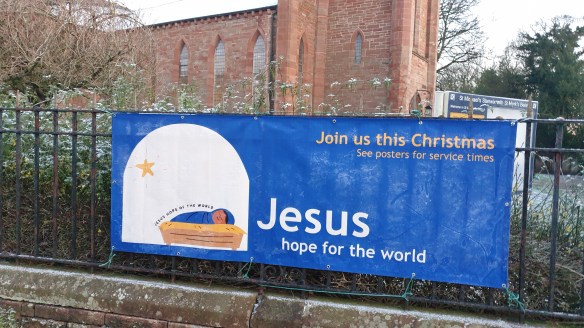
Jesus – Hope for the World declares the banner outside the church near where I live. I can’t help but wonder about the naivety of the people who came up with the slogan and what it means. What are the possibilities?

‘Peace on Earth, goodwill to all men’ (and maybe women)? If so, the world isn’t showing much of either, certainly none that can be attributed to Jesus and his fractured, fractious and frequently intolerant church.

How about inner peace then, even though that’s a long way from ‘hope for the world.‘ How many Christians exemplify this particular fruit of Spirit? Is this, in the end, all that Jesus offers: the hope of a nice fuzzy feeling inside? Of course, peace of mind can be spirit-generate, though personally I prefer wine. 

Hope of reconciliation with God then. Only if you believe in God in the first place, not to mention ‘sin‘, human sacrifice and magic. If this is the kind of hope Jesus represents, then really, what good is it? 

Possibly the hope of which the banner speaks is the hope the earliest Christians had, of Jesus coming back real soon to slaughter his enemies and set up the Kingdom with, naturally, themselves at the top of the pile? Hasn’t Jesus had two thousand years to deliver this hoped for outcome?  An idea well past its sell-by date, the Kingdom of God on Earth isn’t ever going to materialise, however much ‘hope’ people have.

Maybe, then, it’s a hope of eternal life. The gospel writers have Jesus make such a preposterous offer (e.g. John 10:27-28). If this is what Christians are hoping for they are sadly deluded, and, as Paul puts it, the most pitiable of all people (1 Cor 15:19). No human being outside of myth and comic books has ever lived forever. None ever will.

Hope of heaven? See above. Besides, the Bible really doesn’t offer a place in heaven to anyone. That’s a much later development. It’s a waste of this one and only life to live in the vain hope of something better after death. 

Maybe the hope referred to is hope in hope itself. How futile would that be? Hope is no substitute for food for the hungry, shelter for the destitute, treatment for the sick. 

When I go to the carol service at the church next weekend, I’m confident it will be made clear just what sort of hope Jesus offers the world. If not, I’ll be sure to ask. I’ll let you know.

Jesus Reveals Himself To Me

A true story:

I used to have recurrent dream – at least I think it was recurrent; it may just been that when I dreamt it I also dreamt I’d dreamt it before – that I was prevented from getting home by an oversized lion that blocked my path. It did this not by baring its teeth and confronting me, but by simply lying down in front of my garden gate, apparently asleep. I was always afraid to disturb the sleeping lion in case, once awake, it attacked and ate me. Instead, I would gingerly step round it and walk on, away from my house. In a variation of the dream (I think), I’d turn around and head back the way I’d come.

Evidently, the large lion symbolised something, though I couldn’t understand what it was. Perhaps, I thought, it represented my psychic inability to be myself. After all, I experienced this dream before I came out. It was equally possible the lion was the devil, as described in 1 Peter 5:8, and Satan had invaded my dreams, was blocking access to my heavenly home. Maybe it was – shudder – the demon of homosexuality, which I knew existed because Christians said it did, driving me off the straight and narrow.

A then came the moment of revelation! Jesus is referred to as the Lion of Judah in Revelation (5.5), yea, the Kings of Kings who roars like a mighty lion (Amos 3:8). That’s when I realised that my dream lion was Jesus, protecting my eternal salvation and heavenly home from the attacks of the devil and my very own sinful nature! Why else must I take a different path or turn back, which is one meaning of repentance?

Jesus himself, the Lion of Judah, the King of Kings made himself known unto me in this dream, not once but many times. Praise the Lord! In revealing himself, the Risen Jesus was telling me that the only way to salvation was through Him and Him alone. Only He guards the way. How blessed I am to have had His very real presence in my dreams. He truly lives and has appeared to the very least of his followers – me.

There can be no other explanation for my dream experience.

Can there?

How Do Christians Explain Those Who Renounce Their Faith?

Aka The Death of Ananias by Raphael (Acts 5)

What was original Christianity like, long before it acquired that name? Before Paul’s ideas took hold? Clearly the cult existed prior to Paul. He tells us so himself: worship groups were around – the one he writes to in Rome, for example – before he  established his own. 

The early faith seems to have emanated from the visions of early believers such as Cephas and James. Quite what they ‘saw’ is open to debate but it led to them setting up a sect within Judaism that focused on the saving power of a risen celestial being.

And everything was absolutely hunky dory within these early communities. Members shared all their possessions (except when they didn’t, in which case they were annihilated on the spot) and lived in perfect harmony together, worshipping Jesus and experiencing miracles on a daily basis.

According to Acts, that is. According to Paul, by the time he came to be involved, it was all very different. Many of the early ‘churches’ were characterised by squabbling, greed, legal disputes, confusion about doctrine, sleeping around, visiting prostitutes and power struggles (Galatians 5.20; 2 Thessalonians 3.14-15; 1 Corinthians 1.10, 4.21; 1 Corinthians 6.1-10; 1 Corinthians 6.12-20; Galatians 1.6-9; 1 Corinthians 5.9-13 etc.) Worse still, there were defections by converts who came to their senses and left the cult.

How can this be when, according to Paul these people were inhabited by God’s holy spirit and saved once and for all by the redeeming blood of Jesus? Just as today, early believers, including Paul, had a hard time explaining how a person could be once saved and then lose their faith. They came up with various excuses how this could happen:

Excuse #1. Apostates were never really been saved: they were faking it in some way, their faith hadn’t been deep enough or Satan had snatched it away from them. One enterprising and influential cult member even came up with the sneaky idea of putting these explanations into the mouth of Jesus (because of course he would have foreseen the problem.) So arose the parable of the sower. According to Mark 4.1-20, the ‘word’ doesn’t always ‘take’. It might seem as if it has but sometimes it is uprooted by the cares of this world. Alternatively, it falls on stony ground and really doesn’t stand a chance of growing. Or Dick Dastardly Satan intervenes and destroys the faith of those who once believed. As a cultist called John later put it,

They went out from us, but they did not really belong to us. For if they had belonged to us, they would have remained with us; but their going showed that none of them belonged to us… (1 John 2.19)

Which really says nothing: ‘they left, so really they weren’t part of our gang to begin with.’ A brilliant bit of exposition.

Excuse #2. Apostates are still saved. In direct contradiction of the parable of the sower, some Christians invented a different way of accounting for those who had ‘fallen away’: the ‘once saved always saved’ argument, based on a few cherry-picked bible verses. Despite appearances, those who’ve left the faith are nonetheless still savedThe ‘reasoning’ is that because salvation is a work of God, it cannot be undone, no matter how much one refutes the faith, or provides reasons for leaving it or demonstrates the untruthfulness at the heart of it. Salvation is like a tattoo you regret getting but with which you’re stuck for the rest of your existence. (Except not really, for a whole host of reasons but principally because there’s no God to work the magic in the first place.) This line of reasoning runs entirely contrary to the acknowledgement in the parable of the sower that there are always those who will leave the faith.

Excuse #3. Apostates have been hurt by the church and as result have abandoned the faith (but Jesus is waiting for them to return!) While I don’t know anyone who has renounced Christianity for this reason alone, it does play a small part in some defections. Why? Because self-serving and vindictive Christians are evidence that Christianity simply doesn’t work. It doesn’t make ‘new creations’, infusing people with a holy spirit that makes them better people. Believers, despite their claims, are no more moral than those who are unsaved. You’ll know this if you’ve been on the receiving end of Christian judgment or condemnation. When Christians themselves undermine the claims of their religion it creates a justifiable scepticism in one-time brothers and sisters.

Excuse #4. Apostates just want to wallow in sin. Back to the parable of the sower for this one: ‘Satan has ensnared you into life of sin and debauchery and you have abandoned the one true way’. I have to say this is not true of any ex-Christians I know.  They’ve dispensed with the wholly religious idea of ‘sin’, and now live their lives as authentically as they can, looking after their loved ones and helping others where possible. Then again, so what if people want to wallow a little bit?   

The one reason that causes others to leave the fold that is never recognised by Christians is the gospel itself. No sir. That some people are able to see how irrational, contrived and downright untrue it is, is not a possibility Christians are willing to entertain. Jesus himself, however, seems to recognise that some people are just too intelligent to go along with it:

I praise you, Father, Lord of heaven and earth, because you have hidden these things from the wise and learned, and revealed them to little children (Matthew 11.25).

Even he knew – or, far more likely, the sect that put these words into his mouth – that for anyone capable of a modicum of critical thinking (‘the learned and the wise’), the cult’s claims simply don’t stand up to inspection.