Are You Doing What Jesus Christ Says?

Billboard

Dale McAlpine, sometime commenter here and fanatical street-preacher in these parts, has posted a tasteful little video on his web-site – that’s the smugly named Repent.com if you’re interested – called Are You Doing What Jesus Christ Says? Take a look at it over on Repent.com or on YouTube; it’s ludicrously melodramatic and wonderfully over the top. You’re sure to enjoy its typos and spelling mistakes too.

What’s remarkable about it apart from these things is that, despite its title, it makes little reference to what Jesus is supposed to have said. Instead, it’s all about how you’ll go to hell if you don’t repent and accept him as your saviour; but Jesus never said this. It says you’re a ‘vile, wretched, hell-deserving son or daughter of Adam’ – Jesus didn’t say this either. It also insists you should let his cross ‘disrupt the very centre and citadel of your life of self’ (whatever that means) and guess what? This wasn’t part of Jesus’ teaching either. In fact, none of these claims were part of his ‘good news’.

Of the things Jesus did say – go the extra mile, sell all you have to give to the poor, turn the other cheek, avoid judging so you won’t be judged, give to all who ask, give away your shirt as well as your coat, feed the hungry, visit the sick, clothe the naked and love your enemies – the video makes no mention. Funny that. Maybe that’s why we don’t see Christians doing them very often.

So, Christians – and Dale too – are you doing what Jesus said or are you, like the video, only interested in pointing out others’ supposed sins and shouting about how they need to join you in your delusional mumbo-jumbo?

Yes. Thought so.

The Stuff Christians Say… (part three)

DoorToDoorAtheists are aggressive/militant/unreasonable: The Christians might’ve got us on this one. After all, it is incredibly irritating when we atheists start preaching in the town centre or invade others’ events to tell them what to believe or dish out loony pamphlets or turn up at people’s doors when they’re just about to have their tea. And what about all those meeting places we have, on just about every corner of the city, with smart-arse posters about Adam and Steve on the board outside? And let’s not forget our readiness to blow up ourselves and others in the name of our great cause. Now that’s ‘militant’! Yes, we atheists really do have too much freedom to push our views on others. No wonder we’re so insufferable. (Note to self: check you’ve got this right.)

It takes more faith to be an atheist than a Christian: It takes no faith to recognise there are no supernatural beings. It takes no more faith not to believe in God – or to acknowledge that there is no God to believe in – than it does not to believe in Santa Claus, Poseidon or Ra. Christians themselves require no great abundance of faith to dismiss these characters. Is it so difficult to understand that atheists disregard the Christian pantheon of fantasy figures in exactly the same way? Or are believers practising their dishonesty-for-Jesus again? There is no faith involved in being an atheist. On the other hand, believing in an omnipotent but suspiciously inactive God, a super-hero Saviour, a magic Spirit, angels, cherubim, seraphim, demons, Satan, resurrected saints, Heaven, Hell and all manner of powers and principalities – this requires faith in delusional quantities. No atheist could possibly compete. Nor would they want to.

My preciousss is mine (and mine alone)

bible3Christians have a monopoly on the Bible. No-one else should comment on it, criticise it or even quote from it. Or so Christians tell me. The reason for this, apparently, is that ‘it is absurd to contest the Bible when (you’re) missing the one main ingredient: Jesus’. Not so, of course; the Bible is there for anyone who wants to consider and ‘contest’ it. Granted one’s perspective will be coloured by how one regards it to begin with –

whether you approach it with a reasonable degree of objectivity or look at it through the myopia of faith;

whether you take what it says at face value or apply shifty exegesis to smooth out its many inconsistencies;

whether you acknowledge it was created over time by a succession of fallible men or assume it represents the accurately recorded words of God;

whether you regard it as beliefs of ancient tribesmen and religious fanatics or see it as the means of salvation and the ultimate guide to life.

It is only reasonable that those who take the first of each of these alternatives look to those who take the latter to see how closely they adhere to the demands the Bible makes of them. It’s reasonable because those who believe in its magical properties use it to tell the rest of us how wicked and/or lost we are and how much we need Jesus. If the Bible is the Word of God (as I’ve noted before, it doesn’t claim to be; it’s Christians who say it is), instructing believers on how to live their lives while spreading the gospel, it is not unreasonable for those of us on the receiving end of their ‘witness’ to take a look at how that works out. Not so well as it happens.

Now either this is the fault of the book – heaven forfend that it isn’t clear about what’s expected of God’s Chosen – or Christians themselves are to blame for failing to live as it expects. Unsurprisingly, it’s a combination of the two; a book of mixed messages in the hands of flawed human beings. When Christians refuse to acknowledge that the Bible is far from perfect they are faced with the challenge of making its impossible demands compatible with their own imperfections. They have a number of cop-out excuses that enable them to do this, several of which appear in the comments on this blog. I’ve discussed a number of them before, but here’s a quick summary:

Christians are not perfect and the Bible doesn’t say we should be (actually it does, in Matthew 5.48);

Others have no right to be critical of Christians when we’re doing our best;

You can’t use our own book against us when you don’t know Jesus (see above);

You’re a sinner so what do you know?;

You’re quoting out of context (and only Christians can do that);

You’re not applying the correct exegesis and/or hermeneutics (i.e. mine);

The Christians you’re criticising aren’t real Christians;

It is unfair to lump all Christians together.

Is it? Is it really unfair to lump all Christians together? Aren’t you all meant to be one body, the Body of Christ – you, the Pope, Westboro Baptists, the mega-churches and their celebrity pastors, Joyce Meyer, those who would stone gays, those who affirm gays, Franklin Graham, Alpha converts, abortion-clinic bombers, African witch-finders, Archbishop Sentamu, ‘Emergents’, those who belong to one of the thousands of other denominations and all your friends in your own little church? Who are you to say who’s saved and who isn’t? All Christians represent all other Christians, who represent Christ himself. The Bible says so in 1 Corinthians 12.12-26, Ephesians 4.14 -16 and elsewhere. Or did it get it wrong again?

Hermeneutics = Sameoldtrics?

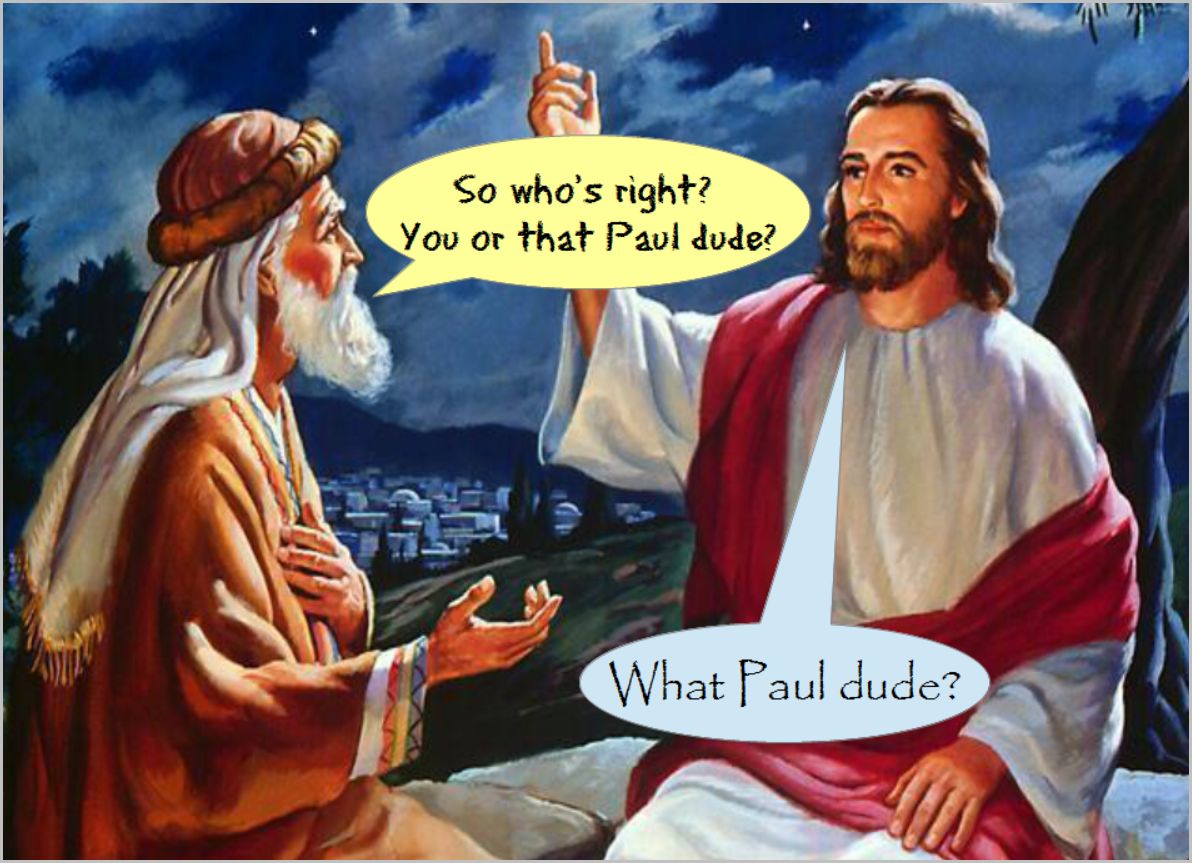
Paul&JCHermeneutic consistency is the means by which Christian apologists try to harmonise disparate parts of the Bible. Saddled with the premise that the Bible is the Word of God they need to demonstrate a consistency it doesn’t have because God, as its ultimate creator, could not possibly be the author of confusion (1 Corinthians 14.33). Consequently, they set about ironing out the Bible’s many discrepancies and contradictions to arrive at what they claim is a consistent and uniform Salvation Plan.

Unfortunately, this being an essentially dishonest enterprise, they have to pretend that New Testament authors with conflicting ideas about what it means to be a follower of Jesus are really saying the same thing. As I demonstrate in Jesus v Paul Round 2, there are vast differences between Paul’s good news and that ascribed to Jesus in the synoptic gospels. In the latter, Jesus is made to say that ‘righteousness’ can be cultivated in a measure-for-measure arrangement so that the extent to which a person forgives, gives to others and demonstrates compassion and mercy is mirrored exactly in how much God forgives, gives and shows mercy and compassion to that person in return. Paul on the other hand sees ‘salvation’ as being entirely undeserved. It is, rather, the result of God’s ‘grace’, which is given even though unmerited. According to Paul, showing compassion and mercy and offering forgiveness has no bearing on whether one is saved or not. These – Jesus’ path of righteousness and Paul’s unearned salvation – are two entirely different, and mutually exclusive, ‘ways to God’. Christians choose to remain blind to this fact.

They see no difference between the two ways to redemption because they are taught that Christianity is one grand scheme, woven, as it were, from a single piece of cloth. From this perspective, Jesus and Paul are simply drawing attention to different aspects of what is taken to be a consistent pattern. But this isn’t so; the New Testament is more like an untidy patchwork, a series of explanations by at least a dozen hands of what Jesus was about. Its most prominent voice is Paul’s (and those who pretend to be him); Christians prioritise Paul’s teaching over and above that of the synoptic gospels, which is markedly different, and interpret their ‘good news’ in the light of Paul’s mysticism. What doesn’t fit, they discard.

This has been a problem ever since the start of Christianity; the differences and disputes between Paul and the original disciples is well documented in the New Testament itself. Paul did not regard those who had walked and talked with Jesus as having a grasp of the true gospel (his) and was not reticent about saying what he thought of them. In Galatians 5.12, for example, Paul is so pissed off with the apostles he wishes they would accidentally castrate themselves.

Enter Luke, the original hermeneutic harmoniser. His Acts of the Apostles is designed to reconcile the radically different doctrines. By and large he succeeds, with most believers down the ages, perhaps because they haven’t wanted to, unable see the joins. But Acts doesn’t get Paul’s itinerary right, let alone his theology. The speeches Paul makes in Acts are not about the salvation through grace that concern him in his letters. They make concessions to other teaching – that of repentance and forgiveness (for example in Acts 13.38 and 17.30) while the real Paul makes no such compromise. There are no exhortations to repentance nor the promise of forgiveness in Paul’s own writing; there he mentions repentance only once, in a strikingly different context (Romans 2.4), and forgiveness not at all.

Moreover, Paul is adamant that he did not receive his doctrine from Peter or anyone else (Galatians 1.11-12). Instead he insists he got it direct from the Lord – i.e. through the hallucination he alludes to in Galatians 1.11-12 and 1 Corinthians 9.1 & 15.45 – which explains why it is so radically different from the original believers’. In Acts, however, Luke isn’t very happy with this – he’s trying to harmonise, after all – and has Paul meet Peter and James very soon after his conversion (Acts 9.26-30). Following some initial sheepishness, Luke implies, they all get on famously.

According to Paul, however, he and Peter didn’t meet for the first time until three years after Paul’s conversion (Galatians 1.18) and it was fourteen years later before he talked with a larger group of disciples (Galatians 2.1), when ‘the pillars of the church’ summoned him because of his wayward teaching. Paul records how he ‘rebuked’ Peter shortly after this (Galatians 2.11-13) because he objected to Peter’s interpretation of what was involved in following Jesus. In short, Paul and the apostles could not agree on what constituted belief in Jesus and what part Jewish law played.

Two questions result that Christians need to ask themselves, though invariably they don’t:

1. Where there are discrepancies between Paul’s theology and account of events, and Luke’s – written 15-20 years after Paul’s death – which is more likely to be correct?

2. Who is more likely to have the greater understanding of Jesus’ teaching: Paul who never met him but made it all up in his head, or Peter and the other disciples who spent years with him, listening to what he said?

In answer to the second, Christians down the ages have opted for Paul, the one who made it all up. His Salvation Plan is, after all, easier to buy into than Jesus’ mad idea of giving everything away and loving your enemies. Having chosen their man, it follows that the rest of the New Testament must be forced to comply with Paul’s ideas.

This is hermeneutics in the hands of Christians; an intellectually dishonest sleight of hand designed to bring everything into line with their interpretation of Paul’s idiosyncratic take on a man he never met. As for those who are unimpressed by their contortions, well, it must be that they have a faulty hermeneutic. Praise the Lord!

We owe it all to Jesus

MarySo the UK is a Christian country. Prime minister Dave Cameron has decreed it. In his hallowed Christmas message he proclaims that Britain derives all of its values from Christianity:

As a Christian country, we must remember what (Jesus’) birth represents: peace, mercy, goodwill and, above all, hope. I believe that we should also reflect on the fact that it is because of these important religious roots and Christian values that Britain has been such a successful home to people of all faiths and none.

‘Peace, mercy, goodwill, hope and tolerance’. Doesn’t it warm your heart? This country of ours has these wonderful sentiments at its core and all of them derive from the baby Jesus. I’m not sure about where our other values – capitalism, colonialism, democracy, free-thought and expression – originate but no doubt Dave will tell us they too spring from our ‘religious roots’.

What about the values he mentions though? Do they originate with Jesus as Dave claims?

Peace we covered last time: Christianity have not brought peace into the world, ever. Dave seems to have forgotten that Britain is currently at war; the so-called ‘war on terror’ Is he now suggesting that as a ‘Christian country’ we should turn the other cheek and propose peace, because that’s what Jesus would want? I doubt it, somehow.

Mercy? Here’s the kind of mercy Jesus proposed: ‘But those enemies of mine who did not want me to be king over them – bring them here and kill them in front of me’ (Luke 19:27). Nice.

Goodwill? Jesus always extended goodwill to others. Like here: ‘It is not right to take the children’s bread and toss it to the dogs (non-Jews)’. And here: ‘Do not give dogs what is holy, and do not throw your pearls before pigs (non-Jews again), lest they trample them underfoot and turn to attack you’ (Matthew 15.26 & Matthew 7.6).

Hope? The Bible does speak about hope – hope that this will all soon be over and God will consign non-believers to hell, set up his kingdom on earth and put Jesus in charge (Matthew 19:28 & 24.51). Is this what Cameron means by hope?

Tolerance? Paul on tolerance: ‘do you not know that wrongdoers will not inherit the kingdom of God? Do not be deceived: Neither the sexually immoral nor idolaters nor adulterers nor men who have sex with men’ (1 Corinthians 6:9). It’s difficult to see how modern notions of equality and acceptance can derive from bigotry like this.

No, Britain does not get its values from Christianity or the Bible or baby Jesus. It has worked them out for itself, principally through social progress and the reforms of modern times.

The UK is not a Christian country in any other sense either. Christians are required to turn the other cheek (Matt. 5.38–42), give all they have to the poor (Luke 14.33) and buy into a convoluted salvation scam plan (2 Timothy 1.9 etc). Can a country do these things? It would be unthinkable for it to give away its wealth, accede to other countries’ demands and respond non-aggressively to attack. Individual Christians don’t or won’t do these things and it would be nothing short of suicidal for a country to attempt to; yet this is what Jesus insists is involved in following him. It’s impossible for individuals to live this way, let alone entire nations.

Cameron can’t even claim that the majority of the population subscribes to the great salvation plan either. A recent government poll showed that only 49% of the population admits to being Christian and in any case, the plan is designed for individuals, not countries. So let’s hope (hah!) the Prime Minister will stop fawning over Christians, fatuously pretending that the UK is a Christian country when it isn’t. Let’s hope too he understands that our values, whatever they are, do not derive from an ancient, expired superstition. The UK is not a Christian country in any sense. Let us rejoice in that fact.

You’re not as saved as you think

God2So now you’re a Christian. You’ve listened to the street preacher or that Christian at work and you’ve accepted Christ. You’re saved and going to Heaven when you die.

Or are you? You’re not going to Heaven that’s for sure, because Heaven isn’t on offer – as we saw here, the Bible doesn’t promise an eternal life in Heaven. But are you even saved? Has ‘the most important decision of your life’ really made you one of God’s own?

If you think you’ve chosen God, you’re wrong. You don’t choose God, he chooses you (or not, as the case may be). And if he hasn’t chosen you, then any decision of yours is of no consequence. You can shout all you like about how you’re now saved, born again and a follower of Jesus but if God says you’re not, then you’re not.

How do we know this? Because the Word of God™ says so:

Blessed be the God and Father of our Lord Jesus Christ, who has blessed us in Christ with every spiritual blessing in the heavenly places, just as he chose us in Christ before the foundation of the world to be holy and blameless before him in love. He destined us for adoption as his children through Jesus Christ, according to the good pleasure of his will… (Ephesians 1. 3-5)

In other words, you’re only saved if God decided you were going to be right back at the beginning of time. And if he didn’t, well, you can talk the talk and even walk the walk, but it will all be for nothing.

Jesus too is quite clear that it isn’t up to you whether or not you’re one of God’s chosen few. Here he is the middle of one of his tiresome parables about the Kingdom of God, where the King has told his slaves:

“Go… into the main streets, and invite everyone you find to the wedding banquet.” His slaves went out into the streets and gathered all whom they found, both good and bad; so the wedding hall was filled with guests. But when the king came in to see the guests, he noticed a man there who was not wearing a wedding robe, and he said to him, “Friend, how did you get in here without a wedding robe?” And he was speechless. Then the king said to the attendants, “Bind him hand and foot, and throw him into the outer darkness, where there will be weeping and gnashing of teeth.” For many are called, but few are chosen. (Matthew 22.9-14)

So, how do you know if you’re one of the special few hand-picked by God himself and not just one of those poor suckers who’s been invited along only to be thrown out? You don’t. Your capricious God won’t tell you till after you’ve died and you meet him face to face. There’s every possibility you’ll find out then that you’re not saved, because only a few of those called actually are. And then where will you be? Hell, that’s where. You’ll be no better off, according to the Bible anyway, than those who’ve not been duped by all of this nonsense.

So, you can believe all you like that God loves you. You can make all the right noises, study your Bible, pray, imagine you hear God’s voice in your head, go to church, sing the right songs and defend God’s standards, but there’s still a very good chance you’re not saved.

Jesus again:

Not everyone who says to me, “Lord, Lord”, will enter the kingdom of heaven, but only one who does the will of my Father in heaven. On that day many will say to me, “Lord, Lord, did we not prophesy in your name, and cast out demons in your name, and do many deeds of power in your name?” Then I will declare to them, “I never knew you; go away from me, you evildoers.” (Matthew 7.21-23)

But don’t worry, you were never ‘saved’ in the first place, nor lost, nor in need of Jesus; none of this mad fairy tale is real. Your only mistake – and it was a big one – was to think it was.

Our Operators are Waiting to Hear from You!

ApostlesHi! You’ve reached the Salvation Hotline. Calls may be recorded for training purposes. All offers are validated by our six day guarantee.* Please listen carefully to your options:

Press 1 for Matthew. With one of our less popular offers (but don’t let that put you off!) Matthew is waiting to explain our buy-one-get-one-free offer! Keep the Jewish law and be saved, plus, forgive others and be forgiven yourself!

Press 2 for John who will tell you how you can get your very own get-out-of-Hell just by believing! Eternal life awaits!

Press 3 for Luke. Luke wants to let you know you how you can be saved simply by asking for forgiveness. Note: this offer cannot be used in conjunction with any other.

Press 4 for Luke’s bargain Family Ticket! Only one family member need sign up and the rest go free!

Press 5 for Paul and to hear about a unique special offer! ‘God’s grace’ can save you without you making any real effort on your part! Not to be missed.

Press 6 for Paul’s great alternative offer: get saved for free! No need to do anything! (Offer good for Jews only. Terms and conditions apply.)

Press 7 for a special operator who passes himself off as Paul but isn’t. And he has a great offer for our female callers! He’ll tell you about how, just by having babies, you can be saved! It really doesn’t get any better than this, ladies! Get saved just by doing what comes naturally!

Press 8 for a very special guy of ours who wants to stay anonymous! But he will show you how you can escape death by buying into Jesus’ cosmic defeat of evil!

Press 9 for James who will tell you how you need to do good if you want to be saved. So, okay, Paul doesn’t think so, but we want to make sure you hear all our offers!

Please note: these offers are mutually incompatible so you might just want to hang up now and forget all about them.

*Our guarantee isn’t worth the paper it’s written on but for legal reasons, here it is anyway:
Press 1: Matthew 5.17-19 & 6.14.
Press 2: John 5.24.
Press 3: Acts 2.36-38.
Press 4: Acts 16.30-31.
Press 5: Romans 10.5; Ephesians 2.8.
Press 6: Romans 11.26-27.
Press 7: 1 Timothy 2.15.
Press 8: Hebrews 2.14-15.
Press 9: James 2.14-17, 24

Jesus or Paul?

Nicodemus

Jesus is asked a few times in the gospels about how a person can find eternal life – like that’s the most obvious things to ask a travelling snake-oil salesman. Maybe it is, I don’t know. It was in the first century anyway, if the gospels are to be believed.

Jesus gives a variety of answers in the three earliest gospels: in Matthew 19.17 it’s ‘keep the commandments’ – those terrible, brutal laws I talked about last time. In Mark 12.30-31 he says the way to eternal life is to love God with all your heart and soul, and your neighbour as yourself. In other places he tells his audience that if you want to be forgiven by God then first you must forgive others (Matthew 6.14); if you want God’s compassion then first you must be compassionate (Matthew 25:31-46); if you don’t want to be judged, then you shouldn’t judge others (Luke 6.37).

Jesus is particularly fond of this kind of measure-for-measure salvation; it’s the lynch-pin of his good news – do unto others as you would have God do unto you. And almost every time he mentions it, he connects it with the Law and commandments.

Never does he say, anywhere in the gospels, that if you want to gain eternal life, or find favour with God, or be saved, then what you have to do is believe in the redemptive power of his own imminent death. Even when he could have done so, when he could have worked a little bit of Christian dogma into his teaching, he doesn’t. And that’s strange really, when you consider that Paul’s brand of Christianity – the one that’s come down to us today – is built entirely on the idea that the death and resurrection of Christ is the only thing can save us from God’s wrath.

Paul’s alternative gospel, which is expounded in Romans and summarised in Galatians 3.10-13, goes something like this:

Paul looks at the old Jewish Law and says, ‘actually it’s impossible. None of us can keep it. We’re all under a death sentence for some tiny infringement of it, because any and all infringements lead to the death penalty. But,’ he goes on, ‘Christ has taken that penalty for us by dying in our place. So although the law demands we should die and then suffer for eternity, we won’t, because he died for us. Then he rose again, just as those who believe in him will.’ That last bit – about believers rising from the dead – really doesn’t follow from his premise that the Law is impossible, but this is Paul talking, a man with only a passing acquaintance with logic. He doesn’t, either, have any evidence that Jesus took the penalty for the rest of humankind – he made that bit up too.

And that, in a nutshell – I do mean nut shell – is Paul’s ‘good news’. It bears no relation to the good news that Jesus preaches in the synoptic gospels. Admittedly, the Jesus who wanders his way through the first three gospels is for the most part a pre-death Jesus. You could argue, as a result, that he wouldn’t talk about redemption through his death before it had happened… but then again, why not? He talks about all sorts of other things he thinks are going to happen after he dies and rises again; he’s going to return pretty damn soon in a blaze of glory, through the clouds with an army of angels; heaven and earth are going to pass away; God is going to unleash his kingdom on the new earth.

But in spite of these mad speculations, he doesn’t mention even once in the synoptic gospels that people can be saved merely by accepting that he has paid – or will pay – the penalty for their infringements of the law, their sins if you will. Never. All the more odd when you consider that Mark, Matthew and Luke were putting their gospels together long after Paul preached his particular brand of salvation. Yet they don’t put this message into Jesus’ mouth, nor do they add it to the narrative.

It’s just not there.

So… were the gospel writers not aware of it? If they did know of it, was it that they didn’t like it? Did they know, in fact, that Paul’s formula didn’t square with what Jesus himself had said, or what they at least believed he’d said?

Whatever it was, the result is there are two conflicting versions of the ‘good news’ in the New Testament: Paul’s and Jesus’. One is easier than the other; in Paul’s plan all you have to do is believe. The other is difficult (and if we’re honest, really only designed for Jesus’ fellow Jews); it entails things like forgiving repeatedly, showing compassion, putting others first, turning the other cheek and, especially, following the six hundred and odd commandments that make up the Law.

So guess which one Christians today prefer.

Here’s a clue: it’s not Jesus’ gospel – the one without the magical incantation but with the barbaric Jewish law. But if, as Christians believe, Jesus was the Son of God – maybe even God himself – then why do they always accept Paul’s reinterpretation over and above everything their Lord said? Why do they disregard all that Jesus demands of those who would follow him, and take instead Paul’s easy path?

In the end, though, what Jesus and Paul (as well as the gospel writers and different factions of the early church) are in dispute about is the highly improbable and the absolutely impossible. It doesn’t matter whether they thought you could gain ‘eternal life’ by obeying the commandments or by letting someone else take your punishment for you; humans do not live forever. Just because a zealous first-century preacher thought they could does not make it so. Just because a different fanatic from roughly the same time believed it doesn’t make it happen either. There’s no evidence any human has ever, after this brief earthly existence, gone on to live forever. Equally, there’s no evidence that a deity exists, so those rules that are so important, in different ways, to Jesus and Paul can’t have originated with him. They’re man-made too.

So, with no God and no eternal life, Jesus and Paul might as well have been discussing whether the tooth fairy wears a pink dress or a green dress. What does it matter when she doesn’t exist?

How much more were they wrong about?

How long you got?

Christians’ Favourite Delusions 17: You get saved by being washed in the blood of the lamb (Romans 5.9 etc)

Sermon

Not according to Jesus you don’t. And you’d think he being the Son of God – not to mention ‘the lamb’ in question – he’d be in a position to know. So how does Jesus say you find salvation? No magic formula for him; no quick-fix like the one Paul invents after Jesus’ death.

So how does Jesus reckon you get right with God? For once, he couldn’t be clearer:

If you want to receive God’s forgiveness, first you have to give it:

For if you forgive men their trespasses your heavenly Father also will forgive you; but if you do not forgive neither will your Father forgive your trespasses. (Matthew 6.14)

If you want to avoid God’s judgement… then don’t judge others:

Judge not that you be not judged. For with the judgement you pronounce you will be judged, and the measure you give will be the measure you get. (Matthew 7.1-2)

If you want God to show you mercy, first show mercy yourself:

Blessed are the merciful, for they shall obtain mercy. (Matthew 5.7)

If you want to experience God’s riches and blessings, first you have to be generous yourself:

Give and it will be given to you; good measure, pressed down, shaken together, running over, put into your lap. For the measure you give will be the measure you get back. (Luke 6.38)

If you want God to show you compassion, first be compassionate yourself:

The King will say to those at his right hand… I was hungry and you gave me food, I was thirsty and you gave me drink, I was a stranger and you welcomed me… Then the righteous will answer him, ‘Lord when did we see the hungry and feed thee or thirsty and give thee drink? And when did we see thee a stranger and welcome thee?… And the King will answer them, Truly I say to you, as you did it to one of the least of these my brethren, you did it to me’.

Then he will say to those at his left hand, ‘Depart from me, you cursed, into the eternal fire prepared for the devil and his angels, for I was hungry and you gave me no food, I was thirsty and you gave me no drink, I was a stranger and you did not welcome me… Truly I say to you, as you did it not to one of the least of these my brethren, you did it not to me’. (Matthew 25.34-46)

That’s right, Jesus sees being saved as a ‘measure for measure’ arrangement and uses that exact term repeatedly in order to get the message across. According to the ‘Son of God’, you get what you give. And, what’s more, his death has nothing to do with it. He starts preaching his ‘gospel’ message long before he’s crucified (Mark 1.14) and it most definitely doesn’t include any mystical piggy-backing on a death that hasn’t happened yet in order to gain God’s favour. Even Matthew, Mark and Luke don’t add it to their stories of Jesus, even though they wrote them after he died and after Paul’s invention of his magic salvation formula.

Jesus’ ‘measure-for measure’ gospel is very different from Paul’s – the two are incompatible in fact, though Christians refuse to see this. Jesus’ gospel is practical and moral: the way to God’s heart, he says, is through treating others, even those who might despise us, with kindness and compassion.

This, though, is too hard for Christians. They find Paul’s spiritualised, self-centred version of salvation much more to their taste.