And now, the Conclusion

It’s a game you can play all day.

  • First, choose a story – any story – from the gospels.
  • Look for all the metaphors in the story.
  • Note its allegorical elements.
  • Find either the myth from Jewish scripture and/or the part of Paul’s fantasy that the story is based on.
  • Read the story in light of these insights.

Once you’ve done this a few times – which you can, literally, till Kingdom come – you’ll realise that all the stories in the gospels are literary inventions. Stories that are replete with metaphor, reliant on earlier mythical sources and that read like allegory would be considered, in any other context, to be fiction.

And what will you conclude from this?

That just because the stories are from the gospels doesn’t grant them a free pass. Stories that fulfil all the criteria of fiction, as the gospel stories do, are elsewhere considered to be fiction: think Romulus, the non-canonical gospels, King Arthur, the Book of Mormon, the Chronicles of Narnia. So why not here?

That calling the stories ‘pericopes’, in an attempt to elevate their status, merely disguises the fact they are just stories.

You’d acknowledge that History, as in the recording of past events, is not written as allegory. It doesn’t depend on metaphor and symbolism to reveal hidden meanings. Historians reject or are highly sceptical of any accounts that depend on such literary techniques. They usually conclude these are not history, whatever else they might be.

You could, I suppose, try arguing that history in ancient times wasn’t the discipline it is now and did indeed incorporate elements from fiction. But you’d be wrong. Historical accounts of the first century have survived and do not confuse historical fact, however interpreted, with fiction. Writing that relies on allegory and hidden meanings is not considered to be history. You would then have to concede that the gospel narratives do not qualify as history. You would then be in agreement with the majority of scholars who think this.

Then you’d ask, why? Why, if Jesus was such an incredible guy, did so much have to be made up about him? You could, I guess, argue that an itinerant first-century preacher successfully manipulated events so that he fulfilled ‘prophecy’, complied, at least in Mark, with Paul’s (future) teaching and managed to make himself some sort of living breathing metaphor. Or you could conclude, applying Occam’s razor, that the stories are simply made up. And if you did, you’d be agreeing with Mark when he reveals that ‘everything is in parables’ (Mark 4:11).

You’d then ask yourself: if the miracles, the healings, the profundities, hyperbole, nativity tales, angels, demons, zombies, the transfiguration and much else besides are all fiction, then why not too the resurrection? Is it one of only a few episodes in the gospels – the crucifixion is often cited as another – that isn’t fiction? Is it the one of only a few stories in that’s factual and true? The empty tomb, the angels, the sightings by Mary, the disciples and Thomas, the fish breakfast, the ascension: are these historical when everything else is not? You’d have to ask on what criteria you were salvaging this particular story as historical when all that precedes it patently is not.

Then you’d have to start wondering if there really was a Jesus. The versions of him who appear in the gospels are constructs, characters created from metaphor, Old Testament stories and the teaching of the early Christian cult. If there really was a man who trailed around Palestine with an apocalyptic message, he is long gone. Indeed, he had vanished by the time the stories about him that we know as the gospels came to be written.

God and the Domino Effect

Once free of belief in God, everything that follows collapses.

No God means –

   No divinely inspired scripture, no sin, no salvation, no need of salvation, no repentance or divine forgiveness (and no need of these things either), no grace.

   No supernatural, no heaven or hell, no Satan, angels or demons, no Holy Spirit, no effective prayer, no miracles, no judgement, no eternal life.

  No Son of God, no God Incarnate, no prophecy, no atonement, and, most significantly, no resurrection. 

According to the Bible, God resurrected Jesus (Romans 6:4; Galatians 1:1; Acts 2:22 etc). Therefore, no God = no resurrection.

So, where did all these ideas that, once God ceases to exist, fall like dominoes? Answer: the only place ideas ever come from: the human mind. Everything ever associated with gods, and with YHWH (Old and New versions) is entirely human invention. This is the only logical, rational conclusion.

  Paul’s vision of what he took to be the Risen Christ and his consequent theology: the product of a tortured imagination.

  The resurrection appearances supposedly experienced by Cephas and others: within their own heads (grief-induced hallucinations, dreams, trances, emotional agitation). Or: an emotional response to some natural phenomenon such as bright lights.

  The stories of Jesus that these visions inspired: invented by creative writers imaginatively applying ‘prophecy’ imagined by earlier writers.

  If he existed, Jesus’ Messiah complex: worked up entirely within his own religion-soaked brain.

  His conclusion that the end of the age was nigh and that he would be king of the new order (assuming he really did think this): the result of wishful thinking, all in his imagination.

Subsequent additions to the Christian experience: the Trinity, guesswork about the Messiah’s delayed return, the panoply of saints, heresy, blasphemy, ‘God’s standards’, the inerrancy of scripture, apologetics and, coming full circle, conversion experiences. All creations of the human imagination and emotions.

With no actual God, this is the only viable explanation of the phenomenon that is religion. Human beings did it.


Whatever Happened to Judas Iscariot?

Even more significant in the gospels than Mary Magdalene is Judas. Like her, he is strangely absent from the rest of the New Testament. Apart from Luke’s ridiculous story of his death in Acts 1:18 – a story that contradicts the one in Matthew 27:5 – he isn’t mentioned anywhere else. You might think that’s to be expected, given he’s the disciple who betrays Jesus in the gospels. His name must have been anathema to early Christians.

We might expect, however, that when Paul is describing the Lord’s Supper for the very first time in 1 Corinthians 11:23-26, he might, when he gets to the part where he says ‘on the night he was betrayed’, have mentioned the name of the betrayer. It would seem the natural thing to do. Unfortunately, the word ‘betrayed’ (prodidomi) doesn’t appear in 1 Corinthians 11:23-26 or anywhere else in the epistles. The word Paul uses is paradidomi, meaning ‘handed over’, a handing over by spiritual agents (God himself?) not a traitorous human. Judas is in fact absent from Paul’s description of the Lord’s Supper, a revelation he claims to have received directly from the heavenly Jesus, who neglects to include Judas and all the other disciples too. Nor does Paul call the event ‘The Last Supper’; that name would come later. Read 1 Corinthians 11:23-26 for yourself and see. Bart Ehrman also addresses the problem here.

Bizarrely though Judas does turn up, sort of, in 1 Corinthians 15:3-8, when Paul is quoting a creed thought to originate in the earliest days of the new faith. Because it is considered so early, this creed is greatly valued and frequently cited by apologists. Never mind that it contradicts the later gospel sightings of the Risen Jesus (see the previous post). Here’s what Paul says in 1 Corinthians 15:5: ‘(Jesus) appeared to Cephas, and then to the Twelve.’ Then to the Twelve? What Twelve? As Simon Peter, wasn’t Cephas one of the Twelve to begin with? Maybe they weren’t the same person after all.

More significantly, the Twelve, at least according to the later gospels, originally included Judas. He was one of Jesus’ inner circle. And according to Matthew 27 and Acts 1 he killed himself almost immediately after betraying Jesus. He wasn’t around to see the Resurrected Christ. Yet according to Paul and the early creed all of the Twelve saw Jesus alive again. Either Judas wasn’t one of the Twelve and the gospels are wrong, or he was and he didn’t betray his Master after all, remaining alive for his reappearance. (Just to be clear, the Twelve at the time of the resurrection appearances did not include Judas’s replacement, Matthias (Acts 1:23-26). Matthias doesn’t become one of the Twelve till after Jesus has returned to Heaven (Acts 1: 9).

So, Judas isn’t mentioned as a Jesus’ betrayer by anyone other than the gospel writers, decades after the supposed resurrection. He isn’t mentioned by name at all. The only possible reference to him is in 1 Corinthians 15:5 where he’s still one of the Twelve and sees the resurrected Jesus. It couldn’t be could it, that Mark, reading Paul’s description of the Lord’s supper mistook, or deliberately misinterpreted, the phrase ‘was handed over’ to mean ‘was betrayed’ and constructed his story about the duplicitous Judas accordingly? Why, yes it could.

Conveniently, ‘Judas’ is the Greek form of ‘Judah’, the kingdom of the Jews who, so far as early Christians were concerned, rejected Jesus as the Messiah. Judas is a symbolic character in a literary work, representing those foolish Jews who turned their backs on salvation and so ‘betrayed’ the true Messiah.

The Great Resurrection Scam

Brothers and sisters, we do not want you to be uninformed about those who sleep in death, so that you do not grieve like the rest of mankind, who have no hope.  For we believe that Jesus died and rose again, and so we believe that God will bring with Jesus those who have fallen asleep in him. According to the Lord’s word, we tell you that we who are still alive, who are left until the coming of the Lord, will certainly not precede those who have fallen asleep. For the Lord himself will come down from heaven, with a loud command, with the voice of the archangel and with the trumpet call of God, and the dead in Christ will rise first. After that, we who are still alive and are left will be caught up together with them in the clouds to meet the Lord in the air. And so we will be with the Lord forever.

1 Thessalonians 4:13-17 (circa AD 49-51)

Paul said that because Jesus died and rose from the dead others would too. How does this follow?

He also claimed that all a person had to do to be sure of a spiritual resurrection was to believe that Jesus had already risen (1 Corinthians 15:20, AD 53-54), How did he know this? Almost certainly it came to him in one of his visions and his subsequent ‘revelations’ (‘the Lord’s word’ as he puts it in the letter to the Thessalonian sect).

Possibly, though less likely, he learnt it from the Christians he persecuted prior to his conversion. If so, where did they get the idea from? That the cult members in Thessalonica had to ask Paul what would happen to those who had passed away suggests this wasn’t a significant concern prior to this point. Paul and other early believers thought the Messiah/Son of Man was going to appear within their lifetimes (‘we who are still alive’ etc). It was only when cultists started dying off in noticeable numbers, and the Lord remained a no-show, that it started to become an issue. Paul had to make something up. And make it up he did.

Just suppose…

Let’s imagine that the gospels were all written by eye-witnesses or the associates of eye-witnesses. Let’s suppose that prior to their composition there was a vibrant oral tradition that accurately preserved the Jesus story and his teaching in particular. Let’s suppose that Paul learnt what he knew of Christianity initially from the early believers he persecuted and then, following his miraculous conversion, from his meetings with the disciples. Let’s suppose that the later books of New Testament were written by people who knew Jesus personally or were really by Paul. Let’s suppose that everything in the bible was inspired by God and is truly his word. Let’s imagine that as result of all this, everything predicted and prophesied in the gospels, in Paul’s letters and the later ones by apostles, came to pass.

Because we’d have to imagine this. Even if everything we’ve supposed was true, none of the prophesies, predictions or promises have materialised in reality. Not one. No Son of Man beaming down from heaven while the disciples and Pilate were still alive, (as he promises in Mark 9:1 and Mark 14:62 respectively), no visit from the Messiah while Paul and his acolytes were living (1 Thessalonians 4:17), no final judgement, no Kingdom of heaven on Earth, no Christians performing miracles greater than those attributed to Jesus. Not even any ‘new creations’ imbued with the Holy Spirit (‘by their fruits shall ye know them.’)

Apologists put a lot of effort into explaining away these failures, some even arguing the Kingdom is actually with us now (how incredibly disappointing it is if this is the case!) Most disappointing of all is that no Christian has ever resurrected from the dead. Not Paul, not Peter, Mary Magdalene nor any other early follower, and no-one since: not Martin Luther, Charles Wesley, C. S. Lewis, Billy Graham nor any bishop, minister or evangelist who has ever lived. All have remained resolutely dead, just like everyone else who has ever ‘fallen asleep’ and everyone who will in the future.

However much Christians want to insist the Bible is true, accurate and God-breathed, in the end it simply doesn’t deliver.

How the Bible tells us the Resurrection was nothing more than Visions

I’ve written about this before, but want to pull together some strands that demonstrate the risen Jesus was a vision or hallucination. He appeared only in the mind of others: the New Testament tells us as much.

Exhibit 1. Paul writes of the appearance of the risen Jesus, whom he sees as a ‘life-giving Spirit’, being ‘in’ him (Galatians 1.16). Paul has more than one such vision, including his trip to heaven recounted in 2 Corinthians 12.2, which he refers to as his ‘revelations’.

Exhibit 2. Paul implies in Corinthians 15.5-8 that others who have experienced the post-mortem Jesus ‘saw’ him in exactly the same way he did. For Paul, there was no difference between his inner-visions and those experienced by the so-called apostles.

Exhibit 3. The author of Acts creates a story out of Paul’s first vision, the famous account of his conversion on the road to Damascus. It’s a fabrication of course, told differently each time it’s referred to Even so, Luke retains the visionary nature of the experience: Jesus is a bright light and a disembodied voice.

Exhibit 4. The other sightings of the risen Jesus in Acts are visions. When, for example, Stephen is about to be stoned (Acts 7:54-56) he sees in his mind’s eye the heavens open and Jesus sitting at the right hand of god. Other New Testament encounters of the resurrected Jesus, such as John’s Revelation, are explicitly said to be visions.

Exhibit 5. Many of the sightings of the risen Jesus in Matthew and Luke are not of a real, physical human being. Those who experience him see him materialising in locked rooms, vanishing at will and floating up into the clouds. None of these events actually happened; they are the gospel writers’ literary realisations of visions experienced decades earlier, and they retain the hallucinatory qualities of those experiences.

Exhibit 6. Remaining with the gospels’ accounts of the risen Jesus, there is the strange phenomenon of those experiencing him failing to recognise him. Mary in the garden thinks he’s the gardener; the disciples on the road to Emmaus don’t know its him until he breaks bread; the disciples mistake him for someone else on the shore until he tells them how to fish properly. Most damning of all, some of the inner circle of disciples doubt it’s Jesus they’re seeing in their collective visions (Matt 28:17-18). Again, these stories preserve the tradition that the earlier visions weren’t always recognised as Jesus. And why wasn’t he? Because he was an hallucination

Exhibit 7. The risen Jesus has to prove who he is. According to Acts 1:1-3, he ‘presents himself’ his followers, some of whom have wandered around aimlessly with him for three years, and has to convince them he is who he appears to be. And, the text suggests, it takes him forty days to do it. This makes no sense. A far better explanation of this story (and it is a story) is that having experienced their visions of something-they-took-to-be-the-resurrected-Jesus (bright lights? Disembodied voices?), his followers set about convincing themselves that what they experienced really was their former Master. This they did by scouring the scriptures to find ‘proof’ that the Messiah would die and rise again. We know this is how their thinking worked. The same process was used to create the gospels and is evident throughout the New Testament.

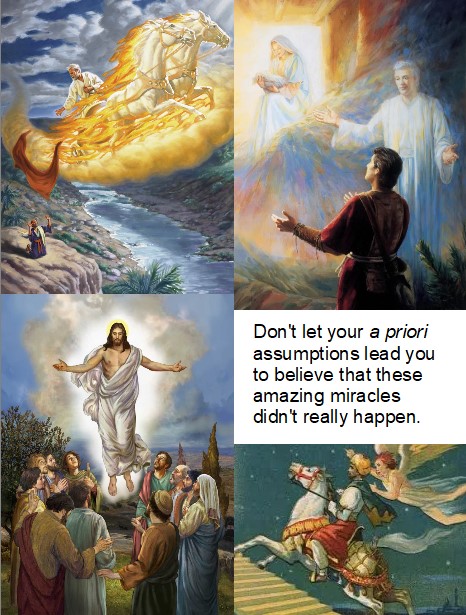
Exhibit 8. Dead people stay dead. They do not resurrect.. This is not an a priori assumption. No corpse has ever revived after 36 hours or indeed any other period of time. We know this experientially, statistically and scientifically. Only in stories and religious myth do the dead return. This is what we are dealing with here: stories and myth that flesh out the visions and hallucinations of a few religious zealots.

Either All True Or None True

About 2,500 years ago, a man called Elijah went up to heaven while still alive. He was taken through a whirlwind in a chariot of fire, pulled by horses of fire. This amazing event was witnessed by several other people who were profoundly affected by it. The story of this ascension was possibly relayed orally for many years until finally being written down in what is now 2 Kings 2.

Did any of this really happen?

Of course not. It’s a myth.

Some time in the 4th century BCE, the first king of Rome, Romulus, was taken, while still alive, to the dwelling place of the gods. From that time on he was worshipped as a god – some said he was eternal to begin with – with a temple being built in the very place from where he had ascended. Later he appeared to one of his followers, Julius Proculus who said the resurrected Romulus was larger and more beautiful than ever, armed with weapons shining like fire. Julius Proculus attested to this appearance of the resurrected Romulus, swore an oath to its veracity and relayed it faithfully to others.

Did any of this really happen?

Of course not. It’s a myth.

https://mythologymatters.wordpress.com/2019/04/18/easter-mythology-the-resurrection-as-modeled-on-greco-roman-myths/

It is not known when Mithras was born, if indeed he was. He emerged from a rock in the spiritual realm as a child or youth, ritually slaughtering a bull and sharing a banquet with the god Sol. He guided souls to the after-life, propelled as they were by the bull’s blood and flames. He was worshipped primarily by soldiers who saw him as their salvation from the bitterness of earthly life. There were rituals to be followed to become a true initiate and for Mithraic mysteries to be revealed. How Mithras made himself known to his acolytes is unknown, but in the first three centuries CE, his cult rivalled that of the Christians in popularity.

Did all of this really happen?

Of course not. It’s a fabrication, a myth.

In the 8th century CE, the prophet Muhammad flew from Mecca to Jerusalem on a winged equine. Once in Jerusalem he climbed a ladder to heaven. Once there he travelled through the various levels, having conversations with other lesser prophets, before entering Allah’s domain. His journey was later revealed to two early prophets who had known Muhammed when they were boys. They conveyed the details accurately until they were recorded, briefly at first in the Qur’an and later in more detail in its supplement, the hadith.

Did any of this really happen?

Of course not. It’s a fabrication, a myth.

In the early 19th century, Joseph Smith was visited by Jesus and his Father in a vision. They told him that he should not join any existing church because they were all in error. Later, a hitherto unknown angel named Moroni appeared to Smith and indicated to him where some gold plates were buried. He instructed Smith to dig up and translate the plates. Obediently, Smith did so, using a pair of seer stones for the translation. The resulting Book of Mormon was a revelation of Christ’s activities in North America following his resurrection. Smith wisely had a number of his associates witness, in writing, the existence of the gold plates as well as their supernatural provenance.

Did any of this really happen?

Of course not. It’s a fabrication.

In 1916 the Virgin Mary appeared numerous times to three poor Portuguese children, giving them instruction and prophesying to them. She also promised that she would perform a miracle at Fatima. Accordingly, between 30,000 and 100,000 people, including reporters and photographers, gathered at Fatima where many saw multi-coloured lights before the sun itself ‘danced’. It came closer to the Earth before zig-zagging back to its usual place in the sky. While not all of the attendees testified to the phenomenon of the dancing sun (some saw only the lights, others nothing at all) many did and testified to the effect the miracle had had upon them.

Did all of this really happen?

Of course not. It’s a fabrication based on hallucinations.

Around 30CE, a rabbi known as Jesus, who had been born of a virgin, gathered together 12 followers and went around Galilee preaching absolution from sin and the imminence of the Kingdom of God. He announced he was the Messiah who would rule the Earth when the kingdom arrived. The Jewish authorities took exception to his claims and petitioned the Romans to have him executed. This they did, only for Jesus to come back to life three days later, appearing in visions to his followers. He ascended to heaven, promising that those who believed in him would enjoy eternal life. Some of his disciples spread his message faithfully until it was eventually written down, first by a former Pharisee called Paul and then by four authors who accurately recorded what Jesus had said and done.

Did all of this really happen?

What do you think?

Beyond The Grave

A few years ago, a friend of mine was working in his front garden when he spotted what he was sure were a couple of Jehovah’s Witnesses further down the street. He aimed to back inside before they reached his house, from where he could safely ignore them. But he timed it badly and before he knew it, the JWs were upon him.

My friend was under some stress at the time so when they asked him, ‘Wouldn’t you like to live forever?‘ he responded with, ‘Good God, no. This life’s bad enough. Why would I want it to go on forever?’ This took the wind out of their sail though didn’t divert them from their sales pitch for very long.

I’ve been in the same state of mind myself, and maybe you have, when life was so difficult I spent far too much time contemplating whether being dead might not be a better option. Thankfully, I couldn’t really contemplate doing anything about it, and was aware of the effect it would have on my loved ones if I did, but nonetheless I spent too much time considering – desiring even – my own non-existence.

I was pretty sure this was what awaited after death. I hadn’t, by this stage of my life, the conviction of the Jehovah’s Witnesses and mainstream Christians that a better life, one that would last forever, lay beyond this one. Instead, I made radical changes to my life in the here and now, to lift myself out of the slough of despond in which I found myself.

I love life now. It isn’t without its difficulties, not least the physical problems that come with older age, but I enjoy it to the full (apart from supermarket shopping). Having found my pearl of great price, I hope life will last for many years yet. I can’t guarantee it will, of course, so I make the most of every moment, surrounded by people I love and who love me.

Would I like my life to go on forever? Certainly, but I know it won’t. There is simply no evidence life continues after death. Assurances that it does in religious texts is no evidence at all. Even if it were, the type of eternal life suggested by the Bible, worshipping a needy, despotic God for evermore, is not the way I’d like to spend eternity.

Ask Christians how they know they will and the best that can come up with is that the Bible tells them so or that Jesus promises they will (which amounts to the same thing.) Ask them where this everlasting life will be lived and you’ll get one of two answers: in heaven or here on a restored Earth, once Jesus ‘returns’. The earliest writings in the New Testament support the here-on-Earth scenario. The later ones – perhaps because their authors had begun to realise Jesus wasn’t coming back any time soon – start, like John 14:2, to hint at a celestial existence.

No Christian – no non-believer either – has survived death to face eternal bliss or eternal damnation. Some will tell you that rising from the dead happens in an ethereal way immediately following death. The soul (or whatever) is resurrected either to be reunited with God outside of time and space or thrown to the demons in hell. The biblically savvy, like the JWs, will tell you the resurrection will not occur until Jesus’ return at some point in the future. Significantly, both expectations occur off-stage: the first in a undemonstrable plane of existence, the second in a future that never arrives. Both are wishful thinking, scenarios dreamt up by those frightened of their own non-existence.

The offer of everlasting life is one of the New Testament’s most pernicious lies. The idea is not to be found in the Jewish scriptures that make up the Christian Old Testament. It is a later development, dreamt up by extremists who convinced themselves, on the basis of a few visions, that God would ensure their continued survival, just as he had Jesus’s.

If this isn’t how the promise of living forever came about, then what is the evidence there is an existence beyond death? Empty assurances by first and second century cultists are not it.

  • Show me someone other than Jesus – whose ‘resurrection’ is metaphorical at best – who has risen from the dead.
  • Show me evidence that ordinary human Christians have already gone on to eternal life.
  • Show me, if you don’t subscribe to this view of immortality, the souls who rest with God awaiting a future resurrection (1 Thessalonians 4:13-18; Revelation 6:9-11).
  • Show me just one human, Christian or otherwise, who has gone on beyond death.
  • Prove that the promise of eternal life is real.

The Bible as Metaphor (again)

A few days ago, Dennis and I visited Penrith, a small market town a short distance from the city where we live. What a delight it was to discover that the street preacher who plagues our city – the humourless Dale McAlpine – also inflicts himself on this smaller place. We so enjoyed hearing him bellow out, as we manoeuvered past his confederates handing out poorly written tracts, that we were all sinners – ye, everyone of us – bound for hell.

As we stopped at an ATM we heard Dale announce how Jesus healed lepers and cured leprosy, which patently he did not. He said Jesus’ healing of lepers was a metaphor for what he could do for us all, by removing our sin and making us whole again. His metaphor schtick – an sophisticated one for a simple street preacher – put me in mind of our very own Camp commenter. As Sunday school teacher Don frequently reminds us, the Bible is a) literature and b) largely metaphorical.

In case he’s forgotten and is arguing this week that we should view the bible’s stories as historical accounts (his other favourite tack), here’s what he actually said:

Much of scripture is the kind of literature in which metaphor and other kinds of figurative language is common… you are out of touch with the literary character of ancient literature.

I hope you all feel thoroughly chastised by this. I know I do. Don was taking exception to my post in which I itemised the Bible’s mythical creatures, talking animals and impossible events. So, I’m going to take him, and Dale at their word and take a fresh look at the Bible’s use of ‘metaphor and other kinds of figurative language’

First though, let’s understand that metaphor and figurative language are distinctly literary techniques. In literature and sometimes in speech, metaphors make subtle comparisons and bring to mind a host of associations that the author does not then have to explain. Outside of fiction, they don’t have much of a function. We don’t, for example, attribute metaphorical meaning to human events and interactions in the real world. The present war in the middle east is not a metaphor for something else, like, for example, the warfare that Christians believe rages in the Spirit world. Sleepy Joe Biden’s activity, or lack of it, is not a metaphor for the present condition of the USA (let’s hope not anyway). Our personal relationships are not metaphors for something grander. There is no metaphor embedded in actual events or real world interactions.

No. Metaphor exists almost entirely in literature. While the occasional non-fiction author might add a metaphor for flourish, strictly speaking, metaphor exists in and for fiction and poetry. More than this, when, in fiction, ideas are expressed metaphorically, it signals that the surface meaning is of lesser significance. It is the underlying or hidden meaning that matters. The fiction is the vehicle by which the metaphorical truth is conveyed. Don admits as much in his comment.

Let’s try some illustrations. The underlying metaphor of The Great Gatsby, its truth, is the dark underside of the American dream. Its surface story isn’t real; it is fiction. The metaphor conveyed through Moby Dick – the fictional whale as well as the novel as a whole – is the destructive nature of obsession. Again, as powerful as this is, none of the story that conveys it actually happened. Frankenstein’s central metaphor is the danger that uncontrolled science represents to humankind. The story that carries this message is, however, pure invention. In All The Light We Cannot See, Light is the metaphor, as it frequently is. The characters’ insights into truth are what the author seeks to convey. The fiction is the vehicle of that truth. Choose your own example: fiction embodies metaphor, the ‘truth’ of the story. But the story itself is rarely an actual event. Even when it’s based on one, as the movies say, the narrative is extensively fictionalised.

So, let’s go back to Dale’s leprosy metaphor. In several gospel stories, the authors have Jesus cure lepers precisely to illustrate how he can heal people of their inner leprosy: their sinful nature. Jesus almost certainly did not heal any lepers; this is the fiction. The creators of the gospels designed the story to carry metaphorical meaning, which, in this case, is that Jesus can heal us from sin.

Likewise the stories in which he heals the blind; the blindness is metaphorical. The saviour opens people’s eyes to spiritual truth. He didn’t really cure blind people; that is the fictional vehicle for the metaphor.

He didn’t turn water into wine; the writers of the fourth gospel wanted to convey the spiritual ‘truth’ that the new cult’s beliefs were superseding old Jewish ones; a metaphor was a memorable way to do it.

Lazarus was not raised from the dead; the story is a metaphor to illustrate how God will raise believers at the last day.

The Romans did not execute Jesus; it was the spiritual rulers of the age who, according to Paul in 1 Corinthians 2:8, put the saviour to death. The Romans are the metaphor for the wickedness of these supernatural beings.

Jesus did not rise from the dead. This too is a metaphorical fiction.

How did I do, Don? I’ve interpreted isolated periscopes from the gospels metaphorically. I’ve borne in mind that metaphor and other figurative devices are purely literary, techniques in fiction. I’ve channelled the literary character of ancient literature as defined by you (except of course you never actually do define it.)

You are invited to respond. I offer to post your comment, if it is as lengthy as I expect it to be. You must, however, keep to the point and resist making personal jibes. Choose any of the miracles, healings or pericopes from the gospels and demonstrate that they are real historical events.

It matters to you and to other Christians that the events of Jesus’ life did happen. That they’re not just the invention of clever writers who, taking inspiration from Jewish scriptures, created metaphorical events to convey higher ‘truths’. So persuade us that at least one miracle, healing or episode is more than a literary device, a metaphor for some fanciful theological ‘truth’. Provide the evidence that it really happened. Claiming the disciples witnessed the miracles or healing won’t cut it, when the disciples are themselves characters in the stories, and metaphorical at that.

The Son of Man

I started wondering why, if his creators believed him to be the Messiah, they have gospel Jesus habitually refer to saviour-figures in the third person? He does it Matthew 23 which we looked at couple of weeks ago, when he talks about there being ‘one instructor: the Messiah’, and he does it repeatedly in all four gospels when he refers to ‘the Son of Man’. The term comes from Daniel 7:13 where it is rendered as ‘one like a son of Man’.

In my vision at night I looked, and there before me was one like a son of Man, coming with the clouds of heaven. He approached the Ancient of Days and was led into his presence.

The interpretation of which, supplied in Daniel 7:27, is that:

The sovereignty, power and greatness of all the kingdoms under heaven will be handed over to the holy people of the Most High. His kingdom will be an everlasting kingdom, and all rulers will worship and obey him (my emphasis).

The phrase used for ‘son of Man’, bar enash, means simply ‘human being’ and is used to contrast with the ‘beasts’ of nations that the ‘prophecy’ says will rule prior to this. However, as Daniel explains, the human being in question is the nation of Israel – the holy people of the Most High – who will finally triumph over the four beastly nations that will dominate the Earth first. The nation of Israel will metaphorically emerge from the clouds and join the Ancient of Days to rule from Heaven. There is no mention anywhere in the Daniel dream-prophecy of a Messiah or individual human being who will accomplish any of this.

As Neil Godfrey puts it:

The coming of this “Son of Man” is within the realm where one expects deities to travel. The coming is, moreover, to another station within the clouds, namely the throne of the Ancient of Days. The context again explains that this “coming” is effecting a change of rule on earth. A kingdom is falling, and freedom is given to “the saints of the Most High”.

Nevertheless, it is this title – the now fully capitalised ‘Son of Man’ – that Mark has Jesus assume. The other three gospel writers copy it from him. Paul, writing decades before them, seems not to know that Jesus used it. Evidently the celestial Christ he encountered in visions and revelations didn’t feel the need to mention it. (Hardly surprising when Mark is freely inventing years later.)

So what does this tell us about Jesus, or, more specifically, about how the Jewish Christians of Mark’s community viewed him?

A number of scholars (e.g. Ehrman, Carrier, Goodacre, Westar Institute) have argued (as have I in my own amateurish way) that gospel Jesus is constructed from ‘prophecies’ lifted from Hebrew scriptures. Other commentators have demonstrated how he is, in the first two gospels at least, the personification of the nation of Israel*. This isn’t just because he identifies with the son of Man figure in Daniel. He also equates himself with the Suffering Servant of Isaiah 53 and elsewhere. Strictly speaking, he is made to identify with the Suffering Servant by Mark and the other gospel authors, particularly Matthew, who all copy Mark’s original idea. As Isaiah 53 makes clear, God’s Suffering Servant is not a person: it is Israel.

Not only is Jesus identified with Daniel’s son of Man and Isaiah’s Suffering Servant – the personification of the Jewish nation – but Isaiah 53 is used as a template for his trial, mockery, crucifixion and resurrection. It is the nation that is God’s servant which, as Mark was writing, was going through trials, tribulation, suffering and apparent death: the destruction of Jerusalem and its temple, with thousands of Jewish people being crucified by the Romans.

So it will be Israel, Mark hints in his extended parable, that will emerge resurrected and who will ascend metaphorically through the clouds to sit at the right hand of God to rule the nations. He leaves out the details of this resurrection and ascension from the end of his gospel because at the time of his writing they had yet to happen. But, he tells his readers and listeners, they will. They have to because Daniel and Isaiah say so: after suffering comes God-assured victory. Mark’s Jesus story, then, is an allegory of the history of the Jewish nation and its projected future. The allusions to Abraham, Moses, the Exodus, Elijah, Isaiah’s Suffering Servant, Daniel’s son of Man and the accompanying ‘prophecies’ make this more than apparent.

Gospel Jesus is a metaphor (or indeed a simile, one who is like a son of Man/the Jewish nation), his life made to conform in every respect with the history of that same nation. He is an allegory as Mark makes clear throughout his gospel. 

The clues are there for all to discern and as Mark advises, ‘he who has ears, let him hear’.

*See Watts: Isaiah’s New Exodus and Mark and numerous Christian apologists who make the same point: Google ‘Jesus and Israel’.