A new creation? Or same old same old?

Preaches3Over at Answers In Genesis, John C. P. Smith (who?) argues that Christianity must be true because of ‘the testimony of countless Christians to the efficacy and potency of the gospel to radically change people’s lives for the better.’ Supposedly, this change is the result of a radical take-over of the individual by the Holy Spirit. As Paul explains in 2 Corinthians 5.17:

Therefore, if anyone is in Christ, he is a new creation. The old has passed away; behold, the new has come.

Even as we speak, Christian Voice’s Stephen Green is proposing, in one of his more spiteful and petty blog posts, that this is only way a young activist can be saved from a selfish, insensitive and deluded – talk about the pot impugning the kettle! – ‘gay lifestyle’, whatever that is. But do such changes really happen and are they ‘for the better’?

Speaking from personal experience and observation, I’d have to say they do. Sometimes they entail an apparent overhaul of the convert’s view of life, mindset and values. It’s as if the possibility of a spiritual aspect to life takes them by surprise and everything in their psychology shifts to accommodate new ideas. For others, the change is superficial and merely accentuates characteristics they already possess.

Having said that, many people have life-changing experiences without a religious catalyst; when they survive a bad accident or a potentially fatal illness, for example, or win lots of money; when they come to a full realisation of who they are or ‘come out’; when they first have sex or a baby; when they lose a loved one or experience an out-of-body experience or start a new job or move to a new area… and on and on.

None of these transformations involves Jesus, his Holy Spirit or ‘the gospel’. Humans are capable of the most drastic and radical of psychological change all on their own. How many times have you heard it said that someone isn’t themselves? Or that no-one knows what’s got into them? Or they’re acting out of character? Some even transform themselves without any external event playing a part. You may have done so yourself.

I would suggest that religious conversion is like that. The change can be real, but it has nothing to do with an external, supernatural agent. The human personality or psyche, whatever you want to call it, is much more fluid and pliable than we care to admit. Your self, values and thought patterns are in fact undergoing constant change, sometimes radically and rapidly so. The consistency you feel you maintain, the unchanging ‘you’, is an illusion. You are regularly updated, like the operating system on your computer. You’re not the same ‘you’ that you were last year and are certainly not the same as a decade ago or when you were a child. What you regard as ‘you’ is constructed from constant change.

The change that comes from religious conversion is no different. More, it doesn’t necessarily change you for the better; it can harden attitudes and make you less sympathetic towards others by transplanting values that are not conducive to empathy and generosity. You become one of ‘us’ and no longer one of ‘them’ as your chosen place of worship and the collective influence of fellow believers make a significant contribution to the process. This is why evangelists and those who are driven to convert others always insist you become part of a church (mosque or synagogue) afterwards – provided, of course, it’s one with the right sort of teaching (theirs). Your new attitudes and values are then reinforced by those who already have them, entrenching them further and convincing you that they, and now you, are ‘right’. This is how the ‘new creation’ you’re becoming is constructed and moulded.

As I’ve argued before, conversion can often reinforce behaviours that have already become habitual for individuals. Every church and Christian movement has adherents who are petty and spiteful, as well as those who are generous and considerate. But what becoming a new creation never entails, is making converts more intelligent, rational or stable. Why not? If it’s a miracle we’re talking about – and undoubtedly we are if God’s spirit suddenly or gradually takes up residence within a person – then surely it would result in a little cognitive rewiring so that the new Christian reaches their full intellectual potential. The fact it doesn’t bring about the ‘renewal of the mind’ (Romans 12.2) in anything like this sort of substantive way is the equivalent of the missing limb that no amount of prayer and laying on of hands can regenerate.

All of which suggests – no, more than suggests; demonstrates – that neither God nor his ‘Holy Spirit’ nor a dead Jewish preacher, nor ‘the gospel’, has anything to do with it. And perhaps that’s because an increase in intelligence, rationality or stability would run counter to the process which depends on blind faith and a submission to the very social forces that reshape the self.

For God So Loves The World

NepalFor God so loves the world he let an earthquake and its many aftershocks kill up to 10,000 people in Nepal.

For God so loves the world he stood by while up 100,000 more people lost everything, including their homes, because of the same earthquake.

For God so loves the world he drowned 900 refugees fleeing the terrors of war in their own countries.

For God so loves the world he allowed 250 individuals to be killed by a rogue pilot who flew the plane they were on into the side of a mountain.

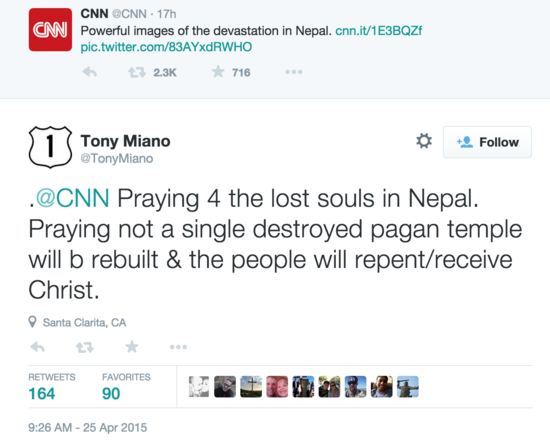
But wait! One particular Christian preacher knows why this kind of thing happens. He can explain how these catastrophes, particularly the devastation caused by the earthquake, are compatible with a God of love. Here’s what it’s really all about:
Tweet

That’s right. God only allowed these terrible things to happen so that more people – excluding the ones he murdered, obviously – would have the chance to turn to Christ. Isn’t that marvellous? And Tony Miano, who is the same lunatic street preacher arrested in London in 2013 for sharing God’s ‘love’ for LGBT people, is not alone. German pastor Wolfgang Wegert said much the same thing of those who died on Germanwings Flight 9525: ‘A plane crash is a reminder of our own mortality. By that, God wants to make people repent, so that we (can) be saved by Jesus.’

And, do you know, they’re right. No, really, they are. There is no other response available to the Christian who wants to explain events that involve the terrible loss of life. That’s because the Christian God, the one who purports to love us so much, as well as all the other versions, is conspicuous by his absence. He’s always absent, always powerless to prevent such disasters, too remote to want to. Which might just suggest he doesn’t exist (which of course he doesn’t) leaving those who feel the need to cling to belief in him to explain his actions or, rather, the lack of them. So they supply him with an ulterior motive. And why not? A fabricated being needs a fabricated excuse. But this being the real world, the options are limited. So what we get is this; God is only trying to draw people to him. How truly loving. The equivalent of a human father murdering several of his children so that those he spares might love him more. A monstrous and preposterous idea for a monstrous and preposterous God.

And so it falls to human beings of all persuasions to show compassion and to help the survivors of earthquakes, the relatives of plane crashes, the misplaced and grieving refugees. We might be flawed, fallible and – according to the self-righteous – ‘sinful’, but we can at our best, demonstrate the love so lacking in their absent deities. And unlike the many meaningless gods, from Yahweh and Jesus to Allah and Vishnu, we can be present too, because we are real.


You can donate to the Nepal earthquake appeal here.

Idiotic Stuff Jesus Said 10: How to Entertain

Last supper 2Here’s something you don’t see every day.

When you give a luncheon or a dinner, do not invite your friends or your brothers or your relatives or rich neighbours, in case they may invite you in return, and you would be repaid. But when you give a banquet, invite the poor, the crippled, the lame, and the blind. And you will be blessed, because they cannot repay you, for you will be repaid at the resurrection of the righteous.
Luke 14.12-14

In fact, you don’t see it at all, because Christians feel free to flout this command of their Lord’s. I mean, he couldn’t speak any more plainly than he does here, could he? And yet, Christians, you don’t invite the poor, the dispossessed and the disabled to your luncheons and dinner parties. Like the rest of us – that’s the unsaved and sinners in Christian-speak – you only invite your friends, family and fellow-believers. If you’re well-placed, maybe as an official of the established church or as an obscenely wealthy evangelist, you invite those who are similarly rich and famous. As far as you’re concerned Jesus and his ridiculous ideas can just f**k off.

What? You object? You don’t say this, Christians? It would be blasphemous? But of course you say it, when you spiritualise his point, explain it away (‘what he really means is…’), claim the context excuses you or just plain ignore him.

Please don’t misunderstand me; I don’t blame you. Jesus’ expectations are totally unreasonable – idiotic even. But I’m not a Christian; I don’t pretend to follow him and don’t have to do as he says. You, on the other hand claim him as your saviour, your God, and profess to live your life in obedience to him. Except you don’t, do you; you wilfully disregard the clear, direct instructions, like this one, that he gives you.

You much prefer setting your own agenda, whether that’s ‘defending God’s standards’ (your God is incapable of defending his own standards?), bashing the gay or making sure you yourself are ‘blessed’. But these are not part of Jesus’ agenda; his good news (mad as it is), is much more concerned with elevating the lowest of the low, including inviting them into your homes and feeding and entertaining them.

So how about it Christians? How about it all you outspoken men of God – Stephen Green, Steven Anderson, Scott Lively, Matt Barber, Franklin Graham – and all you other Christians; isn’t it time you got down off your soap-box of whatever it is you’re opposing this week and made a start doing what your saviour commands you to do?

Well, isn’t it?

The Reverend Green in the conservatory with a rope

Stephen3The ever-green, ever gay ‘National Director’ of Christian Voice Stephen ‘Act-the-man’ Green is at it again. In a video on YouTube that drips with the most un-Christ like sarcasm and vitriol, the Blessed Stephen takes on Stephen Fry and Benedict Cumberbatch’s petition to have gay men with historic convictions for ‘gross indecency’ pardoned (that’s consenting adult sex at a time when homosexuality was illegal.) Here’s the gist of Green’s ‘argument’:

There can be no doubt that ours is the most intelligent, compassionate, sophisticated and clever generation that has ever walked this earth. Clearly, if something is not against the law now, it never should have been.

Of course he intends this ironically, but for once he has stumbled on a truth of sorts. This is the cleverest generation that ever lived. We know more today than we ever did; it is estimated, for example, that the average person alive today knows far more than the cleverest Greek who lived in, say, Jesus’ time. That ancient Greek, in turn, knew far more than an illiterate Galilean preacher. So yes, we are cleverer – though not more intelligent – than people of the past; we have the benefit of two thousand years of learning behind us. Of course, our cleverness is marred by our continual reversion to tribalism, territorialism, greed and concomitant stupidity. This is the result of our being evolved primates – another fact Green disputes in his video with an attack on both Darwin and Dawkins – but nonetheless it remains the case that we humans have never known as much as we do today.

As for Green’s second sarcastic point, ‘if something is not against the law now, it never should have been’, well, that’s not what anyone is saying. Neither Fry nor Cumberbatch nor anyone else is trying to re-write history. What they are saying is that the injustice of the situation in the past should be acknowledged and rectified. Laws change as morals evolve. Green, however, thinks we should reclaim the values of a (non-existent) golden age when gay men were persecuted and prosecuted. According to this reasoning we should also reclaim other barbaric ‘standards’ of long ago; Green’s ‘logic’ dictates it. In fact, he advocates that we should be obedient to Biblical law, which would involve a return to things that are now illegal in all civilised societies; keeping slaves, beating others, rape, regarding women as property, suppressing women and executing non-conformists. These weren’t against the law once and weren’t even regarded as wrong, even though, when judged by any objective standard, they most emphatically were. Significantly, all were actively endorsed by Green’s God in his Magic Book*. We know they are inherently wrong, however, not just because we are clever and compassionate, but because we are repulsed by them when we see them practised by ISIS and other extremists today.

Christianity was once itself illegal, as was reading the Bible in English instead of Latin. This meant that in the past, Christians were sometimes executed simply for being Christians, heretics burnt at the stake. Green’s ironic principle can be applied here too: ‘if something is not against the law now, it never should have been’. With the benefit of hindsight and, yes, a bit of cleverness, we can see that being a Christian and reading the Bible in English should never have been crimes. Equally, those men convicted of victimless offences in the past shouldn’t have been. It is, however, and as I’ve already suggested, impossible to change the past. But we can try to rectify some of its mistakes.

However, the Rev. Green would prefer it that anything that was once illegal remains so. Christianity included, Stephen?

 
God (or those writing in his name) supports slavery in Leviticus 25:44-46, Ephesians 6:5, 1 Timothy 6:1-2 and many other places; beating children in Proverbs 10:12-14 & 23.14; rape in Deuteronomy 22:28, Exodus 21:7-8 and Judges 19:16-30; women as property in Genesis 19.8, Exodus 21:7 and Deuteronomy 22.28-29; suppressing women in 1 Corinthians 14:35 and encourages the execution of non-conformists in Genesis 38.24, 2 Chronicles 15.13-15, Deuteronomy 13:9, 2 Peter 2:1-22 etc etc


Gentle Jesus – meek and mild?

StonedWhen it comes to derogatory and hateful remarks about minorities, Jesus is frequently given a pass. His ‘meek and mild’ persona – not one he actually had, but one he’s acquired over time – is brought into play to absolve him of all unpleasantness.

For example, and as liberal bloggers are fond of saying, here’s what he had to say about gay marriage:

                                                                                                                                            ”


Yup, that’s right; he said absolutely nothing about it – not directly anyway. But what Jesus did say, if ‘Matthew’ is to believed, was that he upheld the Jewish Law in its minutest detail:

Do not think that I have come to abolish the law or the prophets; I have come not to abolish but to fulfil. For truly I tell you, until heaven and earth pass away, not one letter, not one stroke of a letter, will pass from the law until all is accomplished. Therefore, whoever breaks one of the least of these commandments, and teaches others to do the same, will be called least in the kingdom of heaven; but whoever does them and teaches them will be called great in the kingdom of heaven. (Matthew 5.17-19)

That’s the Law that prescribes death for even the smallest infraction that he’s endorsing there. Here’s a brief sample of that Law and the penalty for breaking its petty rules:

Stone to death anyone who works on the Sabbath. (Exodus 35.2 and Numbers 15.32-36)

Kill publicly children who dishonour their father or mother. (Leviticus 20.9)

Stone to death anyone who blasphemes the name of the Lord. (Leviticus 24.16)

Execute a married couple who have sexual intercourse during the woman’s period. (Leviticus 18.19)

Put to death those involved in adultery. (Leviticus 20.10)

Execute any man who lies with another man, as with a woman. (Leviticus 20.13)

Stone to death at her father’s door any woman who is not a virgin on her wedding night. (Deuteronomy 22.13-14 and 20-21).

Sound familiar? With its oppressive brutality and liberal use of the death penalty, this sort of behaviour is like IS practices today. They’re both desert ‘moralities’, after all. And this is the law that Jesus advocates and insists remains in place until ‘heaven and earth pass away’. As that hasn’t happened yet, the Law, according to Jesus anyway, remains in effect. Never mind that Paul says it doesn’t – God himself, in the shape of Jesus Christ says it does. How’s that for meek and mild?

(Cue Christians referencing the story of the woman caught in adultery. That, however, is a late addition to the Bible and, in any case, Jesus only saves the woman because his beloved Law hasn’t been properly complied with.)

Thankfully, civilised human beings – and civilised Christians too – ignore Jesus and don’t seek to apply such old barbaric laws (though there are some believers who want to when it comes to LGBT people; see my previous post.) But if you want to know Jesus’ position on moral issues that he doesn’t pontificate on explicitly, just remember he fully supports the death penalty for adultery, homosexuality, working on the Sabbath, not being a virgin on your wedding night, having sex at the wrong time of month, dancing, listening to the radio, tweeting and texting… oh wait… now I have got him confused with Islamic extremists. It’s so easy to do.
Next time: Jesus says that the only way to gain eternal life is to follow this vicious Law with all its unreasonable demands.

This week in the wacky world of religion…

AtrocitiesBecause my invisible super-being is better than yours, this week I’ve:

murdered you at prayer;

beheaded you as an infidel;

denied you an education;

raped your girls and young women;

committed brutal acts of terrorism;

denigrated LGBT people;

flogged you and imprisoned you.

…And all because of my invisible super-being. Isn’t he wonderful?

As for me, I’m just glad I don’t have an imaginary god if this is the kind of thing he tells his followers to get up to.

Good For Nothing

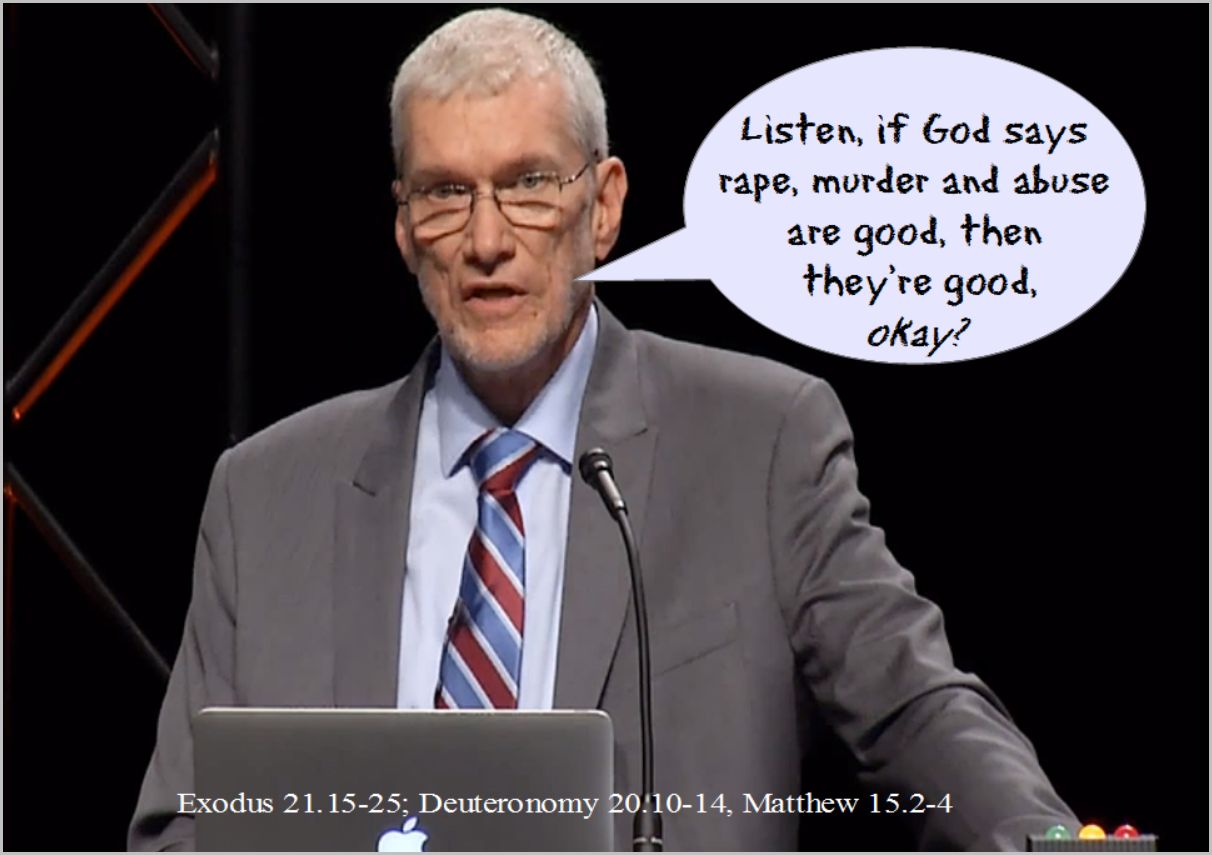
HamWhere does morality come from? Ken Ham of Answers In Genesis says it can only come from (his) God. Atheists have no grounds for morality, he claims, because, without a God to tell them, they’ve no way of knowing the difference between right and wrong .

As usual, Ham is being creative with the truth. Clearly atheists are as capable of being moral as anyone else. Equally and also evidently, Christians and other brands of believers are capable of deplorable immorality. Hardly a week goes by without more reports of Christians abusing, cheating, lying and killing in Jesus’ name.

Why do Christians act so despicably when, supposedly, they have God’s Spirit inside them – that’s the God from whom all morality flows, according to Ken Ham. Why doesn’t his indwelling Spirit guide Christians so that they always behave morally, or even just considerately?

I don’t have the answer. Perhaps Ken Ham or some other knowledgeable Christian can tell us.

No, morality doesn’t derive from any god. It has evolved, inevitably and like much of our behaviour, from our being social animals. Living in close proximity with other humans has meant we have developed ways of behaving that take these others into account, as well as the repercussions of our behaviour on ourselves.* The principle of treating others as we ourselves would like to be treated is very old – much older than Christianity.

Morality, though, is not absolute and is far from infallible. Non-believers, like the religious, make mistakes and don’t always treat others as they should. But the fact they behave well most of the time is evidence that behaving morally has nothing to do with a god, especially not the capricious, murderous psychopath of the Abrahamic religions.

Ken Ham’s position, and that of other religionists who tell us we have no grounds for morality without such a god, is as offensive as it is absurd.


* There are innumerable books that consider our moral evolution; you might like to try Frans De Waal’s Primates and Philosophers; How Morality Evolved or Christopher Boehms’s Moral Origins.


What did you do today, God?

Duck

What have you achieved today? I finished some illustrations for a children’s book a friend has written. It’s a minor accomplishment, of course, but one I like to think hasn’t added to the sum total of suffering and misery in the world (though you might want to disagree.) There’s every chance that whatever you’ve done today has been productive and positive too. That is, unless you also happen to be a deity.

What are God’s accomplishments today? What has the Omnipotent, Omniscient and All-loving God achieved in the last twenty-four hours?

Has he, for example, eliminated Ebola, Aids or cancer, or even helped those sinful human beings who strive to develop cures for these terrible diseases (which we would be right in thinking God himself created in the first place)? Erm, no. He hasn’t. Ebola, Aids and cancer are still with us today, their cure and prevention a little closer only because of human endeavour.

Has he prevented any further brutal murders by those who claim to operate in his (alternate) name? Has he rushed to the assistance of Christians being persecuted in Syria and Iraq? Erm… that’s another no. You’d think he might, wouldn’t you, given that his own people are among the persecuted, but no. And given that ‘gentle and compassionate’ relief worker, Alan Henning, has today been beheaded by Islamic extremists, you’d be right to wonder just where God is. What does he spend his days doing?

Did he, then, decide that today was the day he’d let us know which of his many manifestations is the real him – Yahweh? Allah? Shiva? Ra? One of the myriad others? None of the above? No, he didn’t do that either. He left us in our ignorance about which of the many religions, groups and sects has got it right about him. He couldn’t find the time today to tell us who it is that worships the real him, and who it is who’s deceived. Just as he couldn’t for all of the days that have so far made up recorded time.

Maybe, however, he hasn’t had time to do this because he’s been too busy sustaining the universe; you know, winding up gravity and giving the Earth those little pushes it needs to make it spin. But of course, the universe doesn’t work like this. It needs no external power source to keep it going. Even if it was God who set the ‘laws of physics’ in motion at the beginning of everything (it wasn’t), they have been self-sustaining ever since. So, no, he hasn’t the excuse that he spends his days making sure everything is ticking over nicely.

Does he spend them instead empowering believers to move mountains, heal the sick, raise the dead and perform miracles even better than those of his ‘son’, just like he had Jesus promise? Not so’s you’d notice. In fact, not at all.

Oh dear. We really are running out of possible things for God to do. Despite the sometimes desperate state of the world, perhaps all of his time is taken up finding parking spaces for Christians and sorting out their career prospects. Perhaps he’s too busy directing the thoughts and words of his ‘chosen instruments’ (see my previous post) so they can express their hatred for non-Christians and gay people. Or maybe all of his energies go into inspiring those Holy Spirit led church services that ‘bless’ Christians but are no more than human emotion run riot. Alternatively, maybe he just spends his time being offended by everything and everybody. If these are his accomplishments over the last twenty-four hours, then, given all the things he could have been doing, doesn’t it all seem rather pathetic? This is all he can manage?

Of course not. All of the triviality, and all of the brutality, attributed to him is entirely human in origin and manifestation; the beheadings, the euphoria, the offence, the vitriol. All part of the self-delusion that is ‘faith’. There is no God doing all these things, no God who manifests himself in the operation of the universe, in human suffering or the pleasures and happy coincidences of life.

It’s possible, I suppose, that there is a god somewhere, one without any interest in human beings and life here on Earth, but then he’d be even more irrelevant than the impotent gods we’ve invented for ourselves.

As Ariane Sherin famously said, ‘There’s probably no God’, with the ‘probably’ looking ever more redundant.

Let’s Suppose…

This article originally appeared as a guest post on Bruce Gerenscer’s U.S. blog, ‘The Way Forward’ a couple of months back. Bruce has since had to close his blog and as a result the article became inaccessible. I’ve rescued it, my little lost sheep among a hundred, and present it here for your delight and delectation. Or something.

While on ‘The Way Forward, the post generated quite a few comments from Bruce’s readers. Feel free to respond to it here in like manner – and indeed to any other posts. All comments, spam excluded, are published whether agreeing or disagreeing with what I have to say.

BlessedLet’s, for the sake of argument, suppose that Christians could prove that the universe was created by a supernatural agent.

Let’s further suppose that they could demonstrate conclusively that this supernatural agent is none other than their very own God, as opposed to, say, Allah or Atum or Marduk.

And then let’s say they are able to show us, with sundry proofs, that an itinerant Jewish preacher, generally known by the Greek name, Jesus – though he was never called that by those who knew him – was somehow a manifestation of this God on Earth.

Then let’s say we grant them, although it doesn’t seem it from reading Jesus’ story in the synoptic gospels (Mark, Matthew and Luke, all written between forty and sixty years after this man lived) that his death somehow or other bridged the gap between humanity and this very touchy deity.

And then let us suppose that, although he never met Jesus but only had some sort of hallucination about him, the man Paul was right to say that through magically invoking Jesus’ name, people could be reunited with God and completely remade.

Let’s further grant them that, although their book about Jesus and Paul doesn’t actually say so in so many words, they really are going to go and live in Heaven when they die.

Assuming all of this is true – even though Christians are unable to demonstrate even the first of these propositions (the one about the universe being made by a supernatural being) – why is it they disregard and otherwise ignore most of what their god-man, Jesus, tells them about how they should live their lives?

Why are they, for example, so cavalier about forgiving others when he says in order to be forgiven they must first forgive those who have offended them? (Matthew 6.14-15)

Why are they so harsh in their judgements of others when he tells them that how they judge others will be how they themselves will be judged? (Matthew 7.1-2 & Matthew 25.34-46)

Why are they so lacking in compassion, when he says the amount of compassion they’ll receive is directly related to the amount they show others? (Matthew 5.7 & Luke 6.38)

Why are they so vociferous in their condemnation of others when they should be dealing with their own ‘sins’ first? (Luke 6:42)

Why do so many of them fail to serve others sacrificially, without expectation of reward and with no ulterior motive? (Mark 9.35 & 10.43-44)

Why are they not known for selling their possessions, giving to all who ask and going the extra mile? (Luke 12.32, Matthew 19.21, Luke 6.38 & Matthew 5.41)

Why do they not turn the other cheek, bless and pray for those who abuse them, and treat others like they want to be treated themselves? (Luke 6.28-29 & Matthew 7.12)

Why do they not love their neighbour as themselves, and their enemies too? (Matthew 22.39 & Matthew 5.44)

Shouldn’t they be doing these things, and more, as if their eternal lives depended on it? Especially when Jesus says their eternal lives do depend on it (Matthew 25.37-40). Shouldn’t they be just so much more radical than they actually are, changing the world by serving others? (Matthew 25.34-40)

Yes, they should, but they’re not, and they never have. Deep down, they know that Jesus is too extreme, too demanding. They make excuses for themselves; he doesn’t really mean the things he says; he speaks in metaphor and uses hyperbole (specially when he’s saying something they don’t like the sound of) and they invoke the bumper-sticker theology of ‘we’re not perfect, just forgiven’, even when ‘perfect’ is the very thing Jesus tells them they must be (Matthew 5.48).

The only reasonable conclusion we can draw from all of this is that Christians don’t really believe the man they call God and Saviour. Their actions, or lack of them, speak far louder than their words. It’s so much easier to claim Paul’s magical incantation, looking heavenward and damning the rest of us, than it is to do what Jesus demands. Who cares what Jesus said anyway. What did he know?

New series! Idiotic stuff Jesus said!

This one’s gonna run and run!

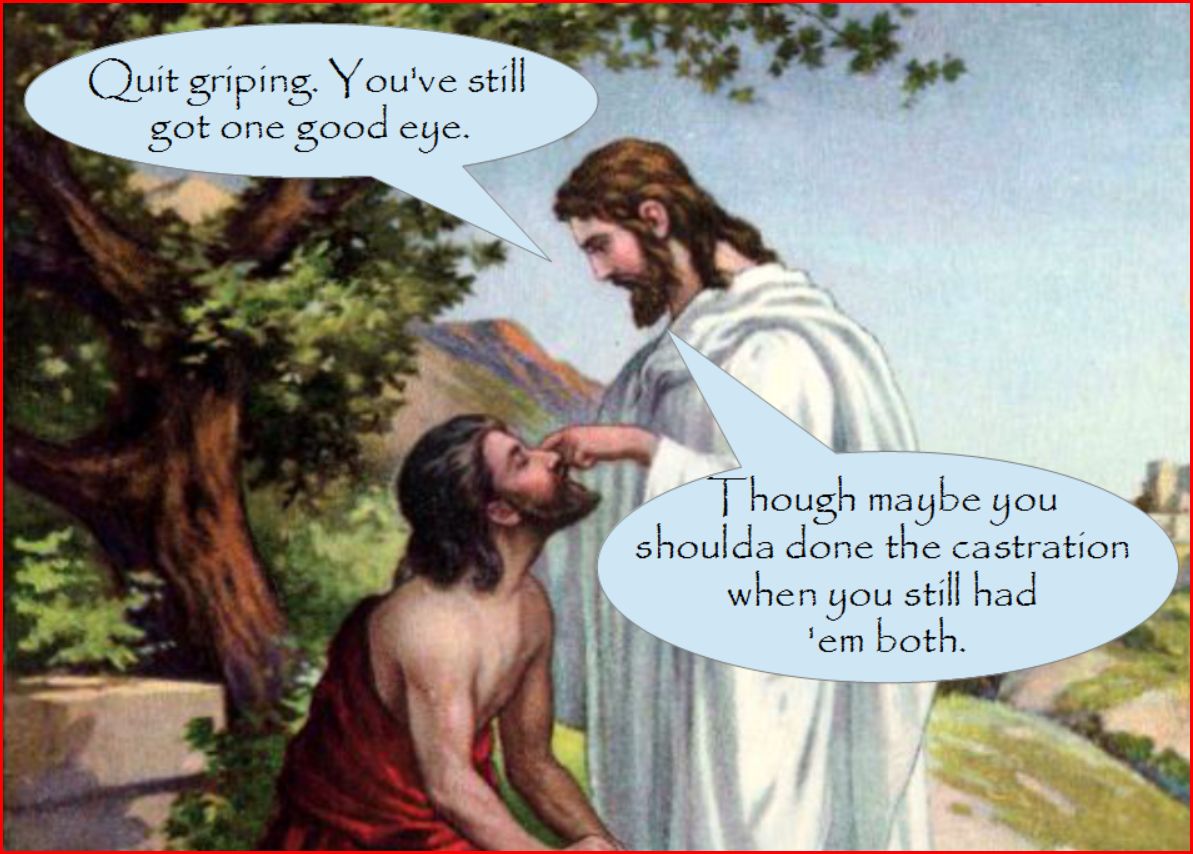
EyesYou hear the one about the blind Christian bloke with only one hand and no balls? And he did it all to himself! Cut off his hand, gouged out his eyes and castrated himself. When asked why he’d done it the man explained, ‘I’m a follower of Jesus and when he tells me to do something, I do it. My self-mutilation is my witness to what a great guy he is. He wouldn’t steer me wrong.’

Sure enough, the normal people who heard him were incredulous, until one of them looked in the Bible and found the very instructions to which the eyeless, testicle-free, one-handed believer referred.

In Matthew’s gospel chapter 5, Jesus is talking about lusting after a woman, which in his eyes (he still had both of his) is as bad as having sex with her. Course it isn’t, not by a long way, but he tells his followers, ‘If your right eye causes you to sin, tear it out and throw it away; it is better for you to lose one of your members than for your whole body to be thrown into hell’ (Matthew 5.29).

A bit drastic perhaps, but there it is; the Son of God is clear about how to avoid the sin of checking out a member of the opposite sex. That’s why you see so many one-eyed Christians around the place because they all take his admonition very seriously.

Except… you don’t. Either Christians ignore him entirely on this one or they never look at the opposite sex with an eye to sexual congress. We all know they’re like the rest of us in this respect – some, as Jimmy Carter once famously did, are honest enough to admit it – and some even act on it; the divorce rate among Christians is not the same as it is for everyone else just because they get tired of being married.

Perhaps though Jesus is being metaphorical when he proposes that gouging out one’s eyes is the best way to deal with lust. Not surprisingly, Christians prefer this possibility. In The Method and Message of Jesus’ Teachings, Robert Stein argues that:

what Jesus was seeking to convey to his listeners by this use of overstatement was the need to remove from their lives anything that might cause them to sin… Jesus is saying in effect, “Tear out anything in your life that is causing you to sin and keeping you from God”.

If that was his intention, Jesus might have actually used these words. If he wants to say ‘in effect’ that the believer should jettison anything from his life that causes him to sin then why doesn’t he?

But eyes are not enough. You gotta get rid of that wanking* hand too (the context of Jesus’ comments is specifically sexual and entirely male orientated throughout these verses): ‘And if your right hand causes you to sin, cut it off and throw it away; it is better for you to lose one of your members than for your whole body to go into hell’ (Matthew 5.30). This must be why we see so many one-handed Christians…

The difficulty with interpreting these and other verses metaphorically is that Christians want to claim that the Bible is the literal ‘word of God’ and then want select parts of it to be metaphorical – and guess who they think should do the selecting. But they can’t have it both ways. Even if they could, how would they know which parts to interpret literally and which symbolically? Perhaps the Holy Spirit tells them, or maybe, and more likely, it’s just their personal preferences. After all, who wants to lose eyes and hands just for being human?

If that’s not enough, Jesus encourages other mutilations for the sake of his Kingdom when he reveals in Matthew 19.12 that ‘there are eunuchs who have made themselves eunuchs for the sake of the Kingdom of heaven. Let anyone accept this who can’. No Christians today seem able to ‘accept’ this recommendation, either; what a truly feeble bunch they are, putting their testicles before the Kingdom!

It seems likely that, given he believed the end of the age was fast approaching, Jesus actually meant what he said, counting on the probability (as he saw it) that anyone who followed his ridiculous suggestions would not be eyeless or handless for long. They would, at the resurrection, be fully restored to live in the Kingdom where, according to Matthew 22.30, they would not be troubled by either impure thoughts or marriage itself (and so wouldn’t need those testicles anyway).

Whichever way you cut it (off) – literally or metaphorically – Jesus words in these verses are remarkably idiotic. Throughout history there have been some individuals, like the dude we started with, who have indeed made themselves eunuchs for the cause. But the vast majority of male Christians have always dismissed this advice or have decided JC was only speaking metaphorically (as he always is when they don’t like what he’s telling them to do).**

So next time True Believers start thundering on about the evils of same-sex marriage and gay sex, tell them to get their own house in order first. A little amputation is all that the Lord requires.


* ‘Jerking off’, for any Americans reading.

**Read more in my (five star reviewed!) book Why Christians Don’t Do What Jesus Tells Them To …And What They Believe Instead, available from Amazon.