A Big Myth-take

The nativity story is evidently a myth. The evidence?

The virgin conception and birth (similar to other myths);

Angels everywhere;

Warnings in dreams;

The wand’rin’ star;

Events created from out-of-context scraps of Jewish scripture (the virgin birth again; the shoe-horning of Bethlehem; Herod’s massacre; the flight and return from Egypt);

The heavy-handed symbolism (shepherds and their gifts; the magi and theirs);

Historically inaccurate details (disparate dates, the Roman census, Herod’s massacre);

Discrepancies between the two accounts;

The absence of the nativity and its events in the other two canonical gospels,

Disparity with later events in the gospels (Mary treasures the nativity events in Luke 2:19 only to seemingly having no knowledge of them later (Mark 3:12); John and Jesus are second cousins… or not).

And on and on.

Yet the story is analysed endlessly – two thousand years (almost) and counting – as is all that follows in the gospels. There’s a whole lot of jargon to intellectualise this , of what is, in the end, just myth: exegesis, hermeneutics, soteriology, apologia, discourse analysis, close reading. All exist to expose the truth embedded in the text and to defend it. Even those who acknowledge that the nativity story is myth (quite an attractive, cosy myth admittedly) want to confine this admission to the nativity alone. The rest – the symbolic miracles, unfulfilled prophecies, literary sermons, the metaphorical pericopes (more jargon!), the trial, crucifixion and resurrection – they want honoured as historical, factual and mystically embodying Truth. Unfortunately, all of these stories bear the same hallmarks of myth as the nativity tales. Why should these other stories be regarded as anything different?

**********

Christmas is upon us. I’m happy to call it Christmas; the name has a long pedigree and ‘Holidays’ has, in any case, its own religious connotations. Dennis and I will be spending it with my daughter and her family. I hope you too are able to enjoy it in whichever way suits you best.

A happy Christmas to you, both my readers.

The Anunciation: A Ghost Story for Advent

The Nativity in Matthew and Luke begins long before Jesus’ birth. Matthew introduces Mary and Joseph once the former has been impregnated with The Holy Sperm. He doesn’t go into any detail about how this happened, he just drops in, in Matt 1:18, that the deed is done. Mary has had sex with a ghost.

This isn’t good enough for Luke though, who after reading Matthew’s tall tale, decides it needs some expansion. A lot of expansion, in fact. He takes the story back to before Mary’s non-consensual encounter with the Holy Spirit and picks on Elizabeth and Zechariah, an elderly couple well past the age of having kids. All the same, they do enjoy a tumble in the sack every now and then, and the Lord – ever the voyeur – decides he’ll bless one such union with fruitfulness. (There is much wrong with the details of this unbelievable yarn, some of which I consider here; I won’t reiterate them now for fear of awakening any amateur theologians who might be lurking here in the wings.)

Suffice to say, Luke – for it is he, lest we forget, who is making this stuff up – decides that Elizabeth is a long lost cousin of Mary’s, like in one of those soaps where long lost relatives pop up all the time, usually to no good end. In this particular episode, however, all goes well and Mary visits Elizabeth, whose baby is, in a strange twist of fate, destined to be John the Baptist from the earlier two gospels. In this story his embryonic self jumps for joy inside his mother once he realises his uterine Saviour has come to visit.

But were getting ahead of ourselves. First Mary has to go through the rigmarole of getting pregnant. Obviously as a good Catholic girl she can’t have sex with her betrothed prior to their wedding and just when she’s considering when that might be, an angel appears unto her. It’s Gabriel who has quite a bit to do in the Nativity story as a whole. As angels do, he annunciates to Mary all about the pregnancy part of the plot and she acquiesces to the Lord getting her with child by magically transferring his seed into her womb. I’m guessing it was by magic. It’s possible some sort of actual rumpy-pumpy occurred but Luke delicately passes over the intimate parts. As apparently the Holy Spirit does too.

Mary is so overjoyed to be pregnant before her 13th birthday that she bursts into song on the spot and spontaneously produces a hymn based on the Psalms and the future teaching of the baby she has only just conceived. It’s hard to believe that no actual time travel was involved. It is instead, a miracle, as her impromptu ditty flourishes into the literary masterpiece now known as The Magnificat, which is not, it turns out, a feline super-hero. Fortunately, she can remember it all, word for word, decades later when Luke decides he needs to invent record it. Honestly, the whole thing puts Cole Porter to shame.

You’d think then Mary would dash off to tell her betrothed, Joseph, the wonderful news that she is pregnant without his or any other man’s assistance, but Luke makes no mention of it. Luckily, it’s covered by Matthew, where an angel drops in on Joseph, a person of great gullibility faith. On hearing what the angel has to say, he swallows the story hook, line and stinker.

Then it’s back to where we came in. Mary’s sets off down the road to see the cousin, the wonderful bearer of John. She pitches up there for three whole months, perhaps to avoid Joseph, who, it turns out, was not as gullible as she thought.

**********************************************

Honestly, this is really what happened. Would I lie to you? No, but someone would, and did. We’ll see what else he has in store in his over-worked imagination, next time.

**********************************************

PS. Don, I know you like indulging in a bit of biblical exegesis. If you’d like to borrow this totally respectful effort for your blog, get in touch and we’ll work something out.

When A Child Is Born… Supernaturally

To what extent are the conflicting nativity stories in Matthew and Luke historical? That depends on whether or not you believe in the supernatural.

There is no evidence of a supernatural realm nor the beings who are said to inhabit it: God, heavenly Jesus, the Holy Spirit, angels and those they are constantly at war with: Satan and his demonic hordes. It is not as Jonathan Cahn describes it in The Serpent’s Prophecy:

Behind the perceivable realm lies another, beyond our ability to measure or quantify. Behind the history of this world lies another, unrecorded, unrecited, unknown. And behind that which moves and transforms the world lie unseen forces, causes, agents, undying and primeval (p3).

Cahn cannot possibly know any of this, any more than fake-Paul could when he wrote Ephesians 2,000 years ago (6:12). A reality that exists above and beyond nature – the meaning of supernatural – that is ‘unseen’, undetectable and ‘unknown’ is one that doesn’t exist, except in the imagination of a few fantasists.

Yet the supernatural is the basis of Christianity. Without it, its agents, as Cahn calls them, could not have interacted with the only reality there is. The Holy Spirit could not have impregnated Mary; angels could not have materialised to announce Jesus’s birth to a group of credulous shepherds; a divine being could not have communicated through dreams with Joseph and the Magi; a magic star could not have been manoeuvred into place over Jesus’ house. Most significantly, a non-existent God could not have sent his ‘son’ into this world.

It is futile to argue whether Matthew or Luke’s nativity narrative is the more historically accurate. Nor is there any point in trying to harmonise the two accounts. Neither is historical: the involvement of the supernatural rules out their being factual.

The inclusion of the supernatural in everything that follows is also fatal to claims made for the gospels’ historicity. The clues are there in the text: God’s pronouncements from the sky; the inexplicable miracles and healings; the presence of angels, demons and Satan; the dead rising; visions, prayers and prophecies. These tell us that what we’re dealing with is fantasy material. The creators of the gospels and other books of the New Testament had no more evidence than Cahn does that secretive super-beings existed, even if they did take them for granted. God and his interventions no more exist than Santa Claus and his magical Christmas deliveries.

Paul tells us that God raised Jesus from the dead (Romans 8:11). But there is no God, so he didn’t. There was no supernatural resurrection and without a resurrection there were no encounters, like those in the gospels, with a reanimated body.

Remove the supernatural from the Jesus story and there’s nothing left. Some wise advice lifted from Jewish scripture perhaps, plus a few cult rules, but that’s all. Paul’s experience of the risen Christ, like that of Cephas before him (described nowhere in the New Testament but allegorised in the gospels) and John of Patmos after him, were as Paul himself says, a ‘revealing’ in their own heads.

I hope none of this spoils Christmas for you. The Nativity isn’t a bad story, indeed it’s quite beautiful in places. But it is not historical. Like much in gospel Jesus’ life, and the resurrection itself, it is a fantasy generated by irrational and superstitious minds.

A very happy Christmas to both my readers.

Encounters with God

I had a couple of encounters with God on a recent trip to the Baltic states of northern Europe. Both were in churches, the first in Helsinki, Finland. The Lutheran Temppeliaukio Kirk (above) is a remarkable structure hewn from solid rock into a stunning enormous cavern. The choir was practising when our tour guide took us there. The singing was sublime, amplified and enhanced by the acoustics of the cave. Listening to the ‘heavenly’ voices was a truly spiritual experience. After the performance, the choir leader dedicated their performance to the glory of God.

The second church was the protestant St Nikolai’s in Kiel, Germany where, local legend has it, a miracle occurred during the second world war. When the town was in danger of being bombed, church officials had all of the church’s historic pews removed and safely stored. The massive suspended crucifix, however, was too big to take down and had to be left in place. Some parishioners quickly became unhappy standing for services and started bringing their own seats, including quite a few sofas. When the town and the church were eventually bombed, the huge crucifix fell from its height and crashed down. While the church itself was all but destroyed, the crucifix survived with only minimal damage, thanks to the sofas on which it landed. A miracle!

The cross suspended again in the restored St Nikolai church

Singing that reflects the glory of God and a miracle in which Christianity’s holy symbol is preserved. Presumably today’s attendees at both churches (St Nikolai’s interior was rebuilt) believe these events to be the work of God. Our tour guide that day expressed his scepticism, as did I, inwardly at least. The singing in the cave church was a tribute not to God but to the human ability to create beauty. It spoke too of the skill of the church’s architects and engineers who provided the building with its stunning acoustics. Human ingenuity, creativity and, I would guess, hours of practice produced the sublime sound.

The crucifix ‘miracle’ was a remarkable convergence of coincidence. A good story to be sure, but not an event that requires any God.

I drew the same conclusion from the two experiences: human beings are prone to give credit to their deities for things they achieve themselves – beautiful singing and stunning architecture included – and to attribute chance events and coincidences to their gods. We should take credit for our achievements (as well as responsibility for our bad behaviour.) The gods have no part to play. There are no gods.

And now, the Conclusion

It’s a game you can play all day.

  • First, choose a story – any story – from the gospels.
  • Look for all the metaphors in the story.
  • Note its allegorical elements.
  • Find either the myth from Jewish scripture and/or the part of Paul’s fantasy that the story is based on.
  • Read the story in light of these insights.

Once you’ve done this a few times – which you can, literally, till Kingdom come – you’ll realise that all the stories in the gospels are literary inventions. Stories that are replete with metaphor, reliant on earlier mythical sources and that read like allegory would be considered, in any other context, to be fiction.

And what will you conclude from this?

That just because the stories are from the gospels doesn’t grant them a free pass. Stories that fulfil all the criteria of fiction, as the gospel stories do, are elsewhere considered to be fiction: think Romulus, the non-canonical gospels, King Arthur, the Book of Mormon, the Chronicles of Narnia. So why not here?

That calling the stories ‘pericopes’, in an attempt to elevate their status, merely disguises the fact they are just stories.

You’d acknowledge that History, as in the recording of past events, is not written as allegory. It doesn’t depend on metaphor and symbolism to reveal hidden meanings. Historians reject or are highly sceptical of any accounts that depend on such literary techniques. They usually conclude these are not history, whatever else they might be.

You could, I suppose, try arguing that history in ancient times wasn’t the discipline it is now and did indeed incorporate elements from fiction. But you’d be wrong. Historical accounts of the first century have survived and do not confuse historical fact, however interpreted, with fiction. Writing that relies on allegory and hidden meanings is not considered to be history. You would then have to concede that the gospel narratives do not qualify as history. You would then be in agreement with the majority of scholars who think this.

Then you’d ask, why? Why, if Jesus was such an incredible guy, did so much have to be made up about him? You could, I guess, argue that an itinerant first-century preacher successfully manipulated events so that he fulfilled ‘prophecy’, complied, at least in Mark, with Paul’s (future) teaching and managed to make himself some sort of living breathing metaphor. Or you could conclude, applying Occam’s razor, that the stories are simply made up. And if you did, you’d be agreeing with Mark when he reveals that ‘everything is in parables’ (Mark 4:11).

You’d then ask yourself: if the miracles, the healings, the profundities, hyperbole, nativity tales, angels, demons, zombies, the transfiguration and much else besides are all fiction, then why not too the resurrection? Is it one of only a few episodes in the gospels – the crucifixion is often cited as another – that isn’t fiction? Is it the one of only a few stories in that’s factual and true? The empty tomb, the angels, the sightings by Mary, the disciples and Thomas, the fish breakfast, the ascension: are these historical when everything else is not? You’d have to ask on what criteria you were salvaging this particular story as historical when all that precedes it patently is not.

Then you’d have to start wondering if there really was a Jesus. The versions of him who appear in the gospels are constructs, characters created from metaphor, Old Testament stories and the teaching of the early Christian cult. If there really was a man who trailed around Palestine with an apocalyptic message, he is long gone. Indeed, he had vanished by the time the stories about him that we know as the gospels came to be written.

The Feeding of the 4000

Mark 8:1-15 has the credibility-defying story of Jesus feeding 4000 people. The story is in fact one of numbers, all of which have symbolic significance. Numbers, bread and fish.

At first reading the account seems to be little more than a retelling of the earlier feeding of the 5000 in Mark 6:30-44. However its numerology is different and Mark has Jesus explicitly compare the two stories in verses 8-21. Both are intentional inclusions in his gospel, not an editorial oversight.

The events almost certainly didn’t happen in reality; significant numbers of people, 5000 and 4000 respectively, following an itinerant preacher around for – magic number alert! – three days would not have escaped the attention of the Romans. Nor would the men (Matthew 13:58 insists 4000 was the number of men) have been able leave their livelihoods for this length of time to follow Jesus around the distant countryside.

Then there’s the repetition of the bread and fish motif. In both stories the entire crowd fails to bring a single thing to eat. On both occasions, the disciples somehow, from nowhere at all, come up with a few loaves and some fish. Symbolic food for symbolic crowds.

Bread, while a staple food of the first century always has spiritual significance in the bible. From manna from heaven in Exodus 16:17 to the Body of Christ in Paul’s teaching. Fish likewise: Mark has it that several of the disciples were fishermen and makes Jesus declare they’re ‘fishers of men’ (Mark 1:17). John will later take bread and fish symbolism to extremes.

The bread in the feeding of 4000 is spiritual manna. Jesus is not feeding a real crowd with real bread. He is ‘feeding’ those who follow him, the early cult, with himself: ‘Jesus took bread… and said this is my body which is for you’ as Paul has him say in 1 Corinthians 11:23-24. So satisfying is this heavenly Bread that there is a great abundance left even after his followers have taken their fill.

There’s more: the numerology signifies that the crowd following Jesus in the story aren’t any old rag tag collection. They are specifically Gentile. Mark alludes to this when he mentions they have come ‘a long distance’ (8:3) and again when he has Jesus explain, in typically obtuse fashion, the meaning of the miracle (8-21):

Jesus asked (the disciples): “Why are you talking about having no bread? Do you still not see or understand? Are your hearts hardened? Do you have eyes but fail to see, and ears but fail to hear? And don’t you remember? When I broke the five loaves for the five thousand, how many basketfuls of pieces did you pick up?”

Twelve,” they replied.

And when I broke the seven loaves for the four thousand, how many basketfuls of pieces did you pick up?”

They answered, “Seven.”

He said to them, “Do you still not understand?”

Seven loaves with seven baskets left over, seven being the number of the Gentile nations. In the earlier feeding of the 5000 the twelve leftover baskets represent the twelve tribes of Israel.

And still the dumb old Jewish disciples don’t understand. The story is about how the early Jesus cult was open to anyone, Gentiles as well as Jews, who recognised and accepted Jesus as the Bread of Heaven, the Saviour. As Mark was aware, Paul had already expressed this universality:

when we break the bread, aren’t we sharing in the body of Christ? And though we are many, we all eat from one loaf of bread, showing that we are one body. (1 Corinthians 10:18).

For his next miracle, the healing of a blind man in Mark 8:22-26, Jesus/the cult/Mark go on to hammer home the point still further.

Ramifications

I started writing this blog as a way of working out just what it was I’d believed prior to my realisation there was no God. While this ‘revelation’ caused the whole Christian edifice to collapse, I still had a lot of conditioning to deal with. I had been taught over the years that, like every other human being, I was worthless without God/Jesus. I needed first to regain some self-worth.

I had hang-ups too about how I spent my time and money. The cult had assured me that God was obsessively interested in how I used both. Did my use of my time and money further his kingdom? Was I using my time wisely? Tithing? Giving my money to alleviate suffering? I knew buying CDs and comic books didn’t really fit the bill, but I sinfully persisted in spending my hard-earned cash on them, when I had any to spare after taking care of my family and giving to the church and charity. Then the guilt! How could I be so thoughtless, so selfish? I had let God down badly (specially if I’d bought some of the devil’s music.)

The guilt was self-induced of course. I think I have a personality type that is prone to feeling guilty – it’s been the predominant emotion of my life – but the Christianity I encountered exacerbated it. I still struggle with guilt, not over any great ‘sin’ but in terms of how much I help others and whether my use of my money is self-indulgent and wasteful.

Despite now having no truck with the idea of sin (which is a worthless religious concept) I do sometimes catch myself worrying that I’ll be made to suffer in the next life (which doesn’t exist either) for who I am and my ‘lifestyle’ in this world. Completely irrational, I know, but the conditioning runs deep. It hasn’t been fully rooted out yet.

On the plus side, I can now see the Bible for what it is: a collection of stories, those in the so-called New Testament designed, as they declare quite openly, to promote the beliefs of the ancient Jesus-cult.

I realised that in an ocean of myth, legend and invention I had been taught to regard the gospels as an island of historical fact. Yet two of them are prefaced with patent fantasy – the incompatible nativity stories – and conclude with equally incompatible resurrection and ascension narratives. Yet I was expected to trust that everything in between these make-believe beginnings and endings – the miracles, the visions, the speeches, the fulfilled prophecy, the false promises and unlikely new prophecies – were all somehow factual and true.

No longer gullible, I came to see this as a preposterous expectation. Sandwiched between fantasy and illusion the gospels are all myth and legend. It’s pointless to argue, as apologists do – and quite a few sceptical scholars too – that we can discern the real Jesus among the invention:

that we can make something worth considering out of the discrepant resurrection appearances;

that because one or two historical figures are written into the story it must therefore be historical throughout;

that we can sift the factual wheat from the metaphorical chaff;

that there is a kernel to the tales that can be teased out from the fantastical accretions;

that contradictions can be explained (away) and by sleight of hand made compatible;

that somehow believing all of this fantasy material can ensure eternal life.

None of these things can be done, any more than they can with the legendary tales of Romulus, Buddha and King Arthur. Legends, are legends are legends. Stories are stories are stories.

Would I have been happier never to have been a Christian, never to have committed my life to Jesus? Almost certainly. But we are all where we are. Christianity and I have a history. It’s probably left me scarred, and perhaps you too. At least I escaped it to live my life as I needed to, even if I am still working my way through its legacy.

Just suppose…

Let’s imagine that the gospels were all written by eye-witnesses or the associates of eye-witnesses. Let’s suppose that prior to their composition there was a vibrant oral tradition that accurately preserved the Jesus story and his teaching in particular. Let’s suppose that Paul learnt what he knew of Christianity initially from the early believers he persecuted and then, following his miraculous conversion, from his meetings with the disciples. Let’s suppose that the later books of New Testament were written by people who knew Jesus personally or were really by Paul. Let’s suppose that everything in the bible was inspired by God and is truly his word. Let’s imagine that as result of all this, everything predicted and prophesied in the gospels, in Paul’s letters and the later ones by apostles, came to pass.

Because we’d have to imagine this. Even if everything we’ve supposed was true, none of the prophesies, predictions or promises have materialised in reality. Not one. No Son of Man beaming down from heaven while the disciples and Pilate were still alive, (as he promises in Mark 9:1 and Mark 14:62 respectively), no visit from the Messiah while Paul and his acolytes were living (1 Thessalonians 4:17), no final judgement, no Kingdom of heaven on Earth, no Christians performing miracles greater than those attributed to Jesus. Not even any ‘new creations’ imbued with the Holy Spirit (‘by their fruits shall ye know them.’)

Apologists put a lot of effort into explaining away these failures, some even arguing the Kingdom is actually with us now (how incredibly disappointing it is if this is the case!) Most disappointing of all is that no Christian has ever resurrected from the dead. Not Paul, not Peter, Mary Magdalene nor any other early follower, and no-one since: not Martin Luther, Charles Wesley, C. S. Lewis, Billy Graham nor any bishop, minister or evangelist who has ever lived. All have remained resolutely dead, just like everyone else who has ever ‘fallen asleep’ and everyone who will in the future.

However much Christians want to insist the Bible is true, accurate and God-breathed, in the end it simply doesn’t deliver.

Either All True Or None True

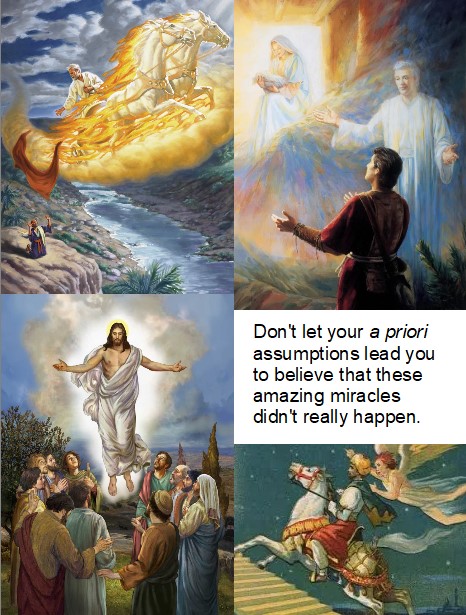
About 2,500 years ago, a man called Elijah went up to heaven while still alive. He was taken through a whirlwind in a chariot of fire, pulled by horses of fire. This amazing event was witnessed by several other people who were profoundly affected by it. The story of this ascension was possibly relayed orally for many years until finally being written down in what is now 2 Kings 2.

Did any of this really happen?

Of course not. It’s a myth.

Some time in the 4th century BCE, the first king of Rome, Romulus, was taken, while still alive, to the dwelling place of the gods. From that time on he was worshipped as a god – some said he was eternal to begin with – with a temple being built in the very place from where he had ascended. Later he appeared to one of his followers, Julius Proculus who said the resurrected Romulus was larger and more beautiful than ever, armed with weapons shining like fire. Julius Proculus attested to this appearance of the resurrected Romulus, swore an oath to its veracity and relayed it faithfully to others.

Did any of this really happen?

Of course not. It’s a myth.

https://mythologymatters.wordpress.com/2019/04/18/easter-mythology-the-resurrection-as-modeled-on-greco-roman-myths/

It is not known when Mithras was born, if indeed he was. He emerged from a rock in the spiritual realm as a child or youth, ritually slaughtering a bull and sharing a banquet with the god Sol. He guided souls to the after-life, propelled as they were by the bull’s blood and flames. He was worshipped primarily by soldiers who saw him as their salvation from the bitterness of earthly life. There were rituals to be followed to become a true initiate and for Mithraic mysteries to be revealed. How Mithras made himself known to his acolytes is unknown, but in the first three centuries CE, his cult rivalled that of the Christians in popularity.

Did all of this really happen?

Of course not. It’s a fabrication, a myth.

In the 8th century CE, the prophet Muhammad flew from Mecca to Jerusalem on a winged equine. Once in Jerusalem he climbed a ladder to heaven. Once there he travelled through the various levels, having conversations with other lesser prophets, before entering Allah’s domain. His journey was later revealed to two early prophets who had known Muhammed when they were boys. They conveyed the details accurately until they were recorded, briefly at first in the Qur’an and later in more detail in its supplement, the hadith.

Did any of this really happen?

Of course not. It’s a fabrication, a myth.

In the early 19th century, Joseph Smith was visited by Jesus and his Father in a vision. They told him that he should not join any existing church because they were all in error. Later, a hitherto unknown angel named Moroni appeared to Smith and indicated to him where some gold plates were buried. He instructed Smith to dig up and translate the plates. Obediently, Smith did so, using a pair of seer stones for the translation. The resulting Book of Mormon was a revelation of Christ’s activities in North America following his resurrection. Smith wisely had a number of his associates witness, in writing, the existence of the gold plates as well as their supernatural provenance.

Did any of this really happen?

Of course not. It’s a fabrication.

In 1916 the Virgin Mary appeared numerous times to three poor Portuguese children, giving them instruction and prophesying to them. She also promised that she would perform a miracle at Fatima. Accordingly, between 30,000 and 100,000 people, including reporters and photographers, gathered at Fatima where many saw multi-coloured lights before the sun itself ‘danced’. It came closer to the Earth before zig-zagging back to its usual place in the sky. While not all of the attendees testified to the phenomenon of the dancing sun (some saw only the lights, others nothing at all) many did and testified to the effect the miracle had had upon them.

Did all of this really happen?

Of course not. It’s a fabrication based on hallucinations.

Around 30CE, a rabbi known as Jesus, who had been born of a virgin, gathered together 12 followers and went around Galilee preaching absolution from sin and the imminence of the Kingdom of God. He announced he was the Messiah who would rule the Earth when the kingdom arrived. The Jewish authorities took exception to his claims and petitioned the Romans to have him executed. This they did, only for Jesus to come back to life three days later, appearing in visions to his followers. He ascended to heaven, promising that those who believed in him would enjoy eternal life. Some of his disciples spread his message faithfully until it was eventually written down, first by a former Pharisee called Paul and then by four authors who accurately recorded what Jesus had said and done.

Did all of this really happen?

What do you think?

If the Gospels were History…

If the gospels were written by eye-witnesses, we should see the use of the first person singular or plural: ‘I saw this happen’, ‘we heard him say that’ and so on. This would not necessarily mean that the author was present, just as he isn’t in the ‘we’ passages in Acts, but it is what we should reasonably expect if the authors were involved in at least some of the events. There are no such instances in any of the gospels.

We would see gospel authors identifying themselves, at the start of their accounts, for example. We don’t.

We would not see an eye-witness lifting significant amounts of material from someone who wasn’t an eye-witness. Yet Matthew plagiarises Mark, ‘improves’ it and passes it off as his own. This isn’t eye-witness behaviour and it is not how eye-witness testimony works.

We would see the gospel writers cite their sources: Mark would tell us he’s recording Peter’s recollections and that he witnessed Jesus’ trial personally (there’s no evidence he did either, speculation from centuries later notwithstanding.) Luke would tell us which accounts he’s referring to in Luke 1:1-2. While we now know he too plagiarises Mark and quite probably Matthew, he doesn’t admit it. We would know the source of events that took place behind closed doors such as Jesus’ interview with Pilate.

We could expect contemporaneous accounts independent of the gospels, recording the miraculous events they claim occurred; the wandering star, the earthquakes, the hours long eclipse, the healings and controlling of nature, the resurrected zombies, the ripping of the 35 foot temple curtain, the resurrection of an executed criminal. Instead there’s nothing, not even in later works such as those of Josephus (because all of these events are metaphorical).

We should expect Cephas (known as Simon Peter in the later gospels) to have recorded his experiences with Jesus. Yet, when he gets his chance, in the letters he supposedly wrote (1 and 2 Peter), he makes no mention of them at all.

We should expect the Christians prior to Paul to have recorded some of these episodes. Some argue that they did, in a document now called Q, but this precious document was, unbelievably, soon lost or abandoned. Alternatively, they may not have seen the need to write anything down because they believed the world was about to end very soon. Either way – no accounts from them about ‘the history of Jesus’.

We should expect Paul to mention aspects of the Jesus story in his letters. After all, he claims to have persecuted Christians for some time before his conversion and to have met and conversed with Cephas for 15 days. Yet he conveys no details at all. Instead, he claims all he knows of Jesus derives from visions and ‘revelations’ in his head. His account of the bread and wine ritual informs Mark’s story of the Last Supper, not the other way round; it is – Paul says clearly – another ‘revelation’ in his head.

We should expect there to be details about Jesus’ earthly life in other books of the NT. Instead we find only a celestial high priest in Hebrews and a warrior Christ in the supposed visions of Revelation. Nothing historical here.

We should, if the gospels are history, expect them to read like history. History, including that written at a similar time does not include angels, devils and apparitions, magic stars, virgin births, miracles and supernatural healings. Where it does, as in Constantine’s vision of the cross, such elements are seen for what they are: myth, not history.

We would not expect the central figure of the gospels to be constructed almost entirely from parts of older religious writing. This is not a technique used in genuine historical records.

We would not expect to find the level of metaphor and mythic tropes – magic, supernatural characters, returns from the dead – in what is ostensibly an informational text. History does not rely heavily on metaphor and symbolic tropes the way the gospels do. There is no ‘logic of history’ in the Jesus story.

We would expect to see geographical and political details relayed reasonably accurately. Instead, Jesus’ trial arrangements are highly improbable; they do not conform with what is known about Roman trials – and we know a lot, because of the records they kept. Jesus would not have had a personal interview with an indecisive Pilate, who would not have consulted the mob, would not have sent Jesus to the Jewish authorities or Herod and would not have offered to exchange Jesus for Barabbas (there was no ‘tradition’ of exchanging one criminal for another) and so on. From what we know of him, Pilate would have authorised the execution without a qualm, as he did for many other would-be messiahs. The rest – the gospel details – are drama, Jewish scripture brought to life with added metaphor. Fiction, in other words.