But Some Doubted

We know that all the accounts of the resurrection appearances are inconsistent, incompatible with each other and read like visions or hallucinations. If that’s not enough there are two aspects of the stories that are delivered almost as asides that give the game away.

Matthew 28:17 records that

…the eleven disciples went to Galilee, to the mountain where Jesus had told them to go. When they saw him, they worshipped him; but some doubted.

Meanwhile, in a completely different set of resurrection appearances, Acts 1:3 claims that

After his suffering, (Jesus) presented himself to (his chosen apostles) and gave many convincing proofs that he was alive. He appeared to them over a period of forty days and spoke about the kingdom of God.

These verses from Matthew and Acts are almost always overlooked by true believers. In the Matthew passage we have a number of the eleven remaining disciples doubting that what they were experiencing was the resurrected Jesus. That’s the same disciples whom the gospel tells us trailed round the countryside with him listening to him as he regularly predicted his death and resurrection. Yet when the resurrection happened (spoiler: it didn’t really) they doubted that what they were seeing was Jesus.

How can this be? Did he not look himself, as in the other tall-tales of his reappearance? Was he so changed he was unrecognisable? If so, how did anybody recognise him? That’s the trouble with visions and apparitions: they’re just not clear or convincing.

Luke, meanwhile, extends the time that Jesus spends with his followers from a day or so in his gospel to 40 days in Acts. This is when Jesus offers the ’many convincing proofs’ that he is the Messiah and has survived death. This really makes no sense at all. As I asked in a previous post (slightly edited here) –

By ‘many convincing proofs’: what does this mean? That he had to prove he’d come back to life? Couldn’t his old chums see that for themselves? Couldn’t they recognise the man with whom they’d spent the last three years (allegedly)? Or if they could, weren’t they convinced he’d returned from the dead so that he felt the need to prove it? And how did he prove it? With a death certificate? By letting them poke his holes? And this took forty days?

Isn’t it more likely they were subject to group hysteria and some sort of hallucination (they’d had hallucinations before – see Matthew 17:1-9) and they then had to convince each other that what they’d experienced was really Jesus?

This is what was really going on: it took those who’d hallucinated seeing the heavenly Messiah a significant amount of time (what ‘40 days’ actually means) to concoct what they thought proved their visions were real. Like Paul (perhaps copying him), they found this ‘proof’ in the ‘prophecies’ of Jewish scripture.

This is the ‘many convincing proofs’ Luke refers to. No resurrected god-man spent 40 days offering evidence from scripture that he was really back from the dead. The visionaries themselves came up with it. Unfortunately for them, relying on shaky exegesis and misapplied passages from ancient texts is no proof at all.

Try telling that to Paul and the gospel writers though. All of Christianity rests on the visions of a few and the ‘many convincing proofs’ from scripture that persuaded them that what they’d experienced was really the Messiah, manifested in all his glory.

We’re talking a faith built on sand indeed. No wonder those sensible early disciples doubted every part of it.

Dear Christian…

I’m seriously considering converting but need some help figuring what I should believe. Can any Christians out there help me out?

1. As a Christian, what will happen when I die? Will I –

a) Go immediately to heaven like my pastor says;

b) Go into suspended animation until Christ’s coming and the final judgement, as it says in 1 Thessalonians 4:13-16;

c) Just cease to exist like my atheist friends tell me?

2. Can you clear up for me how long was Jesus in the grave?

a) Was it about 36 hours (Friday evening till early Sunday morning);

b) Three whole days like he predicts in Matthew 12:40;

c) Was he not really in the grave but down in hell like it says in the Apostles’ Creed?

3. Where can I find information in Paul’s letters about

a) Jesus’ miraculous birth;

b) Jesus’ parables, teaching and miracles;

c) The Empty Tomb?

4. How often did Paul refer to Jesus’ second coming?

a) In all of his letters

b) 2 or 3 times

c) Never

5. Can you tell me how often Jesus referred to his second coming? Was it –

a) Once or twice;

b) Frequently;

c) Never because it was someone called the Son of Man who was going to come?

6. Can you clear up my confusion about when Paul says the Messiah will be coming to the Earth? Is it –

a) While Paul was still alive;

b) Thousands of years later;

c) Any day now?

7. When did Jesus say this Son of Man would be coming to the Earth?

a) He didn’t

b) Thousands of years in the future

c) While those he was talking to were still alive

8. What is the Word of God? I’ve heard the term used for –

a) The Bible

b) The Church

c) Jesus

9. Help me out: which was written first?

a) Mark’s gospel

b) Acts of the Apostles

c) Paul’s letters

10. Can you clarify what it’s referring to when the Bible talks about ‘the Scriptures’?

a) Ancient Jewish writings;

b) The whole of the Bible as we now know it;

c) The New Testament.

11. How does the New Testament writers prove Jesus was the Messiah?

a) By claiming the scriptures predicted he would be;

b) By pointing to his miracles;

c) By quoting things he said

12. How would Jesus want me to spend my time?

a) By witnessing to atheists on the internet;

b) By worshipping him;

c) By feeding the hungry, healing the sick and helping the weak

(I know which I’d prefer.)

Conclusions

So what do we see when we arrange the books of the New Testament in chronological order?

  1. In all probability, Jesus was first experienced in visions experienced by a few Jewish zealots looking for the arrival of the Messiah. His name – Yeshua – is symbolic and means ‘The Lord is Salvation’.

  2. These visions led to ‘revelations’ that convinced these zealots that the Messiah would soon arrive on the Earth to set God’s plans in motion.

  3. A small number of Jews were convinced of the veracity of these claims and sought to spread the message that the Messiah/Jesus was soon to arrive on Earth.

  4. A few years later, a Hellenized Jew who called himself Paul, argued that the Messiah – ‘Christ’ in Greek – had died in the heavenly realm and been raised from the dead by God. His sacrifice, Paul insisted, was a propitiation for human sin, both Jew and Gentile.

  5. Also according to Paul, the Christ’s arrival would trigger the resurrection of the dead, prophesied in Daniel 12:1-3 and Isaiah 26:19-20, the final judgement (Daniel 7:22) and the establishment of God’s kingdom on Earth, governed by God’s Chosen (Daniel 7:27). Regrettably, he drew most of these conclusion from a book, Daniel, now known to be fake.

  6. Paul ‘proved’ that the Messiah-figure he’d seen in his visions really was the Messiah prophesied in Jewish scripture by quoting from them extensively.

  7. Soon after Paul died, the original group of visionaries, who had had their differences with Paul, were all but wiped out when the Romans destroyed Jerusalem.

  8. Around the same time, an unknown cultist took it upon himself to write an allegorical history of the Christ’s activities. He based this allegory on Paul’s teaching about the Christ as well as events from Jewish scripture. He set his story in Galilee some forty years earlier and has his fictional Christ, Jesus, prophesy the arrival on Earth of the real Messiah whom he calls the Son of Man, after Daniel 7:13-14.

  9. Two other cultists set about altering and improving this original history. One re-establishes the Christ’s Jewish credentials, and extending references to and allegorising aspects of Jewish scripture.

  10. A completely imaginary history of the early cult was created by one of these writers, smoothing over the differences between the beliefs of the earliest visionaries and Paul.

  11. Other writers, including some pretending to be the late Paul, continue to write of Jesus the Christ as a celestial saviour.

  12. A fourth history of the Christ was created, this time providing Jesus with a bodily resurrection (contrary to Paul) and discarding some of the cult’s earlier beliefs, the imminence of God’s kingdom on Earth included. The authors of this account imply that dead believers will awaken to new life in heaven (John 14:2)

  13. The idea that the Messiah will arrive imminently was, however, kept alive by other writers. One anticipated the Christ would soon purge the world of evil-doers and bring a holy, bejewelled Jerusalem down to Earth.

  14. Others soon abandoned the idea that any of this would happen soon. The arrival of the Christ was postponed indefinitely.

  15. The notion the Son of Man/Messiah/Jesus had yet to appear was also dropped as the church adopted the allegorical gospels as real history. It began to expel those who disputed the gospels’ veracity and denied that Jesus was the Christ incarnate.

  16. While the term is not used in the New Testament the Christ’s delayed arrival was, from the early second century, thought of as a second coming.

  17. The church, once well established went on to embellish doctrine, adding the Triune God; eternal life in Heaven; the elevation of Mary and the saints; the New Testament as the Word of God and the infallibility of the Bible as a whole. Some of these were, and are, in direct contradiction of the beliefs of the earliest Christians.

  18. Believers today, if they read the New Testament at all, take its traditional order at face value, which distorts the evolution of its ideas. They allow their preachers to smooth over what now appear to be random contradictions (hermeneutics).

  19. Today’s Christians believe primarily in the heavenly Christ, who forgives their sins and guides their lives from Heaven. They also hold on to the belief that he was manifested as a human, and vociferously oppose the idea he was and is only an imagined supernatural being.

  20. At the same time they prioritise Paul’s teaching about him over anything he is made to say in the gospels .

That how I see it anyway. The more time I spend looking at the New Testament books in their correct order, as well as what this reveals about the beliefs of early Christians, the more I’m driven to these conclusions. They’re the only ones that make sense of all that we find in their writings. I realise this is contentious. Mythicism is not widely accepted but it is the only position that explains the recorded facts as we have them. The original Jesus was seen (in the mind of the first visionaries and by many later) as a heavenly Messiah. While the gospels were generally accepted as historical many decades after they were written, they are anomalies in the expression of the early faith. They can only be seen as allegories of the living, dying and rising of a cosmic saviour, a sequence not uncommon in the mythologies of the ancient world.

I recognise too that there may well be other problems with this position, which I’ll get to soon.

The New New Testament

With the New Testament books in their traditional sequence, it’s easy to conclude that there was first a remarkable individual who travelled around Galilee proclaiming the arrival of his Father God’s kingdom on Earth. He demonstrated great wisdom and compassion before being crucified by the Romans at the behest of the Jewish authorities. The first four books of the existing New Testament tell us so; that all of this happened first and all that follows occurred afterwards as a consequence of the events the gospels describe.

But, put the gospels where they belong in the chronological arrangement of the New Testament, and the events of the gospels do not happen first. Paul does:

I acknowledge that in putting the books in their correct order in my previous post, I cheated when I made the first the work of the very earliest cultists. No such book exists (no, it’s not Q and even if it were, we don’t have it). The earliest Christian beliefs are largely lost to us. All we know is that some individuals had visions of the Messiah. Paul tells us so in 1 Corinthians 15:5:

He (first) appeared to Cephas, and then to the Twelve.

These visions undoubtedly mark the beginnings of the cult. It later finds a convert in the Hellenized Jew Paul who he has his own vision(s). That these are visions and not an encounter with an actual person is clear from Paul’s declarations in Galatians 1:15-17 and 2 Corinthians 12. He stresses in Galatians that what he knows of the Messiah (‘Christ’ in Greek) comes not from any human source but from what this Christ has revealed to him in his own head: the revelations he’s fond of referring to. These, he says, showed him the importance of the Christ’s sacrifice, the crucifixion being the only Jesus event he’s interested in. Nowhere in his seven letters (1 Thessalonians to Philippians) does he mention anything a Galilean said, did or had done to him, apart from the crucifixion, which is mentioned without any historical detail. Paul’s interpretation of the crucifixion is devoid of Romans, the Sanhedrin, Gethsemane, Judas, Pilate, the scourging and cross carrying, Golgotha, the centurion, grieving disciples and empty tomb. Paul appears not to know anything specific about the event he obsesses over. Who can blame him when these details had yet to be invented?

Paul also has it revealed to him, or so he says, that this heavenly saviour will soon be coming down to the Earth to raise the dead, rescue the faithful who yet live and usher in God’s new golden age (1 Corinthians 15:52; 1 Thessalonians 4:16). It is an idea that permeates the rest of the New Testament writings.  

Paul’s faith, then, rests entirely on his visions/revelations. When proving that they really were of Jesus the Christ, he does so by repeatedly citing Jewish scriptures, never by referring to a particular saying, miracle or healing of an earthly Jesus. Paul’s Christ is a cosmic Superman who is raised from the dead as a ‘life giving spirit’ (1 Corinthians 15.46). (I’ve written about this on numerous occasions, including this post, so won’t reiterate all the details here.)

Written about a decade after Paul’s last letter, we come to the first gospel, which, lo and behold contains an abundance of sayings, miracles and healings of an earthly Jesus. Where did ‘Mark’ get these from? Not from a hitherto unknown document which won’t be posited for almost two millennia (Q); not from an ‘oral tradition’ when the only oral tradition we know of is Paul’s preaching, which doesn’t mention any details about an earthly Jesus.

  • To compound the problem, the first gospel is littered with angels, demons and other supernatural elements (voices from heaven anyone?)
  • It makes extensive use of stories from Jewish scripture, rewriting them and recasting their original protagonists with Jesus in their place.
  • It has him utter teaching that ‘astonishes’ those around him, when much of it is lifted directly from Jewish scriptures and would have been familiar to his listeners.
  • It makes him address the issues of the church as they existed around 70CE when the gospel was written and reflects the rules of the cult at that time.
  • It relies heavily on metaphor and allegory.
  • It has Jesus promise that the Son of Man will soon arrive on Earth to sort out its problems. This is Paul’s teaching about the imminent arrival of the Saviour through the clouds, dressed up in jargon from the book of Daniel. While apologists assume the Son of Man character is Jesus himself, promising his own future return, it evidently is not (it is rather, as I demonstrate here, a metaphor for the Jewish nation). What we have in Mark then, is a fictionalised Jesus predicting the appearance of the ‘real’ Christ from Heaven, just as Paul does.    

Mark’s gospel is most certainly not history nor an accurate record of the activities and teaching of a real human being. It is, as I’ve demonstrated before, fiction, from start to finish.

Following Mark in our chronological New Testament are two forged letters, purportedly by Paul (2 Thessalonians) and Peter (1 Peter) but actually by two different, anonymous authors. In them we’re back to hearing about a celestial Christ not an earthly Jesus. Earthly Jesus doesn’t get a mention despite the fact that one of the letters is supposedly by Peter, the fisherman who trailed around Galilee with Jesus for three years – allegedly – and witnessed his resurrection appearances. You think he’d have mentioned some of this in the letter. But no. Not a word.

And then two more gospels, both of which make extensive use of the first. ‘Matthew’ uses 80% of ‘Mark’ and adds some extra material of his own, including a birth narrative that is pure fantasy (including a magic dream and wandering star) and several new miracles. Where does this extra material (the so-called M source) come from? Some theologians speculate that again it’s from an oral tradition (the same hypothetical tradition used in Mark or a different one? Certainly not one known by Paul.) Even if so, we have no way of knowing whether it is reliable nor who originally reported it. It could just as easily have been invented by the anonymous creator of Matthew’s gospel. In fact, Matthew’s gospel is demonstrably a literary construct that plagiarises and embellishes Mark with more symbolic parallels – with Moses in particular – from Jewish scriptures. The stories of the resurrection are constructed in precisely this way.

Luke’s gospel is open to the same criticism. Where did his extra material (L) come from and why was it unknown to Paul and the creators of the two forgeries that preceded it? The obvious conclusion is that ‘Luke’ also made stuff up.

Here’s the problem with the synoptic gospels (those that carry the names of Mark, Matthew and Luke.) They appear in the midst of a sea of writing that knows nothing of an earthly Jesus and speaks only of a supernatural Superman. Yet we’re expected to believe that in the middle of this sea of myth and fantasy, the three gospels are an island of factual information about a real person. We’re required to accept that the synoptic gospels are reliable, factual, historical accounts of Jesus’ life on Earth. Apparently the gospel authors are the only ones who know the truth about his earthly existence while Paul and other writers evidently did not (or couldn’t care less about it) despite living and writing closer to Jesus’ supposed lifetime.

This is not the only problem. Even if the information about Jesus contained in the gospels was derived from an oral tradition, a hypothetical sayings gospel (‘Q’) or other lost sources (M & L) this would not make it any more reliable. It is just as likely to have been invented.

The next book of our chronological NT, the Acts of the Apostles was written by the same anonymous author as the third gospel. This story of the early days of the cult includes: a Jesus who beams up into the sky; visions; dreams; magic hankies and imaginary table cloths; angels; supernatural murders: miracle earthquakes and characters re-enacting events from Odyssey and the Jewish book of Jubilees. It gets Paul’s itinerary and theology wrong, smooths over his disputes with the pillars of the Jerusalem church and invents speeches for both him and various support characters. History it is not.

Immediately after Acts, we’re back to forgeries: Colossians and Ephesians, the latter being a composite of other Pauline letters and Colossians itself. We’re also back to the supernatural Jesus who makes salvation known through revelation. The two people who created these letters masquerading as Paul appear to have no knowledge of an Earthly Jesus. Had they not read any of the synoptic gospels? Did they not know any of the oral traditions or Q? Do they not care about all the supposedly factual information about Jesus that by this point was in wider circulation? Evidently not. They were interested only in promoting a celestial being, the Christ Jesus.

We’ll see more of this as we move on to the remaining books of the chronological New Testament, next time.

*It’s a trick question. Neither is any sense real.

Getting Things in the Right Order

It’s difficult to find the probable chronology of the New Testament online. The Christians have taken over, many insisting the order of the books as we have them today is correct. I’ll work from one originally devised by Bart D. Ehrman in The New Testament: A Historical Introduction (accessed here). While there are apologists who insist improbably on earlier dates and scholars who argue for later ones, there is general consensus amongst scholars for the order of the books as they’re shown here:

The first book of our reordered New Testament, if we had it, would describe the visions of Cephas, and possibly others, who believed they’d seen the heavenly Jewish Messiah. Apparently, this envisioned Messiah told them he was coming to the Earth real soon to usher in God’s kingdom. This is all we know of the beliefs of these original Christians and we know it only from Paul. They themselves left no writing of their own. And why would they? The Messiah had appeared to them (in their heads), which could only mean he’d be coming to the Earth imminently. It was all too urgent to bother writing a treatise about it. It was going to happen any day!

Paul opposed these early Jewish cultists over their very concept of the Messiah. After his own visions converted him to a belief in Jesus, he profoundly disagreed with them over their insistence that the Messiah was coming from Heaven to rescue only his own people, the Jews. They held, as Paul did not, that Jewish rites and traditions must therefore be maintained. These ‘so-called pillars of the church’ as Paul snidely calls them in Galatians 2, were probably wiped out when the Romans destroyed Jerusalem and most of its inhabitants in 70 CE.

Following this representation of pre-Pauline cultists, our reordered New Testament would next have Paul’s letters. Written between 49 and 59 CE or thereabouts, the letters derive from the visions Paul claimed he’d had of the Jewish Messiah and what he thought these meant: his so-called revelations from the Lord. He decided the Messiah had made the ultimate sacrifice in order to offer salvation to all people, not just Jews. While the letters in chronological order reveal Paul’s evolving theology they have nothing to say about a human Jesus who wandered around Galilee a couple of decades earlier. Either Paul knew nothing about this character or he didn’t care about him. Or there was no earthly Jesus for him to know about. Paul boasts several times that he devised all of he knew about ‘the Christ, Jesus’ from his visions and subsequent contemplation.

The first gospel (‘Mark’) was written circa 70 CE. Whoever created it transplanted Paul’s Heavenly Messiah into a geographical and historical context. He structured his story around Paul’s ideas, predictions about the Messiah from Jewish scripture and sayings from those same scriptures. He also incorporated cult beliefs and rules from his own time. The original ‘so- called pillars of the church’ he cast as Paul viewed them – as boneheaded disciples who failed to understand the significance of what they were experiencing. He didn’t, curiously, include any resurrection appearances.

Next comes the second letter to the cult in Thessalonica and the first of the letters supposedly by Peter. Both are considered to be forgeries for all the reasons Ehrman discusses here and here.

2 Thessalonians concentrates on the vengeance Jesus will wreak on those who have rejected him. Like in the real Paul’s letters, there’s nothing about any historical Jesus. 2 Thessalonians and 1 Peter demonstrate that possibly as early as 70 CE, cultists were happily making stuff up and passing it off as written by cult heroes (who’d also made stuff up.)

Matthew, Luke and Acts follow. Again, these books were written anonymously only acquiring their traditional attribution many years later. Matthew takes 80% of Mark, adds some material of his own derived from the Jewish scriptures, and presents his new gospel as the definitive account of the Jewish Messiah’s time on Earth. Matthew’s gospel takes the use of allegory and metaphor that he’s picked up from Mark to extremes.

Luke likewise plagiarises Mark, adds some Matthew (though he’s not keen on Matthew’s Jewish emphasis so eliminates it) and creates material of his own based on Paul and Josephus. 

Buoyed by the success of his story, Luke ploughs straight on into an account of the early church and Paul’s doings. There are multiple problems with Acts, not least that Paul’s theology in the book is nothing like that of the real Paul. It is not history but a fabrication, reworking parts of older stories, such as the Odyssey, in several places.

A couple more forgeries follow: Colossians and Ephesians, both written between 80 -100 CE, long after Paul’s death in 64/65 CE. The two books make no mention of an earthly Jesus, despite at least three accounts of his supposed life that were, by the time Colossians and Ephesians were written, in circulation among the various sects of the new cult. Instead, Jesus is depicted as a heavenly super-being. Because they’re forgeries, they really don’t belong in our new New Testament; they muddle Paul’s already muddled thinking.

Well, we’re only half way through and I figure we all need a break. We’ll pick up on the second half of Putting The New Testament In The Right Order next time.

Jesus and the Blind Man

This time we’ll take a closer look at Mark 8:22-26, a story about Jesus healing a blind man:

They came to Bethsaida, and some people brought a blind man and begged Jesus to touch him. He took the blind man by the hand and led him outside the village. When he had spit on the man’s eyes and put his hands on him, Jesus asked, “Do you see anything?”

He looked up and said, “I see people; they look like trees walking around.”

Once more Jesus put his hands on the man’s eyes. Then his eyes were opened, his sight was restored, and he saw everything clearly. Jesus sent him home, saying, “Don’t even go into the village.”

This parable is doing a lot of metaphorical heavy lifting.

First, it is located in Bethsaida, the home of some of the disciples as well as the place where Jesus does some of his most spectacular miracles, only later to curse the village for its lack of interest in him (Mark 11:21). It is symbolic of those who reject the cult’s message, or are too dim to see that their heavenly Jesus is the Messiah.

Second, the story is sandwiched (no pun intended) between the feeding of the four thousand, in which the hapless disciples fail to recognise Jesus’ miraculous status, and the account of Peter realising that Jesus is in fact the Messiah. The healing of the blind man, neatly placed between the two, is therefore an allegory within allegories about seeing (gettit?) Jesus for who he really is (i.e. what cultists believed him to be.)

Third, the story is a prophecy-fulfilled parable. Isaiah 35:5 says that when the Messiah comes ‘the eyes of the blind will be opened and the ears of the deaf unstopped.’ Jesus has to be made to do these things – he performs some ear unstopping too (Mark 7:31-35) – to show he is indeed the prophesied Messiah.

Fourth, physical blindness is a very obvious metaphor for spiritual blindness. The preceding story reminds those who can’t ‘see’ the cult’s truth for themselves: ‘Do you still not see or understand? Are your hearts hardened? Do you have eyes but fail to see, and ears but fail to hear?’ (Mark 8:18). This is itself a borrowing of Isaiah 6:9-10. Indeed, the entire story, together with that of the deaf man being cured, is a parable of Isaiah’s ‘prophecy’:

You shall indeed hear but never understand, and you shall indeed see but never perceive. For this people’s heart has grown dull, and their ears are heavy of hearing, and their eyes they have closed, lest they should perceive with their eyes, and hear with their ears, and understand with their heart, and turn for me to heal them.

Jesus’ healing of blindness then becomes a metaphor for seeing the light, as Peter does in the subsequent story when he finally recognises him, like the cult has done, as the Messiah.

Fifth, Jesus spits on or in the man’s eyes: a very clumsy metaphor for the streams of living water that emanate from God himself in Jeremiah 2:13. Perhaps too there’s a reference to the baptism ritual beloved of the early cult. (Christian bloggers themselves have trouble explaining this gross detail that Mark sees fit to include in his story.)

Sixth, in order to give sight to the blind man, Jesus (or rather the cult) first removes him – the initiate – from the village, from those who don’t even know they are blind. Next, Jesus/the cult shows him how those who are spiritually blind are no better than trees wandering around aimlessly (yes, Mark really does mix his metaphors). Jesus/the cult then opens the initiate’s eyes to the Truth so that finally he sees ‘everything clearly.’ He can now never return to his former state; his ‘home’ is with the cult, not with the spiritually blind outside it.

The story is evidently metaphorical. That Jesus spits in the man’s face is not, as some Christians claim, evidence that it really happened. It is weighed down by so much symbolism and clunky metaphor, and at the same time strategically placed between two other ‘seeing the light’ stories that its literary origins are apparent. Mark and his fellow cultists knew what they were doing when they dressed their beliefs up in stories like these. As they themselves insist, you need only open your eyes to see it.

God and the Domino Effect

Once free of belief in God, everything that follows collapses.

No God means –

   No divinely inspired scripture, no sin, no salvation, no need of salvation, no repentance or divine forgiveness (and no need of these things either), no grace.

   No supernatural, no heaven or hell, no Satan, angels or demons, no Holy Spirit, no effective prayer, no miracles, no judgement, no eternal life.

  No Son of God, no God Incarnate, no prophecy, no atonement, and, most significantly, no resurrection. 

According to the Bible, God resurrected Jesus (Romans 6:4; Galatians 1:1; Acts 2:22 etc). Therefore, no God = no resurrection.

So, where did all these ideas that, once God ceases to exist, fall like dominoes? Answer: the only place ideas ever come from: the human mind. Everything ever associated with gods, and with YHWH (Old and New versions) is entirely human invention. This is the only logical, rational conclusion.

  Paul’s vision of what he took to be the Risen Christ and his consequent theology: the product of a tortured imagination.

  The resurrection appearances supposedly experienced by Cephas and others: within their own heads (grief-induced hallucinations, dreams, trances, emotional agitation). Or: an emotional response to some natural phenomenon such as bright lights.

  The stories of Jesus that these visions inspired: invented by creative writers imaginatively applying ‘prophecy’ imagined by earlier writers.

  If he existed, Jesus’ Messiah complex: worked up entirely within his own religion-soaked brain.

  His conclusion that the end of the age was nigh and that he would be king of the new order (assuming he really did think this): the result of wishful thinking, all in his imagination.

Subsequent additions to the Christian experience: the Trinity, guesswork about the Messiah’s delayed return, the panoply of saints, heresy, blasphemy, ‘God’s standards’, the inerrancy of scripture, apologetics and, coming full circle, conversion experiences. All creations of the human imagination and emotions.

With no actual God, this is the only viable explanation of the phenomenon that is religion. Human beings did it.


The Great Resurrection Scam

Brothers and sisters, we do not want you to be uninformed about those who sleep in death, so that you do not grieve like the rest of mankind, who have no hope.  For we believe that Jesus died and rose again, and so we believe that God will bring with Jesus those who have fallen asleep in him. According to the Lord’s word, we tell you that we who are still alive, who are left until the coming of the Lord, will certainly not precede those who have fallen asleep. For the Lord himself will come down from heaven, with a loud command, with the voice of the archangel and with the trumpet call of God, and the dead in Christ will rise first. After that, we who are still alive and are left will be caught up together with them in the clouds to meet the Lord in the air. And so we will be with the Lord forever.

1 Thessalonians 4:13-17 (circa AD 49-51)

Paul said that because Jesus died and rose from the dead others would too. How does this follow?

He also claimed that all a person had to do to be sure of a spiritual resurrection was to believe that Jesus had already risen (1 Corinthians 15:20, AD 53-54), How did he know this? Almost certainly it came to him in one of his visions and his subsequent ‘revelations’ (‘the Lord’s word’ as he puts it in the letter to the Thessalonian sect).

Possibly, though less likely, he learnt it from the Christians he persecuted prior to his conversion. If so, where did they get the idea from? That the cult members in Thessalonica had to ask Paul what would happen to those who had passed away suggests this wasn’t a significant concern prior to this point. Paul and other early believers thought the Messiah/Son of Man was going to appear within their lifetimes (‘we who are still alive’ etc). It was only when cultists started dying off in noticeable numbers, and the Lord remained a no-show, that it started to become an issue. Paul had to make something up. And make it up he did.

Either All True Or None True

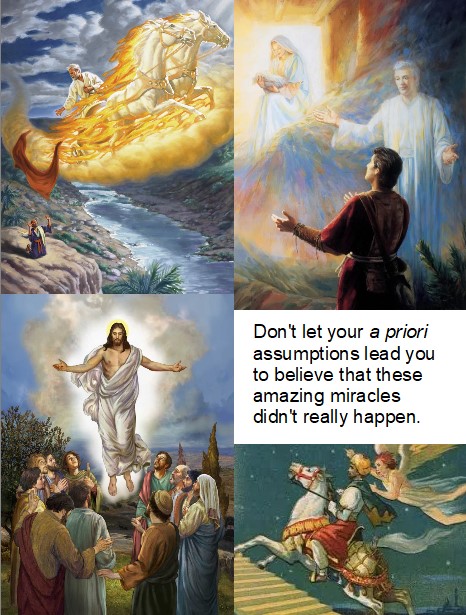
About 2,500 years ago, a man called Elijah went up to heaven while still alive. He was taken through a whirlwind in a chariot of fire, pulled by horses of fire. This amazing event was witnessed by several other people who were profoundly affected by it. The story of this ascension was possibly relayed orally for many years until finally being written down in what is now 2 Kings 2.

Did any of this really happen?

Of course not. It’s a myth.

Some time in the 4th century BCE, the first king of Rome, Romulus, was taken, while still alive, to the dwelling place of the gods. From that time on he was worshipped as a god – some said he was eternal to begin with – with a temple being built in the very place from where he had ascended. Later he appeared to one of his followers, Julius Proculus who said the resurrected Romulus was larger and more beautiful than ever, armed with weapons shining like fire. Julius Proculus attested to this appearance of the resurrected Romulus, swore an oath to its veracity and relayed it faithfully to others.

Did any of this really happen?

Of course not. It’s a myth.

https://mythologymatters.wordpress.com/2019/04/18/easter-mythology-the-resurrection-as-modeled-on-greco-roman-myths/

It is not known when Mithras was born, if indeed he was. He emerged from a rock in the spiritual realm as a child or youth, ritually slaughtering a bull and sharing a banquet with the god Sol. He guided souls to the after-life, propelled as they were by the bull’s blood and flames. He was worshipped primarily by soldiers who saw him as their salvation from the bitterness of earthly life. There were rituals to be followed to become a true initiate and for Mithraic mysteries to be revealed. How Mithras made himself known to his acolytes is unknown, but in the first three centuries CE, his cult rivalled that of the Christians in popularity.

Did all of this really happen?

Of course not. It’s a fabrication, a myth.

In the 8th century CE, the prophet Muhammad flew from Mecca to Jerusalem on a winged equine. Once in Jerusalem he climbed a ladder to heaven. Once there he travelled through the various levels, having conversations with other lesser prophets, before entering Allah’s domain. His journey was later revealed to two early prophets who had known Muhammed when they were boys. They conveyed the details accurately until they were recorded, briefly at first in the Qur’an and later in more detail in its supplement, the hadith.

Did any of this really happen?

Of course not. It’s a fabrication, a myth.

In the early 19th century, Joseph Smith was visited by Jesus and his Father in a vision. They told him that he should not join any existing church because they were all in error. Later, a hitherto unknown angel named Moroni appeared to Smith and indicated to him where some gold plates were buried. He instructed Smith to dig up and translate the plates. Obediently, Smith did so, using a pair of seer stones for the translation. The resulting Book of Mormon was a revelation of Christ’s activities in North America following his resurrection. Smith wisely had a number of his associates witness, in writing, the existence of the gold plates as well as their supernatural provenance.

Did any of this really happen?

Of course not. It’s a fabrication.

In 1916 the Virgin Mary appeared numerous times to three poor Portuguese children, giving them instruction and prophesying to them. She also promised that she would perform a miracle at Fatima. Accordingly, between 30,000 and 100,000 people, including reporters and photographers, gathered at Fatima where many saw multi-coloured lights before the sun itself ‘danced’. It came closer to the Earth before zig-zagging back to its usual place in the sky. While not all of the attendees testified to the phenomenon of the dancing sun (some saw only the lights, others nothing at all) many did and testified to the effect the miracle had had upon them.

Did all of this really happen?

Of course not. It’s a fabrication based on hallucinations.

Around 30CE, a rabbi known as Jesus, who had been born of a virgin, gathered together 12 followers and went around Galilee preaching absolution from sin and the imminence of the Kingdom of God. He announced he was the Messiah who would rule the Earth when the kingdom arrived. The Jewish authorities took exception to his claims and petitioned the Romans to have him executed. This they did, only for Jesus to come back to life three days later, appearing in visions to his followers. He ascended to heaven, promising that those who believed in him would enjoy eternal life. Some of his disciples spread his message faithfully until it was eventually written down, first by a former Pharisee called Paul and then by four authors who accurately recorded what Jesus had said and done.

Did all of this really happen?

What do you think?

After the Gospels

None of the New Testament documents written prior to AD70 – those by Paul – contain any of the sayings, miracles or activities attributed to the Earthly Jesus in the later gospels. They don’t reflect anything of the oral tradition, first proposed in the 18th century. Those same gospels don’t reflect much of it either; the only ‘good news’ passed on by word of mouth was of a transcendent celestial Godman seen in visions. There is no evidence of any other. The later gospels incorporate the visions experienced by Cephas and others in their resurrection stories.

What then of the letters and books written after the appearance of the gospels? Do they reference, quote or base their teaching on the pre-crucifixion aspects of the Earthly Jesus of the gospels? Or do they, like Paul, concentrate solely on demonstrating the heavenly Jesus is the Messiah on the basis of what can be found in Jewish scriptures? You’d think that, with the gospels in circulation by then, that It’d be the former. But you’d be wrong.

Let’s make a quick survey of New Testament books post AD70. I’m taking their composition to be those listed here.

Hebrews (composed anywhere between 60 and 115 by unknown author[s])

Hebrews describes the Messiah as a heavenly high priest. Everything the writers ascribe to him is taken not from the gospels, nor an oral tradition on which the gospels are supposedly based, but from ancient Jewish writing; what we know as the Old Testament. Every single reference is from this source. Read the book for yourself and take note of the footnotes. Like gospel Jesus, Jesus the High Priest is constructed from snippets lifted from the Old Testament.

Revelation (composed anywhere between 70-110)

In Revelation, warrior Jesus has a lot to say, most of it quotations from the Old Testament. None of it is derived from the gospels nor the oral tradition on which the gospels are supposedly based. John’s ‘revelation’ is a fantasy constructed around ancient ‘prophecy’. Again, read the book for yourself and take note of the footnotes. Like gospel-Jesus, Jesus the Great Warrior is constructed from snippets lifted from the Old Testament.

1 Peter (70-100) and 2 Peter (125-150)

You’d think the letters purportedly written by the disciple Peter (or Cephas), the man who, according to the gospels spent three years with Jesus, would be full of his teaching, the mysteries he explained only to his closest followers, reports of his miracles or any of his other activities. But no. The best he can do across the two letters (written by two different people, decades apart, neither of them Peter the disciple) is this:

For we did not follow cleverly devised stories when we told you about the coming of our Lord Jesus Christ in power, but we were eyewitnesses of his majesty. He received honour and glory from God the Father when the voice came to him from the Majestic Glory, saying, “This is my Son, whom I love; with him I am well pleased.” We ourselves heard this voice that came from heaven when we were with him on the sacred mountain (2 Peter 1: 16).

Remarkably, this fake Peter recalls an event which never happened: when Jesus glowed like a lightbulb as two long-dead prophets beamed down from Heaven. It is, however, finally a reference to a gospel story. But then, doesn’t the author disparage ‘cleverly devised stories’ in this same passage? What else could he be referring to if not the gospels? We find a similar warning in 1 Timothy (and again in Titus 3: 9):

…command certain people not to teach false doctrines any longer or to devote themselves to myths and endless genealogies. Such things promote controversial speculations rather than advancing God’s work – which is by faith (1 Timothy 1: 4, written by a fraud pretending to be Paul).

These New Testament writers, even when they seem aware of gospel myths and their endless genealogies don’t approve of them. Perhaps that is why they prefer to ignore them, deriving proof of the Messiah from ancient Jewish scriptures instead. Every other reference to Jesus in the Peter epistles is from the Old Testament. How strange for someone pretending to know the man in the flesh.

We could go on to look at other books of the New Testament – for example, that written by ‘James’, supposedly Jesus’ brother – but this post is already too long. Rest assured if we did, we would see the same thing: none of the information about Jesus is derived from the gospels or the oral tradition on which the gospels are said by apologists to be based. There was no oral tradition, apart from stories of visions. The gospels are literary recreations – allegories – of those visions. They were not well received by the other writers of the New Testament who either ignore or disparage them. All that mattered to these early cultists were ‘revelations’ directly from the Lord and the Old Testament ‘prophecies’ that validated them.