Racism? What Would Jesus Do?

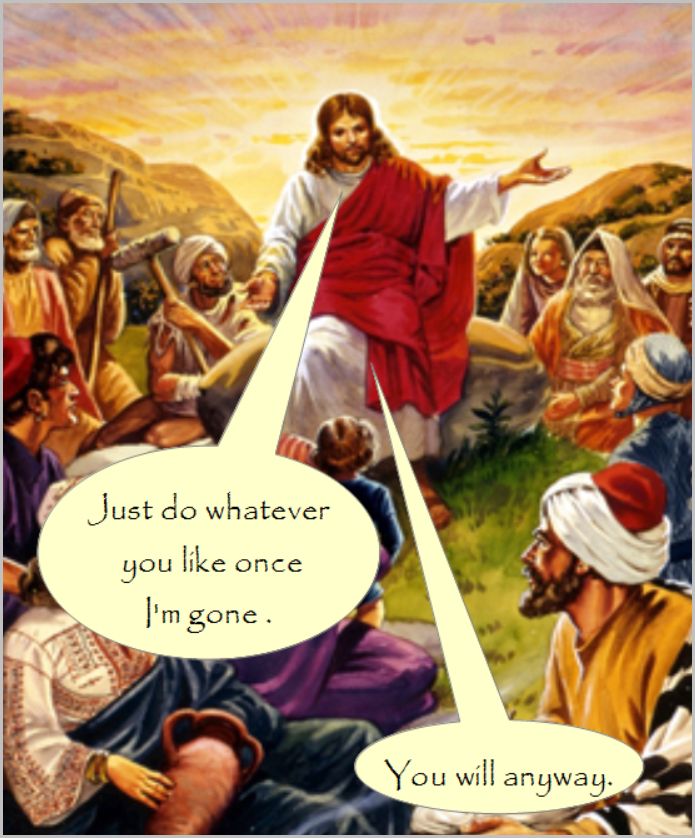
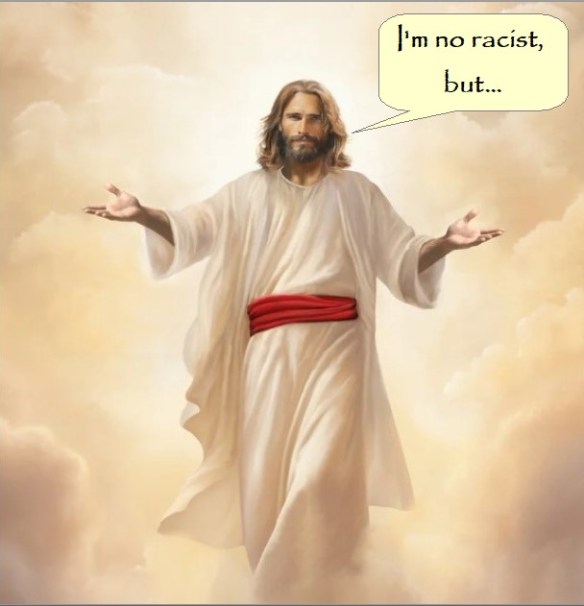
The Church Of England recently issued guidelines to its London clergy advising them to preach anti-racist sermons and suggesting how they might go about it. Asked about it on UK TV, the reverend Sam Norton said he was worried that expressing concerns about the number of migrants entering this small island, many of them illegally, might unreasonably be construed as racist. He argued that it is not; I agree. The reverend was at pains to emphasise that racism was abhorrent (again, I agree) and was not something Jesus would condone.

So, again, Jesus gets a free pass. As he’s portrayed in the four gospels, Jesus is racist. Or, rather, the men who made up his script, the early cult members now known as Mark, Matthew, Luke and John, were. They were racist about those who were not part of the new movement, particularly towards those who were hostile towards it. Granted the gospel creators had Jesus say some pretty good things too: love your neighbour as yourself, love and pray for your enemies, the parable of the good Samaritan; all wildly impractical and widely ignored by Christians everywhere.

Many of Jesus’ admonishments were written by cultists anticipating the end of the age for members of their own group; they were all too happy to lash out at those who weren’t part of it. Hence, the Syrophoenician woman of Mark 7:24–37 whom Jesus calls a ‘dog’, dogs being unclean in Judaism. This woman would have had a paler complexion than Jesus, who would not be the fair Caucasian he’s often portrayed as being. His name-calling is racist; it is only the woman’s pluckiness that persuades him to respond to her pleas.

The story is repeated in Matthew 15:21-28 where the woman is said specifically to be from Canaan, Jesus says explicitly that he ‘was sent only to the lost sheep of Israel’. Earlier, in Matthew 10:5, he instructs his disciples not to take his supposed life-saving message to anyone other than his fellow Jews: ‘Do not go into the way of the Gentiles, and do not enter a city of the Samaritans’. Matthew would, of course, have his version of Jesus exclude those who were not Jewish. Jesus’ racism here reflects Matthew’s community intent on preserving their Jewish heritage. Which makes the anti-Semitism Jesus is made to express in the fourth gospel all the more startling;

You (Jews) belong to your father, the devil, and you want to carry out your father’s desires. He was a murderer from the beginning, not holding to the truth, for there is no truth in him. When he lies, he speaks his native language, for he is a liar and the father of lies… Whoever belongs to God hears what God says. The reason you do not hear is that you do not belong to God [‘the right cult’?]

This is the racism of John 8:44, the rift between the new cult and Judaism having widened by the time the fourth gospel was written.

There are those online who argue that even though Jesus was God incarnate, his ‘human side’ and his upbringing in a prejudiced environment account for his narrow views of ethnicity.  This excuses his racism, they say, and shows how like us he really was. It doesn’t. It reflects the prejudices and racism of those who created the various versions of him. (Alternatively, online Christians argue, as here, that the pericope is invariably read ‘out of context’.) And, please, don’t get me started on the overt racism of Jesus ‘Holy Father’, the genocidal tyrant of the Old Testament.

The Bible as a whole is rife with blatant, divinely-inspired racism. Apart from this, I agree with the reverend Norton: having concerns about the scale of immigration is not racism. Just as criticism of Jesus is not blasphemy and censure of Muslim beliefs and practices is not Islamophobic.

Do You See What I See?

Christianity with its visions of God, angels and resurrected god-men, is not distinctive. It emerged from a culture in which such epiphanies were commonplace and highly esteemed. Appearances of deities, other supernatural beings and dead people were valued as genuine encounters with a reality on the other side of this mortal life. Paul was a Hellenised Jew and a Roman citizen (if Acts 17 can be believed); it was perfectly natural for him and his contemporaries to see and hear things that weren’t there.

Not only was the fledging Christ-cult influenced by the superstitious culture around it, but was born too of Judaism, itself awash with visions, apparitions and revelations. How could the new religion fail to be when its originators existed in such a milieu. One or other of these ‘visionaries’ believed they’d seen a resurrected Jesus. Of course they did. This is how gods manifested themselves then; everyone knew it. There were even those who hadn’t really had any inner-visions but wanted to be regarded as mystics themselves so would pretend they too had had direct contact with the deities.

The human mind has always been susceptible to illusions, to the potency of dreams and to misinterpreting what is going on around it. It’s also prone to a spot of fantasising now and then. This propensity didn’t cease once Christianity established itself. Muhammed claimed to have been visited by angels who revealed new truths about the nature of God – not least a change in name.

In the 19th century, a young farmer, Joseph Smith, living during a widespread and particularly intense religious revival, imagined (or pretended) he’d been visited by God and Jesus. Later, he said he’d been visited by a hitherto unknown angel with the unlikely name of Moroni. The result of course was multiple wives for Smith and the foundation of the Church of Jesus Christ of Latter Day Saints. Sufficient numbers of people believed Smith’s cockamamie stories about his alleged visions to commit to Mormonism. Smith wasn’t alone; others had visions of deities, including but not restricted to the Big Two, Jesus and his Father God. Hundreds recently saw the Virgin Mary hovering above New York City. They couldn’t all be wrong could they? Of course not, but they were all be deluded. Just like Joshua Mhlakela whom Jesus appeared to and told him the date of the Rapture was 22nd September, or possibly the 23rd, then with ‘billion percent’ certainty 7th October. Or maybe 8th…

This is how religions are made, changed and adopted: on a bed of illusory sand. If we need any further evidence that such experiences are illusory, created by the mind itself, then consider this: each time God, his angels or his Son appear in the religion-soaked brains of mystics and fraudsters, they reveal a message at odds with that revealed to previous visionaries. Each revelation has to be different of course. There would be no reason for such ‘visits’ otherwise.

Hence Abraham (or his script writer) imagining YHWH promising an eternal covenant and a new land.

Moses (or his script-writer) claiming YHWH had issued new laws while at the time commanding the slaughter of tribal enemies.

Cephas thinking he’d seen a risen Jesus who may or may not have told him of the imminent the End of the Age.

Jesus himself reportedly talking with his ‘Father’ about the necessity of his execution.

Paul flying to heaven so that Jesus could explain in great detail a new covenant, negating the original ‘eternal’ covenant with Abraham.

John of Patmos envisaging Jesus coming to Earth to slaughter the enemies he purportedly instructed his followers to love. (And Christians claim the Bible presents a unified message!)

All of these are manifestations of, and within, the minds of fantasists. Such manifestations are a naturally occurring malfunction of the brain.

And so it continues. Beware anyone who claims to have seen or heard from a deity of any sort. They, like their biblical counterparts, are deluded and almost certainly ill.

Mystic Revelations

What do the three ‘great’ Abrahamic religions have in common?

They all started with visions, hallucinations, dreams and mystic revelations. They’re not only based on these but owe their very existence to encounters with the supernatural that took place entirely within people’s heads. This of course is if they happened at all; many of these encounters with angels and God’s revelations take place in stories that have all the characteristics of myth or legend. Even so, they reveal much about the primitive state of mind (still around today) that believed God frequently revealed himself to, and in the minds of, chosen individuals.

First, the grand-daddy of the Abrahamic religions, Judaism: 

When Abram was 99 years old, YHWH appeared to him. He said to Abram, “I am El Shadday. Live in my presence with integrity. I will give you my promise, and I will give you very many descendants.” Immediately, Abram bowed with his face touching the ground, and again Elohim spoke to him, My promise is still with you. You will become the father of many nations. So your name will no longer be Abram [Exalted Father] but Abraham [Father of Many] because I have made you a father of many nations. I will give you many descendants. Many nations and kings will come from you. I will make my promise to you and your descendants for generations to come as an everlasting promise. I will be your Elohim and the God of your descendants. (Genesis 17)

Then Moses:

The Angel of YHWH appeared to (Moses) in a flame of fire from the midst of a bush. So he looked, and behold, the bush was burning with fire, but the bush was not consumed.

Then Moses said, “I will now turn aside and see this great sight, why the bush does not burn.”

So when YHWH saw that he turned aside to look, Elohim called to him from the midst of the bush and said, “Moses, Moses!” And he said, “Here I am.” (Exodus 3)

Notice how the inner voice goes from being that of ‘the angel of YHWH’ to YHWH himself (or one of his aliases). The entire scenario is preposterous of course, as is the Abraham episode before it. I’ve omitted the other occasions YHWH is said to appear to Abraham, including the infamous Genesis 22, where YHWH instructs Abraham to sacrifice his son. These stories are legends written, created from whole cloth, centuries after Abraham purportedly lived. He, like the later Moses, is almost certainly mythical, a character created to represent the beginnings of the Jewish faith. Even his names are symbolic. In truth, no one knows how Judaism began.

Onto Christianity:

The angel said to (Mary), “Don’t be afraid, Mary; God has shown you his grace. Listen! You will become pregnant and give birth to a son, and you will name him Jesus. He will be great and will be called the Son of the Most High. The Lord God will give him the throne of King David, his ancestor. He will rule over the people of Jacob forever, and his kingdom will never end.” (Luke 1)

Did this happen? If you believe angels exist then possibly, but we know they do not. We also know that this is myth. However, Luke wanted his readers to know that Jesus’ birth was miraculous so invented a story in which Mary encounters a heavenly being. The gospel writer anchors the divinity of Jesus to an implausible event which at best can only be a young woman’s vision (though it most certainly isn’t.)

The same is true of the resurrection appearances. Here’s Matthew 28:1-8:

Now after the Sabbath, as it began to dawn toward the first day of the week, Mary Magdalene and the other Mary came to look at the grave. And behold, a severe earthquake had occurred, for an angel of the Lord descended from heaven and came and rolled away the stone and sat upon it. And his appearance was like lightning, and his clothing as white as snow. The guards shook for fear of him and became like dead men. The angel said to the women, “Do not be afraid; for I know that you are looking for Jesus who has been crucified. He is not here, for He has risen, just as He said.”

More angels (they multiply in later gospels); again at best, though still highly improbable, the angel(s), if seen at all, can only be a vision or an hallucination (or mistaken identity.)

Onto the only first hand account of an encounter with the divine that the bible includes, Paul’s:

God was pleased to reveal His Son in me so that I might preach Him among the Gentiles… I want you to know, brothers and sisters, that the gospel I preached is not of human origin. I did not receive it from any man, nor was I taught it; rather, I received it by revelation from Jesus Christ. (Galatians 1)

I know a man in Christ who fourteen years ago—whether in the body I do not know, or out of the body I do not know, God knows—such a man was caught up to the third heaven. And I know how such a man—whether in the body or apart from the body I do not know, God knows— was caught up into Paradise and heard inexpressible words, which a man is not permitted to speak. (2 Corinthians)

This is all there is. This is the extent Paul talks about his heavenly encounters. In Galatians he admits that God revealing whatever it was he revealed was ‘in’ him, that is, in his own head. The bizarre tale he relates in 2 Corinthians reads like an hallucination (Paul says he doesn’t know whether it was in the body or out of it) which is all it could’ve been; there is no paradise or ‘third heaven’.

And finally, there’s Mohammed:

while I was sleeping last night, the keys of the treasures of the earth were brought to me till they were put in my hand.”… 

The angel came to him and asked him to read. The Prophet replied, “I do not know how to read. The Prophet added, “The angel caught me (forcefully) and pressed me so hard that I could not bear it any more. (Sahih Bukhari 6998)

Encounters with heavenly beings in dreams, ‘revelations’, visions, hallucinations and invented stories: these are central to Judaism, Christianity and Islam. The religions would not exist without them. Written as myth long after they supposedly occurred or referred to obliquely by those who claim to have experienced them, they are the products of fevered pre-scientific minds.

Post-script: I’ve searched in vain for Darwin’s admission that an angel revealed the process of evolution to him. I can only find his collection of evidence, his scientific observations and his careful analysis of his findings. Likewise Mendeleev who calculated the existence of elements that were at the time unknown. Likewise Crick, Watson and Franklin who discovered the structure of DNA. Strangely, none of these people relied on visions, dreams or divine revelations in uncovering truths about reality.

The Evolution of Jesus I: from Itinerant Preacher to Death-Defying Vision

Image by Doppler, from YouTube video The Evolution of Jesus Christ.


Everything evolves. Not just Life, but the Mind, Personality, Morality and Culture. This is the thesis of Matt Ridley’s book, The Evolution of Everything: How Small Changes Transform Our World, in which he demonstrates that everything, from the Economy and Technology to Government and Education, were originally, and to some extent remain, bottom up phenomenon. Each emerged because of the developments that had preceded them; for this reason, they couldn’t arrive before they did, but their arrival, when it came, was inevitable. The time was right. Once each did arrive, it embarked on an inexorable process of change. It evolved.

‘Everything’, of course, includes Religion. As Ridley says (p259):

Further evidence for the man-made nature of gods comes from their evolutionary history. It is a little-known fact, but gods evolve. There is a steady and gradual transformation through human history not only from polytheism to monotheism, but from gods who are touchy, foolish, randy and greedy people, who just happen to be immortal, to disembodied and virtuous spirits living in an entirely different realm and concerned mainly with virtue. Contrast the vengeful and irritable Jehovah of the Old Testament with the loving Christian God of today.’

This is undoubtedly the case (Ridley presents his evidence); religion is an entirely human enterprise that developed from the bottom up. It too evolved. As Ridley shows, there is no other way.

While Ridley doesn’t discuss it, this evolutionary process applies to Jesus too. This seems to me apparent, rather than a little-known fact. He didn’t spring from nowhere; the time was right for him. By the start of what is now the first century, an apocalyptic brand of Judaism had emerged, inspired in part by the book of Daniel and other late Old Testament prophecy. It was whipped to fever pitch during the Roman occupation. People were anticipating that the Messiah would soon rescue them by force; the time was right for him to appear. And appear he did, in multiple forms, all of them eliminated by the Romans. Jesus was one of these.

He began either as an itinerant preacher with delusions of grandeur or he was an imaginary being whom a few people thought miraculously appeared to them. It doesn’t matter which; even if he existed, he very quickly evolved into a supernatural being. As an itinerant preacher he would have wandered around a small part of Palestine with a handful of followers, mouthing platitudes and predicting that God’s Kingdom would soon be arriving, and that he would be its king. Instead, he was executed for insurgency. Shortly afterwards, a couple of his followers swore they’d seen him alive again. With this claim Jesus made an evolutionary leap, from troublesome Jewish preacher to death-defying vision.

His evolution was underway.

To be continued…

Battle Of The Magic Books

Don Camp replies (in blue) to my previous post. My responses are in black.

There are multiple reason for rejecting Mormonism. The primary reason is similar to discerning between a fake $20 bill and the real thing. The fake just doesn’t feel like the real thing. Of course, that test requires that one knows what a $20 bill feels like. Anyone who does not know is easily fooled.

In fact, if you don’t know what the real thing is like, it is impossible to identify a fake. You might notice an ink smudge and a difference in paper, but who is to say one is fake and the other is not?

This presupposes that your version of Christianity is ‘the real thing’. For a Jew, Judaism is the real thing and Christianity the Johnny-come-lately fake. All you’re saying here is that you ‘feel’ your version of Christianity is the real thing and you ‘feel’ Mormonism isn’t. This isn’t persuasive. I know, for reasons other than intuition, that Christianity isn’t the real thing. To use your analogy, it is the twenty dollar bill received in change when in the UK a twenty pound note is the ‘real thing’.

But since you have a knowledge of literature, Neil, why not apply those standards? Nice concession there, Don. The Bible is indeed literature and as such deserves to have the same standards applied to it as any other work of fiction.

Is the Bible and the narrative in the Bible coherent?? No. Its central character is ridiculously inconsistent. Described as an unchanging God, he changes from book to book and most noticeably between the Old and New Testaments. As someone commented on Debunking Christianity recently, it’s as if he ate a Snickers bar between the two. (He does get hungry again towards the end of the NT, when he reverts to being an omnipotent Putin.)

As the protagonist undergoes his major rewrite, the plot also suddenly deviates, becoming a completely different story. It starts by being about this poorly conceived character’s ‘everlasting covenant’ with his chosen people, but then two thirds of the way through, this everlasting covenant is scrapped and replaced with a new, largely incoherent deal involving a human sacrifice that the unchanging God has previously said he finds abhorrent.

Does it stick together and develop a single theme across the whole? No, it doesn’t ‘stick together’, not unless you ignore the gaping inconsistencies in character and plotting, and its overall implausibility.

Do you know what the theme of the Bible is, Neil? Yes, thank you, Don. Condescending of you to ask. Any apparent consistency is because the writers of the second part of the story had access to the first part. They plundered it for their own purposes, drastically altering it so that it suited their new theme. That is why much of the Jesus story appears to be foreshadowed in the Old Testament. The Jesus story – and it is a story – is built on events and episodes they found there.

Remember that the Mormons tell us that the Book of Mormon is an extension of the Bible and that the people of the Americas were related to the Jews and held to the basic truths of the Jews. (Remember also the Mormons believe that Jesus appeared to these people in the New World shortly after his resurrection.) So if you put the Torah and the Book of Mormon together, is the narrative coherent? Does it develop a single theme? The Old testament and the New Testament are a coherent whole, but I do not think the Old Testament and the Book of Mormon are. As you can tell, I dispute that the Old and New Testament are a coherent whole. The Old Testament and the Book of Mormon aren’t either. That lack of coherency becomes even more obvious when we compare God in the Old Testament with God in the Book of Mormon. The person of Jesus is also inconsistent in the Book of Mormon with the Bible.

But they’re inconsistent within the Bible too, Don. Compare John’s Jesus with Mark’s. Compare Paul’s beatific Christ with Revelation’s grotesquely super-powered warlord.

Of course, the standard explanation by Latter Day Saints is that the Bible has not been adequately translated, though I know of no place where they can demonstrate that claim. There are significant translation problems with the Bible, which mainstream scholars consider at length. Mormon desperation to resolve these conflicts is the same as that demonstrated by Christian theologians.

Finally, there is a matter of provenance. We know in very good detail where the Bible came from.

We do? We know who Matthew, Mark, Luke and John actually were? No, we don’t nor do we know where they wrote or what their sources were. We don’t have the autographs (originals) of any of the New Testament documents but we do know some of them are forgeries and others have been tampered with.

There are many copies, especially for the New Testament, and there are many commentaries of both the OT and NT from very early in the their history. Proving what? Only that they were copied, frequently inaccurately. The copies are all much later than the probable time of composition. The commentaries are similarly far removed from them; there are commentaries on the Book of Mormon much closer to its composition.

What is the provenance of the Book of Mormon? It apparently appeared magically out of nowhere pretty recently. No mention in any other literature of its existence. It did appear magically! Oh ye of little faith! God sent an angel, like he does numerous times in the Bible, and told Joseph Smith to translate the golden tablets. The NT books were similarly created, with God breathing his word into cult followers as they wrote. God, angels, Holy Spirit, magic – all of a muchness, don’t you think?

No copy is available to examine. Nor of the original copies of anything in the Bible.

That is not to speak of the total lack of any archaeological evidence for the Mormon claims of Jews in the Americas. Mormons dispute this, of course. There are similar problems with some locations mentioned in the Bible. More fatally, most of what the Bible promises has proven false. For example: Jesus’ imminent return, his guarantee of miracles, believers becoming new creations. (Paul spends much of his time ticking off these ‘new creations’ who remain resolutely unreformed.)

So, I would say the Book of Mormon fails on all levels.

I would too. As does the Bible for the reasons I’ve outlined, and despite your special pleading. You don’t apply the same rigour in your consideration of the Bible that you do to Latter Day Saint fiction. Why is this, Don?

Goodbye, Jesus

The Jesus narrative is a made-up story, originally created by a member of one of the many branches of a first century cult centred on a supernatural being experienced in visions. We call this cult member ‘Mark’. His ‘gospel’ was not written to convert anyone – I doubt any of them were – it was written as a ‘what if?’ story for fellow cult members: ‘what if our celestial saviour had lived on Earth?’ It is made up of St Paul’s teaching, Old Testament mythology, and ideas taken from pagan dying-god myths (probably in that order). It amalgamates the cult’s rules with what cultists believed about the end of the age: that their celestial saviour would very soon be coming down to Earth to save them and annihilate their enemies.

Ten or fifteen years later, another writer took Mark’s fiction and rewrote much of it for his branch of the cult. This was a group who saw themselves as still firmly within Judaism, so ‘Matthew’ toned down Paul’s teaching, eliminating a good deal of it. He heightened Jewish teaching for his co-religionists, and created a Jesus who was a manifestation of prophecy, as he saw it, from the Jewish scriptures. This construct had no time for any magic salvation-formula; like the cult who created him, he taught obedience to Jewish Law and believed that serving others was the way to eternal life.

A few years on and a third sect found Mark and Matthew’s stories weren’t entirely to their liking. They didn’t quite get Jesus right. So they took them and altered them again. Their scribe, known now as Luke, created a third Jesus. It’s possible this sect didn’t realise the original story was fiction. There’s some evidence Luke thought Jesus had really existed, 50 years or so before he remodelled him.

Later still, the creators (plural) of a fourth gospel created a Christ totally unlike the other three. This branch of the cult had ceased to believe, perhaps because it hadn’t happened when earlier believers said it would, that the saviour would be coming through the clouds at any minute to set up God’s kingdom on Earth. That part of the original idea was dropped; this Jesus is made to preach an internalised salvation, and everlasting life in heaven is beginning to be hinted at.

And that’s it. The adventures of Jesus on Earth began as a ‘what if?’ story created for existing cult members. Other branches of the cult took it and reshaped its central character so that he suited their needs and beliefs. A real Jesus was not necessary for any of this to happen. Just as it was for Paul, whether one existed or not is immaterial,. Even if he did, we can know nothing about him. The Jesuses created by each sect is a product of what they imagined their saviour to be, just like the various Christs that are worshipped today.

So, I’m saying a final goodbye to Jesus – or rather to all the Jesuses, Christs and made-up Messiahs spawned by the visions, fantasies and fan-fiction of the first century. I don’t need them, and neither do you.

This blog will be taking a new direction in the new year. Next time, though, I hope you’ll read one of my Christmas stories, as featured on the BBC.

Stay safe. 

The Gods of Christianity

Blog366

Christians who argue that only their God is real and that life is futile without him, are like the person who jumps up and down on thin ice insisting the ground beneath him is solid.

The various forms of Yahweh belief have rarely been monotheistic. While Isaiah declares there is only one God, the Jewish scriptures also refer to ‘him’ as ‘Elohim’ and ‘Adonai’, plurals meaning ‘deities’ and ‘my lords’ respectively. Other gods abound, with Psalm 82.1 relating how Yahweh presides over an assembly of other deities. From the beginning – certainly the beginning of the bible – a belief in other supernatural agents has been a requirement; Satan and angels are both present in Genesis and throughout the Old Testament. There are also the cherubim and seraphim of Genesis 3.24 and Isaiah 6:1-8 who do Yahweh’s dirty work for him. All of these beings are supernatural entities of immense power; gods in everything but name.

And this is before we get to the New Testament where several new superhuman characters are introduced. Most notable, of course, is the Christ, the invention of cultist Paul. This eternal being is capable of rescuing human beings from the wrath of God and has the power to resurrect them after death. He is, in Paul’s eyes, on an equal footing with Yahweh himself, a god in his own right (Philippians 2.6-11). While the Christ himself has resided in heaven for the past two thousand years (or for eternity, give or take thirty years), his spirit haunts the Earth to this day, possessing members of the Christ cult. The three of them together – the Christ, the Spirit and Yahweh (re-imagined as ‘The Father’) – are the chief gods of Christianity. The church has spent almost two millennia trying to explain how there is only one god who is simultaneously three distinct deities. The Vatican declares the Trinity to be the greatest mystery of all, though of course it is only a mystery in the same way something that makes no sense whatever can be considered a mystery.

According to the gospels, Jesus himself believed in yet another collection of supernatural agents; demons who caused all manner of illness and mischief, opposing Jesus wherever he went. According to the writer of Ephesians (6.12), these ‘wicked spirits’ and ‘principalities’ rival God in terms of power, and are, together with their overlord, Satan, the real rulers of this world

For Catholics, this pantheon of three-in-one gods, angels, devils and demons is supplemented by another layer of super-beings. These are humans who have attained the status of divine immortality, and who are prayed to and worshipped by acolytes on Earth. Mary, the supposed ‘mother of God’ is the most significant, followed by ‘saints’ who have been translated to Heaven and now have free access to the chief gods, ‘interceding’ with them on behalf of ordinary mortals. While no doubt Catholics would dispute that these figures are themselves gods, it’s difficult to see how they are not: they’re immortal, eternal, possessed of great power and in direct communication with the Big Three. They are the equivalent of the Titans’ offspring in Greek mythology.

There is nothing monotheistic about Christianity (nor Judaism) despite the protestations of those who claim to follow the one true God. Christianity has, like most of its predecessors, a pantheon of gods. This not surprising when history repeatedly demonstrates the extent to which humans are inclined towards ensemble theistic imaginings.

So, beware those who tells us they know what the one true God wants, what he approves of and what he condemns: that ice is exceedingly thin and already cracked. It has been from the very beginning.

Theology: Much Ado About Nothing

Toothfairy2

I heard Richard Dawkins speak at the Edinburgh Book Festival recently. He suggested that the best way to understand views that are the opposite of one’s own is to study them for oneself. He was then asked by a smart-alec in the audience, that if this was so, how many works of theology he had read. Dawkins responded by saying he wouldn’t waste his time reading ‘pure theology’ because, in discussing the nature of God or the Trinity or the mechanics of the Resurrection, theology presupposes that the supernatural is real. As there is no evidence it is, there is no point in reading books the sole purpose of which is to discuss the nuances of the non-existent.

It was a good answer. There is no such thing as intellectual Christianity (or Judaism or Islam, or any religion.) No matter how complex the arguments become, they are essentially ones about nothing. Debates about theological matters, within and between the many versions of Christianity, are, as I’ve said before, as relevant as arguments about the colour of the tooth fairy’s dress.*

*Actually she wears a white dress to symbolise healthy teeth. I know this because of my deeply held faith and personal experience of tooth fairies.

The Sect Hiding in Plain Sight

Condemning-Pharisees

With thanks to David Eves.

Back at the start of Christianity, the cult was divided into numerous factions; not unlike its modern counterpart. Acts’ claim that all the new converts – the church – got on famously, sharing all they had and generally taking part in one big love-in is spin, a lie concocted by its author, ‘Luke’. Its not the only lie he invents; later in Acts he tries to present the new faith’s ambassadors, Paul and the original apostles, as being largely in agreement about what the Christian message was about. We know from Paul’s own writing that this wasn’t so.

Likewise the united church. We know that there was part of the cult that had a very different theology and soteriology (doctrine of salvation) from Paul. They didn’t subscribe to his incantational magic about a dying god-man who would save them if they claimed his death for themselves. Instead, this group believed that the way to find favour with God was to be ‘righteous’, by doing good works and generally expending oneself on others. Its members promoted, and probably practised, a yin and yang measure-for-measure philosophy: God would show forgiveness, mercy and compassion, they said, only to the same extent that a believer demonstrated them him or herself. Because they believed Jesus had commanded it and God favoured it, they denounced wealth and advocated a self-deprecating way of life. They were predominantly Jewish. They believed Jewish Law was still valid and should still be followed by cult members. They were, however, hostile towards those who, unable to see any value in the new cult, remained within Judaism. The sect invented anachronistic stories about Jesus sparring with the Jewish leaders of their time, half a century or more after Jesus died.

Though it is unlikely any of members of this sect had ever encountered Jesus in person, they believed he was going to return to the Earth while they were still alive in order to judge humankind. Naturally he would vindicate them while condemning all others, particularly the rich and powerful. He would do this because they were the ones who were doing as he commanded – helping the sick, the hungry and the homeless – which would ensure the returning Lord would look on them favourably. None of them had seen the resurrected Jesus but nevertheless they valued the stories they heard about those who supposedly had, and they promoted these stories themselves.

How do we know this? Because this particular sect left behind a record of their beliefs. They imbued them with authority by putting them into the mouth of a preacher who had lived more than fifty years earlier. Who knows, maybe he did say such things. The sect either believed that Jesus had actually contradicted Paul’s notion that the Jewish Law was no longer valid or they felt it necessary to to make Jesus say so themselves. Likewise, they rejected the magical mysticism preached by Paul that was beginning to take hold in those early days. The group’s beliefs were radically different and their writing specifically designed to counteract ideas they opposed with a passion.

Where will you find this group’s writings? In the bible, at the very start of the New Testament in the book called ‘The Gospel According to St Matthew’; this book is their writing, give or take the odd bit of tampering from later on. Matthew’s gospel details the sect’s beliefs about Jesus, their measure-for-measure morality, their recipe for righteousness and their beliefs about salvation and the coming judgement.* So different are these from Paul’s ideas that the gospel can only have been created to counteract his doctrines. The community that produced Matthew had no truck either with Paul’s theology or his soteriology.

Read Matthew for yourself and see how much it is at odds with Paul. The discrepancy is there for all to see, yet Christians have always convinced themselves, if they’ve thought about it at all, that not only is Matthew’s gospel compatible with the mumbo-jumbo that follows it, but that its ‘good news’ and Paul’s are identical. Nothing could be further from the truth.


* I’m happy to provide chapter and verse from Matthew’s gospel to support all I say about it.

Do No Harm

sermon2

If religions took ‘do no harm’ to heart (as the Hippocratic Oath does) and their adherents were made to comply with it, what a better place this world would be. There’d be –

No more religiously-motivated suicide bombers and terrorist atrocities;

No more murder in the name of the Lord (whichever);

No more children molested by priests and pastors;

No churches attempting to cover up their crimes;

No more child deaths as a result of ‘faith-healing’;

No religiously-sanctioned denigration and abuse of women;

No more ritualistic mutilation of children’s and young women’s genitals;

No more religious scams and shams;

No more religiously-inspired vitriol directed at gay and transgender people;

No more barbaric executions of ‘minorities’, like gay men, women and those of other faiths.

Of course, even without these, the world would still not be perfect. Awful things would still happen. But the principle of doing no harm would eliminate much of the trauma inflicted on people by the proponents of irrational superstition.

On paper at least, the Abrahamic religions have expectations that are more demanding than simply doing no harm:

Love your neighbour as yourself (Leviticus 19:18; Judaism);

Love your enemies; treat others as you would like to be treated’ (Matthew 7.12 and 5.44; Christianity);

…compete with each other in doing good (Surat al-Ma’ida, 48; Islam).

However, these are just too damned hard for so many religionists. They disregard them and opt instead for the spiteful paranoia of the same holy books. Perhaps the simpler injunction of ‘do no harm’ would be easier for them. But until the preachers of judgement and hatred find it in themselves to promote such a principle, we will all continue to suffer the destructive effects of the ‘great’ faiths.

So, how long until the next terrorist attack? The next church child-abuse cover-up? The next rape scandal? The next persecution of gay people?

      Not long at all.

           Praise the Lord (whichever)!