The End of Days

A friend of mine was recently given the book The Dragon’s Prophecy: Israel, the Dark Resurrection and the End of Days by Jonathan Cahn. My friend, already concerned about the state of the world, said how much the book had disturbed her. She had become convinced that the time we live in had been predicted in the Bible, in Revelation in particular. ‘It’s all there in the Bible,’ she said to me. ‘It’s all happening just as it says.’

I tried to reassure her that Revelation was written by someone who, 2000 years ago, believed that the situation then couldn’t get any worse, what with the Roman occupation, the destruction of Jerusalem and the persecution of Christians (as the writer saw it.) This, together with his belief that the Lord would soon be coming on the clouds (Revelation 1:7), convinced him he was living in the world’s last days. I told my friend that because of the mess the world is in today (and when is it not a mess?) the book of Revelation resonates with some people; a voice from the past echoing down the ages. In no way, however, was it written about today.

My friend was unconvinced so I took it upon myself to read The Dragon’s Prophecy. Coincidentally, I had just begun to read Bart D. Ehrman’s Armageddon: What the Bible Really Says About the End, dealing with the same concerns. The comparison between the two books couldn’t be more striking.

Ehrman’s is a measured analysis of Revelation and other ‘prophetic’ books of the Bible. He demonstrates from the outset that Revelation was written for believers of the late first/early second century and that its symbolism represents individuals and events of that time. John of Patmos, whoever he may have been (a cult leader, Ehrman suggests) expected, like most early Christians, that the End was going to materialise soon, in the first or early second century, emphatically not in the 21st.

Ehrman warns that ‘professional prophecy writers’ (he doesn’t name Cahn) think ‘the way to use the Bible is to assemble the pieces to reveal the big picture, which until now no one has seen before’ (p17). He’s right. This is precisely what they do. In his book, Cahn promises ‘to put together the pieces of the mystery’ (p11) and claims ‘We (sic) will now begin assembling the pieces of the puzzle’ (p36). He then proceeds to jump around the Bible like a grasshopper on steroids. He’s one of the ‘prophets’ who, as Ehrman puts it, sees the Bible as ‘a great jigsaw puzzle with one piece hidden in this place, one in another and yet a third somewhere else’ (p17).

Cahn opens his argument with a series of bald, unsupported assertions: ‘Behind the perceivable realm lies another, beyond our ability to measure or quantify’ and ‘Behind the history of this world lies another, unrecorded, unrecited (sic), unknown,’ his readers evidently not expected to ask how he knows any of this codswallop. He goes from there to build his argument, such as it is, with a bombardment of ridiculous questions and pseudo-profundities:

What is evil? And how did it come into existence? It is both a mystery and a problem. The mystery is the problem (p9).

Then there are the propositional statements of the ‘If… then we’d expect’ variety. There’s rarely any evidence for the ‘if’ and none at all for the proposed expectation. Here’s the two – rhetorical question and propositional statement – rolled into one: ‘If evil is uncreated, how did it come to exist?’ (p32). Naturally, Cahn is going to answer this question and all the others like it, with a series of unfounded assertions, non-sequiturs and a smattering of unrelated Bible verses.

A central premise of The Dragon’s Prophecy, the dragon being that of Revelation 12:9 and therefore the devil, is ‘the dark resurrection’ of its subtitle. This Cahn explains, pretending the idea comes from the Bible when it doesn’t, is the re-emergence of the Israelites’ old, (extinct) enemies, the Philistines. Like the Israeli nation they too have now been resurrected: as the Palestinians. Under the control of the dragon/devil, they re-enacted on October 7th last year one of the many ancient Philistine attacks recorded in the Bible, only this time with ‘guns and explosives’:

On that October morning, the ancient drama replayed. The resurrected Philistines had again invaded the land, and the resurrected Israelites had again gone into hiding, keeping silent and still in fear of their pursuers (pp99-100).

How do we know this is a replay of an ancient invasion? Because some of those under attack on 7th October went into hiding, just as the Israelites did in 1 Samuel 13:6. As if no other group of besieged civilians hasn’t tried to hide at any other point in history. That and the ‘fact’ there were, according to Cahn, exactly 3,000 invaders on each occasion. Yes, the book really is this bad.

And so, Cahn says, the stage is set for the final battle and the return of Christ who will knock a few heads together, torture and slaughter everyone who isn’t a Christian and set up his faithful followers in a new Jerusalem made of gold and fancy stuff. As Ehrman says, this is indeed what Revelation promises – for the world 2,000 years ago. Ehrman argues that the author of this revenge porn, (he doesn’t use the term: that’s my contribution – you’re welcome) creates a Christ so unlike those of the gospels that he can only be a fiction (aren’t they all?)

Revelation barely made it into the canon and we would all be better off if it hadn’t; certainly my friend would be, and as Ehrman shows, human society and the planet in general would be too. He warns us to read what the Bible actually says, instead of, as Cahn does, forcing it to say what we want it to (to sell books). Irritatingly, Ehrman consistently refers to the Christ’s prophesied appearance on the clouds as his ‘Second Coming’ when the Bible never uses the phrase. Read what it says Bart!

I don’t know whether I’ll finish Dragon’s Prophecy. Its cover blurb boasts that Cahn is a New York Times best seller so clearly there’s an audience for such poorly argued, alarmist nonsense – which is itself alarming. While Bart D. Ehrman has also made the NYT list in the past, Cahn easily outsells him. Nevertheless, I’ve bought my friend a copy of his Armageddon in the hopes it might serve as an antidote to the dire The Dragon’s Prophecy.

Neil’s Second Letter, to the Literalists

Dear Literalist,

I’m confused. Please help me understand which Jesus you believe in, the one whose spirit dwells within you.

Is it the Jesus of one of the first three gospels? The rabbi who walked in Galilee two thousand years ago? You see, I expect it to be him but then I find you ignore most of what he says. You know, stuff like love your enemies, pray for those who persecute you, sell all you have and give to the poor. So I can only conclude this isn’t the Jesus you believe in and commune with.

Is it the Jesus in John’s gospel? The problem with this version, I think you’ll agree, is that he isn’t the same as the Jesuses in the other three gospels. He feels kind of made up. Probably no more so than those Jesuses but, you know, more obviously so.

Or is it the Christ Paul talks about? The one he saw in his visions? Because this Jesus really bears no similarity to the ones in the gospels. Paul doesn’t seem to know those Jesuses. Paul’s version is a heavenly being like other demi-gods of the ancient world: Osiris, Apollo, Mithras, Romulus, even defied Emperors, all of whom mystics claimed to have seen in visions. Is this the Jesus you believe in?

Perhaps you believe in the Jesus some New Testament writers claim sits at the right hand of God the Father ‘interceding’ on behalf of sinners. It’s a mystery how they know this, but they seem sure, so no doubt this Jesus is as legitimate as any other. You’d be perfectly entitled to include him in your internal pantheon.

You may also believe, as Paul did, in the Jesus who’ll be coming back to the Earth real soon to put the world to rights. Except of course Paul thought this was going to happen in his lifetime as did the writers of the synoptic gospels, none of whom refer to Jesus ‘returning’. It’s as if they didn’t believe he’d been here in the first place. Still, nothing to stop you from believing your Jesus will return in your lifetime, like millions of others have done in the past two thousand years.

Possibly though the Jesus you believe in is the one you encountered in your conversion experience (or think you did.) The one who you credit with changing your life and who now ‘walks with you and talks with you along life’s narrow way’. I confess this is probably the Jesus I believed in when I was a Christian, with a few extra details added from all the other Jesuses. Of course, my Jesus wouldn’t have been the same as yours. He was my own unique creation, just as yours is for you.

Perhaps you’ve convinced yourself that your own personal Jesus is actually the spirit or ghost of the original. After all, earthly Jesus appears to say in some of the gospels that his ghost will stick around to ‘comfort’ his followers after he himself returns to the heaven just above the clouds. Is this the Jesus you know and love? Does his spirit-ghost dwell inside you? If so, where exactly does it dwell? In your head? And how do you distinguish the Jesus-ghost from your own thoughts, imagination and conditioning? (Asking for a friend.)

I’d really like to know which of these Jesuses is your Jesus. Perhaps he’s an amalgam of them all, a confection of best bits. Please let me know in the comments.

But, if you don’t mind me saying so, almost all of these Jesuses are entirely made up. They’re the product of the human imagination, making themselves known in visions and dreams; they’re the result of subjective emotional experiences, or composites made from different sources.

So your best option is to say you’re committed to the ‘real’ Jesus of the gospels. But as we’ve established, you don’t really believe in him or you’d do as he commanded. In any case, there are several different, often incompatible Jesuses in the gospels. Some of them have to be made up. Oh, wait. They all are. The real Jesus is nowhere to be seen. If he ever existed he’s lost to us, replaced by the heavenly being seen in visions and the metaphorical stories invented about him.

What a quandary! Let me know how I can help.

Yours,

The Apostle Neil

The Missionary Position

Dear Missionary friend,

Why is it you have to tell everyone about what you believe? Whether you’re on the bus, in the middle of town or online, you are compelled, it seems, to tell everyone about your faith. Why is that? You think we’ve never heard of Jesus, Jehovah, Krishna or Muhammed? Let me tell you, we have and most of us are not interested in your mumbo jumbo in whatever form it takes. I guess you think if you can ‘plant a seed’ or draw at least one unsuspecting soul into listening to you, you’re doing the Lord’s work. It’s vital of course that everyone hears your version of the good news. You don’t want even one lost soul to go to hell on your watch.

Well, that’s what you’d say, or something like it. But I think you go around preaching for entirely different reasons. I think you’re compelled to proselytise because you’re indoctrinated by your church to do it. Your minister tells you you must do it, because Jesus or some other prophet commands it. It is a commission. I know this because I was once where you are now. Your standing in your congregation depends on your ‘witnessing’. It also means you can say you’ve done your bit. Those who don’t listen to you, who don’t commit to your religion, have only themselves to blame when they face holy judgement and are thrown in the Lake of Fire/Hell/Jahannam.

But these are not the only reasons. Your church/mosque/meeting house needs more members to keep its coffers full and to maintain its credibility; we can recruit! That and the fact you and those in your church/sect/cult are insecure. Yes, that’s right, you’re insecure in your faith. You need others to validate what you’ve chosen to believe. You need new converts to join you because there’s safety in numbers. They allow you to feel it isn’t just you who’s fallen for whatever malarkey you’re wrapped up in. There are people as gullible as you: what a relief!

So please, next time you feel moved by the Spirit/prophet/saviour to share your beliefs with unsuspecting passengers on the bus, shoppers, passers-by in the street and people minding their own business in their own homes, we’ve got your number. We know what you’re up to.

Yours in Christ alone knows,

The Apostle Neil


The Feeding of the 4000

Mark 8:1-15 has the credibility-defying story of Jesus feeding 4000 people. The story is in fact one of numbers, all of which have symbolic significance. Numbers, bread and fish.

At first reading the account seems to be little more than a retelling of the earlier feeding of the 5000 in Mark 6:30-44. However its numerology is different and Mark has Jesus explicitly compare the two stories in verses 8-21. Both are intentional inclusions in his gospel, not an editorial oversight.

The events almost certainly didn’t happen in reality; significant numbers of people, 5000 and 4000 respectively, following an itinerant preacher around for – magic number alert! – three days would not have escaped the attention of the Romans. Nor would the men (Matthew 13:58 insists 4000 was the number of men) have been able leave their livelihoods for this length of time to follow Jesus around the distant countryside.

Then there’s the repetition of the bread and fish motif. In both stories the entire crowd fails to bring a single thing to eat. On both occasions, the disciples somehow, from nowhere at all, come up with a few loaves and some fish. Symbolic food for symbolic crowds.

Bread, while a staple food of the first century always has spiritual significance in the bible. From manna from heaven in Exodus 16:17 to the Body of Christ in Paul’s teaching. Fish likewise: Mark has it that several of the disciples were fishermen and makes Jesus declare they’re ‘fishers of men’ (Mark 1:17). John will later take bread and fish symbolism to extremes.

The bread in the feeding of 4000 is spiritual manna. Jesus is not feeding a real crowd with real bread. He is ‘feeding’ those who follow him, the early cult, with himself: ‘Jesus took bread… and said this is my body which is for you’ as Paul has him say in 1 Corinthians 11:23-24. So satisfying is this heavenly Bread that there is a great abundance left even after his followers have taken their fill.

There’s more: the numerology signifies that the crowd following Jesus in the story aren’t any old rag tag collection. They are specifically Gentile. Mark alludes to this when he mentions they have come ‘a long distance’ (8:3) and again when he has Jesus explain, in typically obtuse fashion, the meaning of the miracle (8-21):

Jesus asked (the disciples): “Why are you talking about having no bread? Do you still not see or understand? Are your hearts hardened? Do you have eyes but fail to see, and ears but fail to hear? And don’t you remember? When I broke the five loaves for the five thousand, how many basketfuls of pieces did you pick up?”

Twelve,” they replied.

And when I broke the seven loaves for the four thousand, how many basketfuls of pieces did you pick up?”

They answered, “Seven.”

He said to them, “Do you still not understand?”

Seven loaves with seven baskets left over, seven being the number of the Gentile nations. In the earlier feeding of the 5000 the twelve leftover baskets represent the twelve tribes of Israel.

And still the dumb old Jewish disciples don’t understand. The story is about how the early Jesus cult was open to anyone, Gentiles as well as Jews, who recognised and accepted Jesus as the Bread of Heaven, the Saviour. As Mark was aware, Paul had already expressed this universality:

when we break the bread, aren’t we sharing in the body of Christ? And though we are many, we all eat from one loaf of bread, showing that we are one body. (1 Corinthians 10:18).

For his next miracle, the healing of a blind man in Mark 8:22-26, Jesus/the cult/Mark go on to hammer home the point still further.

Jesus and the Leper

I thought we might share a couple of Bible studies these next couple of weeks. Some of you will remember these from your Christian days, when you’d gather with other eager believers so that a self-appointed expert could tell you what a particular story in the Bible really meant. I’m no expert, just someone who subjected myself to such indoctrination while all the time wondering if what I was being told was really what the passage was about. Doubts, however, were ‘of the devil’ so any such critical thinking needed to be suppressed. Since my eyes were opened to the allegorical nature of much of what is in the Bible and in the gospels in particular, I now see these same passages in a completely different light. I hope you’ll allow me to share my insights with you.

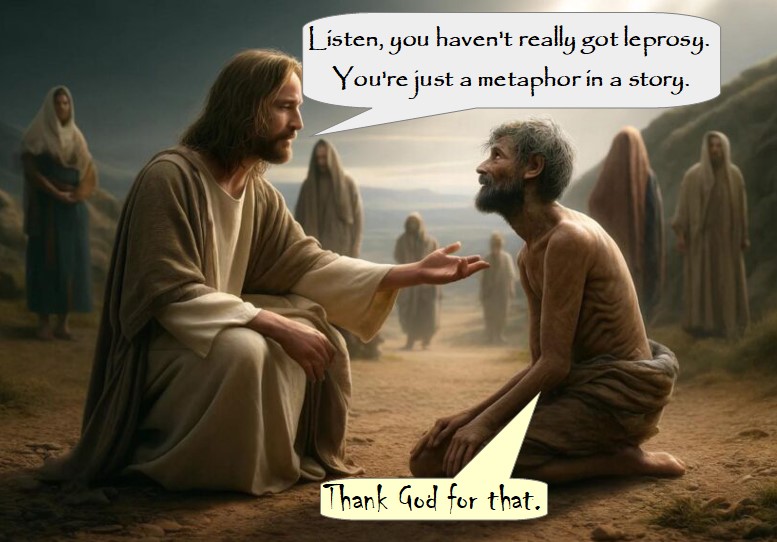
First off, it’s Mark 1:40-45, in which Jesus (seemingly) heals a leper:

 A man with leprosy came to him and begged him on his knees, “If you are willing, you can make me clean.” Jesus was indignant. He reached out his hand and touched the man. “I am willing,” he said. “Be clean!” 

Immediately the leprosy left him and he was cleansed. Jesus sent him away at once with a strong warning: “See that you don’t tell this to anyone. But go, show yourself to the priest and offer the sacrifices that Moses commanded for your cleansing, as a testimony to them.” 

Instead he went out and began to talk freely, spreading the news. As a result, Jesus could no longer enter a town openly but stayed outside in lonely places. Yet the people still came to him from everywhere.

The giveaway phrase here is ‘make me clean’. The man does not ask Jesus to heal him which, suffering from a debilitating disease as he was, would have been the most obvious, most pressing request to make. Instead, he asks to be ‘cleansed’ with all its ritual connotations, the word used here, καθαρίζω (katharizo), also meaning ‘purify’. According to Leviticus 4: 11-12, leprosy was a condition that was spiritually unclean. Only by making the prescribed offerings – the usual doves, lambs and ‘crimson stuff’ – could a leper who was already healed become ritually pure.

Who, according to the New Testament, replaces all the sacrificial offerings of the old covenant? Why, it’s Jesus himself of course (1 Corinthians 11:25, Ephesians 5:25-26 etc). Jesus cleanses and purifies the leper in the story, just as he is able to cleanse and purify sinners. This is what the early cult believed: ‘Ask Jesus, the heavenly Christ, to cleanse you of your sins and, just like he does for the leper in this parable, he’ll do it for you. As a penitent believer, you are the leper. Not only are you cleansed of your sin, you are purified.’

This also explains why Jesus is ‘indignant’ when the leper first approaches him. On the surface it makes little sense for him to be indignant with the man, which is why some translations change this verse to say Jesus ‘felt compassion for him.’ Jesus’ metaphorical annoyance is for those who have allowed the man’s spiritual condition to have deteriorated to a state comparable with leprosy. The Jewish priestly system, symbolised anachronistically in Mark as the Scribes and Pharisees, the later arch-enemies of the new cult.

Jesus commands the leper to visit the Jewish priest to demonstrate that he, Jesus, is the new cleanser of sins, replacing the priesthood itself. Instead, the leper goes against Jesus’ and the early cult’s wishes. My God, how could the cult remain secret and exclusive if newly cleansed converts behaved like this!

So there you have it. The leper is a metaphor for the sinner in need of the heavenly Jesus’ cleansing. His leprosy is a metaphor for the sin itself. The healing is a metaphor for the penitent’s spiritual purification. The man’s by-passing of the Jewish law is a metaphor for Jesus replacing the law. The cleansed leper’s shouting about it is a metaphor for the early cult’s desire to keep its rituals and teaching secret. Its parables like this one were designed to enlighten cult members while obfuscating and confusing the unbeliever (Mark 4:11-12).

As a literary creation, an allegory replete with metaphor, this event need never have happened in reality. Given its literary nature, it’s highly unlikely it did.

Ramifications

I started writing this blog as a way of working out just what it was I’d believed prior to my realisation there was no God. While this ‘revelation’ caused the whole Christian edifice to collapse, I still had a lot of conditioning to deal with. I had been taught over the years that, like every other human being, I was worthless without God/Jesus. I needed first to regain some self-worth.

I had hang-ups too about how I spent my time and money. The cult had assured me that God was obsessively interested in how I used both. Did my use of my time and money further his kingdom? Was I using my time wisely? Tithing? Giving my money to alleviate suffering? I knew buying CDs and comic books didn’t really fit the bill, but I sinfully persisted in spending my hard-earned cash on them, when I had any to spare after taking care of my family and giving to the church and charity. Then the guilt! How could I be so thoughtless, so selfish? I had let God down badly (specially if I’d bought some of the devil’s music.)

The guilt was self-induced of course. I think I have a personality type that is prone to feeling guilty – it’s been the predominant emotion of my life – but the Christianity I encountered exacerbated it. I still struggle with guilt, not over any great ‘sin’ but in terms of how much I help others and whether my use of my money is self-indulgent and wasteful.

Despite now having no truck with the idea of sin (which is a worthless religious concept) I do sometimes catch myself worrying that I’ll be made to suffer in the next life (which doesn’t exist either) for who I am and my ‘lifestyle’ in this world. Completely irrational, I know, but the conditioning runs deep. It hasn’t been fully rooted out yet.

On the plus side, I can now see the Bible for what it is: a collection of stories, those in the so-called New Testament designed, as they declare quite openly, to promote the beliefs of the ancient Jesus-cult.

I realised that in an ocean of myth, legend and invention I had been taught to regard the gospels as an island of historical fact. Yet two of them are prefaced with patent fantasy – the incompatible nativity stories – and conclude with equally incompatible resurrection and ascension narratives. Yet I was expected to trust that everything in between these make-believe beginnings and endings – the miracles, the visions, the speeches, the fulfilled prophecy, the false promises and unlikely new prophecies – were all somehow factual and true.

No longer gullible, I came to see this as a preposterous expectation. Sandwiched between fantasy and illusion the gospels are all myth and legend. It’s pointless to argue, as apologists do – and quite a few sceptical scholars too – that we can discern the real Jesus among the invention:

that we can make something worth considering out of the discrepant resurrection appearances;

that because one or two historical figures are written into the story it must therefore be historical throughout;

that we can sift the factual wheat from the metaphorical chaff;

that there is a kernel to the tales that can be teased out from the fantastical accretions;

that contradictions can be explained (away) and by sleight of hand made compatible;

that somehow believing all of this fantasy material can ensure eternal life.

None of these things can be done, any more than they can with the legendary tales of Romulus, Buddha and King Arthur. Legends, are legends are legends. Stories are stories are stories.

Would I have been happier never to have been a Christian, never to have committed my life to Jesus? Almost certainly. But we are all where we are. Christianity and I have a history. It’s probably left me scarred, and perhaps you too. At least I escaped it to live my life as I needed to, even if I am still working my way through its legacy.

Whatever Happened to Yeshua bar Yosef?

What happened to the real Jesus? The itinerant Jew who trudged around Palestine with a small group of followers, preaching who knows what. How to survive the imminent end of the world perhaps. His name wasn’t really Jesus. That’s a Hellenised version of the Jewish name Yeshua: Ἰησοῦς’ pronounced ‘Yay-soos’, which means (suspiciously) ‘YHWH is salvation’. The bar Yosef part means son of Joseph, not son of God. Whatever he was about, this Yeshua was crucified by the Romans and soon after his death, one or two of his friends convinced themselves they’d seen him alive again. Or so the story goes.

The earliest information we have about Yeshua includes very little of what we now think we know of him. The crucifixion/resurrection are the only parts of the story that interest Paul, and then only because he thinks he too has seen the risen Yeshua inside his own head. But this Yeshua, whom Paul does indeed call Jesus, is no itinerant preacher. Paul seems unaware of any of his story, his parables, aphorisms or miracles. Instead he consistently describes Jesus as a heavenly being who speaks to him through ‘revelation’, explaining in convoluted terms how his death leads to salvation. This Jesus, now with appended ‘Christ’, Greek for Messiah, is an amalgam of elements from mystery religions, resurrection myths and Paul’s own fanciful ideas. He is hard to reconcile with a real man who walked the Earth years earlier.

Verdict: Paul’s celestial Christ isn’t Yeshua bar Yosef. Paul’s Christ never existed.

The accounts of Jesus that appear decades later attempt to ground Paul’s imaginary being historically and geographically. In this, the gospels are superficially successful but even a cursory analysis reveals serious fault lines. The gospels rely heavily on myth, metaphor and the misapplication of ‘prophecy’, rather than historical fact. They are a form of midrash. The first, written anonymously round about 70CE and later attributed to someone called Mark, is, as today’s TV dramas often say, based on an idea by Paul. It is unlikely it reflects an historical Yeshua. Subsequent gospels, also anonymous but known later as Matthew and Luke, are themselves based on Mark’s, importing its flaws and introducing spurious material of their own. In neither is Jesus the son of Joseph; he’s the son of God, born of a virgin

Verdict: the Jesus of the synoptic gospels is not Yeshua bar Yosef. He’s a literary construct, a fantasy figure.

When the fourth gospel appears, sixty to seventy years after Yeshua is supposed to have lived, the Jesus character has evolved yet again. John’s supremely confident, egotistical creation equates himself fully with God: ‘I and the Father are one,’ as he puts it. This Jesus bears little relation to Mark’s central character who keeps his mission and identity secret (as well he might as a literary construct created primarily for cult members in the know.)

Verdict: the fourth gospel’s Jesus is not Yeshua bar Yosef. He’s constructed from the beliefs of later versions of the cult.

By the time of Revelation (95-96CE), Christ has become a Game of Thrones reject, overseeing the destruction of demons, dragons and other non-existent creatures. Any semblance of reality has been left far behind.

Verdict: Revelation’s Christ isn’t Yeshua bar Yosef. He’s as imaginary as Paul’s Christ, another fanatic’s ‘vision’.

Can Yeshua bar Yosef be rescued from all these accretions? Can a historical figure be detected beneath the layers of fantasy constructed around him (or the idea of him at least)? The attempts made in the last 150 years suggest not. He is lost for good underneath layers of myth and magic.

Does it matter? Not really. None of his followers today would be interested even if he could be unearthed and resurrected. They are content with the Jesus of imagination: Paul’s, the gospel writers’, the creators of creeds, ministers who interpret the stories about him and their own emotional need. Today’s Christ is an imaginary being, a heavenly superman as unreal as the sky gods who preceded him; a faith-created myth.

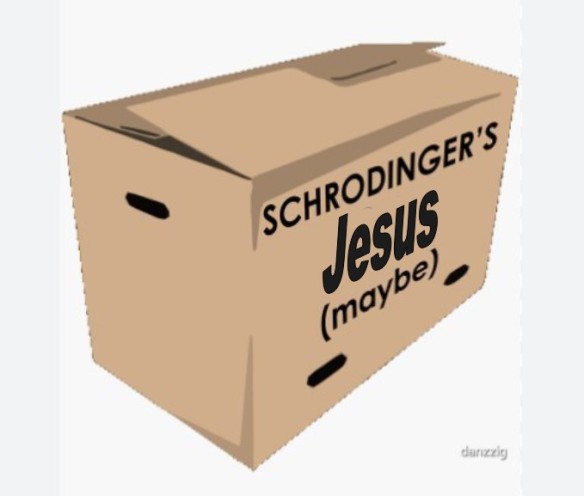
Verdict: the Jesus worshipped by today’s Christians isn’t Yeshua bar Yosef either. That character is lost to us. So early did cultists lose sight of him, he may as well have not existed.

Perhaps he didn’t. 

Presenting a well-thought through Christian Response*

If there’s one thing I love about writing this blog it’s the considered, articulate comments I get from loving Christians.

A brave anonymous commenter left one the other day on the 2015 post ‘Gentle Jesus – meek and mild?‘. Short on time and rhetorical skills, Brave Anon opted instead for a different range of tactics. Here’s what he(?) had to say:

I’m a little short on time, and i wish I wasn’t, because I could pick apart your post piece by piece for hours. I WILL say though, that I’d expect someone who has dedicated a whole site to this matter to have actually read the book he’s so dedicated to disproving. It’s pretty clear that you haven’t and only used quick Google searches to try to prove your point. The big thing that i’d really like to point out is that most of the scripture you quoted to try to prove your point is from the Old Testament. That means it was law BEFORE Jesus was born. Yes, some of them are pretty harsh. That is why Jesus whittled the 613 commandments in the OT down to 10 in the NT. The most important being, ”Love the Lord your God with all your heart, and with all your soul, and with all your mind.” The most important one, right behind that, is to, “Love your neighbor as yourself.” That is why I just prayed for you. I wish that people like you would get away from trying to disprove the Word and find something else (literally ANYTHING else) to spend your time doing. What do you have to gain by making this site? Do you have such little self worth that, as a grown adult (I assume, but maybe I’m wrong), you really need someone to pat you on the back and say, “WOW! You did a really good job! You get a gold star. That means, you get to pick out what toy you want to play with at recess first today!” Will, if that’s what you need, I ain’t the one to say it. Your arguments are weak, and you are clearly uninformed on the subject you’ve chosen to focus on. Why don’t you, at least, read the Bible (I mean cover to cover) before you speak on it. If you need a little motivation, why don’t you remember that Satan knows the Bible better than ANYONE here on Earth. I mean, even better than the POPE!!! Familiarize yourself so you can, at least, make an educated, organized, well informed, argument. You do that, and I’ll consider giving you a shred of respect. Otherwise, good luck on your day of reckoning. I hear it’s hot down there, so make sure you pack shorts!!

Let’s ‘pick apart’ the tactics in use here:

  1. Mind reading: Brave Anon knows that I have never read the Bible. Impressive. Wrong, but impressive. He uses his telepathy too to work out my motivation for writing: so I’ll be rewarded with praise. Thanks, Brave Anon; in the 12 years I’ve been blogging I’ve never realised this.

  2. Jumping to conclusions: Brave Anon decides all my information comes from Google. While it’s true I do use Google to verify sources and provide links to articles, when it comes to the Bible, I quote it directly. All those references in brackets are the clue that this is what’s going on. They look like this: (Matthew 7:1-3), (1 Corinthians 5:12). Brave Anon might want to look these two up on Google.

  3. Confused irrelevancy: Brave Anon is unhappy I ‘quoted… from the Old Testament’ in the post in question. Wait – didn’t he just say I’ve never read the Bible? Isn’t the Old Testament part of the Bible any more? The point made by the post is that Matthew’s very Jewish Jesus says that the Law – that’s the one in the Old Testament – will never pass away, not one jot or tittle of it. Wasn’t the Old Testament, under a different name of course, the only scripture Jesus knew? Maybe that’s why I quote it alongside the later stuff Matthew makes up for him to say.

  4. Intuition: Brave Anon intuits I’m a full grown adult. Brilliant. He could of course have read ‘The Author…’ above, which would have told him that, and would also have informed him of why I post what I do. Guessing is so much more effective though, don’t you think?

  5. Condescension: Brave Anon prayed for me. Nice. Nevertheless, he felt moved to send a derisory comment.

  6. Withholding his respect: Jeez, if I’d known this was going to happen I’d never have written the post. I’m positively bereft.

  7. More confused irrelevancy: Satan, the capitalised POPE… what the…?

  8. Desperation: ‘Just wait until the day of reckoning then you’ll regret criticising my buddy Jesus ‘cause you’ll be burning in hell!’ This threat is always a part of Christians’ comments. I’m thrilled Brave Anon remembered to include it.

Thanks for dropping by, Brave Anon, and for reminding me to pack my shorts.

*Not really.

Just suppose…

Let’s imagine that the gospels were all written by eye-witnesses or the associates of eye-witnesses. Let’s suppose that prior to their composition there was a vibrant oral tradition that accurately preserved the Jesus story and his teaching in particular. Let’s suppose that Paul learnt what he knew of Christianity initially from the early believers he persecuted and then, following his miraculous conversion, from his meetings with the disciples. Let’s suppose that the later books of New Testament were written by people who knew Jesus personally or were really by Paul. Let’s suppose that everything in the bible was inspired by God and is truly his word. Let’s imagine that as result of all this, everything predicted and prophesied in the gospels, in Paul’s letters and the later ones by apostles, came to pass.

Because we’d have to imagine this. Even if everything we’ve supposed was true, none of the prophesies, predictions or promises have materialised in reality. Not one. No Son of Man beaming down from heaven while the disciples and Pilate were still alive, (as he promises in Mark 9:1 and Mark 14:62 respectively), no visit from the Messiah while Paul and his acolytes were living (1 Thessalonians 4:17), no final judgement, no Kingdom of heaven on Earth, no Christians performing miracles greater than those attributed to Jesus. Not even any ‘new creations’ imbued with the Holy Spirit (‘by their fruits shall ye know them.’)

Apologists put a lot of effort into explaining away these failures, some even arguing the Kingdom is actually with us now (how incredibly disappointing it is if this is the case!) Most disappointing of all is that no Christian has ever resurrected from the dead. Not Paul, not Peter, Mary Magdalene nor any other early follower, and no-one since: not Martin Luther, Charles Wesley, C. S. Lewis, Billy Graham nor any bishop, minister or evangelist who has ever lived. All have remained resolutely dead, just like everyone else who has ever ‘fallen asleep’ and everyone who will in the future.

However much Christians want to insist the Bible is true, accurate and God-breathed, in the end it simply doesn’t deliver.

Either All True Or None True

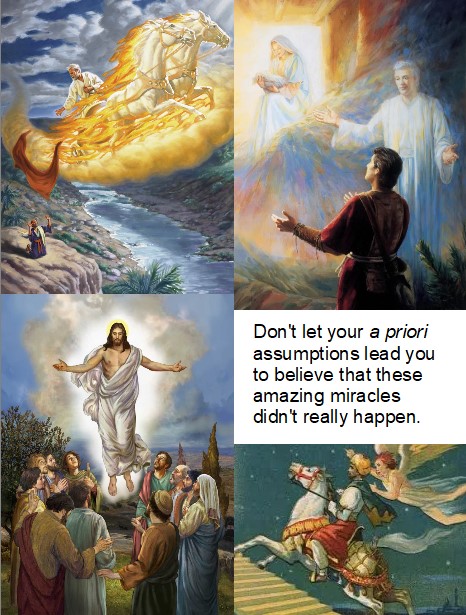
About 2,500 years ago, a man called Elijah went up to heaven while still alive. He was taken through a whirlwind in a chariot of fire, pulled by horses of fire. This amazing event was witnessed by several other people who were profoundly affected by it. The story of this ascension was possibly relayed orally for many years until finally being written down in what is now 2 Kings 2.

Did any of this really happen?

Of course not. It’s a myth.

Some time in the 4th century BCE, the first king of Rome, Romulus, was taken, while still alive, to the dwelling place of the gods. From that time on he was worshipped as a god – some said he was eternal to begin with – with a temple being built in the very place from where he had ascended. Later he appeared to one of his followers, Julius Proculus who said the resurrected Romulus was larger and more beautiful than ever, armed with weapons shining like fire. Julius Proculus attested to this appearance of the resurrected Romulus, swore an oath to its veracity and relayed it faithfully to others.

Did any of this really happen?

Of course not. It’s a myth.

https://mythologymatters.wordpress.com/2019/04/18/easter-mythology-the-resurrection-as-modeled-on-greco-roman-myths/

It is not known when Mithras was born, if indeed he was. He emerged from a rock in the spiritual realm as a child or youth, ritually slaughtering a bull and sharing a banquet with the god Sol. He guided souls to the after-life, propelled as they were by the bull’s blood and flames. He was worshipped primarily by soldiers who saw him as their salvation from the bitterness of earthly life. There were rituals to be followed to become a true initiate and for Mithraic mysteries to be revealed. How Mithras made himself known to his acolytes is unknown, but in the first three centuries CE, his cult rivalled that of the Christians in popularity.

Did all of this really happen?

Of course not. It’s a fabrication, a myth.

In the 8th century CE, the prophet Muhammad flew from Mecca to Jerusalem on a winged equine. Once in Jerusalem he climbed a ladder to heaven. Once there he travelled through the various levels, having conversations with other lesser prophets, before entering Allah’s domain. His journey was later revealed to two early prophets who had known Muhammed when they were boys. They conveyed the details accurately until they were recorded, briefly at first in the Qur’an and later in more detail in its supplement, the hadith.

Did any of this really happen?

Of course not. It’s a fabrication, a myth.

In the early 19th century, Joseph Smith was visited by Jesus and his Father in a vision. They told him that he should not join any existing church because they were all in error. Later, a hitherto unknown angel named Moroni appeared to Smith and indicated to him where some gold plates were buried. He instructed Smith to dig up and translate the plates. Obediently, Smith did so, using a pair of seer stones for the translation. The resulting Book of Mormon was a revelation of Christ’s activities in North America following his resurrection. Smith wisely had a number of his associates witness, in writing, the existence of the gold plates as well as their supernatural provenance.

Did any of this really happen?

Of course not. It’s a fabrication.

In 1916 the Virgin Mary appeared numerous times to three poor Portuguese children, giving them instruction and prophesying to them. She also promised that she would perform a miracle at Fatima. Accordingly, between 30,000 and 100,000 people, including reporters and photographers, gathered at Fatima where many saw multi-coloured lights before the sun itself ‘danced’. It came closer to the Earth before zig-zagging back to its usual place in the sky. While not all of the attendees testified to the phenomenon of the dancing sun (some saw only the lights, others nothing at all) many did and testified to the effect the miracle had had upon them.

Did all of this really happen?

Of course not. It’s a fabrication based on hallucinations.

Around 30CE, a rabbi known as Jesus, who had been born of a virgin, gathered together 12 followers and went around Galilee preaching absolution from sin and the imminence of the Kingdom of God. He announced he was the Messiah who would rule the Earth when the kingdom arrived. The Jewish authorities took exception to his claims and petitioned the Romans to have him executed. This they did, only for Jesus to come back to life three days later, appearing in visions to his followers. He ascended to heaven, promising that those who believed in him would enjoy eternal life. Some of his disciples spread his message faithfully until it was eventually written down, first by a former Pharisee called Paul and then by four authors who accurately recorded what Jesus had said and done.

Did all of this really happen?

What do you think?