Effective Preachin’ (Part Two)

Sheep

Reverend M. T. Vessal of the Church of The Raised Up here again, with the second part of my guide to Effective Preachin’. In case you missed it, repent! (The first part’s here.)

Now we’re really gonna get going, praise the Lord! The tools you’re gonna need for your talk proper are:

Lots of anecdotes (make up ’em up if you don’t know any true ones), specially ones about life- and-death situations. Stories about encounters with people on planes always go down well, as there’s always the chance the plane will too, and accounts of foolish follk who hear the gospel and ignore it, only to die in a terrible accident soon after.

Cod-psychology. That’s the stuff about God-shaped holes, how only Christ can forgive sin and meet all our needs, even though he doesn’t and never said he would. You can add something in here slagging off atheists and anyone else you disagree with.

Conviction. This is crucial. Sound as if you mean whatever it is you’re spouting. Sound as if you really know what the Bible says. Make it sound like it’s relevant and meaningful, even though it isn’t.

Modulation, otherwise known as shouting and dropping your voice. Shout when the argument is weak (and they’re all weak – you’re making this stuff up, remember)) and drop your voice almost to a whisper so that people know you’re being really, really sincere.

Drama. Pace up and down, like ‘Bishop’ T. D. Jakes, and mop your brow a lot. Wave your arms about, like Joseph Prince and show you really mean it. Maybe you could use props, like Beth Moore does, though you run the risk then of diverting the attention away from yourself. Better is to demonstrate what a cool guy you are, even if you’re not a guy, by sitting on the edge of the altar steps or, if you’re in a really cool church like Steve Furtrick’s, the Stage. This shows the congregation/audience just how cool you are.

Whipped up emotion. This is optional but if you lay it on thick about what Jesus has done for the spiritually inferior, how their sin caused those nails to be driven in, then you’re on to a winner. Aim for some arm waving from ’em, babbling in jibberish speaking in tongues and maybe even some crying. Don’t forget to tell ’em that whatever they’re feeling is the Outpouring of the Holy Spirit. Definitely nothing to do with your manipulating their already fragile emotions. No sir. This here frenzy is divinely inspired.

Finally, get to the challenge bit of your sermon/talk/self-promotion. This can involve an appeal for money. Correction: this will involve an appeal for money. The God who supplies everything doesn’t supply money so you’ll need to lay a guilt trip on your fans/congregation to provide you with the cash to maintain your lavish lifestyle continue the Lord’s work. But it’s not only about money; remember to pressurise/inspire the congregation/audience/fans to go out and harrass their neighbours so maybe they and their wallets will come to church next week. As the Lord Jesus himself said, ‘the harvest is plentiful but the labourers are few’!

Above all, though, let everyone leave feeling that they’ve had a good time. Like kettles, they should have had a real great Outpouring and feel well and truly Blessed. Leave ’em feeling ready for more, same time, same place next Sunday.


Christianity: always winter but never Christmas

Spot the difference:Shore

Christians are hot on evidence.

There isn’t enough for evolution, they say, even though there’s an abundance.     

None, they claim, that the Earth is billions of years old, but only 6 thousand.

Not enough that climate change is man-made, when there’s considerable evidence it is.

None that there’s a genetic component to homosexuality when science reveals that there is.

But, as far as the resurrection of the body, judgement and eternal life in either Heaven or Hell are concerned, these they believe in, no evidence required.

I recently challenged Christians on Charisma magazine’s blog-site to provide or point me to evidence that any one of the 107 billion people who has ever lived who after they had died had gone on to enjoy either eternal life in Heaven or eternal punishment in Hell. Unfulfilled promises from magic books weren’t admissible, because a promise of something happening is not the same as it actually doing so. Jesus didn’t count either, as there are no eye-witness accounts of his bodily resurrection, only stories written decades after the supposed event. In any case he was half Vulcan or something, not an ordinary mortal.

Alas, my challenge went unanswered. You won’t find it on the Charisma site now because it has been removed by the moderator there. Expecting evidence from Christians for what they believe is patently unreasonable. After all, who needs evidence when you can exercise your licence to believe whatever you’re told?

Of course, there is no evidence of any resurrection nor of anyone who has gone on, post-mortem, to enjoy everlasting life. Have you noticed how everything about Christianity is either invisible – God, the Holy Spirit, Heaven, angels, demons – or lies permanently in the future; the Second Coming, the resurrection of the body, the Kingdom of God, judgement and eternal life? All of them always just that little bit further on. This year, next year, sometime, never. Just not now.

Yet Jesus, Paul, Revelation’s John and most other New Testament luminaries believed God’s Kingdom, the resurrection and judgement were coming within their own lifetimes.* Not one of them entertained the thought that 2000 years down the line none of these miraculous events would have materialised.

Small wonder then, that at the start of the second century, believers began to lose hope in the Second Coming, the Kingdom’s arrival and an earthly resurrection of the dead. Maybe, some of them began to think, eternal life would be not be here on Earth, as Jesus and Paul had promised, but in Heaven with God, which they most definitely hadn’t. This way, everything that hadn’t happened here on Earth would happen instead after death (we can see this transition taking place in the very late gospel of John). All of which was fortunate, because it dispensed with the need for confirmation and evidence; no-one could prove – apart from the fact nobody has ever survived their own extinction – that believers didn’t go to Heaven when they died. Equally, no-one could provide evidence they did.** How neat and convenient.

So if any Christians reading this would like to like to show us some evidence for the resurrection of the dead, post-mortem judgement, Heaven, Hell, God’s Kingdom on Earth – any of it – I’m sure we would all like to see it. Until then, I will go on regarding all of these assurances as empty promises – pie in the sky – that believers cling to desperately, while calling their desperation ‘faith’.

* See Matthew 16.27-28 & 24.27, 30-31, 34; Luke 21.27-28, 33-34; 1 Corinthians 15.51-52; 1 Thessalonians 4.15-17; 1 John 2:17-181; Peter 4.7; Revelation 1.1 & 21.2-4

** Psychics claim to commune with the dead of course, or at least with their spirits; more hokum from the minds of the deluded. Even if it weren’t, this isn’t the kind of resurrection Christians envisage for themselves. They dismiss psychics’ ‘evidence’ of life-after-death as so much demonic deception.

The Stuff Christians Say… (part three)

DoorToDoorAtheists are aggressive/militant/unreasonable: The Christians might’ve got us on this one. After all, it is incredibly irritating when we atheists start preaching in the town centre or invade others’ events to tell them what to believe or dish out loony pamphlets or turn up at people’s doors when they’re just about to have their tea. And what about all those meeting places we have, on just about every corner of the city, with smart-arse posters about Adam and Steve on the board outside? And let’s not forget our readiness to blow up ourselves and others in the name of our great cause. Now that’s ‘militant’! Yes, we atheists really do have too much freedom to push our views on others. No wonder we’re so insufferable. (Note to self: check you’ve got this right.)

It takes more faith to be an atheist than a Christian: It takes no faith to recognise there are no supernatural beings. It takes no more faith not to believe in God – or to acknowledge that there is no God to believe in – than it does not to believe in Santa Claus, Poseidon or Ra. Christians themselves require no great abundance of faith to dismiss these characters. Is it so difficult to understand that atheists disregard the Christian pantheon of fantasy figures in exactly the same way? Or are believers practising their dishonesty-for-Jesus again? There is no faith involved in being an atheist. On the other hand, believing in an omnipotent but suspiciously inactive God, a super-hero Saviour, a magic Spirit, angels, cherubim, seraphim, demons, Satan, resurrected saints, Heaven, Hell and all manner of powers and principalities – this requires faith in delusional quantities. No atheist could possibly compete. Nor would they want to.

The stuff Christians say… (part one)

Jesus-Facepalm

On the day Christians remember the time Jesus allegedly spent being dead and buried (that’s one day, if you’re counting; what happened to the three he promised?) by going shopping or watching sport, let’s take a look at some of the nonsense they spout about atheists:

Atheism/humanism is of Satan: Given there’s no evidence for any supernatural beings, there can be no devil, Satan, Lucifer – or whatever other name Christians come up with for this fantasy figure. (Bizarrely, it’s Jesus who’s called Lucifer in Revelation 5.5) The devil is a creation of the human mind, intended to explain the nasty stuff in life and to let a supposedly good God off the hook. It follows that an imaginary being can’t make human beings be anything. The devil therefore does not make people atheists nor direct them in their ways.

Humanists/atheists set themselves up as God: Every manifestation of the god(s), including those that happen to be popular at present, is of human origin. Like all the others, the Christian God is a product of the human imagination that is made manifest only through human behaviour. So who is it who sets themselves up as God? Those who recognise that this creation of the human mind has no external reality, or those who claim an intimacy with the ‘Supreme Being’, believe his Holy Spirit lives within them and delude themselves into thinking they speak for him? No prizes.

Humanists/atheists worship man as God: Atheists don’t do this either. We are well aware of humans’ fallibility, inconsistency and capacity to bugger things up. However, we’re all we’ve got. There’s no God going to come and save us or solve our problems. We have to do it ourselves (or, as the case may be, not). Nor do atheists regard other people as wicked sinners who have no good in them – a particularly unhealthy viewpoint favoured by the religious – but this hardly constitutes ‘worship’.

Atheists hate God: Only to the same extent we ‘hate’ Santa Claus, Poseidon and Ra. You can’t hate (or rebel) against something that doesn’t exist. We do get very tired though of Christians foisting their views on us, insisting we should believe what they believe. And we get angry when they disparage others and attempt to curtail their freedom because they alone know what Jesus would want. But being angry about Christians’ unreasonableness is not the same as hating something that doesn’t exist.

To be continued

Round in Circles

JC2

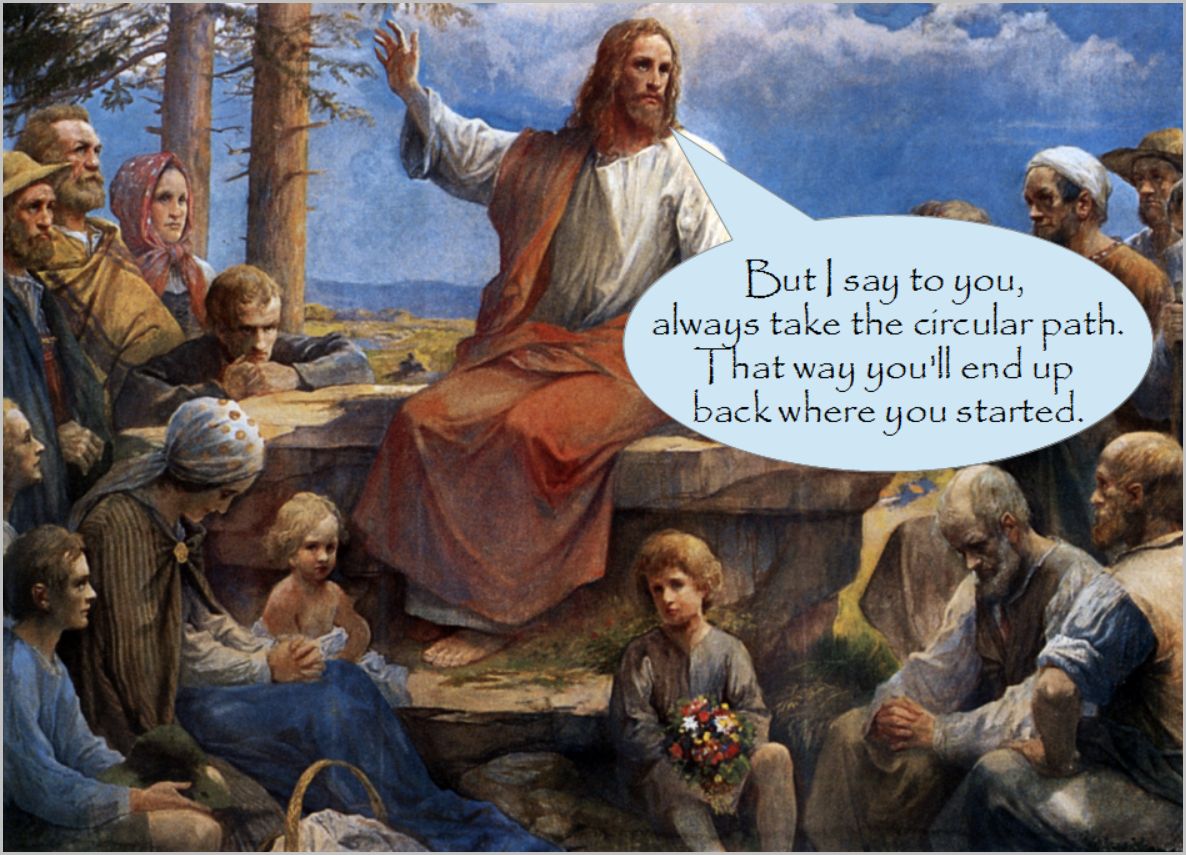
Being a religious believer means you can’t be a free thinker. Your conclusions are already determined for you – in the Bible or Qu’ran or some other holy book – and you are compelled, if you’re fundamentalist in your beliefs, to reach and affirm these conclusions. More than this, you are compelled to begin with them, which is why Ken Ham can say that where you start determines where you end up (though this only applies to those who think magic books have all the answers). So if you believe, because the Bible appears to say so, that the universe and all that is in it was created in six days about 6,000 year ago, then that is the premise from which you begin. You are then highly selective in the evidence you’ll consider, forcing it to support your predetermined conclusion. Christian argument is always this circular and heavily dependent on confirmation bias.

It can’t be anything else:

William Lane Craig ‘knows’ that the Holy Spirit is real because he feels it inwardly; the Bible tells him this kind of feeling is attributable to the Holy Spirit, so consequently the Holy Spirit must be real.

Pastor Mike Ratcliff understands that the Bible says everyone is a sinner; Mike’s confirmation bias means he sees sin and apostasy everywhere; therefore the Bible is right when it says everyone is a sinner.

Pastor Steven Anderson condones slavery. God approves of it in the Bible therefore slavery cannot be morally repugnant, and attempts to eradicate it are misguided. How does he know this? Because the Bible says slavery is okay.

Christians generally argue that God is good (because the Bible says he is) but have to disregard the horrors of his creation and the cruelties of life to reach the conclusion that, yes, God is good.

There really is no arguing with such arrested development, such intellectual dishonesty. Christian are not open to wherever reason and the evidence might take them; the end is always assumed at the beginning. Maybe that’s why comments are rarely allowed on Christian web-sites. You can’t argue with the Truth™ – another premise masquerading as a conclusion.

Who Decides?

DavisI’ve written before about how some parts of the Bible are more important than others; about how Christians relegate some of it – ironically much of what Jesus is purported to have said – while elevating other bits. These latter aspects trump the former, so that if there’s ever any dispute about how Christians should behave in a given context, they’ll happily cite the elevated parts while overlooking those that are less to their liking. This happened recently in the Kim Davis case,* which I talked about last time. In that context, the verses from Romans I quoted, in which Paul instructs believers to obey civil authorities, are explained away and dismissed in favour of other passages. Here are commenters doing just that on the crackpot Christian site, World Net Daily:

Have you not read Acts 4:19 and 5:29? There is a time when God’s authority trumps human authority. In this case, Kim Davis stood up for God’s authority. God’s word calls homosexuality an abomination. Ephesians 5:11 teaches that Christians must have nothing to do with the works of darkness, but instead expose them.

and

Sometimes…when you give to God…what is God’s…you will have to disobey the civil authorities that are over you. Kind of like Paul…refused to stop preaching and jailed…God took care of him, though, I do believe. Although never truly jailed, except at the end…didn’t Jesus disobey the “law”, Mosaic Law, when He preached?

It’s not as if Paul was writing about ‘authorities’ that conducted themselves in considered or considerate ways; this was the Romans, after all. They would eventually execute Paul – so much for God taking care of him! – just as they had Jesus himself. Nonetheless, Paul tells the brethren they must honour Roman authorities. But somehow, if Christians today are to be believed, he just didn’t understand what it’s like to obey civil (in both senses of the word) secular authorities in the 21st century. They consider his teaching in the early part of Romans 13 to be invalid, no longer applicable, irrelevant to the very situation it was designed to address. Other passages from the Bible are far more important and therefore trounce it easily.

But who decides this? Who decides, in what these same Christians deem to be the literal Word of God, which words are less literal than others; less applicable; less relevant? And, consequently, which are more important, more applicable, more ‘of God’?

The evidence would suggest it’s the individual Christian who does, led, no doubt, by the Holy Spirit, who inexplicably leads different believers to different conclusions about the same source material. There’s no ‘free-will’ involved in this process, however; individual interpretations of scripture are informed by the consensus of the church or the movement with which individual Christians align themselves. But who in these institutions determines the order of priority for the Bible’s many confused and often contradictory injunctions?

Determining what is important in the Bible, and what isn’t, is the result of a consensus of prejudices and biases. It’s easy to find ‘teaching’ in the Bible that supports one’s own views and opinions and equally easy to find that which doesn’t and is incompatible with the position one already holds. To reconcile the two, and to deal with the discomfort of any cognitive dissonance, Christians demote any teaching that doesn’t correspond with their pre-existent world-view – sorry, Paul, but this includes your silly suggestion that we should obey the authorities – while promoting those ideas that conform to and confirm that outlook (so hurray for those verses that say gay people are abominations and have no place in the Kingdom of God!) The very words of God are ranked according to the whims and prejudices of those reading them.

Again, I’ve written before about Christian priorities, about how those parts of the Bible they find unpalatable and challenging – such as those that say they should give away all they have and love their enemies – are explained away or ignored. But as for those passages that tell Christians how superior they are while excoriating others as ‘works of darkness’ – well, now you’re talking!  


*While Davis claims all her husband swapping took place before she met Jesus, she was a member of the Baptist church while she was busy trying them all on for size. At least three of her wedding ceremonies were conducted by Baptist ministers. All that happened in 2011 was that she joined the more extreme pentecostal movement, which empowered her to ignore the log in her eye and concentrate on the speck in others’.

The Holy Spirit: transparently nonsense

CageIf anything is unsubstantiated fantasy, it’s the Holy Spirit. It – I know Christians prefer ‘he’, but the pronoun used in the Greek of the New Testament is more often neutralit began life as the comforting, fuzzy feeling the early believers got when they remembered their recently deceased leader. The same feeling that convinced them he was alive again in a sort of not-really-alive but as-good-as kind of way:

“He’s, like, alive-in-our-hearts and, hoo boy, what a buzz there is when a few of us get together and share that vibe at the same time. Far out, man. Hey, let’s put it in the story that this is exactly what he said it would be like when he was still alive!” (Matthew 18.20, sort of)

High on this feeling some believers started imagining they were actually in the dead leader’s presence and – miracle of miracles – could see him and commune with him (1 Corinthians 15.5-8). Such an experience, they felt, could only be from God and must, in some inexplicable way, actually be a part of God (1 Corinthians 2.10). And so the Holy Spirit – the capital letter version – was born. Spiritual highs had taken on independent existence as an aspect of God.

Except, of course, they didn’t. They remained feelings, amplified in and by a communal setting. And that’s what they are today. Which is how, when a Christian tells you the Holy Spirit prompts him or her to say or do certain things, the result is always in line with the teaching of his or her particular church or sect. So, for example, the interpretation of the scriptures to which the Holy Spirit leads a group of believers is fully in keeping with that of their denomination, church and pastor. Dissent is actively discouraged and those with different views are apostate, deceived by the devil and not led by the Spirit at all. Maybe, they’re told, they were never really Christians in the first place, which is remarkable, when the dissenters’ experience of the Spirit is every bit as real as the rest of the community’s. Experiencing one’s own thoughts and feelings usually is.

It never seems to occur to Christians how odd it is that this supposed aspect of God, the Spirit, leads different groups of believers down different, often contradictory, paths. How could it do that if it was truly of God? Why would it do that? It’s erratic, idiosyncratic methods are clear evidence of the human origin of its ‘working’. The Holy Spirit’s prompting is, as it was in the beginning, a communal feeling given ’embodiment’ by corporate consent. It even works effectively when believers are separated from each other, social pressure producing conformity.

Experiencing the Holy Spirit is not unlike the way those involved in a séance or in a ‘haunted’ house convince each other there is a presence in the room. These ‘ghosts’ are socially constructed too, from shared feelings and often not a little ‘guidance’ from those who claim to know better. The Holy Spirit is ‘realised’ in the same way, most clearly among a ‘worshipful’ group of Christians whipped up into a state of euphoria attributed to the work of the Spirit.

But the Holy Spirit is without independent existence in both origin and manifestation. It is human make-believe through and through. Any Christians who think otherwise are invited to provide evidence of the Spirit’s independent existence, separate from human emotions and imagination.

Idiotic Stuff Jesus Said 11: Build Your Lives on the Things I Say

WhoDoJesus demanded you base your life on his teaching. It’s the only way, he said, that you’re going to find meaning, as well as the principles you’ll need when the going gets tough:

Everyone then who hears these words of mine and acts on them will be like a wise man who built his house on rock. The rain fell, the floods came, and the winds blew and beat on that house, but it did not fall, because it had been founded on rock (Matthew 7.24-25).

And what exactly were those words of his? Here’s what he taught:

  • The Son of Man was coming to the Earth to establish God’s Kingdom within the lifetime of his original followers (Matthew 16:27-28; Matthew 24:27, 30-31, 34; Luke 21:27-28, 33-34);
  • His own people needed to be more ‘righteous’ in order to be part of this Kingdom (Matthew 5.20; Matthew 6.33; Matthew 13.49 etc);
  • Being righteous entailed some extreme behaviour; loving your enemies, giving away all you had, turning the other cheek, forgiving repeatedly, being perfect (Matthew 5.44; Matthew 5.42; Luke 6.29; Luke 6.37; Matthew 5.48; Matthew 19.21);
  • It was crucial to obey Jewish law, even if some of it could be reinterpreted (Matthew 5.17-18; Matthew 12.1-7);
  • Once the Kingdom arrived Jesus himself would be King of the world, aided and abetted by his pals (Matthew 19.28; Luke 22.30);
  • His followers would do even greater miracles than he did himself. Given he controlled the weather, healed the sick and raised the dead, that’s going some (John 14:12).

Anybody know anyone who believes all of this or lives this way? Anyone who operates on these exacting principles? I don’t know of anyone and never have. I didn’t even when I was Christian myself. Jesus demands are impossible. No-one can live according to them. ‘Of course not,’ say Christians. ‘You need supernatural help to live like this.’ So why don’t they, when they have God’s spirit living within them (John 14.16-17)? Why don’t we see Christians who perform spectacular miracles, who constantly go the extra mile, who give away everything they have, who are, as Jesus tells them they should be, perfect?

We don’t because no-one can live as Jesus insisted they should. Nor do we see Christians who believe his prophecies either, particularly the one about the Son of Man bringing God’s Kingdom to Earth two thousand years ago. Christians pretend he didn’t really say it, or if he did, that he meant something else entirely. They’ve changed his very words – the ones they should be building their lives on – to claim Jesus himself will be returning any time now (the synoptic gospels are confused about whether Jesus is this Son of Man, or someone else). When he does, they say, true believers will be going with him to Heaven. Never mind that Jesus teaches nothing of the kind and there’s absolutely no foundation for these beliefs in his words. As such, they’re the faith built on sand he tells them is worthless:

And everyone who hears these words of mine and does not act on them will be like a foolish man who built his house on sand. The rain fell, and the floods came, and the winds blew and beat against that house, and it fell—and great was its fall! (Matthew 7.26-27).

So, if Christians don’t do what Jesus tells them and don’t believe his promises or prophecies, then in what way can it be said they take his words as the foundation of their lives? Don’t they, rather, base them on Paul’s teaching, about a supernatural Christ who bears little resemblance to the zealous Jewish preacher they pretend is their ‘Lord’? Teaching that has nothing to do with that of the man who demands his pronouncements be the very basis of life? Paul doesn’t quote any of Jesus’ teaching.  The foundation Jesus speaks of is of no interest to him; so, naturally, this is whom Christians follow – not Jesus, but Paul and his mythical Christ.

Christians have no time for Jesus’ words – and who can blame them? All he offers is impossible morality, false promises and failed prophecies. Far better to go with what Paul offers, because that’s about what’s in it for them. But even Paul didn’t believe anyone was going to Heaven, so they ignore that bit in his teaching too.

A new creation? Or same old same old?

Preaches3Over at Answers In Genesis, John C. P. Smith (who?) argues that Christianity must be true because of ‘the testimony of countless Christians to the efficacy and potency of the gospel to radically change people’s lives for the better.’ Supposedly, this change is the result of a radical take-over of the individual by the Holy Spirit. As Paul explains in 2 Corinthians 5.17:

Therefore, if anyone is in Christ, he is a new creation. The old has passed away; behold, the new has come.

Even as we speak, Christian Voice’s Stephen Green is proposing, in one of his more spiteful and petty blog posts, that this is only way a young activist can be saved from a selfish, insensitive and deluded – talk about the pot impugning the kettle! – ‘gay lifestyle’, whatever that is. But do such changes really happen and are they ‘for the better’?

Speaking from personal experience and observation, I’d have to say they do. Sometimes they entail an apparent overhaul of the convert’s view of life, mindset and values. It’s as if the possibility of a spiritual aspect to life takes them by surprise and everything in their psychology shifts to accommodate new ideas. For others, the change is superficial and merely accentuates characteristics they already possess.

Having said that, many people have life-changing experiences without a religious catalyst; when they survive a bad accident or a potentially fatal illness, for example, or win lots of money; when they come to a full realisation of who they are or ‘come out’; when they first have sex or a baby; when they lose a loved one or experience an out-of-body experience or start a new job or move to a new area… and on and on.

None of these transformations involves Jesus, his Holy Spirit or ‘the gospel’. Humans are capable of the most drastic and radical of psychological change all on their own. How many times have you heard it said that someone isn’t themselves? Or that no-one knows what’s got into them? Or they’re acting out of character? Some even transform themselves without any external event playing a part. You may have done so yourself.

I would suggest that religious conversion is like that. The change can be real, but it has nothing to do with an external, supernatural agent. The human personality or psyche, whatever you want to call it, is much more fluid and pliable than we care to admit. Your self, values and thought patterns are in fact undergoing constant change, sometimes radically and rapidly so. The consistency you feel you maintain, the unchanging ‘you’, is an illusion. You are regularly updated, like the operating system on your computer. You’re not the same ‘you’ that you were last year and are certainly not the same as a decade ago or when you were a child. What you regard as ‘you’ is constructed from constant change.

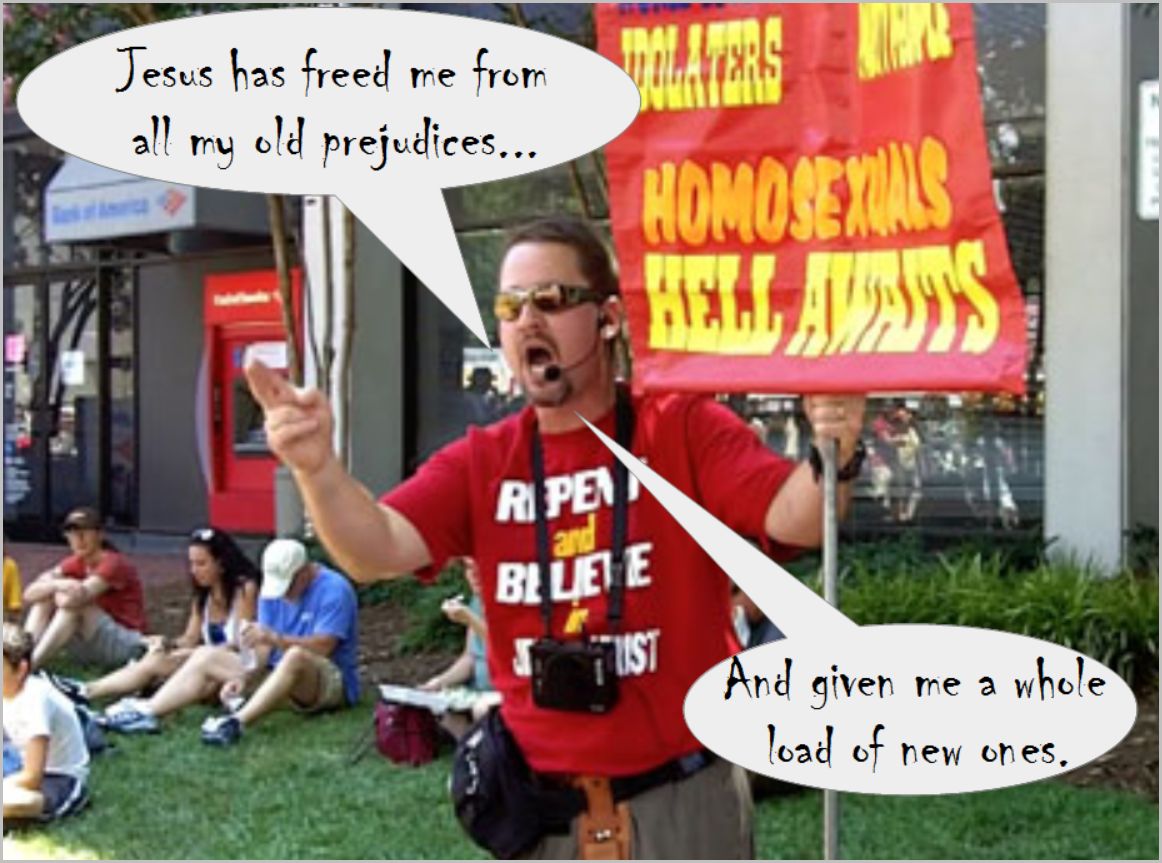
The change that comes from religious conversion is no different. More, it doesn’t necessarily change you for the better; it can harden attitudes and make you less sympathetic towards others by transplanting values that are not conducive to empathy and generosity. You become one of ‘us’ and no longer one of ‘them’ as your chosen place of worship and the collective influence of fellow believers make a significant contribution to the process. This is why evangelists and those who are driven to convert others always insist you become part of a church (mosque or synagogue) afterwards – provided, of course, it’s one with the right sort of teaching (theirs). Your new attitudes and values are then reinforced by those who already have them, entrenching them further and convincing you that they, and now you, are ‘right’. This is how the ‘new creation’ you’re becoming is constructed and moulded.

As I’ve argued before, conversion can often reinforce behaviours that have already become habitual for individuals. Every church and Christian movement has adherents who are petty and spiteful, as well as those who are generous and considerate. But what becoming a new creation never entails, is making converts more intelligent, rational or stable. Why not? If it’s a miracle we’re talking about – and undoubtedly we are if God’s spirit suddenly or gradually takes up residence within a person – then surely it would result in a little cognitive rewiring so that the new Christian reaches their full intellectual potential. The fact it doesn’t bring about the ‘renewal of the mind’ (Romans 12.2) in anything like this sort of substantive way is the equivalent of the missing limb that no amount of prayer and laying on of hands can regenerate.

All of which suggests – no, more than suggests; demonstrates – that neither God nor his ‘Holy Spirit’ nor a dead Jewish preacher, nor ‘the gospel’, has anything to do with it. And perhaps that’s because an increase in intelligence, rationality or stability would run counter to the process which depends on blind faith and a submission to the very social forces that reshape the self.

What Christians Believe: Part Two

AscensionHi, Thea Lojan here talking about the creed. Here’s what else it says, following on from last time:

I believe Jesus ascended into heaven and is seated on the right hand of God and will come to judge the living and the dead. As I was saying, Jesus could do amazing things. He could, like, beam up into the sky and out into space – that’s what ‘ascended’ means. Amazing. And he is coming back to judge the Earth, just like he promised. I know he said he’d be back real soon, like while his disciples were still alive, but to God a minute is like a thousand years so a few years can be anything like a million, or something like that. We shouldn’t take it literally when he said he’d be back while his friends were still around, though the Bible is, without a doubt, the literal Word of God.

Anyway, when he returns Jesus is going to send those who don’t believe in him to Hell, where they’ll suffer eternal torment for, like, forever and ever, amen. And he’ll take people who are saved, like me, back to Heaven with him. I can’t actually find the bit in the Bible where he says he’ll be taking me to Heaven, but I have faith so I’m sure he will.

Just a thought, but why doesn’t this creed mention the Bible, and how it’s the ineffable and literal Word of God? You’d think it would, wouldn’t you.

I believe in the Holy Spirit, the holy Catholic Church and the communion of saints. Definitely. The Holy Spirit is like the feeling of God that you get when you’re being blessed. You can’t see it – though it’s actually a ‘him’ because God is a ‘him’ – but it’s there, helping you make decisions, like whether you should buy a new car or install a heated pool in the yard. You definitely get a sense of him then. In my experience, he’s never let me down. He always guides me right.

I’m less sure of the holy Catholic Church because of course we’re not all Catholics and nor should we be when Catholics have got everything so wrong. But the pastor at church says it just means ‘the Body of Christ’ here, the same as ‘the communion of saints’ does, though that makes you wonder why we’ve got it in there twice. The communion of saints means all worshippers everywhere being united and working together. So, yes, I totally believe that because, that’s what we do as Christians; we all love each other. I don’t accept any of those lies that some people put about that there’s, like, 41,000 different kinds of churches. I don’t think God would let that happen, do you?

I believe in the forgiveness of sins. Yes I surely do, for God has forgiven my sins through the redeeming blood of the Lord Jesus Christ, his son. And if they’re really, really sorry I can forgive the sins of others, except of course if they’re, like, homosexuals. It really grosses me out to think about what so-called “gay” people do with each other. It’s unforgivable and even the Lord doesn’t forgive it. But my sins, yes, he forgives those.

The resurrection of the body and the life everlasting. Well, I already covered this. This is another repeat. What this really means is that everyone whose sins are forgiven and have been saved will go to live with God in Heaven after they die. Isn’t that amazing? Just think, whatever happens to your body all the time you’re dead, even if it’s been burnt or has rotted away to nothing, God will repair it and make it good as new. And then you’ll live forever in Heaven, because that’s what it means when it says ‘the life everlasting’. Even if I still can’t find that bit in my Bible.

Well, that’s it. That’s my creed, and what Christians everywhere believe. It was written, in fact, by the apostles, that’s Jesus’ friends, way back when he was still alive or just after. If you were to give your life to the Lord – and you really should if you want live forever in Heaven – then it’s what you’d believe too. Isn’t that, like, really, literally incredible?