
All is Vanity

DaleThe idea that human beings can live forever is a very old one, being part of a number of ancient religions. The Egyptians, for example, believed there was an afterlife and that where you spent it was determined by a post-mortem judgement. Christianity would later embrace similar notions of judgement and everlasting life.

The idea is, however, largely absent from Judaism. Ecclesiastes in the Christian Old Testament (‘Kohelet’ in Judaism) has this to say about death and its aftermath:

I said in my heart with regard to human beings that God is testing them to show that they are but animals. For the fate of humans and the fate of animals is the same; as one dies, so dies the other. They all have the same breath, and humans have no advantage over the animals; for all is vanity. All go to one place; all are from the dust, and all turn to dust again (Ecclesiastes 3.18-20).

This seems to me to be an entirely realistic, if somewhat pessimistic, view of life and death. (And humans as animals! Today’s believers still have trouble accepting this, even when their holy book spells it out for them.) Later writing – the book of Daniel, for example – begins to toy with the idea of eternal life, but it isn’t until we get to Jesus’ time that the idea really takes off.

As the writer of Ecclesiastes knew, and as I suggest here, there is no evidence we survive death. Death would hardly be death if we did. The dessicated bodies of those Egyptians, mummified so their ‘owners’ could reclaim and re-use them on the other side, are still with us. There’s no evidence either that a special part of us – a soul or spirit – makes the transition. In any case, this is a predominantly pagan idea and is not what the New Testament offers. Both Jesus and Paul are firm believers in bodily resurrection here on the Earth.

The desire to live beyond the brief few years that our physical bodies last is understandable. It’s hard to imagine that one day every single one of us will no longer exist, that our consciousness, personalities, thoughts, memories, emotions – everything that makes us who we are – will simply no longer be. That’s why, I suppose, people in the past rebelled against that inevitability and fantasised about a continued existence once this one came to an end. Eventually religions came to offer such compensatory life-after-death, provided of course suckers people believed the right things.

Such is Christianity.

When you think about it, what a truly absurd notion it is; that believing in a magic formula will defeat death and enable you to be resurrected on the Earth to live in God’s new Kingdom here, or (when that didn’t quite pan out) taken up to Heaven to live there. All you have to do is believe the right things and God will do this for you. Death will be defeated by the simple expedient of your belief. We’re so used to the idea after 2,000 years of Christianity that the absurdity ceases to register – but absurd it surely is.

to be continued


Where was God?

GodGod

While they were communing with God, gunman Dylann Roof sat among them for forty-five minutes. Then he opened fire and killed nine of them. That’s forty-five minutes during which time God could have warned the Christians who believed he was listening to them that something terrible was about to happen. But he didn’t. The communication was all one way. They talked to him but he didn’t talk to them. He didn’t even listen. Why not? Because either he doesn’t care what happens to his people, despite what Jesus promised, or he isn’t there.

After the massacre, Christians across America resorted to pleading with this negligent God to comfort the bereaved and to help police find the killer. We can be sure God didn’t do any such thing because if he cared at all, he wouldn’t have let the massacre happen in the first place. 

Presidential hopeful Mike Huckabee declared that if only some of those at the prayer meeting had been ‘pistol-packing’ themselves, they could have taken out Roof before he did too much damage. And he’s right – absurd as it sounds, one of them could have done. So why didn’t the God who never forsakes his people prompt one of them to take a gun to church? Perhaps because, unreasonably, he thinks it’s better to turn the other cheek. Either way, mark God down for another fail.

Fellow crank, the ‘reverend’ E. W. Jackson, blamed the shootings on liberals, gays and Obama. So, God – pissed with those who don’t support ‘Christian values’ –  allowed a gunman to mow down nine of his own. Makes sense.   

Debbie Dills, meanwhile, spotted the killer’s car on the freeway and informed the police. She later claimed this was God’s doing; the very God incapable of warning his loved ones they were about to be murdered. This God, who allowed his people to be massacred, directed Debbie Mills, who cannot see that she was just happened to be in the right place at the right time, to notice the killer’s vehicle and report his whereabouts.

Let’s get real: a God who can’t prevent the murder of nine of his children but then behaves like a third-rate Jessica Fletcher is no God at all. He is an impotent creation, a being of trivial pursuits, who fails to materialise when he’s really needed; a mythical figure who keeps his super-powers to himself, except in the most insignificant and coincidental of occurrences; a figment of believers’ imaginations.

Show us he’s not, Christians, why don’t you. Show us how he loves you, never forsakes you and protects even the hairs on your heads. Where is he? Where’s the evidence he exists, outside your inconsistent, fallacious scriptures and your own wishful thinking? Where in this real world? The people of Charleston really need to know.

Idiotic Stuff Jesus Said 12: My words will never pass away

AndersonThe premise of my first ‘Jesus’ book* is that while Christians profess to believe in Jesus, they choose to ignore most of what he taught while he was alive. While they claim a vapid super-hero Christ as personal saviour, they replace what the human Jesus had to say with words of their own choosing. In reality, they have about as much time for Jesus’ ‘eternal words’ as the average non-believer or atheist. You don’t have to look very far to see how much his words have already ‘passed away’:

Jesus said, ‘Don’t judge so that you won’t be judged’ (Matthew 7.1). Our representative Christian says, ‘LGBT people are filthy and wrong.’

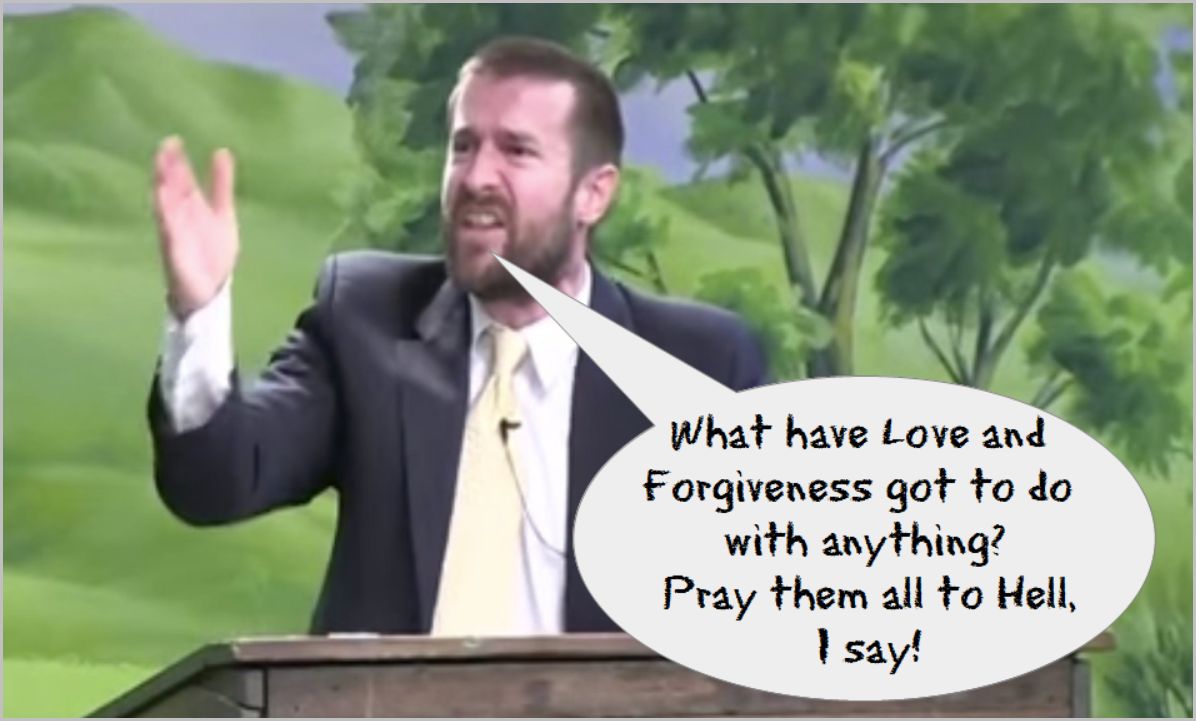
Jesus said ‘Love your enemies, pray for those who persecute you’ (Matthew 5.44). Our representative Christian says, ‘I’m gonna pray a transgender person dies and goes to Hell.’

Jesus said, ‘Love your neighbour as yourself’ (Mark 12.31). The Christian says, ‘The way to show love is to tell other people they’re going to Hell.’

Jesus said, ‘sell all you have and give to the poor’ (Mark 10.21). The Christian is concerned about where to buy jewellery: ‘…somewhere other than Tiffany’s, because Tiffany’s is gay friendly.’

Jesus said, ‘Forgive those who sin against you so you can be forgiven yourself’ (Matthew 6.14). Our believer rants, ‘LGBT people should be executed.’

Jesus said, ‘Don’t commit adultery and don’t get divorced’ (Matthew 5.27-28 and 19.9). Significant numbers of Christians , including our own Stephen Green, say, ‘that doesn’t apply to me.’

See what I mean? Christians regard the words of their saviour, not as having everlasting value, but as if they’re nothing more than worthless bits of fluff. Even if God were real, every word of the Bible true, every aspect of the Great Salvation Plan genuine, it wouldn’t change the fact that believers treat as optional almost everything Jesus commanded and live as if he never had.


* Why Christians Don’t Do What Jesus Tells Them To …And What They Believe Instead is available from Amazon worldwide (UK here, US here) but not, alas, from Tiffany’s.

The picture shows the deplorable Pastor Steven Anderson (linked above). He knows better than Jesus ever did.


Idiotic Stuff Jesus Said 11: Build Your Lives on the Things I Say

WhoDoJesus demanded you base your life on his teaching. It’s the only way, he said, that you’re going to find meaning, as well as the principles you’ll need when the going gets tough:

Everyone then who hears these words of mine and acts on them will be like a wise man who built his house on rock. The rain fell, the floods came, and the winds blew and beat on that house, but it did not fall, because it had been founded on rock (Matthew 7.24-25).

And what exactly were those words of his? Here’s what he taught:

  • The Son of Man was coming to the Earth to establish God’s Kingdom within the lifetime of his original followers (Matthew 16:27-28; Matthew 24:27, 30-31, 34; Luke 21:27-28, 33-34);
  • His own people needed to be more ‘righteous’ in order to be part of this Kingdom (Matthew 5.20; Matthew 6.33; Matthew 13.49 etc);
  • Being righteous entailed some extreme behaviour; loving your enemies, giving away all you had, turning the other cheek, forgiving repeatedly, being perfect (Matthew 5.44; Matthew 5.42; Luke 6.29; Luke 6.37; Matthew 5.48; Matthew 19.21);
  • It was crucial to obey Jewish law, even if some of it could be reinterpreted (Matthew 5.17-18; Matthew 12.1-7);
  • Once the Kingdom arrived Jesus himself would be King of the world, aided and abetted by his pals (Matthew 19.28; Luke 22.30);
  • His followers would do even greater miracles than he did himself. Given he controlled the weather, healed the sick and raised the dead, that’s going some (John 14:12).

Anybody know anyone who believes all of this or lives this way? Anyone who operates on these exacting principles? I don’t know of anyone and never have. I didn’t even when I was Christian myself. Jesus demands are impossible. No-one can live according to them. ‘Of course not,’ say Christians. ‘You need supernatural help to live like this.’ So why don’t they, when they have God’s spirit living within them (John 14.16-17)? Why don’t we see Christians who perform spectacular miracles, who constantly go the extra mile, who give away everything they have, who are, as Jesus tells them they should be, perfect?

We don’t because no-one can live as Jesus insisted they should. Nor do we see Christians who believe his prophecies either, particularly the one about the Son of Man bringing God’s Kingdom to Earth two thousand years ago. Christians pretend he didn’t really say it, or if he did, that he meant something else entirely. They’ve changed his very words – the ones they should be building their lives on – to claim Jesus himself will be returning any time now (the synoptic gospels are confused about whether Jesus is this Son of Man, or someone else). When he does, they say, true believers will be going with him to Heaven. Never mind that Jesus teaches nothing of the kind and there’s absolutely no foundation for these beliefs in his words. As such, they’re the faith built on sand he tells them is worthless:

And everyone who hears these words of mine and does not act on them will be like a foolish man who built his house on sand. The rain fell, and the floods came, and the winds blew and beat against that house, and it fell—and great was its fall! (Matthew 7.26-27).

So, if Christians don’t do what Jesus tells them and don’t believe his promises or prophecies, then in what way can it be said they take his words as the foundation of their lives? Don’t they, rather, base them on Paul’s teaching, about a supernatural Christ who bears little resemblance to the zealous Jewish preacher they pretend is their ‘Lord’? Teaching that has nothing to do with that of the man who demands his pronouncements be the very basis of life? Paul doesn’t quote any of Jesus’ teaching.  The foundation Jesus speaks of is of no interest to him; so, naturally, this is whom Christians follow – not Jesus, but Paul and his mythical Christ.

Christians have no time for Jesus’ words – and who can blame them? All he offers is impossible morality, false promises and failed prophecies. Far better to go with what Paul offers, because that’s about what’s in it for them. But even Paul didn’t believe anyone was going to Heaven, so they ignore that bit in his teaching too.

Always and Forever

nurseGod is trustworthy and true. He always keeps his promises. We know this because Christians, either in person or on web-sites, like to tell us so.

Let’s take a look at some of the promises God made back when he only liked Jewish people. How well do they hold up?

As part of his promise (covenant) with Jewish patriarch, Abraham, that he would look after his descendants in perpetuity, Yahweh came up with a particularly gross way for them to sign up:

I will always keep the promise I have made to you and your descendants, because I am your God and their God… Abraham, you and all future members of your family must promise to obey me. As the sign that you are keeping this promise, you must circumcise every man and boy in your family. This will be a sign that my promise to you will last forever. Any man who isn’t circumcised hasn’t kept his promise to me and can’t be one of my people… The promise I am making to you and your family will be for (your son) and his descendants forever (Genesis 17.7, 9-13, 21; my emphases).

‘Always’ and ‘forever’ obviously meant only until God changed his mind – which he did when he came up with the new ‘covenant’. You know the one: ‘believe in Jesus to be saved, no primitive surgery required.’ Of course, Jews still feel the original promise is in force and so keep up the old slicing’n’dicing membership requirement. So who’s right? Jewish people who feel that a promise is a promise? Or Christians who insist God eventually lost interest in mutilating penises? It’s hard to tell, but if it’s the Christians, then God, being omniscient and all, must have known he would change his mind eventually. So why tell ol’ Abe the agreement with him was ‘always’ and ‘forever’?

Then there’s the one where God promises there’ll be a descendant of King David’s on the throne forever:

I will establish your royal throne over Israel forever, as I promised David your father when I said, ‘You shall never fail to have a successor on the throne of Israel’ (1 Kings 9.5).

Oops. David’s line ceased ruling over Israel when the Assyrians defeated it in 586BCE. Since then there has been no king of the Davidic line ruling over Israel. Why didn’t God see this coming? And if he did, why’d he make a promise, with ‘forever’ and ‘never fail’, that he knew he wasn’t going to keep? Yes, I know Christians like to claim that Jesus took over the kingship when he came along, but he didn’t, not really. His descent from David is highly questionable and there’s still that awfully long gap between 586BCE and Jesus’ time that blows a hole in ‘never fail’ and ‘forever’. In any case, Jews, by definition, have never seen Jesus as their king and they’ve got a point: it’s difficult to see how someone dead and/or totally invisible can be king of anything.

Never mind, let’s try another. This time God’s promise that everything’s going to work out okay:

(The Lord) will judge between the nations and will settle disputes for many peoples. They will beat their swords into ploughshares and their spears into pruning hooks. Nation will not take up sword against nation, nor will they train for war anymore (Isaiah 2.4).

Safe to say this didn’t happen either. Not while people were still using swords and spears anyway.

Finally, what about the promise that’s trotted out every Christmas? –

For to us a child is born, to us a son is given, and the government will be on his shoulders. And he will be called Wonderful Counsellor, Mighty God, Everlasting Father, Prince of Peace. Of the increase of his government and peace there will be no end. He will reign on David’s throne and over his kingdom, establishing and upholding it with justice and righteousness from that time on and forever (Isaiah 9:6-7).

Whatever Christians might claim for these verses, they’re not about Jesus. At the risk of repeating myself, I’ll repeat myself: Jesus did not and does not reign on David’s throne. He said he would, it’s true, believing himself to be the fulfilment of ‘prophecies’ like this, but he was wrong, as events went on to demonstrate. He didn’t, in any case, fit the description of whoever it is who’s being spoken of here; an earthly ruler who – yes, you guessed it – has still to show up. We’d have spotted him if he had. Some Jewish scholars think they might have done, pointing to King Hezekiah who ruled Israel in the 8th and 7th centuries BCE, for almost 30 years. That’s hardly ‘forever’ though, is it. Yet more evidence that ‘prophecy’ doesn’t ever work, principally because it’s impossible to know the future.

God’s promises are like those of politicians: you just can’t trust them. There has to come a time when those who believe in them must face up to the fact they’re not promises at all, just ancient wishful thinking.

The Revolution Has Been Postponed

LiteralSo we all sat down on the grass and waited for the great man to speak.

“You’re a winner,” he said eventually, “if you’re ordinary and oppressed, because one day you’re going to rule the Earth!” Everyone gasped. We were all of us just ordinary, plain-speaking folk and things like this didn’t happen to us.

“Yes, really,” he said, “because God is going to establish his kingdom on Earth. And when he does he’ll sweep away the rich and the powerful, and you’ll be in charge. This I promise.”

We couldn’t believe it – proper gobsmacked we were.

“You’re in luck too,” the teacher went on, “if you’re poor, because once God’s kingdom comes, you’ll be rich beyond measure. And as for those of you who are hungry, you’re going to be filled like you’ve never been filled before. God, you see, is going to turn everything upside. Those of you at the bottom of the heap now – and let’s face it, that’s all of you sorry schmucks – are suddenly going to find yourselves at the top. And those who are on top now will be right down at the bottom. This, I promise you, is how it’s going to be.”

I can tell you everyone was beaming. We could already feel the change in the air.
Then Eli, sitting next to me sticks up his hand. “Hey, boss,” he shouts.

“Eli,” I says to him, “don’t be disrespectful. This bloke obviously knows what he’s talking about. He’s a messenger from God.”

“Yo, boss!” shouts Eli again.

“Yes,” the man up front says to him. “What?”

“When’s all this going to happen, then?” asks Eli. “When can we expect this big change?”

“Oh,” the teacher says, “I was thinking… maybe in a couple of thousand years?”

“What?” Eli says. “What good is that to us? From the way you were talking we thought all these wunnerful things were going to happen soon. What’s the point of telling all of us, sitting here in front of you, that we’re gonna be top dog and everything if it’s not us you’re talking about.”

“Good point,” the great man says. “All right then. How about if it’s sooner?”

There’s a lot of murmuring and everybody thinks this a good idea.

“Great,” he says. “Then that’s settled. We’ll make it sooner, so that you guys are still around. How does that sound?”

Everybody says it sounds marvellous.

“Great,” the big man says again. “It’s agreed, then – it’ll be soon. On that, you have my word.”

That was good enough for us and so we all set off home to get ready for the big changes we’d been promised.

“Thousands of years in the future,” Eli scoffs. “What a bloody con. Who does he think he is? God Almighty?”

There Is No God. And Here’s Why

adamSometimes I wonder why I continue writing this blog. There seems to be little that can shake believers from their delusions; what I write here doesn’t appear to be it. When they do respond it’s to tell me that I’m in for a shock when, after my death, I stand in front of the the throne of God and have to give an account of myself. I’ll not be smiling then, they tell me. They’re right, I won’t be. Not because of any ‘judgement’, but because dead people don’t smile. Not of their own volition anyway.

Christians can’t seem to see the ludicrousness of their post-mortem proposals. Religion, all religion, is wrong about most things at most levels; it denies death, which does exist, and replaces it with fantasies about supernatural beings, eternal life and judgements, none of which does. Christianity offers false promises, failed prophecies and an impossible morality, which Christians themselves can’t even manage. By and large they don’t even try to (see previous posts on all of this) yet they stick uncritically, unthinkingly, blindly to the fantasy elements of their ‘faith’ because they’re frightened of their own extinction and want to live forever. Christianity deceitfully promises them that they will – the ultimate false promise.

So let’s cut to the chase. There is no God. This is an indisputable fact, though believers will dispute it anyway. Even now, any Christians who are reading this will be muttering something about the fool saying in his heart there is no God; another tired, cliched response, which I’ve already considered here. But there is no God, not because of any foolishness on my part but because of the evidence. Or rather the absence of it. There is no evidence there is anything other than the physical universe or that life came about as the result of anything other than physical processes (it is not the case that scientists do not know how life emerged from non-life; they do and it did) or that humans evolved by any means other than blind, mindless natural selection. God is not required to explain any of this; not necessary to explain anything at all to do with life, the universe and ‘why there is something rather than nothing’. That being the case, we can know for certainty that he wasn’t in any way involved.

Let’s take a more down-to-Earth parallel to illustrate the point: we do not need to resort to stories of the tooth fairy to explain dentistry. I’m guessing that even Christians would agree with this; the tooth fairy has no part in matters of dental hygiene, orthodontist training or even the payment sometimes made by indulgent parents when their child’s tooth falls out. Trying to force the tooth fairy into any of these scenarios is not only entirely unnecessary, it’s erroneous and unhelpful. Dentistry is far better explained without reference to a mythical sprite. The tooth fairy not being needed, we can safely conclude that she doesn’t actually exist; she is a figment invented for children intended to take the away the pain of tooth loss, nothing more.

So it is with God in explanations into which he too is shoe-horned. He’s not needed, he’s superfluous to requirements. That being so, we can similarly conclude that he isn’t real either. A being that isn’t needed to explain anything is one that doesn’t exist.

This is not, note, a rejection of a figure who, even now, is sitting up in the sky somewhere feeling sad or angry because we’re ‘shaking our fist’ at him. If that’s what you’re seeing, you’re still believing in God, even if it is one you might be in the process of rejecting. It’s worse than that, Jim (or better): there is no super-being in the sky, or anywhere else. The universe is devoid of gods and of God; it always has been and always will be. There are none to be found because there are none there; not your pet god, nor those of other faiths, ancient or modern. None. There is only the physical universe itself and for the brief time we are here in it, we are lucky to be here in it. Which is more than any god has ever managed.

What Christians Believe: Part Two

AscensionHi, Thea Lojan here talking about the creed. Here’s what else it says, following on from last time:

I believe Jesus ascended into heaven and is seated on the right hand of God and will come to judge the living and the dead. As I was saying, Jesus could do amazing things. He could, like, beam up into the sky and out into space – that’s what ‘ascended’ means. Amazing. And he is coming back to judge the Earth, just like he promised. I know he said he’d be back real soon, like while his disciples were still alive, but to God a minute is like a thousand years so a few years can be anything like a million, or something like that. We shouldn’t take it literally when he said he’d be back while his friends were still around, though the Bible is, without a doubt, the literal Word of God.

Anyway, when he returns Jesus is going to send those who don’t believe in him to Hell, where they’ll suffer eternal torment for, like, forever and ever, amen. And he’ll take people who are saved, like me, back to Heaven with him. I can’t actually find the bit in the Bible where he says he’ll be taking me to Heaven, but I have faith so I’m sure he will.

Just a thought, but why doesn’t this creed mention the Bible, and how it’s the ineffable and literal Word of God? You’d think it would, wouldn’t you.

I believe in the Holy Spirit, the holy Catholic Church and the communion of saints. Definitely. The Holy Spirit is like the feeling of God that you get when you’re being blessed. You can’t see it – though it’s actually a ‘him’ because God is a ‘him’ – but it’s there, helping you make decisions, like whether you should buy a new car or install a heated pool in the yard. You definitely get a sense of him then. In my experience, he’s never let me down. He always guides me right.

I’m less sure of the holy Catholic Church because of course we’re not all Catholics and nor should we be when Catholics have got everything so wrong. But the pastor at church says it just means ‘the Body of Christ’ here, the same as ‘the communion of saints’ does, though that makes you wonder why we’ve got it in there twice. The communion of saints means all worshippers everywhere being united and working together. So, yes, I totally believe that because, that’s what we do as Christians; we all love each other. I don’t accept any of those lies that some people put about that there’s, like, 41,000 different kinds of churches. I don’t think God would let that happen, do you?

I believe in the forgiveness of sins. Yes I surely do, for God has forgiven my sins through the redeeming blood of the Lord Jesus Christ, his son. And if they’re really, really sorry I can forgive the sins of others, except of course if they’re, like, homosexuals. It really grosses me out to think about what so-called “gay” people do with each other. It’s unforgivable and even the Lord doesn’t forgive it. But my sins, yes, he forgives those.

The resurrection of the body and the life everlasting. Well, I already covered this. This is another repeat. What this really means is that everyone whose sins are forgiven and have been saved will go to live with God in Heaven after they die. Isn’t that amazing? Just think, whatever happens to your body all the time you’re dead, even if it’s been burnt or has rotted away to nothing, God will repair it and make it good as new. And then you’ll live forever in Heaven, because that’s what it means when it says ‘the life everlasting’. Even if I still can’t find that bit in my Bible.

Well, that’s it. That’s my creed, and what Christians everywhere believe. It was written, in fact, by the apostles, that’s Jesus’ friends, way back when he was still alive or just after. If you were to give your life to the Lord – and you really should if you want live forever in Heaven – then it’s what you’d believe too. Isn’t that, like, really, literally incredible?

Idiotic Stuff Jesus Said 9: God knows what you need before you ask him

PrayJesus said: ‘Do not be like non-Jews, for your Father knows what you need before you ask him.’ Matthew 6.8

Prayer has been in the news quite a bit lately. Not, of course because it’s suddenly started working, but because prominent Christians have been pretending, yet again, that it does:

Archbishop of Canterbury, Justin Welby, has been telling us just how important prayer is. He prays for others while he does the ironing.

The pope has been praying for victims of Islamic State.

Churches in Glasgow have been praying for the victims and families involved in last Monday’s terrible accident there.

Bishops in Australia prayed for victims of the Sydney seige.

Christians inherit this futile behaviour and empty posturing from Jesus himself. He believed that talking ‘in secret’ to his god-in-the-sky could actually change things down here on Earth. This God, according to Jesus, knew what his children wanted even before they asked.

His children were not, however, Christians; they were Jews. The phrase I’ve interpreted above as ‘non-Jews’ is ‘Gentiles’, which means exactly that – outsiders who weren’t Jews. These outsiders, Jesus implies, just don’t get prayer. Only the chosen people, the Jews, do. Only they know how to talk to the big Sky Daddy properly and it’s only their needs that he knows about beforehand. He isn’t interested in others, their needs or their prayers.

But if he knows the needs of his chosen before they even ask him, why doesn’t he simply meet those needs? Why does he have to be asked? What sort of perverse and twisted version of a loving father is this, who insists on being asked before he will consider acting? I’m only a fallible and flawed human being but when I know my children’s needs, I don’t wait to be asked to meet them.

Maybe God isn’t really as magic as Jesus seems to think. Maybe he needs time to let things happen by chance so that he can then take the credit. Because there’s absolutely no evidence prayer works. The opposite is the case; there’s plenty of evidence to suggest that the supposed results of prayer are no more likely than if they happened by chance.

As if this weren’t ludicrous enough, many of the examples of prayer we’ve heard about recently are prayers after the event; appeals for the victims and survivors of disasters once the disaster has struck. So did God not know those involved ‘needed’ not to be killed or tortured or bereaved? If he didn’t already know this, then Jesus’ claim is, like so many others he made, utterly worthless. And if God did know, why did he not do anything to prevent the loss of life, the hardship, the devastation? Because he wasn’t asked

It’s likely though that he was asked, by those believers who were caught up in appalling circumstances. So then, why didn’t he act? Why didn’t he meet those needs he knew so much about beforehand?

Perhaps he just doesn’t care or he’s not able. Or, more likely, maybe he doesn’t exist.

And if he doesn’t exist, then Jesus was wrong in everything he said about him. He was wrong to think God was there in Heaven, taking an interest; wrong to think he cared. It also means Jesus certainly wasn’t the son of any such god. Nor was he the human manifestation of a make-believe Sky Daddy on Earth.

Banned from the Kingdom of God

PaulHere’s ‘Saint’ Paul’s list of those who won’t be allowed in God’s Kingdom:

Do you not know that the unrighteous will not inherit the kingdom of God? Do not be deceived; neither the immoral, nor idolaters, nor adulterers, nor sexual perverts, nor thieves, nor the greedy, nor drunkards, nor revilers, nor robbers will inherit the kingdom of God. (1 Corinthians 6. 9-10)

We can do better than that though. Who else could we add? How about the self-righteous? The converted? The born-again? The saved? Fundamentalists? Evangelicals? Evangelists? Ministers, bishops and popes? Christians of all stripes and persuasion? Will they all make it into the Kingdom?

No, they won’t. Not one of them will enter the magic Kingdom.

Why not?

Jesus, Paul and other New Testament writers were sure that the Kingdom of God would be arriving on the Earth soon. That’s ‘soon’ as in their own time, 2000 years ago*, and, as you’ll have noticed, the Kingdom, promised in the past for the past, never arrived. It’s not going to now either; neither Jesus nor Paul thought their fantasy was going to materialise some time in the distant future.

More than this, both were wrong that God was preparing to establish a heavenly kingdom on Earth at all. They were religious fanatics caught up in the religious zeitgeist of their day, religion being all they had to explain life, the universe and everything. Their interpretation was wrong on so many levels – but they were stuck with it. And so, when so much seemed unjust, unfair and unreasonable to them, Jesus in particular felt sure the only solution was for God to intervene to set things right; the meek would inherit the Earth, those last would be first and the first last. It was a dream, a vain hope, a complete invention. Not only did the Kingdom not arrive when Jesus and Paul said it would, it was never going to. There was no God waiting in the wings to make everything better.

So don’t worry if you’re gay or you like sex with more than one partner or you drink a bit too much or you’ve not been as honest as you might have been. You won’t be part of the Kingdom of God, to be sure, but that won’t be because of your sexuality or your morals or your ‘lifestyle’. You won’t be part of the Kingdom because it isn’t real. You’ll be in good company though – those who love the Lord won’t be getting in either. They’re just as far from Jesus and Paul’s land of make-believe, their special magic club, as you are.


* See Matthew 24:27, 30-31, 34; Luke 21:27-28, 33-34; Matthew 16:27-28; Matthew 19.28; 1 Corinthians 15.51-52; 1 Thessalonians 4.15-17; 1 John 2:17-181 and Peter 4.7 for predictions by Jesus, Paul and other NT writers that the Kingdom was coming real soon.