Spiritual Forces of Evil in the Heavenly Realms

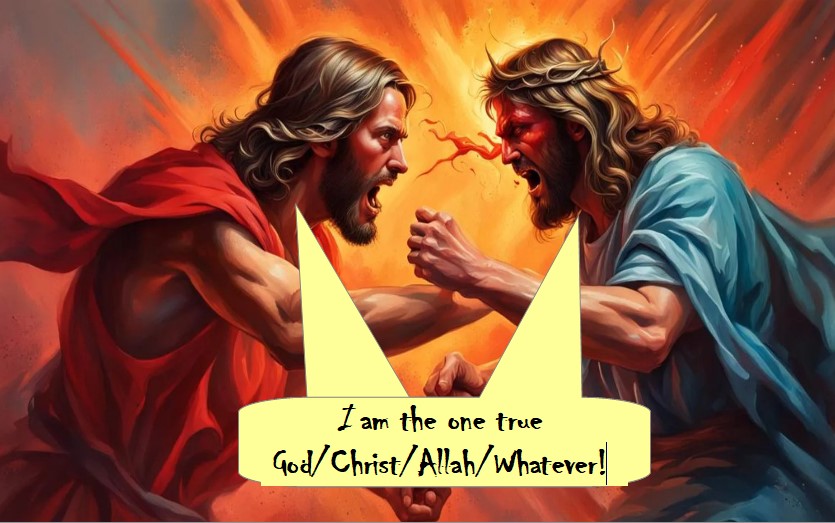
Original AI image from Night Cafe 

For our struggle is not against flesh and blood, but against the rulers, against the authorities, against the powers of this dark world and against the spiritual forces of evil in the heavenly realms. (Ephesians 6:12)

…you followed the ways of this world and of the ruler of the kingdom of the air, the spirit who is now at work in those who are disobedient. (Ephesians 2:2)

the prince of this world now stands condemned. (John 16:11)

The first-century worldview of early Christian cultists was that somewhere above the Earth a battle raged between God and Satan. The powers of darkness – the devil and his demons – had in ages past launched an attack on the Lord and his angels. This war in the spiritual realm continued unabated up to the time when a cultist wrote Ephesians, pretending to be Paul. Paul himself had already alluded to Satan as the god of this age (2 Corinthians 4:4), while the authors of the fourth gospel would later refer to him as the archon – ruler and prince – of this world (John 12:31; 14:30).

Which just goes to show how the Almighty God they believed in was nothing of the sort. He had tussled with his arch-enemy for eons without quashing his rebellion and putting an end to his persistent attacks. The stand-off had gone on for millennia, and, according to today’s Christians, is still happening. A puny god it is who cannot get the better of one of his far less powerful creations.

And what are God and Satan fighting over? Us, apparently. The devil wants control of human beings.

Why? Who knows. In fact, according to Paul, Satan already has control over us. He enslaves us to sin, which in turn leads to death (Romans 5:12, 6:23). 

Not to worry though, Paul, fake Paul and the fourth gospel writers assure us that their enfeebled God has a cunning plan! He’ll allow a being who is precious to him – like a son, in fact – to be sacrificed so that anyone who believes in him will no longer be enslaved to Satan and sin and will be granted eternal life. How’s that for special magic!

Who shouted out from the back that that sounds like a cop-out? It’s a fantasy bordering on the insane. Like it or not, we are somehow embroiled in heavenly warfare, specially if we’re of the number who’ve bought into this malarkey.

While we’re at it, have you noticed how so many of the wars and skirmishes currently afflicting the world have religion at their heart? YHWH is scrapping with Allah, Allah is up against the Great Satan while Jesus – no stranger to war-mongering himself – presides over it all, leading the world to Armageddon and his own ultimate ‘return’.

Here’s my suggestion. All the gods and demons need to get their act together. They should agree to an ultimate slug-fest, a final battle in the spiritual realm to decide who’s really the Supreme God – the last deity standing – and leave us humans out of it entirely. Surely, being gods, they’re up for finding out who can piss furthest up the wall.

A preposterous idea? Of course it is. None of these fantasy beings exist. There’s no YHWH, Allah, Heavenly Father, Jesus, Krishna, angels, archons, Satan or ‘spiritual forces of evil’ to duke it out. There’s no ‘heavenly plane’ where they can get to it. Everyone of these despotic characters is a human creation, as are the wars, disputes and skirmishes they underpin. It follows that none of them can be the supreme god and certainly none of them are worth fighting over. It’s time we grew up and put away all of our childish imaginary tyrants.

What to make of the Supernatural

When I was young, about 8 or 9, I was frightened of creatures that invaded my bedroom in the dark: monsters under the bed, devils in human form lurking in the shadows, that kind of thing. One night when I couldn’t sleep through fear, it came to me that if these creatures were real then so too were the super-heroes I loved: Superman, Batman and the Legion of Super-Heroes! Now, I knew these DC characters didn’t really exist and so I reasoned (I think pretty well for a 9 year old!) that that neither did their evil counterparts, the monsters and devils I was scared of. With this realisation, the horrors were vanquished. Shadows were just shadows. There was nothing scary under the bed.

Somewhere in a recent comment, either here or elsewhere (I can’t remember which nor can I find it), someone informed me that I make the a priori assumption that the supernatural isn’t real.

The term a priori is used with abandon by people who don’t necessarily know what it means so here’s how The Oxford English dictionary defines it:

relating to or denoting reasoning or knowledge which proceeds from theoretical deduction rather than from observation or experience.

I’ll take that. The only way one can assess the supernatural is through reasoning and deduction. There’s no independent evidence for it that can be considered; no external phenomenon to observe and analyse; no science, history or philosophy books that take it seriously or even consider it. I have no personal experience of the beings that supposedly inhabit the supernatural realm; no gods, angels, spirits, demons, ghosts or goblins have manifested themselves in front of me. I’ve never experienced magic, spells or exorcisms, at least not ones that can’t be explained far more convincingly in other ways. So what does that leave in terms of evidence?

Fantasy stories and religious texts. These are the only sources of information about the supernatural, and at least one of them is entirely fictional. Fantasy stories are by definition fiction. They are made up. Similarly, religious works are the products of minds from before the advent of science; explanations of the world and human experience that their creators could construct only in terms of their localised, pre-scientific superstitions. No-one outside of those who’ve chosen to believe in them takes them seriously, which is why their claims are never considered in serious science or history books (Ken Ham’s ‘scientific’ publications are nothing of the sort; they’re religious texts masquerading as science.)

That the supernatural has to be argued for, from an assumption that it does exist, is clear indication it does not; such powerful beings would surely be apparent in the real world, just as they are in Stranger Things (a fiction in case you’re not sure.) No-one has so far demonstrated that the supernatural is real. It is possible to argue it is but only through reliance on the same religious texts, the authority and reliability of which is in dispute on such matters

So, do I make an a priori assumption the supernatural doesn’t exist? Yes, in the sense I take it a priori that it doesn’t. Is this an assumption? No, it is a conclusion arrived at through an assessment of the evidence – there isn’t any: consideration of accounts of the supernatural reveals they’re fictional or prescientific, while personal experience of the apparently supernatural is better explained by rational means. I don’t therefore assume the supernatural doesn’t exist, I deduce it does not.

Actually, I did this when I was 8 or 9.

When A Child Is Born… Supernaturally

To what extent are the conflicting nativity stories in Matthew and Luke historical? That depends on whether or not you believe in the supernatural.

There is no evidence of a supernatural realm nor the beings who are said to inhabit it: God, heavenly Jesus, the Holy Spirit, angels and those they are constantly at war with: Satan and his demonic hordes. It is not as Jonathan Cahn describes it in The Serpent’s Prophecy:

Behind the perceivable realm lies another, beyond our ability to measure or quantify. Behind the history of this world lies another, unrecorded, unrecited, unknown. And behind that which moves and transforms the world lie unseen forces, causes, agents, undying and primeval (p3).

Cahn cannot possibly know any of this, any more than fake-Paul could when he wrote Ephesians 2,000 years ago (6:12). A reality that exists above and beyond nature – the meaning of supernatural – that is ‘unseen’, undetectable and ‘unknown’ is one that doesn’t exist, except in the imagination of a few fantasists.

Yet the supernatural is the basis of Christianity. Without it, its agents, as Cahn calls them, could not have interacted with the only reality there is. The Holy Spirit could not have impregnated Mary; angels could not have materialised to announce Jesus’s birth to a group of credulous shepherds; a divine being could not have communicated through dreams with Joseph and the Magi; a magic star could not have been manoeuvred into place over Jesus’ house. Most significantly, a non-existent God could not have sent his ‘son’ into this world.

It is futile to argue whether Matthew or Luke’s nativity narrative is the more historically accurate. Nor is there any point in trying to harmonise the two accounts. Neither is historical: the involvement of the supernatural rules out their being factual.

The inclusion of the supernatural in everything that follows is also fatal to claims made for the gospels’ historicity. The clues are there in the text: God’s pronouncements from the sky; the inexplicable miracles and healings; the presence of angels, demons and Satan; the dead rising; visions, prayers and prophecies. These tell us that what we’re dealing with is fantasy material. The creators of the gospels and other books of the New Testament had no more evidence than Cahn does that secretive super-beings existed, even if they did take them for granted. God and his interventions no more exist than Santa Claus and his magical Christmas deliveries.

Paul tells us that God raised Jesus from the dead (Romans 8:11). But there is no God, so he didn’t. There was no supernatural resurrection and without a resurrection there were no encounters, like those in the gospels, with a reanimated body.

Remove the supernatural from the Jesus story and there’s nothing left. Some wise advice lifted from Jewish scripture perhaps, plus a few cult rules, but that’s all. Paul’s experience of the risen Christ, like that of Cephas before him (described nowhere in the New Testament but allegorised in the gospels) and John of Patmos after him, were as Paul himself says, a ‘revealing’ in their own heads.

I hope none of this spoils Christmas for you. The Nativity isn’t a bad story, indeed it’s quite beautiful in places. But it is not historical. Like much in gospel Jesus’ life, and the resurrection itself, it is a fantasy generated by irrational and superstitious minds.

A very happy Christmas to both my readers.

My Gay Demon

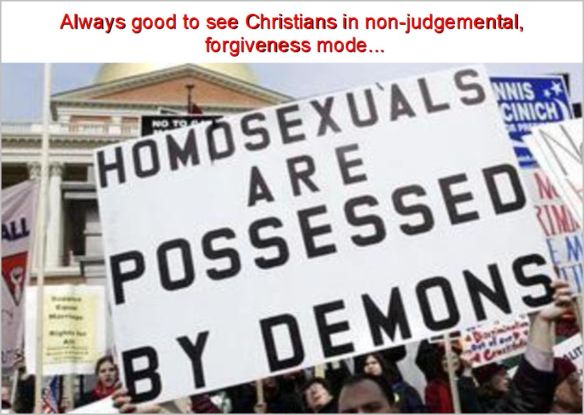
I am demon possessed. I know this for a certainty because Christians all over the Internet tell me. I am gay therefore I am possessed by a demon. Maybe more than one, I don’t know.

I’ve been trying to get in touch with my inner demon but he’s been keeping schtum. I assume he’s a him given he’s a demon of gayness, but again who knows. I’ve enquired in the deepest, darkest recesses of my mind and have searched my heart (though if I’m honest I wasn’t really sure how to do this) and can’t find him anywhere.

I was going to ask him why, if he’s a demon and therefore a real nasty piece of work from the pit of hell, why he’s led me to a happy and loving relationship with Dennis, one that has taken each of us from loneliness and depression to peace and contentment. I just didn’t know demons were so… well, so positive and creative. I always thought they were destructive and devious, like C. S. Lewis’s Screwtape. I think mine must be shy and more like Casper the Holy Ghost.

Alternatively, maybe there’s no such thing as demons, invisible evil super-beings who can’t be detected in any way. In my ‘worldview’ anything that’s invisible, undetectable and is a figment of rather dim-witted people’s imaginations is a being that doesn’t exist.

But then maybe that’s just me.

  And science.

    And every other academic discipline.

       And rationality.

         And reality.

It’s possible, after all, that a book written thousands of years ago by ignorant religious zealots trumps all of that.

Where’s Jesus?

Not a rhetorical question. Christians keep telling us that he’s alive, so where is he exactly? If he’s alive he has to be some place. The old hymn, ‘I Serve A Risen Saviour’, which I sang many times in my younger days, thinks it knows:

He lives, He lives, Christ Jesus lives today!
He walks with me and talks with me along life’s narrow way.
He lives, He lives, salvation to impart!
You ask me how I know He lives?
He lives within my heart.

This isn’t much use though, is it. All it’s saying is ‘I’ve convinced myself Jesus is alive because I feel him inside me.’ That’s the extent of it, and this being so, it’s really no evidence at all that Jesus is alive in any sense the word is usually understood, let alone that he has an independent on-going existence.

Perhaps the bible will be of more use. Acts 7.55-56 has Stephen see Jesus alive in heaven, standing at the right hand of God. Well, that’s great. Now we’ve got two problems. Not only do we still not know where Jesus abides, we don’t know where God lives either. They’re both together somewhere, ‘heaven’ according to Acts says, but we’re no closer to knowing where this is either.

According to the preceding verse, Acts 7.54, Stephen is ‘looking up’ when he has his vision of heaven. This is significant because for early Christians, God’s abode – heaven – was in the sky. The New Testament speaks of different levels or realms of heaven, all of them up in the sky.

In 2 Corinthians 12, Paul claims to have visited the third (and highest?) level, while the Paul-imposter who wrote Ephesians helpfully explains that the lower level, the one nearest the earth, is occupied by demons and Satan’s minions whom he refers to as ‘the powers of the air’, ‘cosmic powers’ and ‘powers and principalities’. These are the very beings whom Paul claims in 1 Corinthians 2:8 killed Jesus (betcha thought it was the Romans) and 1 Peter 5:8 says seek to devour men’s souls.

Next is the heavenly realm inhabited by angels and the original perfect copies of everything here on Earth (Hebrews 9:22-24).

Then, finally, there’s the highest heaven (alluded to in Luke 2:14)) where dwells the CEO, God himself. If Jesus stands or sits at his right hand, then presumably that’s where he is too. But where is this highest heaven, or indeed any of the levels the early cultists believed existed? There’s no evidence for any of them.

In fact, the Bible’s heavenly hierarchy (which you can read about in detail here) is absolute drivel. Above us, as John Lennon was known to say, is mere sky – the stratosphere, mesosphere, thermosphere and the like – followed by the endless vastness of largely empty space. If Jesus is alive in an imaginary highest heaven somewhere out there, then he, like it, is similarly non-existent.

But let’s not write a living Jesus off just yet. It’s possible that he, his Father and all those lesser supernatural beings – the demons and devils, powers and principalities as well as the angels and snoozing saints – are hidden away in some other invisible and undetectable alternate dimension.

Other dimensions are, according to some scientists, theoretically possible. There may, they say, be as many as 11, but unfortunately for Jesus, none of the Bible authors knew of them. Those who wrote about heaven in the early days of the Jesus cult, were convinced it was overhead and, as ‘intellectual’ Christians are fond of pointing out, we need to read and interpret scripture as the ancients themselves did, not with a modern sensibility. Certainly not with an understanding of ‘dimensions’ derived from Star Trek.

Despite this, theologians have to work mighty hard to transplant such theoretical dimensions into the Bible in order to claim that heaven, and therefore Jesus, exists in one of them. And work hard they do, at what is little more than a god-of-the-gaps argument: ‘we know Jesus is not a few (or even many) miles up above us, therefore we must find a location for him somewhere that science appears to allow.’

(Interestingly, when it comes to the fine-tuning argument, apologists are quick to dismiss the idea of other dimensions, multiverses and parallel worlds; these make the earth less special, less ‘just right’ for life, less designed by God specially for us.)

Locating the living Jesus is like finding Wally/Waldo in one of those cluttered pictures, except this time he hasn’t been included. So tell us, Christians, where is Jesus? And where is the evidence he’s where you say he is?

Assertions

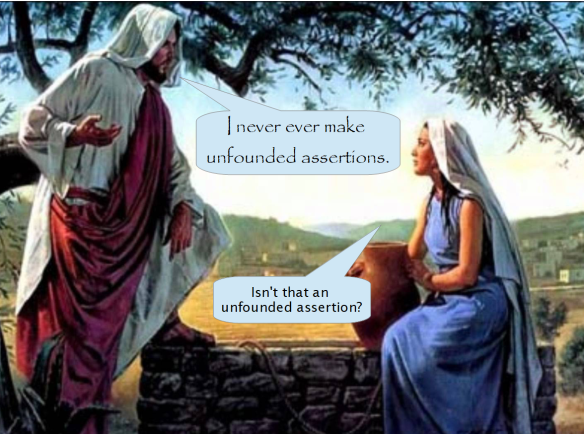
Don likes to take me to task for what he says are assertions in my arguments. I do make assertions, as do we all, because not all points in an argument need to be demonstrated every time they’re used. Indeed, not all assertions can be.

There are assertions that we all accept are likely to be true: the sun will ‘rise’ tomorrow; the Earth is a sphere; evidence is better than no evidence and so on. There are those who dispute these assertions but the onus is then on them to provide the evidence or argument that their counter-assertion is true. Yes, there may come a day when the sun doesn’t rise but it is statistically improbable; the Earth is demonstrably not flat; faith is not an reliable substitute for evidence. There is abundant evidence and sound argument why these things are not the case. But – and this is my point – this evidence does not have to be trotted out every time an argument relies on such probabilities; they can be asserted.

I write, and indeed live my life, on the basis of the fact (‘assertion’) that the supernatural does not exist. Over the last ten years, I’ve posted several arguments why this is the case. I frequently provide a link to these arguments when asserting that, outside of the human imagination, gods, spirits, angels, devils, demons, powers, principalities, ghosts, avatars, heaven and hell do not exist. These arguments form the backbone of any subsequent assertion that the supernatural is not real.

Nonetheless, the onus to ‘prove’ that this is the case does not rest with me. First, because it is impossible to prove a negative. Consider, for example, the Christians challenge to prove their God doesn’t exist. While there is plenty of circumstantial evidence that this is the case, there is no absolute ‘proof’ of God’s non-existence (as I’ve argued before, it all comes down to probability, or, in God’s case, improbability.) Absence of evidence is invariably evidence of absence.

The onus instead lies with the one making the incredible claim. Those who take it as fact that the supernatural and God are real need to demonstrate to the rest of us that this is the case. They have, in my long experience, failed to do this. The best they can do are the various arguments (the ontological, Kalam cosmological, teleological, fine-tuning and the argument from design) that suggest the possibility of the supernatural but fall far short of convincing evidence that the supernatural is real, and further still that the Christian God exists. They depend in the end on the feelings they have in their heads and the Bible (or some other holy book.) This is wholly inadequate

Consequently, I’ll continue to operate from and make my assertion that the supernatural does not exist until such time as Don or any other of his co-religionists demonstrate the probability that it does.

From my assertion, backed up, remember, by earlier arguments, a number of other facts follow:

With no supernatural, there are no gods; YHWH in all his incarnations is a God, therefore YHWH does not exist.

Much follows from this:

If YHWH does not exist, Jesus cannot have been either his avatar, Son or incarnation;

Jesus cannot have been raised from the dead by a being who doesn’t exist;

Stories that he did so must therefore be merely that: stories;

The celestial, eternal Jesus who sits at the right hand of God in heaven is not real;

Any experience people have of this being is entirely within their own imaginations;

The Bible is based on such imagined encounters with these imagined characters;

There is no after-life or judgment;

The Christian faith, including my own, cannot be explained in terms of the supernatural;

Only explanations that are rooted in naturalism, as in science, have any validity.

There are more implications that can be drawn from the premise that there is no supernatural, including the fact that the world makes much more sense (if it makes any sense at all) without drawing gods and demons into it.

Consequently, I shall continue to make my assertions, like those above, supported as always by previous argument. Any religious believer who wants to challenge them is welcome to do so, but must do more than point out the obvious, that they are assertions. They must provide the evidence for the supernatural, and all that follows from it, independent of the goings on in their heads and without reference to holy books written by those with similar subjective feelings.

The Trouble With Atheists: A Christian Sets Us Straight

My friend Bruce Gerencser was good enough to repost my previous post on his blog. It prompted a comment from someone calling himself James Thompson, who Bruce says used a fake email address and quite possibly a false name. (These Christians; so fearless and honest in all their doings!) Here’s what ‘James’ had to say:

It’s because that’s what you live to do argue the truth. You’re not “atheists”. Antitheists yes. Agnosticism yes. A true atheist would not give a rip about the discussion on this blasphemous blog.

And atheists don’t go out seeking to remove Mickey Mouse from everything.

Or Buddha or Mohammed.

But they do Jesus Christ because Satan knows he is the only one who can bring salvation

I did respond to James on Bruce’s blog but wanted to address his garbled points, such as they are, more fully here. They’re typical of the low level thinking Christians and others use to defend their beliefs.

It’s because that’s what you live to do argue the truth.

Amazingly James has an uncanny insight into the minds of atheists; we live only to argue the truth, by which he means, presumably, critiquing his pet deity and magical saviour. Most of the time, most atheists barely give these two mythical beings a second thought; neither do I when I’m not blogging. I live for entirely different things.

You’re not “atheists”. Antitheists yes. Agnosticism yes.

But wait! People who don’t believe in his God aren’t, according to the omniscient James, atheists; they’re anti-theists. Okay, I concede; I am opposed to the notion that there’s a loving God somewhere out there who is interested in us and has made it possible for us to know him by, according to James and other deluded souls, making his only son a blood sacrifice. I dispute this silly idea, which has no evidence to support it, and is, as Jesus is made to say in Matthew 11.25, irrational and illogical. So yes, I’m an anti-theist. I’m also anti-theist because of what believers in the one true God (in his various guises) do terrible things to each other and to non-believers. And when they’re not doing that, they’re parading their ignorance, propagating their book of myths and spells, denying evolution, dumbing down children’s education, suppressing LGBT+ people and threatening everyone who doesn’t subscribe to their superstition with eternal damnation. I mean, what’s not to like?

 A true atheist would not give a rip about the discussion on this blasphemous blog.

And then James returns to his mind reading act. How does he know what a ‘true atheist’ might think of Bruce’s blog? There are plenty of atheists who comment there; whether they are ‘true’ atheists apparently only James knows.

And atheists don’t go out seeking to remove Mickey Mouse from everything.

It is true atheists (which we’re not, according to James) don’t seek to remove Mickey Mouse from everything, whatever this means. But then Mickey Mouse doesn’t start wars, condemn everyone as wicked sinners or try to control their sex lives. Disneyworld would quickly go out of business if he did. (That Donald Duck is a different kettle of fish however.)

Or Buddha or Mohammed.

James then scrapes the bottom of the cliché barrel: ‘You wouldn’t dare criticise the revered characters of other religions’. Yes, we would. As I said in my post, which evidently James didn’t read, there is no supernatural. All gods, ghosts, spirits, angels, demons, heaven and hells, from whichever religion or superstition they emanate, are figments of the imagination.

But they do Jesus Christ because Satan knows he is the only one who can bring salvation

These two as well. The Christ and his evil doppelganger, Satan, are human inventions. As fantasy figures they are open to as much ridicule and ‘removal’ as any other imaginary being. Perhaps more, given the damage they’ve caused and continue to cause.

James has been sold salvation snake-oil and thinks that because he’s been duped, everyone else should be too. Or at the very least should respect his delusion. Ain’t gonna happen, Jimmy boy. You need to grow up a little. And maybe also learn some grammar.

Slippin’ and Slidin’

Recycled picture, new post

I’ve written before about how impossible it is to argue with Christians. It’s either that they have superior knowledge because an invisible ghost possesses them and is guiding them towards truths that non-believers can’t possibly perceive. Or it’s that the supernatural just cannot be understood in an evidential, naturalistic way. Science and empiricism – what we can detect with our own eyes, with specialist equipment that serves as an extension of those eyes or that can be mathematically demonstrated – just cannot detect, perceive or understand the supernatural. Gary Matson is currently experiencing this on Escaping Christian Fundamentalism, where a Catholic Christian (an oxymoron to many other religionists) is arguing that the things he believes in – hell specifically and his God generally – are just too sophisticated for the ignorant layman to understand. We’ve met this before too, from pseudo-intellectual Christians who think their faith, which its supposed founder said was best understood by becoming like a child, requires a degree or three in theology or philosophy.

It’s all a sleight of hand, and rather like wrestling with a jelly-fish. The assertion that the believer in the supernatural makes, that his or her particular brand of woo lies outside the purview of science, is mere flannel. ‘You can’t prove this because you haven’t the tools to’, applies to any form of magical belief – in heaven and hell, in an afterlife, in ghosts, and angels, gods who speak to mortals, mystical saints, flying horses, reptilian overlords, UFO abductions… you name it – does not stand up to scrutiny. If supernatural entities and states are outside the natural universe (and they are, by definition) then they will never be detected by science, observation and empirical measurement; but not because our means of detection is inadequate, but because they don’t exist. It isn’t that they are out there somewhere, detectable only with the right frame of mind or with the help of a spirit that itself has no physical presence; they are nowhere; they are not real. It is not the inadequacy of our means of detection that is at fault; it is that the invisible, non-physical and intangible have no substance outside the human imagination. As I’ve said before, remove human imagination from the equation and the supernatural goes with it. If humans were to become extinct tomorrow, so too would all the magical beings and places that humans have ever conjured up. They have no  existence independent of the human imagination.

Arguing that this isn’t so is to assume your conclusion in your premise: ‘Of course supernatural things exist, you just can’t see them. But I can prove them with my argument/philosophy/faith’. This, however, is a demonstration of irrationality, not of the supernatural. In any case, the fact the supernatural has to be argued for at all is evidence that it doesn’t exist. Nothing real has to be argued for, it can be detected, shown, demonstrated and measured by the senses, by instruments, by mathematical proofs. That gods and ghosts can’t be, but have to be argued for, tells us they are not real – not that they are beyond the scope of our capabilities.

Prophets At A Loss (again)

What a joy it is to witness the prophets of the Lord who a few weeks ago assured the world that Jesus had told them Donald Trump was going to win the US presidential election. Look at them floundering now to explain away their foolishness:

Pat Robertson on 20th October: ‘Without question, Trump is going to win the election.’

After the election: ‘Here is my take on the election. In my opinion I think Trump won it. That may shock you… There are cases being filed in many courts but I don’t give them much chance of winning.’

Paula White on 5th November: I hear a sound of victory. I hear a sound of abundance of rain. I hear a sound of victory. The Lord says it is done. The Lord says it is done. The Lord says it is done.

After the election: ‘God’s decision has been made… the church must enforce some things in the realm of the Earth. We must take authority over every demonic spirit, every high thing.’

Kat Kerr on 24th October: ‘Trump will win. He will be president of the United States. He will sit in that office for four more years and God will have his way in this country.’

After the election: ‘One of the things [God] had me say was that Trump would win by a landslide… But many times, as we know in the Word or even just from experience ourselves — especially as a prophet — that doesn’t ever mean what man thinks that means.’

Jeremiah Johnson on 30th September: ‘I had a dream… God showed me… President Trump will be re-elected.’

After the election: ‘There has been a chorus of mature and tested prophets in America with a proven track record that have predicted Donald J. Trump would be re-elected President of the United States. I am one of them… Either a lying spirit has filled the mouths of numerous trusted prophetic voices in America or Donald J. Trump really has won the Presidency and we are witnessing a diabolical and evil plan unfold to steal the Election. I believe with all my heart that the latter is true.’

Denise Goulet on 19th October, speaking to Trump in person: ‘The Lord showed me today that you are going to get a second wind…another in-filling of the Holy Spirit…because the Holy Spirit makes you able to finish, to take this to the end, Mr President.’

After the election: f*** all.

It’s demons! An evil plan! I meant something else! I still think I’m right! I hope everyone forgets what I said.

Friendly Atheist Hermant Mehta has a whole lot more. These people are either frauds or self-deluded idiots. It’s stating the obvious to say that God and Jesus do not communicate directly with them. They haven’t been singled out to receive divine messages. Yet that is what they believe, or claim to anyway. They know no more about the future or God’s intentions than a typical house fly does. Yet the gullible, those caught in the same pretence that is Christianity, believe them. Yes, there are smart arse discerning Christians out there who say they never fall for these charlatans. Yet they do.

In Jesus Eclipsed, David Chumney cites Eugene Boring who, he says, ‘catalogs dozens of sayings ascribed to Jesus in the Gospels that very likely originated with later Christian prophets’ (my emphasis). Yet the writers of the gospels pass off these ‘spiritual insights’ as though they were Jesus’ own. Those who first read the gospels believed they were. Christian’s today assume the same. They’re not. They’re the words of religious zealots making things up as they went along. Some, most perhaps, no doubt believed what they were channelling the words of the Lord. Others wouldn’t have been quite so sincere.

There is no such thing as a prophet. God doesn’t make his intentions known through cranks and fraudsters. There’s no God and no Eternal Jesus to do such a thing, as today’s holy con-artists so ably demonstrated with their predictions of a Trump victory.


Will the real Jesus please stand up? (part 2)

What evidence is there in the Bible that Jesus really existed? Let’s take a look*:

Paul’s Christ – imaginary (only in his head)

The crucifixion – invented (structured around and based on selected parts of the Old Testament. These aren’t prophecies of his death, they’re used as the template for people writing centuries later)

The Resurrection stories – made up (following various visions and ‘revelations’. The stories themselves are not in Paul or Mark; they’re made up later)

The empty tomb – imaginary (added to bolster resurrection stories. Unknown to Paul)

Miracles – made up (not in Mark where Jesus flatly refuses to perform them. Later miracles all have symbolic meaning. They are symbolic)

Nativity stories – make-believe (the two accounts in Matthew and Luke conflict and have all the properties of myth)

Jesus’ ‘I Am’ statements – invented (only in John: missing entirely from the other gospels. How did they miss them?)

Sermon on the Mount – made up by Matthew (not in Mark but suddenly in Matthew where it is clearly a literary construct)

Jesus’ teaching – invented (next to none of it is original, based as it is on Paul’s teaching, Old Testament ‘wisdom’ and what the gospel writers needed him to say to fit their agendas)

Cult rules – made up (by members of the early cult church)

The Beloved Disciple/Lazarus and Nicodemus – imaginary (not in the other three gospels. How could they not know about Jesus’ most impressive miracle, the raising of Lazarus?)

The woman caught in adultery – invented (a very late addition to the fourth gospel; possibly as late as 350CE)

The Ascension – make-believe (I mean, really?)

Paul’s adventures in Acts – made up (largely incompatible with what Paul himself relates)

Revelation – total lunacy (made up in its entirety: Jesus didn’t say any of the things attributed to him there: he didn’t dictate letters to churches, isn’t a cosmic warlord, hasn’t brought a celestial city to the Earth, etc, etc)

Satan, demons, angels, spirits, powers and principalities – imagined (all non-existent)

Old Testament tales – made up (Creation, Adam & Eve, Tower of Babel, Noah, the Exodus, Job, Jonah, Daniel. Too many to list)

Ephesians, Colossians, 2 Thessalonians, 2 Peter, James, Jude, 1 & 2 Timothy, Titus – forgeries

Jesus – imaginary? It makes you wonder. So much is demonstrably made up about him. If he did exist, he has been buried under layers of make-believe, myth and other fiction; a grave from which he will never rise.

To be continued…

* Examples derived from my own considerations, Richard Carrier’s On The Historicity of Jesus, Bart D. Ehrman’s Forged and Did Jesus Exist?, Michael J. Alter’s The Resurrection, Barrie Wilson’s How Jesus Became Christian &  Freke and Gandy’s The Jesus Mysteries, amongst others.