Christians’ Favourite Delusions 27: The Bible Is The Ultimate Authority On All Things

Biblereader* Mark Twain

Since writing my posts about the Bible, I’ve stumbled across a few assertions out in Blogland that the Bible is the ‘ultimate authority’ on some subject or other. ‘The ultimate authority on the issue of homosexuality is the Bible’ says Tim Brown, while Marsha West claims ‘the Bible’s the final authority in all matters of faith’ and the snappily titled ‘Ethics & Religious Liberty Commission of the Southern Baptist Convention’ insists that ‘as Christians we must affirm our commitment to divine revelation, the written Word of God— the Bible—as our ultimate authority base.’ 

You might wonder how a book, written largely by bronze and iron-age tribesmen and first-century zealots who thought their world was going to end any day soon, could produce anything authoritative. Especially when these men (and they were all men) get it wrong about –

How the world was created. Genesis 1 tells us how Yahweh formed the Earth pretty much as it is today. In this made up explanation, light, night & day and plant life all precede the creation of the sun, and the order in which animal life appears is completely wrong.

How humans came into beingas fully formed adults. No messy evolution here. Moreover, woman is created from man, even though all foetuses are female to begin with and male comes always from female.

How the world got to be the mess it’s in. Sin, apparently; this first couple fucked the whole thing up. There was no death before they ate some fruit. After, there was.Move along. No understanding of evolution here.

How old the Earth is. The Bible’s genealogies imply the Earth is now 6000 years old or thereabouts. Actually it’s about 4.5 billion, but that doesn’t stop Ken Ham and other wingnuts insisting it can’t be, because, you know, the Bible.

How important the Israelites were. They weren’t; they were a relatively obscure and insignificant tribe. Their only ‘achievement’ seems to have been creating the idea of there being only one God, and even that took time to develop. Little of what the Torah/Old Testament claims for them has been supported by archaeological and other evidence, and much has been soundly refuted.

How the Israelites were slaves in Egypt. There is no evidence at all that they were. Moses and the whole of the ‘let my people go’ story appear to be complete fabrication.

How the world really works. According to Bible animals can sometimes talk (Genesis 3.1; Numbers 22. 23-30); humans once lived to be well over a hundred years old (Genesis 7.6;, 23.1 etc); the sun goes round Earth (Ecclesiastes 1.5); the sun can be stopped in the sky (Joshua 10.12-13); the Earth is flat (Isaiah 40.22 etc); Heaven is in the sky (Psalm 103.11 etc) and Hell is under the Earth (Psalm 63.9 etc)

How God’s Kingdom was going to come to the Earth in the first century. You’ve probably spotted that it didn’t. Yet the belief that it would drove both Jesus and Paul, and accounts for the very existence of Christianity (see previous posts). How wrong can you get?

How believers would never ‘perish’ (John 3.16). From the very first convert to the Christians who will die today, every believer has ‘perished’. There is no evidence whatsoever that any of them has been resurrected or that they enjoy eternal life. Like the end of the rainbow, this promise is perpetually out of reach, always somewhere in the future – even though Jesus and Paul were telling their followers 2000 years ago that it was all going to happen real soon.

How Jesus was coming back any minute. See above. Always going to happen just about now. Never does.

And so it goes.

That’s some ‘authority’, I’m sure you’ll agree. The Bible is wrong about practically everything, except when a preacher needs it to support his bigotry and/or prejudices. Then, miraculously, it’s the ultimate authority.
The Most Important Words In The Bible

EternalLife1Some parts of the Bible are more important than others. A few verses have a prominence far greater than all the other parts of God’s Word™ and are far more authoritative. To obey these few verses alone guarantees one’s status as a true, born-again Christian.

I can announce that today I will be revealing which the verses are that matter more than all the rest.

There are only about three of them, one in the Old Testament, and two in the New. It’s possible there are a couple of others hidden away somewhere but they’re a little more obscure and don’t, as a result, give us the clarity we’ve come to expect from God’s Word™.

More ink has been spilt, or in recent times, more keyboards bashed, to pound out the implications of these verses than almost any others in the Good Book. Check out any Christian blog, any church web-site and the chances are you will find multiple postings and even entire sections dedicated to these three special verses. You could start looking here or here or here or here… There are sermons about them too and even protests and counter-protests, so important are they.

So, you might be wondering, are these the verses that tell us to love our neighbour as ourselves? Are they the ones that say we should turn the other cheek? To attend to the log in our own eye before pointing out the speck in someone else’s?

No, it’s none of these. In fact, The Most Important Words In The Bible are not ones uttered by Jesus who failed, inexplicably, to recognise their importance. Maybe they’re the words of St Paul then, about love being the most important thing or how to gain eternal life? No, it’s not those either. Only modern Christians have been able to recognise fully the significance of The Most Important Words.

And they are – fanfare from the Heavenly Host, please –

Leviticus 18.22 (duplicated in Leviticus 20.13):
You shall not lie with a male as with a woman; it is an abomination.

Romans 1.26-27
…God gave them up to degrading passions. Their women exchanged natural intercourse for unnatural, and in the same way also the men, giving up natural intercourse with women, were consumed with passion for one another. Men committed shameless acts with men and received in their own persons the due penalty for their error.

1 Corinthians 6.9-10 (plagiarised in 1 Timothy 1.9-10)
Fornicators, idolaters, adulterers, male prostitutes, sodomites, thieves, the greedy, drunkards, revilers, robbers – none of these will inherit the kingdom of God.

So now you know. The Most Important Words In The Bible are these, the verses condemning gay people. These are what Christians prioritise, write about and rant about more than any others. Not ‘forgive others if you want to be forgiven’, not ‘don’t judge’, not ‘give to all who ask’… but the ‘sin’ of homosexuality.

It’s irrelevant, apparently, that Jesus himself has nothing to say about same-sex relationships; irrelevant that, even in the verses where he touches on homosexuality, Paul lists a whole load of other ‘sins’ that Christians themselves are known to indulge in from time to time. No. The Bible is not, you see, about salvation, not about witnessing to non-believers – it’s about homosexuality and what a dreadful thing it is. Today’s Christians, having isolated these few verses, know this and so have their priorities straight.

Never mind that the Bible isn’t really God’s Word (see my previous two posts); never mind it has other things to say besides a few mentions of homosexuality; never mind that it demands a great deal of Christians themselves, which, naturally, they ignore – today’s believers know what Christianity is really about.EternalLife2

Christians’ Favourite Delusions 26.2: The Bible is the Word of God

WritingRight on cue, after my post on the Bible as ‘the Word of God’, Mike Ratcliff over at the intense Possessing the Treasure, posted his own item on the forged 2 Timothy 3.16-17, using it to show how the Bible is truly God’s Word.

You should know that Mike will not be contradicted in any way. You’re wasting your time posting a comment about his ‘exegesis’ of biblical texts because his musings – and there are many, many of them – are without any sort of error. Mike doesn’t make mistakes! He explains in his post how the Bible is ‘inspired, infallible and inerrant’. Many evangelical Christians hold this view of the Bible, which is as mistaken as it is idolatrous.

Infallible literally means ‘incapable of failure’ and ‘trustworthy’, but as I’ve attempted to show in many of my previous posts, the Bible fails in all sorts of ways:

It fails as science. It claims light existed before the sun was created; it claims the sun goes round the Earth, which it thinks is the centre of the universe. It has no idea about the order in which life-forms developed; no idea about evolution; no idea about life-forms that cannot be seen with the naked eye. It describes insects as having four legs and gives animals the power of speech.

It fails morally. It endorses slavery, polygamy, rape, incest, genocide and cruelty to both animal and human life. It denigrates women, children, the disabled and gay people. It prescribes brutal and barbaric punishments for those who infringe its petty laws.

It fails in its promises and prophecies. None of its promises ‘work’, none of its prophecies have come true (except those made after the event they’re meant to be predicting.)

Can something that fails so spectacularly and consistently be considered trustworthy? Yes, say Christians like Mike. No, says anyone capable of a little elementary reasoning.

Inerrant means incapable of error. As if the errors in the ‘failure’ category aren’t enough, the Bible is littered with mistakes and contradictions. The gospels, for example, all have different visitors to the tomb of the supposedly risen Jesus. These visitors are all met by different strangers – one man, two men, angels and their dog, Spot. More importantly, the New Testament can’t decide how a person is saved. Paul’s formula is radically different from Jesus’, and different again from the message Luke puts into his mouth in Acts. In total, there are eight different and conflicting ways to find salvation in the New Testament*.

Inspired literally means ‘breathed out’; Mike Ratcliff and others insist that the Bible is ‘breathed out’ by God. Apparently, he ‘breathed out’ his confused, contradictory message into and through fallible tribesmen, and first-century hallucinatory zealots, causing the former to exaggerate their own importance and success and the latter to create those eight different routes to salvation. He didn’t, however, see fit to give them a clear picture of who Jesus actually was, nor a precise formulation of the so-called Trinity (that fanciful nonsense had to be worked out much later), nor of what would happen to believers after death. He did, though, inspire forgeries and fakes like 2 Timothy and left it forty to a hundred years to prompt four individuals who had never met Jesus to write the muddled tales of his adventures on Earth. He didn’t think it important to preserve the originals of any of the manuscripts he’d inspired, nor did he take steps to prevent them from being altered both deliberately and accidentally throughout the ensuing years**. Perhaps he ‘breathed out’ the alterations and errors too.

The real problem with the inspiration argument is though that it is circular; the Bible ‘proves’ God and God proves the Bible.

No, the Bible is not infallible. Nor is it inerrant, nor inspired. It is an all too human creation, fallible and error-ridden. There is greater consistency and style in the works of Shakespeare than there is in the shambolic collection of books cobbled together as the Bible in 397CE. Those who see it as something more, see what they want see and are wilfully blind to its many failings. God’s Word it isn’t.


Notes:

* For the eight (at least) salvation plans in the New Testament see my book, Why Christians Don’t Do What Jesus Tells Them To …And What They Believe Instead, chapter 6.

** For errors, alterations and the non-preservation of any original documents see Bart Ehrman’s Misquoting Jesus: The Story Behind Who Changed The Bible And Why.


Christians in denial

Trial

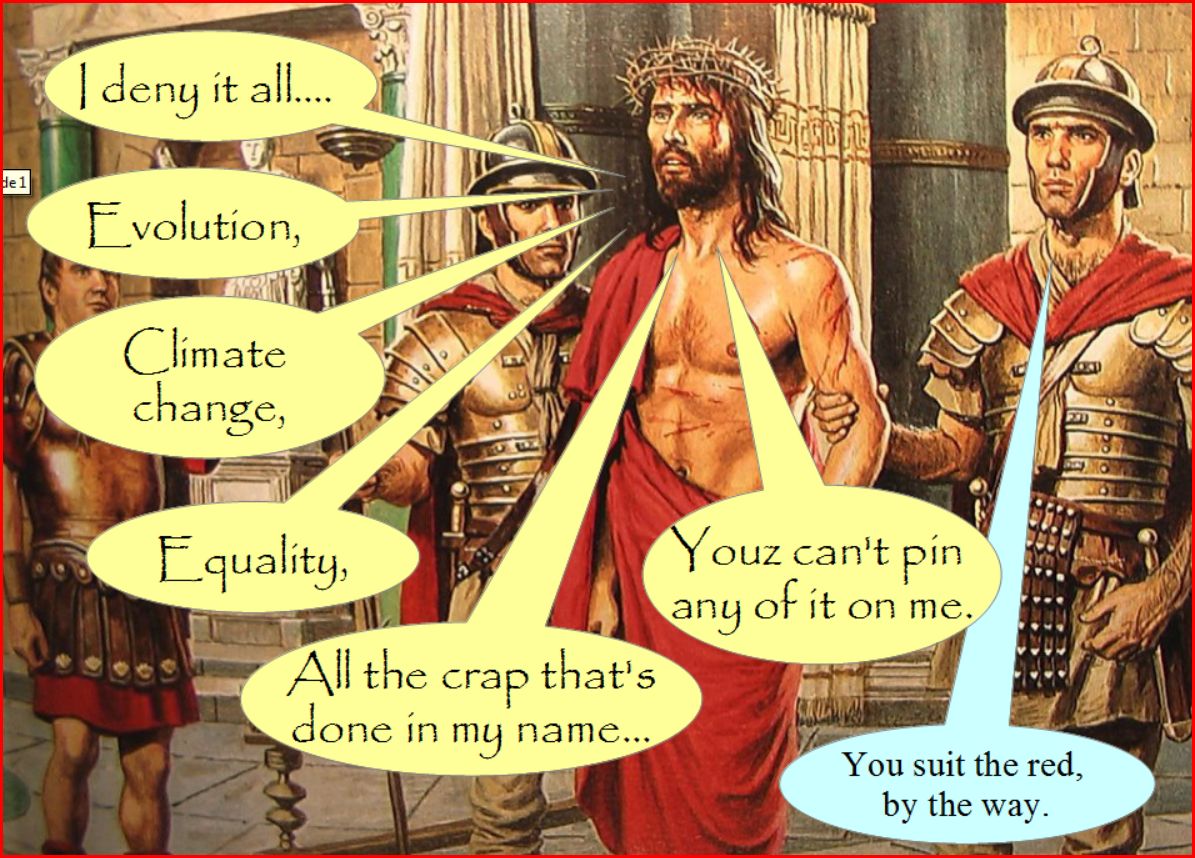
Deny yourself, deny your parents, deny your family. That’s what Jesus tells his followers they’ve to do. Today’s Christians can do better than that though! They’re in complete denial about everything, especially stuff for which there’s tons of evidence. Believing loads of made-up stuff is more their thing.

So, they deny climate change because God wouldn’t allow it (or something).

They deny that human beings contribute in any way to climate change because it’s not part of God’s plan.

They deny evolution because God created everything (in six days).

They deny how unpleasant, wasteful and cruel evolution is in order to believe that God used it to develop life here on Earth.

They deny that death existed before humans evolved because the Bible says it didn’t.

They want to deny gay people equality because the Bible says marriage is for one man and one woman (it doesn’t).

They seek to deny others their rights, often slanderously and viciously, but expect their ‘right’ to do so to be protected.

They deny that morality has anything to do with the way we treat other people and is really only about sex.

They deny that anyone can be moral or rational without believing in their God.

They deny that for most of us things are better than they’ve ever been and insist instead that things have only got steadily worse.

They deny the humanity of fellow human beings but believe in fantasy creatures like angels, spirits and demons.

They deny their own humanity, with its corresponding needs and limitations, and insist instead we’re designed to be spiritual creatures.

They deny most of what Jesus taught but tell everyone else they’re sinners.

They deny that Jesus said he’d be back in his disciples’ lifetime, and believe instead he’s still on his way.

They deny death and imagine they’re going to live forever in Heaven instead.


Christianity is a religion of negativity. Truth, reality and other people are the casualties of its life-denying efforts at self-preservation.


Unbelievable: Why, despite everything, Christianity makes absolutely no sense whatsoever.

Spufford2

There’s no real reason to believe in God.

 
Who says so? Francis Spufford in his book Unapologetic: Why, Despite Everything, Christianity Can Still Make Surprising Emotional Sense. Francis does believe though, because sometimes when he’s alone – specially after a tiff with his wife or while sitting quietly in church – he gets a funny feeling. And this feeling is so funny, as in weird, that it can only be God. Or so Frank says, slipping in as many four letter words as he can, just to show he’s not a namby-pamby sort of believer. (He’s especially proud of his new term for ‘sin’: ‘the Human Propensity to Fuck things Up’, or HPtFtU for short.)

 
What’s more, even though there are a hundred and one reasons to think there isn’t a God, at least not one who cares about us (think pain, suffering, death, evolution and his complete lack of interest in his creation, all of which Frank’s acknowledges) he nevertheless wants to say that he does believe because, you know… feelings.

 
That’s not all. This God Frank’s decided to believe in as result of feeling funny, is the Christian God. He could’ve turned out to be Allah or Zeus or Ra, but he isn’t, because Frank feels he’s the Christian God, for no other reason than he wants him to be. Then, in a final leap of faith, he decides that Yeshua, as he insists on calling Jesus, is the walking embodiment of this God, and he rewrites the gospel story so that it fits with the funny feeling that kick-started his delusion in the first place.

 
And so we have it from the horse’s mouth; a Christian who’s proud to admit there’s nothing remotely rational or empirical about believing in God. Faith, he confirms, is no more than some very human, very peculiar feelings that lead you merrily down whichever garden path you choose to take.

Proof that God is real?

Thor

Christians – can you prove God exists? J. Lee Grady of Charisma magazine thinks he can and offers ‘7 Things That Prove God Is Real’. Leaving aside the fact that it shouldn’t be necessary to prove God is real – the God of the universe, Creator of Heaven and Earth, Father of Mankind should be more… apparent, shouldn’t he? – what are Mr Grady’s incredible proofs? Glad you asked. You can read the full article here, but to cut a long story short, they are:

Babies, thunderstorms, flowers, the Bible, the global spread of Christianity, Jesus and a personal friendship with God.

I hope you’re convinced. I know I am.

Problem is, all of these things are also evidence that God doesn’t exist.

Babies: Babies are miracles, according to Lee. We’ve evolved to find human babies cute and appealing even when they’re yelling, pooping and spewing – it helps us nurture them. But they’re not miracles; nearly 37,000 are born every day. What’s more, over a million of them die every year on the day they’re born. Which might just suggest God is not real at all.

Thunderstorms: Mr Grady says that because storms are powerful they put him in mind of God. This, however, is not proof of anything. Unless of course it’s Thor, god of thunder in Norse mythology and star of Marvel Comics. Is this who you mean, Lee?

Flowers: Lee says flowers are proof of God because they’re pretty. He seems to be unaware that their appearance is the result of natural selection; it has developed in order to attract insects and birds who then unwittingly assist in the plant’s reproduction. Yes, flowers are pleasing to the human eye as well, but their job is emphatically not ‘to simply make the world beautiful’, as Lee claims. They are evidence of evolution, not of a flower-arranging god.

The Bible: Lee trots out the false assertion that the Bible, in spite of having numerous authors over thousands of years, presents a consistent message. It doesn’t. There are, for example, at least nine different ways of being saved expressed by writers in the New Testament (some of whom, including the one Lee quotes, are forgers) – and they lived within a few decades of each other! A book cobbled together more than 300 years after the supposed main event, by men – not God – with a vested interest in its success, is not proof of the divine.

The global spread of Christianity: Human beings have worked hard throughout the ages to spread their own particular version of Christianity – often converting others on pain of death. There are today over 34,000 Christian groups, sects and cults, which is ‘proof’ that there is no one Mastermind behind it all. Other religions spread too, so perhaps that’s evidence their God is real as well (or instead), and so do diseases. The spread of an idea only illustrates human preoccupation with that idea.

Jesus: Really? His broken promises, failed prophecies, impossible morality and shabby treatment of those who didn’t buy into his mission somehow ‘prove God’? Maybe Lee means that Christ proves God. But ‘the Christ’ is an invention of Paul’s and has little to do with the man Jesus. In any case, one mythical figure does not prove another. Unless it’s Thor, of course, whose existence definitely proves there’s an Odin.

A personal friendship with God: What goes on in Lee’s head doesn’t prove anything, never mind the existence of God. A person’s feelings are subjective, solipsistic and entirely unverifiable. Thinking he’s got a relationship with God doesn’t mean that he has. Unlike my friendship with Thor. That’s really real.

So, seven proofs of God that are no proof at all. Anyone else care to take a turn?

Christians’ Favourite Delusions 11: God is ours

preacher3

Apparently, you surrender any right to talk about or comment on God when you’re an atheist. Or so Christians would have it. ‘If you don’t believe in God, why don’t you just shut up about him? Why does it bother you that others believe?’ is the sort of line they take. You’ll find it in the comments on this blog and other sites that are critical of faith.

Like so much else, Christians are wrong about who can have an opinion about God. Unbelievers have as much right as believers, of whatever persuasion, to express views on the God-concept. It’s fair game for everyone.

So why do I bother? Six reasons.

1) I gave Jesus the best years of my life. Well, not really ‘Jesus’ because you can’t give anything to someone who’s been dead these past two millennia – but I was a Christian for twenty plus years and I complied with what the church and the Bible told me. It was a mistake; I denied myself, as I was told to do (in Matthew 16.24) and wasn’t able to be who I really am. I’m so much happier without being told what that should be.

2) I find the persistent proselytising by Christians to be thoroughly objectionable. It’s almost impossible to walk through the town centre where I live without being told by some street-preacher or other that without Jesus we’re all bound for Hell and that ‘evolution is lie’. (One of these claims is, that’s for sure.) If you get too near, a confederate will thrust a tract into your hand, replete with Bible quotations, spelling mistakes and dodgy grammar. And should you manage to avoid these particular desperadoes, you’ll then have to watch you don’t fall over the stands of Jehovah’s Witness literature, ‘manned’ by smiling ladies who think their brand of superstition is the truth.

3) Christians’ treatment of gay people is generally deplorable. ‘Hate the sin but love the sinner’ is the line frequently trotted out, even though it’s entirely unbiblical.  They may claim to love gay people but it’s a hollow claim when ‘in love’ Christians condemn gay people as sinners of the worst sort; ‘abominations’ is the word used in their holy book (and some Christians use worse language than this). Because of what the Bible says, many believers seek to deny same-sex couples the right to marry and resist attempts to grant them the same rights as everyone else. Christians insult us all by calling this love.

4) Christians’ uncritical adherence to superstition is incomprehensible. There are innumerable Christian web-sites, some of which I read (purely for research purposes, you understand) that are, variously, sources of hilarity and despair in equal measure. There has to be some counter-balance to the irrationality and evangelistic fervour of these sites and thankfully there is. Hopefully this blog makes some small contribution.

5) However much they preach at the rest of us, Christians fail to do as their saviour commands them. They think they’re ‘saved’ through St Paul’s magic formula but ignore everything Jesus says is required of them (see previous posts and my book Why Christians Don’t Do What Jesus Tells Them To …And What They Believe Instead.) It’s all specks and logs, to paraphrase JC himself; Christians enjoy pointing out everyone else’s sinfulness – and arguing about doctrine, of course – while blatantly ignoring Jesus’ commands. I feel obliged to point this out.

6) If, through this blog, I can lead people to question their beliefs, help them reflect critically on what they are told by church leaders and very selective reading of ‘God’s Word’, encourage them to think rationally about their belief in supernatural beings and, most of all, if I can be instrumental in rescuing one person from the Jesus cult, then I’ll be more than happy.

That’s why I bother.

Christians’ Favourite Delusions 10: God cares

dead-sparrow

@deadsparrow had just made his final Tweet.

The Bible says God controls the weather and 53% of Americans believe it. A further 17% say they don’t know or don’t want to say whether he does; evidently, they aren’t prepared to rule out the possibility, otherwise they would be among the 29% who know that he doesn’t.

I wonder what those who were hit yesterday by the typhoon in the Philippines think of God’s control of the elements? Was the destruction he brought about by sending Haiyan a mark of his love for mankind? Presumably not – destroying lives, homes, possessions and livelihoods hardly speaks of love.

Was it a punishment then? Right-wing Christians like to tell us that natural disasters are God’s judgement on human sin and our ‘shaking a fist at God‘ by redefining marriage to include gay people.  Why then does he consistently punish those in parts of the world which are already prone to extreme weather conditions? Why does he punish those who are already poor? Why does he send devastating weather to the fifth largest Christian country in the world, which doesn’t recognise gay marriage? It’s all a bit indiscriminate, wouldn’t you say? What sort of Almighty are we dealing with here, who can’t even direct his punishments at the right target? It doesn’t speak much of ‘control’.

Jesus might claim, in Matthew 10:28-31, that God cares even for the sparrows but this is another of his bare-faced lies. The evidence tells us otherwise: ‘God’ doesn’t care how many humans perish in storms, typhoons, tornadoes, tsunamis, earthquakes and all manner of natural disasters. He doesn’t care how many lose their homes, loved ones and all they’ve worked for.

The weather, in fact, is random, largely unpredictable and indifferent to human and animal needs. If God exists, then he is as indiscriminate and uncaring as the weather he supposedly creates. But of course God is not needed to explain the weather; science tells us how it occurs in terms that don’t involve him. His very superfluousness – the same superfluousness we find in evolution and all the other ‘laws’ of the universe – is all the evidence we need that he doesn’t exist.

An experiment in Christian morality

Forget

Time for a little experiment: some data gathering for ourselves that will demonstrate the extent to which Christians are willing to comply, without cynicism or irony, with their Saviour’s peculiar requirements. While the Bible assures us it is wrong to put the Lord God to the test (Deuteronomy 6.16, etc), rest assured the same does not apply to believers themselves.

Our experiment is a cruel one to be sure, but given Jesus’ command in Matthew 5.42, that believers should ‘give to everyone who begs from you, and do not refuse anyone who wants to borrow from you’, we would be within our rights to test their adherence to the principle. After all, Jesus specifies that his followers must oblige ‘everyone’ and ‘anyone’ who asks, which is accommodating enough to include any sceptics conducting an experiment. He doesn’t stipulate either that those doing the asking have to have genuine need; indeed the entire thrust of his teaching in this section of Matthew is about responding sacrificially to unreasonable demands. We won’t be unreasonable – so no slapping of cheeks – and we will do our best to ensure our request is designed to meet as genuine a need as we can create.

For any experiment we need a hypothesis, so I propose that for this particular one we go with something like ‘Christians will not give to those who beg from them nor lend to those who ask to borrow’. If you want to amend this to suit your own circumstances, by all means do. You can choose too whether you’re going to beg, which means you get to keep anything you are given, or to borrow, in which case you won’t and you’ll need to pay it back at a later date.

Next, you’ll need to select your subject: you can choose an individual – they must of course be a card-carding, Spirit-filled Christian – or an institution: a church, say, or Christian organisation like Christian Voice or Focus on the Family. Whichever you opt for, you’ll need to ensure they are capable of meeting your request – we’re not going to pick on Christians of more modest means – and decide what you will ask for. I suggest that if your subject is a renowned evangelist or the pastor of a so-called mega-church you could reasonably ask him or her to lend you the money to pay off your mortgage, for example, or to meet medical expenses. I’m sure he or she will agree that these qualify as truly genuine needs, though you don’t necessarily have to tell them why you want the money, given there’s no mention of the beggars in Jesus’ instructions explaining themselves. On the other hand, if you think it will go some way to help disprove the hypothesis, you can and perhaps should be clear about why you want the cash.

Right. You should be all set. Be sure to let me know how you get on and whether your Christian subject demonstrates the hypothesis or refutes it. I’ll collate the data.

What’s that you say? You’re not going to bother because it’s a foregone conclusion that most Christians, whether prominent individuals, churches, organisations or ordinary believers won’t give to anyone and everyone who asks?

You could well be right, because, although Christians do give generously to causes close to their hearts, they baulk at the idea of giving to just anybody, in spite of what Jesus says. Maybe Christian readers of this blog can explain why; why don’t you do what Jesus tells you in this and many other respects? You cannot be his disciple, he says in Mark 10.25, unless you give away all that you have and he won’t recognise you as a follower unless you obey him entirely (Luke 6.46). So how about it?

Today in Christian Love…

HugChristians, what do you do when you’re required to provide a service, say the photos or the food, at a gay wedding? It’s a tricky one, isn’t it, when the Bible tells you that homosexuality is an affront to God and you feel honour-bound to uphold his standards.

Well, Dan Reuter, pastor and attorney-at-law in Bloomington, Indiana has the perfect solution! Here’s what ol’ Danny-boy suggests:

The Christian purveyor of pictures or food should tell the sodomite couple:

Of course, I will provide my stuff for your wedding. I serve, and am required to serve, everyone, whether or not I approve of what he is doing. However, you do understand that if I am at your so-called ‘wedding,’ I will consider it my duty to call attention to God’s view of what you are doing. I will consider it my obligation to warn the guests of the danger they are running and of the harm all of you are doing to your own lives as God observes them. So, I will be distributing literature that explains all this.

And I thank you for the opportunity to reach people who otherwise might never hear this message that I believe they desperately need to hear.

What a neat suggestion! I know it’s neat because most of the comments on the site say so.

Christian love in action – a wonder to behold.

PS. Don’t forget, everyone else, to have some literature handy in your job so you can demonstrate how belief in Old Testament codswallop is an affront to your principles of tolerance and rationality. It’s a message the faithful desperately need to hear.

Hat tip to Steve Wells at http://dwindlinginunbelief.blogspot.co.uk/

The picture caption is not mine this time (they usually are) but I can’t locate the original source.