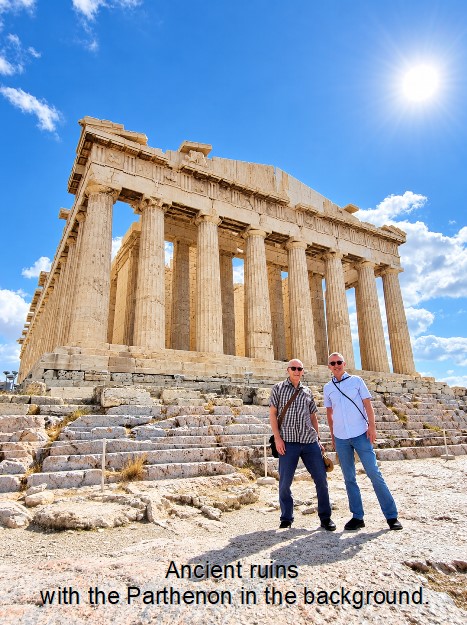
Dennis and I were recently in Greece enjoying some late summer sun and visiting places I learnt about exactly 60 years ago in my first term at Grammar School. Most spectacular of these was the Acropolis, the ancient ‘high city’ of Athens with the beautiful Parthenon at its centre. The Parthenon was completed in 776 BC as a temple to the city’s Goddess, Athena. Athena, Goddess of wisdom, was considered a virgin, hence the temple’s name from parthenos, the Greek for virgin.
The white marble temple had gleamed over Athens, and Athena had protected her people (or so they thought) for more than 800 years when the creator of Acts decided to give his hero Paul a little adventure there.
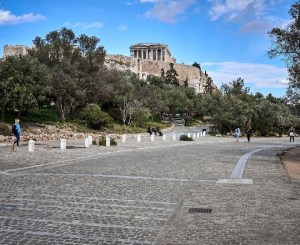
‘Luke’ had evidently read Paul’s first letter to the Thessalonians, written circa AD 55, in which Paul makes a passing reference (3:1) to stopping off briefly in Athens. 25 years later, Luke, conjures up the story now found in Acts 17:16-34 in which Paul takes on the souvenir trade of Athens. He spots that small statues of Athena and other gods are being sold in the Odos Tripodon (the modern version pictured below), where people would meet to socialise, listen to philosophers and buy statues of their deities. Paul of course gets the better of all of them, pointing out that he knows the Unknown God whose inscription appears on some trinket and immediately makes converts of a number who hear him. Because in every New Testament account that’s what happens.
The entire account is of course invented. Paul’s theology in 1 Thessalonians is not that reflected in Acts; it’s completely different in fact. More than this, Paul really wouldn’t have been listened to by the educated and erudite philosophers who frequented both the Odos Tripodon and the Aeropagus. Much less would they have considered debating an interloper they describe in Acts 17:18 as a ‘babbler’. (See Bart Ehrman’s take on the episode here.)
The Acts story is an allegory, as so many are in the New Testament. It is designed to show how superior the fledgling Christianity is to the old religions. Jesus whups Athena’s ass and by extension all the Greek pantheon. And unfortunately, ultimately, that’s how it turned out to be: in the long term Christianity all but wiped out the gods of antiquity. One set of imaginary deities defeated by a decidedly inferior, but no less imaginary, new mob. Despite Greek science, philosophy and vastly superior knowledge, Paul’s superstition, hallucinations and visions won out. The Odos Tripodon became known as the Dionysiou Areopagitou, supposedly after Paul’s first convert, and is now also known as Apostolou Pavlou Street, after Paul himself. The Parthenon was converted into a church in the 6th century, when the Christians did away with the ancient statue of Athena. They had their own Virgin Goddess and she was the real deal (or so they thought.)
In the 15th century the temple became a mosque and in the 19th, the British plundered some of its sculptures, the so-called Elgin marbles. These can still be seen today in the British Museum, but really should be returned to the ancient site where they were created and belong.
Still, visit Athens, the Acropolis and the Parthenon – and you really should – and you can feel the old gods prevail. They gave us, through their acolytes, science, mathematics, democracy, drama, theatre, literature, education, art, the Olympic Games and civilisation in general. Did the gods of Christianity and Islam give us anything remotely comparable?

