Christians’ Favourite Delusions 28: Evolution says we are no more than animals

AngryHere we go again. Christians claiming that evolution reduces human beings to being ‘just’ or ‘no more than’ animals.

Does it? Where? The ‘just’ and ‘no more than’ are unnecessary and invalid value judgements. They’re not there in Darwin, who goes out of his way to avoid making any such statement, while Richard Dawkins explicitly rejects the idea that we are ‘just’ gene carriers.

Evolutionary theory recognises that humans are indeed animals – with no ‘just’ or ‘no more than’ to qualify the fact. How can we not be animals? We do everything they do; like them, we have – indeed are – physical bodies that breath, eat, sleep, excrete, bond, mate, experience pain and pleasure and fight; we are, like most other animals, territorial and also like them, we put a great deal of effort into ensuring our own survival and that of our offspring. Even Christians who deny the body and its demands engage in these kinds of animal behaviour.

Of course, we also do things other animals don’t, or don’t to the same extent; we have remarkably complex social arrangements, which have resulted in our developing systems of morality and sophisticated ways of dealing with each other (though our morality is remarkably flawed); we have achieved much in the fields of culture, technology and in our understanding of the world and the universe beyond our tiny planet. We have also made a mess of our environment.

Our intelligence, our self-awareness, is the evolutionary equivalent of adaptations developed in other species. Our characteristics may seem to us to be somehow superior to those of other animals, but really they’re not. They have enabled our continued survival and allowed us to achieve all that we have, both good and bad. But in evolutionary terms, they are no different from the refinements that have enabled other animals to do the equivalent in their environments. This doesn’t mean, however, we are ‘just’ or ‘no more than’ animals. No creature is ‘just’ an animal and human achievements are all the more remarkable because we’re animals.

What Christians usually mean by their ‘just’ and ‘no more than’ is that as animals we are not extra-special to God, not ‘made in his image’. And of course, we’re not; there’s no God to be extra special to or made in the likeness of. Even if there were, he doesn’t seem to be particularly pre-disposed towards us; we exist as physical bodies that are as susceptible to the same hunger, disease, illness, injury, weakness, infirmity and death as any other animal. We are not immaterial, spiritual beings – though presumably the Christian God could have made us that way if he’d wanted to. To say, as some Christians do, that we are spiritual beings temporarily trapped in material bodies, or that we must deny the body and its demands to become spiritually perfect, is the grand perversion that is the Christian faith. It denies the reality of this physical, material world and our own natures. Any spirituality we might claim for ourselves is a projection of our intelligence and self-awareness; any morality the result of those complex social arrangements.

So, we are not ‘just’ animals, nor are we ‘no more than’ animals in any way that makes sense biologically. We are animals, remarkable perhaps in rising above our biology from time to time, but animals nonetheless, whether Christians want to believe it or not. ‘Just’ and ‘no more than’ don’t come into it.

No True Christian

WeekendA favourite response of Christians to any criticism is, ‘it doesn’t apply to me. I’m not that sort of Christian. The people who do or believe or think those things are not true Christians.’ This the ‘no true-Scotsman‘ fallacy.

  • You get it when you point out how God’s People™ agitate in Africa and Europe to deprive LGBT people of rights, protection and safety (unless of course you’re talking to a Christian who thinks this is a loving thing to do.)
  • You get it when you challenge Christians about Westboro baptist church’s activities, (the latest of which is claiming that Ebola is God’s punishment for Obama, which must be why he’s smiting poverty-stricken Africans.)
  • You get it when you mention those Christians who believe mumbo-jumbo that’s slightly different from theirs.
  • You get it when you ask them about any of the other deplorable things Christians do in Jesus’ name.

‘These other people are not true Christians,’ they say. ‘Their theology isn’t the same as mine; they’re misinterpreting the Bible; I wouldn’t do those kind of things; you’re picking out extremists.’

And do you know, Christians, those very people you say are not true Christians would say the same about you.

So what defines a Christian? Isn’t it that you accept Jesus Christ as your Lord and Saviour, profess him as such, and avail yourself of the salvation you think he offers?

Indeed it is. And it’s precisely this that you have in common with the Westboro baptist church, with those who peddle the absurd, with those who seek to damage LGBT people, with those who use their positions to abuse others and those with different ideas about what being a Christian is really all about.

You and they have bought into the same fantasy: they, like you, have accepted Jesus; they, like you, have his Holy Spirit in their hearts. That they do things you don’t approve of, or regard as embarrassing or despicable, doesn’t alter that fact. You’re all in it together; they represent Jesus just as much as you do; are as much a part of the ‘bride of Christ’ as you are. The zealots, extremists and wackos are your brothers and sisters in Christ, and if you’re right about Jesus being your Saviour – which of course you’re not; I’m being generous here – you’re going to be spending all of eternity with them.

So time to knock the ‘no true Christian’ excuse on the head – it’s going to be so embarrassing for you when you get to heaven.

Good For Nothing

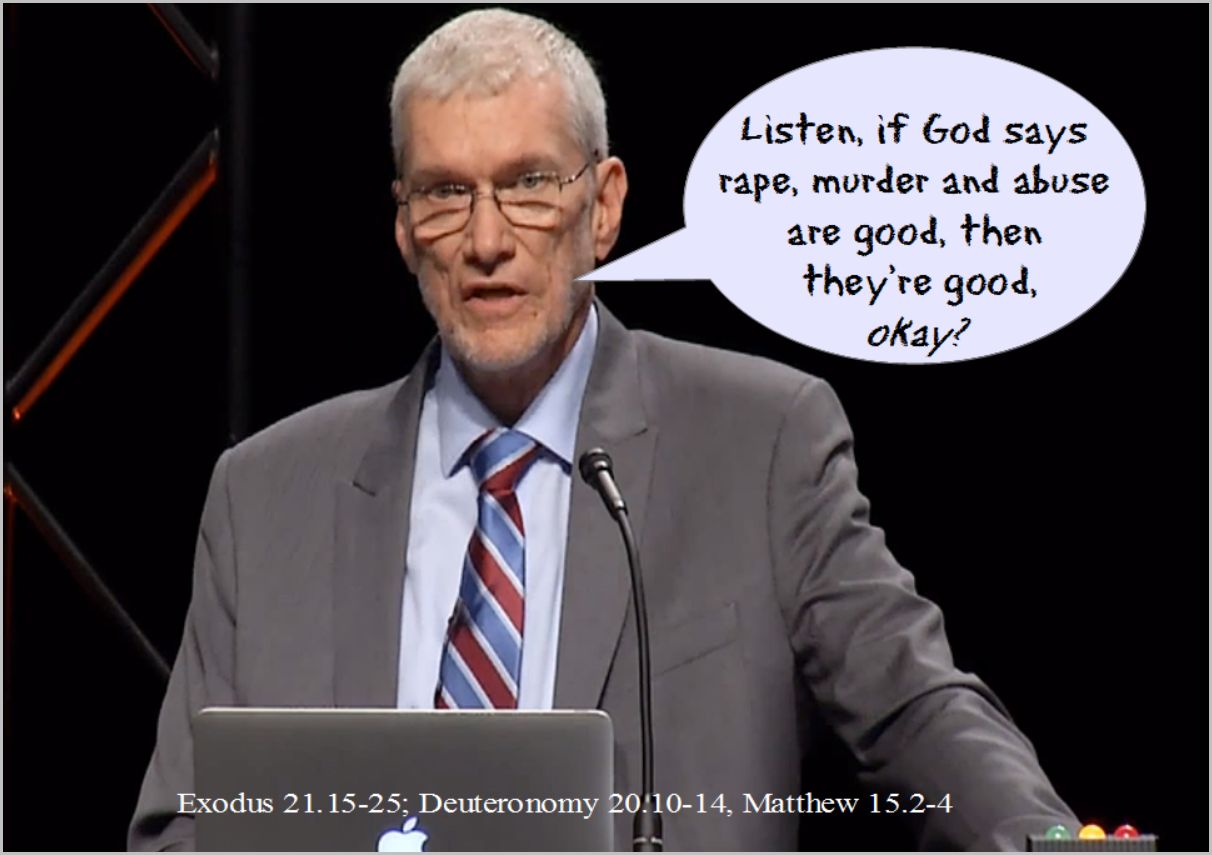
HamWhere does morality come from? Ken Ham of Answers In Genesis says it can only come from (his) God. Atheists have no grounds for morality, he claims, because, without a God to tell them, they’ve no way of knowing the difference between right and wrong .

As usual, Ham is being creative with the truth. Clearly atheists are as capable of being moral as anyone else. Equally and also evidently, Christians and other brands of believers are capable of deplorable immorality. Hardly a week goes by without more reports of Christians abusing, cheating, lying and killing in Jesus’ name.

Why do Christians act so despicably when, supposedly, they have God’s Spirit inside them – that’s the God from whom all morality flows, according to Ken Ham. Why doesn’t his indwelling Spirit guide Christians so that they always behave morally, or even just considerately?

I don’t have the answer. Perhaps Ken Ham or some other knowledgeable Christian can tell us.

No, morality doesn’t derive from any god. It has evolved, inevitably and like much of our behaviour, from our being social animals. Living in close proximity with other humans has meant we have developed ways of behaving that take these others into account, as well as the repercussions of our behaviour on ourselves.* The principle of treating others as we ourselves would like to be treated is very old – much older than Christianity.

Morality, though, is not absolute and is far from infallible. Non-believers, like the religious, make mistakes and don’t always treat others as they should. But the fact they behave well most of the time is evidence that behaving morally has nothing to do with a god, especially not the capricious, murderous psychopath of the Abrahamic religions.

Ken Ham’s position, and that of other religionists who tell us we have no grounds for morality without such a god, is as offensive as it is absurd.


* There are innumerable books that consider our moral evolution; you might like to try Frans De Waal’s Primates and Philosophers; How Morality Evolved or Christopher Boehms’s Moral Origins.


Here Be Dragons

dragonChrist The White does battle with the dragon of Revelation 12

Over on Answers in Genesis, one of Ken Ham’s drones is arguing for the existence of dragons. They are, he or she tells us triumphantly, mentioned in the Bible, so they must really have existed.

As we already know, the Bible has more than its fair share of nonsense, but to insist it provides evidence of mythical creatures is to take its credibility to a new low. Don’t Christians care they do this to their magic book? After all, their faith relies almost entirely on the Bible, alongside their own emotional responses to it (no kiddin’, they say this is ‘the Holy Spirit’.)

Christians spend so much time arguing for the Bible’s daftest excesses – the world being created in six days, Jesus returning soon, homosexuality being just the worst sin ever and now dragons – that they haven’t any time left to read what it has to say about how they should be living their lives.

You mean forgiving others, feeding the hungry, giving everything away, not judging (in case you’re judged in return), being compassionate, going the extra mile, turning the other cheek, giving to all who ask and blessing your enemies is in the Bible? Jeez, I never knew.

Yeah, but it’s all secondary to dragons and damning others. ‘By their fruits shall ye know them,’ says Jesus of his followers in Matthew 7.16-20. Turns out there’s no fruit, just a wide assortment of nuts.

Christians’ Favourite Delusions 27: The Bible Is The Ultimate Authority On All Things

Biblereader* Mark Twain

Since writing my posts about the Bible, I’ve stumbled across a few assertions out in Blogland that the Bible is the ‘ultimate authority’ on some subject or other. ‘The ultimate authority on the issue of homosexuality is the Bible’ says Tim Brown, while Marsha West claims ‘the Bible’s the final authority in all matters of faith’ and the snappily titled ‘Ethics & Religious Liberty Commission of the Southern Baptist Convention’ insists that ‘as Christians we must affirm our commitment to divine revelation, the written Word of God— the Bible—as our ultimate authority base.’ 

You might wonder how a book, written largely by bronze and iron-age tribesmen and first-century zealots who thought their world was going to end any day soon, could produce anything authoritative. Especially when these men (and they were all men) get it wrong about –

How the world was created. Genesis 1 tells us how Yahweh formed the Earth pretty much as it is today. In this made up explanation, light, night & day and plant life all precede the creation of the sun, and the order in which animal life appears is completely wrong.

How humans came into beingas fully formed adults. No messy evolution here. Moreover, woman is created from man, even though all foetuses are female to begin with and male comes always from female.

How the world got to be the mess it’s in. Sin, apparently; this first couple fucked the whole thing up. There was no death before they ate some fruit. After, there was.Move along. No understanding of evolution here.

How old the Earth is. The Bible’s genealogies imply the Earth is now 6000 years old or thereabouts. Actually it’s about 4.5 billion, but that doesn’t stop Ken Ham and other wingnuts insisting it can’t be, because, you know, the Bible.

How important the Israelites were. They weren’t; they were a relatively obscure and insignificant tribe. Their only ‘achievement’ seems to have been creating the idea of there being only one God, and even that took time to develop. Little of what the Torah/Old Testament claims for them has been supported by archaeological and other evidence, and much has been soundly refuted.

How the Israelites were slaves in Egypt. There is no evidence at all that they were. Moses and the whole of the ‘let my people go’ story appear to be complete fabrication.

How the world really works. According to Bible animals can sometimes talk (Genesis 3.1; Numbers 22. 23-30); humans once lived to be well over a hundred years old (Genesis 7.6;, 23.1 etc); the sun goes round Earth (Ecclesiastes 1.5); the sun can be stopped in the sky (Joshua 10.12-13); the Earth is flat (Isaiah 40.22 etc); Heaven is in the sky (Psalm 103.11 etc) and Hell is under the Earth (Psalm 63.9 etc)

How God’s Kingdom was going to come to the Earth in the first century. You’ve probably spotted that it didn’t. Yet the belief that it would drove both Jesus and Paul, and accounts for the very existence of Christianity (see previous posts). How wrong can you get?

How believers would never ‘perish’ (John 3.16). From the very first convert to the Christians who will die today, every believer has ‘perished’. There is no evidence whatsoever that any of them has been resurrected or that they enjoy eternal life. Like the end of the rainbow, this promise is perpetually out of reach, always somewhere in the future – even though Jesus and Paul were telling their followers 2000 years ago that it was all going to happen real soon.

How Jesus was coming back any minute. See above. Always going to happen just about now. Never does.

And so it goes.

That’s some ‘authority’, I’m sure you’ll agree. The Bible is wrong about practically everything, except when a preacher needs it to support his bigotry and/or prejudices. Then, miraculously, it’s the ultimate authority.

Christians in denial

Trial

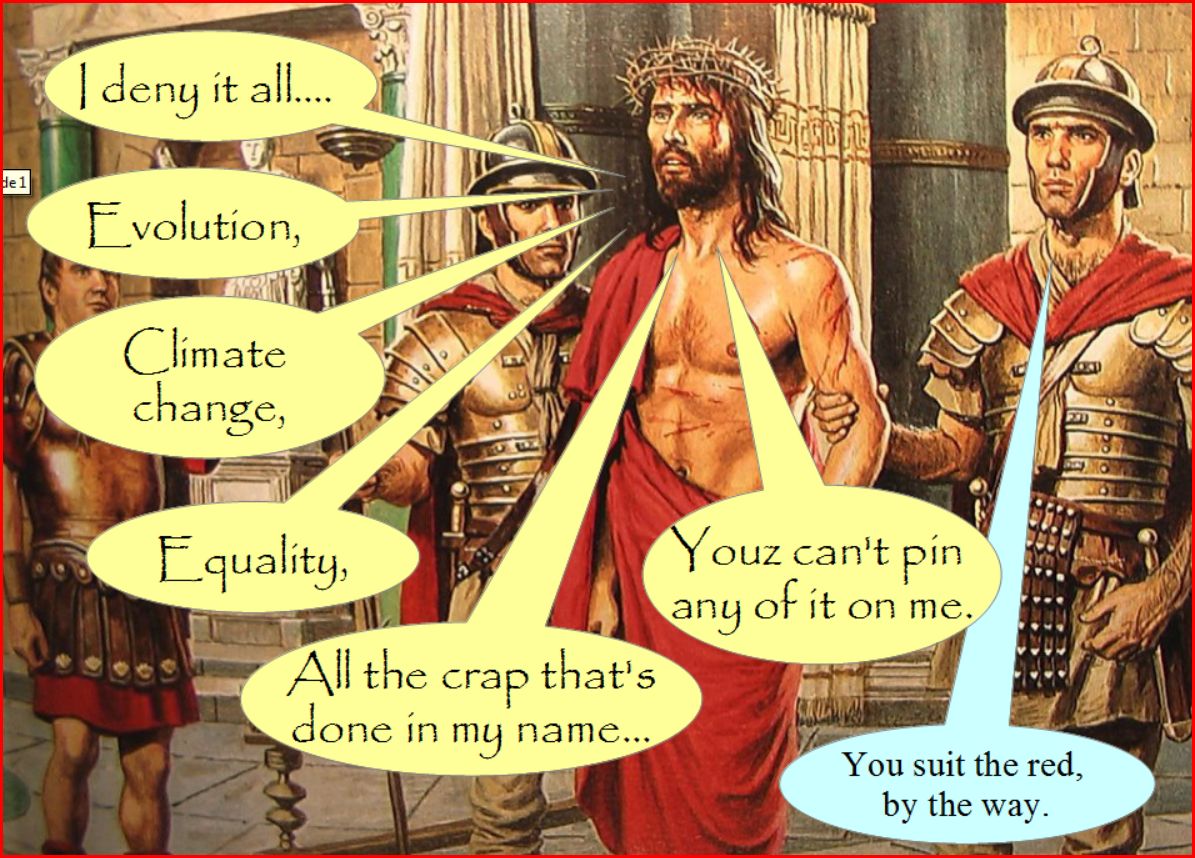
Deny yourself, deny your parents, deny your family. That’s what Jesus tells his followers they’ve to do. Today’s Christians can do better than that though! They’re in complete denial about everything, especially stuff for which there’s tons of evidence. Believing loads of made-up stuff is more their thing.

So, they deny climate change because God wouldn’t allow it (or something).

They deny that human beings contribute in any way to climate change because it’s not part of God’s plan.

They deny evolution because God created everything (in six days).

They deny how unpleasant, wasteful and cruel evolution is in order to believe that God used it to develop life here on Earth.

They deny that death existed before humans evolved because the Bible says it didn’t.

They want to deny gay people equality because the Bible says marriage is for one man and one woman (it doesn’t).

They seek to deny others their rights, often slanderously and viciously, but expect their ‘right’ to do so to be protected.

They deny that morality has anything to do with the way we treat other people and is really only about sex.

They deny that anyone can be moral or rational without believing in their God.

They deny that for most of us things are better than they’ve ever been and insist instead that things have only got steadily worse.

They deny the humanity of fellow human beings but believe in fantasy creatures like angels, spirits and demons.

They deny their own humanity, with its corresponding needs and limitations, and insist instead we’re designed to be spiritual creatures.

They deny most of what Jesus taught but tell everyone else they’re sinners.

They deny that Jesus said he’d be back in his disciples’ lifetime, and believe instead he’s still on his way.

They deny death and imagine they’re going to live forever in Heaven instead.


Christianity is a religion of negativity. Truth, reality and other people are the casualties of its life-denying efforts at self-preservation.


Christians’ Favourite Delusions 20: The Lord God Made Them All

creation

The poster outside a church in my neighbourhood informs all who pass by that ‘the Earth is the Lord’s and everything that is in it’ (Psalm 24.1). Christians seem to think it’s important that their deity is the one who made the universe and life in this particular small part of it. Some even go so far as to say their God (though being Jewish he wasn’t their God back then, of course) made the world and all of its occupants including ourselves, literally within 6 days, about 6,000 years ago. I suppose that’s where you end up if your premise is that mythical beings, like ol’ Jehovah, actually exist. A third of Americans believe in Creation, innumerable web-sites insist an Intelligent Designer is responsible for life on Earth and street preachers are happy to tell you that evolution is a lie. ‘Were you there?’ asks Ken Ham of Answers in Genesis, as if this clinches the deal.

But let’s be generous. Let’s concede that we don’t know how life started on this planet – because we don’t – and let’s jump to the conclusion that therefore it must’ve been the Christian God. It’s not a very convincing line of reasoning, I know, but I’m being generous as I say. So let’s acknowledge that the Lord did indeed make hummingbirds and butterflies, roses and angel fish, lambs and tygers and all other bright and beautiful things, more or less in their present form.

But that means we’ll also have to concede that he made mosquitoes, flies, lice, ring-worms, parasites of all descriptions, E-Coli, pneumacoccus, all manner of harmful bacteria, viruses, AIDs, cancer – and on and on. The naturalist David Attenborough points out that Creationists are quick to give credit to their God for hummingbirds but that he himself sees ‘a little child in east Africa with a worm burrowing through his eyeball. The worm cannot live in any other way, except by burrowing through eyeballs. I find that hard to reconcile with the notion of a divine and benevolent creator.’

How do Christian creationists square their loving God with such harmful creatures?

There are only four possible ‘explanations’ available to them:

1. Harmful bacteria, viruses and parasites were ‘good’ when God first made them (Genesis 1.31). Then, like everything else, they become perverted when Adam and Eve ate some forbidden fruit.

But this creates more questions than it answers. What were these creatures like in their original forms? How did they live, when their ‘life-cycle’ depends on them infecting other forms? How did they change from being ‘good’ into the creatures they are today? It can’t have been by the process we know as evolution because, of course, evolution is a lie.

2. The Devil made them to plague mankind. He even made sure they survived Noah’s flood – no doubt in the bodies of Noah’s family and the animals supposedly on the Ark.

But if Satan did create them, doesn’t that make him as clever as God in his own way? (I know, I know, the devil doesn’t exist either but I’m trying to think like a Christian here). In any case, why would God let him? Ultimately, he’s responsible for his creation.

3. God made them because, even from the beginning, infections, infestations and disease were all part of what he considered ‘good’.

If this is the case, what an evil bastard he is, indistinguishable from Satan himself.

4. God, the Intelligent Designer just set things in motion at the beginning before leaving evolution to do his work for him.

But, as Darwin pointed out, evolution is a mindless, haphazard, wasteful process that relies heavily on sex and death. What is a supposedly loving, intelligent designer doing using it to bring about his creation? Did he forget that evolution is lie?

Which leaves us with the fact that if God designed and created all life intelligently, as many Christians want to believe, then much of his creation shows little sign of either his love or his intelligence. It does, however, show every sign of having come about as the result of a mindless, haphazard, wasteful process, in which all life-forms occupy their own particular niche to which they have adapted and have evolved, through an infinite amount of sex and death, into the life-forms we see today – hummingbirds and eye-burrowing worms included.

Is your marriage a Bible-based marriage? Find out in this simple quiz.

Marry

1. If you’re male, have you got more than one wife? If female, has your husband got other wives as well as you?

If you answer ‘yes’, score 20 points: all the heroes of the Old Testament had multiple wives: Abraham, Esau, Jacob, Moses, Gideon, David, Solomon… Clearly, polygamy is acceptable in the sight of the Lord (Exodus 21.10). Even Jesus approves of it (Matthew 5.17-18 & 25.1-13). Well done if this is you! No points for a ‘no’ answer – you’ve a lot of catching up to do.

2. Are you married to your brother/sister?

20 for yes, nothing for no. God approves of this kind of marriage in Genesis 16.1-3 and as we know, the answer’s always in Genesis.

3. Ladies, were you a virgin on your wedding night?

Score 20 if you were. Otherwise, get your husband to have you stoned to death on your dad’s doorstep, like Deuteronomy 22.13-21 says he should.

4. Were you under-age when you married?

No problem. In fact, the minimum age for marriage in the Jesus’ time was 12 for girls, 13 for boys so award yourself 25 bonus points if you were still a child when you married. Nothing though if you were ancient… like say, 20.

 5. Have you taken a slave as a partner?

Another 30 points if you have. God’s quite happy with this arrangement. The slave might not be, but who cares? Not God, that’s for sure (Numbers 31.17-18).

6. Men, did you buy your bride off her father? Ladies were you bought?

To really qualify as a bible-based marriage, this how it should be. You gonna argue with Genesis 34.12 and Exodus 22.16-17? Score 50 if money changed hands. Nothing if it you did it all for love: that’s not biblical at all.

7. Have you married your brother’s newly widowed wife?

70 points if you did – it’s what God expects (Genesis 38.9 & Deuteronomy 25.5-10). Just don’t spill your semen on the ground on the wedding night because, as Onan discovered, sex-obsessed Yahweh will smite thee if thou doest.

 8. Do you frolic naked round a garden with your partner without bothering with a formal marriage service?

Score 50 if this Adam-and-Eve arrangement is for you – they didn’t bother with marriage either. You get nothing if you keep your clothes on while gardening.

9. Do you hate your spouse (and children and your father and mother)?

Jesus says you should, in Luke 14.26, so that you can follow him more zealously. If you really can’t stand the person you’ve married to, score 100 points. You get nothing if you’re soppy and still love your wife or husband.

10. Christians, have you shunned marriage altogether?

Your Saviour says you should (Luke 20.34-35) otherwise you’re not worthy of a place in his Kingdom (offer good only in the first century, admittedly). Award yourself 200 points if you’ve been obedient, nothing if you decided this instruction wasn’t for you and you went ahead and got married anyway!

11. Have you castrated yourself for Jesus’ sake?

He thinks you should, you know; see Matthew 19.12. Score 500 (though not much else) for taking this final step. You get nothing for deciding – again! – that this isn’t for you. What are you? A man or a wimp?

12. Have you divorced your partner and married another?

True, Jesus doesn’t approve of divorce, but more ‘bible-believing’ Christians divorce in the USA than non-believers (32% compared with 30%) and they can’t all be wrong. What does Jesus know anyway? Add an extra 100 points to your score for every additional wife or husband you’ve had.

So how did you do?

0. Forget it. You marriage is worthless in the eyes of the Lord.

5-100: What must God think? You’ve really let him down. He offers you all these attractive, biblical options – multiple wives, slaves, siblings  – and you’ve not gone for any of them. For shame.

100-199: Get serious! You think biblical marriage is negotiable?

200 and 499. Pretty good. You’ve avoided marriage, just like JC says you should.

Over 500: You’ve definitely got a bible-based marriage. Or rather, you haven’t, and no balls either.

My creed (sort of)

Image

I was asked recently by a good Christian friend, now I’m no longer a believer myself, what I ‘place my faith in’ these days. Despite the claim from some Christians – Ken Ham of Answers In Genesis, for example – that atheism itself is a religion, we atheists generally don’t have ‘faith’ in anything; we are much more interested in knowing, in evidence and in not accepting on trust whatever self-appointed authorities might tell us. Nor do we have ‘faith’ in the ‘goodness’ of man as Christian Voice’s Stephen Green tells me we do. Though we might recognise that the only way to solve the many problems we face is going to be through human endeavour; there is no god who is going to bail us out.

So in these liberating post-Christian days, my world-view differs from my friend’s and other believers’ in a number of crucial ways. This post looks at the first three of these and there’ll be three more next time. Together, these make up something of a creed for me, even if some, like these first three, are expressed as negatives:-

There are no supernatural beings.

There is no empirical evidence that supernatural beings exist. There is, however, plenty of evidence that such ‘beings’ are the creations of the human imagination. It follows from this that are no fairies, ghosts, demons, spirits (holy and otherwise), angels, Santa Claus, Satan, Zeus, Osiris, Baal, Allah, Yahweh, resurrected Christ, or God of any sort ‘out there’.

And, no, books written by human beings are not evidence of the external, independent existence of any of these characters. Such inventions bring us back squarely into the realm of the human imagination.

Neither, as Romans 1:20 claims, is the natural, physical universe evidence of a supernatural realm. To argue that it is is the same as saying that because there is an Athens there must be a Zeus, or that the existence of tea-shops proves Bertrand Russell’s celestial teapot must really be orbiting the sun. That which is material, visible and natural can never be proof of something that is invisible, immaterial and supernatural. And in the end, there is no difference between something that is invisible, immaterial, supernatural and unprovable – and that which is non-existent.

Faith is no substitute for evidence (and wishful thinking doesn’t work).

Declarations, statements and views that begin ‘I believe’ are suspect and not to be trusted. They usually mean the person uttering them has no evidence for their belief. Otherwise, why believe? Wouldn’t you ‘know’ if you had evidence? ‘Believing’ does not make the object of your belief a reality. ‘Believing’ that you have eternal life won’t enable you to live forever. Hoping you’re going to Heaven when you die doesn’t mean heaven exists nor will it get you there in the future. Having ‘faith’ in Jesus will not make you right with God for all sorts of reasons. In short, wishful thinking doesn’t work.

Science, not religion, offers the best explanations of life, the universe and everything.

Religionists (wilfully?) misunderstand the scientific use of the word ‘theory’; they insist it is a synonym for guesswork or argue that because some scientific theories, like evolution, cannot be replicated in the laboratory they are therefore null and void (see Answers in Genesis again with its battle cry of ‘were you there [when the world was made]?’ No, and neither was Ken Ham, nor the writers of Genesis, nor any deity; see above). But a scientific theory offers an explanation which can be tested against observable phenomena and processes. It asks ‘is this what we might expect if the theory (explanation) is accurate?’ If yes, the theory is validated, repeatedly. If no, the theory has to be modified to fit the facts or completely reformulated, again so it accurately mirrors what is observed. The scientific principle of actively seeking out evidence that might refute a given theory, or aspects of it, ensures a process that can be trusted. Note though, that having such trust in science is not a matter of faith: it is about considering the evidence and developing knowledge from it.