
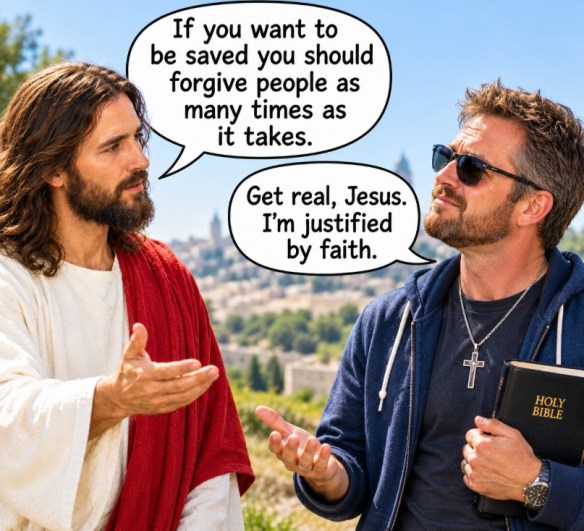
Back when I started this blog in 2013 (that first post now sadly missing), I wrote about the irreconcilable differences between Paul’s version of salvation and that which Jesus promotes in the synoptic gospels. I’m not going to reiterate all of those differences here, but one in particular is pertinent to Bart D. Ehrman’s argument in Love Thy Stranger.
Ehrman points out that Jesus repeatedly says that the way to be reconciled with God is to demonstrate genuine remorse for your ill treatment of others (repent of your sins) and ask God to forgive you. Jesus insists, both in his teaching and parables, that the forgiveness God grants you must then be reflected in your forgiveness of others. He goes further, insisting that unless you forgive others then God will not forgive you. This is embedded in the so-called Lord’s prayer as ‘forgive us our sins as we forgive those who sin against us.’ That ‘as’ means ‘to the extent’: ‘forgive us our sins to the extent we forgive others.’ This is clearly spelt out in Matthew 6:14–15:
For if you forgive others their trespasses, your heavenly Father will also forgive you. But if you do not forgive others their trespasses, neither will your Father forgive your trespasses.
According to Jesus, forgiving is the means of being reconciled to God. Not so with Paul. Paul mentions forgiveness only once in his letters and then in an entirely different context. For Paul, the only means of reconciliation with God is through belief in the atoning death of Jesus. As Ehrman asks, if God is entirely willing to forgive sins without a blood sacrifice, as happened when Jesus was still alive, why does he require one after his death, or indeed at all? Because, it would seem, Paul says so. And his say-so apparently overrules Jesus, the supposed Son of God, the Messiah. The atonement, reconciliation, salvation, justification by faith – call it what you will – that quickly took hold in the new faith was Paul’s. Churches today preach Paul’s means of redemption, not Jesus’.
What caused the sudden change? Paul was writing only 20 years after Jesus’ death and already Jesus’ theology is forgotten and replaced. The gospels did not of course exist when Paul was writing, but he did meet with ‘the disciples’. Did they not remember what Jesus had said about forgiveness? Was this one of the areas they disagreed on?
Ehrman accounts for the change by a critical event that occurred between Jesus life and Paul’s writing. That event was the death and resurrection of Jesus. This he says changed the disciples’ view of how being reconciled to God was to be achieved. They abandoned Jesus’ teaching about forgiveness, and the giving away of wealth too, and worked out a different theology: namely that Jesus’ death and resurrection were the only means of salvation. Paul of course was in line with this new way of thinking. But there are so many problems with this hypothesis, not least the absence of evidence.
Next time…

