It’s the End!

AI shows how it’s done. Arrange your elements carefully, and – hey, presto! – Jesus appears!

I’ve reached the end! The end of Jonathan Cahn’s The Dragon Prophecy that is. He has me convinced: the end of the age and the world itself, is just around the corner. He looks around the world, particularly the Middle East, sees the state it’s in and dives into the scriptures to uncover the prophecies that presage present day events. He then reveals how, collectively, these scriptures accurately describe the state of the world today following Hamas’s invasion of Israel on 7th October 2023.

Had he collected these passages prior to 7th October, would they have accurately foretold the events of that day? They should’ve done if that’s what they are really about. So where was this expose before 7th October? Where were the books, by Cahn or anyone else, revealing how the Bible predicted in detail, events that still lay in the future? Predicatbly (pun intended), they don’t exist. Cahn’s The Serpent’s Prophecy could only be written with hindsight, after the events, 7th October 2023 in particular, that he’s decided fulfil biblical prophecy. The prescience of these ancient scriptures is only apparent, to Cahn if no-one else, in retrospect.

He gathers disparate verses together to demonstrate how they do indeed predict current events. He omits many that don’t, even though they too appear to prophesy the future. He does this because they don’t fit the picture he’s trying to create: his interpretation of events in Israel and the significance he wants ascribed to them.

Cahn disingenuously forces unrelated verses to work together, like pieces from different jigsaw puzzles, to create a picture that loosely and disjointedly conforms with and thereby confirms his own conclusions. 

The culmination of The Dragon’s Prophecy is that the time is right and the stage set for Christ’s ‘return’. Cahn advises his readers to surrender to him before he comes though the clouds to do unspeakable things to them. While none of the ‘prophecies’ he’s pressed into service have ever been fulfilled and are certainly not being now, this one must surely be the greatest of the Bible’s failed prophecies.

Does all of this sound familiar? It should. Starting with Paul and the gospel writers, numerous hacks have pulled together biblical prophecies to show how events of their times fulfil the conditions for Christ’s return.

More than this, the gospels were created in exactly the same way that Cahn creates his end-of-the-world scenario. Mark, Matthew and Luke, ruthlessly plundered ancient Jewish scripture to show how their suffering Messiah (whether real or not) was predicted there. Significantly, no-one prior to the early days of the Christian cult believed that these particular scriptures foresaw a suffering Messiah who would die for the sins of his people before coming back to life. The scriptures could only be made to do so in retrospect. After some claimed to have seen the risen Jesus, early cultists began to scour the scriptures for passages – how many they had to ignore or misinterpret! – that could be made to create a loose, disjointed picture of their super-hero. It’s how Paul attempted to persuade others that Jesus was the Messiah (1 Corinthians 15:3,4 etc).

So Cahn is doing nothing new, finding a ready audience for his particular sleight of hand.

When A Child Is Born… Supernaturally

To what extent are the conflicting nativity stories in Matthew and Luke historical? That depends on whether or not you believe in the supernatural.

There is no evidence of a supernatural realm nor the beings who are said to inhabit it: God, heavenly Jesus, the Holy Spirit, angels and those they are constantly at war with: Satan and his demonic hordes. It is not as Jonathan Cahn describes it in The Serpent’s Prophecy:

Behind the perceivable realm lies another, beyond our ability to measure or quantify. Behind the history of this world lies another, unrecorded, unrecited, unknown. And behind that which moves and transforms the world lie unseen forces, causes, agents, undying and primeval (p3).

Cahn cannot possibly know any of this, any more than fake-Paul could when he wrote Ephesians 2,000 years ago (6:12). A reality that exists above and beyond nature – the meaning of supernatural – that is ‘unseen’, undetectable and ‘unknown’ is one that doesn’t exist, except in the imagination of a few fantasists.

Yet the supernatural is the basis of Christianity. Without it, its agents, as Cahn calls them, could not have interacted with the only reality there is. The Holy Spirit could not have impregnated Mary; angels could not have materialised to announce Jesus’s birth to a group of credulous shepherds; a divine being could not have communicated through dreams with Joseph and the Magi; a magic star could not have been manoeuvred into place over Jesus’ house. Most significantly, a non-existent God could not have sent his ‘son’ into this world.

It is futile to argue whether Matthew or Luke’s nativity narrative is the more historically accurate. Nor is there any point in trying to harmonise the two accounts. Neither is historical: the involvement of the supernatural rules out their being factual.

The inclusion of the supernatural in everything that follows is also fatal to claims made for the gospels’ historicity. The clues are there in the text: God’s pronouncements from the sky; the inexplicable miracles and healings; the presence of angels, demons and Satan; the dead rising; visions, prayers and prophecies. These tell us that what we’re dealing with is fantasy material. The creators of the gospels and other books of the New Testament had no more evidence than Cahn does that secretive super-beings existed, even if they did take them for granted. God and his interventions no more exist than Santa Claus and his magical Christmas deliveries.

Paul tells us that God raised Jesus from the dead (Romans 8:11). But there is no God, so he didn’t. There was no supernatural resurrection and without a resurrection there were no encounters, like those in the gospels, with a reanimated body.

Remove the supernatural from the Jesus story and there’s nothing left. Some wise advice lifted from Jewish scripture perhaps, plus a few cult rules, but that’s all. Paul’s experience of the risen Christ, like that of Cephas before him (described nowhere in the New Testament but allegorised in the gospels) and John of Patmos after him, were as Paul himself says, a ‘revealing’ in their own heads.

I hope none of this spoils Christmas for you. The Nativity isn’t a bad story, indeed it’s quite beautiful in places. But it is not historical. Like much in gospel Jesus’ life, and the resurrection itself, it is a fantasy generated by irrational and superstitious minds.

A very happy Christmas to both my readers.

Experiencing Jesus

Back in my students days, sometime in the Middle Ages, I was involved in the conversion of a couple of friends. I’d only just met them, after starting college a week or so earlier. I was training to be a teacher and the college thought it would be a good idea if their new recruits spent a couple of weeks travelling to a school miles away to observe how education was delivered there (pretty chaotically it turned out.)

Jan, Karen and I travelled to the school in Rob’s Triumph Herald car. Rob was a new friend too. He and I met the first day of college and hit it off straight away, both being evangelicals (his guitar was covered in Arthur Blessit ‘One Way’ stickers) and bonding over our mutual love of Larry Norman.

Rob had one such sticker on the dashboard of his car and one day, on our way back from the school, Jan and Karen asked about it and what it was like to be a Christian. We had somewhere taken an unintended detour and the journey back to the college was taking longer than usual so we had plenty of time to share our faith with them. It was a dream come true – what committed Christian didn’t look for opportunities to witness to non-believers, which we did with great enthusiasm.

Before going off to college I’d had a strange vision: a vivid scenario playing out in my head. In it, some people I hadn’t yet met came to my dorm room and asked me to lead them to Christ. While I hadn’t seen my room at this point it turned out to look exactly as I’d seen it in the vision. Lo and behold, after our chat in the car, Rob appeared at my door that evening and said Jan and Karen had arrived at his room saying they wanted to become Christians. We took them to the little prayer room in the back of the college chapel and there the Holy Spirit took over. We prayed with ‘the girls’ and introduced them to Jesus. The entire room was filled then with another powerful presence like a wind or tongues of fire as we sensed Jesus there with us.

It was a powerful experience and for the girls an overwhelming one. They left praising the Lord on an all-time spiritual high. Soon after, Jan had to go into hospital (I forget why) and used the time to read the Bible we gave her in its entirety. She was on fire for the Lord there in that hospital ward. Later she surrendered her yoga materials to us once we’d shown her how the practice was Satanic and, doing the Lord’s bidding, we destroyed it for her. Jan and Karen joined the Christian Union, coming to the twice weekly meetings and began to attend the local evangelical church every Sunday.

To this day, Jan remains a Christian. I haven’t seen her for many years but we share Christmas cards and very occasionally comment on Facebook posts. Karen abandoned her faith a few years after her conversion.

How to explain this amazing experience? Conditioning meets emotion. That it was life-changing for both Jan and Karen (for a while) and also for Rob and me, was the result of our own intense feelings. Neither Jesus nor his Spirit was present in that little prayer room. We thought he was and that was enough. We didn’t need to see him, it was enough to sense his powerful presence (in reality our own heightened emotions.)

Wasn’t this how it was for the earliest Christians? Those Paul told about Jesus never actually ‘saw’ him; they felt him among them. This is how the gospels say it works, not the sighting of a physical body but the sensing of a presence. Matthew makes his version of Jesus predict that this is exactly what will happen (in reality Matthew is reflecting what early cultists had been experiencing for decades when he came to write his gospel):

For where two or three are gathered together in my name, I am there among them (Matt 18:20).

In other words, a small group intent in their worship would experience the presence of their heavenly saviour. They would manifest a sense of his being there through their collective emotions, just as Jan, Karen, Rob and I did in that prayer room. As did those, like Cephas, who experienced him way back at the start of the Jesus movement, and as Paul did in his imagined encounters with the risen Christ.

No reanimated corpse required.

Encounters with God

I had a couple of encounters with God on a recent trip to the Baltic states of northern Europe. Both were in churches, the first in Helsinki, Finland. The Lutheran Temppeliaukio Kirk (above) is a remarkable structure hewn from solid rock into a stunning enormous cavern. The choir was practising when our tour guide took us there. The singing was sublime, amplified and enhanced by the acoustics of the cave. Listening to the ‘heavenly’ voices was a truly spiritual experience. After the performance, the choir leader dedicated their performance to the glory of God.

The second church was the protestant St Nikolai’s in Kiel, Germany where, local legend has it, a miracle occurred during the second world war. When the town was in danger of being bombed, church officials had all of the church’s historic pews removed and safely stored. The massive suspended crucifix, however, was too big to take down and had to be left in place. Some parishioners quickly became unhappy standing for services and started bringing their own seats, including quite a few sofas. When the town and the church were eventually bombed, the huge crucifix fell from its height and crashed down. While the church itself was all but destroyed, the crucifix survived with only minimal damage, thanks to the sofas on which it landed. A miracle!

The cross suspended again in the restored St Nikolai church

Singing that reflects the glory of God and a miracle in which Christianity’s holy symbol is preserved. Presumably today’s attendees at both churches (St Nikolai’s interior was rebuilt) believe these events to be the work of God. Our tour guide that day expressed his scepticism, as did I, inwardly at least. The singing in the cave church was a tribute not to God but to the human ability to create beauty. It spoke too of the skill of the church’s architects and engineers who provided the building with its stunning acoustics. Human ingenuity, creativity and, I would guess, hours of practice produced the sublime sound.

The crucifix ‘miracle’ was a remarkable convergence of coincidence. A good story to be sure, but not an event that requires any God.

I drew the same conclusion from the two experiences: human beings are prone to give credit to their deities for things they achieve themselves – beautiful singing and stunning architecture included – and to attribute chance events and coincidences to their gods. We should take credit for our achievements (as well as responsibility for our bad behaviour.) The gods have no part to play. There are no gods.

The Great Eternal Life Scam

Heathens like me, and you dear reader, are gambling how we’ll spend eternity by rejecting Jesus. We’re turning down everlasting life to live in the mire of our own sin. Or so we’re told by evangelicals and other religious zealots.

So convinced am I that the claims of Christianity are wrong in every respect that I know I’m not gambling anything. Like everyone else who has ever lived, I will not survive my death. This is the nature of death – extinction, obliteration, oblivion. It is absurd to believe it is anything other when we know it is not.

I would not be averse to existence, particularly my own, continuing after death. I’d definitely go for it if that were available; I like being around, all sentient and self-aware and such. This is the sentiment to which Christianity appeals; most people do not want to think their existence is finite and that this often challenging life is really all there is. But life patently does not continue post mortem, except in works of fiction: fantasy, science fiction, the gospels.

Everlasting life is not the only promise Christianity makes, of course. There’s the whole ‘getting right with God’ shtick, forgiveness of sins and Life in all its fullness. Eternal life is the big one though, Christianity’s most miraculous, death-defying special offer.

Those doing the gambling are not atheists or sceptics. It’s Christians themselves doing that, succumbing to the false, utterly worthless promise of life after death. Those fully committed to Christianity spend their lives enslaved to its cultish demands, desperately trying to convince others they should surrender to its preposterous claims.

I value this life too much to squander any more of it on such nonsense. Yes, I did once, but I saw the light and stepped into it. Life is what you make it and needs to be lived before you die. There is zero chance you’ll be able to once it’s over.

Burst the bubble, those of you trapped within it. Your one and only life awaits you here on Earth. The clock is ticking.

Speaking in Tongues


I used to be so uncomfortable in prayer meetings that I attended back when I was a true believer when someone would start praying in tongues. It usually went something like alaluboolubamuba repeated over and over again, like a babbling brook. Babbling is what it was. In the churches I experienced it in, there was rarely any interpretation of the tongues as Paul instructed there should be. Even when someone was led by the Spirit to pipe up, what the speaker in tongues had said in gobbledegook was standard praise stuff: ‘Thank you Jesus for your wonderful mercies. Praise you for all you have done for us. Alleluia! Praise you’ etc, etc. And who were we, the others present, to say it wasn’t? Some would add their own Amens to the interpretation, adding credence to the meaningless phenomenon. The Spirit at work indeed.

Speaking in tongues, glossolalia, seems to have afflicted the cult in Corinth in particular. Paul addresses it in his first letter to the church there, and nowhere else. He doesn’t seem to know what to make of it. He feels unable to say that it’s merely a few people getting carried away (because that’s pretty much what all early Christian worship was) and can’t say it’s not the Spirit moving them to babble when that’s what the church was claiming. So he fudges it, claims he speaks in tongues more than anyone else (why do I hear Donald Trump in this boast?) and makes a few stipulations:

Only speak in tongues if there’s an interpreter present. (What happens if you get the urge the Spirit moves you when there’s no interpreter around?)

Glossolalia is ‘uttering mysteries’ in the Spirit that no-one can understand (so how can they be translated/interpreted by someone else?)

You shouldn’t speak in tongues all at the same time. It’s unseemly.

Use tongues only in private (according to the great know-it-all apostle, tongues are of the spirit and are merely a way of praising God. Tongues then are God praising God: what a narcissist he is! Other than this, Paul concludes they’re not much good.)

Interestingly, at no time does Paul suggest or acknowledge that some of the tongues manifesting themselves are other languages – real languages as opposed to unintelligible babbling. In fact he makes much of the fact that no-one understands what is said. It’s left to Luke to elevate linguistic nonsense to miracle status. In Acts 2:4-12, he has the disciples speak in real foreign languages after the Holy Spirit takes hold of them. Those around are ‘amazed’ (aren’t they always?) that they can suddenly hear the gospel message in their own tongue. Luke labours the point that, conveniently, there were men from ‘every nation under heaven’ present to verify the use of multiple languages by otherwise uneducated fishermen. Far more likely is that Luke, aware of the outbreak of babbling in at least one early church, shaped what he’d heard into what he thought was a more credible account. In other words he made up the story of the disciples spontaneously becoming fluently multi-lingual.

Later still, the unknown writer who invented the longer ending of Mark decided to mention the tongues phenomenon in the prophecies he invented for Jesus. In Mark 16:17 he has Jesus promise that those who believe in him would miraculously speak in ‘other languages’. How many times has this happened in the ensuing two millennia? I’d put money on there only ever having been sporadic outbreaks of meaningless babbling, such as that which I experienced. 

The church today continues to be confused about tongues. Some claim that ‘the gifts of the Spirit’, of which tongues are a part, no longer manifest themselves among believers. It’s a neat way to consign bizarre behaviour to the dumpster of history, but alas, it’s unscriptural. Nowhere does Paul suggest tongues and the other gifts of the Spirit would have a sell-by date before the Lord’s coming. Admittedly, he thought the Lord would be coming real soon. Only then, not before, would tongues and the other gifts of the Spirit ‘pass away’.

Other churches today are open to the possibility of tongues. Some even claim that the Spirit does indeed enable believers to launch fluently into languages, complete with correct syntax and vocabulary, that they don’t actually know. We can be sure there would be evidence of this online if it really occurred. There isn’t. 

Others are happy to go along with the unintelligible babbling, preferably with an interpreter who makes stuff up is also led by the Spirit to make sense of the mumbo jumbo.

Some abandon all restraint, with entire congregations babbling at the same time. Paul’s rules be damned!

And they wonder why we don’t take them seriously. As Paul himself warned:

If the whole church comes together and everyone speaks in tongues, and inquirers or unbelievers come in, will they not say that you are out of your mind? (1 Corinthians 14:23)

They surely will.

Have any of you encountered speaking in tongues? What did your church make of it?

Neil’s Second Letter, to the Literalists

Dear Literalist,

I’m confused. Please help me understand which Jesus you believe in, the one whose spirit dwells within you.

Is it the Jesus of one of the first three gospels? The rabbi who walked in Galilee two thousand years ago? You see, I expect it to be him but then I find you ignore most of what he says. You know, stuff like love your enemies, pray for those who persecute you, sell all you have and give to the poor. So I can only conclude this isn’t the Jesus you believe in and commune with.

Is it the Jesus in John’s gospel? The problem with this version, I think you’ll agree, is that he isn’t the same as the Jesuses in the other three gospels. He feels kind of made up. Probably no more so than those Jesuses but, you know, more obviously so.

Or is it the Christ Paul talks about? The one he saw in his visions? Because this Jesus really bears no similarity to the ones in the gospels. Paul doesn’t seem to know those Jesuses. Paul’s version is a heavenly being like other demi-gods of the ancient world: Osiris, Apollo, Mithras, Romulus, even defied Emperors, all of whom mystics claimed to have seen in visions. Is this the Jesus you believe in?

Perhaps you believe in the Jesus some New Testament writers claim sits at the right hand of God the Father ‘interceding’ on behalf of sinners. It’s a mystery how they know this, but they seem sure, so no doubt this Jesus is as legitimate as any other. You’d be perfectly entitled to include him in your internal pantheon.

You may also believe, as Paul did, in the Jesus who’ll be coming back to the Earth real soon to put the world to rights. Except of course Paul thought this was going to happen in his lifetime as did the writers of the synoptic gospels, none of whom refer to Jesus ‘returning’. It’s as if they didn’t believe he’d been here in the first place. Still, nothing to stop you from believing your Jesus will return in your lifetime, like millions of others have done in the past two thousand years.

Possibly though the Jesus you believe in is the one you encountered in your conversion experience (or think you did.) The one who you credit with changing your life and who now ‘walks with you and talks with you along life’s narrow way’. I confess this is probably the Jesus I believed in when I was a Christian, with a few extra details added from all the other Jesuses. Of course, my Jesus wouldn’t have been the same as yours. He was my own unique creation, just as yours is for you.

Perhaps you’ve convinced yourself that your own personal Jesus is actually the spirit or ghost of the original. After all, earthly Jesus appears to say in some of the gospels that his ghost will stick around to ‘comfort’ his followers after he himself returns to the heaven just above the clouds. Is this the Jesus you know and love? Does his spirit-ghost dwell inside you? If so, where exactly does it dwell? In your head? And how do you distinguish the Jesus-ghost from your own thoughts, imagination and conditioning? (Asking for a friend.)

I’d really like to know which of these Jesuses is your Jesus. Perhaps he’s an amalgam of them all, a confection of best bits. Please let me know in the comments.

But, if you don’t mind me saying so, almost all of these Jesuses are entirely made up. They’re the product of the human imagination, making themselves known in visions and dreams; they’re the result of subjective emotional experiences, or composites made from different sources.

So your best option is to say you’re committed to the ‘real’ Jesus of the gospels. But as we’ve established, you don’t really believe in him or you’d do as he commanded. In any case, there are several different, often incompatible Jesuses in the gospels. Some of them have to be made up. Oh, wait. They all are. The real Jesus is nowhere to be seen. If he ever existed he’s lost to us, replaced by the heavenly being seen in visions and the metaphorical stories invented about him.

What a quandary! Let me know how I can help.

Yours,

The Apostle Neil

Frankie Goes to Hollywood

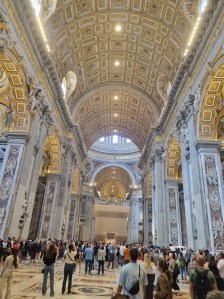
Dennis and I found ourselves in Rome last week, doing what I’m sure native Romans don’t do: the tourist trail. It’s a magnificent city.

As we were passing, we thought we’d call round at Frankie’s little place. We knew he wasn’t in, seeing as he was still on his world tour, just behind The Boss himself. He’s certainly got a great pad – Frankie that is, not Bruce – and after being frisked by hunky security guards we were admitted to St Peter’s Square. We felt moved, in the Pope’s absence, to grant an audience to the fairly thin crowd (it would get bigger later in the morning) and issue the benediction they so evidently craved. ‘Go, get a life,’ we offered from the steps of the Basilica. The faithful remained unmoved by this sage advice.

The Vatican is, I have to say, stunningly beautiful, a monument to human ingenuity and skill. But the cynic in me couldn’t help wonder what the majesty of it all had to do with the (supposed) teaching of Jesus in the Bible. I found myself playing a little game in my head along the lines of ‘how many ways does all of this contravene, contradict or downright ignore the beliefs of the earliest Christians, as expressed in what is now the New Testament?’ (Before any evangelicals tell me this is only to be expected of the Roman Catholic church, let’s not pretend that every other denomination doesn’t do the same thing.)

So, here are my suggestions for the Biblical admonitions that had to be ignored to create a religious monument on the scale of the Vatican. Feel free to make your own suggestions in the comments.

You shall not make for yourself an image in the form of anything in heaven above or on the earth beneath or in the waters below. (Exodus 20:40)

The statues of Paul and the apostles atop the buildings, the numerous images and carvings of saints, pious Marys and gruesome blood-spattered Jesuses certainly qualify as exalted images. The prohibition might not be New Testament but it is one of the Big Ten. The Vatican ditches it wholesale.

Jesus answered, “If you want to be perfect, go, sell your possessions and give to the poor, and you will have treasure in heaven. Then come, follow me.” (Matthew 19:21)

Like this ever happens!

Jesus said, ‘I am the way and the truth and the life. No one comes to the Father except through me (John 14:6)

And the Pope. And Mary. And the Saints. And the Church. And the Priests.

…the Most High does not live in houses made by human hands. (Acts 7:48)

So why build them for him? They may be meant to reflect his power and glory but they really only reflect that of the popes who had them built, plus the gullibility of their followers.

Do not store up for yourselves treasures on earth… But store up for yourselves treasures in heaven… For where your treasure is, there your heart will be also. (Matthew 6:19-21)

The Vatican’s tax free wealth, only some of which is on display around St Peter’s Square, is estimated to be between ten and fifteen billion dollars.

As I say, the Vatican is stunningly impressive; my photos don’t do it justice. If Christianity had never existed it would not have been created. But something equally impressive would have been, inspired by different ideals, deities or practicalities. Rome has stunning examples of these kinds of structures too. Nor am I getting at Catholicism per se. But you won’t find in it any expression of the beliefs, apocalyptic expectations and social reversals of the original Christian cult, nor in religion in general. Like all movements the cult had to evolve to survive, to the point it would be unrecognisable to its original quarrelsome adherents. Even if their images do look down on you from the roofs of beautiful buildings.

Jesus and the Blind Man

This time we’ll take a closer look at Mark 8:22-26, a story about Jesus healing a blind man:

They came to Bethsaida, and some people brought a blind man and begged Jesus to touch him. He took the blind man by the hand and led him outside the village. When he had spit on the man’s eyes and put his hands on him, Jesus asked, “Do you see anything?”

He looked up and said, “I see people; they look like trees walking around.”

Once more Jesus put his hands on the man’s eyes. Then his eyes were opened, his sight was restored, and he saw everything clearly. Jesus sent him home, saying, “Don’t even go into the village.”

This parable is doing a lot of metaphorical heavy lifting.

First, it is located in Bethsaida, the home of some of the disciples as well as the place where Jesus does some of his most spectacular miracles, only later to curse the village for its lack of interest in him (Mark 11:21). It is symbolic of those who reject the cult’s message, or are too dim to see that their heavenly Jesus is the Messiah.

Second, the story is sandwiched (no pun intended) between the feeding of the four thousand, in which the hapless disciples fail to recognise Jesus’ miraculous status, and the account of Peter realising that Jesus is in fact the Messiah. The healing of the blind man, neatly placed between the two, is therefore an allegory within allegories about seeing (gettit?) Jesus for who he really is (i.e. what cultists believed him to be.)

Third, the story is a prophecy-fulfilled parable. Isaiah 35:5 says that when the Messiah comes ‘the eyes of the blind will be opened and the ears of the deaf unstopped.’ Jesus has to be made to do these things – he performs some ear unstopping too (Mark 7:31-35) – to show he is indeed the prophesied Messiah.

Fourth, physical blindness is a very obvious metaphor for spiritual blindness. The preceding story reminds those who can’t ‘see’ the cult’s truth for themselves: ‘Do you still not see or understand? Are your hearts hardened? Do you have eyes but fail to see, and ears but fail to hear?’ (Mark 8:18). This is itself a borrowing of Isaiah 6:9-10. Indeed, the entire story, together with that of the deaf man being cured, is a parable of Isaiah’s ‘prophecy’:

You shall indeed hear but never understand, and you shall indeed see but never perceive. For this people’s heart has grown dull, and their ears are heavy of hearing, and their eyes they have closed, lest they should perceive with their eyes, and hear with their ears, and understand with their heart, and turn for me to heal them.

Jesus’ healing of blindness then becomes a metaphor for seeing the light, as Peter does in the subsequent story when he finally recognises him, like the cult has done, as the Messiah.

Fifth, Jesus spits on or in the man’s eyes: a very clumsy metaphor for the streams of living water that emanate from God himself in Jeremiah 2:13. Perhaps too there’s a reference to the baptism ritual beloved of the early cult. (Christian bloggers themselves have trouble explaining this gross detail that Mark sees fit to include in his story.)

Sixth, in order to give sight to the blind man, Jesus (or rather the cult) first removes him – the initiate – from the village, from those who don’t even know they are blind. Next, Jesus/the cult shows him how those who are spiritually blind are no better than trees wandering around aimlessly (yes, Mark really does mix his metaphors). Jesus/the cult then opens the initiate’s eyes to the Truth so that finally he sees ‘everything clearly.’ He can now never return to his former state; his ‘home’ is with the cult, not with the spiritually blind outside it.

The story is evidently metaphorical. That Jesus spits in the man’s face is not, as some Christians claim, evidence that it really happened. It is weighed down by so much symbolism and clunky metaphor, and at the same time strategically placed between two other ‘seeing the light’ stories that its literary origins are apparent. Mark and his fellow cultists knew what they were doing when they dressed their beliefs up in stories like these. As they themselves insist, you need only open your eyes to see it.

The Feeding of the 4000

Mark 8:1-15 has the credibility-defying story of Jesus feeding 4000 people. The story is in fact one of numbers, all of which have symbolic significance. Numbers, bread and fish.

At first reading the account seems to be little more than a retelling of the earlier feeding of the 5000 in Mark 6:30-44. However its numerology is different and Mark has Jesus explicitly compare the two stories in verses 8-21. Both are intentional inclusions in his gospel, not an editorial oversight.

The events almost certainly didn’t happen in reality; significant numbers of people, 5000 and 4000 respectively, following an itinerant preacher around for – magic number alert! – three days would not have escaped the attention of the Romans. Nor would the men (Matthew 13:58 insists 4000 was the number of men) have been able leave their livelihoods for this length of time to follow Jesus around the distant countryside.

Then there’s the repetition of the bread and fish motif. In both stories the entire crowd fails to bring a single thing to eat. On both occasions, the disciples somehow, from nowhere at all, come up with a few loaves and some fish. Symbolic food for symbolic crowds.

Bread, while a staple food of the first century always has spiritual significance in the bible. From manna from heaven in Exodus 16:17 to the Body of Christ in Paul’s teaching. Fish likewise: Mark has it that several of the disciples were fishermen and makes Jesus declare they’re ‘fishers of men’ (Mark 1:17). John will later take bread and fish symbolism to extremes.

The bread in the feeding of 4000 is spiritual manna. Jesus is not feeding a real crowd with real bread. He is ‘feeding’ those who follow him, the early cult, with himself: ‘Jesus took bread… and said this is my body which is for you’ as Paul has him say in 1 Corinthians 11:23-24. So satisfying is this heavenly Bread that there is a great abundance left even after his followers have taken their fill.

There’s more: the numerology signifies that the crowd following Jesus in the story aren’t any old rag tag collection. They are specifically Gentile. Mark alludes to this when he mentions they have come ‘a long distance’ (8:3) and again when he has Jesus explain, in typically obtuse fashion, the meaning of the miracle (8-21):

Jesus asked (the disciples): “Why are you talking about having no bread? Do you still not see or understand? Are your hearts hardened? Do you have eyes but fail to see, and ears but fail to hear? And don’t you remember? When I broke the five loaves for the five thousand, how many basketfuls of pieces did you pick up?”

Twelve,” they replied.

And when I broke the seven loaves for the four thousand, how many basketfuls of pieces did you pick up?”

They answered, “Seven.”

He said to them, “Do you still not understand?”

Seven loaves with seven baskets left over, seven being the number of the Gentile nations. In the earlier feeding of the 5000 the twelve leftover baskets represent the twelve tribes of Israel.

And still the dumb old Jewish disciples don’t understand. The story is about how the early Jesus cult was open to anyone, Gentiles as well as Jews, who recognised and accepted Jesus as the Bread of Heaven, the Saviour. As Mark was aware, Paul had already expressed this universality:

when we break the bread, aren’t we sharing in the body of Christ? And though we are many, we all eat from one loaf of bread, showing that we are one body. (1 Corinthians 10:18).

For his next miracle, the healing of a blind man in Mark 8:22-26, Jesus/the cult/Mark go on to hammer home the point still further.