Bible Study

Again he entered the synagogue, and a man was there with a withered hand. And they watched Jesus, to see whether he would heal him on the Sabbath, so that they might accuse him. And he said to the man with the withered hand, Come here.” And he said to them, Is it lawful on the Sabbath to do good or to do harm, to save life or to kill?” But they were silent. And he looked around at them with anger, grieved at their hardness of heart, and said to the man, Stretch out your hand.” He stretched it out, and his hand was restored. The Pharisees went out and immediately held counsel with the Herodians against him, how to destroy him. (Mark 3:1-6)

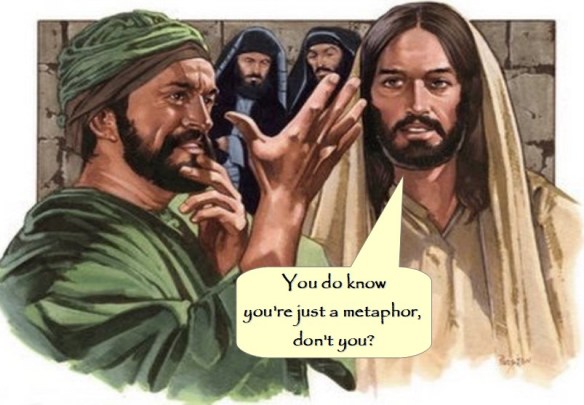
Greetings, my beloved Brethren. Today we are going to look at God’s Holy Word as revealed to our dear brother in the Lord, the one who will one day be called ‘Mark’. We’re looking specifically at the passage above, because some of you have expressed difficulty in discerning the full import of the text. I have to say I’m surprised at this. You only have to bear in mind Mark’s rule of thumb that everything in his gospel is a metaphor, which, when looked at with discernment, reveals a previously hidden mystery: 

To you has been given the secret of the kingdom of God, but for those outside everything is in parables, so that “‘they may indeed see but not perceive, and may indeed hear but not understand, lest they should turn and be forgiven’” (Mark 4:11-12, referencing Isaiah 6:9)

Our passage today begins with the Lord healing a man with a withered hand, which should straight away alert us to the fact we are dealing with metaphor. All of the healings in the gospels are. They stand for something more significant than any actual healing.

Some of you might already have made the connection between the use of ‘withered’ here, with its use in another story (Mark 11-12-14), where Jesus withers an unfruitful fig tree. Of course, no actual fig trees were harmed during this miracle. The fig tree and its withering are metaphors.

The tree, you see, is a metaphor for the Jewish system of worship, the old Covenant of the Law. This had reached the end of its life. It was fruitless and God was done with it. He was in the process of replacing it with salvation through Grace. All of this is represented metaphorically by Jesus cursing the fig tree and causing it to wither.

So it is in our passage today, except this time, God offers healing to the Jewish nation. He is nothing if not gracious, reaching out and offering acceptance into the new Covenant, expressed here as the healing of a withered hand. You won’t have missed the fact – again symbolic – that the healing occurs in the synagogue, the Jews’ place of worship. We might also remember Deuteronomy (6:8) where the Lord God instructs the Jews to wear his Law on their foreheads and, more significantly, to tie them to the backs of their hands. But now their hands have, metaphorically speaking, withered away, just as the fig tree will.

God knows of course that few will accept his proffered healing, insisting instead of labouring blindly under the old Covenant. The rest of the story reflects this stubbornness and the incalcitrant attitude as the Pharisees – metaphors for the Jews as a whole – round on Jesus and castigate him for breaking the Sabbath laws in healing the man – in spiritual reality the Jews themselves. That Jesus heals on the Jews’ sacred day is metaphorical too, demonstrating as it does that all the old laws are now surpassed. Jesus, and more importantly his followers – you, my dear brethren – are no longer under the yoke of that law but have new freedom serving Jesus under his new yoke, which is easy to bear. At the end of the story, the Pharisees – the Jewish leaders of our own time, lest we forget – leave to plot against the Lord; in reality against us. With his help we will of course bear this persecution stoically.

So you see my brothers, this story was written for you, to remind you that you are saved. You are the New Covenant. The Old has passed away. You can follow Jesus’ example and do good, yea, even on the Sabbath. You need not fear the Jews or others who might persecute you because the Lord is with us. The Jews, on the other hand, will soon be cast into outer darkness when he comes in person. Even so, Lord Jesus, come quickly.

I hope this has made clear to you the mystery hidden in this part of Mark. I know there will be some of you who are not sufficiently advanced in their understanding of the mysteries, being still babes in Christ, and may yet object to this exposition of the deeper secrets of the Lord. So be it. But don’t say you haven’t been made aware of the Truth.

Next time, if there are those who need to know more of the mysteries hidden in God’s new revelation, we can look at the next part of Mark, though I trust that you are, by now, developing sufficient spiritual insight to discern for yourselves the hidden mysteries embodied by the gospel’s metaphors.

Announcement

The story so far…

While he used to argue vociferously that the gospels are history – remember they must be history because Pilate and Herod are in them? – our resident apologist has backed away from this position. He says now they’re not history as such but are only ‘like’ history, which means they’re ‘historical but not written as histories’, whatever this means. He derides the likes of Ehrman and Tabor for their inability to recognise this (newly invented) fact. These no-nothings make a category error when they confuse the gospels with history.

I suspect Don wants to reclassify the gospels because he recognises they make rather poor history. It’s safer to pretend they’re designed to be something else, something that doesn’t require external evidence to verify it: ‘announcement’, for example.

This, however, merely sidesteps the question of where the gospel writers got their information from. Don has previously argued that the gospels are based on eye-witness reports, Peter’s dictation to Mark and a reliable oral tradition. But conjecture like this is only necessary if the gospels are history. If they’re not, but are ‘announcement’ instead, then their sources need  be neither historically reliable nor demonstrable.

If the accounts are ‘announcement’ rather than history then where does their ahistorical, announced information come from? Fortunately, Mark gives us a clue:

To you has been given the secret of the kingdom of God, but for those outside everything is in parables, so that “‘they may indeed see but not perceive, and may indeed hear but not understand, lest they should turn and be forgiven’” (Mark 4:11-12, referencing and misquoting Isaiah 6:9)

In fact, the gospels’ ‘announcement’ is conveyed by a story constructed from supposed prophecies from Jewish scripture and the immediate concerns of the early cult communities, expressed in metaphors of the gospel writers’ making. All of the internal evidence supports this conclusion. In fact, the source of the gospels’ material is the same as Paul’s and that of other writers in the New Testament. Here’s how the great, self-appointed apostle puts it: 

My gospel and the preaching of Jesus Christ [is] according to the revelation of the mystery which was kept secret for long ages, but now is made visible through the prophetic scriptures and is made known to all nations, according to the command of the eternal God, for the obedience of faith. (Romans 16:25-26)

Christ died for our sins according to the Scriptures. (1 Cor 15:3-8)

Compare this with:

Today this scripture is fulfilled in your hearing. (Gospel Jesus in Luke 14:21)

He said to them, “How foolish you are, and how slow to believe all that the prophets have spoken! Did not the Messiah have to suffer these things and then enter his glory?” And beginning with Moses and all the Prophets, he explained to them what was said in all the Scriptures concerning himself. (Gospel Jesus in Luke 24:25-27)

He said to them, “How foolish you are, and how slow to believe all that the prophets have spoken! Did not the Messiah have to suffer these things and then enter his glory?” And beginning with Moses and all the Prophets, he explained to them what was said in all the Scriptures concerning himself. (Gospel Jesus in Luke 24: 25-27)

(Paul) reasoned with them from the Scriptures, explaining and proving that the Messiah had to suffer and rise from the dead. “This Jesus I am proclaiming to you is the Messiah,” he said. (Fictional Paul in Acts 17:2-3)

The revelation of the Messiah and the secrets and mysteries revealed to Paul and the other apostles are ‘explained and proved’ in their entirety by ancient scripture. But, these scriptures in and of themselves do not prophesy the kind of Messiah the early apostles envisaged. Rather, the scriptures are retrospectively pressed into service to match the revelations of the Messiah that Paul and the others experienced.

This is Don’s ‘announcement’: secrets and mysteries founded not on history but on revelation expressed through metaphor and the misapplication of scripture.

Beyond The Grave

A few years ago, a friend of mine was working in his front garden when he spotted what he was sure were a couple of Jehovah’s Witnesses further down the street. He aimed to back inside before they reached his house, from where he could safely ignore them. But he timed it badly and before he knew it, the JWs were upon him.

My friend was under some stress at the time so when they asked him, ‘Wouldn’t you like to live forever?‘ he responded with, ‘Good God, no. This life’s bad enough. Why would I want it to go on forever?’ This took the wind out of their sail though didn’t divert them from their sales pitch for very long.

I’ve been in the same state of mind myself, and maybe you have, when life was so difficult I spent far too much time contemplating whether being dead might not be a better option. Thankfully, I couldn’t really contemplate doing anything about it, and was aware of the effect it would have on my loved ones if I did, but nonetheless I spent too much time considering – desiring even – my own non-existence.

I was pretty sure this was what awaited after death. I hadn’t, by this stage of my life, the conviction of the Jehovah’s Witnesses and mainstream Christians that a better life, one that would last forever, lay beyond this one. Instead, I made radical changes to my life in the here and now, to lift myself out of the slough of despond in which I found myself.

I love life now. It isn’t without its difficulties, not least the physical problems that come with older age, but I enjoy it to the full (apart from supermarket shopping). Having found my pearl of great price, I hope life will last for many years yet. I can’t guarantee it will, of course, so I make the most of every moment, surrounded by people I love and who love me.

Would I like my life to go on forever? Certainly, but I know it won’t. There is simply no evidence life continues after death. Assurances that it does in religious texts is no evidence at all. Even if it were, the type of eternal life suggested by the Bible, worshipping a needy, despotic God for evermore, is not the way I’d like to spend eternity.

Ask Christians how they know they will and the best that can come up with is that the Bible tells them so or that Jesus promises they will (which amounts to the same thing.) Ask them where this everlasting life will be lived and you’ll get one of two answers: in heaven or here on a restored Earth, once Jesus ‘returns’. The earliest writings in the New Testament support the here-on-Earth scenario. The later ones – perhaps because their authors had begun to realise Jesus wasn’t coming back any time soon – start, like John 14:2, to hint at a celestial existence.

No Christian – no non-believer either – has survived death to face eternal bliss or eternal damnation. Some will tell you that rising from the dead happens in an ethereal way immediately following death. The soul (or whatever) is resurrected either to be reunited with God outside of time and space or thrown to the demons in hell. The biblically savvy, like the JWs, will tell you the resurrection will not occur until Jesus’ return at some point in the future. Significantly, both expectations occur off-stage: the first in a undemonstrable plane of existence, the second in a future that never arrives. Both are wishful thinking, scenarios dreamt up by those frightened of their own non-existence.

The offer of everlasting life is one of the New Testament’s most pernicious lies. The idea is not to be found in the Jewish scriptures that make up the Christian Old Testament. It is a later development, dreamt up by extremists who convinced themselves, on the basis of a few visions, that God would ensure their continued survival, just as he had Jesus’s.

If this isn’t how the promise of living forever came about, then what is the evidence there is an existence beyond death? Empty assurances by first and second century cultists are not it.

  • Show me someone other than Jesus – whose ‘resurrection’ is metaphorical at best – who has risen from the dead.
  • Show me evidence that ordinary human Christians have already gone on to eternal life.
  • Show me, if you don’t subscribe to this view of immortality, the souls who rest with God awaiting a future resurrection (1 Thessalonians 4:13-18; Revelation 6:9-11).
  • Show me just one human, Christian or otherwise, who has gone on beyond death.
  • Prove that the promise of eternal life is real.

If the Gospels were History…

If the gospels were written by eye-witnesses, we should see the use of the first person singular or plural: ‘I saw this happen’, ‘we heard him say that’ and so on. This would not necessarily mean that the author was present, just as he isn’t in the ‘we’ passages in Acts, but it is what we should reasonably expect if the authors were involved in at least some of the events. There are no such instances in any of the gospels.

We would see gospel authors identifying themselves, at the start of their accounts, for example. We don’t.

We would not see an eye-witness lifting significant amounts of material from someone who wasn’t an eye-witness. Yet Matthew plagiarises Mark, ‘improves’ it and passes it off as his own. This isn’t eye-witness behaviour and it is not how eye-witness testimony works.

We would see the gospel writers cite their sources: Mark would tell us he’s recording Peter’s recollections and that he witnessed Jesus’ trial personally (there’s no evidence he did either, speculation from centuries later notwithstanding.) Luke would tell us which accounts he’s referring to in Luke 1:1-2. While we now know he too plagiarises Mark and quite probably Matthew, he doesn’t admit it. We would know the source of events that took place behind closed doors such as Jesus’ interview with Pilate.

We could expect contemporaneous accounts independent of the gospels, recording the miraculous events they claim occurred; the wandering star, the earthquakes, the hours long eclipse, the healings and controlling of nature, the resurrected zombies, the ripping of the 35 foot temple curtain, the resurrection of an executed criminal. Instead there’s nothing, not even in later works such as those of Josephus (because all of these events are metaphorical).

We should expect Cephas (known as Simon Peter in the later gospels) to have recorded his experiences with Jesus. Yet, when he gets his chance, in the letters he supposedly wrote (1 and 2 Peter), he makes no mention of them at all.

We should expect the Christians prior to Paul to have recorded some of these episodes. Some argue that they did, in a document now called Q, but this precious document was, unbelievably, soon lost or abandoned. Alternatively, they may not have seen the need to write anything down because they believed the world was about to end very soon. Either way – no accounts from them about ‘the history of Jesus’.

We should expect Paul to mention aspects of the Jesus story in his letters. After all, he claims to have persecuted Christians for some time before his conversion and to have met and conversed with Cephas for 15 days. Yet he conveys no details at all. Instead, he claims all he knows of Jesus derives from visions and ‘revelations’ in his head. His account of the bread and wine ritual informs Mark’s story of the Last Supper, not the other way round; it is – Paul says clearly – another ‘revelation’ in his head.

We should expect there to be details about Jesus’ earthly life in other books of the NT. Instead we find only a celestial high priest in Hebrews and a warrior Christ in the supposed visions of Revelation. Nothing historical here.

We should, if the gospels are history, expect them to read like history. History, including that written at a similar time does not include angels, devils and apparitions, magic stars, virgin births, miracles and supernatural healings. Where it does, as in Constantine’s vision of the cross, such elements are seen for what they are: myth, not history.

We would not expect the central figure of the gospels to be constructed almost entirely from parts of older religious writing. This is not a technique used in genuine historical records.

We would not expect to find the level of metaphor and mythic tropes – magic, supernatural characters, returns from the dead – in what is ostensibly an informational text. History does not rely heavily on metaphor and symbolic tropes the way the gospels do. There is no ‘logic of history’ in the Jesus story.

We would expect to see geographical and political details relayed reasonably accurately. Instead, Jesus’ trial arrangements are highly improbable; they do not conform with what is known about Roman trials – and we know a lot, because of the records they kept. Jesus would not have had a personal interview with an indecisive Pilate, who would not have consulted the mob, would not have sent Jesus to the Jewish authorities or Herod and would not have offered to exchange Jesus for Barabbas (there was no ‘tradition’ of exchanging one criminal for another) and so on. From what we know of him, Pilate would have authorised the execution without a qualm, as he did for many other would-be messiahs. The rest – the gospel details – are drama, Jewish scripture brought to life with added metaphor. Fiction, in other words.

Parables

Jesus’ parables are analogies: similes or metaphors. ‘The Kingdom of heaven is like’; ‘there once was a man…’ Every one of the parables tells a story that didn’t actually happen. There was no literal Good Samaritan, no Prodigal Son or Sower. Jesus, or more probably the gospel authors, made up these stories to illustrate ‘mysteries’ (μυστήριον; gnosticism anyone?) What do they say about the parables? The majority appear in Matthew’s gospel, though Mark and Luke also include them. There are none in John. Did he, a supposed eye and ear- witness, not know of them?

Mark has Jesus say to his disciples:

To you has been given the secret of the kingdom of God, but for those outside everything is in parables, so that “‘they may indeed see but not perceive, and may indeed hear but not understand, lest they should turn and be forgiven’” Mark 4:11-12

Mark lets his readers in on the ‘secret’ (μυστήριον again) because there are mysteries within the cult, secrets available only to the initiated. Remember, the parables were written – they are almost certainly literary creations – 40 years after the cult was established. Only cultists would understand the secrets/mysteries embodied in the parables. Parables, Mark tells us, are intended to disbar those who are not spiritually attuned from salvation/the kingdom of God/eternity.

The word translated as parable also means ‘riddle’, designed to puzzle or obfuscate. But Mark doesn’t just say the parables are intended to do this. He says ‘everything is in parables’. What did he mean by ‘everything’? All of the teaching he attributes to Jesus? All of the episodes he relates? Could it be that the entire Jesus story, crucifixion and resurrection included, is one long, extended parable? A metaphor, if you like.

You bet it is.

Related:

Stories about Jesus

The Jesus Story v. Reality

Cruci-fiction

Inventing Jesus

The Bible as Metaphor (again)

A few days ago, Dennis and I visited Penrith, a small market town a short distance from the city where we live. What a delight it was to discover that the street preacher who plagues our city – the humourless Dale McAlpine – also inflicts himself on this smaller place. We so enjoyed hearing him bellow out, as we manoeuvered past his confederates handing out poorly written tracts, that we were all sinners – ye, everyone of us – bound for hell.

As we stopped at an ATM we heard Dale announce how Jesus healed lepers and cured leprosy, which patently he did not. He said Jesus’ healing of lepers was a metaphor for what he could do for us all, by removing our sin and making us whole again. His metaphor schtick – an sophisticated one for a simple street preacher – put me in mind of our very own Camp commenter. As Sunday school teacher Don frequently reminds us, the Bible is a) literature and b) largely metaphorical.

In case he’s forgotten and is arguing this week that we should view the bible’s stories as historical accounts (his other favourite tack), here’s what he actually said:

Much of scripture is the kind of literature in which metaphor and other kinds of figurative language is common… you are out of touch with the literary character of ancient literature.

I hope you all feel thoroughly chastised by this. I know I do. Don was taking exception to my post in which I itemised the Bible’s mythical creatures, talking animals and impossible events. So, I’m going to take him, and Dale at their word and take a fresh look at the Bible’s use of ‘metaphor and other kinds of figurative language’

First though, let’s understand that metaphor and figurative language are distinctly literary techniques. In literature and sometimes in speech, metaphors make subtle comparisons and bring to mind a host of associations that the author does not then have to explain. Outside of fiction, they don’t have much of a function. We don’t, for example, attribute metaphorical meaning to human events and interactions in the real world. The present war in the middle east is not a metaphor for something else, like, for example, the warfare that Christians believe rages in the Spirit world. Sleepy Joe Biden’s activity, or lack of it, is not a metaphor for the present condition of the USA (let’s hope not anyway). Our personal relationships are not metaphors for something grander. There is no metaphor embedded in actual events or real world interactions.

No. Metaphor exists almost entirely in literature. While the occasional non-fiction author might add a metaphor for flourish, strictly speaking, metaphor exists in and for fiction and poetry. More than this, when, in fiction, ideas are expressed metaphorically, it signals that the surface meaning is of lesser significance. It is the underlying or hidden meaning that matters. The fiction is the vehicle by which the metaphorical truth is conveyed. Don admits as much in his comment.

Let’s try some illustrations. The underlying metaphor of The Great Gatsby, its truth, is the dark underside of the American dream. Its surface story isn’t real; it is fiction. The metaphor conveyed through Moby Dick – the fictional whale as well as the novel as a whole – is the destructive nature of obsession. Again, as powerful as this is, none of the story that conveys it actually happened. Frankenstein’s central metaphor is the danger that uncontrolled science represents to humankind. The story that carries this message is, however, pure invention. In All The Light We Cannot See, Light is the metaphor, as it frequently is. The characters’ insights into truth are what the author seeks to convey. The fiction is the vehicle of that truth. Choose your own example: fiction embodies metaphor, the ‘truth’ of the story. But the story itself is rarely an actual event. Even when it’s based on one, as the movies say, the narrative is extensively fictionalised.

So, let’s go back to Dale’s leprosy metaphor. In several gospel stories, the authors have Jesus cure lepers precisely to illustrate how he can heal people of their inner leprosy: their sinful nature. Jesus almost certainly did not heal any lepers; this is the fiction. The creators of the gospels designed the story to carry metaphorical meaning, which, in this case, is that Jesus can heal us from sin.

Likewise the stories in which he heals the blind; the blindness is metaphorical. The saviour opens people’s eyes to spiritual truth. He didn’t really cure blind people; that is the fictional vehicle for the metaphor.

He didn’t turn water into wine; the writers of the fourth gospel wanted to convey the spiritual ‘truth’ that the new cult’s beliefs were superseding old Jewish ones; a metaphor was a memorable way to do it.

Lazarus was not raised from the dead; the story is a metaphor to illustrate how God will raise believers at the last day.

The Romans did not execute Jesus; it was the spiritual rulers of the age who, according to Paul in 1 Corinthians 2:8, put the saviour to death. The Romans are the metaphor for the wickedness of these supernatural beings.

Jesus did not rise from the dead. This too is a metaphorical fiction.

How did I do, Don? I’ve interpreted isolated periscopes from the gospels metaphorically. I’ve borne in mind that metaphor and other figurative devices are purely literary, techniques in fiction. I’ve channelled the literary character of ancient literature as defined by you (except of course you never actually do define it.)

You are invited to respond. I offer to post your comment, if it is as lengthy as I expect it to be. You must, however, keep to the point and resist making personal jibes. Choose any of the miracles, healings or pericopes from the gospels and demonstrate that they are real historical events.

It matters to you and to other Christians that the events of Jesus’ life did happen. That they’re not just the invention of clever writers who, taking inspiration from Jewish scriptures, created metaphorical events to convey higher ‘truths’. So persuade us that at least one miracle, healing or episode is more than a literary device, a metaphor for some fanciful theological ‘truth’. Provide the evidence that it really happened. Claiming the disciples witnessed the miracles or healing won’t cut it, when the disciples are themselves characters in the stories, and metaphorical at that.

How To Read The Bible

A step by step guide to reading God’s Word, courtesy of Don Camp.

Always read passages in context. This is the only way you can understand what they mean.

Synthesise different passages from a range of contexts so that collectively they say something else.

Read the Bible with all the discernment of a fifth grader.

Always take what is being expressed at face value.

Work out what the original author intended. (Note: ignore the Intentional Fallacy for this purpose.)

Scrutinise what the author intended until he says what you think he should say.

Because the Bible is made up of stories, poems and other literary forms, make sure you recognise the genre you’re dealing with and process it accordingly. (Note: different genres may be synthesised if it suits your purposes.)

Always assume that the improbable, implausible or ludicrous parts of the bible are metaphor, allegory or hyperbole.

Interpret metaphor and allegory in a way that eliminates their obvious ludicrousness.

Do not apply the metaphor/allegory principle to the gospels. The gospels are 100% historical documents, untainted by metaphor and allegory.

Ignore any of Jesus’ commands that are expressed as metaphors.

Dismiss any of Jesus’ more extreme commands – give away all you have, love your enemies, turn the other cheek etc – with the assurance that they’re hyperbole and/or metaphor.

Read the Bible like a first-century believer, even though the Bible didn’t exist in the first century.

On no account concede that Carrier, Ehrman or any other scholar with a book to sell has reached a far more valid conclusion than you have yourself.

To appreciate fully the nuances of New Testament theology, learn Ancient Greek.

Above all, remember that cognitive dissonance is one of the most powerful tools at your disposal.

(Continues in similar vein for 86 pages.)

Thank you, Don. I appreciate how you’ve collected together the many and varied points you’ve made in your recent voluminous comments, synthesised them and presented them here to equip us to read the Bible the Don Camp way. I can’t help but think that, as a result, we’re all that much closer to a personal encounter with Jesus.

The Bible Is Fantasy

The Bible contains:

113 appearances of angels, usually interacting with human beings;

50+ visions, on which all of Christianity hangs: those of Daniel; Cephas and others who ‘saw’ the risen Christ; Paul and John the Elder in Revelation. 

21 supernatural dreams, including those experienced by Jacob, Technicolor Joseph, NT Joseph, the Magi, Pilate’s wife and Paul

Numerous apparitions and ghostly appearances, including that of the resurrected Jesus as well as Moses and Elijah and, in the Old Testament, the spirit of Samuel, conjured up from the grave by the witch of Endor.

Innumerable resurrections: not only that of Jesus but several Old Testament characters, and, in the New, Lazarus, Jairus’ daughter, the young man of Nain and the hordes who rose from their graves at the time of the crucifixion.

Multiple impossible astronomical events, ranging from the sun stopping in its orbit(!); a star wandering and hovering over a small house; a solar eclipse lasting several hours; stars that one day will fall from the sky; a God who lives just above the clouds and a ‘firmament’ between the Earth and the heavens that holds back water;

Several events in which nature is magically controlled: the parting of the Red Sea; Moses’ magician’s staff becoming a snake; the Nile turning to blood; Jonah being swallowed but not digested by a ‘great fish’ and Jesus calming a storm.

An abundance of fantastic beasts and fairy tale creatures: Giants (Genesis 6:1-4, Numbers 13:33); Leviathan the sea monster (Isaiah 27:1 etc); the Behemoth (Job 40:15-24); the Cherubim monsters (Ezekiel 1:4-21); the dragon and other beasts from Revelation

Many characters who are clearly legendary, from Adam & Eve, Noah, Lot and Abraham to Moses, Job, Daniel and gospel Jesus. Some of the Bible’s fictional characters lived to a literally incredible age: Adam 930 years, Seth 912, Methuselah 969, Noah 950, Abraham 175, Moses a pitiful 120. Jesus holds the record being now either 2,000 years old or eternal, depending on how you count it.

5 mythical places: Eden at the beginning of the book; New Jerusalem at the end; Heaven, the abode of God; Sheol the Old Testament place of the dead; Hades (Sheol mark II?) which Jesus visited while supposedly dead in his tomb (Acts 2:27, 31; Matt 16:18).

2 sentient ‘pillars’: one of cloud, one of fire (Exodus 13).

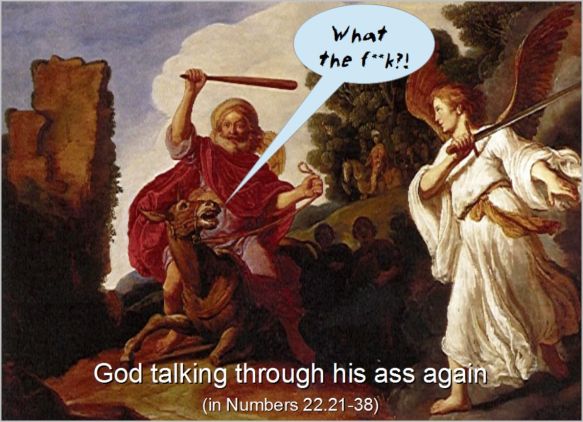
2 talking animals: the serpent in Eden and Balaam’s ass.

1 talking plant (Exodus 3:3).

0 science. No understanding whatsoever of what we now call astronomy, meteorology, germ theory, genetics, evolution, psychology… you name it.

So how do we read all of this? As the ancients themselves would, with an understanding of the world that regarded the supernatural, magic, miracles and monsters as real? We’re told often enough that this is how we should interpret scripture, not from a modern perspective. Perhaps we might credit the creators of the many books of the bible with greater skill, however, and interpret the inclusion of magic and miracle as allegorical or metaphorical; literary pieces, if you will. But then we have to decide which far-fetched stories are myth and which are historical accounts,. There really is no way to do this. A New Testament story awash with impossible events, implausible characters and symbolic tropes is every bit as allegorical or metaphorical as the same kind of story in the Old Testament (or, indeed, in Egyptian, Greek and Roman myth.) The reader who wants to see stories in the Old Testament as carefully crafted allegories has to concede that the Jesus narratives are of the same order.

It looks like we have to read the Bible as 21st century readers, because that is what we are. After all the Bible is supposedly a book for all time. We can, however, recognise the way in which its many creators saw the world – populated with fantasy creatures and subject to impossible events – and accept that they were wrong. Reality is not as they perceived it. What we cannot do is claim that the Jesus story is an oasis of truth in the midst of all this fantasy . 

Mr J: The Defence

Unfortunately, Mr J is unable to speak for himself so I have taken it upon myself to defend him. I’m going to prove to you he exists and that he loves us all.

The first thing I want to mention is how he created the Earth and everything in it in six days, about six thousand years ago. Or possibly not. It’s might’ve been billion years ago and it might have taken a very long time. Mr J would like to keep his options open.

In any case, he eventually created human beings, either on the sixth day or billions of years later. He quite probably controlled evolution to get to them, killing off billions of other creatures along the way just so humans could emerge. Some might say this was pretty heartless but it’s the only way natural selection could produce Mr J’s favoured creation. All a bit hit and miss, but Mr J knew what he was doing. I read it in a Richard Dawkins book some time.

Anyway, once humans appeared they managed to upset Mr J in some silly, insignificant way, so that he had to come up with a whole series of complicated plans to bring them into line.

The first plan was, admittedly, not all that great. It was necessary though. He drowned the lot of them, every man, woman and child, except for one old drunkard and his family. Needless to say the humans that came along after them weren’t any better than the ones who’d come before. No surprise there! Mr J rightly blamed the humans themselves for the shortcomings he’d built into them. That and the demons with their boss, Satan, whom he’d thoughtfully made right back at the start of the six days. Or maybe it was during the billions of years when he was creating everything by process.

Er… moving swiftly on, his second plan was that he’d just concentrate on one special group. He picked, for reasons best known to himself, a small, nomadic desert tribe. He demanded of those who had them that they should slice the tops off their penises. Weird, I know, but other tribes were doing it and Mr J thought if it was good enough for them and their fertility deities then it was good enough for his besties too. They also had to obey all 613 of the rules he would make up as he went along. This was to set a moral example to his Chosen People so naturally included instructions on how to beat their slaves, how to stone people to death and how to massacre their neighbours. Needless to say, despite how reasonable Mr J’s terms were, the useless humans couldn’t manage to comply with them. He was more than pissed. He let other tribes brutalise them, had them turn on each other and sent them into exile. But still they didn’t learn. You might think he’d have done better offering some encouragement, a little bit of positive enforcement, but you’d be wrong. Mr J always knows best.

The time rolled round for another half-arsed plan. This time Mr J sent a Figment Of His Imagination down to the Earth so the friends for whom he’d set such a good example while punishing them endlessly, could engineer his death. Or maybe it was the Romans who did it. Whatever, the story got around that after his execution this Figment had come back to life, which meant all sort of marvellous things would happen, including a complete reboot of the Earth. The old deal with its dick-docking and interminable lists of rules was over. There was a new deal now: believe it and you’d live forever: don’t and you’d boil forever in a fiery pit while demons tortured you for eternity.

Soon after this (because a thousand years is like a day to him), Mr J became something of a recluse. He removed himself from time and space – no more walking in gardens and masquerading as a burning bush – he would become… transcendent! He also announced, in a revelation to some churchy types, that he wanted, henceforth, to identify as a threesome. He insisted he be called ‘Daddy’, ‘Sonny’ and ‘Friendly Ghost’ all at the same time. It was a mystery why he…

Hang on. I just can’t go on with this. I mean, I know I’m supposed to be defending Mr J but when you see it written down like this, none of it makes sense. None at all. It’s rubbish and if this is what Mr J is all about, he can’t be defended. Not by anyone with half a brain anyway, and I like to think I have at least that. Mr J will just have to defend himself or, failing that, get someone without any critical faculties at all to do it for him.

Evidence of God

As for evidence, you might be aware of Israel. That nation has been in the news much of late. So, without being flippant at all, I present Israel as evidence. Think about it. They are living the script written thousands of years ago. Not by chance.

Israel as evidence for the existence of God. I’m thinking about it as Don suggests.

Where did it all begin, this bizarre notion that one tribe in the Middle East was chosen by God to be his special people? According to the Genesis myth, it was when YHWH promised Abraham he’d be his best buddy forever and ever, so long as he mutilated his body and those of his sons in perpetuity. They would also have to keep every one of this bullying god’s 365 rules and regulations, including the petty and piffling ones. So far so good, apart from the fact it was all very one-sided, and the mutilation of course. You’d think this would’ve been a sign that things weren’t quite kosher, but no; Abraham and his descendants buy into it and almost straight away, YHWH begins to let them down.

God’s Chosen Ones soon find themselves slaves in Egypt. A second mythical character is needed – up pops Moses – to get them out of this scrape. Unfortunately, after Moses has finished chatting with YHWH, who identifies as a burning bush on the top of a mountain, the sulky deity feels slighted by something the Israelites are doing. As is his way, he has many of them slaughtered and the rest he forces to troop around the same small plot of land for 40 years. This is how best buddies treat each other!

Later, the Jews find themselves defeated by the Babylonians and are carted off into exile. This exile, which YHWH does nothing to prevent, lasts 70 years. Still, it leads to a pleasant song made famous by Boney M in 1978 so I suppose it was worth it.

For the next few hundred years, Israel falls under the rule of other nations more powerful than itself. Not to worry though, YHWH is still ‘looking after them’, particularly those who are slaughtered in the rebellions that ensue. As Robert Conner says in a recent comment on Debunking Christianity, ‘If Yahweh ever threatens to bless you and your children, just kill yourself and get it over with.’

Fast forward to the Roman occupation of Israel. YHWH, having undergone a makeover, reneges on his promise to take care of his Chosen Nation forever and ever and comes up with a different plan to save people from his own cussedness. Now, if they want to continue as his friend, they have to believe a supernatural being has returned from the dead.

Abandoned by God, as he now wants to be called, Jews who haven’t defected to the new faith see their sacred, eternal temple destroyed by the Romans in AD70. Thousands of them are massacred and the Jewish nation ceases to exist.

This sets the pattern for the next two millennia in which God’s new friends organise pogroms, massacres and vicious persecution of Jews. This culminates in the Final Solution of the Third Reich which seeks to eliminate the Jewish people entirely. While awaiting extermination in a concentration camp, Andrew Eames scrawls on the wall of his prison: ‘If there is a God, He will have to beg for my forgiveness.’ God allows six million of his Chosen People die at the hands at the Nazis.

Following the second world war, Israel takes possession of the area surrounding Jerusalem, then occupied by Palestinian Muslims who are themselves descended from earlier immigrants. Thousands on both sides are slaughtered in the conflict that follows. In 1948, after almost 2,000 years, Israel becomes a nation once again; not through any miracle of God but as a result of human endeavour and bloodshed.

Tension and further skirmishes followed, leading to the present day when Israel finds itself under attack by Hamas terrorists. Thousands of innocents – women, children and babies – have been slaughtered without mercy. Israel is, as I write, retaliating and intends to enact further vengeance. And where is God in all this? You guessed it: nowhere to be seen.

All of this, according to some – including the naive writer at the top of this post – serves as evidence of God’s existence. That Israel has persevered for so long, despite opposition, persecution and the holocaust is not, however, evidence of God, any more than the great cathedrals of the world are. It is instead testimony to the resilience, resolve and sheer bloody mindedness of the people themselves. Perhaps their belief in YHWH (they don’t of course recognise his Christian counterpart) has fuelled their persistence, as it has their territorial claims.

Jewish beliefs and history are not evidence that YHWH exists. If anything, his apparent abandonment* during their many trials and tribulations is evidence to the contrary.

*Of course a non-existent entity can’t actually abandon anything, any more than it can lend its support or favour one group of people over another.