The End Times Are Here! Again.

livelyWhat does the future hold? It’s difficult to say, really, when the future isn’t, as Doris Day once so very wisely expressed it, ours to see. That doesn’t stop Christians from claiming they can though. They know exactly what the future holds, they insist, because the Bible tells them so.

There are at least two problems with this claim, the first being that the Bible’s predictions were written by men with as little ability to see the future as anyone alive today. The second is that their prophecies, like all other predictions, are suitably nebulous. It’s easier to see vague, non-specific claims come true when you can add the details yourself at a later date.

So it is for anti-gay pastor Scott Lively, who, incidentally, wishes to make it known that he’d prefer not to be referred to as anti-gay. This, of course, rests entirely in the anti-gay pastor’s own hands, though you’ll not be able to tell him so as he doesn’t allow comments on his blog. Christian leaders must never be contradicted!

The Reverend Lively, as well as being anti-gay, reckons that abortion, multi-culturalism, international discord and gay marriage are, in all likelihood, paving the way for the Anti-Christ and, ultimately, the end of everything. God is going to get so angry with the good ol’ US of A for all these things that he’s going to bring about the end times prophesied in the Bible.

The Reverend is quick to say he doesn’t know this for certain because God hasn’t actually told him so directly (why not, Scott?) so he’s just making an ‘educated’ guess. He does this by cherry-picking verses from all over the Magic Book – from Daniel to the gospels and Revelation – and shows, or thinks he does, how the USA is really the focus of God’s concerns in these last days. This is an impressive feat when the Bible doesn’t say anything of the sort, not least because its writers were completely unaware of the entire American continent.

From there, anti-gay Scott outlines how the world’s woes, but chiefly gay marriage in the USA, are going to allow the Anti-Christ in. That’s the Anti-Christ of which the Bible doesn’t speak. It doesn’t say, anywhere, that there is one almighty Anti-Christ. There are only four uses of the term in the entire Bible, all in the letters written by a John (not the same John credited with John’s gospel) in the New Testament. Letter-writer John whines about those in the early church who, two thousand years ago, were fomenting dissent; these people, he says, are literally anti Christ. And that’s it; you won’t find the all-powerful Anti-Christ that later fantasists like Scott Lively believe in, either here or anywhere else in ‘God’s Word’.

That’s because Lively and fanatics like him confuse these long dead dissenters with a figure from one of the Bible’s nuttiest books, Revelation. Known as ‘The Beast’, this pantomime villain is actually a caricature of barking-mad Emperor Nero, who began the first wave of persecutions against the early church. But that’s not good enough for nutters believers like Scott. The anti-gay pastor insists that the Beast, whom he mistakenly calls the Anti-Christ, is actually a politician of future times – our times in fact. He – that’s the Beast, not cuddly old Scott – is going, pretty soon, to exploit the mess the world is in, put things right and then take over. In so doing he’ll be usurping Christ’s position as ruler of everything. (You didn’t know Christ was ruler of everything? Just think what a mess the world would be in if he wasn’t.) This, the Reverend warns us – with capital letters to show how significant it all is – will be only the Beginning of Sorrows. Oh, and there’ll be Blood Moons too, just to add a splash of colour.

God is going to be so pissed off with this state of affairs that after a while he’s going to destroy everything, just like Jesus predicted he would be doing around about AD30, and Paul said would happen soon after AD55 and Revelation’s John (no relation to the crank who wrote the anti-Christ letters) claimed was still going to happen soon after AD95. Just as thousands of others have predicted in the 2,000 years since; every one of them wrong.

Statistically, rationally and empirically it isn’t remotely likely that current events in the USA mark the beginning of the end either. The Bible’s writers had absolutely no idea of what the future held, as their disastrous track record shows. Their rambling, vague prophecies didn’t come true when they said they would and they’re not going to now, even with an anti-gay pastor’s US-centric gloss on them. Which isn’t to say the world might not end some day. If it does, however, it certainly won’t be because it is following an expired Biblical timetable, open to a multitude of interpretations.

Better to stick to what you do best, Scott, being anti-gay. Though that’s not exactly going your way at the moment either, is it?

What Christians Believe: Part Two

AscensionHi, Thea Lojan here talking about the creed. Here’s what else it says, following on from last time:

I believe Jesus ascended into heaven and is seated on the right hand of God and will come to judge the living and the dead. As I was saying, Jesus could do amazing things. He could, like, beam up into the sky and out into space – that’s what ‘ascended’ means. Amazing. And he is coming back to judge the Earth, just like he promised. I know he said he’d be back real soon, like while his disciples were still alive, but to God a minute is like a thousand years so a few years can be anything like a million, or something like that. We shouldn’t take it literally when he said he’d be back while his friends were still around, though the Bible is, without a doubt, the literal Word of God.

Anyway, when he returns Jesus is going to send those who don’t believe in him to Hell, where they’ll suffer eternal torment for, like, forever and ever, amen. And he’ll take people who are saved, like me, back to Heaven with him. I can’t actually find the bit in the Bible where he says he’ll be taking me to Heaven, but I have faith so I’m sure he will.

Just a thought, but why doesn’t this creed mention the Bible, and how it’s the ineffable and literal Word of God? You’d think it would, wouldn’t you.

I believe in the Holy Spirit, the holy Catholic Church and the communion of saints. Definitely. The Holy Spirit is like the feeling of God that you get when you’re being blessed. You can’t see it – though it’s actually a ‘him’ because God is a ‘him’ – but it’s there, helping you make decisions, like whether you should buy a new car or install a heated pool in the yard. You definitely get a sense of him then. In my experience, he’s never let me down. He always guides me right.

I’m less sure of the holy Catholic Church because of course we’re not all Catholics and nor should we be when Catholics have got everything so wrong. But the pastor at church says it just means ‘the Body of Christ’ here, the same as ‘the communion of saints’ does, though that makes you wonder why we’ve got it in there twice. The communion of saints means all worshippers everywhere being united and working together. So, yes, I totally believe that because, that’s what we do as Christians; we all love each other. I don’t accept any of those lies that some people put about that there’s, like, 41,000 different kinds of churches. I don’t think God would let that happen, do you?

I believe in the forgiveness of sins. Yes I surely do, for God has forgiven my sins through the redeeming blood of the Lord Jesus Christ, his son. And if they’re really, really sorry I can forgive the sins of others, except of course if they’re, like, homosexuals. It really grosses me out to think about what so-called “gay” people do with each other. It’s unforgivable and even the Lord doesn’t forgive it. But my sins, yes, he forgives those.

The resurrection of the body and the life everlasting. Well, I already covered this. This is another repeat. What this really means is that everyone whose sins are forgiven and have been saved will go to live with God in Heaven after they die. Isn’t that amazing? Just think, whatever happens to your body all the time you’re dead, even if it’s been burnt or has rotted away to nothing, God will repair it and make it good as new. And then you’ll live forever in Heaven, because that’s what it means when it says ‘the life everlasting’. Even if I still can’t find that bit in my Bible.

Well, that’s it. That’s my creed, and what Christians everywhere believe. It was written, in fact, by the apostles, that’s Jesus’ friends, way back when he was still alive or just after. If you were to give your life to the Lord – and you really should if you want live forever in Heaven – then it’s what you’d believe too. Isn’t that, like, really, literally incredible?

What Christians Believe: Part One

A very special guest post by Thea Lojan.

PilateThe Creed

I’m very pleased to have this opportunity to share my testimony with you and give you an idea of what I and millions of other Christians believe. We call this the Apostles’ Creed and it goes like this:

I believe in one God. Actually no… three. Three Gods. One really, but he’s like three, a buy-one-get-two-free kind of God. Yes, okay, he says he’s the one and only God back in the Old Testament, but that’s before he knew he was really three. This doesn’t make him/them anything like those collections of ancient Greek Gods, though, because he’s still only one God really. That’s what’s called the Trinity and I hope I’ve made it clear for you .

Anyway, I believe in one God and in two others besides, creator, or creators, of Heaven and Earth. Yes, he/they definitely did this even though scientists think the universe was created billions of years before the Bible says it was and that God probably wasn’t even involved. But these scientists are all anti-Christian, that’s why they say that. If you have faith you know that of course God was involved. Other people who are also anti-Christian just out of spite say that if God made the Earth and all that is in it therein, then he must’ve made parasites and poisonous bugs and harmful bacteria and disease. But I’ve an answer to all that. Just don’t think about it.

And I believe in Jesus Christ, his only son, our Lord. Yes definitely this, even though Jesus says he’s not really anything like God’s son in three of the eye-witness accounts of his life in God’s Word. I expect he was just a bit muddled when he said this, being away from home and down here instead of up in Heaven with his Heavenly Father. He probably meant to say he was God’s son because it’d be too weird if he really was God’s Son and didn’t know it. We should be grateful to those people who came after him who realised exactly who he was.

And then there’s that bit somewhere about him being ‘begotten not made, of one substance with the father’, or something, which I think means he was more than God’s son. That he was, like, God himself. You’d think he’d remember that, wouldn’t you, when he was down here on Earth. What confuses me though is, if he was God, then who was he praying to all those times? I can’t get my head round that. But anyway, it’s a good job there were even more people who came after him who knew better than him and could tell he really was God.

He was conceived by the Holy Spirit, born of the Virgin Mary. Well, you’ve got to believe this haven’t you, even though some people say ‘virgin’ should really just say ‘young woman’. A young woman might or might not be a virgin, especially if she wasn’t a Christian to begin with. It does make me wonder that if she was pregnant then it’s more than likely Mary wasn’t a virgin, ’cause we all know how babies get made. Still, if God’s Word says it was the ‘Holy Spirit’ that was the father then that’s what we should believe. If you want to know more about the Holy Spirit that can make people pregnant, well, we’ll get to it soon.

He suffered under Pontius Pilate, was dead and was buried. He descended into hell and on the third day he rose again. I think a bit got missed out here – all the stuff Jesus said and did in between being born and suffering under Pontius Pilate. Isn’t that important? You bet it is. Pontius Pilate, by the way, was a Roman perculator who worked for Julius Caesar. I can’t find anything about Jesus ‘descending into hell’ in my Bible but I suppose it must be right. I definitely believe though that after three days and nights in the tomb he rose again from the dead. I mean, that’s a really important bit. I know he wasn’t in the tomb for a full three days and nights, even though he said he would be, but a day and a half is close enough. I guess that’s why we say ‘on the third day’ instead; it sounds like three days when it was only a day and half. But, you know, Friday night till Sunday morning – it’s legit to say ‘on the third day’.

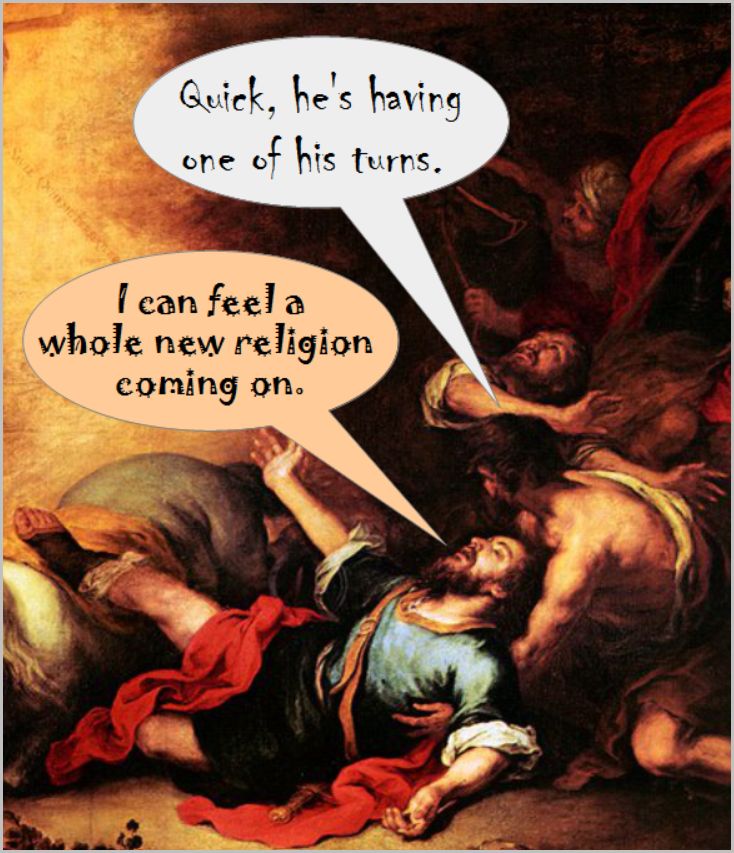
And we know he rose from the dead because Saint Paul said so – he saw him himself, in person. Well, not exactly in person but in his head. He was like an amazing flash of light in Paul’s head, a bit like an epileptic event, except, you know, like really real. And then other people started seeing him but not in their heads, as a real person, but one who could walk through walls and disappear if he felt like it. Totally real. Amazing.

I’ll be back next time to tell you what else Christians believe. In the meantime, keep praising the Lord!


Thea was talking about the Apostles’ Creed, though she also mentions the Nicene Creed. The Apostles’ Creed was created prior to 390CE and the Nicene Creed in 325, both quite a bit after Jesus’ lifetime. Three hundred years after, in fact.

Oh, and Pontius Pilate was a Roman procurator or prefect during the reign of the Emperor Tiberius.

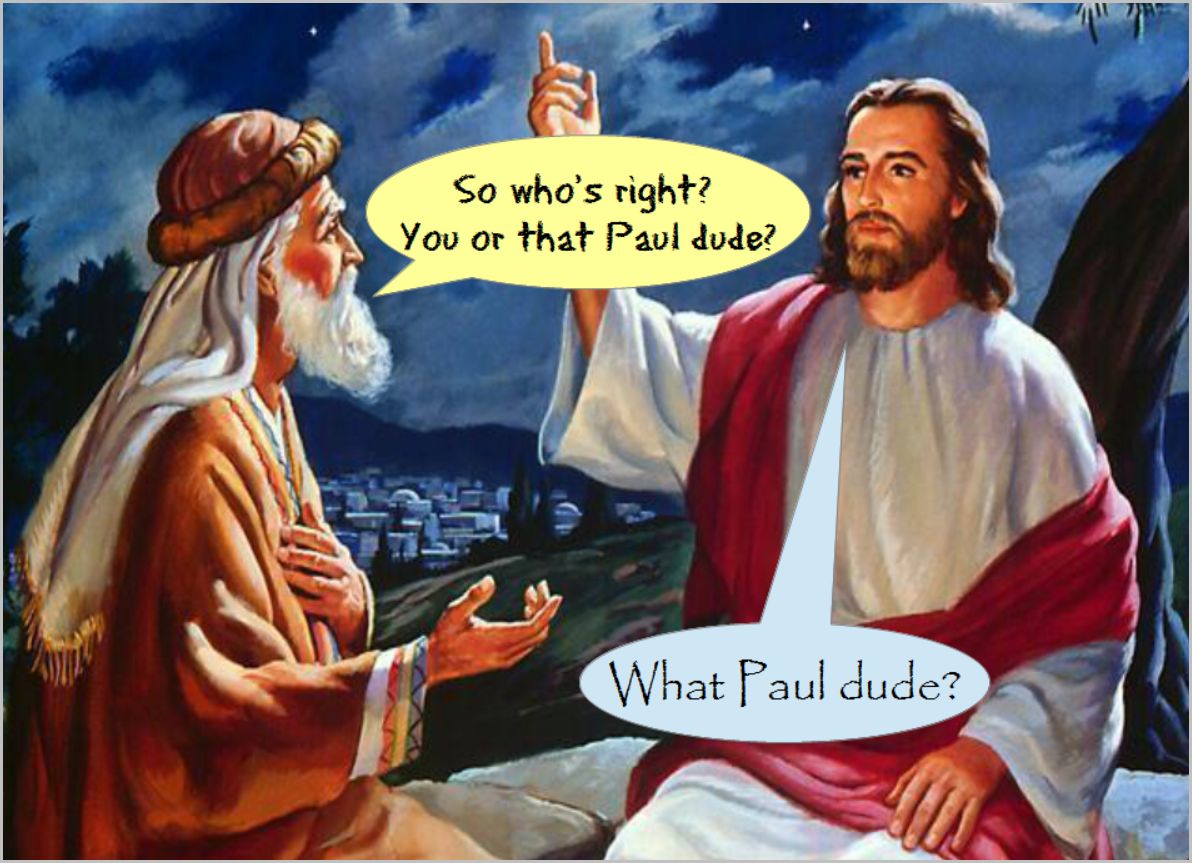
Jesus or Paul?

Nicodemus

Jesus is asked a few times in the gospels about how a person can find eternal life – like that’s the most obvious things to ask a travelling snake-oil salesman. Maybe it is, I don’t know. It was in the first century anyway, if the gospels are to be believed.

Jesus gives a variety of answers in the three earliest gospels: in Matthew 19.17 it’s ‘keep the commandments’ – those terrible, brutal laws I talked about last time. In Mark 12.30-31 he says the way to eternal life is to love God with all your heart and soul, and your neighbour as yourself. In other places he tells his audience that if you want to be forgiven by God then first you must forgive others (Matthew 6.14); if you want God’s compassion then first you must be compassionate (Matthew 25:31-46); if you don’t want to be judged, then you shouldn’t judge others (Luke 6.37).

Jesus is particularly fond of this kind of measure-for-measure salvation; it’s the lynch-pin of his good news – do unto others as you would have God do unto you. And almost every time he mentions it, he connects it with the Law and commandments.

Never does he say, anywhere in the gospels, that if you want to gain eternal life, or find favour with God, or be saved, then what you have to do is believe in the redemptive power of his own imminent death. Even when he could have done so, when he could have worked a little bit of Christian dogma into his teaching, he doesn’t. And that’s strange really, when you consider that Paul’s brand of Christianity – the one that’s come down to us today – is built entirely on the idea that the death and resurrection of Christ is the only thing can save us from God’s wrath.

Paul’s alternative gospel, which is expounded in Romans and summarised in Galatians 3.10-13, goes something like this:

Paul looks at the old Jewish Law and says, ‘actually it’s impossible. None of us can keep it. We’re all under a death sentence for some tiny infringement of it, because any and all infringements lead to the death penalty. But,’ he goes on, ‘Christ has taken that penalty for us by dying in our place. So although the law demands we should die and then suffer for eternity, we won’t, because he died for us. Then he rose again, just as those who believe in him will.’ That last bit – about believers rising from the dead – really doesn’t follow from his premise that the Law is impossible, but this is Paul talking, a man with only a passing acquaintance with logic. He doesn’t, either, have any evidence that Jesus took the penalty for the rest of humankind – he made that bit up too.

And that, in a nutshell – I do mean nut shell – is Paul’s ‘good news’. It bears no relation to the good news that Jesus preaches in the synoptic gospels. Admittedly, the Jesus who wanders his way through the first three gospels is for the most part a pre-death Jesus. You could argue, as a result, that he wouldn’t talk about redemption through his death before it had happened… but then again, why not? He talks about all sorts of other things he thinks are going to happen after he dies and rises again; he’s going to return pretty damn soon in a blaze of glory, through the clouds with an army of angels; heaven and earth are going to pass away; God is going to unleash his kingdom on the new earth.

But in spite of these mad speculations, he doesn’t mention even once in the synoptic gospels that people can be saved merely by accepting that he has paid – or will pay – the penalty for their infringements of the law, their sins if you will. Never. All the more odd when you consider that Mark, Matthew and Luke were putting their gospels together long after Paul preached his particular brand of salvation. Yet they don’t put this message into Jesus’ mouth, nor do they add it to the narrative.

It’s just not there.

So… were the gospel writers not aware of it? If they did know of it, was it that they didn’t like it? Did they know, in fact, that Paul’s formula didn’t square with what Jesus himself had said, or what they at least believed he’d said?

Whatever it was, the result is there are two conflicting versions of the ‘good news’ in the New Testament: Paul’s and Jesus’. One is easier than the other; in Paul’s plan all you have to do is believe. The other is difficult (and if we’re honest, really only designed for Jesus’ fellow Jews); it entails things like forgiving repeatedly, showing compassion, putting others first, turning the other cheek and, especially, following the six hundred and odd commandments that make up the Law.

So guess which one Christians today prefer.

Here’s a clue: it’s not Jesus’ gospel – the one without the magical incantation but with the barbaric Jewish law. But if, as Christians believe, Jesus was the Son of God – maybe even God himself – then why do they always accept Paul’s reinterpretation over and above everything their Lord said? Why do they disregard all that Jesus demands of those who would follow him, and take instead Paul’s easy path?

In the end, though, what Jesus and Paul (as well as the gospel writers and different factions of the early church) are in dispute about is the highly improbable and the absolutely impossible. It doesn’t matter whether they thought you could gain ‘eternal life’ by obeying the commandments or by letting someone else take your punishment for you; humans do not live forever. Just because a zealous first-century preacher thought they could does not make it so. Just because a different fanatic from roughly the same time believed it doesn’t make it happen either. There’s no evidence any human has ever, after this brief earthly existence, gone on to live forever. Equally, there’s no evidence that a deity exists, so those rules that are so important, in different ways, to Jesus and Paul can’t have originated with him. They’re man-made too.

So, with no God and no eternal life, Jesus and Paul might as well have been discussing whether the tooth fairy wears a pink dress or a green dress. What does it matter when she doesn’t exist?

How much more were they wrong about?

How long you got?

This Year’s All-New Christmas Quiz!

SantaBack by popular demand (well, mine anyway), try this year’s all-new Christmas quiz!

Answers in the Bible or not, as the case may be. Real answers next time.

1. Where does the word ‘Christmas’ come from?
a) the Bible
b) the Catholic Mass held on the supposed date of Jesus’ birth
c) the Greek, meaning to pull the wool over people’s eyes

2. When was Christ born?
a) he wasn’t
b) 25th December
c) in the year 0

3. Which gospel writers didn’t think the nativity story worth including in their accounts?
a) Luke
b) Mark
c) John

4. Following the miraculous events of Jesus’ birth, what did Mary do?
a) she remembered them all in her heart
b) she wrote them down for later use in the gospels
c) she forgot all about them

5. How many times does Jesus refer to his miraculous birth?
a) never
b) twice
c) he doesn’t shut up about it (well, would you?)

6. How many times does the rest of the New Testament refer to Jesus’ miraculous birth?
a) repeatedly, showing how important it was
b) only when making an important theological point
c) never

7. How well attested are the events surrounding Jesus’ birth in historical documents of the time?
a) not at all
b) quite substantially
c) as you’d expect when mass murder and strange astronomical events are involved, they’re mentioned everywhere

8. When did Christians first start celebrating Christmas?
a) hundreds of years after the event
b) not long after Jesus died
c) immediately

9. Which of these Christmas traditions originate in the Bible?
a) Christmas trees
b) kissing under the mistletoe
c) giving presents

10. Which of these groups has benefited most from Jesus’ birth?
a) women
b) black people
c) LGBT people

11. What does Pastor Steven Anderson want for Christmas?
a) his two front teeth
b) peace and joy
c) the execution of all homosexuals

12. How will Christians celebrate Christmas this year?
a) by fighting the War On Christmas
b) by telling everyone that Jesus is the Reason for the Season
c) by putting the Christ back into Christmas


Picture from memegenerator.net


Idiotic Stuff Jesus Said 7: You Must Be Born Again

Born Again

Jesus answered him, ‘Very truly, I tell you, no one can see the kingdom of God without being born again (or ‘from above’).’ Nicodemus said to him, ‘How can anyone be born after having grown old? Can one enter a second time into the mother’s womb and be born?’ Jesus answered, ‘Very truly, I tell you, no one can enter the kingdom of God without being born of water and Spirit (John 3.3-5).

While John’s gospel isn’t the only source of Christian nuttiness, it’s certainly a mine of golden nuggets. This is mainly because it was made up so long after Jesus lived, by people who had, in all probability, never met him but who belonged to a sect led by someone who claimed he had.

Imagine, in a world without technology, photography and literacy, writing an account from memory (or from other people’s memories) of events that had occurred sixty years earlier. It would be like attempting to create today the history of a charismatic, back-water nobody who lived in the early 1950s – but without any reliable written records, pictures or sound recordings. How much faith would you have in such an account? How far would you trust, at such a distance, the account’s supposedly verbatim dialogue, especially when it conflicts on nearly all crucial points with the few other stories that circulate from the period? Of course you wouldn’t. And yet this is precisely what we have in ‘John’s gospel’, where we find the famous exhortation to be ‘born again’.

Let’s be clear at the outset; Jesus did not say ‘you must be born again.’ The point of the story is that he meant something else (equally ludicrous, but different nonetheless). Despite this, today’s Christians still insist he did say it and that to be truly saved you must indeed be ‘born again’.

But, as Bart Ehrman explains in Jesus, Interrupted (p 155), the misunderstanding central to this exchange, between ‘born again’ and ‘born from above’ occurs only in Greek. As Aramaic speakers, Jesus and Nicodemus would not, if they knew any, have resorted to Greek for this one conversation, just so this very confusion could be created.

The word in question is the Greek word anothen, which can mean both ‘again’ and ‘from above’, and it is this double meaning that prompts Nicodemus to ask if he is expected to crawl back into his mother’s womb so he can be born ‘again’. The contrivance allows Jesus to make a show of correcting him and to make his real point; ‘No, Nic, you dumbkoff. Not ‘born again’, but ‘born from above’. What do they teach you at synagogue school these days?’

So in a conversation he never had, depending as it does on a misunderstanding of the Greek he didn’t speak, ‘born again’ is not what Jesus means: his point, as the writers of John’s gospel make clear (in the Greek Jesus didn’t speak, but they did) is that one has to be ‘born from above’.

And why do people have to be ‘born from above’? Because that’s where the story’s creators believed heaven to be – above them, in the sky. Jesus himself would have believed this too, even though he didn’t utter a single one of the words attributed to him in this fabricated conversation.

Why_Christians_Don't_Cover_for_KindleThis post is adapted from my (five-star rated!) book Why Christians Don’t Do What Jesus Tells Them To …And What They Believe Instead, available from Amazon.co.uk and Amazon.com


Idiotic Stuff Jesus Said 6: The ‘I Am’ sayings

CampLet’s be clear from the outset here; Jesus never actually made any of the seven ‘I am’ claims put into his mouth in John’s gospel. You know the ones: ‘I am the Way, the Truth and the Life’, ‘I am the True Vine’, ‘the Good Shepherd’, ‘the Light of the World’ and so on. So it is a little unfair to lump them with all the idiotic things it’s more likely Jesus did say (see previous posts.)

How do we know he didn’t say them? Lots of reasons. Firstly, they’re not in the other three gospels all of which were written earlier than John’s, and are therefore closer to the time Jesus lived (though the earliest, Mark’s gospel, was probably put together thirty to forty years after Jesus lived.) If Jesus had really made all those grand ‘I am’ claims, wouldn’t the other gospel writers have recorded them too? Yet none of them mentions even one.

Secondly, in the synoptic gospels – Matthew, Mark and Luke – Jesus has a different message from the one given to him in John’s gospel. The earlier gospels have Jesus talk about himself only very rarely. Instead, he goes on at length about the coming of the Kingdom of God (or Heaven) and how y’all better get ready for it ’cause it’s a-coming soon. Was he wrong about that one! On the odd occasion he does refer to himself in the synoptic gospels, he often does it in a sort of coded way, calling himself ‘the son of man’. He hardly ever uses ‘I’, let alone makes grandiose claims about himself.

Thirdly, all three of the synoptic gospels rely on earlier sources, now lost to us, and none of those has Jesus make ‘I am’ statements either. How do we know? Because, again, they’re not there in any of the three accounts – Matthew, Mark or Luke – that are built up from them. Significantly, one of these sources is an early record of Jesus’ sayings; that’s a ‘sayings gospel’ that doesn’t relate any ‘I am’ sayings.

Fourthly, John’s gospel is late – at least sixty years after JC’s death and also after Paul’s supernatural Christianity had gained a foothold among the gullible. The Jesus of John’s gospel is a reworked version, more in-line with the ‘Christ’ that Paul preached and much less like the Jewish peasant who had lived and preached the Kingdom of God. Despite what Christians claim, John’s gospel is not another eye-witness report (none of the gospels is) that differs only in minor details from the other three accounts. It is total reworking of the story, with its central figure transformed into a sort of divine Superman, and the idea of the coming Kingdom relegated to a single mention. This change of agenda renders the fourth gospel utterly unreliable as an historical record of anything the earthly Jesus might have said.

Fifthly, Christians claim John’s gospel differs from the others because in it Jesus reveals special, secret truths about himself to ‘the disciple whom he loved’, traditionally the John whom the gospel is named after. But again, the problem with this explanation is that the synoptic gospels don’t mention Jesus favouring one particular disciple over the others (unless it’s Simon Peter). In these, John, a loud, brash fisherman, plays only a minor role. Why don’t the synoptics refer to the special, more intimate relationship that John’s gospel refers to? Largely because there wasn’t one – not until the fourth gospel came to be written and ‘John’, who led the community that produced it, wanted to bump up his part.

So, idiotic as it would have been for an itinerant Jewish preacher and ‘prophet’, whose mission ended in failure, to make these claims about himself, Jesus never did. He didn’t say he was ‘the Way, the Truth and the Life’. Or ‘the Vine’. Or ‘the Good Shepherd’. These are claims made for him long after he lived, by people who were persuaded by a snake-oil salesman that a God-man had mystically ‘saved’ them. They ‘re-imagined’ Jesus, sayings and all, to fit their idea of what he must have been like – and John’s gospel was born.

Its Jesus, if he was being honest, should really have said, ‘I Am… nothing but Pure Invention.’

Idiotic Stuff Jesus Said 4: Rivers Of Living Water

Or more precisely: Whoever believes in me, as Scripture has said, rivers of living water will flow from within them (John 7.38).

WoundMe: What does this even mean, this ‘rivers of living water’ stuff?

Christian: It’s a metaphor. Jesus means it symbolically.

Me: Symbolically, how? A metaphor for what exactly?

Christian: The wonderful life-giving message that is the gospel.

Me: Which gospel? Jesus’s or Paul’s?

Christian: Oh, you’re splitting hairs. They’re one and the same.

Me: They most certainly aren’t, but we’ll let that pass for now. So by ‘living waters’ you mean that death-obsessed, rag-bag of negativity that fails to deliver in any way? (See all previous posts).

Christian: Well, I wouldn’t put it quite like that, but when one is reborn of the Spirit, then this wonderful feeling takes hold of you. That’s what we mean by ‘living waters’.

Me: I see. So all it comes down to is how good it makes you feel inside. ‘Living waters’ is just a metaphor for feeling good.

Christian: Oh, no, it’s more than that. It’s the Love that compels us to share the good news with others – that’s really what Jesus means by rivers of living waters.

Me: So banging on about hell and how the world is doomed (because, you know, gay people) and how only you know the Truth, is letting your love flow, is it? Is that what we see on sites like this, and this and this? Living waters of love? Or running sores of bile?

Christian: Well, those sites and those people aren’t representative of true Christians.

Me: That’s funny. They say the same about you.

Christian: Now you’re being unfair.

Me: And what’s more, there’s no reference to ‘rivers of living water’ flowing inside people anywhere else in ‘Scripture’. That’s another bit of made-up nonsense.

Christian: Oh, no, you’re mistaken about that. You must be. Jesus wouldn’t get a thing like that wrong.

Me: You know, maybe none of you have rivers of living water sloshing around inside you. Maybe this is just another of those idiotic things Jesus said, or was made to say about a hundred years after he lived, that means absolutely nothing at all.

Christian: Ma! He’s persecuting me.

Idiotic stuff Jesus said 2: You need never have another bad hair day

ThePlanDon’tcha just love him?

Jesus says that whatever else happens, Christians will never, ever have a bad hair day. They may have limbs lopped from their bodies and they may be crucified just as he was, but – blessed assurance! – not a single hair on their heads will come to harm. Isn’t that fabulous?

Here’s how he puts it:

…they will arrest you and persecute you; they will hand you over to synagogues and prisons, and you will be brought before kings and governors because of my name… You will be betrayed even by parents and brothers, by relatives and friends; and they will put some of you to death. You will be hated by all because of my name. But not a hair of your head will perish. By your endurance you will gain your souls. (Luke 21.12, 16-18)

Of course, this particular part of Jesus’ script was written long after he died (wasn’t it all) when there was some mild persecution of Christians under the emperor Nero. Jesus’ promise was designed to be of comfort to those in trouble because of their faith. It turns out to be cold comfort, however, and a blatant lie. Jesus’ own brother and leader of the church in Jerusalem, James was tortured and executed round about 62CE, as were several of the disciples and the self-appointed apostle, Paul (circa 64CE). And we can be fairly certain that whatever hair they had on their heads ‘perished’ when they did.

Perhaps Jesus suffered from male pattern baldness, which might explain his fixation with hair, because as well as promising that not a single hair on believers’ heads would perish, he’s made to declare, equally improbably, in Matthew 10.30 that all the hairs on the disciples’ heads are numbered.

God really does have too much time on his hands. You’d have thought he could use it to prevent the deaths of the 25,000 African children who die each day because of malnutrition and the innumerable diseases he’s seen fit to create. But no. He counts hairs instead.

Consequently and predictably, Christians have tied themselves in tangled knots trying to explain Jesus’ bizarre claim that not a single, numbered hair would be lost. What he meant, some of them tell us, is that the souls of persecuted believers will be unharmed, safe in God’s care, whatever they endure. But hair, it has to be said, is an unlikely metaphor for the soul, and isn’t one that the gospel writers or other New Testament authors use anywhere else.

So maybe, Christians argue, because hair is a part of the physical body, Jesus means it to stand for the whole body, and yes, this might be put to death, but it will live again as a resurrected super-body. God will then reinstate even the hair of those who have died for Jesus’ sake. Which means there are going to be a lot of hirsute people in the Kingdom when all the hair they’ve ever possessed is returned, post-mortem, to their heads. This is what Jesus promises.

Paul, though, says in 1 Corinthians 11.14 that long hair degrades a man, while Augustine argues that, come the resurrection, any excess hair will be incorporated somewhere in the body (extra pubes maybe?). Perhaps, though, God doesn’t intend acting as divine hair-restorer at all, but plans to keep all the hair ever lost, alive and vibrant, in a special heavenly hair-museum.

Or maybe Jesus’ guarantee that even Christians’ hair will be saved is, like the rest of his promises, nothing more than total and utter BS.


The fool says in his heart…

Celia2If you get into a discussion with Christians about their faith and you tell them, often reluctantly because you just know where it’s going to lead, that you don’t share their belief in a deity on account of there being no evidence for one outside of the human imagination, it isn’t long – if they haven’t done so already – before they start quoting ‘scripture’ at you.

Among their favourite verses, along with ‘For God so loved the world…’ (John 3.16) and ‘for a man to lie with a man… is an abomination’ (Leviticus 20.13) is Psalm 14.1: ‘The fool hath said in his heart there is no God’. And having cited it, they stand back in smug triumph, having put you firmly in your place and clinched the argument.

But the Bible would say this, wouldn’t it? It’s in its interest, and in the interest of those who wrote it and believe in it, to rubbish those who don’t buy into its fallacies. Christians who quote this verse, and others, are wilfully refusing to accept that you don’t recognise the ‘authority’ of their magic book. What they are really saying is, ‘You don’t believe in my God or the Bible, but I’m going to use it anyway to ‘prove’ my point.’

Why do they do this? Can they not see the futility of it? It’s like my quoting from ‘Twas The Night Before Christmas to demonstrate that, whether they like it or not, Santa Claus is watching over them to see if they’re naughty or nice. But referencing one make-believe source does not prove the existence of another. You have to believe in Santa Claus to begin with, as children often do, to believe the poem is an accurate account of his activities. So it is with the Bible. It only has significance if you already believe that God exists. It won’t of itself convince you that he does.

The Koran has its own ‘the fool hath said in his heart’ verses. Loads of them. Christians might like to consider whether a Muslim telling them ‘the vilest of animals in Allah’s sight are those who disbelieve’ (Q8:55) would persuade them that Allah is the one true God, and that they’re idiots for thinking otherwise. It wouldn’t, of course, so perhaps they’d kindly stop wasting their own time, and ours, doing the same to atheists.

The best response to a believer who tells you ‘the fool hath said in his heart there is no God’?

‘If even a fool can see it, why can’t you?’