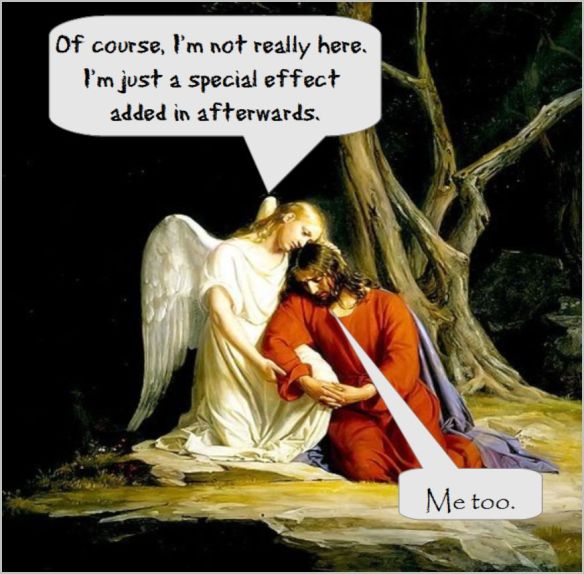
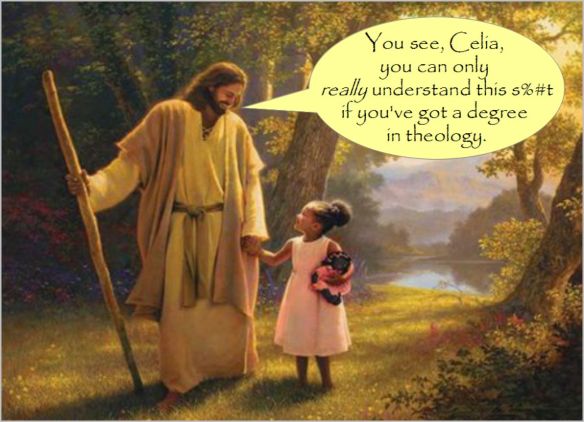
Faith by any other name (is still a waste of time)

celia3Faith; the brand name for ‘wishful thinking’. In what other area of life, other than the religious, do we have faith in faith? Christians like to say we do – we have faith, they say, in the pilot who’s controlling the aircraft we’re flying in, or we have it in the surgeon who’s operating on us. But this is not faith in the sense religious people usually use the term. ‘Faith’ in pilots, surgeons and even our own abilities is more like trust or confidence; trust that the pilot is qualified to fly the plane, confidence that the surgeon is trained and skilled or that we have the ability to complete the task we’ve set ourselves. This is not faith in the sense of ‘belief in things that can’t be seen and for which there’s no evidence’. It’s not faith in the sense of wishing and hoping there really is a God and that he cares enough about us to grant us eternal life, much in the manner of the magic fountains and wish-granting genies of folk tale.

Religious faith – Christian faith particularly – is of this latter kind. It’s not trust in a real person’s capabilities, be it our own or a specialist’s. It’s a blind belief in a God who evolved from being one tribal deity among many into the everlasting, omniscient creator of all things. A God who, if he did create everything, set us on the Earth together with viruses, microbes, infections, disease, sickness, cancer, AIDs and Alzheimer’s. A God who thought putting us in an environment so frequently hostile to our well-being on an insignificant planet in the corner of a vast and indifferent universe was just the right place for us.

This is a God who doesn’t seem to understand us but who is swift to punish us while he himself stands by as half of his favoured creation endures poverty, starvation and the cruelty of much of the other half. His ways are not our ways, believers say, making what they surely know is a flimsy excuse – the flimsiest – for his failure to interact with us in any meaningful way.

Faith is the wishful thinking that despite the evidence, this neglectful, capricious God really does care for us. He cares so much he has devised an illogical, incomprehensible plan (or two) that, with its blood sacrifice and magical overtones, we must believe if we want his forgiveness for the way he made us in the first place.

We need to have faith that this cosmic madman will bring us back to life us after we’ve died and take us to Heaven to live with him, but we must first have the right sort of belief, even if it’s difficult to work out what that is. Faith is necessary for all of this because there isn’t a scrap of evidence anyone has ever been returned to life after they’ve died, or that Heaven exists, or that anyone has ever gone there. That’s why it takes, not trust, but a great wallop of wishful thinking that this fantasy is not only real but more real than the reality in front of us.

As for me, I can’t believe any of it.

  – I can’t believe the claims of those who even today say they’ve seen or heard from God or Jesus or Mary, who reckon they’ve had visions the same way Paul or Peter, Joseph Smith or Mary Baker Eddy did.

  – I don’t believe those who say they almost died and went to Heaven, because what these visions of fantasy figures and make-believe places have in common is that they take place, so far as they occur at all, entirely within people’s heads.

  – I won’t believe that those who say all of this magic, hallucination and mumbo-jumbo is true because it’s in the Bible, when the creators of that book were men far more ignorant and superstitious than any reasonably educated person today.

  – I am unable to believe muddled nonsense that is designed to appeal to our vanity and fear of obliteration.

  – And I really don’t care that some say they get comfort, joy and morality from their belief; their morality no more derives from God as mine does from Superman and emotions don’t make any of it true.

So, faith – what good is it? If your answer is it enables you to believe the impossible, then isn’t it just another word for delusion?


It’s Only Make Believe

godsatan

All you have to do to become a Christian/be saved from sin/gain eternal life is to accept Jesus as your Lord and Saviour.

Except, it isn’t.

You’ve also to put your faith in the Bible, acknowledging it’s God’s word in some form or other. It would be impossible to be a Christian without it; you’re required  to read it, let the Holy Spirit or one of God’s chosen instruments here on Earth interpret it for you and you’ve to live by it.

And this, in turn, entails believing in the menagerie of supernatural creatures and invisible realms the Bible assumes exist. Angels and demons we considered last time, and then there’s –

The Risen Christ who sits at the hand of the Father. He sits? He’s like a real body, but at the same time not a real body? A spiritual body, then, who metaphorically ‘sits’ next to –

God the Father, whom no human has ever seen (confirmed by John 1.18 but contradicted by Genesis 32.20) who abides in –

Heaven, a place no-one has ever seen. No, really, no-one. Not even those people who have hallucinated about being there. Hallucinations, dreams, visions, even so-called out of body experiences, are not evidence Heaven exists. They’re evidence that people sometimes hallucinate, dream and have visions and out of body experiences. The same is true of ‘sightings’ of God himself and of –

The Holy Spirit. That’s the part of God Christians dupe themselves into thinking has moved in inside them to guide them through their Christian life. That’s the same Holy Spirit who’s guided God’s Chosen to create 34,000 different distinct interpretations of the Truth. Even now, the Spirit is leading church after church down the road of apostasy, according to those he also leads to condemn them. Confused yet? It all makes sense if you recognise that it’s all imaginary, created by human beings who didn’t and don’t know any better. Like –

Satan is. He’s the character who evolves during the course of Bible until he’s a cross between Lex Luthor and the Joker; God’s arch-enemy. He only ‘exists’ to get God off the hook. All the bad in the word can’t be God’s fault now, can it? Somebody’s got to carry the can and it sure isn’t YHWH. So Satan, the devil, gets to be the embodiment of evil. Which isn’t to say evil doesn’t exist because it does, but it’s not caused by this third-rate Dick Dastardly. Nor is –

The Anti-Christ. This is the guy Christians believe will appear at the end of the age, some time around AD 100 according to Revelation 14.9-10. Never mind his creator there calls him something else entirely (‘the Beast’ as it happens); unless he’s finally arrived in the shape of Donald J. Trump, he’s no more real than –

Those who’ve died (‘the saints’ according to Catholics) and have been given new, magic bodies in Heaven or –

Those who’ve died and have gone to Hell to be tortured forever. That’s because –

Hell doesn’t exist either.

Nor do seraphim (Isaiah 6.2), cherubim (Hebrews 9.5), dragons (Psalm 148.7), satyrs (Isaiah 13.21) or unicorns (Numbers 23.22 etc) .

How do we know these beings, places and states don’t exist? Well, they’re all invisible, intangible, undetectable, unverifiable, supernatural (literally, ‘outside nature’), and, ultimately, unconvincing. They’re rejects from far more interesting mythologies that abounded in the ancient world. Today’s mythologies – of Middle Earth, Game of Thrones and the innumerable virtual worlds of computer games – are far more plausible (and even then, not very).

The supernatural doesn’t exist; everything we know is part of a physical universe. There is no evidence anything exists outside, alongside or in addition to that universe. (Though if you think there is evidence for the supernatural – and I mean evidence, not ‘feelings’, personal experiences or ancient texts – then please make it known in the comments).

There is an abundance of evidence, however, that –

Human beings are rather good at inventing stories and mythologies;

Their psychology inclines them to inner imaginings;

They are largely irrational and with a tendency to attribute agency to inanimate objects, phenomena and the chimera of their own imagining;

They have a fear of death and their own personal extinction.

How could religion, with all of its make-believe, not fail to materialise under such conditions? And how can anyone in this day and age take it seriously, knowing what we do now?

I know I can’t.

Angels & Demons

angel

Last time, Benjamin Corey was feeling rather pleased with himself that he’s able to take a more considered, adult approach to the Bible. He doesn’t interpret it like those dim-witted fundamentalists. Instead, he consults ‘scholars’ to tell him what the Bible’s really about. And in case we’re in doubt, that is never (ever) anything to do with myths or fairy tales.

Which makes me wonder: what do mature, clever Christians like Benjamin make of the Bible’s supernatural fantasies and its cast of invisible beings?

Do they, for example, dismiss the demons that are all over the New Testament? Jesus, you see, believed in demons; he thought some illnesses were caused by them and had a repertoire of incantations for exorcising them from their victims. There are cranks today who believe the same sort of thing, but that’s a bit too much of a fundie approach for the kind of serious-minded Christian I’m talking about here. They probably don’t care that the Bible says in Ephesians 6.12 (written by fake-Paul) that demons are all around us, engaged in invisible spiritual warfare in equally invisible heavenly realms.

I can’t help but think that if only a demon would make itself visible and show us what it looks like, we would know that fake-Paul and Jesus were right and not just religious fanatics inculcated with the unscientific notions of their primitive cultures. But no, no demons have ever shown themselves in person (as opposed to ‘in a person’) except, of course, in third-rate horror films.

So how about angels? Maybe we could see an angel – an undeniable, indisputable, bona fide angel. According to the Bible, they were often seen back when people didn’t know any better. Mary, shepherds watching their flocks, the disciples, Mary Magdalene, Paul and even Jesus himself encountered angels in the flesh. So why don’t we see them now? Why don’t they make themselves known, outside of people’s imaginations? According to fundies they do, but alas, there’s no evidence this is true, which is convenient to say the least.

Still, I’m sure you can be a Christian without believing in angels and demons, even if the Bible is sure they’re real. You don’t have to believe everything it says (right, Dr Corey?)

So what about the rest of the Bible’s fantasies, its invisible creatures and make-believe places? Next time we’ll take a look at the evidence for them and ask, are they really just the low-fi special effects of a book well past its sell-by date?

Things a Christian Wishes (Some) Atheists Would Stop Doing (And Saying)

corey

On his blog recently, Doctor Benjamin Corey offered up a post called ‘S%#t I Wish (Some) Atheists Would Stop Doing (And Saying)’. I discovered it via the Friendly Atheist blog and naturally felt compelled to respond to Doctor Corey’s four bits of S%#t. The comment I posted on The Official Blog of Benjamin L. Corey is as follows:

S%#t 1: Please stop saying or insinuating that we’re a bunch of uneducated or unenlightened idiots.

Do atheists say or insinuate this? I’m not sure they do. I would suggest atheists find it difficult to understand why people of evident intelligence choose to believe propositions for which little or no evidence exists, that are rooted in myth and which, in reality, fail to deliver on their promise. It’s not that believers are necessarily unintelligent or idiots – clearly many are not – it’s that they are prepared to disengage their intelligence, critical faculties and rationality in order to believe all manner of spurious nonsense.

S%#t 2: Please stop insisting that we read our Bible like right-wing fundamentalists.

I’m surprised you offer this as something you wish atheists would stop ‘insisting’. First of course, atheists don’t insist that anyone read the Bible the same way as anyone else. We would prefer it if no-one read it at all. It is well past its sell-by date and has nothing to offer people living nearly two thousand years after its creation; it is after all a testimony to the failure of the beliefs that spawned it (the Son of Man ascending to the Earth to establish the Kingdom of God here).

Second, implicit in this demand is that there is an intelligent way to read the Bible and there’s the ‘ring-wing fundamentalist’ way. In fact, you don’t even insinuate that certain Christians are ‘ignorant’ and ‘unenlightened’ because of how they read the Bible, you say so explicitly when you talk, ungrammatically, about the ‘unenlightened, ignorant nonsense that fundamentalists do with the Bible.’

But at least fundamentalists regard the Bible as the Word of God (agreed they cherry-pick it and don’t behave according to it precepts) and claim it is ineffable and infallible. Perhaps, as you suggest, more enlightened Christians are free to interpret it in more liberal ways, dismissing that which is context-bound and so on. But then, where does that leave it? Is it authoritative or not? Does it speak directly to people or can it only ‘really’ be understood through the exegesis of scholars? If the latter, as you imply, then can it only be read and understood by those with above average intelligence? How does this square with Jesus’ insistence that his Kingdom was for those with child-like trust?

S%#t 3: Please stop referring to our belief system(s) as fairy tales.

Difficult this one. It depends whether myth and fairy tale are synonymous. Having taught English literature for many years at a university in the UK, I would argue they’re not. To the layman, however, they probably are in that both involve fantasy beings, implausible events, symbolic characters, sacrifice and enlightenment – just like religion really. So no, there is definitely a case here, Dr Corey, that if the cap fits… if your ‘belief-system’ walks, talks and smells like a myth (or fairy tale) then it probably is. You are stuck with atheists pointing this out to you, I’m afraid.

(By the way, your examples of Mickey Mouse and the Old Woman in the Shoe are not fairy tales. One is a commercial enterprise involving anthropomorphised animals and the other a nursery rhyme. I suggest you consult scholars who can explain to you what a fairy tale is, and the differences and similarities between it and myth.)

S%#t 4: Maybe lay off the whole, “religion hasn’t done any good for humanity” type of argument, because it’s obnoxiously untrue.

Reference for this quotation or did you just make it up? Sam Harris perhaps comes closest to saying this sort of thing – comes close but doesn’t actually say it. He says on balance that the good religion has done is outweighed by the evil perpetrated in its name. He doesn’t, though, say no good has come from religion. Sorry, Benjamin, but this is a straw man ‘argument’ you’re presenting here and is itself ‘obnoxiously untrue’.

Would we be better of without religion? Without the myth, the deadening of critical faculties and the adversarial nature of ideologies (even within Christianity)? Of course we would. Without precepts like ‘love your neighbor, love your enemies’? No, but then these are not exclusively religious. Far too many believers disregard them anyway.


The Virgin Birth: what really happened?

mary2

Menachem Av: Month 2

I’ve missed twice. No pains or discharge now for two months. I thought the first time I was just late. I’ve not been having the uncleanness for long so it could have just been things not working like they should. That happens right? But then a second time. Not so good. And then I started to show. How as I going to explain it – to the family, the village and most of all to Yossef who they’ve decided I’m marrying?

It wasn’t him. We haven’t, you know, done anything. I’ve only met him a couple of times. He’s older of course, nearly twice my age. He seems nice enough, though it wouldn’t make any difference if he wasn’t. He’s going to be my husband. I’m going to be his wife. Or I am if I survive this.

So what am I going to say? Can’t tell them who it really was. Thaddaios, Shim’on the builder’s boy. Same age as me. We just got to messing about. I didn’t want to, knew it was wrong. Knew it would land us, specially me, in trouble one way or another. But I did want to do it too. It was nice. Nice being touched under my clothes. He was gentle and kind.

But then there was blood and mess. The blood was mine, the mess was his. I wasn’t expecting that – the blood, I mean. I was shocked. I touched it and cried. Touched myself after I’d touched him. That’s when it must’ve happened. Some of his mess found its way inside me, off my fingers, and that’s how the seed of his baby began to grow in me.

Technically, though, I’m still a virgin. I can tell Yossef that: ‘technically I’m still a virgin’, ’cause technically that’s true. Thaddaios never put his thing in me. I wouldn’t let him even though he wanted to, ’cause I know how important it is I’m a virgin on my wedding night. Yossef’s family could do bad things to me if they found out I wasn’t. But I am. Technically anyway.

So that’s the story. I’m a virgin but, you know, with child. Yeah, doesn’t make sense. Yossef’s going to have trouble believing it. I know I would. Maybe I can tell him the Lord had a hand in it somewhere. The Lord’s hand instead of my fingers! Maybe. He might go for that. His family’s very orthodox.

Ellul: Month 3

‘Come off it, Miriam,’ Yoseff said when I told him. ‘Who was it?’ But I stuck to my story. So he prayed about it and said the Lord told him he’d to stand by me, so he has done. He says that when it comes everyone’ll thinks it’s his and he’ll just let them. He’s not such a bad sort. It could be a lot worse. But, he says, it’d be best if we took off somewhere, away from all the questions, to hide my shame, he said, when I really begin to show So we’re trekking off to some God-forsaken part of the country where he has relatives or something.

Nissan: Month 9

So that’s how we ended up here, in one room where the animals come in at night. It could’ve been worse, I suppose. His aunt or whoever she is delivered it. The baby that is. It went okay, if you think having your body just about ripped in two is okay. The baby was fine though and I’m recovering. After, his aunt held it up; a bloody mess, arms outstretched. ‘Well,’ she said, ‘it won’t change the world, but you have a fine healthy baby.’ I might’ve smiled then. She cleaned it up and wrapped it in the swaddling. I looked and thought, maybe it’s not too bad.

Yoseff came in and peered at it.

‘So,’ he said, as if he was interested, ‘what you going to call her?’


God’s Wrath (and those who direct it)

typhoon-phillipines

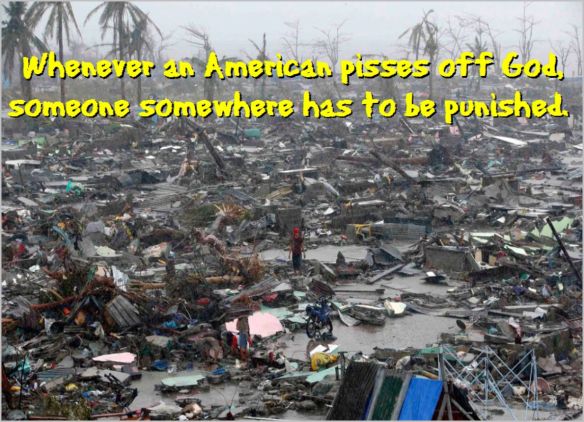
The idea that natural disasters and death are punishments from God – for whatever we humans have done to offend him – is still with us. As I suggested here, such a notion has been around from the beginnings of religious belief. It, together with its counterpart – that we need to appease the god(s) who so afflict us – is responsible for the genesis of all religion. There are those today whose thinking is wilfully stranded in the ancient world-views of ‘sacred’ texts that embody this dual notion of punishment that’s somehow merited and the need to appease the deity dishing out the punishment.

Here it is expressed recently by bear of little brain, Sam Rohrer, who has it directly from the Lord that he, the Almighty, has turned his back on America because it does not force immigrants to believe in him. America, he says has

changed the historic biblical rules (regarding immigration) … this is a reason why God must discipline our country.

Looney tune Pat Robertson, with his direct hotline to the Almighty, insists that it’s abortion that’s going to bring down God’s wrath:

One day, a righteous, holy God is going to demand an accounting for every drop of blood that has been spilled of innocent, unborn babies. And we just keep it in mind, when it happens it’s going to be awful.

Andrew Bieszad, on the other hand, knows that Hurricane Matthew which struck Florida back in August was God punishing the State for its tolerance of ‘evil sodomites’ (you don’t get much more tolerant than that.):

Stop sinning, especially with sodomy, as it is one of the four sins in the Bible which cry out to God for vengeance, which we are seeing now.

And these are just a few examples. There are many more. According to his whack-job servants, God can punish us, entirely indiscriminately, by unleashing earthquakes, tsunamis and floods; he can turn his back on us so that we wallow in our own filth; he can show his distaste for our ‘sin’ by raining down death and destruction upon us.

Naturally there’s plenty of this kind of thinking in the Old Testament, where God is credited with drowning his entire creation when a few ancient tribesmen misbehave (Genesis 6); he’s made to destroy Sodom and Gomorrah after every male turns inexplicably violent-gay (Genesis 19) and he’s said to wipe out whole swathes of his chosen people because they don’t pay him enough attention (Exodus 32.28).

None of these things happened, of course. They’re stories, myths or legends that incorporate the primitive thinking of the pre-scientific people who devised them, people who could only explain violent events in terms of divine punishment. It is this same thinking that is perpetuated today by those whose development is similarly arrested: through exposure to these same stories, an unwillingness to think rationally, an unhealthy preoccupation with God-nonsense and an overweening sense of self-righteousness (‘don’t blame us; it’s those others that attract God’s wrath.’)

There is no correlation between the disasters that befall humankind and God. Not one of the self-appointed prophets who say there is offer a single scrap of evidence that they are inflicted by a deity. Not one of their cause-and-effect assertions has ever been tested, can ever be tested. And – the clincher – there is no God anyway. All of which renders appeasement unnecessary and is good enough reason not to believe a word from these misguided charlatans.

The Gospel of Hatred

nasty

You might have seen the disturbing BBC documentary America’s Hate Preachers this week, featuring hunky Steven Anderson, pastor of Faithful Word Baptist Church’ in Tempe, Arizona, and chunky street preacher Ruben Israel (above). If not, it’s available here for the next few months (and also, I understand, on YouTube, but of course I couldn’t possibly endorse that.)

Both Men of God™ claim they’re preaching the gospel, which is strange when all they have to offer is bile, hatred and self-aggrandisment. Anderson actually says at the end of the programme that he does what he does – mainly reviling gay people – because he wants to ‘do something big with (his) life.’ Maybe that’s what the gospel is – bile and hatred mixed with self-promotion. There’s nothing of the good news attributed to Jesus or Paul’s ‘love-is-all’ message in the vitriol spewed forth by these two sorry individuals and their various acolytes.

The gospel they preach and the Jesus they convey is spiteful, judgemental and unforgiving. Who knows, maybe that’s what he was. But if you claim to believe in Jesus, all you self-righteous souls, all you grandstanding screwballs, then fine, so long as you do as he tells you: sell all you have and give to the poor; hate your father and mother; remain unmarried; tend to the sick, the needy and the imprisoned; give to anyone who asks; turn the other cheek, go the extra mile and be perfect. Do you do these things? Are you faithful to these words? If not, then you don’t really believe in him either.

People like Anderson and Israel take what little good there is in the Bible and poison it all the more with their own prejudices, their own putrification, their own sour self-hatred. This is the fruit we see in them and in others like them, which would also be fine if they kept it to themselves. But they can’t. They are compelled to try to infect the rest of us with their nasty perversion of a gospel.


God’s Election

church4

As we saw in the previous post, the Bible tells us that God chose his ‘Elect’* before the creation of the world (Ephesians 1.4-6). Which begs the questions –

1: On what basis did God select the favoured few untold aeons before they were born? Did he decide by looking at their dress sense, as Jesus’ parable in Matthew 22.1-14 suggests? I guess it must be, given the Bible is the ‘literal’ word of God.

Or did God assess ahead of time just how righteous his Chosen would turn out to be? In Matthew 25.31-46 Jesus says righteousness is the yard stick (though naturally Christians don’t believe him because Paul says something different).

Or did God decide in advance – Paul says he ‘foreknew’ – who would repent and turn to Jesus, free-will be damned? Maybe, but then Jesus suggests that not everyone who does even this will make it into God’s Kingdom (Matthew 22.1-14).

What a bummer! Looks like God’s decision is/was purely arbitrary. You make it, or not, on the whim of a capricious monster.

2: What’s the point of evangelism? If God chose who was going to have eternal life/enter the Kingdom/live in Heaven before the creation of the world, then there can be absolutely no need for anyone to tell anyone else about Jesus, sin and salvation. Why? Because it makes no difference; God’s Chosen will remain his Chosen, as they were long before they were born, and he’ll be sure to rescue them once they die. Those who haven’t been pre-selected will stay lost and will go to Hell whether or not they’ve heard or responded to the gospel.

‘But how will the unsaved Chosen hear the message if we don’t tell them?’ ask our zealous evangelical friends, still not getting the point. Jesus, lads! The Chosen don’t need to hear the gospel: God – has – already – chosen – them. They will go to Heaven, live in the Kingdom or whatever, regardless of your efforts. You and your evangelism are superfluous.

3: How can you be sure, if you’re a Christian, that you’re of the ‘Elect’ and so destined for Eternal Life? Yes, you’ve chosen Jesus – but has he chosen you? How can you know? Your own sense of righteousness, your faith, self-sacrifice and adherence to sound doctrine (whatever that is) are no guide to whether or not you’ve made the grade. Only God knows that, and he’s not telling.

Not yet, anyway, so you’d best make sure you’re buried in your very best clothes, just in case.

* Jesus is made to call the chosen few ‘the Elect’ in Matt 24.22, 24 & 31; Mark 13.20, 22 & 27 and Luke 18.7.

God’s Chosen Ones

chosen The God of the Bible is not the God of Reason that Answers in Genesis, William Lane Craig, Tim Keller, Silence of Mind and others tell us he is. None of the evidence, some of which we’ve reviewed, supports the supposition. That’s because the God of Reason, like all gods, is a construct of the human mind. In much the same way as Yahweh was a reflection of irrationality, this God is a reflection of our rationality. He could not – and did not – exist before the Enlightenment, before Rationalism itself and the new understanding of mathematics, science and philosophy.

As appealing as his apologists try to make him, the God of Reason is demonstrably not the God of the Bible, who is defined by impulsive, destructive passions. No, he’s not the tempestuous Yahweh, nor is he the daddy-god Jesus imagined (who is just Yahweh with a few rough edges knocked off), nor the God of blood-sacrifice and atonement beloved of Paul. He is, like all those inventions, a fabrication of our own making. For Christians who are drawn to him, he is a false god. But then, aren’t they all?

Whichever version of the Christian God Christians choose to worship, however, they’ve got it wrong. They don’t choose to believe in him or to follow Jesus or whatever. Not at all; he chooses them (or not as the case may be.) Now known as Calvinism, the idea that God earmarked a select few to be his best mates right back at the dawn of time – while disregarding others who might want to be but aren’t on the guest list – is right there in the Bible. Paul first:

For those God foreknew he also predestined to be conformed to the image of his Son, that he might be the firstborn among many brothers and sisters. And those he predestined, he also called; those he called, he also justified; those he justified, he also glorified (Romans 8:29-30; see also 1 Thessalonians 1.4)

The idea is picked up by one of Paul’s imitators in the forged letter to the Ephesians:

For he chose us in him before the creation of the world to be holy and blameless in his sight. In love he predestined us to be adopted as his sons through Jesus Christ, in accordance with his pleasure and will—to the praise of his glorious grace, which he has freely given us in the One he loves. (Ephesians 1.4-6)

The same sort of time-loop paradox also finds its way into the gospels. In Matthew 22.1-14, Jesus tells a parable involving a man who has been asked to a Royal Banquet (i.e. the Kingdom of God) only for the King (Jesus) to take offence at the way he’s dressed. For this heinous crime he is bound hand and foot and unceremoniously thrown out. Jesus concludes his cheery tale with the aphorism, ‘Many are called but few are chosen.’

So much for ‘free will’, a notion that’s alien to the Bible in any case. If I were a Christian, which thank God I’m not, I’d really want some answers to the questions this bizarre idea throws up. We’ll take a look at what these are next time.

Picture shows Tim Keller, John Sentamu (Archbishop of York), ‘Pastor’ Rick Warren and ‘Pastor’ Steve Furtick. Chosen by God, every one. And some kids he couldn’t care less about.


The God of Reason strikes again!

planWe’ve been looking at how well The God of Reason™ fares in the reasoning stakes. Is he as logical, rational and reasoned as his self-appointed representatives on Earth say he is? Is he logical, rational and reasoned at all? He didn’t do so well in the set-up, those wacky creation stories at the start of Genesis. There’s nothing reasoned or rational about his behaviour there. So how does he do further down the line? Does his intelligence evolve or does he make like Donald Trump for the rest of eternity? (Spoiler alert…)

Having willfully allowed everything to deteriorate into chaos, God is upset again when his abandoned human creation doesn’t behave as he wants them to. Evidently he couldn’t see this coming, so he decides the most rational thing to is to drown everyone and everything, with the exception of a family left over from an earlier myth by the Babylonians and a floating zoo. Everyone else, every baby, every child, every pregnant woman, every living thing – from the smallest insect on four legs to brachiosaurs and the cutest lickle kittens – he murders in cold water.

After he’s annihilated them all, Yahweh is dismayed when Noah gets pissed and romps around naked in front of his son, who is called Ken Ham (can’t blame him for not seeing that coming) and he realises this plan hasn’t worked out either. Now where, in all of these larks, is rationality? More nul points for the great God of Reason and his ability to think things through.

Yahweh’s next cunning plan involves persuading a bloke who’s a few brain cells short of a pastry case himself to murder his own son and burn his body. Yahweh tells him this will be such fun. But then, at the last minute, just when the kid is trussed up on a pyre with his old man ready to plunge the knife into him, God sends a messenger to call the whole thing off. Turns it was no more than a test. Never mind the trauma to the kid and the damage to his relationship with his father, this was the only logical way for Yahweh to see if ol’ Abe was one of the good guys.

He follows it up with another great plan; he promises he’ll look after Abe and his descendants till the end of time, so long as – wait for it – they all slice off the end of their penises. Now, come on – that’s a well thought through scheme if ever there was one.

Isn’t it?