Ramifications

I started writing this blog as a way of working out just what it was I’d believed prior to my realisation there was no God. While this ‘revelation’ caused the whole Christian edifice to collapse, I still had a lot of conditioning to deal with. I had been taught over the years that, like every other human being, I was worthless without God/Jesus. I needed first to regain some self-worth.

I had hang-ups too about how I spent my time and money. The cult had assured me that God was obsessively interested in how I used both. Did my use of my time and money further his kingdom? Was I using my time wisely? Tithing? Giving my money to alleviate suffering? I knew buying CDs and comic books didn’t really fit the bill, but I sinfully persisted in spending my hard-earned cash on them, when I had any to spare after taking care of my family and giving to the church and charity. Then the guilt! How could I be so thoughtless, so selfish? I had let God down badly (specially if I’d bought some of the devil’s music.)

The guilt was self-induced of course. I think I have a personality type that is prone to feeling guilty – it’s been the predominant emotion of my life – but the Christianity I encountered exacerbated it. I still struggle with guilt, not over any great ‘sin’ but in terms of how much I help others and whether my use of my money is self-indulgent and wasteful.

Despite now having no truck with the idea of sin (which is a worthless religious concept) I do sometimes catch myself worrying that I’ll be made to suffer in the next life (which doesn’t exist either) for who I am and my ‘lifestyle’ in this world. Completely irrational, I know, but the conditioning runs deep. It hasn’t been fully rooted out yet.

On the plus side, I can now see the Bible for what it is: a collection of stories, those in the so-called New Testament designed, as they declare quite openly, to promote the beliefs of the ancient Jesus-cult.

I realised that in an ocean of myth, legend and invention I had been taught to regard the gospels as an island of historical fact. Yet two of them are prefaced with patent fantasy – the incompatible nativity stories – and conclude with equally incompatible resurrection and ascension narratives. Yet I was expected to trust that everything in between these make-believe beginnings and endings – the miracles, the visions, the speeches, the fulfilled prophecy, the false promises and unlikely new prophecies – were all somehow factual and true.

No longer gullible, I came to see this as a preposterous expectation. Sandwiched between fantasy and illusion the gospels are all myth and legend. It’s pointless to argue, as apologists do – and quite a few sceptical scholars too – that we can discern the real Jesus among the invention:

that we can make something worth considering out of the discrepant resurrection appearances;

that because one or two historical figures are written into the story it must therefore be historical throughout;

that we can sift the factual wheat from the metaphorical chaff;

that there is a kernel to the tales that can be teased out from the fantastical accretions;

that contradictions can be explained (away) and by sleight of hand made compatible;

that somehow believing all of this fantasy material can ensure eternal life.

None of these things can be done, any more than they can with the legendary tales of Romulus, Buddha and King Arthur. Legends, are legends are legends. Stories are stories are stories.

Would I have been happier never to have been a Christian, never to have committed my life to Jesus? Almost certainly. But we are all where we are. Christianity and I have a history. It’s probably left me scarred, and perhaps you too. At least I escaped it to live my life as I needed to, even if I am still working my way through its legacy.

God and the Domino Effect

Once free of belief in God, everything that follows collapses.

No God means –

   No divinely inspired scripture, no sin, no salvation, no need of salvation, no repentance or divine forgiveness (and no need of these things either), no grace.

   No supernatural, no heaven or hell, no Satan, angels or demons, no Holy Spirit, no effective prayer, no miracles, no judgement, no eternal life.

  No Son of God, no God Incarnate, no prophecy, no atonement, and, most significantly, no resurrection. 

According to the Bible, God resurrected Jesus (Romans 6:4; Galatians 1:1; Acts 2:22 etc). Therefore, no God = no resurrection.

So, where did all these ideas that, once God ceases to exist, fall like dominoes? Answer: the only place ideas ever come from: the human mind. Everything ever associated with gods, and with YHWH (Old and New versions) is entirely human invention. This is the only logical, rational conclusion.

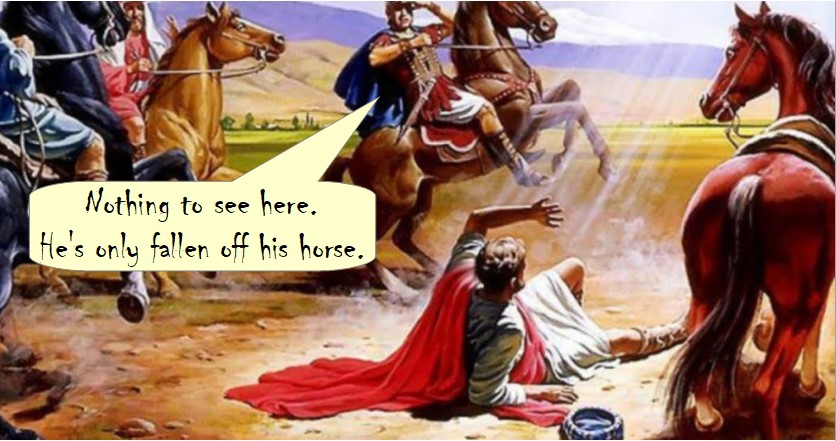
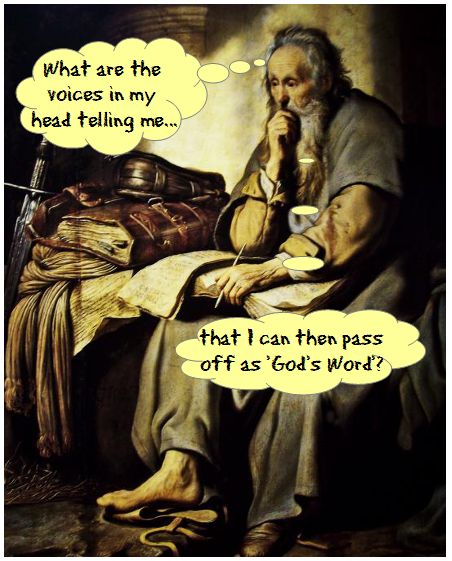
  Paul’s vision of what he took to be the Risen Christ and his consequent theology: the product of a tortured imagination.

  The resurrection appearances supposedly experienced by Cephas and others: within their own heads (grief-induced hallucinations, dreams, trances, emotional agitation). Or: an emotional response to some natural phenomenon such as bright lights.

  The stories of Jesus that these visions inspired: invented by creative writers imaginatively applying ‘prophecy’ imagined by earlier writers.

  If he existed, Jesus’ Messiah complex: worked up entirely within his own religion-soaked brain.

  His conclusion that the end of the age was nigh and that he would be king of the new order (assuming he really did think this): the result of wishful thinking, all in his imagination.

Subsequent additions to the Christian experience: the Trinity, guesswork about the Messiah’s delayed return, the panoply of saints, heresy, blasphemy, ‘God’s standards’, the inerrancy of scripture, apologetics and, coming full circle, conversion experiences. All creations of the human imagination and emotions.

With no actual God, this is the only viable explanation of the phenomenon that is religion. Human beings did it.


Deconversion


In the late 1980s I reach a crisis point in my life. I pray for God’s guidance . I pray for wisdom. I don’t pray to ask him to resolve the situation (not of my making). The heavens, however, are as brass. I begin to entertain the idea that rather than God ignoring me or expecting me to sort the problem (which eventually led to me having a breakdown) he might not – gasp – exist! I had gone from being someone who heard God speaking clearly in my head – telling me I should ‘witness’ to some ‘lost’ soul or other – to someone contemplating whether I’d imagined it all.

What at first seemed like a possibility began over time to feel more like a probability. I borrowed books from my local library written not by evangelical authors but by secular scholars (if bishops can be regarded as such) – John Robinson’s Honest to God, Morton Smith’s Jesus the Magician Resurrection: Myth or Reality? John Shelby Spong’s A Bishop’s Search for the Origins of Christianity, and later still Bart Ehrman’s many books.

I began a journey of discovery, exploring what it was I had believed when a committed Christian. Irrationally perhaps, I clung to a belief in God longer than I did other aspects of Christianity. After all, God is kind of generic and could conceivably exist and operate independently of Christianity. I reasoned that God must, by definition, be superior to the anthropomorphic concepts of the Bible. I held on to this idea of a generic God for another decade or so. It gave me a sort of comfort, I suppose. I was aware he wasn’t compatible with all the Jesus stuff I’d once believed. Would a god who created the universe really require a human sacrifice to make peace with his own creation? It seemed unlikely.

My friendly but distant god sat comfortably in the back of my mind while I got on happily with life without him and without thinking about him very much either. Until one day, walking home from work, I suddenly wondered why I was bothering. Why was I sustaining the idea of a god? Any god: generic, biblical or comfort blanket. I didn’t need to. I didn’t need him (nor, if we pretend he really exists, he me.) Everything about life, the universe and everything was, in any case, more than adequately explained by science, evolution, astronomy, psychology (in which I have a qualification). In something like a revelation, I realised that no God existed. Not the YHWH variations in the Bible and not my nicer version of him. In that instant I stopped believing in God, god and gods. One second I was a believer (of sorts), the next I wasn’t.

It was liberating. I didn’t have to work out what God was really about, didn’t have to please him, ask his forgiveness, seek his grace, or any of the other convoluted nonsense that goes along with ‘him’.

  • Was this revelation as emotional as my original conversion? I don’t think so. It was the culmination of years of thinking, reading and challenging myself. My ultimate deconversion from god-belief was a rational process.

It had repercussions of course, which I’ll deal with next time. In the meantime, how does my deconversion compare with yours, those of you who’ve had the good fortune to have one?


Whatever Happened to Judas Iscariot?

Even more significant in the gospels than Mary Magdalene is Judas. Like her, he is strangely absent from the rest of the New Testament. Apart from Luke’s ridiculous story of his death in Acts 1:18 – a story that contradicts the one in Matthew 27:5 – he isn’t mentioned anywhere else. You might think that’s to be expected, given he’s the disciple who betrays Jesus in the gospels. His name must have been anathema to early Christians.

We might expect, however, that when Paul is describing the Lord’s Supper for the very first time in 1 Corinthians 11:23-26, he might, when he gets to the part where he says ‘on the night he was betrayed’, have mentioned the name of the betrayer. It would seem the natural thing to do. Unfortunately, the word ‘betrayed’ (prodidomi) doesn’t appear in 1 Corinthians 11:23-26 or anywhere else in the epistles. The word Paul uses is paradidomi, meaning ‘handed over’, a handing over by spiritual agents (God himself?) not a traitorous human. Judas is in fact absent from Paul’s description of the Lord’s Supper, a revelation he claims to have received directly from the heavenly Jesus, who neglects to include Judas and all the other disciples too. Nor does Paul call the event ‘The Last Supper’; that name would come later. Read 1 Corinthians 11:23-26 for yourself and see. Bart Ehrman also addresses the problem here.

Bizarrely though Judas does turn up, sort of, in 1 Corinthians 15:3-8, when Paul is quoting a creed thought to originate in the earliest days of the new faith. Because it is considered so early, this creed is greatly valued and frequently cited by apologists. Never mind that it contradicts the later gospel sightings of the Risen Jesus (see the previous post). Here’s what Paul says in 1 Corinthians 15:5: ‘(Jesus) appeared to Cephas, and then to the Twelve.’ Then to the Twelve? What Twelve? As Simon Peter, wasn’t Cephas one of the Twelve to begin with? Maybe they weren’t the same person after all.

More significantly, the Twelve, at least according to the later gospels, originally included Judas. He was one of Jesus’ inner circle. And according to Matthew 27 and Acts 1 he killed himself almost immediately after betraying Jesus. He wasn’t around to see the Resurrected Christ. Yet according to Paul and the early creed all of the Twelve saw Jesus alive again. Either Judas wasn’t one of the Twelve and the gospels are wrong, or he was and he didn’t betray his Master after all, remaining alive for his reappearance. (Just to be clear, the Twelve at the time of the resurrection appearances did not include Judas’s replacement, Matthias (Acts 1:23-26). Matthias doesn’t become one of the Twelve till after Jesus has returned to Heaven (Acts 1: 9).

So, Judas isn’t mentioned as a Jesus’ betrayer by anyone other than the gospel writers, decades after the supposed resurrection. He isn’t mentioned by name at all. The only possible reference to him is in 1 Corinthians 15:5 where he’s still one of the Twelve and sees the resurrected Jesus. It couldn’t be could it, that Mark, reading Paul’s description of the Lord’s supper mistook, or deliberately misinterpreted, the phrase ‘was handed over’ to mean ‘was betrayed’ and constructed his story about the duplicitous Judas accordingly? Why, yes it could.

Conveniently, ‘Judas’ is the Greek form of ‘Judah’, the kingdom of the Jews who, so far as early Christians were concerned, rejected Jesus as the Messiah. Judas is a symbolic character in a literary work, representing those foolish Jews who turned their backs on salvation and so ‘betrayed’ the true Messiah.

The Great Resurrection Scam

Brothers and sisters, we do not want you to be uninformed about those who sleep in death, so that you do not grieve like the rest of mankind, who have no hope.  For we believe that Jesus died and rose again, and so we believe that God will bring with Jesus those who have fallen asleep in him. According to the Lord’s word, we tell you that we who are still alive, who are left until the coming of the Lord, will certainly not precede those who have fallen asleep. For the Lord himself will come down from heaven, with a loud command, with the voice of the archangel and with the trumpet call of God, and the dead in Christ will rise first. After that, we who are still alive and are left will be caught up together with them in the clouds to meet the Lord in the air. And so we will be with the Lord forever.

1 Thessalonians 4:13-17 (circa AD 49-51)

Paul said that because Jesus died and rose from the dead others would too. How does this follow?

He also claimed that all a person had to do to be sure of a spiritual resurrection was to believe that Jesus had already risen (1 Corinthians 15:20, AD 53-54), How did he know this? Almost certainly it came to him in one of his visions and his subsequent ‘revelations’ (‘the Lord’s word’ as he puts it in the letter to the Thessalonian sect).

Possibly, though less likely, he learnt it from the Christians he persecuted prior to his conversion. If so, where did they get the idea from? That the cult members in Thessalonica had to ask Paul what would happen to those who had passed away suggests this wasn’t a significant concern prior to this point. Paul and other early believers thought the Messiah/Son of Man was going to appear within their lifetimes (‘we who are still alive’ etc). It was only when cultists started dying off in noticeable numbers, and the Lord remained a no-show, that it started to become an issue. Paul had to make something up. And make it up he did.

If not Metaphor, then what?

I’ve been arguing that everything in Mark’s gospel is metaphor (because he says so) but there are some pronouncements credited to Jesus in the synoptic that do seem to read as if they’re not. These look as if they are meant to be taken at face value: 

Mark 9:1 And he said to them, “Truly, I say to you, there are some standing here who will not taste death until they see the kingdom of God after it has come with power.”

Mark 10:21. Go, sell everything you have and give to the poor, and you will have treasure in heaven. Then come, follow me.

Matthew 5:39. But I tell you, do not resist an evil person. If anyone slaps you on the right cheek, turn to them the other cheek also.

Matthew 5:40. And if anyone wants to sue you and take your shirt, hand over your coat as well.

Matthew 5: 43-44. You have heard that it was said, ‘Love your neighbour and hate your enemy.’ But I tell you, love your enemies and pray for those who persecute you,

Matthew 6:24. No one can serve two masters. Either you will hate the one and love the other, or you will be devoted to the one and despise the other. You cannot serve both God and money.

Matthew 6.25. Therefore I tell you, do not worry about your life, what you will eat or drink; or about your body, what you will wear. Is not life more than food, and the body more than clothes?

Matthew 7:6. Do not judge, or you too will be judged. For in the same way you judge others, you will be judged, and with the measure you use, it will be measured to you.

Luke 6:30. Give to everyone who asks you, and if anyone takes what belongs to you, do not demand it back.

Luke 14:26 If anyone comes to me and does not hate father and mother, wife and children, brothers and sisters – yes, even their own life – such a person cannot be my disciple.

Perversely, these are the very commands that most Christians insist are intended metaphorically. This includes those who oppose the idea that, Jesus’ parables excepted, the gospels are in any way symbolic. I know from experience that they have any number of unconvincing arguments of why Jesus doesn’t really mean what he is made to say. For example: ‘these pronouncements are too severe and impractical to be taken literally’; ‘the verses are being taken out of context’, and ‘they have a deeper spiritual meaning’ (oops – that’d be metaphor, wouldn’t it?). Ask these same folk if the statements are therefore metaphorical and you can expect to be met with barrage of abuse.

If they’re not metaphorical, why do we not find Christians striving to live according to them: renouncing wealth, giving to all who ask, selling all they have, resisting no-one, judging no-one, hating family, becoming a slave and having no care for their own welfare for the sake of the kingdom that Jesus promised was imminent.

Because they don’t believe him. Easier to disregard his words about the kingdom arriving within his disciples’ lifetime and the instructions for living in the short time until then. The hard stuff is treated as metaphorical when it makes demands on Christians themselves.

Possibly they’re right. I’d suggest that the pronouncements like those above were not Jesus’s at all. They’re cult-speak; the extreme demands of cult leaders seeking to control their acolytes. In case this sounds like an about face on my part, let me assure you it isn’t; I’ve long argued that among the metaphor and the reworking of Jewish scripture, the gospels include copious amounts of early cult rules.

Whether they’re metaphor or extreme demands once imposed on cult members, no-one today takes much notice of Jesus’ commands. What does this tell us about their worth? What does it tell us about Christians from the earliest days until now? What does it say about their willingness to crucify themselves (definitely a metaphor) in order to follow him?

The Bible Is Fantasy

The Bible contains:

113 appearances of angels, usually interacting with human beings;

50+ visions, on which all of Christianity hangs: those of Daniel; Cephas and others who ‘saw’ the risen Christ; Paul and John the Elder in Revelation. 

21 supernatural dreams, including those experienced by Jacob, Technicolor Joseph, NT Joseph, the Magi, Pilate’s wife and Paul

Numerous apparitions and ghostly appearances, including that of the resurrected Jesus as well as Moses and Elijah and, in the Old Testament, the spirit of Samuel, conjured up from the grave by the witch of Endor.

Innumerable resurrections: not only that of Jesus but several Old Testament characters, and, in the New, Lazarus, Jairus’ daughter, the young man of Nain and the hordes who rose from their graves at the time of the crucifixion.

Multiple impossible astronomical events, ranging from the sun stopping in its orbit(!); a star wandering and hovering over a small house; a solar eclipse lasting several hours; stars that one day will fall from the sky; a God who lives just above the clouds and a ‘firmament’ between the Earth and the heavens that holds back water;

Several events in which nature is magically controlled: the parting of the Red Sea; Moses’ magician’s staff becoming a snake; the Nile turning to blood; Jonah being swallowed but not digested by a ‘great fish’ and Jesus calming a storm.

An abundance of fantastic beasts and fairy tale creatures: Giants (Genesis 6:1-4, Numbers 13:33); Leviathan the sea monster (Isaiah 27:1 etc); the Behemoth (Job 40:15-24); the Cherubim monsters (Ezekiel 1:4-21); the dragon and other beasts from Revelation

Many characters who are clearly legendary, from Adam & Eve, Noah, Lot and Abraham to Moses, Job, Daniel and gospel Jesus. Some of the Bible’s fictional characters lived to a literally incredible age: Adam 930 years, Seth 912, Methuselah 969, Noah 950, Abraham 175, Moses a pitiful 120. Jesus holds the record being now either 2,000 years old or eternal, depending on how you count it.

5 mythical places: Eden at the beginning of the book; New Jerusalem at the end; Heaven, the abode of God; Sheol the Old Testament place of the dead; Hades (Sheol mark II?) which Jesus visited while supposedly dead in his tomb (Acts 2:27, 31; Matt 16:18).

2 sentient ‘pillars’: one of cloud, one of fire (Exodus 13).

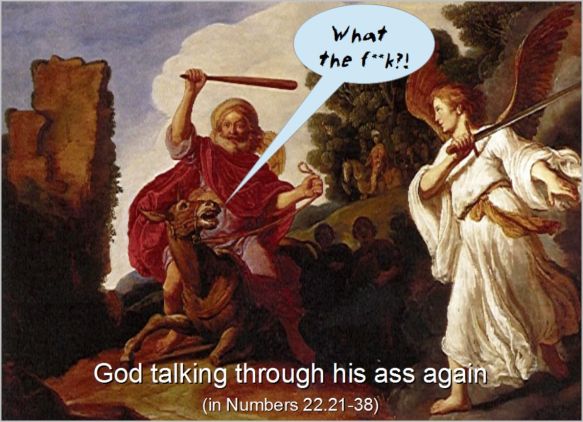
2 talking animals: the serpent in Eden and Balaam’s ass.

1 talking plant (Exodus 3:3).

0 science. No understanding whatsoever of what we now call astronomy, meteorology, germ theory, genetics, evolution, psychology… you name it.

So how do we read all of this? As the ancients themselves would, with an understanding of the world that regarded the supernatural, magic, miracles and monsters as real? We’re told often enough that this is how we should interpret scripture, not from a modern perspective. Perhaps we might credit the creators of the many books of the bible with greater skill, however, and interpret the inclusion of magic and miracle as allegorical or metaphorical; literary pieces, if you will. But then we have to decide which far-fetched stories are myth and which are historical accounts,. There really is no way to do this. A New Testament story awash with impossible events, implausible characters and symbolic tropes is every bit as allegorical or metaphorical as the same kind of story in the Old Testament (or, indeed, in Egyptian, Greek and Roman myth.) The reader who wants to see stories in the Old Testament as carefully crafted allegories has to concede that the Jesus narratives are of the same order.

It looks like we have to read the Bible as 21st century readers, because that is what we are. After all the Bible is supposedly a book for all time. We can, however, recognise the way in which its many creators saw the world – populated with fantasy creatures and subject to impossible events – and accept that they were wrong. Reality is not as they perceived it. What we cannot do is claim that the Jesus story is an oasis of truth in the midst of all this fantasy . 

The God

So the universe isn’t a simulation created by a Mind in its mom’s basement. Shame. I thought Don was onto something there.

Let’s consider then another option. The universe, reality and we ourselves were made by a super-being, a God no less. How would that work?

The God looked round. There was nothing, only himself. He did not know for sure that he was a he because he had no Y chromosome or a penis. He hadn’t invented either yet and as an eternal being he had no need of such things. Heavens above, he didn’t even drink or eat so didn’t need dual purpose genitals, not even for urination. He did plan however to create, eventually, when billions of years had past, a sentient being who would have a Y chromosome and a penis. He intended calling this being A Man. This Man would be inherently male so it seemed only right that he, God, should identify as male too.

Damn, he’d digressed again. Where was he? He realised for the billion billionth time (though it was hard to count when time didn’t yet exist and even if it did he’d be outside it) he was nowhere amidst nothing and hadn’t created anything yet. It was time, bearing in mind no time existed, to create the universe, a reality outside of himself.

He looked round again. He was, he had to admit, a bit stuck. There was nothing around with which to create anything; no quarks, no gravity, elements or even Lego; none of the fundamental forces of the universe. There were no fundamental forces because there was no universe. He was going to have to create these things before he could even think about creating a universe. But how? He looked around for something with which to make the quantum realm and gravity and elements and all the other stuff from; but there was nothing. Even as God he was constrained by the principle that something cannot come from nothing. This was a truth universally acknowledged even if there wasn’t yet a universe.

What to do? Could he make a universe from himself, from his own essence as it were? But if he did, would that not diminish him in some way, make him less of a God? A God with a universe-shaped hole in his middle? He didn’t much like the idea of that. It really wouldn’t work.

Could he, he wondered, zap things into existence with just a word? But wouldn’t that be the same as making something from nothing? As such it couldn’t be done. In the far, far future those who believed in him would insist that something could not come from nothing in their arguments with those who doubted his existence. He couldn’t flout the rule and make his acolytes look foolish.

He decided he would have to abandon the whole project. He’d had such plans too, of making his Man and then destroying his descendants in a flood and every other way imaginable until he could send his other Big Idea down to rescue them with special magic. ‘Shit,’ God thought, though that didn’t exist either: ‘I’ll just have to get used to being here all alone with my Big Ideas, surrounded by all this nothing instead of something.’

God’s conundrum demonstrates that it is logically impossible that a God created the universe. Apparently, something cannot be made from nothing, even by a god.

A Reply to a Slave

I’ve discovered this new gizmo that lets me look stuff up on the Interweb. Goober or somesuch. I used it to find the meaning of ‘doulos’ that the absence of dictionary prevented you from doing. All of the results Goober brought up described doulos thusly:

Doulos (Ancient Greek: δοῦλος, Greek: δούλος, Linear B: do-e-ro) is a Greek masculine noun meaning “slave”. Wikipedia

Doulos (a masculine noun of uncertain derivation) – properly, someone who belongs to another; a bond-slave, without any ownership rights of their own. Biblehub (Christian site)

…anyone could become a slave, in a sense. However, once someone was sold into slavery, they remained a slave for life, and all of their offspring automatically became slaves as well. The only standard way of obtaining freedom was to earn enough money to pay your owner back as much as he had paid for you in the first place. This was a nearly impossible task to accomplish because slave owners did not often facilitate their slaves ability to earn money on the side. As such, most slaves, and their offspring remained slaves for the totality of their lives. Slavesandsons (Christian site)

Doulos is a Greek word in the Bible that has only one true historical option for accurate translation into English, which is slave. It literally means to be owned by someone for a lifetime. This word is found at least 127 times in 119 verses in the New Testament scriptures. It is used in the context of human slavery, which, sadly, was very common throughout the ancient Roman Empire for hundreds of years. Recorder.com (Christian site)

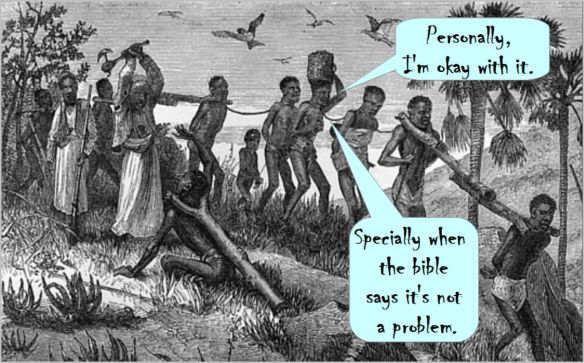
You’ll see none of them say what you say, Don. None think slavery was a nice amicable arrangement. Christian sites especially emphasise how slavery was a downright awful thing so’s they can sermonise about how Jesus saves us from slavery to sin.

If you’re going to reduce real world, God-approved slavery to something akin to a nice comfortable arrangement, you diminish the metaphor of Christ’s redemptive work to… not much at all. (Which of course it isn’t.) I noticed you didn’t comment on this point when I mentioned it in an earlier post and here you are digging yourself in deeper with your ‘slavery wasn’t really all that bad’. Good work, Don!

You’re certainly enslaved to all this Christian mumbo-jumbo. To Christ though, not really. There’s no such being and you certainly don’t give the impression of being a slave in any real world sense. Perhaps that’s because you have no understanding of what slavery was and is.

Applying Christian Logic

Apparently, because I’m no longer a Christian, it means I was never really a Christian. (According to Don I just enjoyed the ‘perks’.)

Convinced by the logic of this great insight, I now realise –

I am no longer young and therefore I was never young. (I just enjoyed thinking I was);

I am not now a teacher and therefore I never really was one. (I just enjoyed the holidays);

I am not now a husband and therefore I never really was. (I just imagined it);

I am no longer raising my children and therefore I never really did. (I just spent 25 years thinking I did);

I am not now a university lecturer and therefore I never really was. (I just experienced an illusion);

I’ll be dead one day and therefore I am not really alive now (I’m just – you guessed it – enjoying the perks).

I feel so much better knowing all this. Thanks, Don.