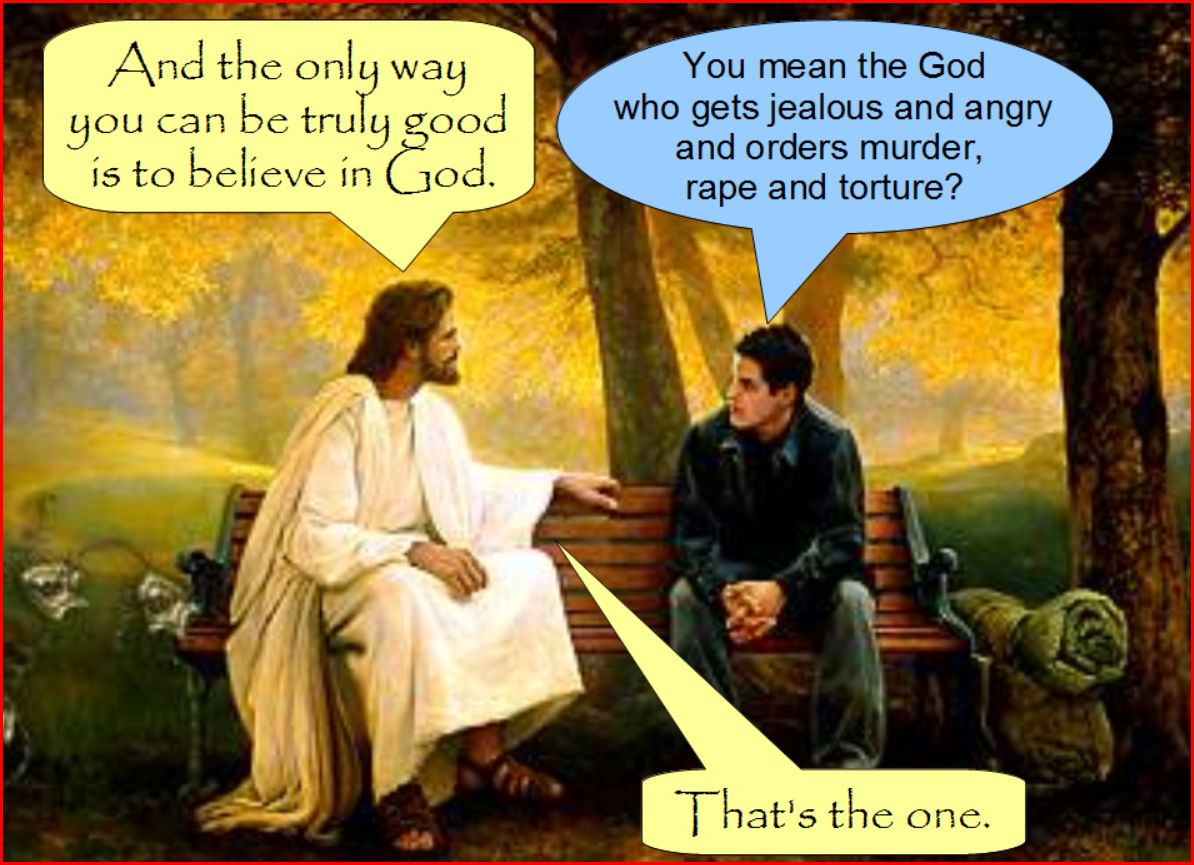
Christians’ Favourite Delusions 16: Christians treat others as they themselves would like to be treated (Luke 6.31).

Gun

Jesus promised his followers, back when he was alive, that they would take over the world when God’s new Kingdom arrived: ‘Blessed are the meek,’ he’s reported as saying in Matthew 5.5, ‘for they shall inherit the earth.’ He failed to tell them that this inheriting wouldn’t be any time soon, even though he himself thought it would be (Mark 13.26-30). Even so, Christians today fully expect JC to return any day now to vindicate them and turn the world over to them. Then, the meek – assuming that Jesus meant ‘Christians’ when (and if) he used the term – will inherit the Earth, whatever that actually means.

Back in the early 1980’s, when I was a Christian myself, I campaigned, in a very small way, for persecuted believers in the pre-Gorbachev Soviet Union. Together with others in my church, I spoke out against the clampdown of Christian worship, restrictions on the availability of the Bible and the harsh punishments meted out for exercising faith. Certainly believers in Russia were meek and humble then, because they had no other choice.

How things have changed in the intervening thirty years. Now in Russia, under Putin, faith is supported and encouraged and formerly persecuted Christians have the upper hand. They have the ear of the Kremlin and are influential in deciding policy especially in so far as it relates to ‘morals’.

And do those Christians, having known the scourge of persecution, say, ‘we cannot support the persecution of others; we disliked it when it was done to us and, in the words of our saviour, we recognise we should treat others as we ourselves would wish to be treated’ (Luke 6.31)?

What do you think? You think the meek, having found acceptance themselves and inherited positions of respectability and influence, use their new prominence to defend other minorities who are now being persecuted?

Of course not. The church in Russia endorses, supports and influences the policies of state that have lead to the persecution of people who have ‘non-traditional’ relationships; LGBT people and those who support them. Watch the Channel 4 Dispatches programme ‘Hunted’ (on 4 On Demand, with clips on YouTube) to see how gay people in Russia are hunted, tortured and humiliated. Witness a so-called Christian proudly relate how he shot a young gay man in the face with a ‘non-lethal weapon’ because he was carrying a rainbow flag. See Father Sergei Rybko from the Russian Orthodox Church demonstrate true Christian love when he says:

Even cattle don’t engage in this (homosexuality). I just consider them spiritually and morally ill. Something is not right here (in their heads)… they’ve started to plant the idea in young people’s minds that this is normal, that they are just a bit different… Well excuse me, paedophiles and sex offenders are just different too. Murderers and thieves are just different – so we should also give them freedom to do what they want? Where gays are allowed, paedophilia will soon flourish. Permitted evil gives rise to more evil. Paedophiles, gays and people like this are basically serving the Devil.

Church condoned persecution of homosexuals is what we can expect when God’s Gentle People inherit the Earth. We know this because it’s happened before, many times in history. When Christians get the upper hand, others suffer, whether they’re Jews, womenchildren accused of witchcraft or LGBT people.

Mercifully, Jesus was wrong, as he was about so much, when he promised the meek would inherit the Earth: they will never hold sway over the entire globe and for that, we should all be eternally grateful.

One rule for the church, another for everyone else

PopeSays

Which of the following is the odd one out?

Bill Roache

Dave Lee Travis

Rolf Harris

400 Catholic priests

Yup, you got it. It’s the 400 Catholic priests. The other three are celebrities currently facing trial for alleged sexual misdemeanours in the 1960s and ’70s because, unlike the USA, there’s no statute of limitations in the UK. The priests, however, all of whom molested children, haven’t had to stand trial and have got away scot free. All that happened to them was that former Pope Benedict XVI defrocked them during 2011 and 2012, while he was still in office. And that, as they say, was that. USA Today explains:

 The maximum penalty for a priest convicted by a church tribunal is essentially losing his job: being defrocked, or removed from the clerical state. There are no jail terms and nothing to prevent an offender from raping again.

So there you have it. You want to escape the penalty of the law? Then hide behind Jesus and the might of the Catholic church and all will be well, whatever you’ve done – and might do again – to the children in your care.

Christians’ Favourite Delusions 15: The Bible is the ultimate standard for morality

Plucking

Jesus claimed that his morality came from the only scriptures he knew, those Christians now refer to as the Old Testament. Here’s how he puts it in Matthew 5.18 & 19: 

Do not think that I have come to abolish the law or the prophets; I have come not to abolish but to fulfil. Whoever breaks one of the least of these commandments, and teaches others to do the same, will be called least in the Kingdom of heaven; but whoever does them and teaches them will be called great in the Kingdom of heaven’.

Today’s believers like to pretend that they too derive their morality from the Bible. One Christian web-site tells us that ‘the Bible becomes our source of morality because the Bible is the very Word of God in written form.’ Overlooking the fact, for now, that the Bible is not, for a whole host of reasons, ‘the Word of God’, what sort of moral guidance does it provide us with? Here’s a small sample:

Stone to death anyone who works on the Sabbath. (Exodus 35.2 and Numbers 15.32-36)

A slave is his master’s property; if you beat him so severely that he takes a day or two to die, you won’t be punished. (Exodus 21. 20-21)

Kill publicly children who dishonour their father or mother. (Leviticus 20.9);

Stone to death anyone who blasphemes the name of the Lord. (Leviticus 24.16);

Execute a married couple who have sexual intercourse during the woman’s period. (Leviticus 18.19);

Put to death those involved in adultery. (Leviticus 20.10);

Execute any man who lies with another man, as with a woman. (Leviticus 20.13)

Stone to death at her father’s door any woman who is not a virgin on her wedding night. (Deuteronomy 22.13-14 and 20-21).

Cut off ‘without pity’ a woman’s hand if, during a fight, she seeks to rescue her husband by grabbing his opponent’s testicles. (Deuteronomy 25.11-12)

Isn’t this just the kind of ‘morality’ promoted by the Taliban? Well, the good news is Jesus approves! And he’s got some corkers of his own. How about these for great moral teaching?

Wherefore if thy hand or thy foot offend thee, cut them off, and cast them from thee: it is better for thee to enter into life halt or maimed, rather than having two hands or two feet to be cast into everlasting fire. And if thine eye offend thee, pluck it out, and cast it from thee: it is better for thee to enter into life with one eye, rather than having two eyes to be cast into hell fire. (Matthew 18.8 & 9 AV).

So, no, very few Christians today get their morality from the Bible. Their moral sense has evolved, like that of the rest of us, without the Bible’s assistance and without any reference to god. Thank goodness for that, even if there are some who would like to see a return to the kind of moral barbarism the Bible, and Jesus, promote.

Christians – Jesus commands you be perfect. So why are you not?

Despot

‘Be perfect, therefore, as your heavenly Father is perfect’ is how he puts it. He even tells you in the verses that precede this one how to go about it: you have to turn the other cheek; give untiringly to anyone who asks (including to those who would sue you); constantly go the extra mile and show only love to your enemies (Matthew 5.38-48).

It is often claimed, even by those who don’t believe in him as their saviour, that Jesus offered great moral teaching. C. S. Lewis though cautions against seeing Jesus as simply ‘a great human teacher’ when, in Lewis’s eyes, he was far more besides. I would, however, invite Christians to consider whether the moral guidance Jesus provides here in Matthew’s gospel – how to be perfect – is in any sense ‘great’. If you think it is, because Jesus is Lord, a perfect being and possibly God himself, then you need to explain why it is never followed by Christians, and never has been. You need to explain why you yourself do not apply it in your life, because as sure as poached eggs is poached eggs, you do not. You do not give to all who ask; you do not invite insult after insult and violence on top of violence; you do not give away valuable and essential possessions when threatened with legal action – you are actually more likely to do the suing. And lest you think I am advocating a far more exacting morality for Christians than I would from anyone else, you will bear in mind, won’t you, that is not I who insists on it, but your Saviour. It’s not unreasonable under the circumstances to expect to see you obeying him.

As it is fairly safe to assume you don’t, I would further invite you to consider whether instead of being ‘great’, Jesus’ teaching is in fact unreasonable, unrealistic and impractical. If you are honest, you will acknowledge that it is all of these things, not great or timeless at all, and that is why you, and all other Christians worldwide, disregard it. Jesus’ moral teaching is no more than a series of reckless suggestions, a formula that applied can lead only to poverty and abuse, not perfection. You are probably wise to ignore it and to spend your time instead opposing gay marriage and judging the rest of us.

Revised from ‘Be Perfect’ in my book, Why Christians Don’t Do What Jesus Tells Them To …And What They Believe Instead, available from Amazon.

Notes: C. S. Lewis on Jesus as ‘great human teacher’: Mere Christianity (1952) William Collins & Sons, Glasgow, p52.

An experiment in Christian morality

Forget

Time for a little experiment: some data gathering for ourselves that will demonstrate the extent to which Christians are willing to comply, without cynicism or irony, with their Saviour’s peculiar requirements. While the Bible assures us it is wrong to put the Lord God to the test (Deuteronomy 6.16, etc), rest assured the same does not apply to believers themselves.

Our experiment is a cruel one to be sure, but given Jesus’ command in Matthew 5.42, that believers should ‘give to everyone who begs from you, and do not refuse anyone who wants to borrow from you’, we would be within our rights to test their adherence to the principle. After all, Jesus specifies that his followers must oblige ‘everyone’ and ‘anyone’ who asks, which is accommodating enough to include any sceptics conducting an experiment. He doesn’t stipulate either that those doing the asking have to have genuine need; indeed the entire thrust of his teaching in this section of Matthew is about responding sacrificially to unreasonable demands. We won’t be unreasonable – so no slapping of cheeks – and we will do our best to ensure our request is designed to meet as genuine a need as we can create.

For any experiment we need a hypothesis, so I propose that for this particular one we go with something like ‘Christians will not give to those who beg from them nor lend to those who ask to borrow’. If you want to amend this to suit your own circumstances, by all means do. You can choose too whether you’re going to beg, which means you get to keep anything you are given, or to borrow, in which case you won’t and you’ll need to pay it back at a later date.

Next, you’ll need to select your subject: you can choose an individual – they must of course be a card-carding, Spirit-filled Christian – or an institution: a church, say, or Christian organisation like Christian Voice or Focus on the Family. Whichever you opt for, you’ll need to ensure they are capable of meeting your request – we’re not going to pick on Christians of more modest means – and decide what you will ask for. I suggest that if your subject is a renowned evangelist or the pastor of a so-called mega-church you could reasonably ask him or her to lend you the money to pay off your mortgage, for example, or to meet medical expenses. I’m sure he or she will agree that these qualify as truly genuine needs, though you don’t necessarily have to tell them why you want the money, given there’s no mention of the beggars in Jesus’ instructions explaining themselves. On the other hand, if you think it will go some way to help disprove the hypothesis, you can and perhaps should be clear about why you want the cash.

Right. You should be all set. Be sure to let me know how you get on and whether your Christian subject demonstrates the hypothesis or refutes it. I’ll collate the data.

What’s that you say? You’re not going to bother because it’s a foregone conclusion that most Christians, whether prominent individuals, churches, organisations or ordinary believers won’t give to anyone and everyone who asks?

You could well be right, because, although Christians do give generously to causes close to their hearts, they baulk at the idea of giving to just anybody, in spite of what Jesus says. Maybe Christian readers of this blog can explain why; why don’t you do what Jesus tells you in this and many other respects? You cannot be his disciple, he says in Mark 10.25, unless you give away all that you have and he won’t recognise you as a follower unless you obey him entirely (Luke 6.46). So how about it?

Christians’ Favourite Delusions 8: Atheists can never be moral or happy

moral

Christians regularly exercise these dishonest sound-bytes; here, here and here, for example.

There’s no need to argue with them. All we need to do is look at the evidence:

Good, moral atheists

Immoral Christians

Happy atheists

Miserable Christians

(click all of the above for examples)

If it’s true that only those with a direct line to God can be good and happy, then we shouldn’t see any of these categories. Christians should be supremely happy all, or at least most, of the time – St Paul says that believers are characterised by love, joy, peace, kindness and generosity (Galatians 5.22) – but they’re not. They should be moral and good all the time too – after all, Jesus commands them to be ‘perfect’ and tells them how to achieve it (Matthew 5.43-48) – but they’re not.

According to Christians moral, happy atheists shouldn’t exist. And yet they do. Christians, when they achieve it, are only good and only happy because they think God is watching over their shoulder. When atheists are good and happy it’s because they can be.

Morality Tale

Preaches   A man who believes in the impossible – and it is a man more often than not – appears as a moral authority every morning on national BBC radio. This same man is frequently asked by television networks to give his views on moral issues of the day, be they assisted suicide, pay-day loans, same-sex marriage & adoption, abortion or capitalism. And even when he hasn’t been asked, the views he expresses on these subjects are widely reported, sometimes all around the world. The man can, in one of his roles, sit in the second most important legislative body of the land, again as a moral authority, influencing laws that are binding on everyone else whether they believe in the impossible or not. Indeed, the man has an automatic, unelected right to be part of this august body.

   Where, you might ask, does this man’s moral authority come form? Is he a psychologist with a profound understanding of human behaviour? Or a geneticist with knowledge of the biological bases of our decision making? Maybe a philosopher who has analysed the cognitive processes that lead to moral decisions? An ordinary, educated person, then, who has given much rational thought to how we might best treat one another?

   No, he’s none of these. He’s just a man who believes in the impossible and wears funny clothes to prove it. Invariably, it is true, he has become quite an expert in believing the impossible and he’s even been granted a special place in society that allows him to encourage others to believe the impossible. As a result, he has somehow made the leap into thinking that, because he believes in the impossible, he must therefore be a moral authority.

   Now, we may not object to the man believing in the impossible in the first place – it’s a free country after all – but we don’t accept, surely, that because he does, it means he knows much more than the rest of us about morality?

   Yes, I’m sorry to report that we do. We acquiesce to the man and say ‘because you believe in the impossible, and for no other reason, you must know more about morality than we do.’ And when we are looking for moral guidance, we turn to him – whether we are the BBC, the rest of the media or the government – and we say, ‘what do you say about this? What should we think about it, because, after all, you are the authority here by virtue of the fact that you believe in the impossible?’ And the man, in whatever guise he appears – pope, archbishop, bishop, reverend, imam, rabbi – says, ‘this is what it says in my magic book (even when it doesn’t) and you should follow it, even though you might not believe in either the magic book or in the impossible.

   And we say, ‘Well, you’re the expert and we respect that you should tell us how to behave, if for no other reason than you believe in the impossible.’