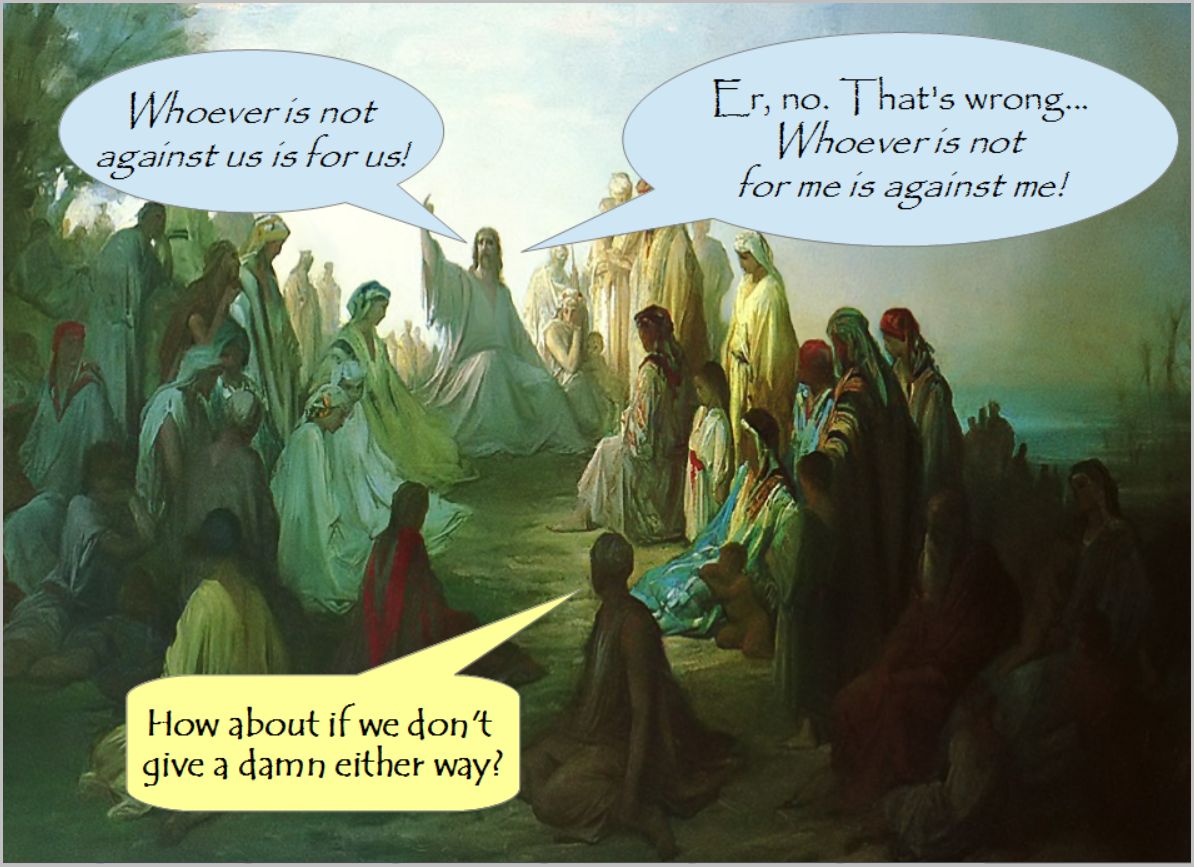
Idiotic Stuff Jesus Said 4: Rivers Of Living Water

Or more precisely: Whoever believes in me, as Scripture has said, rivers of living water will flow from within them (John 7.38).

WoundMe: What does this even mean, this ‘rivers of living water’ stuff?

Christian: It’s a metaphor. Jesus means it symbolically.

Me: Symbolically, how? A metaphor for what exactly?

Christian: The wonderful life-giving message that is the gospel.

Me: Which gospel? Jesus’s or Paul’s?

Christian: Oh, you’re splitting hairs. They’re one and the same.

Me: They most certainly aren’t, but we’ll let that pass for now. So by ‘living waters’ you mean that death-obsessed, rag-bag of negativity that fails to deliver in any way? (See all previous posts).

Christian: Well, I wouldn’t put it quite like that, but when one is reborn of the Spirit, then this wonderful feeling takes hold of you. That’s what we mean by ‘living waters’.

Me: I see. So all it comes down to is how good it makes you feel inside. ‘Living waters’ is just a metaphor for feeling good.

Christian: Oh, no, it’s more than that. It’s the Love that compels us to share the good news with others – that’s really what Jesus means by rivers of living waters.

Me: So banging on about hell and how the world is doomed (because, you know, gay people) and how only you know the Truth, is letting your love flow, is it? Is that what we see on sites like this, and this and this? Living waters of love? Or running sores of bile?

Christian: Well, those sites and those people aren’t representative of true Christians.

Me: That’s funny. They say the same about you.

Christian: Now you’re being unfair.

Me: And what’s more, there’s no reference to ‘rivers of living water’ flowing inside people anywhere else in ‘Scripture’. That’s another bit of made-up nonsense.

Christian: Oh, no, you’re mistaken about that. You must be. Jesus wouldn’t get a thing like that wrong.

Me: You know, maybe none of you have rivers of living water sloshing around inside you. Maybe this is just another of those idiotic things Jesus said, or was made to say about a hundred years after he lived, that means absolutely nothing at all.

Christian: Ma! He’s persecuting me.

Let’s Suppose…

This article originally appeared as a guest post on Bruce Gerenscer’s U.S. blog, ‘The Way Forward’ a couple of months back. Bruce has since had to close his blog and as a result the article became inaccessible. I’ve rescued it, my little lost sheep among a hundred, and present it here for your delight and delectation. Or something.

While on ‘The Way Forward, the post generated quite a few comments from Bruce’s readers. Feel free to respond to it here in like manner – and indeed to any other posts. All comments, spam excluded, are published whether agreeing or disagreeing with what I have to say.

BlessedLet’s, for the sake of argument, suppose that Christians could prove that the universe was created by a supernatural agent.

Let’s further suppose that they could demonstrate conclusively that this supernatural agent is none other than their very own God, as opposed to, say, Allah or Atum or Marduk.

And then let’s say they are able to show us, with sundry proofs, that an itinerant Jewish preacher, generally known by the Greek name, Jesus – though he was never called that by those who knew him – was somehow a manifestation of this God on Earth.

Then let’s say we grant them, although it doesn’t seem it from reading Jesus’ story in the synoptic gospels (Mark, Matthew and Luke, all written between forty and sixty years after this man lived) that his death somehow or other bridged the gap between humanity and this very touchy deity.

And then let us suppose that, although he never met Jesus but only had some sort of hallucination about him, the man Paul was right to say that through magically invoking Jesus’ name, people could be reunited with God and completely remade.

Let’s further grant them that, although their book about Jesus and Paul doesn’t actually say so in so many words, they really are going to go and live in Heaven when they die.

Assuming all of this is true – even though Christians are unable to demonstrate even the first of these propositions (the one about the universe being made by a supernatural being) – why is it they disregard and otherwise ignore most of what their god-man, Jesus, tells them about how they should live their lives?

Why are they, for example, so cavalier about forgiving others when he says in order to be forgiven they must first forgive those who have offended them? (Matthew 6.14-15)

Why are they so harsh in their judgements of others when he tells them that how they judge others will be how they themselves will be judged? (Matthew 7.1-2 & Matthew 25.34-46)

Why are they so lacking in compassion, when he says the amount of compassion they’ll receive is directly related to the amount they show others? (Matthew 5.7 & Luke 6.38)

Why are they so vociferous in their condemnation of others when they should be dealing with their own ‘sins’ first? (Luke 6:42)

Why do so many of them fail to serve others sacrificially, without expectation of reward and with no ulterior motive? (Mark 9.35 & 10.43-44)

Why are they not known for selling their possessions, giving to all who ask and going the extra mile? (Luke 12.32, Matthew 19.21, Luke 6.38 & Matthew 5.41)

Why do they not turn the other cheek, bless and pray for those who abuse them, and treat others like they want to be treated themselves? (Luke 6.28-29 & Matthew 7.12)

Why do they not love their neighbour as themselves, and their enemies too? (Matthew 22.39 & Matthew 5.44)

Shouldn’t they be doing these things, and more, as if their eternal lives depended on it? Especially when Jesus says their eternal lives do depend on it (Matthew 25.37-40). Shouldn’t they be just so much more radical than they actually are, changing the world by serving others? (Matthew 25.34-40)

Yes, they should, but they’re not, and they never have. Deep down, they know that Jesus is too extreme, too demanding. They make excuses for themselves; he doesn’t really mean the things he says; he speaks in metaphor and uses hyperbole (specially when he’s saying something they don’t like the sound of) and they invoke the bumper-sticker theology of ‘we’re not perfect, just forgiven’, even when ‘perfect’ is the very thing Jesus tells them they must be (Matthew 5.48).

The only reasonable conclusion we can draw from all of this is that Christians don’t really believe the man they call God and Saviour. Their actions, or lack of them, speak far louder than their words. It’s so much easier to claim Paul’s magical incantation, looking heavenward and damning the rest of us, than it is to do what Jesus demands. Who cares what Jesus said anyway. What did he know?

Idiotic Stuff Jesus Said 3: Whoever Is Not With Me Is Against Me

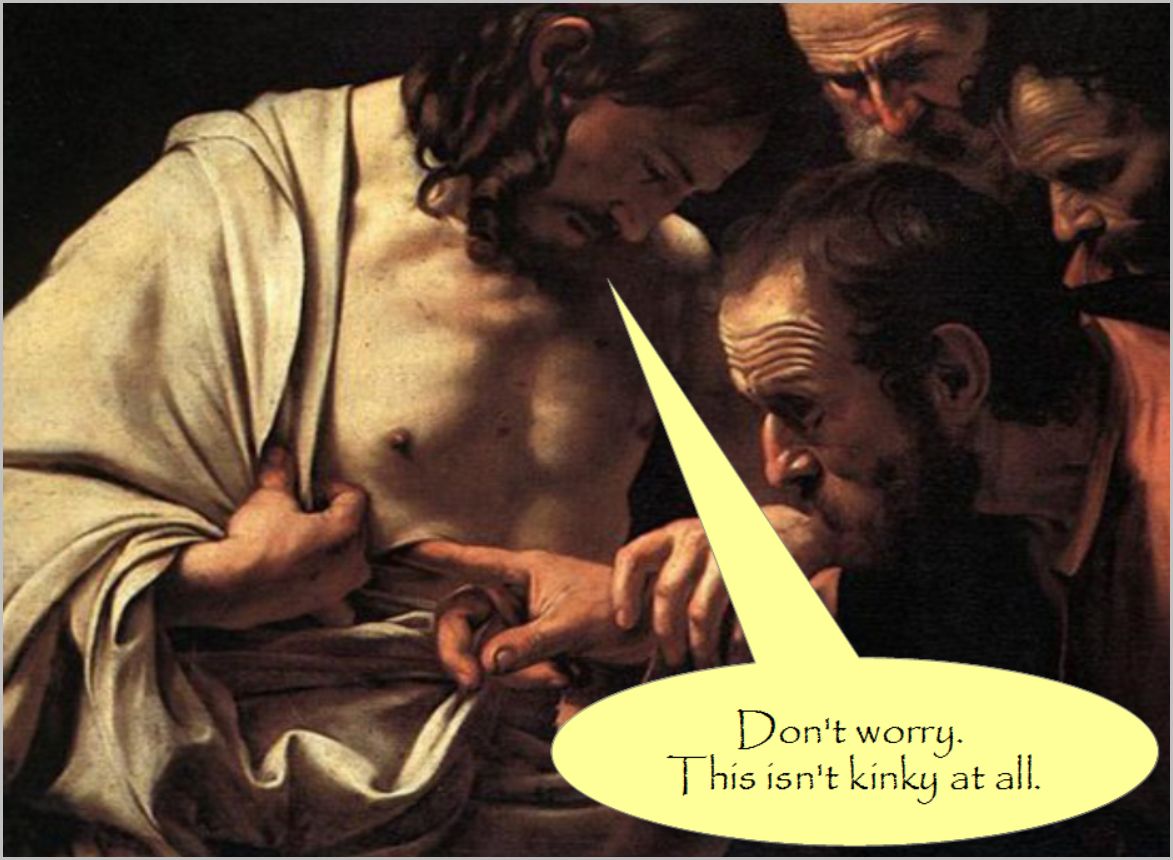
ForUsJesus is reported as saying both that ‘Whoever is not against us is for us’ (Mark 9.40)
and ‘Whoever is not with me is against me’ (Luke 11.23). What he doesn’t seem to realise is that these two statements, each ridiculous in its own right (there is always the third option of not caring either way), mean exactly the opposite of each another. The first is inclusive and relatively friendly. The second is hostile and exclusive; it says, in effect, ‘If you don’t give me your unquestioning devotion you are my enemy.’

This is not the claim of a fully-realised divine being, but of a paranoid megalomaniac. As with much of what he said – or is reported as saying (which is not the same thing) – Jesus reveals himself to be very human; flawed and completely egotistical.

He sets up, as all cult leaders do (and, indeed, as all human groups have a tendency to do) an ‘Us and Them’. Elsewhere, Jesus describes Insiders and Outsiders, with all the rustic charm of a first-century peasant, as the sheep and the goats (Matthew 25.32). It’s still a favourite pastime of Christians to segregate themselves and others into these two categories. They do it with real sophistication these days, of course (I mean, ‘sheep and goats’… c’mon) but it still comes down to Us and Them:

If you’re a mainstream evangelical you’re Saved, while those who don’t subscribe to your brand of Christianity are Lost or Of This World.

If you’re a Bible-believing fundamentalist you’re Regenerate but others are Unregenerate (or Degenerate).

If you’re a Jehovah’s Witness you’re one of the True Church; other believers are part of a False Christianity.

If you belong to the cult formerly known as the Children of God, you’re of The Family and everyone else is part of The System.

If you’re a Roman Catholic you’re the Only True Christians, while all others are Damned.

and so on, throughout all of the 34,000 different Christian sects and denominations.

It is an essential part of the Christian faith to regard yourself as belonging to the only True Church. Everyone else – from those who don’t buy into religion at all to every other faith group – is wrong. They’re an enemy of Jesus because, not being for him or with him in quite the right way (your way) they are, according to the warped logic he expresses here, against him.

The so-called Prince Of Peace proudly declares that he came to bring strife and division into the world (Luke 12.51), which, to this day, remains his greatest achievement. His idiotic words about being either for or against him have proven to be a gift to every sect, cult and church that has ever existed.

Idiotic stuff Jesus said 2: You need never have another bad hair day

ThePlanDon’tcha just love him?

Jesus says that whatever else happens, Christians will never, ever have a bad hair day. They may have limbs lopped from their bodies and they may be crucified just as he was, but – blessed assurance! – not a single hair on their heads will come to harm. Isn’t that fabulous?

Here’s how he puts it:

…they will arrest you and persecute you; they will hand you over to synagogues and prisons, and you will be brought before kings and governors because of my name… You will be betrayed even by parents and brothers, by relatives and friends; and they will put some of you to death. You will be hated by all because of my name. But not a hair of your head will perish. By your endurance you will gain your souls. (Luke 21.12, 16-18)

Of course, this particular part of Jesus’ script was written long after he died (wasn’t it all) when there was some mild persecution of Christians under the emperor Nero. Jesus’ promise was designed to be of comfort to those in trouble because of their faith. It turns out to be cold comfort, however, and a blatant lie. Jesus’ own brother and leader of the church in Jerusalem, James was tortured and executed round about 62CE, as were several of the disciples and the self-appointed apostle, Paul (circa 64CE). And we can be fairly certain that whatever hair they had on their heads ‘perished’ when they did.

Perhaps Jesus suffered from male pattern baldness, which might explain his fixation with hair, because as well as promising that not a single hair on believers’ heads would perish, he’s made to declare, equally improbably, in Matthew 10.30 that all the hairs on the disciples’ heads are numbered.

God really does have too much time on his hands. You’d have thought he could use it to prevent the deaths of the 25,000 African children who die each day because of malnutrition and the innumerable diseases he’s seen fit to create. But no. He counts hairs instead.

Consequently and predictably, Christians have tied themselves in tangled knots trying to explain Jesus’ bizarre claim that not a single, numbered hair would be lost. What he meant, some of them tell us, is that the souls of persecuted believers will be unharmed, safe in God’s care, whatever they endure. But hair, it has to be said, is an unlikely metaphor for the soul, and isn’t one that the gospel writers or other New Testament authors use anywhere else.

So maybe, Christians argue, because hair is a part of the physical body, Jesus means it to stand for the whole body, and yes, this might be put to death, but it will live again as a resurrected super-body. God will then reinstate even the hair of those who have died for Jesus’ sake. Which means there are going to be a lot of hirsute people in the Kingdom when all the hair they’ve ever possessed is returned, post-mortem, to their heads. This is what Jesus promises.

Paul, though, says in 1 Corinthians 11.14 that long hair degrades a man, while Augustine argues that, come the resurrection, any excess hair will be incorporated somewhere in the body (extra pubes maybe?). Perhaps, though, God doesn’t intend acting as divine hair-restorer at all, but plans to keep all the hair ever lost, alive and vibrant, in a special heavenly hair-museum.

Or maybe Jesus’ guarantee that even Christians’ hair will be saved is, like the rest of his promises, nothing more than total and utter BS.


Christians’ Favourite Delusions 27: The Bible Is The Ultimate Authority On All Things

Biblereader* Mark Twain

Since writing my posts about the Bible, I’ve stumbled across a few assertions out in Blogland that the Bible is the ‘ultimate authority’ on some subject or other. ‘The ultimate authority on the issue of homosexuality is the Bible’ says Tim Brown, while Marsha West claims ‘the Bible’s the final authority in all matters of faith’ and the snappily titled ‘Ethics & Religious Liberty Commission of the Southern Baptist Convention’ insists that ‘as Christians we must affirm our commitment to divine revelation, the written Word of God— the Bible—as our ultimate authority base.’ 

You might wonder how a book, written largely by bronze and iron-age tribesmen and first-century zealots who thought their world was going to end any day soon, could produce anything authoritative. Especially when these men (and they were all men) get it wrong about –

How the world was created. Genesis 1 tells us how Yahweh formed the Earth pretty much as it is today. In this made up explanation, light, night & day and plant life all precede the creation of the sun, and the order in which animal life appears is completely wrong.

How humans came into beingas fully formed adults. No messy evolution here. Moreover, woman is created from man, even though all foetuses are female to begin with and male comes always from female.

How the world got to be the mess it’s in. Sin, apparently; this first couple fucked the whole thing up. There was no death before they ate some fruit. After, there was.Move along. No understanding of evolution here.

How old the Earth is. The Bible’s genealogies imply the Earth is now 6000 years old or thereabouts. Actually it’s about 4.5 billion, but that doesn’t stop Ken Ham and other wingnuts insisting it can’t be, because, you know, the Bible.

How important the Israelites were. They weren’t; they were a relatively obscure and insignificant tribe. Their only ‘achievement’ seems to have been creating the idea of there being only one God, and even that took time to develop. Little of what the Torah/Old Testament claims for them has been supported by archaeological and other evidence, and much has been soundly refuted.

How the Israelites were slaves in Egypt. There is no evidence at all that they were. Moses and the whole of the ‘let my people go’ story appear to be complete fabrication.

How the world really works. According to Bible animals can sometimes talk (Genesis 3.1; Numbers 22. 23-30); humans once lived to be well over a hundred years old (Genesis 7.6;, 23.1 etc); the sun goes round Earth (Ecclesiastes 1.5); the sun can be stopped in the sky (Joshua 10.12-13); the Earth is flat (Isaiah 40.22 etc); Heaven is in the sky (Psalm 103.11 etc) and Hell is under the Earth (Psalm 63.9 etc)

How God’s Kingdom was going to come to the Earth in the first century. You’ve probably spotted that it didn’t. Yet the belief that it would drove both Jesus and Paul, and accounts for the very existence of Christianity (see previous posts). How wrong can you get?

How believers would never ‘perish’ (John 3.16). From the very first convert to the Christians who will die today, every believer has ‘perished’. There is no evidence whatsoever that any of them has been resurrected or that they enjoy eternal life. Like the end of the rainbow, this promise is perpetually out of reach, always somewhere in the future – even though Jesus and Paul were telling their followers 2000 years ago that it was all going to happen real soon.

How Jesus was coming back any minute. See above. Always going to happen just about now. Never does.

And so it goes.

That’s some ‘authority’, I’m sure you’ll agree. The Bible is wrong about practically everything, except when a preacher needs it to support his bigotry and/or prejudices. Then, miraculously, it’s the ultimate authority.

Christians’ Favourite Delusions 26.2: The Bible is the Word of God

WritingRight on cue, after my post on the Bible as ‘the Word of God’, Mike Ratcliff over at the intense Possessing the Treasure, posted his own item on the forged 2 Timothy 3.16-17, using it to show how the Bible is truly God’s Word.

You should know that Mike will not be contradicted in any way. You’re wasting your time posting a comment about his ‘exegesis’ of biblical texts because his musings – and there are many, many of them – are without any sort of error. Mike doesn’t make mistakes! He explains in his post how the Bible is ‘inspired, infallible and inerrant’. Many evangelical Christians hold this view of the Bible, which is as mistaken as it is idolatrous.

Infallible literally means ‘incapable of failure’ and ‘trustworthy’, but as I’ve attempted to show in many of my previous posts, the Bible fails in all sorts of ways:

It fails as science. It claims light existed before the sun was created; it claims the sun goes round the Earth, which it thinks is the centre of the universe. It has no idea about the order in which life-forms developed; no idea about evolution; no idea about life-forms that cannot be seen with the naked eye. It describes insects as having four legs and gives animals the power of speech.

It fails morally. It endorses slavery, polygamy, rape, incest, genocide and cruelty to both animal and human life. It denigrates women, children, the disabled and gay people. It prescribes brutal and barbaric punishments for those who infringe its petty laws.

It fails in its promises and prophecies. None of its promises ‘work’, none of its prophecies have come true (except those made after the event they’re meant to be predicting.)

Can something that fails so spectacularly and consistently be considered trustworthy? Yes, say Christians like Mike. No, says anyone capable of a little elementary reasoning.

Inerrant means incapable of error. As if the errors in the ‘failure’ category aren’t enough, the Bible is littered with mistakes and contradictions. The gospels, for example, all have different visitors to the tomb of the supposedly risen Jesus. These visitors are all met by different strangers – one man, two men, angels and their dog, Spot. More importantly, the New Testament can’t decide how a person is saved. Paul’s formula is radically different from Jesus’, and different again from the message Luke puts into his mouth in Acts. In total, there are eight different and conflicting ways to find salvation in the New Testament*.

Inspired literally means ‘breathed out’; Mike Ratcliff and others insist that the Bible is ‘breathed out’ by God. Apparently, he ‘breathed out’ his confused, contradictory message into and through fallible tribesmen, and first-century hallucinatory zealots, causing the former to exaggerate their own importance and success and the latter to create those eight different routes to salvation. He didn’t, however, see fit to give them a clear picture of who Jesus actually was, nor a precise formulation of the so-called Trinity (that fanciful nonsense had to be worked out much later), nor of what would happen to believers after death. He did, though, inspire forgeries and fakes like 2 Timothy and left it forty to a hundred years to prompt four individuals who had never met Jesus to write the muddled tales of his adventures on Earth. He didn’t think it important to preserve the originals of any of the manuscripts he’d inspired, nor did he take steps to prevent them from being altered both deliberately and accidentally throughout the ensuing years**. Perhaps he ‘breathed out’ the alterations and errors too.

The real problem with the inspiration argument is though that it is circular; the Bible ‘proves’ God and God proves the Bible.

No, the Bible is not infallible. Nor is it inerrant, nor inspired. It is an all too human creation, fallible and error-ridden. There is greater consistency and style in the works of Shakespeare than there is in the shambolic collection of books cobbled together as the Bible in 397CE. Those who see it as something more, see what they want see and are wilfully blind to its many failings. God’s Word it isn’t.


Notes:

* For the eight (at least) salvation plans in the New Testament see my book, Why Christians Don’t Do What Jesus Tells Them To …And What They Believe Instead, chapter 6.

** For errors, alterations and the non-preservation of any original documents see Bart Ehrman’s Misquoting Jesus: The Story Behind Who Changed The Bible And Why.


What would the world look like if Jesus had been right?

NewEarth

If everything Jesus promised had come true, then:-

Jesus and his twelve mates – or maybe it’s eleven, what with one of them pissing on the parade – would have been running the world for 2,000 years by now (Matthew 24.34 & Matthew 19.28).

All the undesirables – that’s me and, in all probability, you – would’ve been consigned to Hell and the Righteous would’ve been living on the New Earth, working miracles all day long, not getting married, enjoying eternal life and definitely not having sex (Matthew 13.43, Luke 20.34-35, Matthew 25.46, Matthew 13.41-42).

But seeing how none of that has happened yet, what does the world-according-to-Jesus look like while we wait for the Kingdom to arrive?

Well, duh, look around you; this is how it is:

True Believers go around curing the sick, the blind and the lame, just by touching them or using magic saliva. There’s no need for hospitals, medicine, doctors or heath care. Jesus did this sort of thing and he said his followers would too, to an even greater extent. That’s why Christians can even help amputees grow back missing limbs (Mark 16.18 & John 14.12).

By the same principle, True Believers regularly raise the dead. Okay, so there’s not going to be any death in God’s Kingdom on Earth, but it’s a handy power to have all the same (Matthew 10.8).

Hunger is a thing of the past. When anyone feels a bit peckish – an entire continent, say – Christians feed them using whatever scraps they’ve got lying around, like left-over sardines and burnt toast with Jesus’ face on it (Matthew 14.13-21).

True Believers supply everyone with as much wine as they want, too. They simply pour out some water and change it into alcohol with their water-into-wine superpower. If their beneficiaries turn out to be tee-total, the Righteous change it into something else for them, like coffee or Kool-Aid or cyanide. Of course, cyanide is the beverage of choice for God’s Chosen. He makes sure no harm comes to those who imbibe it (John 2.1-11, Mark 16.18).

Christians are regularly to be seen playing with poisonous snakes, because, like Superman they’re practically invulnerable (Mark 16.18).

Transport is transformed in Jesus’ new world too. No need for ships or ferries; Believers travel overseas by walking over seas. Conditions a bit choppy? The Almighty calms things down for them; all they have to do is ask. (Matthew 14.22-33 & Mark 4.35-41).

Mountains getting in the way? They can just be lifted out of the way using the Power of Faith, and thrown into the sea. Or, if that’s likely to cause problems for those out for a stroll on the oceans, the mountains can be rearranged to make a passage through. Very neat and tidy (Mark 11.23-24).

Best of all, True Believers can ask God for anything at all and whatever they ask for he provides. No questions asked. He does it (Matthew 7.7 & 21.22, Mark 11.24 etc).

Thanks to Jesus’ followers, this is how it is in the world, while they wait for God’s Kingdom to arrive. And when it does, it’ll be even better. Hard to imagine it could be any better than it is, I know, but Jesus guarantees it. What a blessing it is to live, here and now, in such a transformed reality.

Except of course we don’t. None of these things happen. Not the miracles, the healings, the living forever. This is not the world we live in, even though Jesus said it would be. His Kingdom didn’t come; his followers don’t do miracles like his (and certainly don’t do better ones); no-one lives forever. They never have and never will.

Instead his Followers spend their time squabbling between themselves, judging others and living – and dying – pretty much the same way we all do.

Funny that.


Christians’ Favourite Delusions 23: Jesus shows us how to live

Doctor

Was JC a great moral teacher?

No, the best things he said – do unto others, love your neighbour – had already been said eons before he came along. Some of the other stuff he came out with was ridiculously impractical – give away all you have; live only for today; turn the other cheek – that his followers have been unable to do from day one.

Did what he said about God turn out to be right?

No. He said God would establish his Kingdom on Earth while the disciples were still alive.

Did he commit himself to long-term responsibility for others and their needs?

Another no.

Did he experience the infirmities and difficulties of old age?

Nope.

Did he suffer from any of the serious illnesses we mere mortals are prone to?

Apparently not.

Did he give over his entire life to raising children or taking care of elderly relatives?

Not that we know of.

Did he have to work each day to earn a living?

No. He sponged off gullible female fans (Luke 8.1-3).

Did he have any understanding of science and of how the world works?

Erm, no. He thought people became ill because of sin and demon possession and that Heaven was in the sky.

Was he interested in anything but his own futile ‘mission’?

Yet another no.

Apart from his last few days did he know suffering, the everyday frustrations of life or the daily struggle to make ends meet?

Not so’s you’d notice.

Did he, in short, know anything of the life as it was lived and is lived by ordinary people?

Emphatically not.

There was nothing marvellous about Jesus. He was out of touch with ordinary people and at loggerheads with those cleverer than he was. He was a failed prophet who was turned into a supernatural being by those who came along afterwards – mainly Paul, who’d never met him – and is worshipped today by those who ignore most of what he said.