Where was God?

GodGod

While they were communing with God, gunman Dylann Roof sat among them for forty-five minutes. Then he opened fire and killed nine of them. That’s forty-five minutes during which time God could have warned the Christians who believed he was listening to them that something terrible was about to happen. But he didn’t. The communication was all one way. They talked to him but he didn’t talk to them. He didn’t even listen. Why not? Because either he doesn’t care what happens to his people, despite what Jesus promised, or he isn’t there.

After the massacre, Christians across America resorted to pleading with this negligent God to comfort the bereaved and to help police find the killer. We can be sure God didn’t do any such thing because if he cared at all, he wouldn’t have let the massacre happen in the first place. 

Presidential hopeful Mike Huckabee declared that if only some of those at the prayer meeting had been ‘pistol-packing’ themselves, they could have taken out Roof before he did too much damage. And he’s right – absurd as it sounds, one of them could have done. So why didn’t the God who never forsakes his people prompt one of them to take a gun to church? Perhaps because, unreasonably, he thinks it’s better to turn the other cheek. Either way, mark God down for another fail.

Fellow crank, the ‘reverend’ E. W. Jackson, blamed the shootings on liberals, gays and Obama. So, God – pissed with those who don’t support ‘Christian values’ –  allowed a gunman to mow down nine of his own. Makes sense.   

Debbie Dills, meanwhile, spotted the killer’s car on the freeway and informed the police. She later claimed this was God’s doing; the very God incapable of warning his loved ones they were about to be murdered. This God, who allowed his people to be massacred, directed Debbie Mills, who cannot see that she was just happened to be in the right place at the right time, to notice the killer’s vehicle and report his whereabouts.

Let’s get real: a God who can’t prevent the murder of nine of his children but then behaves like a third-rate Jessica Fletcher is no God at all. He is an impotent creation, a being of trivial pursuits, who fails to materialise when he’s really needed; a mythical figure who keeps his super-powers to himself, except in the most insignificant and coincidental of occurrences; a figment of believers’ imaginations.

Show us he’s not, Christians, why don’t you. Show us how he loves you, never forsakes you and protects even the hairs on your heads. Where is he? Where’s the evidence he exists, outside your inconsistent, fallacious scriptures and your own wishful thinking? Where in this real world? The people of Charleston really need to know.
Christians’ Favourite Delusions 34: Atheism is a Religion

NoGodChristians like to claim atheism is a religion. It’s their way of saying, ‘look – atheists are as daft as we are. They believe in bullshit just like we do, except, of course, they’re wrong and we’re right.’ You can see them saying just this here and here and here.

But atheism isn’t a religion, any more than not collecting stamps is a hobby, as Penn Jillette puts it. It isn’t a religion because it is the absence of belief – primarily in a god, but also in any other kind of supernatural being. The atheist knows there are no saviours, angels, devils, demons, ethereal saints or eternal prophets, and no heaven and hell to house them either. Atheism is devoid of any sort of worship of imagined supernatural beings; nor does it address them, commune with them or otherwise revere them. It does not recognise the authority of ‘holy’ books nor that of self-appointed spiritual authorities, including popes, pastors, preachers, imams, mullahs and rabbis. It doesn’t regard anything as sacred, including its own experts; neither Darwin nor the so-called New Atheists are above criticism. (Try that with those who think they represent God’s Truth™!)

Where religionists build their belief systems on the insubstantial foundation of faith, atheists accept nothing on trust. Instead, they look for evidence to support their knowledge and value reason, not dogma – things that are anathema to religion.

Given, then, that atheism is the antithesis of religion and that atheists don’t do what religion demands, it is intellectual dishonesty to insist that atheism is a religion. Those who do so are false witnesses; mistaken at best, liars for sure.

Jesus: The Dark Side

SacrificeDo not think that I have come to bring peace to the earth; I have not come to bring peace, but a sword (Matthew 10.34).

Well, isn’t that a comfort. Jesus, who said ‘blessed are the peacemakers’ and for whom Christians like to claim the title ‘Prince of Peace’, declares himself to be anything but.

Of course, it’s possible these words were put into Jesus’ mouth once belief in him had indeed started splitting families and communities; between those who subscribed to his cult and those who saw it for what it was. Maybe though he really did advocate armed rebellion – against the Roman and Jewish authorities – rather more than later believers care to admit. Even as they’ve come down to us, the gospels retain references to taking up arms in the cause of God’s Kingdom. For example:

  • Jesus didn’t see the transition from the existing system to the Kingdom as a peaceful one:

Matthew 11.12: From the days of John the Baptist until now the kingdom of heaven has been coming violently and the violent take it by force.

Matthew 3.10: Even now the axe is lying at the root of the trees; every tree therefore that does not bear good fruit is cut down and thrown into the fire.

  • He instructed the disciples to arm themselves:

Luke 22. 36-38: He said to them… ‘the one who has no sword must sell his cloak and buy one. For I tell you, this scripture must be fulfilled in me, “And he was counted among the lawless”; and indeed what is written about me is being fulfilled.’ They said, ‘Lord, look, here are two swords.’ He replied, ‘It is enough.’

  • And evidently they did:

Luke 22.48-49: Jesus said to him, ‘Judas, is it with a kiss that you are betraying the Son of Man?’ When those who were around him saw what was coming, they asked, ‘Lord, should we strike with the sword?’ Then one of them struck the slave of the high priest and cut off his right ear. (Jesus promptly heals the slave and then says, sanctimoniously, that ‘those who live by the sword will die by it’, as if swords weren’t his idea in the first place!)

  • More than this, when, as he clearly believed he would be, Jesus is appointed King in God’s new Kingdom, he hints he will be happy to see all of his opponents put to death:

Luke 19.27: “But as for these enemies of mine who did not want me to be king over them—bring them here and slaughter them in my presence.”

  • Jesus was executed by the Romans as a revolutionary. Crucifixion made an example of those who actively opposed Roman rule. The charge against Jesus was that he was an intended usurper of power; two fellow ‘rebels’ are executed with him:*

Mark 15.26-27: The inscription of the charge against him read, ‘The King of the Jews.’ And with him they crucified two rebels, one on his right and one on his left.

So much for ‘love your enemies’ and ‘turn the other cheek’. So much for the Jesus who does nothing but preach love and forgiveness. So much too for Paul’s mystical Christ. There is a very dark side to Jesus that expresses itself in vengefulness and megalomania. That anyone so disturbed could be considered an emissary from God, let alone God the Son, beggars belief.


* Since writing this post I’ve read Marcus J. Borg’s Jesus: Uncovering the Life, Teachings, and Relevance of a Religious Revolutionary. Borg makes precisely the same point about the charges against Jesus (though he sees him as a non-violent revolutionary). He explains that the Greek word used to describe the two killed with him – rendered as ‘rebels’ above – ‘is the term more commonly used for those engaged in armed resistance against Rome – “terrorists” or “freedom fighters”, depending on one’s point of view (p265).

Always and Forever

nurseGod is trustworthy and true. He always keeps his promises. We know this because Christians, either in person or on web-sites, like to tell us so.

Let’s take a look at some of the promises God made back when he only liked Jewish people. How well do they hold up?

As part of his promise (covenant) with Jewish patriarch, Abraham, that he would look after his descendants in perpetuity, Yahweh came up with a particularly gross way for them to sign up:

I will always keep the promise I have made to you and your descendants, because I am your God and their God… Abraham, you and all future members of your family must promise to obey me. As the sign that you are keeping this promise, you must circumcise every man and boy in your family. This will be a sign that my promise to you will last forever. Any man who isn’t circumcised hasn’t kept his promise to me and can’t be one of my people… The promise I am making to you and your family will be for (your son) and his descendants forever (Genesis 17.7, 9-13, 21; my emphases).

‘Always’ and ‘forever’ obviously meant only until God changed his mind – which he did when he came up with the new ‘covenant’. You know the one: ‘believe in Jesus to be saved, no primitive surgery required.’ Of course, Jews still feel the original promise is in force and so keep up the old slicing’n’dicing membership requirement. So who’s right? Jewish people who feel that a promise is a promise? Or Christians who insist God eventually lost interest in mutilating penises? It’s hard to tell, but if it’s the Christians, then God, being omniscient and all, must have known he would change his mind eventually. So why tell ol’ Abe the agreement with him was ‘always’ and ‘forever’?

Then there’s the one where God promises there’ll be a descendant of King David’s on the throne forever:

I will establish your royal throne over Israel forever, as I promised David your father when I said, ‘You shall never fail to have a successor on the throne of Israel’ (1 Kings 9.5).

Oops. David’s line ceased ruling over Israel when the Assyrians defeated it in 586BCE. Since then there has been no king of the Davidic line ruling over Israel. Why didn’t God see this coming? And if he did, why’d he make a promise, with ‘forever’ and ‘never fail’, that he knew he wasn’t going to keep? Yes, I know Christians like to claim that Jesus took over the kingship when he came along, but he didn’t, not really. His descent from David is highly questionable and there’s still that awfully long gap between 586BCE and Jesus’ time that blows a hole in ‘never fail’ and ‘forever’. In any case, Jews, by definition, have never seen Jesus as their king and they’ve got a point: it’s difficult to see how someone dead and/or totally invisible can be king of anything.

Never mind, let’s try another. This time God’s promise that everything’s going to work out okay:

(The Lord) will judge between the nations and will settle disputes for many peoples. They will beat their swords into ploughshares and their spears into pruning hooks. Nation will not take up sword against nation, nor will they train for war anymore (Isaiah 2.4).

Safe to say this didn’t happen either. Not while people were still using swords and spears anyway.

Finally, what about the promise that’s trotted out every Christmas? –

For to us a child is born, to us a son is given, and the government will be on his shoulders. And he will be called Wonderful Counsellor, Mighty God, Everlasting Father, Prince of Peace. Of the increase of his government and peace there will be no end. He will reign on David’s throne and over his kingdom, establishing and upholding it with justice and righteousness from that time on and forever (Isaiah 9:6-7).

Whatever Christians might claim for these verses, they’re not about Jesus. At the risk of repeating myself, I’ll repeat myself: Jesus did not and does not reign on David’s throne. He said he would, it’s true, believing himself to be the fulfilment of ‘prophecies’ like this, but he was wrong, as events went on to demonstrate. He didn’t, in any case, fit the description of whoever it is who’s being spoken of here; an earthly ruler who – yes, you guessed it – has still to show up. We’d have spotted him if he had. Some Jewish scholars think they might have done, pointing to King Hezekiah who ruled Israel in the 8th and 7th centuries BCE, for almost 30 years. That’s hardly ‘forever’ though, is it. Yet more evidence that ‘prophecy’ doesn’t ever work, principally because it’s impossible to know the future.

God’s promises are like those of politicians: you just can’t trust them. There has to come a time when those who believe in them must face up to the fact they’re not promises at all, just ancient wishful thinking.

For God So Loves The World

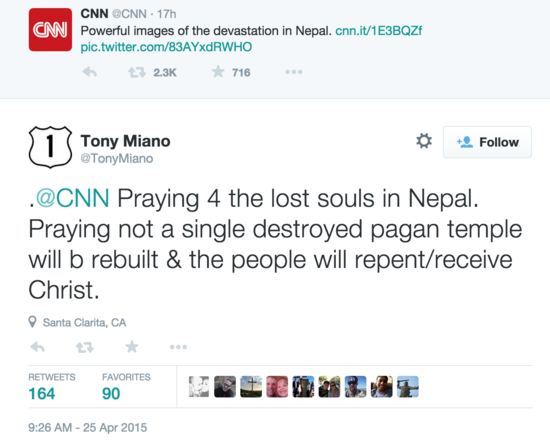
NepalFor God so loves the world he let an earthquake and its many aftershocks kill up to 10,000 people in Nepal.

For God so loves the world he stood by while up 100,000 more people lost everything, including their homes, because of the same earthquake.

For God so loves the world he drowned 900 refugees fleeing the terrors of war in their own countries.

For God so loves the world he allowed 250 individuals to be killed by a rogue pilot who flew the plane they were on into the side of a mountain.

But wait! One particular Christian preacher knows why this kind of thing happens. He can explain how these catastrophes, particularly the devastation caused by the earthquake, are compatible with a God of love. Here’s what it’s really all about:
Tweet

That’s right. God only allowed these terrible things to happen so that more people – excluding the ones he murdered, obviously – would have the chance to turn to Christ. Isn’t that marvellous? And Tony Miano, who is the same lunatic street preacher arrested in London in 2013 for sharing God’s ‘love’ for LGBT people, is not alone. German pastor Wolfgang Wegert said much the same thing of those who died on Germanwings Flight 9525: ‘A plane crash is a reminder of our own mortality. By that, God wants to make people repent, so that we (can) be saved by Jesus.’

And, do you know, they’re right. No, really, they are. There is no other response available to the Christian who wants to explain events that involve the terrible loss of life. That’s because the Christian God, the one who purports to love us so much, as well as all the other versions, is conspicuous by his absence. He’s always absent, always powerless to prevent such disasters, too remote to want to. Which might just suggest he doesn’t exist (which of course he doesn’t) leaving those who feel the need to cling to belief in him to explain his actions or, rather, the lack of them. So they supply him with an ulterior motive. And why not? A fabricated being needs a fabricated excuse. But this being the real world, the options are limited. So what we get is this; God is only trying to draw people to him. How truly loving. The equivalent of a human father murdering several of his children so that those he spares might love him more. A monstrous and preposterous idea for a monstrous and preposterous God.

And so it falls to human beings of all persuasions to show compassion and to help the survivors of earthquakes, the relatives of plane crashes, the misplaced and grieving refugees. We might be flawed, fallible and – according to the self-righteous – ‘sinful’, but we can at our best, demonstrate the love so lacking in their absent deities. And unlike the many meaningless gods, from Yahweh and Jesus to Allah and Vishnu, we can be present too, because we are real.


You can donate to the Nepal earthquake appeal here.

Christians’ Favourite Delusions 32: Jesus Is God

Res2Test your Bible knowledge and see if you can work out when it was Jesus became God:

Was it:

a) After he died?
Paul thought this was when God decided to adopt Jesus. The Almighty noticed what a good man Jesus was and decided to resurrect him. In so doing, he made him his Son:

his Son… was descended from David according to the flesh and was declared to be Son of God with power according to the spirit of holiness by resurrection from the dead. (Romans 1. 3-4, my emphasis)

Paul doesn’t say Jesus was God. In fact, he strongly suggests he wasn’t, both in the phrase ‘descended from David’ and in his assertion that he became God’s Son – not God – only at the resurrection. So, Jesus wasn’t God when Paul wrote Romans, round about 57CE. If, as Bart Ehrman suggests in How Jesus Became God (p224), Paul is quoting an earlier creed, it’s not what the first Christians believed either.* Paul does edge closer to a divine Jesus in other letters – Philippians 2, for example – but that’s not what ‘God revealed’ to him originally.

b) When he was baptised?
In the earliest gospel, Mark says it was when he was baptised that Jesus became God’s son:

(Jesus) saw the heavens torn apart and the Spirit descending like a dove on him. And a voice came from heaven, ‘You are my Son, the Beloved; with you I am well pleased.’ (Mark 1.10-11)

So in Mark, God adopts Jesus earlier in his career than in Paul’s Romans scenario. All the same, while he gets to be God’s beloved son, this doesn’t make him divine; God has many sons in the Bible and a Son of God, with or without capitals, is not the same as ‘God the Son’. Jesus himself makes this clear in Mark 10.18, where he actually denies he’s God.

c) When he was born?
Well, this is more like it. According to Matthew, Jesus is the Messiah from the time he was born. We’ve got even further back now – from Paul’s post-mortem elevation of Jesus, to his baptism, to his birth. Of course all of these can’t right. If Jesus was divine from birth – or even before – there’d be no need for him to be promoted after his death. But Matthew doesn’t actually say he’s divine; he suggests that Jesus fulfils all the prophecies of the Messiah (of course he doesn’t, but that’s what Matthew wants us to believe.) However, the Messiah, according to the very ‘prophecies’ Matthew quotes, is not divine; he’s a human warrior king. Oops.

d) When he was conceived?
Luke is determined to push it back further still. For Luke, it’s when God magically makes Mary pregnant that Jesus becomes truly and literally God’s son (Luke 1.35). Except, of course, Mary appears to have no recollection of this event later in the gospel narratives when she can’t work out why her son behaves in bizarre ways. Could Luke have made up the entire conception story? You bet.

e) Back at the beginning of time?
John’s gospel appears to say so:

In the beginning was the Word, and the Word was with God, and the Word was God. He was in the beginning with God. All things came into being through him, and without him not one thing came into being. What has come into being in him was life, and the life was the light of all people. The light shines in the darkness, and the darkness did not overcome it. (John 1.1-5)

Or does it? John says the Word (Logos) has always existed and is part of God – but does this mean Jesus? This question vexed the church for the best part of it first four hundred years. Was the Logos the same as God and was Jesus the Logos? The council of Nicaea in 325 attempted to clear the matter up but not all bishops agreed with its conclusion – that the Son was ‘begotten not made’ (whatever that means) – and the controversy raged for another few decades.

f) When the church decided he was?
Yup, this is it. A different group of bishops decided, finally, that Jesus was God at the Council of Constantinople in 381. They re-jigged the statement made at Nicaea fifty-six years earlier, which then became the ‘Nicene creed’ that’s still said in some churches today.

So, Jesus didn’t become wholly and officially divine until 381, a mere 350 years after he lived and 300 after Paul and the gospel writers. How scriptural is that?

Jesus wasn’t divine, wasn’t God incarnate, wasn’t the Son of God with capital letters, wasn’t the Messiah, wasn’t and isn’t the saviour of the world. He was a first-century preacher and prophet whose prophecies were a disaster, whose mission to bring the Kingdom of God to Earth failed and who died and was buried. He was resurrected only in the ideas of other men, who tried and eventually succeeded in making him into something he wasn’t.


* I’ve not referred extensively to Ehrman’s writing in this post but undoubtedly his many books, especially How Jesus Became God, have influenced me, as has Barrie Wilson’s How Jesus Became Christian. Jonathan Hill’s Christianity: The First 400 Years, published by Christian company, Lion, was also useful.


It only encourages them

HealDear Believer,

Let us be direct. We have to tell you, out of love, that we can never serve you in our restaurants, never teach you in our colleges, never supply you with goods we make, never sell you items from our shops. Why? Because of your fake faith.

Your belief in a mythical figure and in eternal life is a sin against the intellect. More than this, it causes you to act in mean-spirited, unloving ways. We cannot endorse such abhorrent, evil practices.

So if you come into our restaurants, classrooms, shops or offices wearing a cross or talking about your faith or praying, you will be turned away. We do this only because it breaks our hearts to see you lost in your delusion and to witness the damage you do to other people as a result of your beliefs.

It is our fervent wish, dear “Christian” friend, that by doing this we can lead you to abandon the illusory path you have chosen so that you may reclaim both your intelligence and humanity.

We hope you understand that all we say and all we intend to do, we do out of love and in the spirit of truth.

faithlessly,

The Freethinkers

What do you think? Too judgemental? Too much of a generalisation? Tars all Christians with the same brush? Unforgiving? Moralistic?

You’re right…

The original version of this letter is a long-winded, sanctimonious diatribe by right-wing Christian, Matt Barber. You can find the full thing at this link, but here are the highlights:

Dear homosexual,

…Let us be direct. According to the unequivocal moral precepts of biblical Christianity, explicit throughout both the Old and New Testaments, your homosexual behavior is sin. Sin is evil. Homosexual behavior is the central, defining characteristic of your counterfeit “gay marriage.” Therefore, “gay marriage” is evil. Christians are obligated to avoid sin – to “do no evil”…

It really is that simple. This is why, as faithful Christians (apostate “Christians” notwithstanding), we will never have anything whatsoever to do with your pagan, sin-based “same-sex wedding” rituals.

We will not bake your fake wedding cake.
We will not arrange your fake wedding flowers.
We will not take your fake wedding pictures.
We will not host your fake wedding reception.

We will not do these things because to do these things is to disobey God. It is to aid you in your sin, to cause you to stumble, which, in and of itself, is to layer sin upon sin…

We’re telling you no because we love you with the love of Christ. But understand this: As we are so commanded, we must, and do, hate the evil conduct by which you define your identity… what you do is wrong. Period. Full stop….

Dear “gay” friend, you will one day realize, hopefully before it becomes too late, that you are not only on the wrong side of history, you are on the wrong side of eternity.

It breaks our hearts to see you there.

And so we refuse to help send you.

Sincerely,

The Christians

Yes, definitely unforgiving and judgemental. Presumptuous too: Matt Barber speaks for all Christians? He writes and signs his letter in your name. Who appointed him to do that?

Arrogant in deciding we’re all sinners, gay people more than any. The whole sin thing is a specifically Christian mindset which – surprise, surprise – not all of us subscribe to, not least because it has little purchase in the real world.

Hypocritical that he condemns everyone, gay people more than any, but conveniently ignores the parts of his saviour’s teaching that says ‘don’t judge unless you want to be judged’ (Matthew 7.1). What does it feel like, Christians, when the tables are turned? Those of you, like Barber, who sit in judgement of others merit judgement in return. This is a sound Biblical principle, every bit as much as, or even more than, the ‘principles’ you use to condemn your ‘gay friends’ as ‘evil’. JC himself said so.

Ignorant too, of the scriptures that say ‘give to all who ask’ (JC again, in Luke 6.30-36). They don’t say, anywhere, ‘refuse to do anything for a group of people you don’t approve of.’ As Christians you’re not given that option, no matter how much you twist unrelated verses to endorse the position you’ve already chosen to take.

No, Christians like Barber who stand on ‘principles’ like these, who think they know the mind of Jesus while ignoring the very words he said are unchristian, unforgiving, unbiblical, arrogant and, whatever they may claim to the contrary, unloving. How attractive they make their faith seem.

What Jesus should have said…

KnockLists are the thing, aren’t they. It’s time we had some on this here blog thingy.

List 1. 10 things Christians pretend Jesus didn’t say:

1. Treat others as you like to be treated (Matthew 7.12)

2. Forgive so that you’ll be forgiven (Matthew 6.14)

3. Don’t judge unless you want to be judged (Matthew 7.1)

4. Sell all you have and give it to the poor (Mark 10.21)

5. Turn the other cheek (Luke 6.29)

6. Go the extra mile (Matthew 5.41)

7. Give to all who ask and lend without expecting anything back (Luke 6.30 & 35)

8. Love your neighbour as much as yourself (Matthew 22.39)

9. Love your enemies (Luke 6.27)

10. Don’t worry about the future (Matthew 6.34)

If Christians followed these injunctions, what a very different world it would be. Instead, what do we get..?

List 2. 10 things Christians think Jesus should have said, but didn’t (with a few examples):

1. Show love for others by telling them what sinners they are (1, 2)

2. Stand on principle as much as you can (1, 2, 3).

3. Take easy offence (1, 2)

4. See persecution everywhere (1, 2, 3, 4)

5. Sue those who upset you (1, 2)

6. Demonise those who don’t share your world view (1, 2, 3, 4)

7. Hate homosexuals and oppose same-sex marriage (1, 2, 3)

8. Set yourself up as defender of God’s standards (1, 2)

9. Argue endlessly about points of doctrine (1, 2)

10. Obsess about the future and the state of the world (1, 2, 3)

This is the Christianity we’ve got. Well done, o righteous ones, for perverting Jesus’ radical (and yes, ridiculously impossible) message into this unsavoury concoction of mean-spirited self-centredness. It’s what he wouldn’t have wanted.


Why_Christians_Don't_Cover_for_KindleMy book Why Christians Don’t do What Jesus Tells Them To …And What They Believe Instead looks at how Christians ignore most of what Jesus says in favour of a Christianity of their own making. You can find it here in the UK, here in the US and on Kindle. Go on. You know you want it.


Idiotic Stuff Jesus Said 10: How to Entertain

Last supper 2Here’s something you don’t see every day.

When you give a luncheon or a dinner, do not invite your friends or your brothers or your relatives or rich neighbours, in case they may invite you in return, and you would be repaid. But when you give a banquet, invite the poor, the crippled, the lame, and the blind. And you will be blessed, because they cannot repay you, for you will be repaid at the resurrection of the righteous.
Luke 14.12-14

In fact, you don’t see it at all, because Christians feel free to flout this command of their Lord’s. I mean, he couldn’t speak any more plainly than he does here, could he? And yet, Christians, you don’t invite the poor, the dispossessed and the disabled to your luncheons and dinner parties. Like the rest of us – that’s the unsaved and sinners in Christian-speak – you only invite your friends, family and fellow-believers. If you’re well-placed, maybe as an official of the established church or as an obscenely wealthy evangelist, you invite those who are similarly rich and famous. As far as you’re concerned Jesus and his ridiculous ideas can just f**k off.

What? You object? You don’t say this, Christians? It would be blasphemous? But of course you say it, when you spiritualise his point, explain it away (‘what he really means is…’), claim the context excuses you or just plain ignore him.

Please don’t misunderstand me; I don’t blame you. Jesus’ expectations are totally unreasonable – idiotic even. But I’m not a Christian; I don’t pretend to follow him and don’t have to do as he says. You, on the other hand claim him as your saviour, your God, and profess to live your life in obedience to him. Except you don’t, do you; you wilfully disregard the clear, direct instructions, like this one, that he gives you.

You much prefer setting your own agenda, whether that’s ‘defending God’s standards’ (your God is incapable of defending his own standards?), bashing the gay or making sure you yourself are ‘blessed’. But these are not part of Jesus’ agenda; his good news (mad as it is), is much more concerned with elevating the lowest of the low, including inviting them into your homes and feeding and entertaining them.

So how about it Christians? How about it all you outspoken men of God – Stephen Green, Steven Anderson, Scott Lively, Matt Barber, Franklin Graham – and all you other Christians; isn’t it time you got down off your soap-box of whatever it is you’re opposing this week and made a start doing what your saviour commands you to do?

Well, isn’t it?

The End Times Are Here! Again.

livelyWhat does the future hold? It’s difficult to say, really, when the future isn’t, as Doris Day once so very wisely expressed it, ours to see. That doesn’t stop Christians from claiming they can though. They know exactly what the future holds, they insist, because the Bible tells them so.

There are at least two problems with this claim, the first being that the Bible’s predictions were written by men with as little ability to see the future as anyone alive today. The second is that their prophecies, like all other predictions, are suitably nebulous. It’s easier to see vague, non-specific claims come true when you can add the details yourself at a later date.

So it is for anti-gay pastor Scott Lively, who, incidentally, wishes to make it known that he’d prefer not to be referred to as anti-gay. This, of course, rests entirely in the anti-gay pastor’s own hands, though you’ll not be able to tell him so as he doesn’t allow comments on his blog. Christian leaders must never be contradicted!

The Reverend Lively, as well as being anti-gay, reckons that abortion, multi-culturalism, international discord and gay marriage are, in all likelihood, paving the way for the Anti-Christ and, ultimately, the end of everything. God is going to get so angry with the good ol’ US of A for all these things that he’s going to bring about the end times prophesied in the Bible.

The Reverend is quick to say he doesn’t know this for certain because God hasn’t actually told him so directly (why not, Scott?) so he’s just making an ‘educated’ guess. He does this by cherry-picking verses from all over the Magic Book – from Daniel to the gospels and Revelation – and shows, or thinks he does, how the USA is really the focus of God’s concerns in these last days. This is an impressive feat when the Bible doesn’t say anything of the sort, not least because its writers were completely unaware of the entire American continent.

From there, anti-gay Scott outlines how the world’s woes, but chiefly gay marriage in the USA, are going to allow the Anti-Christ in. That’s the Anti-Christ of which the Bible doesn’t speak. It doesn’t say, anywhere, that there is one almighty Anti-Christ. There are only four uses of the term in the entire Bible, all in the letters written by a John (not the same John credited with John’s gospel) in the New Testament. Letter-writer John whines about those in the early church who, two thousand years ago, were fomenting dissent; these people, he says, are literally anti Christ. And that’s it; you won’t find the all-powerful Anti-Christ that later fantasists like Scott Lively believe in, either here or anywhere else in ‘God’s Word’.

That’s because Lively and fanatics like him confuse these long dead dissenters with a figure from one of the Bible’s nuttiest books, Revelation. Known as ‘The Beast’, this pantomime villain is actually a caricature of barking-mad Emperor Nero, who began the first wave of persecutions against the early church. But that’s not good enough for nutters believers like Scott. The anti-gay pastor insists that the Beast, whom he mistakenly calls the Anti-Christ, is actually a politician of future times – our times in fact. He – that’s the Beast, not cuddly old Scott – is going, pretty soon, to exploit the mess the world is in, put things right and then take over. In so doing he’ll be usurping Christ’s position as ruler of everything. (You didn’t know Christ was ruler of everything? Just think what a mess the world would be in if he wasn’t.) This, the Reverend warns us – with capital letters to show how significant it all is – will be only the Beginning of Sorrows. Oh, and there’ll be Blood Moons too, just to add a splash of colour.

God is going to be so pissed off with this state of affairs that after a while he’s going to destroy everything, just like Jesus predicted he would be doing around about AD30, and Paul said would happen soon after AD55 and Revelation’s John (no relation to the crank who wrote the anti-Christ letters) claimed was still going to happen soon after AD95. Just as thousands of others have predicted in the 2,000 years since; every one of them wrong.

Statistically, rationally and empirically it isn’t remotely likely that current events in the USA mark the beginning of the end either. The Bible’s writers had absolutely no idea of what the future held, as their disastrous track record shows. Their rambling, vague prophecies didn’t come true when they said they would and they’re not going to now, even with an anti-gay pastor’s US-centric gloss on them. Which isn’t to say the world might not end some day. If it does, however, it certainly won’t be because it is following an expired Biblical timetable, open to a multitude of interpretations.

Better to stick to what you do best, Scott, being anti-gay. Though that’s not exactly going your way at the moment either, is it?