A Christian’s Circular Reasoning

Don asks:

Why is it not possible for people to see immaterial things? We see with the mind as much or more than with then eyes. If the mind can conceive of immaterial things we can see them. Often skeptics declare that what Paul saw was a hallucination. If so, he saw something that was not material. We all dream. When we do we see things that are not material. If there are immaterial beings such as spirits, why would it not be possible to see them?

Why is it not possible for people to see immaterial things? Because ‘immaterial things’ by their very nature cannot be seen. Moreover, in the sense you’re talking about – supernatural beings and places – there is no evidence they have independent existence outside the human imagination.

We see with the mind as much or more than with then eyes. The mind processes what the eyes see. Sometimes it produces, imagines, ‘sights’ for itself, as in hallucinations or dreams, but this doesn’t mean these sights are real. Indeed, they are not.

If the mind can conceive of immaterial things we can see them. You mean like ghosts, spirits from the Greek underworld and Norse gods? Of course you don’t,  though your argument applies equally to these. You mean only Christian immaterial things: heaven and hell, angels and demons and the risen Christ. This is merely special pleading.

Your assertion is patently untrue. It begs the question, ‘if the mind can conceive of ’immaterial things’ does this mean these things are real?’ To which the answer must always be ‘no’.

what Paul saw was a hallucination. If so, he saw something that was not material. Yes and yes. Paul hallucinated on more than one occasion, seeing figures and places that were not real. His seeing them did not make them real.

We all dream. When we do, we see things that are not material. A statement of the bleedin’ obvious, but yes, we all dream. Does this make what we see in those dreams real? Again, no.

If there are immaterial beings such as spirits…There aren’t. As you keep stating while failing to recognise it, they are merely figments of the imagination.

why would it not be possible to see them? Because as figments of the imagination, they don’t exist. Here’s where your ‘reasoning’ is entirely circular: the human mind can conceive of immaterial beings and places and these things can be ‘seen’ ((in dreams and hallucinations); because they can be seen they must be real. Therefore, we know they’re real because they can be seen. Can you not ‘see’ the absurdity of your position, Don?  

My 3+ year old granddaughter can distinguish between reality and figments of the imagination, fantasy and dreams. It is really is time you could too.

Redemption Songs

I was listening to some Bob Marley the other day and was struck by a line in his song ‘Get Up Stand Up’: ‘Almighty God is a living man’. He was not of course referring to Jesus but to Haile Selassie, the Emperor of Ethiopia who was still alive when ‘Get Up Stand Up’ was recorded in 1973. Rastafarians like Marley believed the Emperor would redeem African-descended Jamaicans and restore them to Africa from where their ancestors had been taken.

Rastafarians saw and still see themselves as modern day Israelites, like those in the Bible stories of Egyptian slavery and Babylonian captivity. Their perspective is reflected in songs like ‘Exodus’, by Marley, ‘The Israelites’ (Desmond Dekker) and ‘Rivers Of Babylon’ (The Melodians). Selassie himself denied being divine (‘why do you call me good, when only God is good?’) but that didn’t stop those who believed in him from making a saviour god of him. When, inevitably, he died (in 1975), some Rastas left the movement while others reinterpreted his role:

Some Rastas believed that Selassie did not really die and that claims to the contrary were Western misinformation… Another perspective within Rastafari acknowledged that Haile Selassie’s body had perished, but claimed that his inner essence survived as a spiritual force. A third response within the Rastafari community was that Selassie’s death was inconsequential as he had only been a “personification” of Jah rather than Jah himself.

It all sounds rather familiar doesn’t it? The saviour didn’t really die/his inner essence survived/his death was inconsequential. Where have we heard all that before?

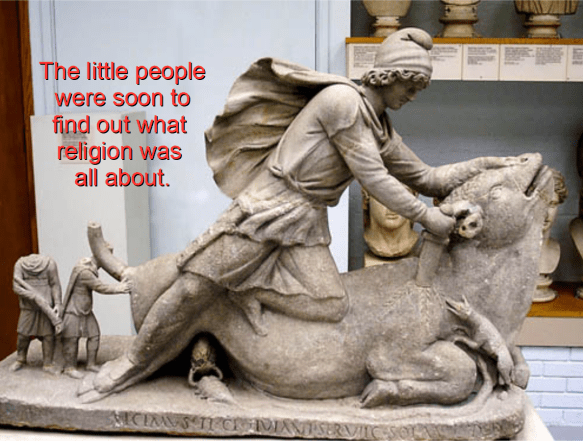
This put me in mind of a cult that for a long time rivalled that of Christianity. Indeed, in the early days of Jesus belief, it boasted more members, all of them men. Unlike Christianity and Rastafari, this cult believed in a saviour whom adherents knew had never existed as a human on Earth. Mithras was a celestial being whose salvific work, which involved the symbolic slaughter of a bull, was carried out in the heavenly realm:

Mithras is the guide of souls which he leads from the earthly life into which they had fallen back up to the light from which they issued… It was not only from the religions and the wisdom of Orientals and Egyptians, even less from Christianity, that the notion that life on earth was merely a transition to a higher life was derived by the Romans. Their own anguish and the awareness of senescence made it plain enough that earthly existence was all hardship and bitterness. Mithras-worship became one, and perhaps the most significant, of the religions of redemption in declining paganism. (Jacob Burckhkart)

Eventually, in the fourth century, Christians suppressed Mithraism to the extent that its adherents, along with its ritualistic texts, were wiped from history. Only its deserted, underground temples remained.

What both examples tell us – and there are hundreds more – is that people have always been willing and eager to make gods of revered figures, both real and imagined. They are ready to believe them capable of impossible feats and to trust in them for whatever form of redemption they feel in need of. There can be no doubt Jesus belief sprang from this same sort of wishful thinking; Jesus being cast as a divine figure with the power to lead believers into the light and/or the promised land of eternal life. It hardly matters whether he existed or not. Like Mithras, an imaginary/imagined figure could just as easily fulfil the role as a real person, like Selassie, who had others’ unrealistic expectations thrust upon him.


Jesus the Nobody

Continue reading

Jesus And The Resurrection Metaphor

While choosing Jesus quotes to use in an earlier post, it struck me how the risen Jesus never declares his resurrected status. He doesn’t say, ‘I am risen’ or indeed anything similar. Instead it’s left to others to claim, ‘He is Risen!’ That’s because the resurrection is a declaration of those others’ visionary experiences and their subsequent faith in those visions. Rather than have him declare himself risen, the Jesus in the (much later) gospels goes about ‘proving’ his reappearance is ‘in accordance’ with scripture (Luke 24:25-27; Acts 1:3 etc).

For those who insist Jesus resurrected physically, this is a bizarre turn of events: Jesus having to ‘prove’ he’s alive again by referencing bits of scripture? In fact, this is the biggest clue we’re dealing with a made-up story. ‘Proving convincingly’ over forty days that he’s risen because it somehow fits with a few unrelated quotes from scripture is an attempt by the gospel writers to ‘prove’ to those in the early Jesus cult that the visions of its founders were completely kosher: ‘visions they might have been, but they really were Jesus, honest: scripture says so!’ If Jesus had really risen in his physical body, he would have had no reason to ‘prove’, convincingly or otherwise, he had resurrected. Eye-witnesses would have seen him in the miraculous flesh. All the ‘proof’ needed, surely.

In fact, the gospel authors knew Jesus’ resurrection was nothing more than inner-visions experienced by a few fanatics. We know this was the case for Paul and John of Patmos. The risen Jesus’ real world appearances were invented by Matthew, Luke and John (Mark of course doesn’t even attempt it) and retain the visionary nature of those original spiritual ‘encounters’. In the stories they created for him, risen Jesus is frequently unrecognisable, even by those who supposedly knew him in life, appears as if by magic in locked rooms, vanishes at will and levitates into the sky.

The gospel authors were well aware they were fleshing out, literarily, the visions of those with overactive imaginations. Nonetheless, despite having him eat fish and inviting others to poke his wounds, they stop short of making Jesus declare explicitly he had returned in the flesh. They knew he had not. The point of the resurrection appearances was to bring to life those visions and to connect them with Old Testament ‘prophecies’. It was not to recount an actual event.

The resurrection is a literary trope, a metaphor intended to illustrate supposed Old Testament prophecies; literature begetting literature. Except in people’s heads, nothing else happened.

Jesus Quiz

Sort these statements of Jesus’ into the following categories: a) metaphor, b) hyperbole, c) literal:

Be perfect as your father in Heaven is perfect

Judge not that ye be not judged

Remove the log from your own eye before attending to your neighbour’s

Slay my enemies in front of me

If your hand causes you to stumble, cut it off.

Turn the other cheek

Give to all who ask

Very truly I tell you, the one who believes has eternal life

Whatever you ask for in prayer believe that you have receive it and it will be yours

If you have faith enough you can move mountains

Love your enemies

There are also eunuchs who made themselves eunuchs for the sake of the kingdom of heaven.

After three days I will rise again

Some who are standing here will not see death before they see the Son of Man coming in his Kingdom

I am the Resurrection

Do works even greater than mine

Answers? Damned if I know (and no doubt damned if I don’t.) I do, however, know a man who thinks he knows. He says as a rule of thumb, if you don’t like the sound of something Jesus says, it’s definitely not literal. But if it fuels your fantasy then of course it is.

Thanks, Don.

If It Walks Like A Duck…

Psychology Today has this to say about cults:

Destructive individuals and cults use deception and undue influence to make people dependent and obedient. A group should not be considered a cult merely because of its unorthodox beliefs. It is typically authoritarian, headed by a person or group of people with near complete control of followers. Cult influence is designed to disrupt a person’s authentic identity and replace it with a new identity.

Let’s break this down a little:

Destructive individuals: But those enemies of mine who did not want me to be king over them – bring them here and kill them in front of me (Luke 19.27).

Do not suppose that I have come to bring peace to the earth. I did not come to bring peace, but a sword (Matthew 10:34).

He said to them, ‘But now, the one who has a purse must take it, and likewise a bag. And the one who has no sword must sell his cloak and buy one. For I tell you, this scripture must be fulfilled in me, “And he was counted among the lawless”; and indeed what is written about me is being fulfilled.’ They said, ‘Lord, look, here are two swords.’ He replied, ‘It is enough’ (Luke 22: 36-38). [This is evidently a fictitious episode created around a supposed prophecy (Isaiah 53:12).]

Use deception: The time has come. The kingdom of God has come near. Repent and believe the good news! (Mark 1:14-15). Therefore I tell you, whatever you ask in prayer, believe that you have received it, and it will be yours (Mark 11.24).

Undue influence: Any one of you who does not renounce all that he has cannot be my disciple (Luke 14.33). No one who puts his hand to the plough and looks back is fit for the kingdom of God. (Luke 9.62).

To make people dependent: If anyone comes to me and does not hate his own father and mother and wife and children and brothers and sisters, yes, and even his own life, he cannot be my disciple (Luke 14.26).

…and obedient: If you love me, keep my commands (John 14:15). Whoever serves me must follow me; and where I am, my servant also will be. My Father will honour the one who serves me (John 12.26).

Typically authoritarian… with near complete control: You are my friends if you do what I command you (John 15.14).

Not everyone who says to me, ‘Lord, Lord,’ will enter the kingdom of heaven, but the one who does the will of my Father who is in heaven. On that day many will say to me, ‘Lord, Lord, did we not prophesy in your name, and cast out demons in your name, and do many mighty works in your name?’ And then will I declare to them, ‘I never knew you; depart from me, you workers of lawlessness’ (Matthew 7.21)

Disrupts a person’s true identity: If anyone wants to come after me, let him deny himself, and take up his cross, and follow me. For whoever wants to save his life will lose it. But whoever loses his life for my sake will find it. (Luke 9.23). 

And replaces it with a new identity: Truly I tell you, unless you change and become like little children, you will never enter the kingdom of heaven (Matthew 18.13).

(John said,)He must become greater; I must become less’ (John 3.30).

It is not the healthy who need a doctor, but the sick. I have not come to call the righteous, but sinners to repentance (Luke 5: 31-32).

Whether Jesus said these things or they were put into his mouth by his early followers, it is still the case that if it looks like a cult, talks like a cult and behaves like a cult… it’s a cult.

As it was in the beginning, now and ever shall be.

Ring-a-ding-ding

Don has responded to my challenge that I set him in the last post. His full response is in the comments section but I’m going to address what he says here:

It is not the fine points of doctrine but the essential points of doctrine that John is talking about…

Really, Don? Where does John say this? Certainly not in the following verse which you cite. Be honest, you just made it up.

This issue rose when you proposed that the Book of Mormon could just as easily by received as scripture as the Bible.

Well, not quite. I asked you why you are not a Mormon, given that the Book of Mormon has, superficially at least, as much credibility as the Bible, perhaps more, given its supposed origin and the eye-witnesses who affirmed its creation. (I’m not a believer in its baloney, just as I’m not in the Bible’s.)   

When I read BoM I do not find a Jesus that is like the Jesus of the Bible. That is sufficient to reject it. I don’t have to worry about baptisms or temples or anything else. If Jesus in the BoM is not the Jesus of the Bible, nothing else matters.

The same is true of the Ken Hams, Douglas Wilsons, and Dillon Awes and Neil Robinsons. If they proclaim a Jesus who is not the Jesus of the Bible, what they have to say about creation, women, homosexuality, or the return of the Lord makes no difference. If they agree with the Bible about Jesus, then we might get down to using out God-given ability to read and interpret. And we might differ. And that won’t matter. Wherever we land on these issues, they are far less important than who Jesus is.

And here we hit some real problems.

You fudge around the issue of whether you agree with the preachers and teachers I quoted, eventually implying that you don’t. (Don’t you get tired of being the only one in step, Don?) You insist that interpretations of Bible verses and the claims Christians make must always be measured against Jesus. But which Jesus is this, Don? The one in your imagination: the meek and mild Mr. Nice Guy that you’ve constructed in your head from a lifetime of conditioning and cherry-picking the Bible? Because if we compare the Jesus in the gospels and the version of him that supposedly inspired Paul and the other NT writers, we find the prattling and general ignorance of Awes, Ham and Wilson matches up perfectly.

For example, Jesus – the man who reputedly said ‘love your enemies’ – tells us what he’d like to do to his own enemies:

But as for these enemies of mine, who did not want me to reign over them, bring them here and slaughter them before me. (Luke 19.27)

And according to Revelation 9, he’ll do just this when he returns with his sword in his mouth. He will unleash plagues of locusts to torment and torture non-believers. However,

(those) not killed by these plagues still did not repent of the work of their hands; they did not stop worshiping demons, and idols of gold, silver, bronze, stone and wood—idols that cannot see or hear or walk. Nor did they repent of their murders, their magic arts, their sexual immorality or their thefts.

Later, while the Son of Man watches on, these poor souls get trampled to death:

The angel swung his sickle on the earth, gathered its grapes and threw them into the great winepress of God’s wrath.  They were trampled in the winepress outside the city, and blood flowed out of the press, rising as high as the horses’ bridles for a distance of 1,600 stadia. (Revelation 14.19-20)

Not hard to see how Ames can justify what he’d like to see done to LGBT+ people, is it. Murderous-Jesus endorses him.

(I know Don, these are among ‘the fine points of doctrine’ your anointed lie-detector doesn’t work on, so you ignore them. Alas, crackpots like Awes do not.)

What about Ham’s contention that dinosaurs and humans co-existed? He’s made a career, not to mention an ark, out of believing such crap. Does your cuddly-Jesus endorse him? Why, yes, he does. He believed in a literal Adam and Eve and a six day creation (Mark 10.6). If he’d have known about dinosaurs, which of course he didn’t, he would have had to fit them into this scenario, just like Ham does.

And how about Jesus’ views of women? While he side-lines them in his pronouncements about divorce (also Mark 10) he consistently ‘reveals’ to Paul and other NT writers that women must submit in all things. The word and its derivatives occur in almost all the passages that discuss women – ‘submit’ and ‘submission’. Easy to see how Wilson believes this applies to sex as well as every other context. Unless of course the Jesus in your head has told you differently. 

So there we have it. Any extremist, despicable view can be justified by appeal to Jesus. To say these differences don’t matter because only Jesus matters is laughably disingenuous. Jesus supports any and all claims made in his name. To paraphrase Paul, he is all things to all men. 

As for me, I’m always careful when discussing Jesus to quote the gospels, as I do above, and where relevant other parts of NT. I realise you don’t like this, because I don’t have your imaginary supernatural radar, but I’m happy to show Jesus in his true light and use his own words to condemn him.


How We Got The New Testament

Recycled pictures, new post.

Once upon a time, there was, possibly, a bloke called Yeshua Bar Yosef. Maybe there was, maybe there wasn’t, but either way, a couple of other blokes, one called Simon (or maybe Cephas or maybe Peter), came to believe that Yeshua had returned from the dead and had appeared to them, alive. This was probably all in their heads and what they saw was at most a blinding light, if they saw anything at all. This was certainly the case for a different bloke, Saul (or maybe Paul) who came along later. He wrote about his experiences and admitted they were all in his mind.

This Simon-Peter-Cephas and maybe one or two others convinced themselves that Yeshua was God’s special emissary and would save them from something, somehow or other. They told other people this and, being gullible, some of these other people believed that Simon-Peter-Cephas and his mates really had seen Yeshua alive again. They started to believe Yeshua would save them too. Saul-Paul, meanwhile, wrote letters to the people he’d persuaded to believe in his version of events – it was a bit different from what Simon-Peter-Cephas and co believed – and, writing in Greek, rendered Yeshua as Iesous (‘Jesus’ came much later when the ‘J’ was invented in the 16th century.) Paul thought Iesous was a celestial being he called ‘the Christ’. He taught that this Christ would soon be coming down to the Earth to set up God’s Kingdom here. Even though they were obviously a bit rubbish, Saul-Paul’s letters were copied multiple times by hand, which is when errors began to creep in. In some places, the letters were deliberately altered.

Other people wanted to get in on the act, so they wrote letters too, pretending they were Saul-Paul. Sometimes these letters said the exact opposite of what the real Saul-Paul wrote. His weren’t the only letters to be forged either. Fifty or more years after the entire scam had got underway, someone pretending to be Simon-Peter-Cephas sent letters as if they were from the man himself. Needless to say there were cultists daft enough to believe it. There were others who wrote letters too, people like James and John. James didn’t see eye-to-eye with Saul-Paul and contradicted many of the things he said.

About 40 years after Simon-Peter-Cephas thought he’d seen the dead-but-alive Yeshua-Iesous-Jesus, somebody in a different country decided to write a back story for the character. He didn’t know much about Yeshua-Iesous-Jesus, what he’d said and done and whatnot, but that didn’t deter him. He borrowed bits from Saul-Paul’s letters and Greek myths and set about it. He scoured the Jewish scriptures for anything that sounded like it might be a prediction of Yeshua-Iesous-Jesus and his supposed escape from death. He made up episodes for him based on these completely unrelated scraps of scripture. He forgot to sign his work, however, and it wasn’t until years later that someone else decided this author’s name should be ‘Mark’.

A couple of other anonymous dudes liked what ‘Mark’ had done when inventing his Yeshua-Iesous-Jesus story but thought they could make a better job of it themselves. The first of these, who would later be called Matthew, lifted most of Mark’s effort (which is how we know ‘Matthew’ wasn’t an eye-witness; an eye-witness wouldn’t plagiarise most of the story from someone who wasn’t) and then went overboard with the prediction/prophecy thing that Mark had started. He found even more spurious bits of scripture and made up a whole lot of new stories about Yeshua-Iesous-Jesus from them. Later still, ‘Luke’ wrote his version of the story, using Mark and Matthew’s accounts and inventing a few new episodes himself. This same person went on to write a fabricated history of the Yeshua-Iesous-Jesus cult, making up stories and speeches for caricatures of Simon-Peter-Cephas and Saul-Paul.

The fourth person to try his hands at writing a script for Yeshua-Iesous-Jesus decided to completely reimagine the character. Strictly speaking, this ‘gospel’ was produced not by a single person but by a collective of cult members. Their Jesus was nothing like the one in the other three gospels. He was more a super-hero, whose special power was boasting about himself. This is the Jesus that, 70 years on, the cult wanted to believe in. Eventually, the name John would be attached to this fantasy, though this isn’t the same John who wrote letters nor the one who created the hallucinatory nightmare that would become the final book of the Bible.

These various letters and stories circulated round the Roman Empire wherever members of the new cult met. Eventually, someone hit upon the idea of collecting them together as one volume. The first we hear of this is when a guy called  Marcion produced his own collection, round about AD140. Stupidly, he didn’t include the right ‘books’ and it wasn’t until AD367 that the collection we now know as the New Testament was first mentioned. This was ratified later that century by a group of men who had elevated themselves to positions of authority in the Church, as the cult was now calling itself. Despite claiming they had been guided by the Holy Spirit, these learned men endorsed the inclusion of several forgeries. Neither did they see fit to arrange the books in the order they’d been written, giving the impression that the accounts of Yeshua-Iesous-Jesus’ life existed before Simon-Peter-Cephas and Saul-Paul’s innervisions that had sparked the whole thing in the first place.

Jump forward a few hundred years and the New Testament, as it was now known, had come to be regarded, by some, as the infallible, inerrant and authoritative Word of God, which clearly it is not. These epithets stuck, however, and are still held to be accurate descriptors of the New Testament by people who have stopped thinking for themselves.

So there we have it: how we got the New Testament –

  • It wasn’t written by eye-witnesses.
  • Its accounts of Jesus’ life are largely fictional.
  • It owes much to fanatics who were prone to visions.
  • It is given to wild speculation, offered without a scrap of evidence.
  • It contradicts itself.
  • It includes many fakes and forgeries.
  • It was banged together by men who didn’t really know what they were doing.

And after that, everyone lived delusionally ever after. The End.

Assertions

Don likes to take me to task for what he says are assertions in my arguments. I do make assertions, as do we all, because not all points in an argument need to be demonstrated every time they’re used. Indeed, not all assertions can be.

There are assertions that we all accept are likely to be true: the sun will ‘rise’ tomorrow; the Earth is a sphere; evidence is better than no evidence and so on. There are those who dispute these assertions but the onus is then on them to provide the evidence or argument that their counter-assertion is true. Yes, there may come a day when the sun doesn’t rise but it is statistically improbable; the Earth is demonstrably not flat; faith is not an reliable substitute for evidence. There is abundant evidence and sound argument why these things are not the case. But – and this is my point – this evidence does not have to be trotted out every time an argument relies on such probabilities; they can be asserted.

I write, and indeed live my life, on the basis of the fact (‘assertion’) that the supernatural does not exist. Over the last ten years, I’ve posted several arguments why this is the case. I frequently provide a link to these arguments when asserting that, outside of the human imagination, gods, spirits, angels, devils, demons, powers, principalities, ghosts, avatars, heaven and hell do not exist. These arguments form the backbone of any subsequent assertion that the supernatural is not real.

Nonetheless, the onus to ‘prove’ that this is the case does not rest with me. First, because it is impossible to prove a negative. Consider, for example, the Christians challenge to prove their God doesn’t exist. While there is plenty of circumstantial evidence that this is the case, there is no absolute ‘proof’ of God’s non-existence (as I’ve argued before, it all comes down to probability, or, in God’s case, improbability.) Absence of evidence is invariably evidence of absence.

The onus instead lies with the one making the incredible claim. Those who take it as fact that the supernatural and God are real need to demonstrate to the rest of us that this is the case. They have, in my long experience, failed to do this. The best they can do are the various arguments (the ontological, Kalam cosmological, teleological, fine-tuning and the argument from design) that suggest the possibility of the supernatural but fall far short of convincing evidence that the supernatural is real, and further still that the Christian God exists. They depend in the end on the feelings they have in their heads and the Bible (or some other holy book.) This is wholly inadequate

Consequently, I’ll continue to operate from and make my assertion that the supernatural does not exist until such time as Don or any other of his co-religionists demonstrate the probability that it does.

From my assertion, backed up, remember, by earlier arguments, a number of other facts follow:

With no supernatural, there are no gods; YHWH in all his incarnations is a God, therefore YHWH does not exist.

Much follows from this:

If YHWH does not exist, Jesus cannot have been either his avatar, Son or incarnation;

Jesus cannot have been raised from the dead by a being who doesn’t exist;

Stories that he did so must therefore be merely that: stories;

The celestial, eternal Jesus who sits at the right hand of God in heaven is not real;

Any experience people have of this being is entirely within their own imaginations;

The Bible is based on such imagined encounters with these imagined characters;

There is no after-life or judgment;

The Christian faith, including my own, cannot be explained in terms of the supernatural;

Only explanations that are rooted in naturalism, as in science, have any validity.

There are more implications that can be drawn from the premise that there is no supernatural, including the fact that the world makes much more sense (if it makes any sense at all) without drawing gods and demons into it.

Consequently, I shall continue to make my assertions, like those above, supported as always by previous argument. Any religious believer who wants to challenge them is welcome to do so, but must do more than point out the obvious, that they are assertions. They must provide the evidence for the supernatural, and all that follows from it, independent of the goings on in their heads and without reference to holy books written by those with similar subjective feelings.

Making Prophecy Work

Recycled image and still no second coming

Never one to belabour a point, Don Camp has responded to my posts and comments about prophecy over on his own blog, Biblical Musing. This is a modified version of my response to that post.

What you seem to be saying, Don, is ‘leave a selected prophecy long enough and eventually it’ll appear to come true’. Perhaps, but then, if you take any selection of predictions from any source and you’ll find this to be the case. Why? Because:

1) You’ll have cherry-picked from the start so only those ‘prophecies’ that are vague enough or appear to have been fulfilled already will make up the bulk of your selection.

2) The vagueness of many that are chosen will make it relatively easy to scout around and alight on circumstances that seem to demonstrate some sort of fulfilment. You may even invent some that do, like the synoptic gospel writers do.

3) Some prophecies will indeed come true, but at no greater rate than chance allows. A prophecy you cite may say a particular city state will fall and return to the wilderness from which it was built. To claim that when, centuries later, it does so is not a fulfilment of this prophecy; it is a happy coincidence (for you and your so-called prophet, not so much for the denizens of the city state.) Just look at the number of ancient cities to which this has happened, without there being a preceding ‘prophecy’. It just happens.

4) You’ll ignore your own failure rate, or explain it away: i) discounting those prophecies that have never come to pass, even after millennia; ii) insisting ‘they could still occur! With God a day is like a thousand years!’; iii) reinterpreting them: ‘they’re metaphorical’ etc.

5) You invoke the get-out clause; the god says ‘if you don’t do ‘x’ then I’ll make ‘y’ happen.’ “Well, praise the god, everyone did ‘x’ and the calamity was averted! It’s a miracle!” This then counts, somehow or other, as a win for the ‘prophecy’.

These are your strategies, Don. You use them in combination to demonstrate the ‘fulfilment’ of biblical prophecy. You work really hard at nullifying your own cognitive dissonance, desperately attempting to demonstrate the truth of ancient fantasies. You conclude your post by saying Jesus will return as King soon. No, he won’t. You need to apply every one of your strategies to believe this is ever going to happen.