Saved by Faith Alone

For it is by grace you have been saved, through faith – and this is not from yourselves, it is the gift of God – not by works, so that no one can boast (Ephesians 2:8-9).

Hi!

I heard this fabulous new speaker last night and have given my life to Jesus. All the things I’ve said and written critical of God, Jesus and the Bible, I take back and repent of. Jesus now lives in my heart. Through God’s grace I am saved, and his grace alone. I have done nothing to save myself. The speaker explained I am saved by faith alone through the atoning blood of Christ. Hallelujah! Saved from sin, from the wrath I merit and from death and hell. I am going to live forever in heaven with God.

There’s nothing I need to do. God has done it all.

There was a wonderful Christian lady, Donna, whom I spoke to afterwards. She knew everything about God and Jesus, she really did. She’s been saved for most of her life. Amazing! Anyway, Donna told me it was really important I should start to work out my salvation. I wasn’t sure what she meant when the speaker had said faith was all I needed, but I will try. Donna also said that now I’m a Christian, the devil will increase his attacks on me. I never really thought about the devil before but now I know he’s real, I’ll be on the lookout for him. Satan and his demon hordes rule the world, but only because God lets them. Of course there’s the angels too, taking care of us, which makes up for Satan’s wickedness.

Donna said I should talk with Jesus as much as I can. He’s always listening and will guide me in my walk with him. She said I will hear him speaking to me. He wants to give me anything I ask for, which is just amazing. Or maybe it’s God who does that. I’ll have to check. She also said that I need to join a church and gave me the addresses of some locally. It’s important, she told me, to worship Jesus on a regular basis and to thank him for saving me. I must make sure I take part in the Lord’s supper too, sharing his body and blood, till he comes back to Earth to take us all to heaven. ‘Us’ just means those who believe in Jesus, obviously.

Donna said it was vital I read my bible as well because it’s the Word of God and is full of his Truth. I’m should get to know more about what the Lord requires of me in my daily walk with him. She recommended I join a bible study group, so I’m going to do that. I asked her about the stuff in the Bible that says to give money to anyone who asks and to forgive people loads of times, but she said that that was all metaphorical and I needn’t bother with it.

She told me I have to tell everyone I can that I now belong to Jesus. I’m never going to be ashamed of proclaiming his holy name and telling others how they can be saved, through his precious blood alone.

She told me my life should reflect the fact that I now belong to Jesus, so no more swearing, smoking or drinking for me! Not that I did those much anyway.

Which brings me to why I’m sending you this message, apart from telling you how wonderful it is to be saved by faith alone, of course. Donna was, I have to say, a little taken aback when I mentioned I was gay. She explained very patiently that it’s a sin God really, really doesn’t approve of. She said Jesus would help me defeat it and as a start I really, really couldn’t live with someone of the same sex any longer, not if I wanted to claim my inheritance from the Lord. I have to turn away from sin, especially that one. Donna says it seriously offends God and he’d never let me into the Kingdom of Heaven as, well… you know, as an abomination. So I’m giving up my previous life.

I know you’ll be a little upset by this, but it’s really why I’m writing. By the time you see this, I’ll have moved out. I still love you, course I do, but it’s for the best. I have to make all the sacrifices I need to preserve my salvation. And think of it this way, it’ll help you give up your life of sin too, so you can be redeemed.

Well, that’s it. Remember, you too can be saved by faith alone and the blood of Jesus and all those other things I’ve mentioned. Simple really. I hope and pray you’ll give your heart to Jesus soon.

Love in Christ who saves us,

Sam

But Is It True?

We can argue till Kingdom come (i.e. forever) about whether or not this or that Bible verse is meant to be taken literally or metaphorically (God couldn’t make himself clearer?) and whether a particular author was an eyewitness or not, but the bottom line is, ‘Is what the Bible says True?’ Nothing else matters. If it is true, then it’s claims must be accepted. It would be extremely foolish to disregard them. If not, if the Bible is one big lie, then we must consign it to the dustbin of history.

Is it true that whatever a believer prays for, God will provide? Jesus says so several times:

If you believe, you will receive whatever you ask for in prayer (Matthew 21:22).

And I will do whatever you ask in my name, so that the Father may be glorified in the Son (John 14:13).

Very truly, I tell you, if you ask anything of the Father in my name, he will give it to you (John 16.23).

No, its not true. We don’t see ‘whatever’ and ‘everything’ being granted even when Christians pray ‘in accordance with God’s will’ as they like to qualify these promises.

Is it true that whatever a believer gives will be returned to him until it overflows (Luke 6:38)? While this is the foundation for the prosperity gospel movement it is patently untrue. Untrue symbolically too; if you give of yourself in God’s service you will be rewarded excessively? Just ask all those burnt-out ministers.

Is it true that with sufficient faith believers can uplift mountains and throw them in the sea (Matthew 21:21)? Obviously not, not even when this hyperbolic promise is interpreted figuratively. Christians can’t resolve their problems, work miracles or bring about radical change more than anyone else, and certainly not by ‘faith’.

Is it true that God looks after those he has chosen, to the extent he knows the number of hairs on their heads (Matt 10:29-30)? Evidently not. It didn’t work this way for Jewish people in the holocaust, it doesn’t work for the 10,000 children who die everyday of hunger and it doesn’t work for Christians, who fair no better than anyone else in life’s calamities.

Is it true that Jesus was born in Bethlehem under a wandering star? No. This is a myth constructed from older stories.

Is it true Jesus walked on water, turned water into wine and raised the dead? Or is it more likely these ‘miracles’ were created for him, ‘signs’ from Jewish scripture designed to present him as the anticipated Messiah? This is the more likely explanation. A man called Iesous did not really perform supernatural feats.

Is it true Jesus rose from the dead after three days and nights? No. While Mark (10.33-34) and Matthew (12:40) claim this was going to happen, they don’t even pretend that it did. Friday evening till Sunday morning is 36 hours, not three days and nights.

Is it true his disciples and lady friends saw Jesus risen from the dead? We don’t know; the accounts of them doing so were written forty and more years after the supposed event by people who weren’t there. The only eye-witness account of a risen-Jesus sighting is Paul’s and he admits it was in his head. So probably the answer is no: it’s not true people saw a resurrected physical body.

Is it true gospel Jesus existed? With his story made up from existing myths and mystical visions, it’s highly unlikely. So no.

Is it true Jesus sends those he’s saved to heaven when they die? The Bible doesn’t say he does; it claims he would be coming from heaven himself, in the time of those who were writing about him, to initiate God’s kingdom on Earth. So, no and no again; its not true he came down from heaven, in the time of those who were writing about him, to initiate God’s kingdom on Earth.

Is it true, that by believing in something akin to magic, people can rise from the dead? No. Believing a secret formula does not enable anyone to escape death. There is no evidence anyone has resurrected after being fully, properly dead because they believed something. There is no evidence anyone has resurrected from the dead ever.

Is it true that believing in Jesus makes people into new creations? No more than many other experiences in life. Does it make for better people – more righteous, more moral, more loving? Evidence from the Bible itself suggests not, as does the appalling behaviour of some Christians today.

Is it true that the spirit of this long-dead first-century itinerant Jewish preacher lives inside people today (John 14:17)? No, it’s not. There is no evidence that dead people, or celestial super-beings from some other plane, inhabit the living. Many believers are embarrassed to acknowledge even the possibility.

Is any of it true? We could play this game all day: taking any of the New Testament’s claims and stories and asking ourselves whether they are true. The answer will be, invariably and demonstrably, no. It takes the closing down of any critical faculties to believe they are, and mental gymnastics to maintain that, even if they’re not literally true, they contain hidden, profound truth. They don’t.

No Sign of Life

For what I received I passed on to you as of first importance, that Christ died for our sins according to the Scriptures, that he was buried, that he was raised on the third day according to the Scriptures. (1 Corinthians 1:4)

This, apparently, is what early Christians believed; Paul is thought to be quoting an early creed here. What an incredible statement it is. Incredible because of its demonstrable falsity.

Christ died for our sins according to the Scriptures’: just where, in which scriptures, does it say this? Presumably Paul, or those he’s quoting, thinks it’s Isaiah 53, where it says:

…the Lord was willing to crush (his servant), and he made him suffer. Although you make his soul an offering for sin, he will see his offspring, and he will prolong his days, and the will of the Lord will triumph in his hand. ‘the Lord makes his life an offering for sin’ (Isaiah 53:10)

Unfortunately for Paul, most scholars agree that Isaiah 53 is not about the Messiah at all, but about the Jewish nation. It looks as if it neatly fits the much later ‘Christ’ because the Christ is a construct built on a handful of believers’ visions and this very chapter, which seemed, but only superficially, to validate their inner experiences.

Paul goes on to say, ‘he (Christ) was buried (and) was raised on the third day according to the Scriptures. Here he is on even shakier ground. The Messiah was not going to die for his people – he would be a triumphant warrior king – and he certainly wasn’t predicted to rise from the dead. There are no references at all, anywhere in the Scriptures, to the Messiah being raised from the dead and certainly not ‘on the third day’. Paul is wrong. At best, he’s mistaken, at worst he’s deliberately perpetuating a falsehood.

When Paul wrote this, the gospels were still many years away from being written. All that new believers, in as faraway a place as Corinth, could rely on was the testimony of preachers who came to tell them about the Christ. Some of these preachers may have known Jesus personally (though I doubt it) but most, like Paul, had limited means of persuading those they aimed to convert that Jesus had died for their sins and had risen again. Not unlike today’s evangelists, all they offered was their own and others’ inner spiritual experiences and visions, together with ‘evidence’ from scripture. Paul admits this is all he’s offering here: ‘what I received’ and ‘according to scripture’. But there is no evidence from the scripture available at that time.

What’s a gospel writer to do? When Mark created his gospel, he undoubtedly knew of Paul’s teaching about the resurrection and he may have known of this early creed. Yet he knew also that there was no prophecy about Jesus rising ‘on the third day’, on which to build his story. Consequently, he has Jesus declare in Mark 8:12 that ‘no sign will be given’ (= ‘there’s nothing in the scriptures about this’) and he omits the resurrection from his story.

Not so Matthew. As is his way, Matthew scoured Jewish scripture till he alighted, in the absence of anything resembling a prophecy, on the story of Jonah. Jonah 1.17 claims preposterously that this ancient prophet spent ‘three days and three nights’ in the belly of a great fish – and Matthew decided, ‘that’ll do!’. He has his Jesus refer to the tall tale as a ‘sign’ that he too will spend three days and nights in the belly of the earth:

Then some of the scribes and Pharisees told Jesus, “Teacher, we want to see a sign from you.” But he replied to them, “An evil and adulterous generation craves a sign. Yet no sign will be given to it except the sign of the prophet Jonah, because just as Jonah was in the stomach of the sea creature for three days and three nights, so the Son of Man will be in the heart of the earth for three days and three nights…” (Matthew 12:38-40)

Contradicting Mark’s Jesus (‘no sign will be given’), Matthew also modifies the original belief that Jesus rose on the third day. Now it’s after ‘three days and three nights’, which does not mean the same as ‘on the third day’. According to Matthew’s own gospel, Jesus was in the tomb – the belly of the earth? Really? – from Friday ‘as the evening approached’ (Matthew 27:57) till before dawn on Sunday morning (Matthew 28:1). This only just qualifies as being ‘on the third day’, given that days are counted from evening to evening in the Jewish calendar; it certainly isn’t ‘three days and nights’. Jesus lay dead in the tomb for no more than 36 hours. The damn ‘sign’ Matthew is so eager to use doesn’t even fit his own story.

What a mess. It’s what you get when you lift any old tall tale from ancient scripture and use it as a symbol for your own made-up story.

A Funny Thing Happened On The Way To The Forum

So I’m saved now.

Saved? From what?

My sins.

Your sins. Right. How’d this happen then?

My friend Marcus told me about a new Saviour.

And how did Marcus know about a new Saviour?

Gaius told him.

And Gaius?

His neighbour Livia told him.

And where’d she hear it?

She said she was told it by a travelling preacher.

Well, travelling preachers are always reliable, so sure.

Paûlos I think she said he was called. Anyway, Livia heard him talking about the new Saviour in the forum and she told Gaius, Gaius told Marcus and he told me.

Right. So what did this Paûlos say?

That he’d had a vision or something and had seen this new Saviour in his vision. I think he said he was called Iesous. Something like that.

So a Jewish Saviour then. I take it this Paûlos was Jewish?

I don’t think Livia said.

So what’s a Jewish Saviour to you? Or Livia and Gaius and Marcus for that matter?

Well, that’s the great thing. Marcus said that Gaius said that Livia said that Paûlos said that this particular Jewish Saviour is for everyone, not just Jews.

And Paûlos worked this out from his vision, did he?

Yes. Iesous told him all about it.

In his vision.

Yeah. He told Paûlos that anyone who wanted to could ask him to save them from their sins. So Livia did, and then when she told Gaius, he did too, and then Marcus.

So, Paûlos. He ever meet this Iesous? In the flesh, I mean.

Oh, I don’t think so. Paûlos didn’t need to, you see. Iesous talked to him from Heaven. He didn’t need to meet him.

He say whether he’d met anyone who had actually met him?

No. He knew of some fellas who’d seen Iesous same as him, in marvellous visions, but he said he didn’t need to meet them either. Like I said, Iesous the Saviour spoke to Paûlos direct. You don’t need any more than that. I’m hoping he’ll speak direct to me before long.

So, how’d you know this Iesous existed if nobody knows anyone who’s seen him in the flesh?

I told you, Paûlos saw him right there in his head and Iesous told him all he needed to know. The Saviour said that when he comes down from the sky, which he will real soon, those of us he’s saved will live with him forever, right here on Earth.

Live forever, you say?

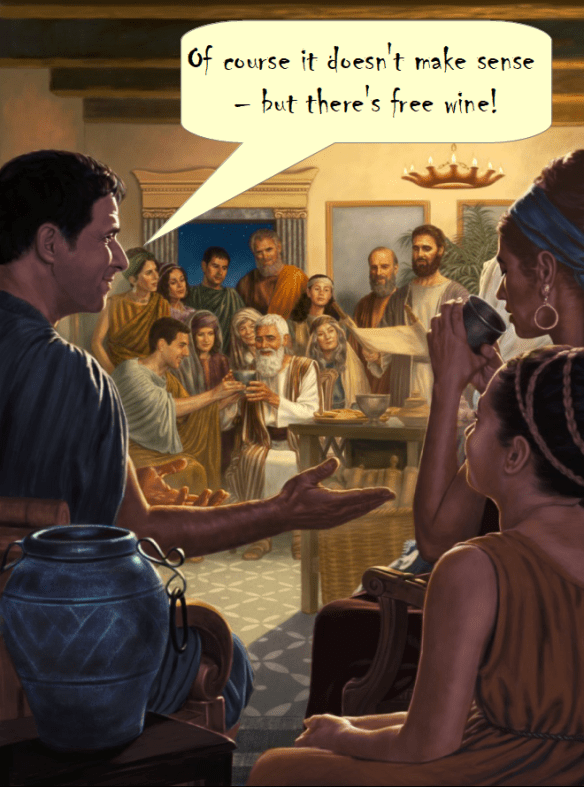
Sure. And there’s free wine while we wait.

Free wine? Why didn’t you say? Where do I sign up?


This time it’s personal

Desperately searching for another reason to dismiss recent critiques of Christianity, Don has suggested that my views and those of commenters here are somehow invalid because they’re ‘personal’. (I declined to publish Don’s latest comment in which he elaborated on this theme; not only was he already on enforced rest but he also decided to have a rant about ‘sexual depravity’. This would appear to have been directed  at my own happy same-sex relationship, as well as all other forms of consensual sex that God Don disapproves of.)

So what’s wrong with ‘personal’? My faith, when I had it was personal. I’d prayed the sinner’s prayer in which I confessed I was a sinner and I received Jesus into my heart (or so I thought) and began to live my life in accordance with what he required of me. This personal relationship with Jesus, as it was usually described in evangelical circles, was reinforced by the preaching I heard in church, by prayer meetings and Bible studies, by the devotional books I read, C. S. Lewis’s writing and the notes I used alongside my personal Bible reading.

I’ve written before how I abandoned all of this when, in a time of crisis, God wasn’t there, and I eventually came to realise, in what I can only describe as a moment of personal revelation, that this was because he didn’t exist.

I then set about discovering what it was I had believed for the previous 30 years; what were these beliefs that had shaped my life, determining what I did, who I married, my morality, my sense of guilt and failure… essentially all that I was. That quest, which began with my broadening my reading well beyond the bounds of devotional Christian books (how treacherous I felt when I first picked them up!) was personal. It was fuelled by the reaction of some Christian friends who attacked me personally when, still later, I came out not only as an atheist but as gay too. My dealings with one particular zealous and homophobic friend led to my first book and ultimately, over 12 years ago, to this blog.

RejectingJesus is a personal working out of my love-hate relationship with Christianity. It is, I hope, informed by my reading but it is first and foremost personal. The posts are my analysis of Christianity as it is practised and my own dissection of the Bible. I’m not a historian nor a theologian (thank god); my Masters is in English Literary Research and it is these skills, together with my knowledge of the Bible from my Christian days, that I apply in my sometimes irreverent analyses. Nothing is sacred, though I’m aware of the importance of providing evidence for my claims and, where relevant, in citing appropriate sources, which is why I provide links and reference relevant verses from the Bible. Perversely, Don also accuses me of being in thrall to the scholars I cite; the opposite of his complaint that posts are ‘personal’.

Do I then, as Don implies, try to discredit the Bible because I’m gay? Am I, as Don suggests, motivated by the ‘constraints’ the Bible places on my sexuality? I don’t believe so. Once I recognised that God didn’t exist, it followed that he could not have any opinion about homosexuality or indeed anything else. Like any other fictional character, his views were created by those who presumed to speak for him: ‘I am so mysterious and my ways unknowable. Oh, but by the way, I really don’t like those depraved gays. Feel at liberty to stone them.’ God’s self-appointed homophobes have to be challenged because of the damage they do.

Am I as an atheist predisposed to being critical of both faith and the Bible, as Christian readers sometimes say? Undoubtedly, but I’m no more predisposed than as a Christian I was predisposed to see God everywhere. As Nan put it in a recent comment:

Any individual who allows him/herself to put aside the centuries-long teachings of Christianity … and read the scriptures without bias and/or preconception … cannot fail to see the multitude of inconsistencies.

Nor can they fail to see the Bible’s flights of fancy, its reliance on dreams and visions, its make-believe and pretend fulfilment of prophecy, its forgeries and false promises, its disconnect from reality and magical thinking, its supernaturalism and sheer cultishness. Critically evaluating scriptures at face value, without making excuses for them or trying to guessing what the original writers might have ‘intended’ or deciding that unpalatable parts are ‘really’ symbolic/metaphorical is, however ‘personal’, by far the more honest approach.

To insinuate with a personal slur that having ‘personal’ reasons for criticising Christianity is a weak ad hominem. It does not address the arguments in question nor the issues at hand. Anyone who wants to demonstrate that what I say about the Bible, Christian belief and practice is wrong needs to provide evidence of their own. Insult, screeds of Bible quotation and ‘a legion of “work arounds”’ (Nan again) is not how to go about it.


Jesus the No-Hoper

Jesus – Hope for the World declares the banner outside the church near where I live. I can’t help but wonder about the naivety of the people who came up with the slogan and what it means. What are the possibilities?

‘Peace on Earth, goodwill to all men’ (and maybe women)? If so, the world isn’t showing much of either, certainly none that can be attributed to Jesus and his fractured, fractious and frequently intolerant church.

How about inner peace then, even though that’s a long way from ‘hope for the world.‘ How many Christians exemplify this particular fruit of Spirit? Is this, in the end, all that Jesus offers: the hope of a nice fuzzy feeling inside? Of course, peace of mind can be spirit-generate, though personally I prefer wine. 

Hope of reconciliation with God then. Only if you believe in God in the first place, not to mention ‘sin‘, human sacrifice and magic. If this is the kind of hope Jesus represents, then really, what good is it? 

Possibly the hope of which the banner speaks is the hope the earliest Christians had, of Jesus coming back real soon to slaughter his enemies and set up the Kingdom with, naturally, themselves at the top of the pile? Hasn’t Jesus had two thousand years to deliver this hoped for outcome?  An idea well past its sell-by date, the Kingdom of God on Earth isn’t ever going to materialise, however much ‘hope’ people have.

Maybe, then, it’s a hope of eternal life. The gospel writers have Jesus make such a preposterous offer (e.g. John 10:27-28). If this is what Christians are hoping for they are sadly deluded, and, as Paul puts it, the most pitiable of all people (1 Cor 15:19). No human being outside of myth and comic books has ever lived forever. None ever will.

Hope of heaven? See above. Besides, the Bible really doesn’t offer a place in heaven to anyone. That’s a much later development. It’s a waste of this one and only life to live in the vain hope of something better after death. 

Maybe the hope referred to is hope in hope itself. How futile would that be? Hope is no substitute for food for the hungry, shelter for the destitute, treatment for the sick. 

When I go to the carol service at the church next weekend, I’m confident it will be made clear just what sort of hope Jesus offers the world. If not, I’ll be sure to ask. I’ll let you know.

The Evolution of Jesus II: from Life Giving Spirit to God the Son and beyond.

A couple of decades after the first visions of a risen Jesus, a Jewish zealot called Saul decided he’d seen him too. He came to imagine a vision he’d had in his head was this same Jesus, who then revealed to Saul – all entirely within his head as he admits – what his death and return from the dead really meant. Paul, as he renamed himself, announced that God had decided Jesus was a good man and returned him to life after his execution. In doing so, God made Jesus his Son (you can read all this poppycock in Romans 1:3-4). Jesus was now a life-giving spirit, the Saviour Christ: 1 Corinthians 15:45. (Maybe though Jesus always had been this; it’s kind of confusing, but in Philippians 2:6-8 Paul seems to think Jesus was some sort of quasi-divine being from the get-go. Take your pick. Whatever.)

Memetic selection ensured the survival and perpetuation of Paul’s bizarre idea, one that was, after all, not unfamiliar to the Hellenised people of the first century. The superstitious embraced and transmitted it without knowing a thing about any itinerant Jewish preacher. 

The next stage of Jesus’ evolution came twenty or so years later, when a believer we now know as Mark decided to write a back story for this Christ. He created his story using Jewish scripture, Paul’s ideas and the rules of the sect to which he belonged. Who knows if Mark believed Jesus had ever been a real person who trudged around Palestine preaching the good news about the end of everything, but in Mark’s story he had him do just that. He decided, crucially, that he wouldn’t have Jesus become God’s adopted son at the time of his spiritual resurrection. Instead, Mark had him become God’s son at his baptism (Mark 1.10-11).

This wasn’t quite good enough for the next two cultists who attempted a Jesus narrative. While they plagiarised much of Mark’s story, they changed details and made up more for Jesus to say and do. Importantly, where Mark had avoided suggesting Jesus’ resurrection appearances had occurred in the real world, Matthew and Luke showed no such reticence. Their Jesus(es) showed himself not in visions but in the flesh. It’s likely Matthew at least knew he was creating a symbolic, literary representation of others’ visions.

At the other end of the story, Matthew and Luke invented largely incompatible birth stories for their hero. For Matthew, Jesus was the Messiah from the time he was born, fulfilling all the prophecies Matthew borrowed to create his nativity story (he doesn’t: the Messiah, according to the very ‘prophecies’ Matthew manipulates is not divine but a human warrior).

Luke, on the other hand, is determined to push Jesus’ divinity even back further. For Luke, Jesus became divine when God magically made Mary pregnant; Luke’s Jesus is quite literally God’s son (Luke 1.35). Unfortunately, Mary forgot all about being impregnated by the Holy Semen Spirit later on in Luke’s ridiculous story. Nevertheless, Jesus’ status had evolved again; he’d become God’s son from the very moment of conception.

Even this was not good enough for the next version of the Jesus’ story. The writers of the fourth gospel decide to make him eternal and part of God himself. Plundering Greek philosophy and Paul’s ruminations from Philippians, they declare Jesus the ‘Logos’; the Word or aspect of God responsible for the creation of everything (John 1:1-5). And despite this being as far from an itinerant peasant preacher as it’s possible to be, even more gullible folk came to believe it.

Jesus’ evolution was still not complete, however. The council of Nicaea in 325 decided that Jesus was ‘begotten not made’ (whatever that means) – but couldn’t quite decide whether being the Logos and the Son of God actually made Jesus God Incarnate. It wasn’t until the Council of Constantinople in 381 that a collection of bishops decided Jesus was, after all, officially part of the Godhead. The apocalyptic preacher from the backwoods finally became God the Son, a mere 350 years after he lived (if indeed he did).

Jesus has continued to evolve ever since, becoming all things to all people; a God pliable enough to be whatever his followers want him to be: Roman Catholic, Greek Orthodox, Russian Orthodox, Evangelical, Mormon, fringe cult. He’s evolved into a schizophrenic deity capable of being both meek and mild and bellicose; best buddy and chief executioner; Christian Nationalist, socialist and capitalist, gay and anti-gay, pro-family and anti-family; anti-abortion and pro-gun; environmentalist and iconoclast; the one who promotes a prosperity gospel and the ‘One True God’ known (only) to a select few. Every contradictory manifestation is supported by the Bible, the Church or tradition. Every one is non-existent and ultimately pointless.

That’s some evolution.

Jesus Reveals Himself To Me

A true story:

I used to have recurrent dream – at least I think it was recurrent; it may just been that when I dreamt it I also dreamt I’d dreamt it before – that I was prevented from getting home by an oversized lion that blocked my path. It did this not by baring its teeth and confronting me, but by simply lying down in front of my garden gate, apparently asleep. I was always afraid to disturb the sleeping lion in case, once awake, it attacked and ate me. Instead, I would gingerly step round it and walk on, away from my house. In a variation of the dream (I think), I’d turn around and head back the way I’d come.

Evidently, the large lion symbolised something, though I couldn’t understand what it was. Perhaps, I thought, it represented my psychic inability to be myself. After all, I experienced this dream before I came out. It was equally possible the lion was the devil, as described in 1 Peter 5:8, and Satan had invaded my dreams, was blocking access to my heavenly home. Maybe it was – shudder – the demon of homosexuality, which I knew existed because Christians said it did, driving me off the straight and narrow.

A then came the moment of revelation! Jesus is referred to as the Lion of Judah in Revelation (5.5), yea, the Kings of Kings who roars like a mighty lion (Amos 3:8). That’s when I realised that my dream lion was Jesus, protecting my eternal salvation and heavenly home from the attacks of the devil and my very own sinful nature! Why else must I take a different path or turn back, which is one meaning of repentance?

Jesus himself, the Lion of Judah, the King of Kings made himself known unto me in this dream, not once but many times. Praise the Lord! In revealing himself, the Risen Jesus was telling me that the only way to salvation was through Him and Him alone. Only He guards the way. How blessed I am to have had His very real presence in my dreams. He truly lives and has appeared to the very least of his followers – me.

There can be no other explanation for my dream experience.

Can there?

A Christian’s Circular Reasoning

Don asks:

Why is it not possible for people to see immaterial things? We see with the mind as much or more than with then eyes. If the mind can conceive of immaterial things we can see them. Often skeptics declare that what Paul saw was a hallucination. If so, he saw something that was not material. We all dream. When we do we see things that are not material. If there are immaterial beings such as spirits, why would it not be possible to see them?

Why is it not possible for people to see immaterial things? Because ‘immaterial things’ by their very nature cannot be seen. Moreover, in the sense you’re talking about – supernatural beings and places – there is no evidence they have independent existence outside the human imagination.

We see with the mind as much or more than with then eyes. The mind processes what the eyes see. Sometimes it produces, imagines, ‘sights’ for itself, as in hallucinations or dreams, but this doesn’t mean these sights are real. Indeed, they are not.

If the mind can conceive of immaterial things we can see them. You mean like ghosts, spirits from the Greek underworld and Norse gods? Of course you don’t,  though your argument applies equally to these. You mean only Christian immaterial things: heaven and hell, angels and demons and the risen Christ. This is merely special pleading.

Your assertion is patently untrue. It begs the question, ‘if the mind can conceive of ’immaterial things’ does this mean these things are real?’ To which the answer must always be ‘no’.

what Paul saw was a hallucination. If so, he saw something that was not material. Yes and yes. Paul hallucinated on more than one occasion, seeing figures and places that were not real. His seeing them did not make them real.

We all dream. When we do, we see things that are not material. A statement of the bleedin’ obvious, but yes, we all dream. Does this make what we see in those dreams real? Again, no.

If there are immaterial beings such as spirits…There aren’t. As you keep stating while failing to recognise it, they are merely figments of the imagination.

why would it not be possible to see them? Because as figments of the imagination, they don’t exist. Here’s where your ‘reasoning’ is entirely circular: the human mind can conceive of immaterial beings and places and these things can be ‘seen’ ((in dreams and hallucinations); because they can be seen they must be real. Therefore, we know they’re real because they can be seen. Can you not ‘see’ the absurdity of your position, Don?  

My 3+ year old granddaughter can distinguish between reality and figments of the imagination, fantasy and dreams. It is really is time you could too.

Redemption Songs

I was listening to some Bob Marley the other day and was struck by a line in his song ‘Get Up Stand Up’: ‘Almighty God is a living man’. He was not of course referring to Jesus but to Haile Selassie, the Emperor of Ethiopia who was still alive when ‘Get Up Stand Up’ was recorded in 1973. Rastafarians like Marley believed the Emperor would redeem African-descended Jamaicans and restore them to Africa from where their ancestors had been taken.

Rastafarians saw and still see themselves as modern day Israelites, like those in the Bible stories of Egyptian slavery and Babylonian captivity. Their perspective is reflected in songs like ‘Exodus’, by Marley, ‘The Israelites’ (Desmond Dekker) and ‘Rivers Of Babylon’ (The Melodians). Selassie himself denied being divine (‘why do you call me good, when only God is good?’) but that didn’t stop those who believed in him from making a saviour god of him. When, inevitably, he died (in 1975), some Rastas left the movement while others reinterpreted his role:

Some Rastas believed that Selassie did not really die and that claims to the contrary were Western misinformation… Another perspective within Rastafari acknowledged that Haile Selassie’s body had perished, but claimed that his inner essence survived as a spiritual force. A third response within the Rastafari community was that Selassie’s death was inconsequential as he had only been a “personification” of Jah rather than Jah himself.

It all sounds rather familiar doesn’t it? The saviour didn’t really die/his inner essence survived/his death was inconsequential. Where have we heard all that before?

This put me in mind of a cult that for a long time rivalled that of Christianity. Indeed, in the early days of Jesus belief, it boasted more members, all of them men. Unlike Christianity and Rastafari, this cult believed in a saviour whom adherents knew had never existed as a human on Earth. Mithras was a celestial being whose salvific work, which involved the symbolic slaughter of a bull, was carried out in the heavenly realm:

Mithras is the guide of souls which he leads from the earthly life into which they had fallen back up to the light from which they issued… It was not only from the religions and the wisdom of Orientals and Egyptians, even less from Christianity, that the notion that life on earth was merely a transition to a higher life was derived by the Romans. Their own anguish and the awareness of senescence made it plain enough that earthly existence was all hardship and bitterness. Mithras-worship became one, and perhaps the most significant, of the religions of redemption in declining paganism. (Jacob Burckhkart)

Eventually, in the fourth century, Christians suppressed Mithraism to the extent that its adherents, along with its ritualistic texts, were wiped from history. Only its deserted, underground temples remained.

What both examples tell us – and there are hundreds more – is that people have always been willing and eager to make gods of revered figures, both real and imagined. They are ready to believe them capable of impossible feats and to trust in them for whatever form of redemption they feel in need of. There can be no doubt Jesus belief sprang from this same sort of wishful thinking; Jesus being cast as a divine figure with the power to lead believers into the light and/or the promised land of eternal life. It hardly matters whether he existed or not. Like Mithras, an imaginary/imagined figure could just as easily fulfil the role as a real person, like Selassie, who had others’ unrealistic expectations thrust upon him.