Our touchy Loving Father is pissed off (again)

DoctorIn 1665, the great plague overtook London and killed about a sixth of its population. The church and other authorities believed the plague was a punishment from God for the sins of those who lived in the city.

Such a view is understandable among people who lived in a pre-scientific era (just) and had no other way of explaining natural phenomena other than from a religious perspective. Their ignorance is perhaps forgiveable.

Speed forward to 2014 and the outbreak of the Ebola virus in Liberia and other parts of Africa. Ebola causes an incurable disease with a 90% fatality rate. And guess what? Those of arrested development, whose thinking is still stuck in the seventeenth century, attribute it to God. More than that, they predict a plague on a scale next to which the 1665 plague looks like little more than a minor skin irritation. And all because of the sins of other people (naturally). According to Liberian church leaders:

God is angry with Liberia. Ebola is a plague. Liberians have to pray and seek God’s forgiveness over the corruption and immoral acts (such as homosexualism, etc.) that continue to penetrate our society. As Christians, we must repent and seek God’s forgiveness.

The usual suspects – atheists, secularists, those pesky homosexuals, pornography, abortionists and women who have abortions – are bringing the judgement of God to Africa, and far more importantly, according to American evangelical leaders, to America itself. There’s an even a lunatic fringe there who welcome it:

Everybody who stands up and embraces sodomy, BE THOU CURSED WITH EBOLA! Cursed be ye for embracing this!’

rants Harlem Pastor James Manning.

As ever God’s judgement, if that’s what we’re dealing with, will be indiscriminate. It will strike down the weak, the elderly, the vulnerable, and, yes, Christian missionaries (the two American medics who have contracted the disease are just that.) Because God’s like that; when he’s in his Hulk-smash mode, he doesn’t care who gets in his way.

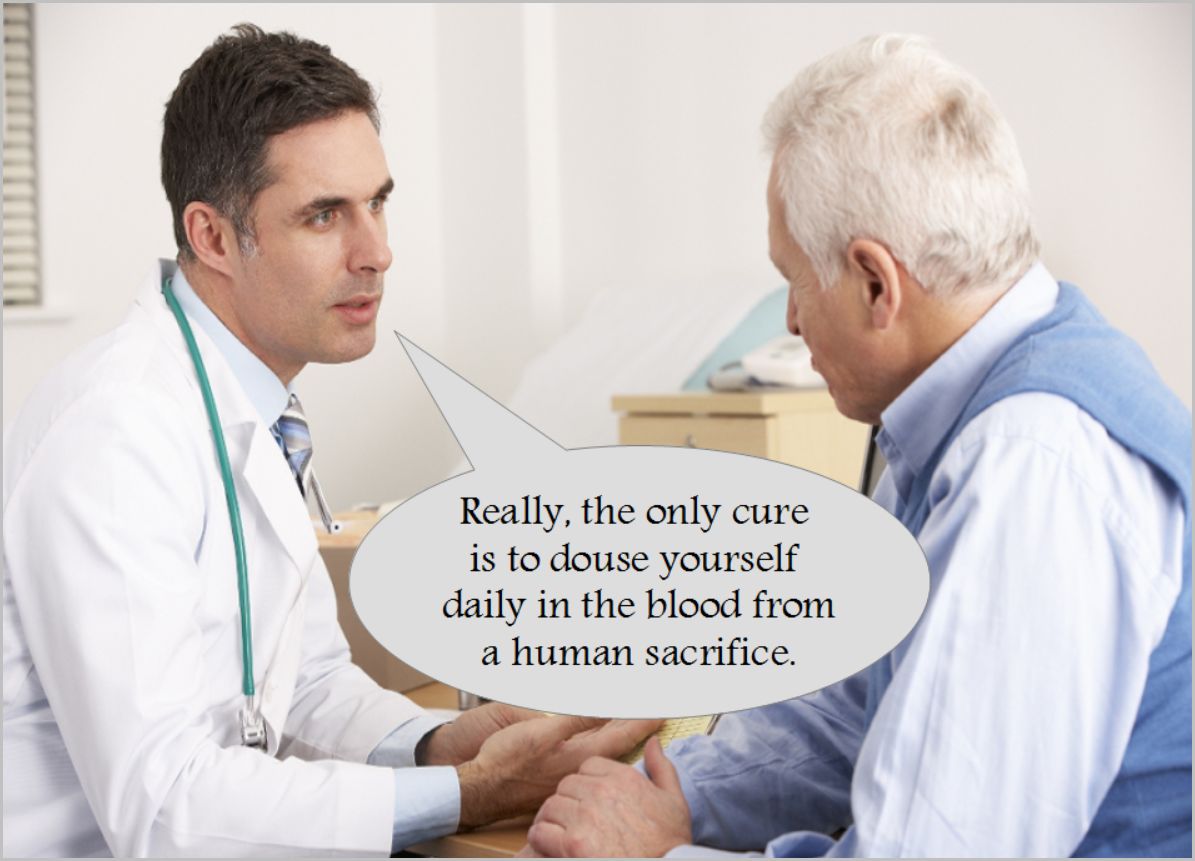
There is a cure though. Just as the scientifically illiterate in 1665 thought prayer would spare them from the plague, the way to survive the coming Ebola pandemic is, according to Pastor Rick Wiles, to be covered in the blood of Jesus:

Now this Ebola epidemic could become a global pandemic and that’s another name for plague. It may be the great attitude adjustment that I believe is coming. Ebola could solve America’s problems with atheism, homosexuality, sexual promiscuity, pornography, and abortion…
If Ebola becomes a global plague, you better make sure the blood of Jesus is upon you. You better make sure you been marked by the angels so that you are protected by God. If not, you may be a candidate to meet the Grim Reaper.

Yes, only true believers who have the blood of a long dead Jewish preacher ‘upon’ them, and angels hovering over their heads, will survive the coming plague (so those Christian missionaries are safe after all – they needn’t bother with the medical care they’re currently receiving back in the States).

This isn’t even seventeenth century thinking; it’s straight from the bronze age.

Will there be a world-wide Ebola plague? It seems unlikely, but who knows; life is more precarious than we sometimes like to admit. If there is, it won’t be because a vengeful, pissed-off God is inflicting it on us… because there’s no such entity. Nor is there a nice, loving, daddy God either – but then he doesn’t figure in this particular scenario anyway.

In spite of what the Bible promises (James 5.14-15), there’s no supernatural protection from Ebola, nor from any other disease. The poor souls who died of the plague in seventeenth century England found that out the hard way. Praying to God and sloshing about in the blood of Jesus, metaphorically or otherwise, protects no-one.

Idiotic stuff Jesus said 2: You need never have another bad hair day

ThePlanDon’tcha just love him?

Jesus says that whatever else happens, Christians will never, ever have a bad hair day. They may have limbs lopped from their bodies and they may be crucified just as he was, but – blessed assurance! – not a single hair on their heads will come to harm. Isn’t that fabulous?

Here’s how he puts it:

…they will arrest you and persecute you; they will hand you over to synagogues and prisons, and you will be brought before kings and governors because of my name… You will be betrayed even by parents and brothers, by relatives and friends; and they will put some of you to death. You will be hated by all because of my name. But not a hair of your head will perish. By your endurance you will gain your souls. (Luke 21.12, 16-18)

Of course, this particular part of Jesus’ script was written long after he died (wasn’t it all) when there was some mild persecution of Christians under the emperor Nero. Jesus’ promise was designed to be of comfort to those in trouble because of their faith. It turns out to be cold comfort, however, and a blatant lie. Jesus’ own brother and leader of the church in Jerusalem, James was tortured and executed round about 62CE, as were several of the disciples and the self-appointed apostle, Paul (circa 64CE). And we can be fairly certain that whatever hair they had on their heads ‘perished’ when they did.

Perhaps Jesus suffered from male pattern baldness, which might explain his fixation with hair, because as well as promising that not a single hair on believers’ heads would perish, he’s made to declare, equally improbably, in Matthew 10.30 that all the hairs on the disciples’ heads are numbered.

God really does have too much time on his hands. You’d have thought he could use it to prevent the deaths of the 25,000 African children who die each day because of malnutrition and the innumerable diseases he’s seen fit to create. But no. He counts hairs instead.

Consequently and predictably, Christians have tied themselves in tangled knots trying to explain Jesus’ bizarre claim that not a single, numbered hair would be lost. What he meant, some of them tell us, is that the souls of persecuted believers will be unharmed, safe in God’s care, whatever they endure. But hair, it has to be said, is an unlikely metaphor for the soul, and isn’t one that the gospel writers or other New Testament authors use anywhere else.

So maybe, Christians argue, because hair is a part of the physical body, Jesus means it to stand for the whole body, and yes, this might be put to death, but it will live again as a resurrected super-body. God will then reinstate even the hair of those who have died for Jesus’ sake. Which means there are going to be a lot of hirsute people in the Kingdom when all the hair they’ve ever possessed is returned, post-mortem, to their heads. This is what Jesus promises.

Paul, though, says in 1 Corinthians 11.14 that long hair degrades a man, while Augustine argues that, come the resurrection, any excess hair will be incorporated somewhere in the body (extra pubes maybe?). Perhaps, though, God doesn’t intend acting as divine hair-restorer at all, but plans to keep all the hair ever lost, alive and vibrant, in a special heavenly hair-museum.

Or maybe Jesus’ guarantee that even Christians’ hair will be saved is, like the rest of his promises, nothing more than total and utter BS.


New series! Idiotic stuff Jesus said!

This one’s gonna run and run!

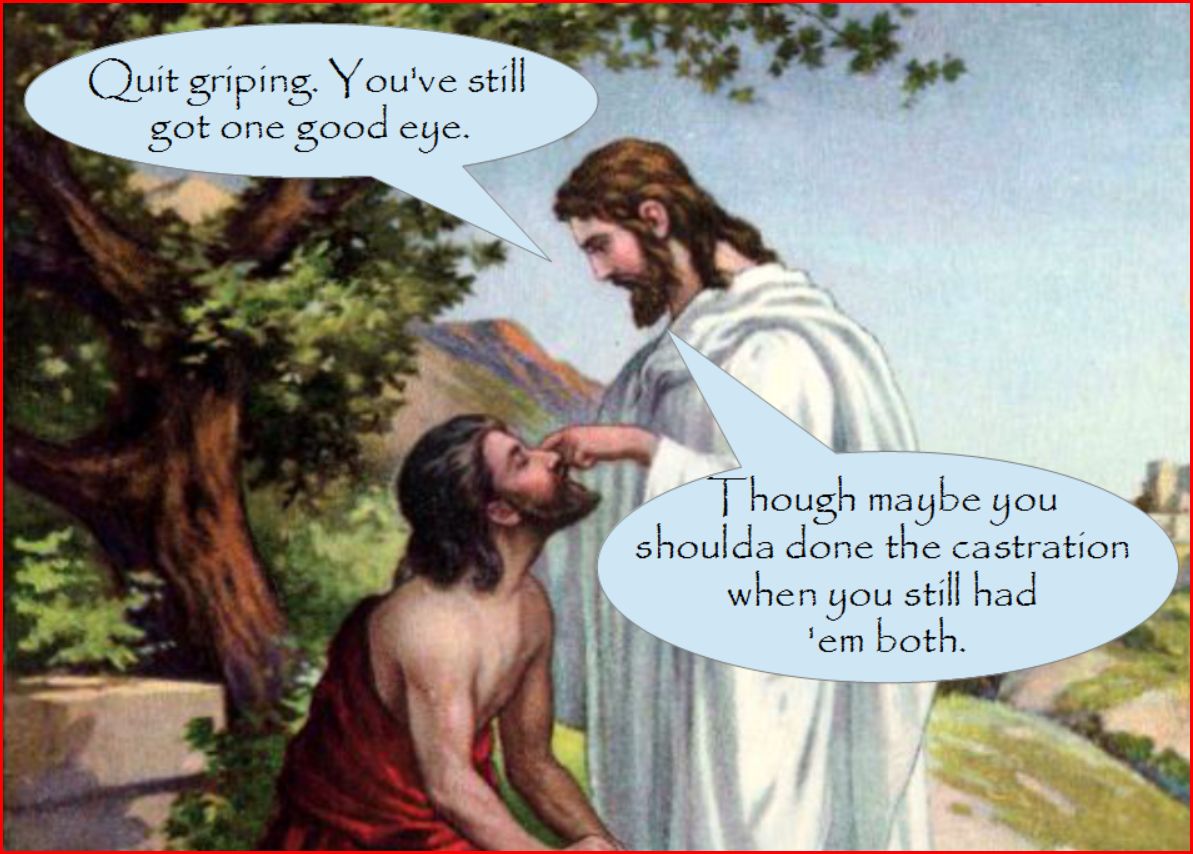
EyesYou hear the one about the blind Christian bloke with only one hand and no balls? And he did it all to himself! Cut off his hand, gouged out his eyes and castrated himself. When asked why he’d done it the man explained, ‘I’m a follower of Jesus and when he tells me to do something, I do it. My self-mutilation is my witness to what a great guy he is. He wouldn’t steer me wrong.’

Sure enough, the normal people who heard him were incredulous, until one of them looked in the Bible and found the very instructions to which the eyeless, testicle-free, one-handed believer referred.

In Matthew’s gospel chapter 5, Jesus is talking about lusting after a woman, which in his eyes (he still had both of his) is as bad as having sex with her. Course it isn’t, not by a long way, but he tells his followers, ‘If your right eye causes you to sin, tear it out and throw it away; it is better for you to lose one of your members than for your whole body to be thrown into hell’ (Matthew 5.29).

A bit drastic perhaps, but there it is; the Son of God is clear about how to avoid the sin of checking out a member of the opposite sex. That’s why you see so many one-eyed Christians around the place because they all take his admonition very seriously.

Except… you don’t. Either Christians ignore him entirely on this one or they never look at the opposite sex with an eye to sexual congress. We all know they’re like the rest of us in this respect – some, as Jimmy Carter once famously did, are honest enough to admit it – and some even act on it; the divorce rate among Christians is not the same as it is for everyone else just because they get tired of being married.

Perhaps though Jesus is being metaphorical when he proposes that gouging out one’s eyes is the best way to deal with lust. Not surprisingly, Christians prefer this possibility. In The Method and Message of Jesus’ Teachings, Robert Stein argues that:

what Jesus was seeking to convey to his listeners by this use of overstatement was the need to remove from their lives anything that might cause them to sin… Jesus is saying in effect, “Tear out anything in your life that is causing you to sin and keeping you from God”.

If that was his intention, Jesus might have actually used these words. If he wants to say ‘in effect’ that the believer should jettison anything from his life that causes him to sin then why doesn’t he?

But eyes are not enough. You gotta get rid of that wanking* hand too (the context of Jesus’ comments is specifically sexual and entirely male orientated throughout these verses): ‘And if your right hand causes you to sin, cut it off and throw it away; it is better for you to lose one of your members than for your whole body to go into hell’ (Matthew 5.30). This must be why we see so many one-handed Christians…

The difficulty with interpreting these and other verses metaphorically is that Christians want to claim that the Bible is the literal ‘word of God’ and then want select parts of it to be metaphorical – and guess who they think should do the selecting. But they can’t have it both ways. Even if they could, how would they know which parts to interpret literally and which symbolically? Perhaps the Holy Spirit tells them, or maybe, and more likely, it’s just their personal preferences. After all, who wants to lose eyes and hands just for being human?

If that’s not enough, Jesus encourages other mutilations for the sake of his Kingdom when he reveals in Matthew 19.12 that ‘there are eunuchs who have made themselves eunuchs for the sake of the Kingdom of heaven. Let anyone accept this who can’. No Christians today seem able to ‘accept’ this recommendation, either; what a truly feeble bunch they are, putting their testicles before the Kingdom!

It seems likely that, given he believed the end of the age was fast approaching, Jesus actually meant what he said, counting on the probability (as he saw it) that anyone who followed his ridiculous suggestions would not be eyeless or handless for long. They would, at the resurrection, be fully restored to live in the Kingdom where, according to Matthew 22.30, they would not be troubled by either impure thoughts or marriage itself (and so wouldn’t need those testicles anyway).

Whichever way you cut it (off) – literally or metaphorically – Jesus words in these verses are remarkably idiotic. Throughout history there have been some individuals, like the dude we started with, who have indeed made themselves eunuchs for the cause. But the vast majority of male Christians have always dismissed this advice or have decided JC was only speaking metaphorically (as he always is when they don’t like what he’s telling them to do).**

So next time True Believers start thundering on about the evils of same-sex marriage and gay sex, tell them to get their own house in order first. A little amputation is all that the Lord requires.


* ‘Jerking off’, for any Americans reading.

**Read more in my (five star reviewed!) book Why Christians Don’t Do What Jesus Tells Them To …And What They Believe Instead, available from Amazon.


Christian Love in Action

CrossI’ve been banned from a ‘Christian’ web-site. From Barbwire, in fact, the extreme mouthpiece of extreme mouthpiece Matt Barber and his chums; Scott Lively, self-confessed ‘father’ of Uganda’s anti-gay movement; Bryan Fischer, bigoted evangelical shock-jock; Laurie Higgins, gay-sex obsessed ‘marriage defender’ and Bradlee Dean, third-rate rockstar-cum-provocatuer, amongst others.

My ban is not because I was abusive. Actually, I’m not sure what prompted it though I’m not alone in having my comments deleted and my name blocked. Others who’ve challenged the bigotry and distortions regularly paraded on Barbwire have been too. Dissent will not be countenanced by ‘Christian’ bullies whose faith is weak and arguments even weaker.

I hope my comments were reasoned and reasonable, even if sometimes flippant; above all, I hope they were challenging. I tried to challenge both those ‘names’ who write for the blog as well as those who comment there, to react and respond as their Saviour commands them to; to treat others as they would want to be treated; to attend to the log in their own eyes before the speck in their neighbours’; not to judge lest they be judged and to show compassion for those with different views.

Have I as a non-believer any right to expect Christians to behave like this? I think so – I think we all have. After all, they’re the ones who’ve bought into Jesus’ demands; the ones who proclaim him as messiah and potential saviour of the world; the ones who feel compelled to tell us about him at every turn. They’re the ones who believe they’re born again as new creatures, filled with the Holy Spirit, who now live transformed lives as Christ-like beings. It’s not unreasonable to expect to see them reflect all of this in how they deal with other people; loving their neighbour, not casting the first stone… and all the rest of it.

So how do they deal with dissenters on Barbwire? They call them ‘morons’, and ‘fools’ and ‘pervs’ and ‘sodomites’ and ‘idiots’. Now, it could well be that I’m all of these things and the good Lord has chosen to reveal it to his gentle people on the site, if not to me. But when you call out these supposed Christians on this less than loving behaviour – pointing out that Jesus says in Matthew 5.22 not to call others fool, let alone all those other things – what happens? You get more abuse, and lots of edging around Jesus’ words (he only meant not to call other Christians fools) and claiming his commands don’t apply to them because he was really only speaking metaphorically – as he always is when they don’t want to do what he says.

And then you, the one on the receiving end of their Christian Love™, are blocked, banned and deleted, while those with the slurs and insults remain, because it’s what Jesus would want, leaving them free to move on to new targets.

ScreenDoes it matter? Not really; as long as for a brief period there are others opposing the bigotry and hatred that spills, in Jesus’ name, from Barbwire and sites like it. Christians such as Matt Barber and, here in the UK, Stephen Green, are relatively powerless individuals, after all. They’re loud bullies who justify their extremism by claiming it is the standard demanded by a mythical being. But all the same, they and their cronies are influential. Witness the sycophantic commenters who commend every scurrilous word these bullies say about non-believers, fellow Christians, gay people, politicians, immigrants and those they imagine ‘persecute’ Christians here and in the States. The articles on Barbwire encourage and reinforce the prejudices, bigotry and small-mindedness of ‘Christians’ like these, helping shape the way they treat people in the real world.

I’d encourage you to take look at Barbwire and to become a commenter yourself, opposing the hatred and bigotry, not to mention the irrationality and stone-throwing, that you’ll find there. If you do, you won’t have to do it for long because, sooner rather than later, you’ll be banned, as the voices of reason and compassion invariably are there.

Then again, there are worse reasons for being thrown out of a sewage plant.


Here Be Dragons

dragonChrist The White does battle with the dragon of Revelation 12

Over on Answers in Genesis, one of Ken Ham’s drones is arguing for the existence of dragons. They are, he or she tells us triumphantly, mentioned in the Bible, so they must really have existed.

As we already know, the Bible has more than its fair share of nonsense, but to insist it provides evidence of mythical creatures is to take its credibility to a new low. Don’t Christians care they do this to their magic book? After all, their faith relies almost entirely on the Bible, alongside their own emotional responses to it (no kiddin’, they say this is ‘the Holy Spirit’.)

Christians spend so much time arguing for the Bible’s daftest excesses – the world being created in six days, Jesus returning soon, homosexuality being just the worst sin ever and now dragons – that they haven’t any time left to read what it has to say about how they should be living their lives.

You mean forgiving others, feeding the hungry, giving everything away, not judging (in case you’re judged in return), being compassionate, going the extra mile, turning the other cheek, giving to all who ask and blessing your enemies is in the Bible? Jeez, I never knew.

Yeah, but it’s all secondary to dragons and damning others. ‘By their fruits shall ye know them,’ says Jesus of his followers in Matthew 7.16-20. Turns out there’s no fruit, just a wide assortment of nuts.

Christians’ Favourite Delusions 27: The Bible Is The Ultimate Authority On All Things

Biblereader* Mark Twain

Since writing my posts about the Bible, I’ve stumbled across a few assertions out in Blogland that the Bible is the ‘ultimate authority’ on some subject or other. ‘The ultimate authority on the issue of homosexuality is the Bible’ says Tim Brown, while Marsha West claims ‘the Bible’s the final authority in all matters of faith’ and the snappily titled ‘Ethics & Religious Liberty Commission of the Southern Baptist Convention’ insists that ‘as Christians we must affirm our commitment to divine revelation, the written Word of God— the Bible—as our ultimate authority base.’ 

You might wonder how a book, written largely by bronze and iron-age tribesmen and first-century zealots who thought their world was going to end any day soon, could produce anything authoritative. Especially when these men (and they were all men) get it wrong about –

How the world was created. Genesis 1 tells us how Yahweh formed the Earth pretty much as it is today. In this made up explanation, light, night & day and plant life all precede the creation of the sun, and the order in which animal life appears is completely wrong.

How humans came into beingas fully formed adults. No messy evolution here. Moreover, woman is created from man, even though all foetuses are female to begin with and male comes always from female.

How the world got to be the mess it’s in. Sin, apparently; this first couple fucked the whole thing up. There was no death before they ate some fruit. After, there was.Move along. No understanding of evolution here.

How old the Earth is. The Bible’s genealogies imply the Earth is now 6000 years old or thereabouts. Actually it’s about 4.5 billion, but that doesn’t stop Ken Ham and other wingnuts insisting it can’t be, because, you know, the Bible.

How important the Israelites were. They weren’t; they were a relatively obscure and insignificant tribe. Their only ‘achievement’ seems to have been creating the idea of there being only one God, and even that took time to develop. Little of what the Torah/Old Testament claims for them has been supported by archaeological and other evidence, and much has been soundly refuted.

How the Israelites were slaves in Egypt. There is no evidence at all that they were. Moses and the whole of the ‘let my people go’ story appear to be complete fabrication.

How the world really works. According to Bible animals can sometimes talk (Genesis 3.1; Numbers 22. 23-30); humans once lived to be well over a hundred years old (Genesis 7.6;, 23.1 etc); the sun goes round Earth (Ecclesiastes 1.5); the sun can be stopped in the sky (Joshua 10.12-13); the Earth is flat (Isaiah 40.22 etc); Heaven is in the sky (Psalm 103.11 etc) and Hell is under the Earth (Psalm 63.9 etc)

How God’s Kingdom was going to come to the Earth in the first century. You’ve probably spotted that it didn’t. Yet the belief that it would drove both Jesus and Paul, and accounts for the very existence of Christianity (see previous posts). How wrong can you get?

How believers would never ‘perish’ (John 3.16). From the very first convert to the Christians who will die today, every believer has ‘perished’. There is no evidence whatsoever that any of them has been resurrected or that they enjoy eternal life. Like the end of the rainbow, this promise is perpetually out of reach, always somewhere in the future – even though Jesus and Paul were telling their followers 2000 years ago that it was all going to happen real soon.

How Jesus was coming back any minute. See above. Always going to happen just about now. Never does.

And so it goes.

That’s some ‘authority’, I’m sure you’ll agree. The Bible is wrong about practically everything, except when a preacher needs it to support his bigotry and/or prejudices. Then, miraculously, it’s the ultimate authority.

Christians’ Favourite Delusions 26.2: The Bible is the Word of God

WritingRight on cue, after my post on the Bible as ‘the Word of God’, Mike Ratcliff over at the intense Possessing the Treasure, posted his own item on the forged 2 Timothy 3.16-17, using it to show how the Bible is truly God’s Word.

You should know that Mike will not be contradicted in any way. You’re wasting your time posting a comment about his ‘exegesis’ of biblical texts because his musings – and there are many, many of them – are without any sort of error. Mike doesn’t make mistakes! He explains in his post how the Bible is ‘inspired, infallible and inerrant’. Many evangelical Christians hold this view of the Bible, which is as mistaken as it is idolatrous.

Infallible literally means ‘incapable of failure’ and ‘trustworthy’, but as I’ve attempted to show in many of my previous posts, the Bible fails in all sorts of ways:

It fails as science. It claims light existed before the sun was created; it claims the sun goes round the Earth, which it thinks is the centre of the universe. It has no idea about the order in which life-forms developed; no idea about evolution; no idea about life-forms that cannot be seen with the naked eye. It describes insects as having four legs and gives animals the power of speech.

It fails morally. It endorses slavery, polygamy, rape, incest, genocide and cruelty to both animal and human life. It denigrates women, children, the disabled and gay people. It prescribes brutal and barbaric punishments for those who infringe its petty laws.

It fails in its promises and prophecies. None of its promises ‘work’, none of its prophecies have come true (except those made after the event they’re meant to be predicting.)

Can something that fails so spectacularly and consistently be considered trustworthy? Yes, say Christians like Mike. No, says anyone capable of a little elementary reasoning.

Inerrant means incapable of error. As if the errors in the ‘failure’ category aren’t enough, the Bible is littered with mistakes and contradictions. The gospels, for example, all have different visitors to the tomb of the supposedly risen Jesus. These visitors are all met by different strangers – one man, two men, angels and their dog, Spot. More importantly, the New Testament can’t decide how a person is saved. Paul’s formula is radically different from Jesus’, and different again from the message Luke puts into his mouth in Acts. In total, there are eight different and conflicting ways to find salvation in the New Testament*.

Inspired literally means ‘breathed out’; Mike Ratcliff and others insist that the Bible is ‘breathed out’ by God. Apparently, he ‘breathed out’ his confused, contradictory message into and through fallible tribesmen, and first-century hallucinatory zealots, causing the former to exaggerate their own importance and success and the latter to create those eight different routes to salvation. He didn’t, however, see fit to give them a clear picture of who Jesus actually was, nor a precise formulation of the so-called Trinity (that fanciful nonsense had to be worked out much later), nor of what would happen to believers after death. He did, though, inspire forgeries and fakes like 2 Timothy and left it forty to a hundred years to prompt four individuals who had never met Jesus to write the muddled tales of his adventures on Earth. He didn’t think it important to preserve the originals of any of the manuscripts he’d inspired, nor did he take steps to prevent them from being altered both deliberately and accidentally throughout the ensuing years**. Perhaps he ‘breathed out’ the alterations and errors too.

The real problem with the inspiration argument is though that it is circular; the Bible ‘proves’ God and God proves the Bible.

No, the Bible is not infallible. Nor is it inerrant, nor inspired. It is an all too human creation, fallible and error-ridden. There is greater consistency and style in the works of Shakespeare than there is in the shambolic collection of books cobbled together as the Bible in 397CE. Those who see it as something more, see what they want see and are wilfully blind to its many failings. God’s Word it isn’t.


Notes:

* For the eight (at least) salvation plans in the New Testament see my book, Why Christians Don’t Do What Jesus Tells Them To …And What They Believe Instead, chapter 6.

** For errors, alterations and the non-preservation of any original documents see Bart Ehrman’s Misquoting Jesus: The Story Behind Who Changed The Bible And Why.


Christians’ Favourite Delusions 26.1: The Bible is the Word of God

IsaiahThe Bible: not so much holy as full of holes.

So much hinges on the fallacy that the Bible is the literal, inerrant Word of God. As the ‘director’ of Christian Voice, Stephen Green, puts it:

We believe the Holy Bible to be the inspired, infallible, written Word of God to whose precepts, given for the good of nations and individuals, all man’s laws must submit.

Try as you might, you will not find the Bible claiming it is the Word of God, capitalised or otherwise. The phrase does appear, without the capital W, but on none of these occasions is the Bible referring to itself.

Christians usually base their conviction that the Bible is the Word of God on a verse in 2 Timothy (3.16):

All scripture is inspired by God and profitable for teaching, for reproof, for correction, and for training in righteousness.

There are some serious problems with this claim.

Firstly, the ‘scripture’ to which 2 Timothy 3.16 refers cannot be the Bible as we know it today. This was not compiled until about 260 years after these words were written*. At best, the author of 2 Timothy is referring to the first five books of the Bible – the Pentateuch – and maybe, possibly, though we cannot know for certain (you see how tentative it is?) some of the writing he had encountered that was eventually included in the New Testament.

By the same reckoning though, he could equally be referring to books that at one time were considered to be inspired but did not make it into the final 27 books of the New Testament**. This is also why the use of the term ‘the word of God’ in other places in the New Testament cannot be referring to the Bible as a whole. No-one knew when using the phrase in its original context that there was going to be a Bible, let alone one divorced from its Jewish roots.

Secondly, most scholars today are convinced that Paul did not write 2 Timothy, even though it claims that he is its author. There are very good reasons for saying the letter was written between 100-150CE, thirty-six years, at the very least, after Paul’s death in 64CE. In other words, 2 Timothy is a fake, claiming to be written by one person – Paul – when it is in fact the creation of another, taking advantage of the reputation of the more well-known writer.

How far can such a false witness be trusted? Most people in any other context would say not at all. And yet Christians take this forger’s letter to be ‘inspired by God’, just because it says it is. In essence they are saying that God is happy to inspire forgery, and not just in this instance either: none of the ‘pastoral’ letters (1 and 2 Timothy, together with Titus) is written by Paul, even though all of them claim to be. The second letter to the Thessalonians and those to the Ephesians and Colossians are not by him either; 1 and 2 Peter are not by the (illiterate) apostle Peter and the letters of James and Jude, while wanting us to think that they are, are not by Jesus’ brothers***.

In short, and as Bible scholar Bart Ehrman puts it:

Many of the books of the New Testament were written by people who lied about their identity, claiming to be a famous apostle — Peter, Paul or James — knowing full well they were someone else. In modern parlance, that is a lie, and a book written by someone who lies about his identity is a forgery.

Christians do not accept that the Qur’an is the word of God (Allah), nor the book of Mormon, even though both say they are, so why do they take it on trust, from a forged document that was lucky enough to find its way into the New Testament, that it and all other ‘scripture’ is inspired? ‘Faith’, they would tell you; but in this as in many other contexts, it is extremely misguided faith.


Notes:

* For the Bible’s late compilation see Charles Freeman (2008) Heretics, Pagans and the Christian State, p42

** For non-canonical texts once considered contenders see Bart Ehrman (2009) Jesus Interrupted: Revealing the Hidden Contradictions of the Bible, chapter 4

*** Forgeries in the New Testament are discussed more fully in Ehrman (2011) Forged: Writing in the Name of God – Why the Bible’s Authors Are Not Who We Think They Are: The pastoral letters – pp96-103; 2 Thessalonians – pp105-108; Ephesians – pp108-112; Colossians – pp112-114; Jude – pp186-188; James – pp192-198. Peter’s illiteracy is noted in the Bible itself (Acts 4.13) and is discussed on pp75-76 of Forged.

UK editions referenced.


What would the world look like if Jesus had been right?

NewEarth

If everything Jesus promised had come true, then:-

Jesus and his twelve mates – or maybe it’s eleven, what with one of them pissing on the parade – would have been running the world for 2,000 years by now (Matthew 24.34 & Matthew 19.28).

All the undesirables – that’s me and, in all probability, you – would’ve been consigned to Hell and the Righteous would’ve been living on the New Earth, working miracles all day long, not getting married, enjoying eternal life and definitely not having sex (Matthew 13.43, Luke 20.34-35, Matthew 25.46, Matthew 13.41-42).

But seeing how none of that has happened yet, what does the world-according-to-Jesus look like while we wait for the Kingdom to arrive?

Well, duh, look around you; this is how it is:

True Believers go around curing the sick, the blind and the lame, just by touching them or using magic saliva. There’s no need for hospitals, medicine, doctors or heath care. Jesus did this sort of thing and he said his followers would too, to an even greater extent. That’s why Christians can even help amputees grow back missing limbs (Mark 16.18 & John 14.12).

By the same principle, True Believers regularly raise the dead. Okay, so there’s not going to be any death in God’s Kingdom on Earth, but it’s a handy power to have all the same (Matthew 10.8).

Hunger is a thing of the past. When anyone feels a bit peckish – an entire continent, say – Christians feed them using whatever scraps they’ve got lying around, like left-over sardines and burnt toast with Jesus’ face on it (Matthew 14.13-21).

True Believers supply everyone with as much wine as they want, too. They simply pour out some water and change it into alcohol with their water-into-wine superpower. If their beneficiaries turn out to be tee-total, the Righteous change it into something else for them, like coffee or Kool-Aid or cyanide. Of course, cyanide is the beverage of choice for God’s Chosen. He makes sure no harm comes to those who imbibe it (John 2.1-11, Mark 16.18).

Christians are regularly to be seen playing with poisonous snakes, because, like Superman they’re practically invulnerable (Mark 16.18).

Transport is transformed in Jesus’ new world too. No need for ships or ferries; Believers travel overseas by walking over seas. Conditions a bit choppy? The Almighty calms things down for them; all they have to do is ask. (Matthew 14.22-33 & Mark 4.35-41).

Mountains getting in the way? They can just be lifted out of the way using the Power of Faith, and thrown into the sea. Or, if that’s likely to cause problems for those out for a stroll on the oceans, the mountains can be rearranged to make a passage through. Very neat and tidy (Mark 11.23-24).

Best of all, True Believers can ask God for anything at all and whatever they ask for he provides. No questions asked. He does it (Matthew 7.7 & 21.22, Mark 11.24 etc).

Thanks to Jesus’ followers, this is how it is in the world, while they wait for God’s Kingdom to arrive. And when it does, it’ll be even better. Hard to imagine it could be any better than it is, I know, but Jesus guarantees it. What a blessing it is to live, here and now, in such a transformed reality.

Except of course we don’t. None of these things happen. Not the miracles, the healings, the living forever. This is not the world we live in, even though Jesus said it would be. His Kingdom didn’t come; his followers don’t do miracles like his (and certainly don’t do better ones); no-one lives forever. They never have and never will.

Instead his Followers spend their time squabbling between themselves, judging others and living – and dying – pretty much the same way we all do.

Funny that.


Christians in denial

Trial

Deny yourself, deny your parents, deny your family. That’s what Jesus tells his followers they’ve to do. Today’s Christians can do better than that though! They’re in complete denial about everything, especially stuff for which there’s tons of evidence. Believing loads of made-up stuff is more their thing.

So, they deny climate change because God wouldn’t allow it (or something).

They deny that human beings contribute in any way to climate change because it’s not part of God’s plan.

They deny evolution because God created everything (in six days).

They deny how unpleasant, wasteful and cruel evolution is in order to believe that God used it to develop life here on Earth.

They deny that death existed before humans evolved because the Bible says it didn’t.

They want to deny gay people equality because the Bible says marriage is for one man and one woman (it doesn’t).

They seek to deny others their rights, often slanderously and viciously, but expect their ‘right’ to do so to be protected.

They deny that morality has anything to do with the way we treat other people and is really only about sex.

They deny that anyone can be moral or rational without believing in their God.

They deny that for most of us things are better than they’ve ever been and insist instead that things have only got steadily worse.

They deny the humanity of fellow human beings but believe in fantasy creatures like angels, spirits and demons.

They deny their own humanity, with its corresponding needs and limitations, and insist instead we’re designed to be spiritual creatures.

They deny most of what Jesus taught but tell everyone else they’re sinners.

They deny that Jesus said he’d be back in his disciples’ lifetime, and believe instead he’s still on his way.

They deny death and imagine they’re going to live forever in Heaven instead.


Christianity is a religion of negativity. Truth, reality and other people are the casualties of its life-denying efforts at self-preservation.