Less religion, not more

Welby

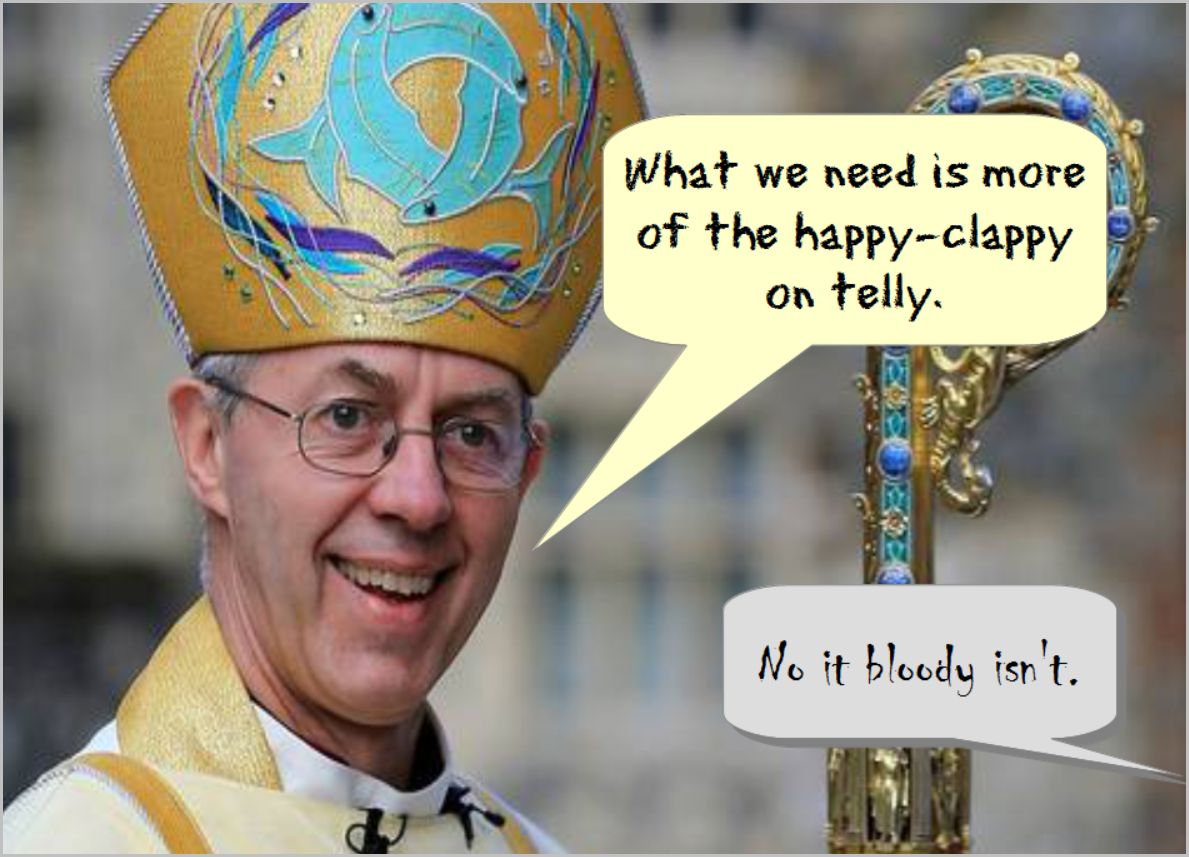
A bloke in a pointy hat and posh frock thinks there should be more religion on television and radio. Justin Welby, Archbishop of Canterbury, says that religion merits as much air time as politics, sport and drama.

The Archbish makes it sound like there’s nothing at all on TV and radio already about religion. In fact, in the last few months in the UK we’ve had a full schedule of Easter programmes; Simon Reeves’ The Ganges on BBC2 (looking at India’s religious heritage); Channel 4’s Unreported World and Dispatches, which regularly consider religious issues; Clare Balding’s trite Good Morning Sunday on Radio 2; the weekly broadcast of church services and daily Thought For the Day on Radio 4; the weekly dollop of worship on Songs of Praise on BBC1 and the 24-hour Christian ‘ministry’ of Trinity Broadcast Network and other God channels for those who just can’t get enough mumbo-jumbo.

Maybe that’s not as much as sport, but then there’s hardly anything on TV that has as much coverage as sport. (Bad news too for those of us with little interest in watching others running, jumping and hitting things; there’s even more to come in the shape of Wimbledon, Euro 2106 and the Olympics.)

Do we really want religion to have the same level of coverage? Are people really as interested in belief systems as they are in sport? Or music? Or art? Or comic book franchises? Even if there are, why is it up to television – the Archbish singles out the BBC as the broadcaster he thinks should indulge his fantasies – to provide it? Isn’t it, rather, up to churches, mosques, temples and other centres of superstition to promote their own particular brand of nonsense?

Make no mistake about it, this is what Justers is proposing; the promotion of religion – ‘religious literacy’ he calls it. He is not, we can be fairly sure, looking for programmes that are critical of religion (unless it’s other people’s). He wants, he says, to see more programmes that give us a better understanding of religious belief. What he means by this are proselytising programmes that create greater empathy for those who subscribe to delusion.

He isn’t advocating, for example, documentaries that explore the irrationality of faith, or ones that show the slap-dash, deceptive ways in which holy books came to be compiled or ones that demonstrate how most adherents to faith fail to live out its exacting demands. Nor is he suggesting programmes that focus on the appalling misery religion brings to some, or shows that give a sympathetic hearing to cults, sects and extremists. I would have no objection to programmes like these (except those that are sympathetic to extremists) because the ugly underbelly of religion deserves to be exposed, like Channel 4’s The Untold History of Islam of a few years ago, taken off air after its presenter was threatened with violence by those who didn’t like its critical perspective.

But these are not the kind of programmes the Archbishop is proposing. The religious literacy he wants us to have is of the cuddly side of faith, the supposed deep spirituality of the obsessive and what he regards as the positive contribution religion makes to the world; a one-sided picture already more than adequately covered by the nation’s broadcasters.

Thankfully, despite the recent political interference in the BBC, the Corporation is still required to present balanced and impartial views of its subject matter. If the Archbishop, who sits in the House of Lords and so is not without influence, is successful in forcing the BBC and other broadcasters to increase their coverage of his obsession, then we should also be able to look forward to programmes that are critical of religion too.

No broadcaster is obliged to promote religion nor to proselytise on its adherents’ behalf. Shame on the Archbishop, with his smiles and pointy hats, for suggesting they are.

Dear Christian

Christians

Dear Christian,

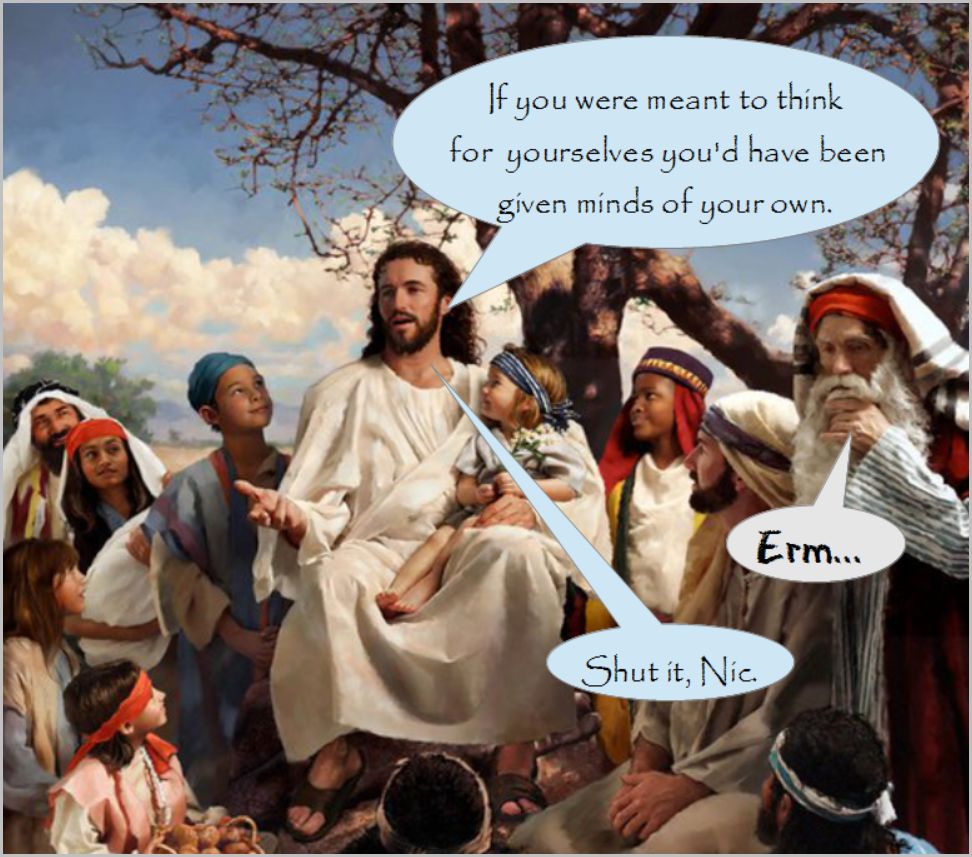
Jesus said treat others as you like to be treated (Matthew 7:12) so why do you treat them with abuse and unpleasantness?

Blog191(2)

Jesus said turn the other cheek (Luke 6:29) so why do you respond with insults?

Blog191(1)Jesus said don’t judge unless you want to be judged (Matthew 7:1) so why do you constantly judge and condemn?

Blog191(5)

Jesus said love your enemies (Luke 6:27) so why doesn’t it happen?

Blog191(11)

Jesus said don’t call anyone a fool (Matthew 5.22) so why do you call them far worse than that?

Blog191(4)

Jesus said don’t pray in public (Matthew 6.5) so why do you pray in public?

Blog191(7)

Jesus said sell all you have and give the money to the poor (Luke 18.22) so why don’t you?

Jesus said you cannot serve God and money (Luke 16.13) so why are some of you so obscenely rich?

CrouchHinn'sJet

Jesus said deny yourself (Matthew 16.24) so why do you indulge and promote yourself above all things?

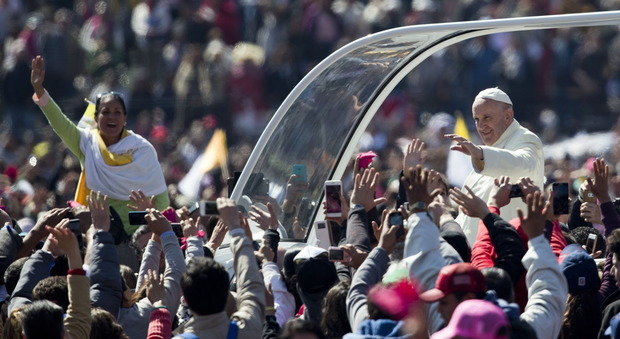
Blog191(8)OsteenPope Francis waves to the crowd, aboard the popemobile in Mexico City's main square, the Zocalo, Saturday, Feb. 13, 2016. Pope Francis kicks off his first trip to Mexico on Saturday with speeches to the country's political and ecclesial elites. The pontiff's five-day visit will include a very personal prayer at the Virgin of Guadalupe shrine. (AP Photo/Moises Castillo)

Jesus said ‘be perfect’ (Matthew 5.48) so why don’t we see you trying?

Sick

Jesus asked why you call him ‘Lord, Lord’ and yet don’t do what he tells you (Luke 6.46). Evidently he didn’t understand, as you do, just how many of his commands are optional. Thank goodness you know better than he did.

Are You Doing What Jesus Christ Says?

Billboard

Dale McAlpine, sometime commenter here and fanatical street-preacher in these parts, has posted a tasteful little video on his web-site – that’s the smugly named Repent.com if you’re interested – called Are You Doing What Jesus Christ Says? Take a look at it over on Repent.com or on YouTube; it’s ludicrously melodramatic and wonderfully over the top. You’re sure to enjoy its typos and spelling mistakes too.

What’s remarkable about it apart from these things is that, despite its title, it makes little reference to what Jesus is supposed to have said. Instead, it’s all about how you’ll go to hell if you don’t repent and accept him as your saviour; but Jesus never said this. It says you’re a ‘vile, wretched, hell-deserving son or daughter of Adam’ – Jesus didn’t say this either. It also insists you should let his cross ‘disrupt the very centre and citadel of your life of self’ (whatever that means) and guess what? This wasn’t part of Jesus’ teaching either. In fact, none of these claims were part of his ‘good news’.

Of the things Jesus did say – go the extra mile, sell all you have to give to the poor, turn the other cheek, avoid judging so you won’t be judged, give to all who ask, give away your shirt as well as your coat, feed the hungry, visit the sick, clothe the naked and love your enemies – the video makes no mention. Funny that. Maybe that’s why we don’t see Christians doing them very often.

So, Christians – and Dale too – are you doing what Jesus said or are you, like the video, only interested in pointing out others’ supposed sins and shouting about how they need to join you in your delusional mumbo-jumbo?

Yes. Thought so.

The Stuff Christians Say… (part three)

DoorToDoorAtheists are aggressive/militant/unreasonable: The Christians might’ve got us on this one. After all, it is incredibly irritating when we atheists start preaching in the town centre or invade others’ events to tell them what to believe or dish out loony pamphlets or turn up at people’s doors when they’re just about to have their tea. And what about all those meeting places we have, on just about every corner of the city, with smart-arse posters about Adam and Steve on the board outside? And let’s not forget our readiness to blow up ourselves and others in the name of our great cause. Now that’s ‘militant’! Yes, we atheists really do have too much freedom to push our views on others. No wonder we’re so insufferable. (Note to self: check you’ve got this right.)

It takes more faith to be an atheist than a Christian: It takes no faith to recognise there are no supernatural beings. It takes no more faith not to believe in God – or to acknowledge that there is no God to believe in – than it does not to believe in Santa Claus, Poseidon or Ra. Christians themselves require no great abundance of faith to dismiss these characters. Is it so difficult to understand that atheists disregard the Christian pantheon of fantasy figures in exactly the same way? Or are believers practising their dishonesty-for-Jesus again? There is no faith involved in being an atheist. On the other hand, believing in an omnipotent but suspiciously inactive God, a super-hero Saviour, a magic Spirit, angels, cherubim, seraphim, demons, Satan, resurrected saints, Heaven, Hell and all manner of powers and principalities – this requires faith in delusional quantities. No atheist could possibly compete. Nor would they want to.

The stuff Christians say… (part one)

Jesus-Facepalm

On the day Christians remember the time Jesus allegedly spent being dead and buried (that’s one day, if you’re counting; what happened to the three he promised?) by going shopping or watching sport, let’s take a look at some of the nonsense they spout about atheists:

Atheism/humanism is of Satan: Given there’s no evidence for any supernatural beings, there can be no devil, Satan, Lucifer – or whatever other name Christians come up with for this fantasy figure. (Bizarrely, it’s Jesus who’s called Lucifer in Revelation 5.5) The devil is a creation of the human mind, intended to explain the nasty stuff in life and to let a supposedly good God off the hook. It follows that an imaginary being can’t make human beings be anything. The devil therefore does not make people atheists nor direct them in their ways.

Humanists/atheists set themselves up as God: Every manifestation of the god(s), including those that happen to be popular at present, is of human origin. Like all the others, the Christian God is a product of the human imagination that is made manifest only through human behaviour. So who is it who sets themselves up as God? Those who recognise that this creation of the human mind has no external reality, or those who claim an intimacy with the ‘Supreme Being’, believe his Holy Spirit lives within them and delude themselves into thinking they speak for him? No prizes.

Humanists/atheists worship man as God: Atheists don’t do this either. We are well aware of humans’ fallibility, inconsistency and capacity to bugger things up. However, we’re all we’ve got. There’s no God going to come and save us or solve our problems. We have to do it ourselves (or, as the case may be, not). Nor do atheists regard other people as wicked sinners who have no good in them – a particularly unhealthy viewpoint favoured by the religious – but this hardly constitutes ‘worship’.

Atheists hate God: Only to the same extent we ‘hate’ Santa Claus, Poseidon and Ra. You can’t hate (or rebel) against something that doesn’t exist. We do get very tired though of Christians foisting their views on us, insisting we should believe what they believe. And we get angry when they disparage others and attempt to curtail their freedom because they alone know what Jesus would want. But being angry about Christians’ unreasonableness is not the same as hating something that doesn’t exist.

To be continued

My preciousss is mine (and mine alone)

bible3Christians have a monopoly on the Bible. No-one else should comment on it, criticise it or even quote from it. Or so Christians tell me. The reason for this, apparently, is that ‘it is absurd to contest the Bible when (you’re) missing the one main ingredient: Jesus’. Not so, of course; the Bible is there for anyone who wants to consider and ‘contest’ it. Granted one’s perspective will be coloured by how one regards it to begin with –

whether you approach it with a reasonable degree of objectivity or look at it through the myopia of faith;

whether you take what it says at face value or apply shifty exegesis to smooth out its many inconsistencies;

whether you acknowledge it was created over time by a succession of fallible men or assume it represents the accurately recorded words of God;

whether you regard it as beliefs of ancient tribesmen and religious fanatics or see it as the means of salvation and the ultimate guide to life.

It is only reasonable that those who take the first of each of these alternatives look to those who take the latter to see how closely they adhere to the demands the Bible makes of them. It’s reasonable because those who believe in its magical properties use it to tell the rest of us how wicked and/or lost we are and how much we need Jesus. If the Bible is the Word of God (as I’ve noted before, it doesn’t claim to be; it’s Christians who say it is), instructing believers on how to live their lives while spreading the gospel, it is not unreasonable for those of us on the receiving end of their ‘witness’ to take a look at how that works out. Not so well as it happens.

Now either this is the fault of the book – heaven forfend that it isn’t clear about what’s expected of God’s Chosen – or Christians themselves are to blame for failing to live as it expects. Unsurprisingly, it’s a combination of the two; a book of mixed messages in the hands of flawed human beings. When Christians refuse to acknowledge that the Bible is far from perfect they are faced with the challenge of making its impossible demands compatible with their own imperfections. They have a number of cop-out excuses that enable them to do this, several of which appear in the comments on this blog. I’ve discussed a number of them before, but here’s a quick summary:

Christians are not perfect and the Bible doesn’t say we should be (actually it does, in Matthew 5.48);

Others have no right to be critical of Christians when we’re doing our best;

You can’t use our own book against us when you don’t know Jesus (see above);

You’re a sinner so what do you know?;

You’re quoting out of context (and only Christians can do that);

You’re not applying the correct exegesis and/or hermeneutics (i.e. mine);

The Christians you’re criticising aren’t real Christians;

It is unfair to lump all Christians together.

Is it? Is it really unfair to lump all Christians together? Aren’t you all meant to be one body, the Body of Christ – you, the Pope, Westboro Baptists, the mega-churches and their celebrity pastors, Joyce Meyer, those who would stone gays, those who affirm gays, Franklin Graham, Alpha converts, abortion-clinic bombers, African witch-finders, Archbishop Sentamu, ‘Emergents’, those who belong to one of the thousands of other denominations and all your friends in your own little church? Who are you to say who’s saved and who isn’t? All Christians represent all other Christians, who represent Christ himself. The Bible says so in 1 Corinthians 12.12-26, Ephesians 4.14 -16 and elsewhere. Or did it get it wrong again?

Con Texting

Cross2Pastor Chris Linzey didn’t like my previous post. He attacked its shoddy journalism(?), complained I exercised faulty hermeneutics and was upset I quoted bits of the Bible ‘out of context’. What he didn’t do, of course, was address the point made in the post, that Christians are selective about the parts of the New Testament they’ll accept, nor did he answer my question about how they decide which commands to follow and which not. Ironic, really, for someone whose blog has the strap line ‘Turning the Bible into Behavior’.

Christians are inherently dishonest about which parts of the supposed ‘Word of God’ – the New Testament specifically – they’ll acknowledge, believe and apply to their own lives. They mask this dishonesty, from themselves as much as anyone else, with a sleight of hand they mistake for hermeneutics (more on this in two post’s time) and by wilfully misinterpreting those who draw attention to their inconsistency. Pastor Chris didn’t seem to understand the fairly simple points I made in ‘Pick and Mix’ so came up with a couple of avoidance strategies. First, he took a swipe or two at my writing style (fair enough, though no-one was compelling him to read it) before, secondly, setting up strawman arguments to attack. They certainly weren’t my arguments he was tilting his lance at, that’s for sure. I guess this is what Christians mean by putting on the armour of God; you gotta deflect criticism by whatever means possible.

I’d like here to address though, Chris’s claim that I was quoting the Bible ‘out of context’. I have to say I find this one of the most unconvincing rejoinders – it hardly qualifies as an argument – that Christians offer in defence of their beliefs, right up there with ‘you wouldn’t dare say this about Islam’.

A quotation from any source, not just the Bible, is necessarily out of context no matter how much of it one uses. There is no way round this, even if one resorts to quoting extensive amounts of material, which I do when the meaning isn’t apparent from a short quotation, like here, for example. Nonetheless, a lengthy quotation is still decontextualised, from its letter or gospel as well as from the original time, place and culture in which it was written. In addition, while long quotations might be appropriate for longer academic papers (I have some experience of these and even there, great chunks are rarely necessary) they’re not always suitable for short, pithy blog posts.

In any case, the objection really only has validity if quoting ‘out of context’ somehow distorts the meaning. If it doesn’t, if the meaning is apparent from the lines referenced, then quoting more isn’t necessary. Readers who have any doubts can always check the source material for themselves – I always provide chapter and verse – to gain a sense of the wider context for themselves. Remarkably, the verses I cite invariably turn out to have the same meaning in their greater context as they do when quoted in isolation. The Christian objection to them being ‘out of context’ is usually nothing more than a smoke screen to avoid addressing the point being made.

What of Christians themselves? Do they ever take ‘scripture’ out of context? Oh my, yes, and they’ve been doing it from the very beginning. The gospel writers, particularly Matthew, wrenched snippets from the ‘Old Testament’ to make ‘fulfilled’ prophecy out of verses that weren’t prophecy to begin with, and, as we’ll see next time, Jesus too lifted lines from their original context to allow him to make theological points.

Nor are Christian bloggers and apologists today averse to doing the same. Then there are those devotional posters with a single, ‘comforting’ verse of scripture on them (like the one I used to have that said, ‘Heaven and earth will pass away but my words will never pass away’); the placards that surround street preachers with ‘For God so loved the world he gave his only begotten Son’ and ‘Ye must be born again’; the banners at marches and parades that declare ‘Repent or Perish’ or ‘Christ died for the Ungodly’. Each and every one out of context. I suppose if the original sense is more or less preserved then these might be seen as legitimate (if not entirely useless) but evidently taking scripture ‘out of context’ is something Christians are allowed do but others shouldn’t. Yet another case of do as I say, not as I do.

Next time, we’ll take a closer look at how believers ease their cognitive dissonance – between what the Bible says they should believe and do and what they actually believe and do – by disregarding context when it suits them.


What Does Atheism Have To Offer? (Part Two)

Think4. Atheism offers genuine morality
Having no magic book to tell them how to behave (not that Christians derive their morals from theirs) atheists work out their own morality. They don’t do this in a vacuum, however, recognising that morality is culturally derived, evolving as the means by which primates with complex social arrangements relate to one another. It’s likely they adhere to their moral codes imperfectly, as do believers of various stripes. Not having an ideology they feel compelled to impose on others, they don’t regard their fellow human beings as mere conversion fodder. The atheists’ world is big enough to embrace all, though they lament the damage wreaked on it by religion. Atheist terrorists are a much rarer breed than their religious counterparts, while secular societies are among the most peaceful and prosperous in the world today (with the more religious generally at the opposite end of the spectrum.) Nor do atheists attribute their behaviour to supernatural forces; neither god nor the devil inspires them to act. Rather they recognise and take personal responsibility for what they do.

5. Atheism offers authenticity
An atheist is free to be him or herself. There is no striving to maintain the imagined standards of an imaginary god, no need to represent the perspective of a ‘sacred’ book or to defend the indefensible. The atheist does not see themselves or other people as lost, worthless, sinners, suppressors of truth, goy, infidels or any of the other disparaging terms used of non-believers in so-called holy books. The atheist can be a free-spirit, possessed of self-respect, and true to themselves and their nature, whatever that may be. Here’s how pastor-turned-atheist Ryan Bell put it in a recent blog post:

I don’t have secrets anymore, which is a huge mental and moral relief. I also wrestle with less cognitive dissonance than ever. All of this means I’m more at peace and more comfortable in my own skin. I give far fewer fucks about what people think of me and my decisions. My ire is raised, from time to time, by unfair attacks, and I will probably always struggle with my tendency to be a people pleaser, but I am in recovery. I’m learning to tell the truth on a more regular basis and trust that people can handle the truth (whether they actually can or not). I’m learning to trust myself and what I know while remaining open to critique and able to say I was wrong.

6. Atheism offers free thought
Having no dogma to represent or promulgate, no myths to restrict them and no cult leaders, shaman or gurus dictating to them, atheists are free to think for themselves. Religion demands that its adherents begin with myth or dogma, which the facts are then forced to fit. When they don’t, which is invariably the case, the believer is compelled to dismiss the facts to preserve the fantasy (if you think not, you’ve never visited Answers In Genesis). The atheist, on the other hand, can begin with the evidence and reason from it to make up their own mind about ethics, the issues of the day and the human condition.

to be continued…

2015: How was it for you?

2ndComingI promised this time last year to revisit my predictions for the year that lay ahead. So how did I do in my prophecies for 2015?:

The first was that there would be no Second Coming in 2015. Well, how wrong could I be! As we all know Jesus returned on September 13th, just as John Hagee hinted he would be. It’s been so great, hasn’t it, living in Hell / God’s Kingdom on Earth (delete as appropriate) since that time. Fantastic. I’m so pleased to have been wrong about this one.

On the other hand, maybe what I said last year still stands: Jesus won’t be back this year. Just like he wasn’t back in 2014, 2013, 2012… 1985… 1914… 1868… 1497… 1000… 446… 35. Just think of all those years – count ’em, nearly two thousand – when he’s failed to return so far. Actually, he promised he’d be back while his followers and those listening to him were still alive, around AD30 or thereabouts. Safe to say he’s not coming back at all, just like dead people don’t. Not in 2015, not ever.

Of course it still stands. As ever Christianity fails to deliver. That hasn’t stopped True Believers™ from telling us that he’ll be back very, very soon. Which was prediction number 2: Christians will go on believing that Jesus is going to return any day now. I gave up collecting examples well before the end of the year – there were just too many – but here’s a few of them: here, here, here, here, here, here and here. Will the gullible Born Again ever come to their senses and stop listening to idiots like these? (Nope).

Prediction 3. There’ll be no natural disasters or human calamities as a result of gay marriage. There have been lots of disasters and calamities during the year, but here’s the thing – natural disasters have natural causes, not supernatural ones, and similarly, human calamities have human causes. Not one of the events this year (or any other) was the direct result of gay marriage. This hasn’t stopped the religious from claiming – as I predicted they would in prophecy number 4 – that disasters and calamities are God’s punishment for gay marriage; here, here , here, here, here, here and here, for example.

Prediction 5: More than one prominent Christian will call for the execution of gay people. Yup. Here are those loving men of God doing just that (and here, here and here too). Jesus would be so proud.

Prediction 6: Christians in the west will claim they’re being persecuted when they’re being expected to treat others fairly and equally, and not to discriminate against them. Yes, I know Christians are persecuted in some parts of the world, but the moaners I’m talking about are only focused on their own self-serving, self-inflicted ‘marytrdom’. Again, there are just too many of these to link to them all, but here are a few (and here, here and here).

Prediction 7. Christians will respond to criticism with clichés like ‘they wouldn’t dare say that about Muslims’… ‘Christians are the last group who are fair game’… ‘It’s time for Christians to speak out’… ‘Stand up for God’s standards…’ etc. Yes, predictable in more ways than one

Prediction 8: Christians will continue to dismiss and disparage anyone who doesn’t share their views, especially atheists. Look out for ‘atheists have no morality’,’the fool hath said in his heart there’s no God’ and ‘atheists want to oppress Christians’ occurring with tedious regularity. And they didn’t disappoint: here, here, here and here.

Prediction 9: There will be more revelations about the abuse of children by church ministers. Of course there were. Christians may be new creatures in Christ but that doesn’t stop some of them behaving in the same old despicable ways, God love ’em.

Ditto number 10: Church hierarchies will attempt to cover up the abuse of children by their ministers. And here they are at it. The body of Christ certainly seems to have an unhealthy interest in the bodies of others. Still, they always ever so modestly cover up afterwards.

Prediction 11. There will be the usual manufactured ‘war on Christmas’. Ho-hum. And you can guess who did the manufacturing.

And finally I offered number 12: these predictions have far more chance of coming to pass than any of the so-called prophecies of Bible. And do you know, they did. That’s because none of the Bible’s predictions have ever come to pass – not those purportedly about Jesus himself, nor of the second coming, nor the judgement of sheep and goats, nor God’s Kingdom on Earth – and (here’s another prediction) they never will.

So, another year of empty promises, failed prophecies and superstitious fantasy in the wonderful, wacky world of religion. May you all be safe from the effects of faith and fundies in the one that lies ahead.

Big Bang Theory

BigBang

You’re probably familiar with William Paley’s teleological argument for the existence of God. If you haven’t used it yourself then you’ll have been subjected to it by proselytising believers. A couple of days ago I had someone treat me to an updated version of the argument.

I was on the phone with a sales-person, talking about his company’s product, when he decided it would be a good time to dust off the old idea, give it a make-over and use it to convince me of God’s existence.

He started by asking me if I would agree that a computer must have an intelligent designer; I agreed this was so (though I have my reservations.) He responded with ‘how much more then must the universe and life on Earth – being so much more complex than a computer – also have an intelligent designer.’ He said this was ‘something to think about,’ and I agreed it was, though maybe this wasn’t the best answer I could’ve given.

Having ‘demonstrated’ that everything must be intelligently designed, my new friend announced that this was therefore irrefutable proof that Allah must have made everything.

Oops. I’m sure this isn’t what the Reverend Paley had in mind when he devised his watch analogy two centuries ago. His proof, however, is every bit as much a demonstration of Allah’s existence and creativeness as it is Yahweh’s. Or Vishnu’s or Marduk’s or any other of the multitude of deities credited with intelligently creating the universe and life in this insignificant part of it. Any one of them could’ve done it according to the teleological argument. Take your pick and sign up for the set of beliefs that corresponds with your choice.

But wait – complex machines like watches and computers bear no relation to anything in nature. A watch found on a heath, as Paley conjectures, or computers in hedgerows, can only have got there because a human being put them there (fly-tipping again). They would not be there because they’d arisen, like the rocks, grass and other plants that surround them, through the processes involved when nature creates something. Moreover, we know that machines have intelligent creators, because we are they. What doesn’t follow is that because man-made objects are demonstrably the product of intelligence that natural ones, which, remember, bear no relation to computers, watches, cars and CAT scanners, are as well.

We are gaining more understanding of how the universe came to be. Significantly, it doesn’t require that there is intelligence behind it. If it did, we would then need to explain how that intelligence arose, who created it and by what process. To say, as religious believers are wont to do, that this supreme intelligence has always existed is no explanation at all. If we’re to have something that has always existed then it is far more likely to be that which we know really does exist, rather than something we don’t. Conceding the longevity of the components of the universe, which we know to exist, is a far better bet than inventing deities to account for it. A God no more explains life, the universe and everything than do fairies the intricacies of my computer (gremlins maybe, but not fairies.)

For all that, life on Earth does have a creator. The genealogy of the universe tells us that physics begat chemistry begat biology. (‘But if life emerged from physical and chemical processes, then how come there’s still physics and chemistry?’) All life on Earth, including ourselves, is the product of these processes, ‘the blind watchmaker‘ that Richard Dawkins speaks of. They are not intelligent, do not have names like Yahweh or Allah and do not, on their own, create the machines that only humans can design.