Young men’s visions, old men’s dreams

Stephen4

In Acts 2.17, Luke (mis)quotes a prophecy from Joel 2.28:

In the last days, God says, I will pour out my Spirit on all people. Your sons and daughters will prophesy, your young men will see visions, your old men will dream dreams.

I was always taught that the Acts version was a prophecy in its own right, predicting what would happen in the very last days before Jesus returned, some time in the future (his future, though maybe not ours.) But it isn’t. Luke, or whoever wrote Acts, is claiming the fulfilment of the prophecy in his own time. He’s not saying,’ this is what will happen at some point in the next few millennia.’ He’s declaring – or he’s making Peter declare – ‘this is what’s happening right now.’ Luke, like all members of the cult in its early days, believed the last days had arrived; God was about to impose his Kingdom on the Earth, in a display of power and glory (Luke 21.27).

The dreams and visions of which Luke speaks were, he believed, happening then, as he was writing. To prove it, he relates numerous dreams and visions in Acts; Stephen’s vision of God and Jesus; Paul’s ‘sighting’ of the risen Christ on the road to Damascus and Peter’s encounter with, erm… a table-cloth to name only a few. Elsewhere, Paul himself refers obliquely the innervision that led to his conversion (Galatians 1.16) and recounts his ‘visit’ to ‘the third heaven’ (2 Corinthians 12.2); he’s kind of embarrassed about this one though – as well he might be – and relates it in the third person.

Luke knows that the new cult is built on dreams and visions. He believes such hallucinations are genuine revelations from God himself. Moreover, Luke tells his readers explicitly and directly in Acts 2.17 that such visions and dreams were how the cult’s founders experienced the risen Jesus. How do we know this is what he means? Because he puts the quotation about young men having visions and old men dreaming dreams into the mouth of Peter. That’s the disciple Peter whom the gospels tell us was one of the first to experience the risen lord. Luke has Peter reveal the nature of that experience. ‘This is how it was for me,’ he confesses. ‘I had a god-given vision, just as the scriptures promise.’

Luke is proud of the fact that the new faith is based on young men’s visions and old men’s dreams. Proud enough to include it in Acts 2.17 and proud enough to make Peter of all people declare it. Christianity owes its existence to these hallucinations and delusions, nothing more.


What A Dream I Had

Resurrection3

Last night.

I dreamt I was troubled and anxious about something or other, even though I’m not aware of being this way in reality.

In the dream, a couple of people drop by to console me. One of those people is my dad. He asks what’s wrong, listens and offers advice. He’s concerned and wise, positive and supportive. I have no doubt this is my father; he looks and sounds like him, but he’s an idealised version of him. I’m dimly aware in the dream that he’s behaving differently from the way he would in life – we rarely had heart-to-heart talks – but I’m so grateful for the help he’s offering, and it’s good to feel close to him.

In reality, my father died over ten years ago. I’m not sure I was aware of this in the dream or perhaps I just ignored it. I certainly ignored the way he was acting slightly out of character; I just was glad to see him again. I woke this morning feeling invigorated by the time spent with him (or the illusion of time spent with him) and with other friends who appeared in the dream to offer support.

I don’t for minute believe that the father I experienced in my dream was really my dad, returned from wherever he’s been these last ten years to offer words of comfort. My real dad has been nowhere for the past decade. He ceased to be in 2007. The version of him in my dream was a construct of my own mind, made from memories, wishful thinking and – okay, I admit it – a glass or two of wine. He was an image of how I’d like my dad to have been, perhaps – not that I give that much conscious thought. Nevertheless, this version of him is evidently buried somewhere in my head, waiting to be resurrected when the dream circumstances are right.

This is what it must surely have been like for those few individuals who, in visions and dreams, experienced Jesus after his death. In their grief and turmoil, the need to embrace the dream version of their friend must have been overwhelming. They would have persuaded themselves it really was him, communicating with them from beyond the grave. The fact one or two others had a similar experience can only have reinforced the compulsion to believe: ‘You saw him too? Then it must really have been him.’

It wasn’t, of course. What those who witnessed the risen lord experienced was, as Paul suggests in Galatians 1.16, a creation of their own minds, constructed from religious fervour, wishful thinking and a powerful need to believe.

From this, all else followed.

The Resurrection Explained

Light2

The earliest reference to Jesus being raised from the dead appears in Paul’s first letter to the Corinthians: 

Christ died for our sins, just as the Scriptures said. He was buried, and he was raised from the dead on the third day, just as the Scriptures said. He was seen by Peter and then by the Twelve. After that, he was seen by more than 500 of his followers (Corinthians 15.3-6).

Scholars are generally agreed that Paul is quoting from a very early creed, created within a few years of Jesus’ death. Ftbond, a commenter on Escaping Christian Fundamentalism, asks that if this creed was in existence

within a year or two or three after Jesus crucifixion (and, obviously, claimed resurrection), then one must ask: What was so important, so astounding, so amazing, so desirable, so attractive, so encaptivating (sic) and charismatic about that person that anyone would think him to be a “candidate” for resurrection in the first place?

It seems to me all of these questions and attendant adjectives are irrelevant and that ftbond is looking at the resurrection claims the wrong way round.

First, the creed doesn’t refer to ‘resurrection’. ‘He was raised’ is the term favoured by these earliest of Christians, one that doesn’t suggest they could only have had a reanimated corpse in mind.

There is no justification for supposing that ‘he was raised’ meant the same, either in Paul’s mind or that of the creed writers, as ‘bodily resurrection’. To assume they’re the same is to impose all the later accretions of the latter term onto the much simpler earlier one. We know Paul’s ‘risen Christ’ was a ‘revelation’ in his own head (let’s call it an hallucination) and nowhere does he suggest that Jesus was brought back to life in his old body. Paul talks only of Jesus being raised as ‘a life giving spirit’, not a ‘corrupt’ body of flesh at all (1 Corinthians 15.46).

Hallucinations of a ‘raised’ Jesus, then, long preceded the idea that he had returned in the same physical body that two days earlier had died on the cross. The notion that he was alive again resulted from the ‘visions’ – quite possibly dreams – that two or three of his early followers had. They took these visions to mean that Jesus had returned spiritually from beyond the grave.

Others came to believe in the risen Jesus, not because they personally experienced a vision or dream about him (though Paul insists there were some who did), but because of the reports of others experiencing them. Still more became believers as a result of reports of reports (of reports.) These experiences were then incorporated into creeds like the one quoted by Paul, and ultimately into the gospels when they were written 40-100 years later. By that time the original hallucinations were being worked up into real encounters with a Jesus physically resurrected in the flesh.

No-one needed to find Jesus ‘captivating’, ‘astounding’ and all those other adjectives ftbond applies to him; most converts, like Paul, would never even have met him. It is all a matter of interpretation; either a few early believers convinced themselves they’d experienced their late charismatic companion alive again, or, if he didn’t actually exist (and he is so mythic this is a possibility), they concocted a back story for their mystical experiences. The result was the creation of stories about Jesus, largely cobbled together from the ‘Scriptures’ (as Paul all but admits.)

This seems to me to be the most likely explanation of the ‘resurrection’. There is so much special pleading in the gospel accounts, so much that is clearly invented and designed to fulfil prophecy, so many inconsistencies and anomalies, that the entire enterprise smacks of imaginative invention, designed to lend credence to a few people’s innervisions.

It all comes down to feelings and subjective experience

Faith4

Argue with Christians (Hi there, Jim! Hi there, Don!) about the veracity of their faith and they will tell you it’s true for two reasons: the Bible and their own personal experience. ‘Christianity is true and Jesus is real because the Bible says so – and, whatsmore, I feel it.’

Or, as William Craig Lane likes to put it, the inner witness of the Holy Spirit testifies to the truth of Christianity. It’s a beautifully circular argument: ‘Christianity and its holy book are true; I know this because the Holy Spirit who lives in me tells me so; I know the Holy Spirit lives in me because the Bible says he does; therefore, I know Christianity and the Bible are true because the Holy Spirit tells me so’.

But equally, Mormons claim that they ‘know’ a completely different set of improbable beliefs are true because they experience a ‘burning in the bosom’ that tells them so. Roman Catholics say their faith is true because they experience Christ through the Eucharist, while Muslims know theirs is true because they have a real sense of Allah’s presence.

All of these spiritual convictions are not, as a liberal theologian like Karen Armstrong might claim, evidence that there is Something-Out-There that loves and communicates with us, but more obviously that human beings’ brains are adept at creating whatever ‘inner witness’ is required to support the beliefs and convictions they have arrived at. William Lane Craig concedes this when he acknowledges that

Anyone (or, at least any sort of theist) can claim to have a self-authenticating witness of God to the truth of his religion. But the reason you argue with them is because they really don’t: either they’ve just had some emotional experience or else they’ve misinterpreted their religious experience.

In other words, any experience of ‘self-authenticating witness’ enjoyed by believers in faiths outside Craig’s own brand of Christianity is at best mistaken, at worst fake. But then, how can anyone know, Craig included, that his own conviction isn’t just as much an emotional flush or mere subjective experience? Why is his conviction any more real than that of other kinds of believers? Ultimately, Craig can only say, “because it is”:

a person (possessed by the Holy Spirit) does not need supplementary arguments or evidence in order to know and to know with confidence that he is in fact experiencing the Spirit of God.

In other words, the true believer knows his experience of the Holy Spirit is real because his experience of the Holy Spirit tells him it is. And round the argument goes, though no amount of assertion makes a subjective experience an event in objective reality.

It is impossible for Craig, or any other Christian, to demonstrate that an entity he imagines inhabits his brain, no matter how convincing its presence may seem, has any existence anywhere other than in his brain. What the person who says ‘I believe’ is really saying is that they have no evidence at all for what they are claiming. If they had, they wouldn’t need to believe it; they would know it. They would, whatsmore, be able to point to independent, external evidence for it.

The Bible makes a virtue out of not knowing, of believing when there is no evidence.  It calls the resulting cognitive dissonance, ‘faith’.

Adapted from my book, Why Chrisitans Don’t Do What Jesus Tells Them To …And What They Believe Instead.

The Sect Hiding in Plain Sight

Condemning-Pharisees

With thanks to David Eves.

Back at the start of Christianity, the cult was divided into numerous factions; not unlike its modern counterpart. Acts’ claim that all the new converts – the church – got on famously, sharing all they had and generally taking part in one big love-in is spin, a lie concocted by its author, ‘Luke’. Its not the only lie he invents; later in Acts he tries to present the new faith’s ambassadors, Paul and the original apostles, as being largely in agreement about what the Christian message was about. We know from Paul’s own writing that this wasn’t so.

Likewise the united church. We know that there was part of the cult that had a very different theology and soteriology (doctrine of salvation) from Paul. They didn’t subscribe to his incantational magic about a dying god-man who would save them if they claimed his death for themselves. Instead, this group believed that the way to find favour with God was to be ‘righteous’, by doing good works and generally expending oneself on others. Its members promoted, and probably practised, a yin and yang measure-for-measure philosophy: God would show forgiveness, mercy and compassion, they said, only to the same extent that a believer demonstrated them him or herself. Because they believed Jesus had commanded it and God favoured it, they denounced wealth and advocated a self-deprecating way of life. They were predominantly Jewish. They believed Jewish Law was still valid and should still be followed by cult members. They were, however, hostile towards those who, unable to see any value in the new cult, remained within Judaism. The sect invented anachronistic stories about Jesus sparring with the Jewish leaders of their time, half a century or more after Jesus died.

Though it is unlikely any of members of this sect had ever encountered Jesus in person, they believed he was going to return to the Earth while they were still alive in order to judge humankind. Naturally he would vindicate them while condemning all others, particularly the rich and powerful. He would do this because they were the ones who were doing as he commanded – helping the sick, the hungry and the homeless – which would ensure the returning Lord would look on them favourably. None of them had seen the resurrected Jesus but nevertheless they valued the stories they heard about those who supposedly had, and they promoted these stories themselves.

How do we know this? Because this particular sect left behind a record of their beliefs. They imbued them with authority by putting them into the mouth of a preacher who had lived more than fifty years earlier. Who knows, maybe he did say such things. The sect either believed that Jesus had actually contradicted Paul’s notion that the Jewish Law was no longer valid or they felt it necessary to to make Jesus say so themselves. Likewise, they rejected the magical mysticism preached by Paul that was beginning to take hold in those early days. The group’s beliefs were radically different and their writing specifically designed to counteract ideas they opposed with a passion.

Where will you find this group’s writings? In the bible, at the very start of the New Testament in the book called ‘The Gospel According to St Matthew’; this book is their writing, give or take the odd bit of tampering from later on. Matthew’s gospel details the sect’s beliefs about Jesus, their measure-for-measure morality, their recipe for righteousness and their beliefs about salvation and the coming judgement.* So different are these from Paul’s ideas that the gospel can only have been created to counteract his doctrines. The community that produced Matthew had no truck either with Paul’s theology or his soteriology.

Read Matthew for yourself and see how much it is at odds with Paul. The discrepancy is there for all to see, yet Christians have always convinced themselves, if they’ve thought about it at all, that not only is Matthew’s gospel compatible with the mumbo-jumbo that follows it, but that its ‘good news’ and Paul’s are identical. Nothing could be further from the truth.


* I’m happy to provide chapter and verse from Matthew’s gospel to support all I say about it.

Were the gospels ‘fact checked’ by those in the know?

Ashes

In a discussion I’ve been having with Don Camp on his blog-site, Biblical Musings, Don has been arguing that the Gospels are completely accurate because a) he wants to believe this and b) the Gospels ‘could have been fact checked by people living who had known Jesus and who had heard the Apostles teach this very story for many years. New and embellished versions would not have been acceptable to these people’ (my emphasis).

Clearly this is not so; John’s gospel presents a very different, highly embellished Jesus from that of the synoptic gospels (a divine being who is preoccupied with himself as opposed to a prophet concerned with ushering in God’s Kingdom), yet nowhere do we have any record of anyone saying, ‘hang on, one of these isn’t right – this isn’t how I remember things.’ Similarly, Paul’s itinerary (not to mention his theology) in Acts differs from that he talks about in his letters. Yet there’s no surviving evidence that anyone pulled Luke up about his inaccuracies.

If it didn’t happen, as far as we are aware, for these discrepancies, then why should we suppose it would have happened for others? It isn’t legitimate to hail the absence of ‘fact checking’ as evidence that everyone thought the gospel writers’ versions of Jesus’ life, despite multiple contradictions and evident embellishments, were reasonably accurate. This absence is not evidence that there was nothing to be disputed; it can be explained in numerous other, more likely ways (no-one was particularly interested in the discrepancies and embellishments because the gospels are literary creations, not historical accounts; the objections weren’t recorded or simply didn’t survive; they were quashed by orthodoxy and so on.)

Still Don insists ‘nobody in the know’ objected to anything in the gospels at the time they were written. This of course is mere conjecture on his part. We simply don’t know whether anyone objected, who did and who didn’t. Perhaps the disciples did object but were overruled (just as they were by Paul over other matters); maybe they objected to being portrayed as idiots, when their interpretation of what Jesus was about was being diminished, and nobody actually cared; maybe they didn’t mind the mythologising of their leader; maybe they never even saw the gospels, written as they were well away from Palestine and long after the events they portray; maybe most of the disciples were dead by the time the gospels were in circulation – life expectancy was short. Yes, I’m hypothesising here, just as Don does, my conjecture being every bit as valid as his.

Finally, Don refuses to see the errors, discrepancies and contradictions in the Gospels, as well as the mythologising of their central figure. Even with their inconsistencies, inaccuracies and flights of fancy (that may or may not have been objected to), Don maintains the Gospels are still ‘true’ and ‘inspired’. He really knows how to stretch a definition to the point of meaninglessness.

As if that’s not bad enough, he now he wants to pray for me.

In which the witnesses try to get their story straight

Tomb2

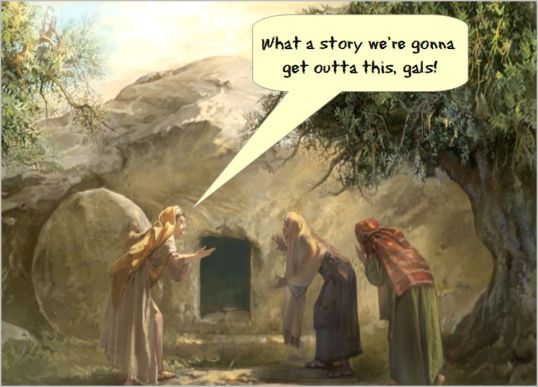
Mary: Well, the other Mary and me (Matthew 28.1) were first to go down to the cave where somebody said they’d put the body overnight.

Salome: I was there too, don’t forget (Mark 16.1).

Mary: Were you? I don’t remember that.

Salome: Bloody was, I’m telling you. So were a bunch of others (Luke 24.10).

Mary: Anyway, we get there and the entrance stone has been rolled away (Mark 16.4).

Peter: Wait a minute… I thought you said that happened after you got there. I thought you said there was an earthquake nobody else could feel and an angel came and rolled away the stone in front of your very eyes (Matt 28.2).

Mary: Did I? Oh yes, that’s right. That’s what happened. And the guards fainted out of sheer fright (Matt 28.4)

Thomas: They did? You didn’t mention any guards the first time you told this story (Mark 16.4).

Mary: Didn’t I? I must’ve forgotten. Oh well. And there was this strange young man sitting inside the tomb (Mark 16.5).

Salome: There were two young men and they were standing outside (Luke 24.4).

Mary: Really? I saw only one and he was definitely inside.

Peter: It wasn’t a young man, it was an angel (Mark 28.5).

Mary: Angel? Oh yes, I suppose you’re right. It must have been an angel. And he said the Master wasn’t there, that he’d risen or something (Matt 28.7).

John: That’s funny, I don’t remember anyone being there at this point. I certainly don’t remember anybody speaking to us (John 20.4-5).

Mary: That’s strange, because the young man in the tomb definitely spoke to me.

Salome: And the two men outside the tomb spoke to me.

Peter: And the angel… don’t forget the angel.

Thomas: So what happened then?

Mary: We were so frightened, we just ran away.

Thomas: You ran away? And then what?

Mary: Nothing. We said nothing to anybody (Mark 16.8).

Thomas: You said nothing to anybody. Then how did Peter find out? ‘Cos the next thing he was running hell for leather to the garden to see this empty cave for himself.

Peter: Oh, she must’ve told me. Yes, that was it, she said something to me and some of the others (Luke 24.10).

Mary: Erm, yes, that’s right. I told Peter and he went to see the empty tomb.

Peter. Ran all the way on my own, I did (Luke 24.12).

John: No, you didn’t. I went with you. In fact I overtook you and got there first (John 20.3-6).

Peter: Did you? I don’t remember that. Are you sure you haven’t just added yourself in here?

John: So anyway, we ran to the tomb…

Peter: And we see that the body has gone. I’m telling you, we couldn’t work out what had happened (John 20.9).

John: Though the most logical explanation seemed to be that he’d risen from the dead. I mean nothing else made sense (John 20.8).

Mary: It’s a shame you didn’t see the young man/men/angel. They’d have spelt it out for you like they did for us.

John: Don’t worry, we’ll bring them into the story later and we’ll have two angels for good measure. (John 20.12).

Mary: So while I was waiting there alone…

Thomas: Wait, you were there alone? I thought you said you ran away with the other women (Mark 16.8)?

Mary: Erm, yes, that’s right, I did. I must’ve gone back later just to hang about (John 20.11) and suddenly I see this, like, apparition. At first, I thought it was the gardener…

Thomas: You mean you didn’t know who it was?

Mary: No, I didn’t, which I agree was a bit odd, but then I realised it must be him, the Master, I mean. Who else could it have been?

Thomas: Well, if it was anyone at all, I’d have thought it more likely it was the gardener than a body back from the dead.

Mary: I suppose, but it just felt like the Master to me. I so wanted to see him again.

Thomas: Did he have holes in his hands and a wound in his side (John 20.27)? Surely that would’ve told you it was him.

Mary: Erm, I can’t recall now. But anyway, it was him.

Thomas: How’d you know?

Mary: ‘Cos he spoke to me. He said, ‘Keep your hands off me, woman, because I’ve not yet, erm… ascended’ (John 20.17, 20).

Thomas: What did that mean? If he was back like you said then how come you couldn’t touch him?

Mary: Well, I don’t know, you’d have to ask him.

Thomas: And how we gonna do that, him being dead and all?

Mary: He’s not dead, I tell you, and you’re all just jealous ‘cos I did better than all of you. I saw him in person and he talked to me!

Peter: All of you, just stop a minute and listen. Can you hear it?

Thomas: No.

Peter: Can you feel it?

Mary: Yes, I can. I can sense his presence (Luke 24.36-37).

John: He’s here with us. He’s back. Hallelujah!

Mary: It’s as if he’s standing right in front of us, talking to us.

John: Yes, that’s exactly what it’s like. He’s here with us. I can feel him. He’s back from the dead, I’m sure of it (John 20.19).

Peter: Let’s tell people we’ve seen him. They’re bound to believe us. I mean, we don’t live in a superstitious first-century backwater for nothing.

Thomas: Jesus Christ! Next you’ll be trying to convince everyone that this cockamamy story is true.

Christianity: a failure from the very beginning

Celia5

Christianity just doesn’t deliver. Jesus doesn’t deliver. None of his promises that I outlined last time have ever produced the goods. Not surprising really when he’s been dead for the past two millennia. He’s no more likely to deliver than anyone else who’s been regarded as a god by misguided devotees (and there’s plenty of them).

Yet for those 2000 years Christians have insisted that he does, even when there isn’t a scrap of evidence he’s listened to a single word they’ve said, answered even one of their prayers, enabled them to heal the sick or helped them move mountains – any of the stuff he promised he’d do. So why do they insist he really does? Partly because many of them haven’t a clue that he even said these things. Discussing their faith with Christians online, they often tell me that Jesus never said, for example, that God would give them whatever they ask for or would make their lives better or give them the ability to do miracles greater than Jesus did himself (which of course he does, in Mark 11.24, Matthew 11.28 and John 14.12-14 respectively). In short, they are ignorant of what the bible actually says and all the preposterous magical promises it makes.

Those who do know of its promises have a range of excuses for why they never happen; they were only meant for the early church; today’s believers don’t have enough faith; they were only ever intended metaphorically; God is currently withholding his good will (usually because Christians are too tolerant of everyone else’s ‘sin’). The fact is the promises of Christianity have never delivered.

I’ve been reading Bart D. Ehrman’s The Triumph Of Christianity, where, for entirely different reasons, he lists the problems that beset the church in Corinth (p291) that Paul addresses in his first letter to them. Here’s a summary:

Serious divisions within the church, with different members following different leaders (1 Corinthians 1.12)

Various forms of sexual immorality (1 Corinthians 5)

Men in the church visiting prostitutes and bragging about it (1 Corinthians 6)

Other men under the impression they shouldn’t have sex at all, not even with their wives (1 Corinthians 7)

Fractious arguments about whether Christians should eat meat from animals sacrificed to pagan gods (1 Corinthians 8 & 10)

Some women attending meetings without their heads covered (1 Corinthians 11)

The wealthy greedily eating the shared meals and leaving none for the less well-off (1 Corinthians 11)

Worship that was chaotic because those speaking in tongues were trying to show spiritual one-upmanship (1 Corinthians 12-14)

Members not using their spiritual gifts for the benefit of the community (1 Corinthians 12 & 13)

Some claiming they had already experienced ‘resurrection’ and so were more ‘saved’ than others (1 Corinthians 15)

Apart from one or two specifics, this could be the church of the 21st century! Paul, though, wrote his letter to the relatively small group of believers in Corinth around 54-55CE, a mere twenty or so years after Jesus’ death. Already by then, Christian communities were overcome with problems. There’s no indication they were experiencing the miracles Jesus promised, nor were they behaving like the ‘new creatures’ Paul’s says the Holy Spirit makes of believers:

If anyone is in Christ, the new creation has come: the old has gone, the new is here! (2 Corinthians 5.17)

The behaviour of the Christians at Corinth was, by any standard, appalling; they seem to have no more understanding of morality, no more sense of charity, no more demonstration of brotherly love than the ‘heathens’ around them. And yet they were new creatures ‘in Christ’, believers in Jesus, vessels of the Holy Spirit. With all this supernatural support they really should have been doing better – much better – than they were.

I’ve often wondered why Paul didn’t just give up at this point, especially when other churches he wrote to had similar problems. Any rational person would have looked at how these new converts were behaving and would have concluded that the new religion simply wasn’t working. The promises Jesus made (if Paul was even aware of them) and the changes he himself said accompanied conversion simply weren’t happening. None of them had materialised, even at this early stage.

But instead, Paul soldiered doggedly on. He travelled far and wide drawing others into the cult and then had to write to them too, to tell them how to behave and what faith in his Christ actually entailed (see his letter to the Galatians, for example, and that to the church at Philippi). Didn’t Paul ask himself where the Holy Spirit was in all this? Where was the guidance and supernatural assistance promised by Jesus? Despite the airbrushed version of the early church presented in Acts, Paul’s letters tell us what it was really like: a complete disaster.

And so it continued. As Ehrman shows, people converted to Christianity in part because of its promises that believers would avoid hell and live forever in heaven instead. Many convert for the same reason today. With the zero success rate of all of its other promises, it’s not difficult to predict how Christianity’s assurances of eternal life are going to pan out.

‘Why attempt to discredit Christian faith and the teaching of Jesus?’

Jesus8

Commenter Rebecca has asked me why I feel moved to ‘disparage or discredit the Christian faith’. It’s a fair question and one I set about answering in the comments section. However, my short answer there became rather too long so I’m posting it here instead. Apologies to those who’ve already read my reasons across many other posts here on RejectingJesus.com. I hope you’ll bear with me in this potted version.

I disparage Jesus, primarily, and Christian faith generally, because I want people to see Jesus as he really is – a man from two thousand years ago whose promises were false, prophecies fake and whose morality is impossible:

False Promises

As I’ve joked before, ‘What do you call a man who always fails to keep his promises?’ – ‘Jesus!’

Nothing he promised (or is made to promise; his script-writers came a long time after him1) has ever come to pass. God’s kingdom did not arrive; believers did not, and do not,  perform miracles greater than Jesus himself; they don’t supernaturally heal the sick; God did not and does not supply whatever believers ask of him; he doesn’t provide every need when a person ceases to be concerned for the future; his Comforter doesn’t guide believers into the truth… You name it, none of Jesus’ promises has ever materialised.

Failed Prophecies

No prophecy Jesus is made to make has ever come to pass either: God’s kingdom and judgement did not arrive while the disciples were still alive; heaven and earth did not pass away; God didn’t judge the rich and powerful; he didn’t reverse the social order so the poor, meek and humble inherited the earth; he didn’t reward the righteous; Jesus himself didn’t rise bodily from the grave (all his appearances, including Paul’s ‘vision’ are suspiciously apparition like); he didn’t become ‘the Christ’ and go on to live forever at the right hand of God (Paul and later followers made this up) and no-one has ever been resurrected as result of believing in Jesus

Impossible morality

Nor is anyone capable of living in the way Jesus said his followers should; as a rule they don’t renounce wealth; don’t sell everything they have and give the proceeds to the poor; don’t go the extra mile; don’t turn the other cheek; don’t give the shirt off their back; don’t love their neighbours, let alone their enemies, as themselves. All of these are laudable goals, to be sure, but they’re simply not possible – not even with God’s supposed indwelling spirit. Just look at the majority of Christians today: they simply don’t do it. They can’t do it.

Why does any of this matter (to me)? In one way, it doesn’t. I couldn’t care less about a fraudulent prophet from 2000 years ago. Except…. except those very Christians who fail to live up to his standards have impacted my life in negative, destructive ways. As I’ve written elsewhere, I foolishly gave my life to Jesus at their behest. I allowed them to convince me that everything I was, everything I did, everything I thought was a sin, and that Jesus died for me so that my sin might be forgiven. As a result, I denied myself in the unhealthiest of ways, the cumulative effect of which was suffering for years from a deep, debilitating depression.

I came to realise through this, however, that the belief system I’d given my life to was a falsehood. When I needed God most, the heavens were, as Deuteronomy 28:23 suggests, ‘as brass’. That was because there was no God waiting to hear from me or to answer my prayers. And no God meant no Son of God, no heaven or hell, no panoply of supernatural beings – spirits, angels and demons – no god-inspired holy books. It became clear, as Rebecca concedes, that everything about the faith was entirely human. Ridiculously and fallibly human.

For a Christian friend, however, this decision of mine was untenable. He pressurised me to return to the fold because if I didn’t, I would surely suffer an eternity in hell. I had returned, he said, to a life of sin (principally because of my sexuality), had abandoned all that my saviour had done for me and consequently I would deservedly suffer God’s wrath. The only way to avoid the punishment to come was to get down on my knees, return to Christ and beg for forgiveness. This lengthy, fruitless correspondence – or at least my half of it – became the basis of my first book Why Christians Don’t Do What Jesus Tells Them To …And What They Believe Instead, and that in turn led to this blog.

I also encountered around this time more of the awful, scurrilous lies Christians tell about gay people – that we cause all manner of natural disasters and bring God’s indiscriminate wrath down on the world; that we are degrading and degraded, Satanic and deserve to be put to death – doesn’t the Bible say so? I couldn’t let this hypocrisy and dishonesty go unchallenged, not when it caused, and causes, so much pain, anguish, suffering and even death among LGBT people. Where, I asked myself, was the Christian love for one’s ‘enemies’, the absence of judgement, the determination not to bear false witness, all of which Jesus advocates? In light of most Christians’ inability to live as he commanded (I did say his moral expectations were impossible) I became convinced I had made the right decision, firstly to walk away from faith and, then, in my own small way, to oppose the nonsense spouted by those who propagate it.

My hope for this blog then is that those waivering in their faith might begin to see aspects of Christian belief from a different perspective. They might then start to realise that it is nothing more than a product of the human imagination; a superstition handed down by pre-scientific tribesmen and first century zealots who weren’t in a position to know any better.

I was told over forty years ago by a Christian leader that the most important thing one could do in life to was to pursue truth wherever it led. He was right. The truth turns out to be that, in all probability, there is no God. Knowing this does not leave one hopeless and without purpose – that’s another Christian lie. Instead, it equips you to make your own purpose, to love others in the knowledge that love, like life, is finite, and that this one-and-only life is to be lived to the fullest. To answer Rebecca’s question, atheism does lead to a much more honest and satisfying way of life than pinning one’s hopes on imaginary beings and the claims of a failed Messiah.

That’s the short answer. For the longer version, there’s always the rest of the posts on this blog.

1. Chapter and verse for all references supplied on request.

How it is

God5

It all depends on the premise from which you begin. I’m tired of the arguments of Christians of all stripes that

   The bible is the inspired word of God

      Jesus died for me

          He really did rise from the dead

                Jesus was, in some sense, the son of God

                     God, or Jesus, loves us and wants to have relationship with us

                          God, or Jesus, will forgive our sins if only we ask him

                            He has supernaturally changed the lives of millions

               We are all, whether we realise it or not, involved in a spiritual battle

       Jesus is coming back soon to judge the world

Most people will go to Hell, a select few to Heaven

We can argue with Christians about these claims – and others you can probably think of yourself – pointing out how the Bible really can’t self-authenticate itself, that just because it appears to say it’s the Word of God doesn’t mean it is; arguing about who wrote the gospels and whether they can be trusted; disputing the resurrection when the bible’s own accounts are so inconsistent; challenging the theology behind Paul’s redemption formula… and so on.

But really, why bother? Take a step back.

All of these ideas are dependent on one thing: that there is a God.

Yet there is no evidence there is. Christians will tell us that that the absence of evidence doesn’t necessarily equate with evidence of absence, but in this case it does. The absence of evidence that I keep a pink unicorn in my garage is fairly conclusive evidence that I don’t – and so it is with God. The evidence for him is circumstantial and so remarkably thin that the probability he exists is virtually zero (I’ve discussed this previously; here, for example). What humans have imagined him to be is not evidence of his external reality; a book written by superstitious sheep-herders and first century fanatics certainly isn’t. And beyond that? Nothing.

It follows that if God doesn’t exist then

       the Bible can’t be his inspired word;

                    Jesus cannot be his son;

                       God cannot have sent Jesus to redeem us;

                            he cannot have raised Jesus from the dead;

                                  he cannot be offended by ‘sin’;

                                        it cannot be God who changes lives;

                                  heaven and hell are not real;

the whole panoply of supernatural beings that populate the bible don’t exist either.

Take away God (and he was never there in the first place) and Christianity with its claims of the supernatural, salvation and eternal life, crumbles to nothing. It is nothing.

So it all depends on your premise. If you’re prepared to believe, against the evidence, that God exists you’ll find substance in the claims of religion. If you recognise that he doesn’t, however, you will also recognise that religion’s claims are illusory, fallacious, deceptive. No need to get involved in fruitless arguments with believers about it; that’s how it is.