The Reverend Green in the conservatory with a rope

Stephen3The ever-green, ever gay ‘National Director’ of Christian Voice Stephen ‘Act-the-man’ Green is at it again. In a video on YouTube that drips with the most un-Christ like sarcasm and vitriol, the Blessed Stephen takes on Stephen Fry and Benedict Cumberbatch’s petition to have gay men with historic convictions for ‘gross indecency’ pardoned (that’s consenting adult sex at a time when homosexuality was illegal.) Here’s the gist of Green’s ‘argument’:

There can be no doubt that ours is the most intelligent, compassionate, sophisticated and clever generation that has ever walked this earth. Clearly, if something is not against the law now, it never should have been.

Of course he intends this ironically, but for once he has stumbled on a truth of sorts. This is the cleverest generation that ever lived. We know more today than we ever did; it is estimated, for example, that the average person alive today knows far more than the cleverest Greek who lived in, say, Jesus’ time. That ancient Greek, in turn, knew far more than an illiterate Galilean preacher. So yes, we are cleverer – though not more intelligent – than people of the past; we have the benefit of two thousand years of learning behind us. Of course, our cleverness is marred by our continual reversion to tribalism, territorialism, greed and concomitant stupidity. This is the result of our being evolved primates – another fact Green disputes in his video with an attack on both Darwin and Dawkins – but nonetheless it remains the case that we humans have never known as much as we do today.

As for Green’s second sarcastic point, ‘if something is not against the law now, it never should have been’, well, that’s not what anyone is saying. Neither Fry nor Cumberbatch nor anyone else is trying to re-write history. What they are saying is that the injustice of the situation in the past should be acknowledged and rectified. Laws change as morals evolve. Green, however, thinks we should reclaim the values of a (non-existent) golden age when gay men were persecuted and prosecuted. According to this reasoning we should also reclaim other barbaric ‘standards’ of long ago; Green’s ‘logic’ dictates it. In fact, he advocates that we should be obedient to Biblical law, which would involve a return to things that are now illegal in all civilised societies; keeping slaves, beating others, rape, regarding women as property, suppressing women and executing non-conformists. These weren’t against the law once and weren’t even regarded as wrong, even though, when judged by any objective standard, they most emphatically were. Significantly, all were actively endorsed by Green’s God in his Magic Book*. We know they are inherently wrong, however, not just because we are clever and compassionate, but because we are repulsed by them when we see them practised by ISIS and other extremists today.

Christianity was once itself illegal, as was reading the Bible in English instead of Latin. This meant that in the past, Christians were sometimes executed simply for being Christians, heretics burnt at the stake. Green’s ironic principle can be applied here too: ‘if something is not against the law now, it never should have been’. With the benefit of hindsight and, yes, a bit of cleverness, we can see that being a Christian and reading the Bible in English should never have been crimes. Equally, those men convicted of victimless offences in the past shouldn’t have been. It is, however, and as I’ve already suggested, impossible to change the past. But we can try to rectify some of its mistakes.

However, the Rev. Green would prefer it that anything that was once illegal remains so. Christianity included, Stephen?

 
God (or those writing in his name) supports slavery in Leviticus 25:44-46, Ephesians 6:5, 1 Timothy 6:1-2 and many other places; beating children in Proverbs 10:12-14 & 23.14; rape in Deuteronomy 22:28, Exodus 21:7-8 and Judges 19:16-30; women as property in Genesis 19.8, Exodus 21:7 and Deuteronomy 22.28-29; suppressing women in 1 Corinthians 14:35 and encourages the execution of non-conformists in Genesis 38.24, 2 Chronicles 15.13-15, Deuteronomy 13:9, 2 Peter 2:1-22 etc etc
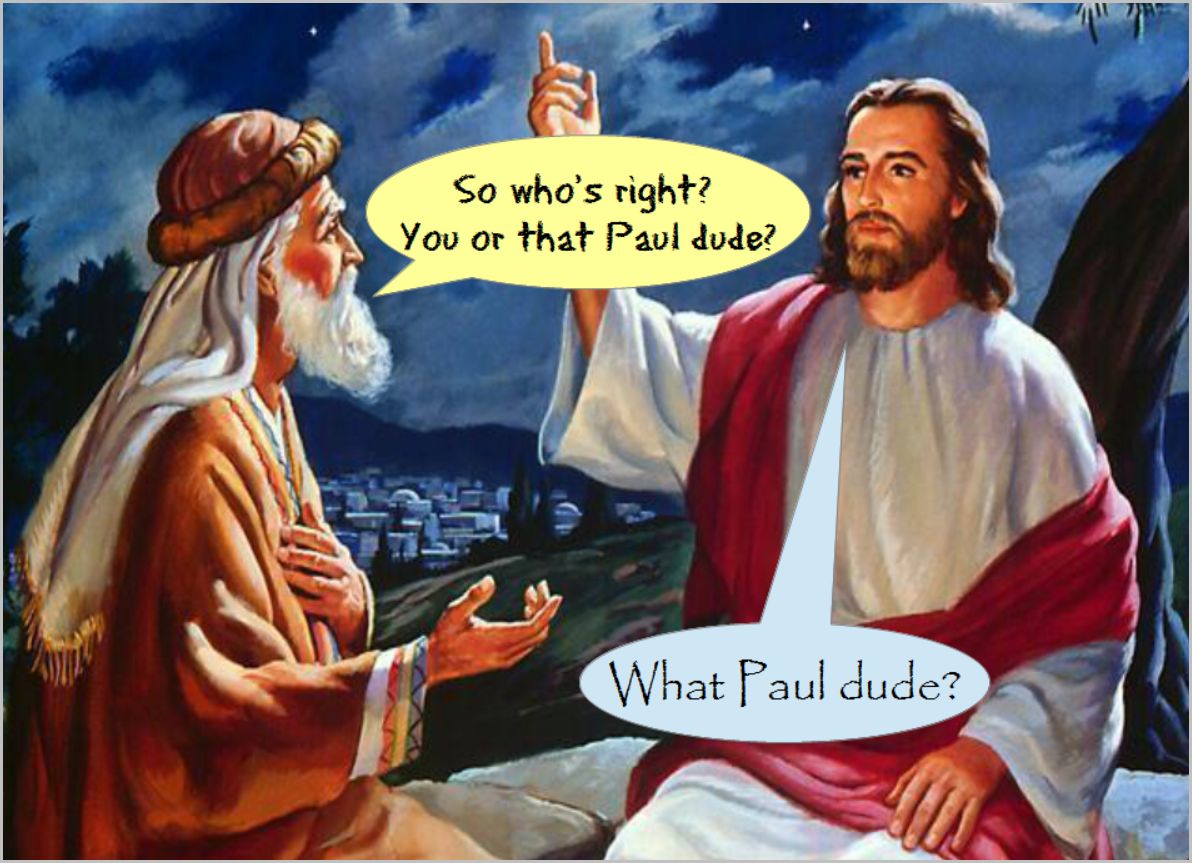
 

Jesus or Paul?

Nicodemus

Jesus is asked a few times in the gospels about how a person can find eternal life – like that’s the most obvious things to ask a travelling snake-oil salesman. Maybe it is, I don’t know. It was in the first century anyway, if the gospels are to be believed.

Jesus gives a variety of answers in the three earliest gospels: in Matthew 19.17 it’s ‘keep the commandments’ – those terrible, brutal laws I talked about last time. In Mark 12.30-31 he says the way to eternal life is to love God with all your heart and soul, and your neighbour as yourself. In other places he tells his audience that if you want to be forgiven by God then first you must forgive others (Matthew 6.14); if you want God’s compassion then first you must be compassionate (Matthew 25:31-46); if you don’t want to be judged, then you shouldn’t judge others (Luke 6.37).

Jesus is particularly fond of this kind of measure-for-measure salvation; it’s the lynch-pin of his good news – do unto others as you would have God do unto you. And almost every time he mentions it, he connects it with the Law and commandments.

Never does he say, anywhere in the gospels, that if you want to gain eternal life, or find favour with God, or be saved, then what you have to do is believe in the redemptive power of his own imminent death. Even when he could have done so, when he could have worked a little bit of Christian dogma into his teaching, he doesn’t. And that’s strange really, when you consider that Paul’s brand of Christianity – the one that’s come down to us today – is built entirely on the idea that the death and resurrection of Christ is the only thing can save us from God’s wrath.

Paul’s alternative gospel, which is expounded in Romans and summarised in Galatians 3.10-13, goes something like this:

Paul looks at the old Jewish Law and says, ‘actually it’s impossible. None of us can keep it. We’re all under a death sentence for some tiny infringement of it, because any and all infringements lead to the death penalty. But,’ he goes on, ‘Christ has taken that penalty for us by dying in our place. So although the law demands we should die and then suffer for eternity, we won’t, because he died for us. Then he rose again, just as those who believe in him will.’ That last bit – about believers rising from the dead – really doesn’t follow from his premise that the Law is impossible, but this is Paul talking, a man with only a passing acquaintance with logic. He doesn’t, either, have any evidence that Jesus took the penalty for the rest of humankind – he made that bit up too.

And that, in a nutshell – I do mean nut shell – is Paul’s ‘good news’. It bears no relation to the good news that Jesus preaches in the synoptic gospels. Admittedly, the Jesus who wanders his way through the first three gospels is for the most part a pre-death Jesus. You could argue, as a result, that he wouldn’t talk about redemption through his death before it had happened… but then again, why not? He talks about all sorts of other things he thinks are going to happen after he dies and rises again; he’s going to return pretty damn soon in a blaze of glory, through the clouds with an army of angels; heaven and earth are going to pass away; God is going to unleash his kingdom on the new earth.

But in spite of these mad speculations, he doesn’t mention even once in the synoptic gospels that people can be saved merely by accepting that he has paid – or will pay – the penalty for their infringements of the law, their sins if you will. Never. All the more odd when you consider that Mark, Matthew and Luke were putting their gospels together long after Paul preached his particular brand of salvation. Yet they don’t put this message into Jesus’ mouth, nor do they add it to the narrative.

It’s just not there.

So… were the gospel writers not aware of it? If they did know of it, was it that they didn’t like it? Did they know, in fact, that Paul’s formula didn’t square with what Jesus himself had said, or what they at least believed he’d said?

Whatever it was, the result is there are two conflicting versions of the ‘good news’ in the New Testament: Paul’s and Jesus’. One is easier than the other; in Paul’s plan all you have to do is believe. The other is difficult (and if we’re honest, really only designed for Jesus’ fellow Jews); it entails things like forgiving repeatedly, showing compassion, putting others first, turning the other cheek and, especially, following the six hundred and odd commandments that make up the Law.

So guess which one Christians today prefer.

Here’s a clue: it’s not Jesus’ gospel – the one without the magical incantation but with the barbaric Jewish law. But if, as Christians believe, Jesus was the Son of God – maybe even God himself – then why do they always accept Paul’s reinterpretation over and above everything their Lord said? Why do they disregard all that Jesus demands of those who would follow him, and take instead Paul’s easy path?

In the end, though, what Jesus and Paul (as well as the gospel writers and different factions of the early church) are in dispute about is the highly improbable and the absolutely impossible. It doesn’t matter whether they thought you could gain ‘eternal life’ by obeying the commandments or by letting someone else take your punishment for you; humans do not live forever. Just because a zealous first-century preacher thought they could does not make it so. Just because a different fanatic from roughly the same time believed it doesn’t make it happen either. There’s no evidence any human has ever, after this brief earthly existence, gone on to live forever. Equally, there’s no evidence that a deity exists, so those rules that are so important, in different ways, to Jesus and Paul can’t have originated with him. They’re man-made too.

So, with no God and no eternal life, Jesus and Paul might as well have been discussing whether the tooth fairy wears a pink dress or a green dress. What does it matter when she doesn’t exist?

How much more were they wrong about?

How long you got?

Christian love… but not so’s you’d notice

Church2Today, the world commemorated the relief of Auschwitz seventy years ago, following the murders of millions of Jews, homosexuals and gypsies.

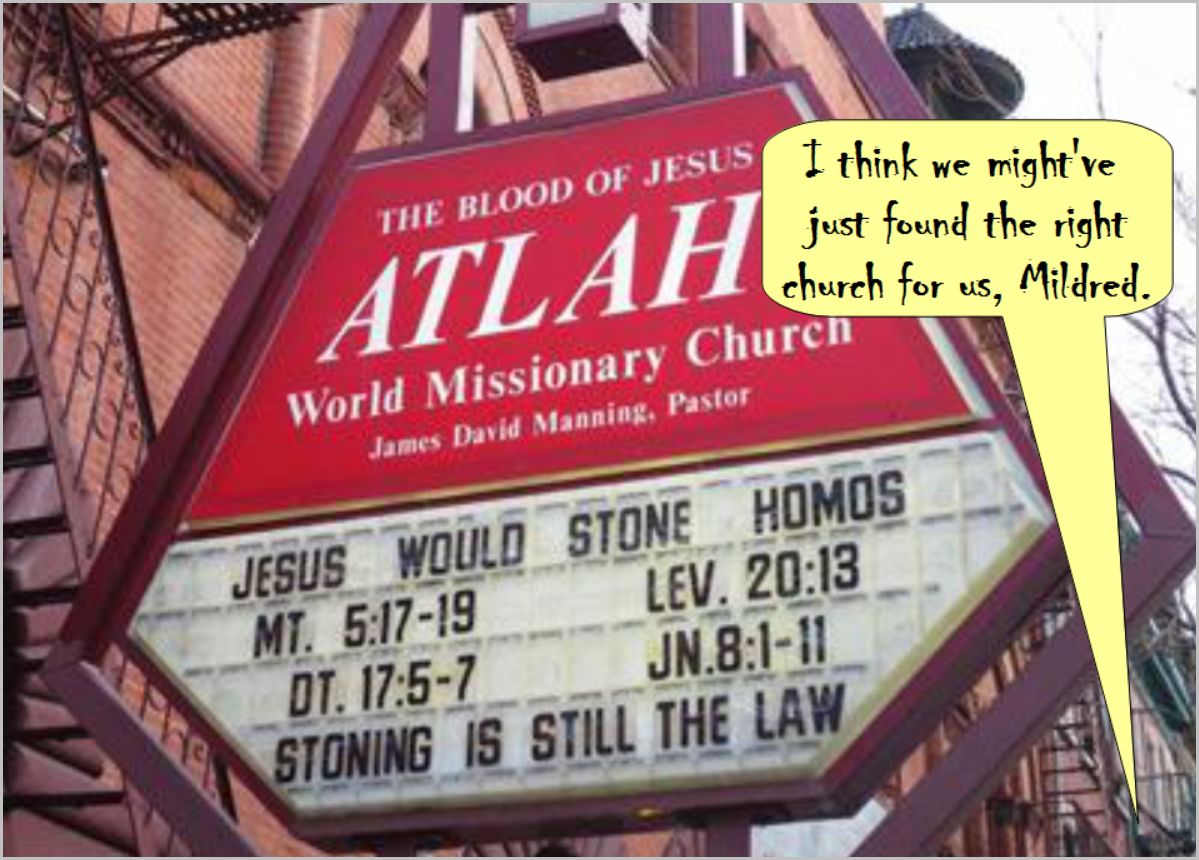
Also today, Christian pastor James Manning said Islamic militants are justified in executing gay people. Another man of God, Ben Carson, implied that Christian bakers might want to add poison to wedding cakes they are ‘forced’ to make for same-sex couples. And just before Christmas, pastor Stephen Anderson said gay people should be exterminated as the means of eradicating AIDS.

Whatever happened to ‘do not kill’? You know, the sixth of the much vaunted ten commandments that believers think should be displayed in public places so that the world might become a better place. I guess it’s far easier to display the commandments than it is to obey them.

What happened too to ‘love your neighbour as yourself’? This doesn’t – big surprise, Christians – mean endlessly pointing out others’ ‘sin’ while relentlessly banging on about ‘the Lord Jesus Christ’ like we’ve never heard of him before. Though again, I guess that sort of ‘love’ is a lot easier than actively caring for other people, regardless of their beliefs, values or sexuality, as much as you care for yourself. That, after all, is the whole point of the story of the Good Samaritan; the Samaritans were despised by the Jews of Jesus’ day in much the same way that homosexuals are despised by many of the righteous today. Yet it is a Samaritan whom Jesus makes the epitome of sacrificial neighbourly-love in his story. Still, what did he know?

And really, that’s my beef with Christianity. It just doesn’t work. Believing in Jesus, following him, as he insists you must, to the point of death doesn’t make you a better person. It doesn’t make you loving if you’re not already. Doesn’t make you meet the demands of the very one you claim was God on Earth. It certainly doesn’t make you more compassionate or even more intelligent, as the men of God above more than amply demonstrate.

So what use is it?


All gods must pass

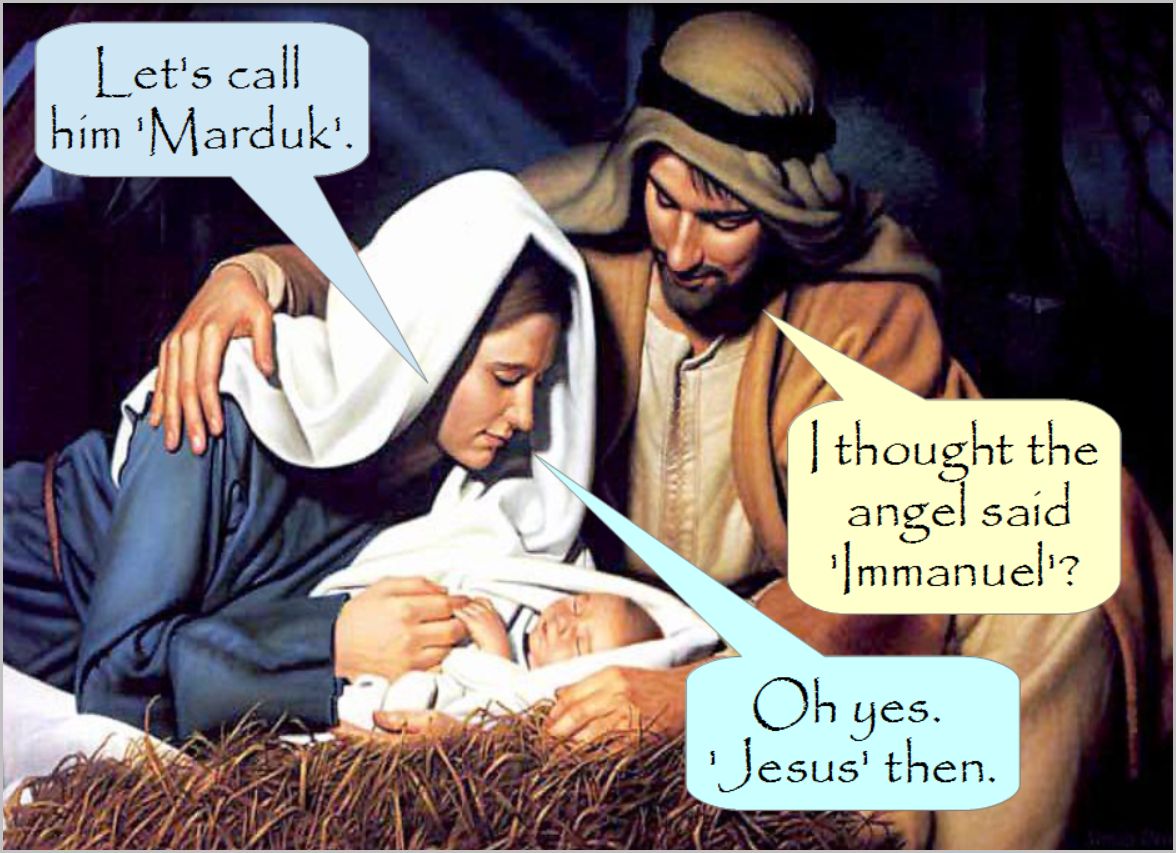
MardukIf human beings were suddenly wiped from the earth through, say, an Ebola pandemic, what would be left of us? What would become of all the things we’ve invented and created? What would happen to language, mathematics, science, literature, medicine, art, agriculture, architecture, democracy, industry, capitalism, civilisation, education, marriage, religion?

They’d all cease, most of them immediately. Remnants of others would survive for a little while before being reclaimed by nature. The surviving flora and fauna, the weather, climates, oceans, land masses would carry on just as before. Indeed, without humans around to abuse it both carelessly and deliberately, the rest of nature would flourish. Reproduction, evolution and the great cycles of life would continue unimpeded.

Which tells us what? That all of our accomplishments and preoccupations, from language and mathematics to marriage and religion are entirely human-made. When we go, they go. And nothing left behind will care. Our religions, all 4,200 of them, will disappear over night and with them their gods; Yahweh, Allah, Vishna will no longer exist, just as Marduk, Anu and Enlil no longer exist.

You’ve never heard of Marduk, Anu and Enlil? Of course not; this particular holy trinity were among the gods of ancient Babylon, a civilisation that existed two thousand years before the Christian God was even thought of. Their worshippers believed in them as enthusiastically as some people now believe in Jesus. For Babylonians, Anu, Enlil and Lord Marduk, the King of the Gods, were just as real, powerful and caring as Christ and Allah are for believers today.

But Enlil, Anu and Marduk have gone. From our vantage point we know they didn’t exist in the first place. They were nothing more than the product of ancient people’s imaginations. That didn’t stop those same people from having real faith in the three of them, praying to them and knowing in their hearts that they were being watched over by them. But as their civilisation fell, the Babylonians discovered that Marduk and company weren’t there to defend and preserve them. When, in 539 BCE, Babylon finally ceased to exist, so too did its mighty gods.

And so will the mighty gods of our own era. Either when a pandemic destroys us or when we destroy ourselves, or even when – as unlikely as it might seem – we come to our senses and abandon belief in made-up things.

However it happens, there will be no repercussions. Yahweh, Christ, Allah and Vishnu will not smite the Earth in their wrath at our abandonment of them. They will, instead, pass silently from history just as Marduk, Anu, Osiris, Zeus and Woden did before them.

If you still cling to human-made deities – and they’re all human-made – why wait? Why not be ahead of the game and let go of them now? Allow your pet god to go gently into that good night. You’ll not miss him, and he certainly won’t miss you. How can he? He’s not real, after all.

 
This post was prompted by Sapiens: A Brief History Of Humankind by Yuval Noah Harari.


Where is the love?

ExecutionThe picture above has shocked and affected me deeply. It shows a man about to be thrown to his death from a high building in Iraq. According to the original news source, a large crowd was gathered below to watch him fall and then die as he hit the ground many metres below. Another man was then killed in the same way. This happened within the last couple of days; the photo, along with some others, was released by IS on Friday.

The men’s ‘crime’ was that they were deemed to be gay. The method of execution is that prescribed by the Koran.

Religion – in this case Shari’a Islam – lies behind and motivates behaviour of such profound inhumanity. It could be argued too that this is part of the culture in which these people live and as such, must be respected. Really? So what is ‘cultured’ about murdering people?

I’ve been asked recently whether I shouldn’t respect the right of people to hold religious views. But how can I – or anyone in a civilised society – accept the right of others to believe that, simply because someone’s perceived sexuality ‘offends’ an imaginary god, that person should die? And not only that, but that they merit a sentence of such barbarity?

I can’t respect such views, nor anyone’s ‘right’ to hold them; they will, inevitably, act upon them, just as we see here.

There are Christians too who support the death penalty for homosexuals (for example, here, here, here, here and here). Well, you men of God, this is what it looks like, though I guess your preferred method of execution would be to stone them to death, just as your own ‘holy’ book advocates (Leviticus 18.22, 20.13).

No respect is due to people who behave like this towards others, nor to the religions that ‘inspire’ them. Bullies who believe fellow human-beings should be executed because of who they are, and thugs who justify murder because it’s done in the name of an invented deity, are not worthy of anyone’s respect.

Where is the international outcry about this? The solidarity? The politicians linking arms? The advocacy of the civilised world?

Je suis découragé.


Thank you, Nick, for your question and to Joe.My.God.

The gift that keeps on giving…

PunchSo that’s it then. The Pope has spoken. We can no longer ridicule religion.

Frankie warned yesterday that faith, his own especially, cannot be mocked.

Shame. I was enjoying this.

Predictions for 2015

BrideMy predictions prophecies for the year ahead:

1. There’ll be no Second Coming in 2015.
Jesus won’t be back this year. Just like he wasn’t back in 2014, 2013, 2012… 1985… 1914… 1868… 1497… 1000… 446… 35. Just think of all those years – count ’em, nearly two thousand – when he’s failed to return so far. Actually, he promised he’d be back while his disciples and those daft enough to listen to him were still alive – around AD30 or thereabouts (Matthew 16:27-28; Matthew 24:27, 30-31, 34; Luke 21:27-28, 33-34). Safe to say he’s not coming back at all now, just like dead people don’t. Not in 2015, not ever.

2. Christians will go on insisting Jesus is going to return any time soon.

3. There’ll be no natural disasters or human calamities as a result of same-sex marriage.

4. Christians will claim natural disasters and human calamities are the result of same-sex marriage. Shaking our fists at God… the wrath of the Almighty… sign of the End Times… blah, blah, blah.

5. More than one prominent Christian will call for the execution of gay people.

6. Christians in the west will claim they’re being persecuted when they’re being expected to treat others fairly and equally, and not to discriminate against them.

7. Christians will respond to criticism with clichés like ‘they wouldn’t dare say that about Muslims’… ‘Christians are the last group who are fair game’… ‘It’s time for Christians to speak out’… ‘Stand up for God’s standards…’ etc.

8. Christians will continue to dismiss and disparage anyone who doesn’t share their views, especially atheists. Look out for ‘atheists have no morality’, ‘the fool hath said in his heart there’s no God’ and ‘atheists want to oppress Christians’ occurring with tedious regularity.

9. There will be more revelations about the abuse of children by church ministers.

10. Church hierarchies will attempt to cover up the abuse of children by their ministers.

11. There will be the usual manufactured ‘war on Christmas’.

12. These predictions have far more chance of coming to pass than any of the so-called prophecies of Bible. I’ll return to them at the end of the year so we can see.

A happy new year to you all!


Original picture: Ursula Klawitter / zefa / Corbis

Idiotic Stuff Jesus Said 9: God knows what you need before you ask him

PrayJesus said: ‘Do not be like non-Jews, for your Father knows what you need before you ask him.’ Matthew 6.8

Prayer has been in the news quite a bit lately. Not, of course because it’s suddenly started working, but because prominent Christians have been pretending, yet again, that it does:

Archbishop of Canterbury, Justin Welby, has been telling us just how important prayer is. He prays for others while he does the ironing.

The pope has been praying for victims of Islamic State.

Churches in Glasgow have been praying for the victims and families involved in last Monday’s terrible accident there.

Bishops in Australia prayed for victims of the Sydney seige.

Christians inherit this futile behaviour and empty posturing from Jesus himself. He believed that talking ‘in secret’ to his god-in-the-sky could actually change things down here on Earth. This God, according to Jesus, knew what his children wanted even before they asked.

His children were not, however, Christians; they were Jews. The phrase I’ve interpreted above as ‘non-Jews’ is ‘Gentiles’, which means exactly that – outsiders who weren’t Jews. These outsiders, Jesus implies, just don’t get prayer. Only the chosen people, the Jews, do. Only they know how to talk to the big Sky Daddy properly and it’s only their needs that he knows about beforehand. He isn’t interested in others, their needs or their prayers.

But if he knows the needs of his chosen before they even ask him, why doesn’t he simply meet those needs? Why does he have to be asked? What sort of perverse and twisted version of a loving father is this, who insists on being asked before he will consider acting? I’m only a fallible and flawed human being but when I know my children’s needs, I don’t wait to be asked to meet them.

Maybe God isn’t really as magic as Jesus seems to think. Maybe he needs time to let things happen by chance so that he can then take the credit. Because there’s absolutely no evidence prayer works. The opposite is the case; there’s plenty of evidence to suggest that the supposed results of prayer are no more likely than if they happened by chance.

As if this weren’t ludicrous enough, many of the examples of prayer we’ve heard about recently are prayers after the event; appeals for the victims and survivors of disasters once the disaster has struck. So did God not know those involved ‘needed’ not to be killed or tortured or bereaved? If he didn’t already know this, then Jesus’ claim is, like so many others he made, utterly worthless. And if God did know, why did he not do anything to prevent the loss of life, the hardship, the devastation? Because he wasn’t asked

It’s likely though that he was asked, by those believers who were caught up in appalling circumstances. So then, why didn’t he act? Why didn’t he meet those needs he knew so much about beforehand?

Perhaps he just doesn’t care or he’s not able. Or, more likely, maybe he doesn’t exist.

And if he doesn’t exist, then Jesus was wrong in everything he said about him. He was wrong to think God was there in Heaven, taking an interest; wrong to think he cared. It also means Jesus certainly wasn’t the son of any such god. Nor was he the human manifestation of a make-believe Sky Daddy on Earth.

Answers to this year’s all-new Christmas Quiz

saving-christmas-posterGod save us all from this, this Christmas time.

1. Where does the word ‘Christmas’ come from?
The answer is b, the name comes from the Catholic Mass held on the supposed date of Jesus’ birth. So all you anti-Catholic Christians need to find a new name for it fast.

2. When was Christ born?
a) is the answer here: Christ wasn’t born. Maybe Jesus was, but ‘the Christ’ is an invention of later Christians (Paul, for example, in Romans 8.3 and John’s gospel, written up to a century after Jesus lived.) The Christ is a mythic, supernatural being who’s always existed. He bears little relation to the itinerant Jewish preacher Yeshua who wasn’t born on 25th December or in the year 0.

3. Which gospel writers didn’t think the nativity story worth including in their accounts?
Mark and John (b & c) don’t bother including it. Did they not know it? The two gospels that do have bits of the story – Luke and Matthew – contradict each other.

4. How well attested are the events surrounding the birth in historical documents of the time?
a) Not at all. You’d have thought the Romans, who were pretty good at keeping records (lots of which have survived) would have noted Herod’s massacre of little boys or the appearance of a new, magic star in the sky – they were, after all, a superstitious lot. Not even Josephus, who, in the late first century, acknowledges the existence of Christians, sees fit to mention any of it.

5. Following the miraculous events of Jesus’ birth, what did Mary do?
According to Luke 2.19, she treasured them in her heart. However, the answer is c) because only a few verses further on, she hasn’t a clue about what her son is up to (Luke 2.48). Later still, she is part of the family’s efforts to ‘restrain him’ (Mark 3.21 & 31). Why, on these occasions, doesn’t she recall his miraculous beginning and think, ‘oh yes, I remember now. He behaves like a lunatic because he’s the son of the Most High.’ She certainly didn’t write down the details of his miraculous birth for later use in the gospels. No-one did. On account of them not really happening. Just sayin’.

6. How many times does Jesus refer to his miraculous birth?
a) Never. Strange that.

7. How many times does the rest of the New Testament refer to Jesus’ miraculous birth?
c) Never, even more strangely. Evidently the story hadn’t been invented when the rest of the New Testament was written.

8. When did Christians first start celebrating Christmas?
a) hundreds of years later.

9. Which of these Christmas traditions originate in the Bible?
None of them. Despite what Kirk Cameron might think, Christmas trees, kissing under the mistletoe and giving presents all have pagan origins. The giving of gifts did not come about because the wise men did it first. The tradition pre-dates Christianity.

10. Which of these groups has benefited the most from Jesus’ birth?
Yes, you’re right; none of them. Not women, not black people and not LGBT people. Christianity has a history of oppressing all three groups.

Speaking of which…
11. What does Pastor Steven Anderson want for Christmas?
c) he’d like to see the execution of all homosexuals so that AIDS – which, as far as the reverend understands it (I use the term loosely) only gay people get – might be wiped out. Peace and joy to you too, Stevie.

12. How will Christians celebrate Christmas this year?
The answer is a, b and c: by fighting the War On Christmas, putting the Christ back into Christmas and by telling us that Jesus is the Reason for the Season. Just like they do every year. As you can see, Kirk Cameron’s disaster of a movie, Saving Christmas, has two of these blessed clichés on its promotional poster alone.

So how did you do?
If you scored –
between 10-12: well done. Betcha don’t believe in Santa Claus either.
Between 7-10: your cynicism needs a little work. Order my book for Christmas – it’ll help.
Between 4-6: oh dear. You’re new around here, aren’t you. There’s hope for you though, so stick around. Oh yeah, and order my book for Christmas – it’ll definitely help.
Between 1-3: Like Christmas, you are in need of saving, my friend. May the scales fall from your eyes this holiday period. Amen.

It’s a Miracle!

MaryDo you believe in miracles? Do they happen? Author Eric Metaxas thinks so. He says so in his new e-book, Miracles: What they are, why they happen and how they can change your life.

He also says that anyone who doesn’t believe in miracles is closed-minded and intolerant, which is his Christian persecution complex speaking. Metaxas and other believers who accept unusual events as miracles are, apparently, ‘open-minded’, while the sceptic who looks for a rational or scientific explanation isn’t.

But isn’t the reality the opposite of this? Isn’t the seeking of rational explanation and analysing the evidence, the open-minded, imaginative act? And isn’t blindly accepting on faith that a particular event is the Christian God (naturally) messing about with ‘the laws of physics’, the closed-minded, unimaginative response? By definition, closing down all other possible explanations is the closed-minded response. It takes no imagination, no being open to possibilities, to refuse to look for an explanation beyond ‘God did it.’

As I’ve said before, most miracles are, in any case, very mundane, trivial affairs. They’re never the regrowing of severed limbs, the eradication of Ebola or the holding back of a tsunami. Why not? Why are ‘miracles’ always so unimpressive, like the ‘inner healings’, visions and coincidences Metaxas writes about? Why do they have far better scientific or rational explanations than supernatural ones? And when it comes to it, why do we more often hear about miracles than see them for ourselves? Why are most miracles nothing more than hearsay, rather like ghost sightings? It’s uncanny how miracles always happen to someone else, who swears they really happened just as they describe them (this is where the exercise of imagination comes into play.) The miracles in Metaxas’s book seem to be just this; second hand accounts of largely unspectacular coincidences and hallucinations, none of which happened to the author himself nor were witnessed directly by him. Why should any thinking person accept such spurious testimony? Why indeed should we be ‘tolerant’ of such woolly wishful-thinking?

If, for you, second-hand reports of unremarkable events qualify as miracles, then so be it. Like Eric Metaxas, you should just close your mind and accept. But don’t tell those of us who are considerably more sceptical that we’re the ones who aren’t open-minded or tolerant.


The picture above was originally used as a billboard by St. Matthews-in-the-City Church in Auckland, New Zealand. The captions were added later, though I don’t know by whom.