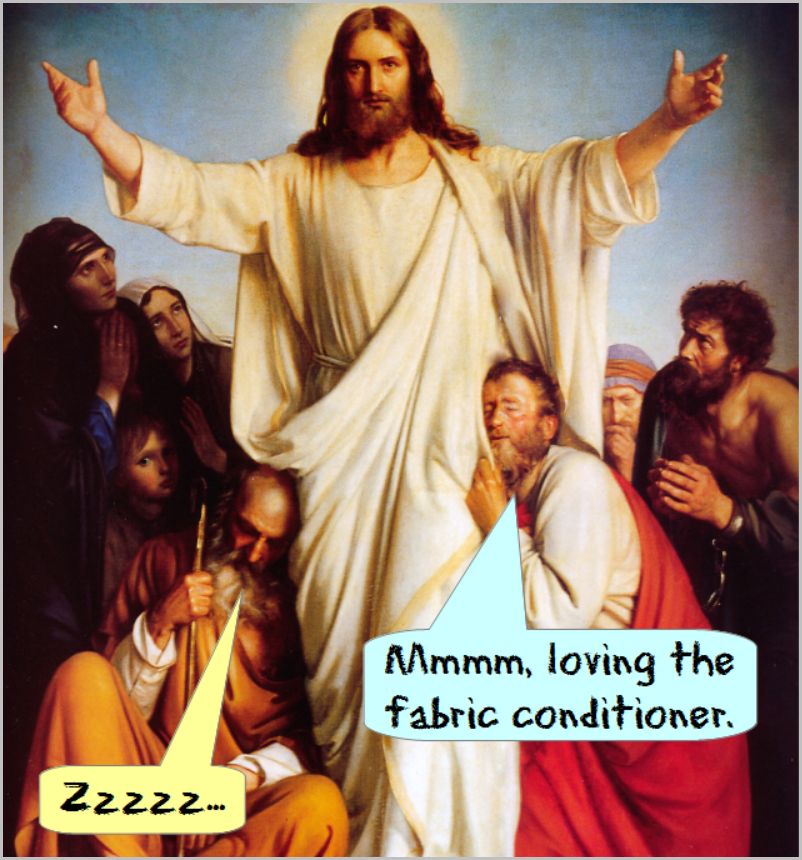
Idiotic Stuff Jesus Said 13: We Don’t Need No Educashun

MegaBut you are not to be called rabbi (teacher), for you have one teacher, and you are all brothers. And call no man your father on earth, for you have one Father, who is in heaven. Neither be called instructors, for you have one instructor, the Christ. The greatest among you shall be your servant. Whoever exalts himself will be humbled, and whoever humbles himself will be exalted. Matthew 23:8-12

Evidently these words were put into Jesus’ mouth by the community that produced Matthew’s gospel and reflect the egalitarianism and communism that characterised it. The phrase that gives away their origins is ‘you have one instructor; the Christ’. ‘The Christ’, as we know, was a creation of the early church and it is highly unlikely Jesus would have referred to himself in such a way. In the synoptic gospels he is reticent even about claiming the Jewish title of Messiah for himself. In any case, the reference is patently to a third party, and is by an author or interpolator who subscribes to the later, supernatural Christ.

In the unlikely event, then, that these words emanated from Jesus himself, all they achieve is to demonstrate his lack of understanding of human psychology. Even as ‘Matthew’ set about recording them, the newly founded church was already ignoring them, which is perhaps why he felt the need to have Jesus say them. Here’s Ephesians 4.11, written by someone pretending to be Paul round about 80-100CE, contradicting them:

Christ gave (us) the apostles, the prophets, the evangelists, the shepherds and teachers…

The imposter who wrote 1 Timothy (5:17) up to a hundred years after Jesus’ death goes further, endorsing the exaltation of those who teach and rule others:

Let the elders who rule well be considered worthy of double honour, especially those who labour in preaching and teaching.

Why? Because human beings like hierarchies. Almost all human societies are hierarchical in nature and groups invariably arrange themselves hierarchically. There will always be people who see themselves as leaders and teachers and still others who look to those who’ve set themselves up as authorities to tell them what to do.

Despite what Jesus or ‘Matthew’ might have preferred – everyone being equal while those who ‘exalt’ themselves are humbled – it just doesn’t happen in human culture. It certainly wasn’t happening in the movement that emerged following Jesus’ death, in the church that existed by the time Matthew was making Jesus say that the only authority Christians should recognise was God’s and his own. The institution that was appearing in place of the end of the age – an institution that Jesus neither anticipated nor instigated – could not function effectively as the simple band of ‘brothers’ he is made to suggest. It was in need of structure, and a hierarchy was it.

And so it was that, before long, the first popes emerged – ‘pope’ deriving from the Latin for ‘papa’. Each of these exalted figures would come to be referred to as ‘Holy Father’, a title still in use today. With complete disregard for Jesus’ instructions, other priests (meaning ‘elders’) in the Catholic church also assumed the title ‘father’. Evangelical churches, lest they think the Catholic church is the only guilty party, have their ‘pastors’, meaning ‘shepherds’, who, by definition, lead others. A common or garden ‘clergyman’ is a ‘learned man’, while a bishop is one who ‘looks down from above’. An archbishop is chief look-downer and exalted indeed. Elsewhere, showmen preachers in mega-churches ‘teach’ with a mixture of anecdote, wild conjecture and stuff they make up as they go along; tune into TV’s God channels for a taste of this particular brand of humility. The church in all its manifestations has, from the beginning, been hierarchical from top to bottom.

Jesus, however, didn’t want there to be a top or bottom; if Matthew 23.8-12 is to be believed, he commanded there shouldn’t be. He envisaged his followers living in harmony with everyone equal under his and God’s authority. No-one was to set themselves up as teacher or leader; no-one was to exalt themselves above others. If any did, they would need to be humbled. But this isn’t how human beings organise themselves, and never how the church has conducted itself. Shouldn’t he have known that?

Who Decides?

DavisI’ve written before about how some parts of the Bible are more important than others; about how Christians relegate some of it – ironically much of what Jesus is purported to have said – while elevating other bits. These latter aspects trump the former, so that if there’s ever any dispute about how Christians should behave in a given context, they’ll happily cite the elevated parts while overlooking those that are less to their liking. This happened recently in the Kim Davis case,* which I talked about last time. In that context, the verses from Romans I quoted, in which Paul instructs believers to obey civil authorities, are explained away and dismissed in favour of other passages. Here are commenters doing just that on the crackpot Christian site, World Net Daily:

Have you not read Acts 4:19 and 5:29? There is a time when God’s authority trumps human authority. In this case, Kim Davis stood up for God’s authority. God’s word calls homosexuality an abomination. Ephesians 5:11 teaches that Christians must have nothing to do with the works of darkness, but instead expose them.

and

Sometimes…when you give to God…what is God’s…you will have to disobey the civil authorities that are over you. Kind of like Paul…refused to stop preaching and jailed…God took care of him, though, I do believe. Although never truly jailed, except at the end…didn’t Jesus disobey the “law”, Mosaic Law, when He preached?

It’s not as if Paul was writing about ‘authorities’ that conducted themselves in considered or considerate ways; this was the Romans, after all. They would eventually execute Paul – so much for God taking care of him! – just as they had Jesus himself. Nonetheless, Paul tells the brethren they must honour Roman authorities. But somehow, if Christians today are to be believed, he just didn’t understand what it’s like to obey civil (in both senses of the word) secular authorities in the 21st century. They consider his teaching in the early part of Romans 13 to be invalid, no longer applicable, irrelevant to the very situation it was designed to address. Other passages from the Bible are far more important and therefore trounce it easily.

But who decides this? Who decides, in what these same Christians deem to be the literal Word of God, which words are less literal than others; less applicable; less relevant? And, consequently, which are more important, more applicable, more ‘of God’?

The evidence would suggest it’s the individual Christian who does, led, no doubt, by the Holy Spirit, who inexplicably leads different believers to different conclusions about the same source material. There’s no ‘free-will’ involved in this process, however; individual interpretations of scripture are informed by the consensus of the church or the movement with which individual Christians align themselves. But who in these institutions determines the order of priority for the Bible’s many confused and often contradictory injunctions?

Determining what is important in the Bible, and what isn’t, is the result of a consensus of prejudices and biases. It’s easy to find ‘teaching’ in the Bible that supports one’s own views and opinions and equally easy to find that which doesn’t and is incompatible with the position one already holds. To reconcile the two, and to deal with the discomfort of any cognitive dissonance, Christians demote any teaching that doesn’t correspond with their pre-existent world-view – sorry, Paul, but this includes your silly suggestion that we should obey the authorities – while promoting those ideas that conform to and confirm that outlook (so hurray for those verses that say gay people are abominations and have no place in the Kingdom of God!) The very words of God are ranked according to the whims and prejudices of those reading them.

Again, I’ve written before about Christian priorities, about how those parts of the Bible they find unpalatable and challenging – such as those that say they should give away all they have and love their enemies – are explained away or ignored. But as for those passages that tell Christians how superior they are while excoriating others as ‘works of darkness’ – well, now you’re talking!  


*While Davis claims all her husband swapping took place before she met Jesus, she was a member of the Baptist church while she was busy trying them all on for size. At least three of her wedding ceremonies were conducted by Baptist ministers. All that happened in 2011 was that she joined the more extreme pentecostal movement, which empowered her to ignore the log in her eye and concentrate on the speck in others’.

The Jesus Cult

Cult2A programme on the UK’s Channel 5 this week, Trapped In A Cult?, featured stories of people who had had encounters with or had escaped from cults. It didn’t spend too much time defining what a cult might be, but suggested that it’s a movement revolving around a charismatic individual who insists that only he or she has a direct line to God or some sort of Higher Truth. Such individuals insist that others must follow their teaching exclusively and that followers sever all ties with family and non-believing friends. They frequently demand too that followers give up their material possessions in order to demonstrate their commitment to the movement.

The programme also noted that once the original founder of a cult dies, or has been discredited in some way, belief in him or her can persist, with followers persuading themselves that their leader has miraculously transferred to a higher plane of existence. (Further information about cults and their leaders can be found on The Cult Education Institute web-site.)

Many modern religious movements conform to this pattern: The Church of Latter Day Saints (Mormons), Jehovah’s Witnesses, Christian Science, the Unification Church (Moonies), Scientology and Branch Davidians to name but a few. Orthodox Christians are always eager to point out the apostate, cultish nature of these heterodox ‘churches’, blind to the fact that their own belief system began in exactly the same way. The original Jesus movement had all the hallmarks of a cult and its leader the characteristics of a cult leader:

Jesus insisted that only he had a direct line to God and Higher Truth:
For example in Matthew 10.32–33: Whoever acknowledges me before others, I will also acknowledge before my Father in heaven.  But whoever disowns me before others, I will disown before my Father in heaven

and John 14.23: Anyone who loves me will obey my teaching. My Father will love them, and we will come to them and make our home with them.

He demanded his teaching be followed exclusively:
For example in Luke 10.16: He who listens to you, is listening to me; and he who rejects you is rejecting me; and he who rejects me is rejecting him who sent me

and Matthew 12.30: Whoever is not with me is against me, and whoever does not gather with me scatters.

He expected his followers to sever ties with family and non-believing friends:
For example in Luke 14.26: If anyone comes to me and does not hate his own father and mother and wife and children and brothers and sisters, yes, and even his own life, he cannot be my disciple.

He told those interested in joining his movement to give up material possessions:                                                                                                             Matthew 19.21: If you want to be perfect, go, sell your possessions and give to the poor, and you will have treasure in heaven. Then come, follow me.

and when he died, his followers persuaded themselves he’d gone on to a higher plane:                                                                                                                  Luke 24.51: While he blessed them, he parted from them and was carried up into heaven.

What do we learn from this? That if it looks like a cult, sounds like a cult and behaves like a cult then the chances are, it’s a cult. Christianity is just a first century cult that hit the big time. We are now so used to having it around – how legit it became! – we overlook its origins and essential characteristics. These are exactly the same as any other cult, both before and since.

I Don’t Believe It

Fabric‘When you think about it’, the taller of the two men said, ‘there is no evidence whatsoever that God, nor indeed any supernatural being.

‘I suppose you’re right’, said the other.

‘With that realisation, my faith began to dissipate. I mean if there’s no God, no angels, demons or Christs, no Holy Spirit, devils, fairies or Santa Claus, then it must mean they’re just figments of the imagination. Take that human element out of the equation and what you’re left with is… well, the natural world and nothing else’.

‘I suppose not’, said the other.

‘From there one realises there is no point in praying – I mean, talking to a being who only exists in your own head. Or reading the Bible; one begins to see it as a very human book, which of course it is’.

‘I suppose so’, said the other.

‘It means too that Jesus can only have been a mortal man – of course he was – and that a good deal of his teaching – if we can believe it really was his and not simply invented by his followers – makes no sense whatever. It was only the eyes of misplaced faith that made it appear so’.

‘I suppose it doesn’t’, said the other.

‘I mean, “pray for whatever you need and God will supply it”. Who has ever believed that sort of thing anyway? No-one. Not really. We all know that doesn’t work; Jesus himself, one suspects. And as for the resurrection, well, if you read those accounts at face value all they saw – Mary Magdalene, Paul and the rest of them – all they saw were visions, not a real person. All in their minds, you see’.

‘I suppose I do’, said the other.

‘No, Christianity is nothing but false promises, failed prophecies – Jesus saying he’d return within his disciples’ lifetime – and impossible morality: “be perfect as your father in heaven is perfect”! Well, I’ve never met anyone who is, Christian or otherwise. Good people are good whether or not they’re Christians and the mean-spirited are mean-spirited whichever side of conversion they’re on.

‘I suppose so’, said the other, before seeing his chance to add, ‘well, that’s £1.80 for your Church Times, Archbishop. Will there be anything else?’

Of Pans & Kettles

WilliamMeet Father Dwight Longenecker. He operates a blog called Standing On My Head, which, if he really does, might account for the topsy-turvy view of the world you’ll find there. Dwight makes grandiose and daft claims for the Roman Catholic church while taking side-swipes at others’ beliefs: Atheism, he says, is dull because – quite unreasonably – it insists on ‘evidence’, which Dwight is sure is quite over-rated. Other belief systems are boring because they don’t involve nearly as much dressing up and parading with statues as Catholicism. Islam is a demonically inspired religion that can only be defeated by Aslan the Catholic church’s special magic… you get the picture.

Here are some other fantastic claims he’s made recently:

On other religions:
There is only one God who is the source and ground of existence. However, there are also demonic beings sometimes called “demi-gods” that many people worship as “gods”.                                                                                                                           

The ‘everybody is wrong but me’ argument, which is ironic when so much of what Catholics believe isn’t even remotely biblical: the Pope, purgatory, Marian worship, saintly intercession, transubstantiation. All this extraneous stuff is regarded by other Christians as being itself ‘demonic’. Dwight doesn’t seem to realise he’s in a glass house (church?) and in no position to cast this particular stone. 

On the after-life:
I would have thought the universal human belief in an afterlife – as well as near death experiences – provide ample evidence, but of course (atheists) dispute that.

The problem here is that there is no ‘universal belief in an afterlife’. As I note in ‘All Is Vanity’ below, the belief in the resurrection of the dead is a very late development even in the Old Testament; ancient Judaism, despite its belief in Yahweh, did not consider the possibility for most of its existence. That said, if there were such a universal belief, it would not mean eternal life actually existed. There has always been widespread belief in fairies and sprites but that doesn’t make such beings real. There is no correspondence between the extent and persistence of a belief and the existence in reality of its object.
As for near death experiences, the clue is in the name; near death. Near death is not death, it’s life. How else would we know of the experiences if not through people who have been resuscitated, brought fully back to consciousness? These experiences are now known to be brain-induced hallucinations while a person remains, if only just, alive.

On the Catholic version of the after-life:
Your understanding of the Catholic approach to the afterlife is immature. We don’t spend our life trying hard to get into heaven. We spend our life in an abundant, joyful and disciplined way being a follower of Jesus Christ and aiming to become “perfect as he is perfect”.

That my understanding of an immature belief is immature seems fitting. I don’t suggest Catholics spend their lives trying to get into heaven; this is a straw man of Longenecker’s creation. I’ve also yet to meet a Catholic who is any more ‘perfect’ than the rest of us. I’ve not encountered many joyful ones either, come to that.

On living this life:
The intrinsic problem with your saying you would rather make the “most of this life” is the question of what that actually means. Your idea of “making the most of life” and your neighbor’s idea of “making the most of life” could vary enormously. Who is to say what “making the most of life” consists of?

Dwight and the church he represents would rather we all conform to Catholic ideas of what makes life worth living. As for who is to say what making the most of life consists of, I’d have thought it was those living it. Dwight has chosen strange religious practices as his way of living his life, but so insecure is he in his choice he feels the need to denigrate others’ choices as a means of bolstering his own.

On the world’s problems:
It seems to me that most of the problems in the world are caused by people “making the most of life”- which usually means unfettered and total selfishness – which of course leads to destruction.      

I’d be the last person to mention the Catholic church’s paedophilia scandals, its covering up of those scandals, its suppression of women and LGBT people, its accumulation of vast wealth in the service of one who constantly preached against it. Nor would I want to say anything about the church’s historic failings (so no mention of the Inquisition, the imprisonment and execution of those who disagreed with it, its support of Hitler and so on.

Dwight presents no evidence for his subjective claim (‘it seems to me’) that the only alternative to Catholicism is hedonism and selfishness. The false dichotomy is wholly disingenuous. It is not hedonism or atheism that says we merit God’s special attention; not atheism that panders to our selfish desire to live forever; not atheism that says God will get us out of the hole into which we’ve dug ourselves; not atheism that promulgates such a supremely arrogant and self-centred view of life. No, it’s the Christian perspective that does that, the Catholic one. Indeed, it could and has been argued, by Hitchens, Harris et al, that most of the problems in the world are caused not by atheism or even ‘unfettered selfishness’, but by religion.

Atheism and the humanism to which it gives rise accept that we got ourselves into this mess and it’s ourselves who will have to get us out of it. Maybe that’s boring and maybe it will prove impossible, but it’s better, more realistic, than appealing to fairy tales, dressing up and talking to statues.


Picture updated 23/08/15

The Holy Spirit: transparently nonsense

CageIf anything is unsubstantiated fantasy, it’s the Holy Spirit. It – I know Christians prefer ‘he’, but the pronoun used in the Greek of the New Testament is more often neutralit began life as the comforting, fuzzy feeling the early believers got when they remembered their recently deceased leader. The same feeling that convinced them he was alive again in a sort of not-really-alive but as-good-as kind of way:

“He’s, like, alive-in-our-hearts and, hoo boy, what a buzz there is when a few of us get together and share that vibe at the same time. Far out, man. Hey, let’s put it in the story that this is exactly what he said it would be like when he was still alive!” (Matthew 18.20, sort of)

High on this feeling some believers started imagining they were actually in the dead leader’s presence and – miracle of miracles – could see him and commune with him (1 Corinthians 15.5-8). Such an experience, they felt, could only be from God and must, in some inexplicable way, actually be a part of God (1 Corinthians 2.10). And so the Holy Spirit – the capital letter version – was born. Spiritual highs had taken on independent existence as an aspect of God.

Except, of course, they didn’t. They remained feelings, amplified in and by a communal setting. And that’s what they are today. Which is how, when a Christian tells you the Holy Spirit prompts him or her to say or do certain things, the result is always in line with the teaching of his or her particular church or sect. So, for example, the interpretation of the scriptures to which the Holy Spirit leads a group of believers is fully in keeping with that of their denomination, church and pastor. Dissent is actively discouraged and those with different views are apostate, deceived by the devil and not led by the Spirit at all. Maybe, they’re told, they were never really Christians in the first place, which is remarkable, when the dissenters’ experience of the Spirit is every bit as real as the rest of the community’s. Experiencing one’s own thoughts and feelings usually is.

It never seems to occur to Christians how odd it is that this supposed aspect of God, the Spirit, leads different groups of believers down different, often contradictory, paths. How could it do that if it was truly of God? Why would it do that? It’s erratic, idiosyncratic methods are clear evidence of the human origin of its ‘working’. The Holy Spirit’s prompting is, as it was in the beginning, a communal feeling given ’embodiment’ by corporate consent. It even works effectively when believers are separated from each other, social pressure producing conformity.

Experiencing the Holy Spirit is not unlike the way those involved in a séance or in a ‘haunted’ house convince each other there is a presence in the room. These ‘ghosts’ are socially constructed too, from shared feelings and often not a little ‘guidance’ from those who claim to know better. The Holy Spirit is ‘realised’ in the same way, most clearly among a ‘worshipful’ group of Christians whipped up into a state of euphoria attributed to the work of the Spirit.

But the Holy Spirit is without independent existence in both origin and manifestation. It is human make-believe through and through. Any Christians who think otherwise are invited to provide evidence of the Spirit’s independent existence, separate from human emotions and imagination.

And the World Turns

SerpentOver at the wackily named ‘Cripplegate‘ blog, pastor Mike Riccardi has an urgent message. Mike, in case you’re wondering, is the Pastor of Local Outreach Ministries at Grace Community Church in Los Angeles. He also teaches Evangelism at The Master’s Seminary. His urgent message is that God is not happy and must be appeased.

As we already know, the most powerful, creative and omniscient being in the whole of the universe and beyond is so very easily upset. And as usual what’s upsetting him is the Gay. But that’s not all this time! Turns out he doesn’t like people changing sex and abortion too. The only way we can put things right with this petulant monster, pastor Mike tells us, is to preach and pray all the bad away, so that he will bless us – well, America anyway, which is all Mike is really concerned about – instead of punishing us.

God likes more than anything else to mete out punishment for the slightest infringement of his rules, even though he neglected to tell us what he thought of transgenderism and abortion when inspiring his Magic Word™. You will search in vain for mention of either in the Bible, or anything like them, so it’s a good job we’ve got pastor Mike to tell us what God really thinks. He ‘processes’ it thus:

these checkpoints of moral degradation – transgrenderism (sic), homosexualism and the destruction of marriage, and abortion – all stem from the same polluted fountain out of which even the first sin flowed: self-deification.

It’s because we want to be like God, Mike concludes, that we are morally polluted. Work that one out if you can.

Haven’t we been here before? We sure have. Go back 50 years and God’s emissaries on Earth warned that if we (i.e. the United States again) accepted inter-racial marriage, it would be the end of civilisation because – yes, you guessed – it was against God’s rules. His wrath should have rained down on everyone once inter-racial marriage passed into law, but for some reason it didn’t. Just as it didn’t when same-sex marriage became legal a little while back. Just as it didn’t because of feminism. Just as it didn’t over the devil’s music, rock and roll (still upsetting Christians and their God even today.) Just as it didn’t when Jesus told everyone that judgement was nigh two millennia ago. Just as it didn’t when the prophets of doom in the Old Testament insisted it would (for example in Jeremiah 23.10-12). Just as it didn’t when primitive humans sought to explain why the harvests had failed.

Always, it was that God or the gods were angry and would punish us if we didn’t mend our ways. “But,” you say (just like Pat Robertson), “disasters and calamities do follow our ‘disobedience’ and ‘degradation’”. Of course they do, and they precede them too, but that does not mean the one causes the other. There is no correlation between our supposed ‘moral pollution’ and natural disasters. The latter are random and indiscriminate events, not divine punishment.

It is a favourite occupation of human beings generally and those of a religious disposition specifically, to assume a higher power will punish us, in this life or the next, if we don’t adjust our behaviour and stop doing what it doesn’t like. This is usually – by pure coincidence – what the religious themselves don’t like. As a result, it’s not all of us the deity is keen to judge, only those who don’t believe the same things as the Saved.

God’s favour is always conditional; not only on whether we have faith or carry out rituals that are pleasing unto him or dress appropriately (or grow straggly beards) but also on how we behave – whether we’re ‘morally polluted’ or ‘degraded’ and whether we regard ourselves, consciously or otherwise, as God. And you thought it was only about believing in Jesus.

And so the Righteous Ones direct their prayers up into the void (saying what, I wonder?) with words that never leave the room, or, sometimes, even, their own heads. No-one is listening. There is no-one there to listen. This same not-there, not-listening human creation is not angry with us because some people are attracted to their own sex or have abortions or change gender. Just like it was not angry about all of those other things we were told it once was. Just like it is not upset about poverty, injustice and cruelty, even though these were the concerns of Jesus, if not his present day followers. Meanwhile, not much changes here on Earth, unless we change it ourselves.

We can expect the next Jeremiah along soon, to tell us how offensive we all are to his make-believe god.

When it’s Gone, it’s Gone

JudgementAs you’ll see in comments to previous posts, Christians like to encourage gambling. Recycling Pascal’s wager, they say things like ‘if I am wrong then I have based my life on a false premise and have ceased to exist. I won’t even have the opportunity to express regrets. However, if you are wrong, having rejected Christ, you, sadly, will have quite a while to weep, wail and gnash your teeth.’

The old faith-as-insurance-policy argument. Rather like the Chance card in Monopoly that lets you avoid jail, it offers you the chance to escape hell, where all this gnashing is supposed to occur, by the simple expedient of holding a particular set of beliefs in your head.

Surely this hedging of bets doesn’t impress God, the supposed creator of the universe, Father of mankind and judge of all the Earth. He won’t really be taken in, will he, on that great and dreadful Judgement Day when we admit, ‘actually, I only believed in you so you wouldn’t send me to hell’? Maybe he will, being a God without discernment or insight. It’s certainly all that evangelical Christianity has to offer – just ask my preacher friends – a Get Out Of Hell Free card. Which is a long way from what Jesus taught about the coming Kingdom and how to be part of it; not, in his case, by believing the right things but by doing them (Matthew 25.31-36).

What if I am wrong, though, as Christians think? Then I could be in trouble. But so might they; they could find they’ve gambled on entirely the wrong God (curse you Pascal for not thinking of that!) and find themselves up before Allah or Vishnu once they’ve miraculously survived death. ‘Wrong God, mate,’ Allah will have to tell them: الله خطأ، تتزاوج . What then?

And given that they think eternal life awaits them, why are so many Christians fearful of leaving this life? Could it be because they’re not convinced that the gamble is going to pay off? They know intuitively that this life is the only life they’ll be getting – and that when it’s gone it’s gone, as it says in Poundland. That will be why they mourn their brothers and sisters in Christ who ‘pass away’; “sorry to hear about your loss,” they say, when according to their magic betting slip it’s no loss at all but an immortal gain.

So I’m confident I’m not wrong. The odds are in my favour; the evidence is on my side. Consider, if you will, Christians:

  • Every single human who has ever lived has died, or will die, and has ceased to be in their entirety;
  • No human has ever lived again after death (not even Jesus who wasn’t, according to you, properly human anyway and so doesn’t qualify.)
  • No human has ever lived forever;
  • There’s nothing on the other side – no judgement, no Heaven, no Hell, no eternal life – because there is no ‘other side’.

If any of you would like to demonstrate that these assertions are wrong, please do. All I ask is that you bear in mind that insisting they’ll happen at some point in the future because the Bible says so, is not evidence; it’s wishful thinking. Which is pretty much where we came in.

All is vanity.

All is Vanity

DaleThe idea that human beings can live forever is a very old one, being part of a number of ancient religions. The Egyptians, for example, believed there was an afterlife and that where you spent it was determined by a post-mortem judgement. Christianity would later embrace similar notions of judgement and everlasting life.

The idea is, however, largely absent from Judaism. Ecclesiastes in the Christian Old Testament (‘Kohelet’ in Judaism) has this to say about death and its aftermath:

I said in my heart with regard to human beings that God is testing them to show that they are but animals. For the fate of humans and the fate of animals is the same; as one dies, so dies the other. They all have the same breath, and humans have no advantage over the animals; for all is vanity. All go to one place; all are from the dust, and all turn to dust again (Ecclesiastes 3.18-20).

This seems to me to be an entirely realistic, if somewhat pessimistic, view of life and death. (And humans as animals! Today’s believers still have trouble accepting this, even when their holy book spells it out for them.) Later writing – the book of Daniel, for example – begins to toy with the idea of eternal life, but it isn’t until we get to Jesus’ time that the idea really takes off.

As the writer of Ecclesiastes knew, and as I suggest here, there is no evidence we survive death. Death would hardly be death if we did. The dessicated bodies of those Egyptians, mummified so their ‘owners’ could reclaim and re-use them on the other side, are still with us. There’s no evidence either that a special part of us – a soul or spirit – makes the transition. In any case, this is a predominantly pagan idea and is not what the New Testament offers. Both Jesus and Paul are firm believers in bodily resurrection here on the Earth.

The desire to live beyond the brief few years that our physical bodies last is understandable. It’s hard to imagine that one day every single one of us will no longer exist, that our consciousness, personalities, thoughts, memories, emotions – everything that makes us who we are – will simply no longer be. That’s why, I suppose, people in the past rebelled against that inevitability and fantasised about a continued existence once this one came to an end. Eventually religions came to offer such compensatory life-after-death, provided of course suckers people believed the right things.

Such is Christianity.

When you think about it, what a truly absurd notion it is; that believing in a magic formula will defeat death and enable you to be resurrected on the Earth to live in God’s new Kingdom here, or (when that didn’t quite pan out) taken up to Heaven to live there. All you have to do is believe the right things and God will do this for you. Death will be defeated by the simple expedient of your belief. We’re so used to the idea after 2,000 years of Christianity that the absurdity ceases to register – but absurd it surely is.

to be continued


Invasion of the Body Snatchers

PissImagine the outcry there would be from Christians if having decided to hold an open-air service, a group of atheists turned up and started shouting through tannoys at them as they attempted to enjoy their celebration. Imagine those atheists shouting ‘Hypocrites!’ and ‘Losers. You need to come to your senses!’ Imagine if they said they were only doing this out of love to break the spell the Christians were under, the spell of religion. Imagine they held up signs the entire time with text inspired by Richard Dawkins and Christopher Hitchens, like ‘Free yourself from your God Delusion’ and ‘ Religion Poisons Everything’.

Yes, imagine the outcry; the Christians would see themselves as persecuted by ‘militant atheists’ out to spoil their day. And, who knows, perhaps they’d be right, though perhaps persecution is overstating it, though we all know Christians like their martyrdom. So long as it doesn’t entail any actual… erm… martyrdom.

This didn’t happen at the weekend in my home town – I doubt it happens anywhere – but pretty much the opposite did. A bunch of Christians, complete with loud speakers and placards with scripture verses on them, turned up at the Gay Pride celebration in the centre of town and proceeded to tell those out to enjoy their day that they were sinners in need of Christ and his salvation. They kept this up, because, they said, they loved the people whose afternoon they were trying to disrupt, for at least two hours. These were not members of a local church; according to the young man I spoke to they had come from various parts of the UK and from the States specifically to interfere with the event, or ‘preach the gospel’ as he put it.

The LGBT people at the Pride were having none of it, of course, and drowned out the tired old rhetoric with whistles and good natured chanting until the Righteous Ones accepted the futility of their mission and packed up to go home… but not before they transplanted themselves near the stage to show off their signs again.

Now, how is this different from the scenario we started with?

Christians would object if others gate-crashed their events and attempted to disrupt their celebrations; yet they think they have the right to do just that to others, with their message of hell and damnation. They’d cry ‘persecution’ and see the same kind of actions as militant (when they have no idea what the word ‘militant’ actually means) and part of an ‘anti-Christian agenda’, if it was they on the receiving end.

It’s Christians themsleves who have the agenda – to judge, impose on and convert those with different beliefs and philosophies. They think they have special knowledge of The Truth that no-one else has and which has never been heard before when all they really have is a superstition, a belief in a sky god and magical incantation, much like any other superstition. Even if this weren’t the case, even if their beliefs were what the Christians think they are, that does not give them the right to exercise their arrogant, shouty agenda by rudely imposing themselves on others’ special days.


Update: Evangelist Dale Mcalpine says it wasn’t his merry little brand of preachers that invaded Pride. Oh no. According to Dale, a bunch of irresponsible LGBT people tried to spoil a bona fide Christian event that just happened to be going on nearby at the same time.

These people’s self-delusion knows no bounds.