It was all just a dream…

Stone2Perry Stone, self-styled prophet, evangelist and teacher is of the view that God provides dreams and visions to his followers. He does this, apparently, when he can’t think of a better way of communicating them. Perry recommends that those on the receiving end of God’s special messages should immediately wake up and quickly write down what their dream was about. If they don’t, they’ll forget it! Who knew we can’t always recall dreams once we wake up? Who knows how to wake up as soon as a dream is over? Perry has big drawings made of his own God-delivered dreams. Here’s one. See if you can guess what it was about:

Stone1

Yes, it was a warning about 9/11. The Lord gave it to Perry, in a dream, long before the 2001 attack.

You can’t see it? You think five tornadoes and the monolith from 2001: A Space Odyssey look nothing like 9/11? Shame on you! You need to take this more seriously. You’re thinking, aren’t you, that Perry’s dream, if he had it at all, was down to the cheese he’d eaten before going to bed. That and a deranged mind.

But you’d be wrong; Perry knows for certain his dream was from God and that his interpretation is right on the mark. And who are we to doubt it? Curious, though, that even though the Lord had warned him about the attack in advance, Perry neglected to tell anyone about it. I wonder why that was? God must have wondered too – why he’d entrusted such an important message to a dimwit who did nothing with it. (Then again, if the Lord is capable of inducing dreams why didn’t he speak directly to the terrorists to prevent them from doing what they did?)

Still, good ol’ Perry’s made up for lost time since and is now more than happy to tell the rubes everyone about his dreams. And so what if it makes him a few million dollars? Frenetic Perry has a significant following on TBN and on his own web-site, which is where you can buy his dream-world DVDs for as little as $45 a set.

Nut-jobs’ dreams and visions have been at the centre of religious belief since forever. Dreams are significant, or so it’d have us believe, in the Old Testament where there are at least two dozen ‘important’ ones, together with advice about their interpretation (Job 33.15-18, for example). They’re quite a presence in the Qur’an too.

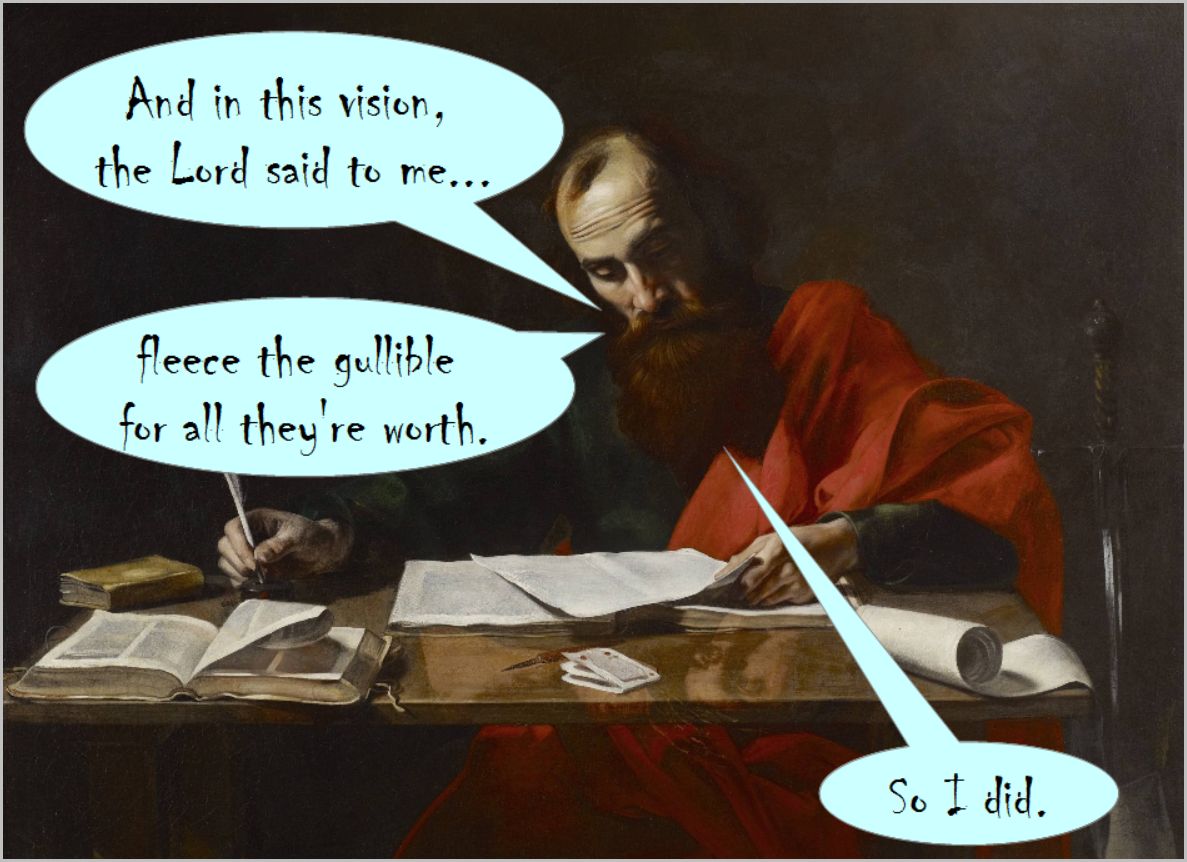
In fact, dreams and their waking equivalent, visions, are ultimately what religion is made of. They’re certainly what Christianity is made of; Joseph, the Magi, Pilate’s wife, Peter and Paul all have deeply meaningful dreams while Peter, Paul, John and others have visions which, they persuade themselves, can only be the monolith from 2001 Jesus returned from the dead, and other fantastic nonsense. The authors of the New Testament attached such importance to converts’ dreamy/visionary experiences that they had them written back into the Jesus narrative itself. That way it sounded like Jesus knew when he was alive that later fanatics would think they could sense his presence (especially when they whipped themselves up together) and could experience him in dreams and visions. Still today there are those who convince themselves they have a ‘relationship’ with him and can see him in their dreams, near-death experiences and other hallucinations. Just ask Perry Stone. It’s all real!

Well, as real as things entirely in the mind can be.

Same as it ever was…
Paul2

(Edited for clarity 2nd Aug)

Effective Preachin’ (Part One)

church3Reverend M. T. Vessal of the Church of The Raised Up here, with the first of my special guest posts for all you wannabe preachers out there. I’m gonna be telling you on how to preach the Good News of Salvation and win souls for Christ.

Right. First off, remember to use the words ‘Blessings’, ‘Sanctify’ and ‘Outpouring’ in your preamble or opening prayer. ‘Course no-one will know what these mean as you haven’t provided any context and they’re pretty meaningless anyway – apart from ‘Outpourings’ which is something kettles do. But it’ll get the folks worked up to expect something real good. Folks in church go for things like Blessings, Sanctifying and Outpourings, believe me.

Next, repeat the title of your sermon – or, if you’re part of a cool modern church like Steve Furtick’s, your talk, or, if you’re really honest (and let’s face it you wouldn’t be doing this if you were really honest) your spot of self-promotion – three times. This is a useful tip for any point of your sermon/talk/self-promotion; if you can’t remember what you were going to say next, say the last thing you can remember saying three times over, putting the emphasis on a different word each time. So, for example, ‘Twelve ways to receiving the Lord’s blessings’ would be: ‘Twelve ways to receive the Lord’s blessings’, then ‘Twelve ways to receive the Lord’s blessings’, and finally, ‘Twelve ways to receiving the Lord’s blessings‘, though feel free to alter this as suits. Saying it three times like this makes it sound like you’ve just come out with something real deep and profound, when you’ve done nothing of the sort. Plus, people sit up and listen to things said in threes. It’s kinda hypnotic.

I said, ‘it’s kinda hypnotic.’

‘It’s kinda hypnotic.’

See? It works.

Next make a joke. Say something like, ‘if you’ll switch on your Bibles’, just to show how with-it and up-to-date you are, knowing most folks bring their iPads to church these days. That way they can shop on Amazon or send an offensive tweet when your sermon gets really boring (and it will get really boring).

Now quote the verse you’re gonna preach about and let the folks follow along; you won’t need to quote it accurately because they’ll all be using different translations, so accuracy’s not important. Unless, of course, you’re one of those churches that only accepts the Authorised Version, the one with all the errors in it that right-royal homosexual James I… well, authorised. (One of the advantages of the KJV is you can  drop in words like ‘lieth’ and ‘unto’ which sound like you really know what you’re talking about.) So, yes, it’s okay to paraphrase the verse your talk is gonna be tenuously connected to because, let’s face it, it’s not going to have much to do with the verse in any case. It’s going to be more about you than whatever’s in the Bible. The exception is if you’re planning on having a rant about homosexuals, in which case you’ll want to stick pretty closely to Leviticus 20.13 and Romans 1.26.

A word on choosing your Bible verse: make it one of Paul’s or something from John. The other stuff, about loving your neighbour and your enemy and going the extra mile isn’t the kind of thing you want to have to talk about. You’re gonna concentrate on Blessings, Sanctification and Outpourings, remember, things that are exclusively for Christians. If you’re feeling really adventurous though you can try a story from the Old Testament. Maybe one of those blood-baths it has a lot of. You can show how all that bronze-age inter-tribal slaughter was really about how much Jesus loves Christians in the twenty-first century.

Right. You’re all set. Next time, I’ll tell you how to preach so that you can make a name for yourself truly reflect the glory of Jesus.

Angels with anuses

Lot

Of the many tawdry stories in the Bible, the tale of Sodom and Gomorrah (Genesis 19.1-29) is one of the most sordid and ludicrous.

In case you don’t know it, two angels visit Lot in the first of these ‘two cities of the plain’ where the local men express a desire to rape the pair. Unbelievable, right? All the men (19.4) wanted to rape two other men? It would appear so, but only because the story, designed to explain the demise of the two cities, is a fabrication by a rabidly homophobic scribe, intent on expressing his own prejudices and sexual fantasies. There is little evidence the cities really existed.

Anyway, Lot offers them his daughters instead, telling the local rapist mob that the gals are virgins, though in fact they have husbands (19.12 & 14). Lot’s rampaging neighbours don’t seem to know this but all the same decline his generous offer. So, to cut a long story short, God destroys both Sodom and Gomorrah allowing only Lot and his family to survive. Then, for no plausible reason, his nameless wife dies as they flee and Lot has drunken sex with his not-so-virginal daughters (19.33-38). As a result of the incest, the two of them give birth to genetically compromised offspring.

So this Lot – I’m tempted to say ‘this Bad Lot’ – who lies, offers his daughters to hormonally charged thugs, fucks the gals himself and has children by them, is declared by God to be a ‘righteous’ man (Genesis 18 and 2 Peter 2.7-8). The bar was set very low in them good Old Testament days.

Over on National Catholic Register’s blog, Thomas L. McDonald tries to explain what this seedy little story really means. (Steve Wells responds to his desultory efforts here). Central to it, are the so-called angels. What sort of beings are these? The term means ‘messengers’ and this pair at least are very mundane; they are incapable of defending themselves against rape threats (Lot has to defend them) and while they claim they are about to destroy the two cities (19.13), it is in fact God who does so (19.24). Later angels are more like the X-Men; they have grown increasingly grotesque (Daniel 10.5-6) and have developed superpowers like flight (Isaiah 6.2) and invisibility (2 Kings 6.17). The Sodom pair though are mere prototypes. There is nothing supernatural about them because the concept of the angel as a supernatural emissary of the divine was in its infancy when this story was written. They are simply human messengers.

Which is how they are capable of being raped. If they were the ‘evolved’ angels of later fantasy it would be inconceivable that they could be overcome and abused in this way. That these two can be potentially is because they are human males with human male anatomy. The bottom line is, if you’ll forgive the pun, they have anuses, without which they could not be anally raped. The story blithely assumes this to be the case even though all subsequent exegesis consistently ignores it.

This ugly, homophobic, semi-pornographic story has led to untold damage to innumerable people throughout the ages. It has given us the disparaging terms ‘sodomy’ and ‘sodomite’, even though no ‘sodomy’ takes place in the story and isn’t, in any case, routinely practised by same-sex couples. It has served as the prototype for the blaming of LGBT people for (always unrelated) natural and man-made disasters, from earthquakes to tsunamis and 9/11. The moral usually taken from it – even though it lacks any morals at all – that being gay is evil, has led to, and provided ‘justification’ for, the persecution and destruction of gay people right up to the present day. Perhaps, given the same story is referenced in the Qur’an, its influence can even be seen in last week’s massacre in Orlando. 

That the prejudiced and ignorant today continue to be influenced by this unimaginative, tawdry little tale is the lasting legacy, the real tragedy, of Sodom and Gomorrah.


What does God think about the Orlando massacre?

Orlando

Let’s see what he’s saying through his spokesmen here on Earth:

According to a minister from the cathedral in my home town, who conveyed this message from the Lord at a vigil on Monday night,

God is just as confused as we are. All the same, he’s full of compassion for those who died and for their loved ones.

Makes you wonder though, if he’s so compassionate, why he didn’t do anything to prevent the murders in the first place. Still, he is sympathetic, which is something.

Oh wait! That isn’t how God feels at all, not according to Pastor Steven Anderson, who knows exactly what the Lord thinks:

…in Leviticus 20:13, God’s perfect law, he put the death penalty on murder, and he also put the death penalty on homosexuality. That’s what the Bible says, plain and simple. So, you know, the good news is that at least 50 of these pedophiles are not gonna be harming children anymore. The bad news is that a lot of the homos in the bar are still alive, so they’re gonna continue to molest children and recruit people into their filthy homosexual lifestyle.

Right. So now we know.

Hang on, though. Christian Today tells us something different again. According to this guy, what God really wants his followers to know is that,

true believers should pray for everyone involved in the terrible events of the weekend and ‘not miss a huge opportunity to build bridges and demonstrate our saviour’s love.’

Phew, glad that’s finally sorted.

Or maybe not, because God has changed his mind again: Pastor Roger Jimenez has this straight from the Lord himself:

The tragedy is that more of them didn’t die… the Bible paints the picture that these are wicked people. These are evil people. God gave them up to their vile affections… they’re not natural… they received a reward for their error… God almighty says, ‘there’s nothing I can do for (homosexuals).’

All these mixed messages, and all supposedly from the same Person! Compassion, punishment, love, abandonment; that truly is one confused, mixed-up deity you worship, Christians. You’d be confused too, I guess, if one nutjob after another put words into your mouth. Just who’s the ventriloquist here and who the dummy?

When, Christians, are you going to stop deluding yourselves that arses like Anderson and Jimenez know anything about what God thinks? When are you going to stop pretending that anyone knows what he thinks? When are you going to recognise that a God who ‘speaks’ so inconsistently through simple-minded ‘intermediaries’ is not God at all?  When are you going to stop deluding yourselves that there even is a God?

Religion poisons the well. Again.

dye

The shooting in Orlando of people in a gay night club (50 dead, 53 wounded) is yet another example of religion as the antithesis of human flourishing. Not Christianity this time, of course, but that other ‘great’ religion, Islam, the religion of peace. But Christians cannot distance themselves from atrocities like this, carried out in the name of God, when the influence of even moderate religion is a pervasive, unhealthy presence in our society.

It’s true that Christians don’t, as rule, rampage in the streets or fly planes into buildings but they do contribute to the medium in which more extreme forms of religion grow:

Westboro Baptist Church, for example, with its own peculiar brand of Bible-based homophobia – ‘God hates fags’ and all the rest – is, like it or not, an expression of Christianity;

Right-wing evangelicals who interfere in the churches and governments of Africa and South America, actively encouraging them to take a homophobic stance and to pass anti-LGBT laws, are equally culpable; Scott Lively, Pat Robertson, Sharon Slater, you too are people filled with hate;

Likewise, those Catholic bishops who use their influence to denounce gay and transgendered folk as ‘mentally disordered’;

Christian bloggers who trot out the old, ‘Woe to those who call evil good and good evil’ (Isaiah 5.20) and misapply it to homosexuality, together with those who quote Leviticus 18.22 (‘abominations!’) and Romans 1.26-27 (‘unnatural and indecent!’)…

All of these contribute to the animus directed towards fellow human beings whose ‘sin’ is merely to be different. Religions, or more specifically their adherents, contribute significantly to the levels of misery in the world today, though Christians will cry ‘foul’ here (or ‘persecution’ even, because how they love claiming they’re being persecuted when asked to demonstrate some empathy and a little love.) After all, it wasn’t a Christian who gunned down the people in the Pulse nightclub this weekend. No it wasn’t. But every time religious bigots –

tell others what despicable sinners they are,

misrepresent and denigrate minorities,

promote ‘gay cures’,

attack same-sex marriage,

add quotation marks around the words gay and gay marriage, as if they’re somehow not real,

assert homosexuality and transgenderism are synonymous with ‘moral decay’,

claim natural disasters are God’s response to gay people’s very existence,

boycott businesses that support equality,

‘take a stand’ against transgendered people using the appropriate restroom and

refuse to serve gay couples –

every time, in short, they say LGBT people are evil, sick or worthless, the self-righteous prepare the ground for individuals like Omar Mateen to do what he did in Florida on Sunday. Religious leaders condemning such atrocities after the event is too little, too late, when they’ve failed to take charge of their acolytes and  do nothing to stem the tide of hatred flowing from their churches, mosques and temples. 

To those of us on the outside, religions are all of a kind; harmful superstitions. If a ‘faith’ entails belief in supernatural beings and puts allegiance to such imaginary figures above fellow human beings, it is without merit. It is the evil among us.

Less religion, not more

Welby

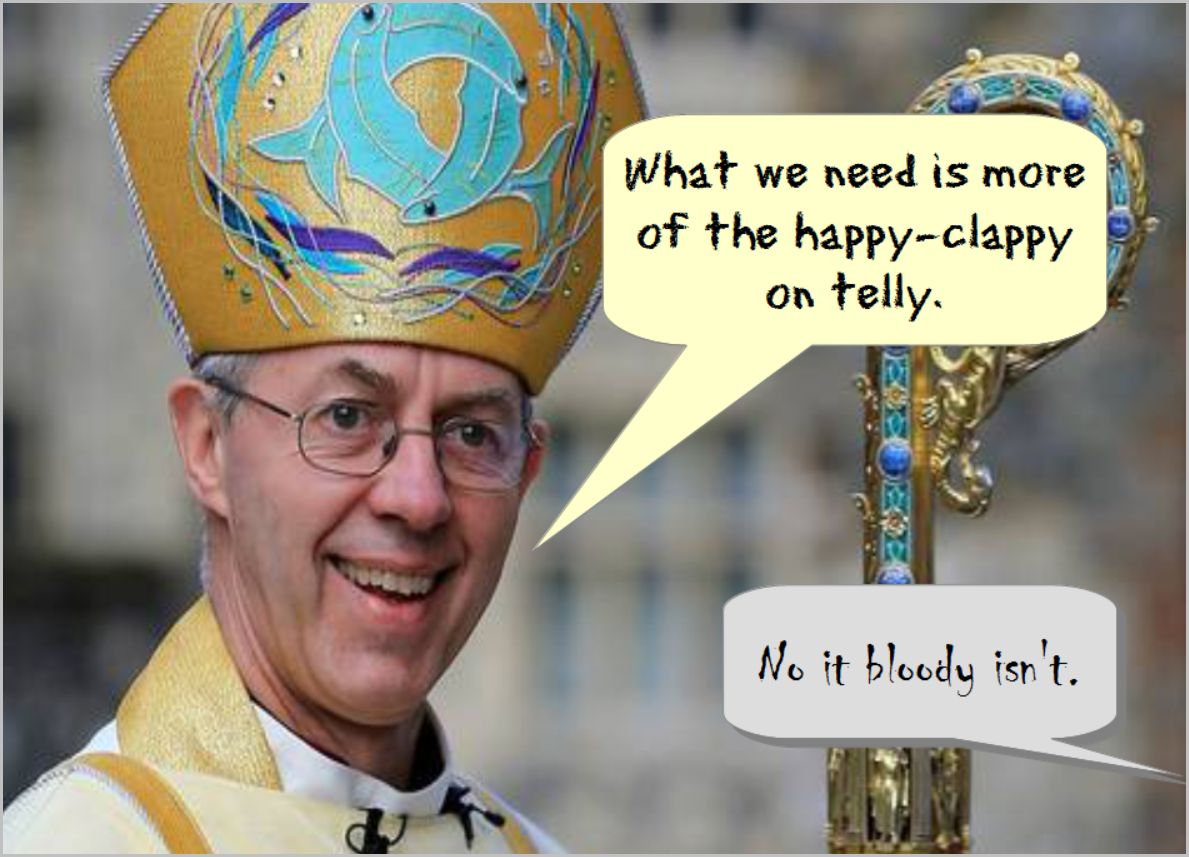
A bloke in a pointy hat and posh frock thinks there should be more religion on television and radio. Justin Welby, Archbishop of Canterbury, says that religion merits as much air time as politics, sport and drama.

The Archbish makes it sound like there’s nothing at all on TV and radio already about religion. In fact, in the last few months in the UK we’ve had a full schedule of Easter programmes; Simon Reeves’ The Ganges on BBC2 (looking at India’s religious heritage); Channel 4’s Unreported World and Dispatches, which regularly consider religious issues; Clare Balding’s trite Good Morning Sunday on Radio 2; the weekly broadcast of church services and daily Thought For the Day on Radio 4; the weekly dollop of worship on Songs of Praise on BBC1 and the 24-hour Christian ‘ministry’ of Trinity Broadcast Network and other God channels for those who just can’t get enough mumbo-jumbo.

Maybe that’s not as much as sport, but then there’s hardly anything on TV that has as much coverage as sport. (Bad news too for those of us with little interest in watching others running, jumping and hitting things; there’s even more to come in the shape of Wimbledon, Euro 2106 and the Olympics.)

Do we really want religion to have the same level of coverage? Are people really as interested in belief systems as they are in sport? Or music? Or art? Or comic book franchises? Even if there are, why is it up to television – the Archbish singles out the BBC as the broadcaster he thinks should indulge his fantasies – to provide it? Isn’t it, rather, up to churches, mosques, temples and other centres of superstition to promote their own particular brand of nonsense?

Make no mistake about it, this is what Justers is proposing; the promotion of religion – ‘religious literacy’ he calls it. He is not, we can be fairly sure, looking for programmes that are critical of religion (unless it’s other people’s). He wants, he says, to see more programmes that give us a better understanding of religious belief. What he means by this are proselytising programmes that create greater empathy for those who subscribe to delusion.

He isn’t advocating, for example, documentaries that explore the irrationality of faith, or ones that show the slap-dash, deceptive ways in which holy books came to be compiled or ones that demonstrate how most adherents to faith fail to live out its exacting demands. Nor is he suggesting programmes that focus on the appalling misery religion brings to some, or shows that give a sympathetic hearing to cults, sects and extremists. I would have no objection to programmes like these (except those that are sympathetic to extremists) because the ugly underbelly of religion deserves to be exposed, like Channel 4’s The Untold History of Islam of a few years ago, taken off air after its presenter was threatened with violence by those who didn’t like its critical perspective.

But these are not the kind of programmes the Archbishop is proposing. The religious literacy he wants us to have is of the cuddly side of faith, the supposed deep spirituality of the obsessive and what he regards as the positive contribution religion makes to the world; a one-sided picture already more than adequately covered by the nation’s broadcasters.

Thankfully, despite the recent political interference in the BBC, the Corporation is still required to present balanced and impartial views of its subject matter. If the Archbishop, who sits in the House of Lords and so is not without influence, is successful in forcing the BBC and other broadcasters to increase their coverage of his obsession, then we should also be able to look forward to programmes that are critical of religion too.

No broadcaster is obliged to promote religion nor to proselytise on its adherents’ behalf. Shame on the Archbishop, with his smiles and pointy hats, for suggesting they are.

Believing is Seeing

Fish

Have you noticed how the risen Jesus seems only to have appeared to those who were already primed to see him? Of course, the accounts of the resurrection are inconsistent, unreliable and constructed long after the supposed event, but just for now, let’s take them at face value. Jesus appears first, according to Matthew, Luke and John, to his female followers – maybe one on her own (in John), maybe two (Matthew), maybe several (Luke) – but to women who would be mourning him and would be longing to see him again. And lo and behold, they do! He’s not quite substantial and not quite recognisable – every bit the hallucination, in fact – but he appears.

Next he is said to have shown himself to the disciples – maybe one (Luke), maybe two (Luke again), maybe several (Matthew) – men who have been thrown into complete disarray by Jesus’ death but who believed in him and his mission to inaugurate the Kingdom of God, and were looking forward to ruling it with him. So naturally they see him in their midst. Never mind he walks through walls and disappears at will, just like an apparition – he appears! As Acts 1.3 puts it, ‘he presented himself alive to them after his suffering by many proofs’.

Wait – ‘by many proofs’? What does that mean? That he had to prove he’d come back to life? Could they not see that for themselves? Couldn’t they recognise the man with whom they’d spent the last three years? Or if they could, weren’t they convinced he’d returned from the dead so that he felt he had to prove it? How? How did he prove it? With a death certificate? By letting them poke his holes? And this took forty days? Isn’t it more likely they were subject to group hysteria and some sort of hallucination (they’d had hallucinations before – see Matthew 17:1-9) and they then had to convince each other that what they’d experienced was really Jesus? No wonder it took forty days to concoct a ‘plausible’ story, to arrive at ‘the many proofs’ that Acts speaks of. Whichever it was, Jesus’ gullible old pals convinced themselves they’d seen him.

During these same forty days – though in his gospel Luke implies it’s a much shorter time (24.40-53) – Jesus fits in a guest appearance at a rock concert in front of 500 believers – believers, note. Not people who were converted as a result of this miraculous appearance, but people who were already part of the Jesus cult when they experienced this vision. Or so Paul tells us in 1 Corinthians 15.3-8. He wasn’t actually there, but he heard about it from a friend of a friend of a friend so it must be true.

And finally he appeared also to Paul himself (1 Corinthians 15.5). Not as a physical body but as a beam of light in Paul’s head. I’m not getting into how this was, as Paul himself admits, no more than an inner vision (he too is prone to hallucinations – see also Acts 16:9-10 and 2 Corinthians 12.1-7) because you can read about that here. Rather, I’m going to argue that Paul, arch-enemy to this point of all things to do with the Jesus cult, is just as primed for a sighting of the Lord as all those other people who think they saw him… next time.

to be continued.

Are You Doing What Jesus Christ Says?

Billboard

Dale McAlpine, sometime commenter here and fanatical street-preacher in these parts, has posted a tasteful little video on his web-site – that’s the smugly named Repent.com if you’re interested – called Are You Doing What Jesus Christ Says? Take a look at it over on Repent.com or on YouTube; it’s ludicrously melodramatic and wonderfully over the top. You’re sure to enjoy its typos and spelling mistakes too.

What’s remarkable about it apart from these things is that, despite its title, it makes little reference to what Jesus is supposed to have said. Instead, it’s all about how you’ll go to hell if you don’t repent and accept him as your saviour; but Jesus never said this. It says you’re a ‘vile, wretched, hell-deserving son or daughter of Adam’ – Jesus didn’t say this either. It also insists you should let his cross ‘disrupt the very centre and citadel of your life of self’ (whatever that means) and guess what? This wasn’t part of Jesus’ teaching either. In fact, none of these claims were part of his ‘good news’.

Of the things Jesus did say – go the extra mile, sell all you have to give to the poor, turn the other cheek, avoid judging so you won’t be judged, give to all who ask, give away your shirt as well as your coat, feed the hungry, visit the sick, clothe the naked and love your enemies – the video makes no mention. Funny that. Maybe that’s why we don’t see Christians doing them very often.

So, Christians – and Dale too – are you doing what Jesus said or are you, like the video, only interested in pointing out others’ supposed sins and shouting about how they need to join you in your delusional mumbo-jumbo?

Yes. Thought so.

The stuff Christians say… (part one)

Jesus-Facepalm

On the day Christians remember the time Jesus allegedly spent being dead and buried (that’s one day, if you’re counting; what happened to the three he promised?) by going shopping or watching sport, let’s take a look at some of the nonsense they spout about atheists:

Atheism/humanism is of Satan: Given there’s no evidence for any supernatural beings, there can be no devil, Satan, Lucifer – or whatever other name Christians come up with for this fantasy figure. (Bizarrely, it’s Jesus who’s called Lucifer in Revelation 5.5) The devil is a creation of the human mind, intended to explain the nasty stuff in life and to let a supposedly good God off the hook. It follows that an imaginary being can’t make human beings be anything. The devil therefore does not make people atheists nor direct them in their ways.

Humanists/atheists set themselves up as God: Every manifestation of the god(s), including those that happen to be popular at present, is of human origin. Like all the others, the Christian God is a product of the human imagination that is made manifest only through human behaviour. So who is it who sets themselves up as God? Those who recognise that this creation of the human mind has no external reality, or those who claim an intimacy with the ‘Supreme Being’, believe his Holy Spirit lives within them and delude themselves into thinking they speak for him? No prizes.

Humanists/atheists worship man as God: Atheists don’t do this either. We are well aware of humans’ fallibility, inconsistency and capacity to bugger things up. However, we’re all we’ve got. There’s no God going to come and save us or solve our problems. We have to do it ourselves (or, as the case may be, not). Nor do atheists regard other people as wicked sinners who have no good in them – a particularly unhealthy viewpoint favoured by the religious – but this hardly constitutes ‘worship’.

Atheists hate God: Only to the same extent we ‘hate’ Santa Claus, Poseidon and Ra. You can’t hate (or rebel) against something that doesn’t exist. We do get very tired though of Christians foisting their views on us, insisting we should believe what they believe. And we get angry when they disparage others and attempt to curtail their freedom because they alone know what Jesus would want. But being angry about Christians’ unreasonableness is not the same as hating something that doesn’t exist.

To be continued

Round in Circles

JC2

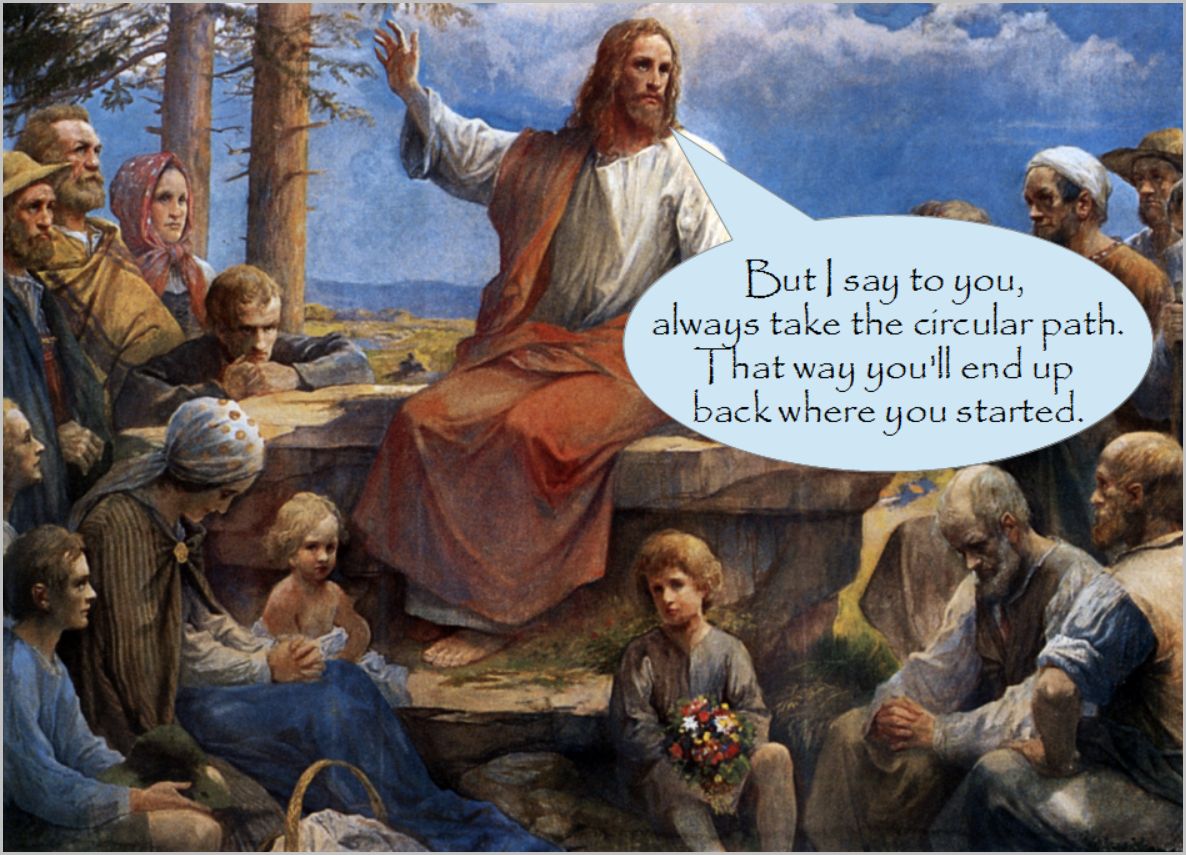
Being a religious believer means you can’t be a free thinker. Your conclusions are already determined for you – in the Bible or Qu’ran or some other holy book – and you are compelled, if you’re fundamentalist in your beliefs, to reach and affirm these conclusions. More than this, you are compelled to begin with them, which is why Ken Ham can say that where you start determines where you end up (though this only applies to those who think magic books have all the answers). So if you believe, because the Bible appears to say so, that the universe and all that is in it was created in six days about 6,000 year ago, then that is the premise from which you begin. You are then highly selective in the evidence you’ll consider, forcing it to support your predetermined conclusion. Christian argument is always this circular and heavily dependent on confirmation bias.

It can’t be anything else:

William Lane Craig ‘knows’ that the Holy Spirit is real because he feels it inwardly; the Bible tells him this kind of feeling is attributable to the Holy Spirit, so consequently the Holy Spirit must be real.

Pastor Mike Ratcliff understands that the Bible says everyone is a sinner; Mike’s confirmation bias means he sees sin and apostasy everywhere; therefore the Bible is right when it says everyone is a sinner.

Pastor Steven Anderson condones slavery. God approves of it in the Bible therefore slavery cannot be morally repugnant, and attempts to eradicate it are misguided. How does he know this? Because the Bible says slavery is okay.

Christians generally argue that God is good (because the Bible says he is) but have to disregard the horrors of his creation and the cruelties of life to reach the conclusion that, yes, God is good.

There really is no arguing with such arrested development, such intellectual dishonesty. Christian are not open to wherever reason and the evidence might take them; the end is always assumed at the beginning. Maybe that’s why comments are rarely allowed on Christian web-sites. You can’t argue with the Truth™ – another premise masquerading as a conclusion.