Jesus: Speak not clearly did he

Blog345JC

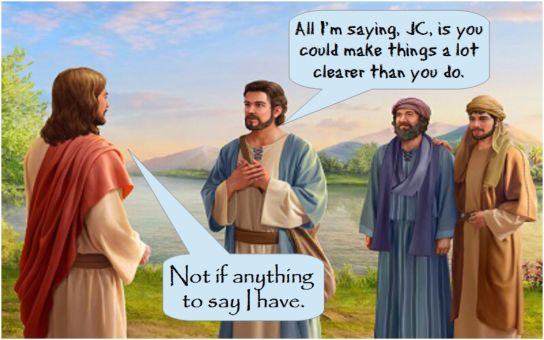
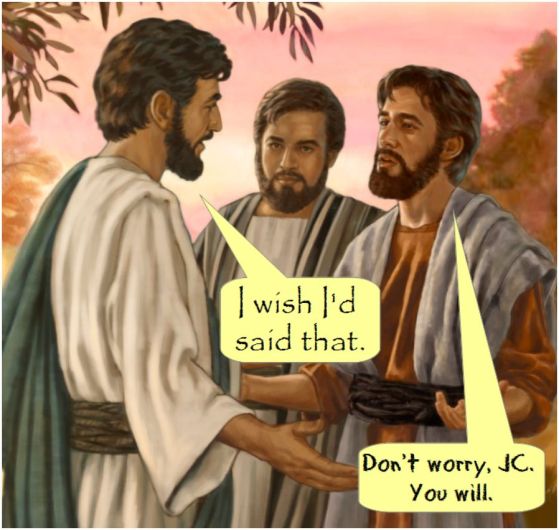
Why did Jesus not speak clearly? If he came from God, or was God in some way, why didn’t he express himself directly and with precision? Why did he obscure what he had to say with hyperbole, riddles and demands that even he couldn’t meet?

Don Camp, light-weight apologist and C. S. Lewis aficionado, has been giving me a little lecture over in the comments section of Debunking Christianity. He’s been providing the basics in how some of Jesus’ remarks in the gospels are hyperbolic and are therefore not to be taken literally. I am, of course, already aware of Jesus’ tendency to exaggerate (how far does this qualify as false witness, I wonder?) but Don and I were specifically discussing Matthew 5.29-30 where Jesus advises those who lust after a woman to pluck out their right eye and cut off their hand. Don asserted that obviously this is an exaggeration, to be understood figuratively, not literally. I asked him how one distinguishes between the two.

Don responded by saying one should look for clues in the scriptures (the bible as Murder, She Wrote); clues that might reveal how early Christians responded to Jesus’ assertions. If they ignored what Jesus said (while most did disregard his more extreme commands, such as the self-mutilation statements, there is evidence that some did indeed take him literally), then we can safely do the same. If, on the other hand (no pun intended) they acted on what he said, then it’s fair to assume it’s okay for today’s Christians to do the same. Sounds simple right? But it still doesn’t help anyone decide what is hyperbole and what is meant literally.

For example, Christians largely ignore Jesus’ commands to go the extra mile, give the shirts of their back to those who ask for them, turn the other cheek, love their enemies, disavow wealth, sell all they have, give no concern for the future and do all they can for the homeless, sick, naked and displaced. There isn’t a lot of evidence that even early followers did these things. Does their disregard for these commands mean that Jesus must have meant them figuratively? That there is spiritual truth to be discerned from them but that no practical action is expected or required?

Where do Jesus’ apparent assurances that his followers would heal the sick, raise the dead (Matthew 10.8) and do ‘works’ even greater than his (John 14.12) fit? Are these hyperbole or are they intended to be taken literally? Given early Christians serve as Don’s yard-stick for what is hyperbole and what is literal, what did they think? We don’t actually know, though evidently some considered the promises significant enough to include in the gospels. Among today’s believers, there are those – and not just on the fringe – who accept them as literal, while others scoff at the idea of taking them at face value.

What about Jesus’ promises that God’s Kingdom was imminent and that he would rise from the dead? Aren’t these just hyperbole too? Don says no, because people at the time didn’t ignore them (as they did his ‘obvious’ hyperbole) but believed they would happen. Therefore, they must have been meant literally. Unfortunately, Don fails to take into account that the promises of a resurrection were applied retrospectively; Jesus didn’t actually predict his own return from the dead (for reasons discussed here.) The Kingdom of God, meanwhile, failed to materialise when Jesus said it would. The extent to which early Christians believed these promises hardly demonstrates their literal truth. In any case, is ultimate truth to be determined by how ordinary, largely uneducated, superstitious back-water folks responded to what they heard or read? What a spurious and unreliable way to decide.

Which brings me back to my original question. Couldn’t Jesus have been a lot clearer about what he meant? Instead, he dressed up a lot of what he said in what might, or might not be, hyperbole. He issued other ‘truths’ in parables that he didn’t intend the hoi-polloi to understand (Mark 4.12). He offered advice that is of no practical use, some of it positively detrimental. He was neither systematic nor consistent and contradicted himself. So much of what he said is open to interpretation, to the extent that there are now thousands of Christian churches, cults and sects, all at odds with one another because they disagree about what he meant.

The New Testament as a whole too is a muddle of conflicting ideas and advice… though that’s a discussion for another time.

Why Jesus can’t possibly have known he’d ‘rise from the dead’.

Blog340JC&Peter

I said at the start of this series of posts about the date of Jesus’ crucifixion that the gospel writers perhaps felt unable to exclude Jesus’ predictions about rising from the grave after three days because these were too well-known. On reflection, it seems more likely that Jesus didn’t make any such prophecies. It is more probable that the gospel writers introduced them into their stories about him decades later.

I’ve written before about how the Resurrection appearances were nothing more than visions and dreams. Paul’s experience of the risen Jesus most certainly was – he says so himself – and Mary’s encounter with angels, telling her Jesus was no longer in his tomb, is described as ‘a vision’ in Luke 24.23. The subsequent accounts of Jesus’ post-mortem appearances also bear all the hallmarks of hallucinations; he disappears at will; passes through closed doors; isn’t always recognisable, drifts up into the sky and so on.

These mystical experiences, those that really happened anyway (it’s safe to say some – the Emmaus story, for example – are complete inventions: see Alter, pp536-8) quickly became a conviction among Jesus’ early followers that he had somehow risen from the grave. By the time of Luke’s and John’s gospel, 50 to 70 years later, this idea had evolved into a full-blown bodily resurrection.

The question is, did Jesus know that this was what was going to happen? Could he have had foreknowledge that he would be seen again after his death? Could he, during his life, have predicted he would rise bodily from the grave?

Christians will tell you that as God or God’s Son, Jesus was omniscient and therefore of course he knew these things in advance. There are, however, several good reasons why we can be sure he didn’t:

  • According to Paul, it was the resurrection that elevated Jesus to his god-like status, not his divinity that enabled the resurrection. Christians who argue that Jesus rose from the dead because he was divine have it back to front. Paul says clearly that Jesus ‘was appointed the Son of God in power by his resurrection from the dead‘ (Romans 1.4; my italics). Without the resurrection, Jesus was, Paul argues, of no great significance (1 Corinthians 12.15-19). However, the only ‘evidence’ for the resurrection is the contradictory, incompatible accounts offered by only three of the gospel writers and by Paul himself. So implausible is this evidence that we can safely conclude, with Michael J. Alter, that there was no such event. How, then, could Jesus possibly ‘know’ he’d rise from the dead when in fact he didn’t?
  • While he suffered from the delusion that he was going to rule God’s imminent Kingdom, it is unlikely Jesus thought he would have to die and be resurrected in order to do so. There was nothing in the Jewish scriptures to suggest either the Son of Man (a figure from Daniel with whom Jesus appears to have claimed some affinity) or the Messiah would be put to death only to rise again. This wasn’t what these characters were about and it wouldn’t have been how Jesus thought.
  • The Kingdom of God did not come about in the way Jesus believed. His death therefore did not bring about the apocalypse, judgement and rule of God he predicted and anticipated. In fact, his death took his cult off in a completely different direction, thanks mainly to Paul’s intervention. Jesus, and to a significant degree, the synoptic writers appear to have little awareness of this seismic shift. The Jesus they portray has little cognisance of events following his demise. Any suggestion he foresaw the creation of the Church is anachronistic, written back retrospectively into the accounts of his life. This was not what his ‘good news’ was about.

  • From their reactions preserved in the gospels, Jesus’ execution evidently came as a shock to both himself and his followers. None of them appear to have been expecting anything like a resurrection. Immediately following his death and burial, not a single one of his followers recalled his supposed predictions of his resurrection, nor did they express the sure and certain hope he would be returning. Even the discovery of the empty tomb (if it happened at all) failed to elicit such an expectation, nor any recollection of his words. The gospels say all those who witnessed the empty tomb were ‘frightened’, ‘astonished’ or ‘amazed’ that the body was missing, but not that they believed he must have risen from the dead. All those who witnessed the empty tomb behaved as if they’d never heard Jesus’ predictions that he’d be returning – probably because they hadn’t

  • It wasn’t until the ‘visions’ started that some of them began to consider the possibility that Jesus had ‘risen’. Not all were convinced, however. Matthew 28.16 notes how a number ‘doubted’ that the apparition they were seeing was Jesus. Significantly, at no point do any of those who think they’re seeing the risen Jesus say, ‘I remember him predicting this would happen.’ On every occasion, either angels or the risen Jesus himself has to explain it to them. (Of course, it’s the gospel writers doing the explaining for those hearing these stories decades later.)

All of this points to the fact that, while he was alive, Jesus didn’t make any predictions about rising from the grave on the third day, after three days, or after three days and nights; these prophecies, incompatible with each other and with the synoptic timeline, were created later, probably much later, after belief in the resurrection had become a central plank – the central plank – of the new cult. They were subsequently written back into the gospels, and placed on Jesus’ lips on the basis to show that of course he knew he’d rise again and knowing would have spoken about it.

The circle was thus complete; his early followers created the myth of Jesus’ return while later ones invented the ‘prophecies’ to bolster the belief that Jesus must have known he would. He said so, didn’t he?

Jesus’ dates with destiny

Blog338Cross

I hope you’ll allow me a little speculation…

Here are the few days leading up to Jesus supposed resurrection as related by the synoptic gospels:

Nisan 15: Wednesday sunset to Thursday sunset. The Day of Preparation when thousands of Paschal lambs are slaughtered ready for the following day’s (i.e. Thursday evening’s) Passover. Jesus instructs his disciples on the arrangements he has made for the feast.

Nisan 16: a. Thursday evening: Jesus celebrates Passover.

b. Thursday evening and night: Jesus is arrested and tried.

c. Friday 9.00: Jesus is put to the cross

d. Friday 15.00: Jesus dies.

Nisan 17: a. Friday ‘evening’: The start of the Sabbath: Jesus is buried by Joseph of Arimathea.

b. Friday evening to Saturday sunset: Jesus body lies in the sealed tomb.

Nisan 18: Saturday sunset to ‘early’ Sunday: The body remains in the tomb overnight(?) but by early next morning is missing.

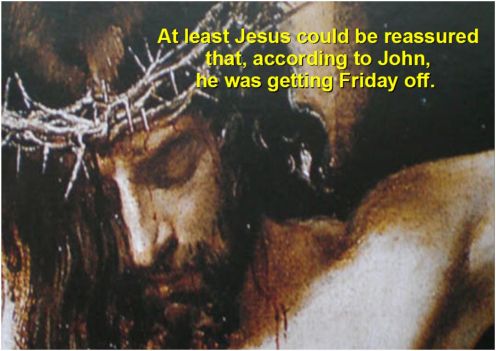
John’s timeline, however, is markedly different. He says that Jesus is arrested on the Day of Preparation for Passover – that’s Nisan 15 according to the synoptics, which started at sunset on Wednesday (John 13.1; 19.14.) In John, therefore, Jesus does not eat a Passover meal with his disciples. He shares an ordinary supper with them on the Wednesday evening, when he washes their feet. Judas slips out to inform on him just as he does in the synoptic gospels, a day later (Mark 14.16-17; Matthew 26.19-20; Luke 22.33-45.) John significantly alters the timing of events though he retains Judas leaving, though from a different meal. In the fourth gospel, Jesus is arrested on the Wednesday evening, the start of Nisan 15. John mentions in 18.28 that the temple officials involved in the arrest have yet to eat their Passover meal; it still awaits on Thursday evening.

In John, Jesus is tried during the night of Nisan 15, or the early hours of Thursday. Eventually, at around noon on the Thursday he is nailed to the cross and dies rapidly (John 19.14, 31, 42). By the time everyone else is eating the Passover meal later that day – a meal Jesus is present for in the synoptic gospels – John’s Jesus is well and truly dead. He is placed in Joseph of Arimathea’s tomb at some point Thursday evening, either the end of Nisan 15 or the start of Nisan 16. He remains there during Friday and Saturday (the Sabbath) but by Sunday morning his body, according to the story, is missing.

It has been argued – given we don’t know the year Jesus was crucified – that John has his Passover falling on the Saturday, the Sabbath (John 19.31), as happened on occasion, and that therefore John’s ‘Day of Passover Preparation’ was not the Thursday – as it is in the synoptics – but the Friday. According to this line of reasoning, Jesus’ arrest in John was also on Thursday evening, at the start of Nisan 16 and his crucifixion was on Friday, as in the synoptic gospels. But the Day of Passover Preparation cannot be freely moved around to accommodate both versions of events; either it was on the Thursday (Nisan 15) as the synoptics record, or it was on the Friday (Nisan 16) as those who seek to locate John’s crucifixion on Friday argue. Either John is wrong about when the Day of Passover Preparation fell or his Jesus was crucified a day earlier than in the synoptics on their Day of Preparation, Nisan 15.

There is further circumstantial evidence for John’s crucifixion being on the Thursday. While the synoptics have the chief priests, scribes and elders witnessing the crucifixion for themselves, John doesn’t mention their presence. In his Thursday scenario, they are too busy preparing for that evening’s Passover, overseeing the ritual slaughter of thousand of animals, to attend the crucifixion. Similarly, the various activities after Jesus dies – the buying of linen and spices, the removal of the body from the cross, the preparation for burial, sundry visits to Pilate and the posting of guards (though John does not report the latter.) – do not entail any infringement of the Sabbath regulations.

Moreover, John has Jesus in the tomb for three days and nights, more or less; the supposed resurrection does indeed occur ‘after three days’ as Jesus is made to predict numerous times (19 in total.)

Nisan 16: Jesus is buried at the start of Nisan 16 (our Thursday evening),

Nisan 17: Jesus remains in the tomb throughout Nisan 17; 6pm Friday to 6pm Saturday.

Nisan 18: 6pm Saturday to the early hours of our Sunday. He remains in the tomb until some indeterminate point, either before dawn (according to John) or just after (the synoptics.)

As well as a resurrection ‘on the third day’, John’s version of events provides an added bonus. By having his crucifixion on the Day of Passover Preparation, John  is able to draw an analogy between the slaughter of the sacrificial lambs and his ‘Lamb of God’ who, in his death, replaces them as an atonement offering.

I don’t know; maybe I’ve got this all wrong. There’s a problem, I concede, with John 19.30 which implies Jesus is on the cross on Friday (though by John 19.42, when Jesus is buried, it looks like the narrative has reverted to the day before the Sabbath; Friday day time.)

The effort to harmonise the two different timelines, that of the synoptics and that of John, involves having two different Days of Passover Preparation (Thursday and Friday) and indeed, two Passovers (Friday and Saturday). Does this seem likely to you? Two lots of lambs to be slaughtered and two celebrations on two consecutive days – I mean, these people weren’t made of money! Isn’t it far more likely there was one Day of Preparation and one Passover? If so, who is right about when they fell? John or the synoptic writers? They both can’t be. Whether apologists like it or not, isn’t it more likely that the fourth gospel has Jesus crucified on the same Day of Preparation that the synoptics mention (the Thursday), while in the synoptics – all based, let’s remember, on Mark’s account – he dies on the Friday after the Passover meal as they relate? It makes more sense of the conflicting timelines than attempting to mash them both together when they won’t. One or other, John or the synoptics, got it wrong about the day Jesus died; perhaps both did.

One thing’s for sure, what follows is pure unadulterated myth.

On what day did Jesus die?

Blog338Passover

I’ve been ‘discussing’ with a commenter on Gary Matson’s Escaping Christian Fundamentalism blog the incongruities between the synoptic gospels and John’s gospel in their accounts of the crucifixion. Specifically, the day on which it took place. While tradition has it on a Friday, it has long been debated whether this is the case; see Michael J. Alter’s The Resurrection: A Critical Enquiry for an excellent overview.

Scholarly consensus is, it has to be said, that Jesus did indeed die on a Friday. However, as discussed last time, one of the many problems surrounding the date of the crucifixion is that we don’t know the year in which it happened. We don’t therefore know the precise time of the Passover that the gospels say occurred around the time of the crucifixion. If we presume that it was during the month of Nisan in AD 33 (again, refer to Alter), then the monthly Passover was on the Thursday. The problem is, we do not know if Jesus died in AD33, or even in the month of Nisan. If the end of his life was in some other year or month (and there are good reasons for thinking it may have been), then the Passover would, in all probability, have fallen on a different day.

A Friday crucifixion creates significant problems. The first is that the synoptic gospels tell us that Jesus’ body was placed in the tomb ‘in the evening’. The evening of Friday (our time) is, and was, the start of the Sabbath, which would have prohibited any activity, including those the synoptic gospels tell us took place during the evening that followed Jesus’ death. These include Mary Magdalene, who apparently could find a shop open on the Sabbath, buying and preparing spices to anoint Jesus’ corpse and Joseph of Arimathea purchasing linen in which to wrap it. It also involves Joseph visiting Pilate to persuade him to release the body and then taking it down from the cross himself. All of these activities qualified as work and were strictly forbidden.

How to get round the problem? The apologist on Escaping Chrsitian Fundamentalism  has been making the case that ‘evening’ in first century Palestine was between 3pm, when Jesus died, and 6pm or thereabouts, when the sun set and the Sabbath began. There is some evidence this period was indeed known as ‘early’ evening. However, the word used for ‘evening’ in the gospels – ὀψίας – always signifies ‘late’ evening (Alter, p98). My apologist, however, argues that people in first century Palestine went to bed early, once the light began to fade (even though the gospels themselves suggest otherwise), so when the gospel writers refer to ‘the evening’ they must actually be referring to ‘late afternoon’.

The second, and to my mind more significant, problem is that a Friday burial, even if before the Sabbath began, means that Jesus was in the tomb for, at most, thirty-six hours; Friday evening to (before) dawn on Sunday when Mary Magdalene and the other women visited the tomb and decided he had risen. Thirty-six hours is only half of the ‘three days and three nights’ Jesus is made to predict he would be buried (Matthew 12.40). The writers of the gospels must surely have known this, and yet they all choose to maintain Jesus’ prediction in one form or another. Perhaps it was too well known to exclude. Or perhaps Jesus wasn’t executed and buried on a Friday.

I have been arguing with my apologist that John’s gospel addresses these two problems by locating the crucifixion a day earlier, on the Thursday, and also by having Jesus die long before 3pm. While the synoptics all say (copying from Mark) that he was put on the cross at 9am and died six hours later, John suggests that the crucifixion took place at around noon and that Jesus died quickly. John’s alternative scenario gives those involved in the burial time to prepare for it (a problem in the synotics) and allows the interment to take place in the evening proper, late Thursday evening not being part of the Sabbath. It also grants a period much closer to the prophesied three days and nights for Jesus to remain in the tomb.

Most scholars, however, agree that all four gospels record the crucifixion as taking place on a Friday. So what is my evidence that John’s gospel suggests otherwise? I’m glad you asked…

How to work out when Jesus died

Blog338Darkness

When did Jesus die? The year, I mean.

The honest answer is we don’t know. In Michael J. Alter’s The Resurrection: A Critical Enquiry, recommended by John Loftus’s Debunking Christianity blog-site, the author considers twelve different dates that have been proposed, together with the reasons why. Ultimately though, we don’t know.

Which is strange, not only because, as Alter points out, Jesus’ death and resurrection are supposedly the most significant events ever to have happened in the entire history of the world, but because it should be really easy to pinpoint the date. It was the year there was –

  • a total eclipse of the sun that, for over three hours, plunged the whole land (some translations have ‘earth’) into darkness,
  • an earthquake that caused appreciable damage, 
  • the tearing from top to bottom of the four inch thick, 82 feet high curtain in the temple,
  • the dead rising from their graves to make themselves known to the inhabitants of Jerusalem (including, presumably, the extensive Roman presence.)

We know this because the gospels tell us so; these events all took place either just before (Luke) or just after (Matthew) Jesus’ death. Let’s overlook the fact that solar eclipses don’t ever occur at the point of a full moon, while Passover, when Jesus died, happens only when there is one, and take a look at Matthew’s version of events:

From noon on, darkness came over the whole land until three in the afternoon. And about three o’clock Jesus cried with a loud voice… and breathed his last. At that moment the curtain of the temple was torn in two, from top to bottom. The earth shook, and the rocks were split. The tombs also were opened, and many bodies of the saints who had fallen asleep were raised. After his resurrection they came out of the tombs and entered the holy city and appeared to many. (Matthew 27.45, 46, 51-53)

All we need to do, therefore, is look for corroboration of these four cataclysmic events occurring together in the records of the time. (The Romans were particularly good at recording such things; we know, for example, there was an eclipse in AD29, though that lasted a measly 2 minutes.) Once we’ve found this corroborative evidence, we’ll know for certain the year in which Jesus died.

But you’re ahead of me: there is no record anywhere, apart from the gospels, of these events ever taking place, certainly not in combination. No record of a widespread darkness, nor of an accompanying earthquake nor of the temple veil tearing from top to bottom, nor of the dead emerging from their tombs. Which isn’t to say they didn’t happen, but you’d think someone, somewhere would have noticed and would have written about them. Josephus maybe, or Plutarch, Greek or Roman authorities, or even Paul; anyone writing at the time or soon after; any of those whose history of the period has survived.

But no.

It’s enough to make you think these earth-shattering events didn’t really happen; that they’re all made up for theological reasons.

And you’d be right.

God is revealed in Jesus… or not


Blog335CompositeOn his blog-site, humbly named after himself, Roger E. Olson trots out the tired old cliche that there’s no such thing as atheism. Atheists, Rog tells us, know in their hearts that God exists, they just choose to ignore him. As a result, Rog has little time for atheism. (I discovered Roger’s wonderfully smug site through Bruce Gerenscer’s excellent one.)

Rog says that if we want to see what this heart-implanted God looks like, then we shouldn’t look to the Old Testament and the tribal warlord we find there – goodness me, no; we can safely discard him! That God just doesn’t match up to our twenty-first century sensibilities. No, if we want to see God then what we must do is look at Jesus, for in Jesus we see what God is really like.

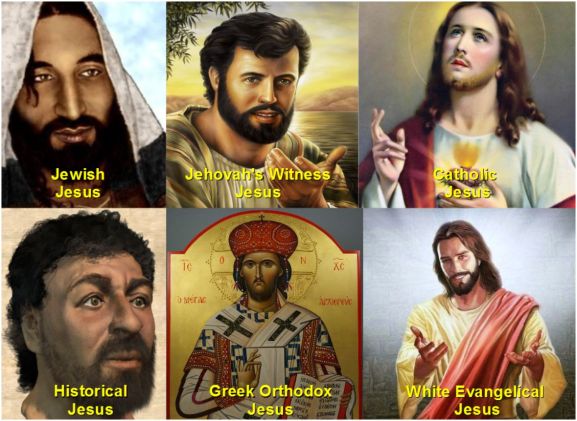
Oops! We’re right back at the problem I’ve been discussing these last few posts: just which Jesus are we talking about? There are so many. There’s the Jesus of the synoptic gospels (though he’s neither consistent nor pleasant), who is nothing like the self-obsessed Jesus of John’s gospel. Paul’s Christ is different again; he’s a complete invention, much like the Jesus of Hebrews who has morphed into a Jewish High Priest. The Jesus of Revelation meanwhile is an Evil Mutant straight out of the Marvel Universe, what with swords coming out of his mouth and all. So which Jesus has Rog got in mind? I think we should be told.

There are so many discrepancies in the various interpretations of Jesus in the New Testament, that it’s hard to see a clear, consistent picture of anything, let alone God, in such a shifting kaleidoscope of images. I’ve recommend that Rog should take atheism a little more seriously; the often incompatible Jesuses of the bible don’t reveal ‘the true nature of God’ anywhere as clearly as he claims. I’d go further: none of them show – can possibly show – what the non-existent is ‘really’ like. What they reveal instead are ideas about a God and a saviour made entirely in the image of the men who tasked themselves with creating them.

Were the gospels ‘fact checked’ by those in the know?

Ashes

In a discussion I’ve been having with Don Camp on his blog-site, Biblical Musings, Don has been arguing that the Gospels are completely accurate because a) he wants to believe this and b) the Gospels ‘could have been fact checked by people living who had known Jesus and who had heard the Apostles teach this very story for many years. New and embellished versions would not have been acceptable to these people’ (my emphasis).

Clearly this is not so; John’s gospel presents a very different, highly embellished Jesus from that of the synoptic gospels (a divine being who is preoccupied with himself as opposed to a prophet concerned with ushering in God’s Kingdom), yet nowhere do we have any record of anyone saying, ‘hang on, one of these isn’t right – this isn’t how I remember things.’ Similarly, Paul’s itinerary (not to mention his theology) in Acts differs from that he talks about in his letters. Yet there’s no surviving evidence that anyone pulled Luke up about his inaccuracies.

If it didn’t happen, as far as we are aware, for these discrepancies, then why should we suppose it would have happened for others? It isn’t legitimate to hail the absence of ‘fact checking’ as evidence that everyone thought the gospel writers’ versions of Jesus’ life, despite multiple contradictions and evident embellishments, were reasonably accurate. This absence is not evidence that there was nothing to be disputed; it can be explained in numerous other, more likely ways (no-one was particularly interested in the discrepancies and embellishments because the gospels are literary creations, not historical accounts; the objections weren’t recorded or simply didn’t survive; they were quashed by orthodoxy and so on.)

Still Don insists ‘nobody in the know’ objected to anything in the gospels at the time they were written. This of course is mere conjecture on his part. We simply don’t know whether anyone objected, who did and who didn’t. Perhaps the disciples did object but were overruled (just as they were by Paul over other matters); maybe they objected to being portrayed as idiots, when their interpretation of what Jesus was about was being diminished, and nobody actually cared; maybe they didn’t mind the mythologising of their leader; maybe they never even saw the gospels, written as they were well away from Palestine and long after the events they portray; maybe most of the disciples were dead by the time the gospels were in circulation – life expectancy was short. Yes, I’m hypothesising here, just as Don does, my conjecture being every bit as valid as his.

Finally, Don refuses to see the errors, discrepancies and contradictions in the Gospels, as well as the mythologising of their central figure. Even with their inconsistencies, inaccuracies and flights of fancy (that may or may not have been objected to), Don maintains the Gospels are still ‘true’ and ‘inspired’. He really knows how to stretch a definition to the point of meaninglessness.

As if that’s not bad enough, he now he wants to pray for me.

In which the witnesses try to get their story straight

Tomb2

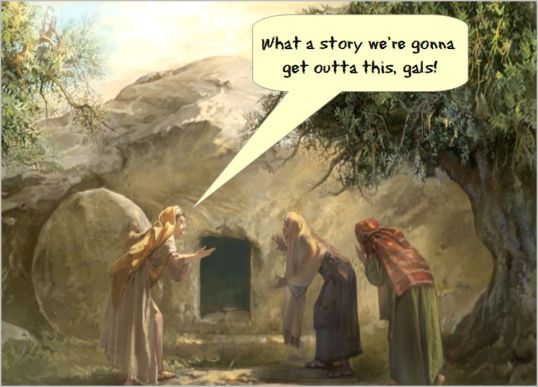
Mary: Well, the other Mary and me (Matthew 28.1) were first to go down to the cave where somebody said they’d put the body overnight.

Salome: I was there too, don’t forget (Mark 16.1).

Mary: Were you? I don’t remember that.

Salome: Bloody was, I’m telling you. So were a bunch of others (Luke 24.10).

Mary: Anyway, we get there and the entrance stone has been rolled away (Mark 16.4).

Peter: Wait a minute… I thought you said that happened after you got there. I thought you said there was an earthquake nobody else could feel and an angel came and rolled away the stone in front of your very eyes (Matt 28.2).

Mary: Did I? Oh yes, that’s right. That’s what happened. And the guards fainted out of sheer fright (Matt 28.4)

Thomas: They did? You didn’t mention any guards the first time you told this story (Mark 16.4).

Mary: Didn’t I? I must’ve forgotten. Oh well. And there was this strange young man sitting inside the tomb (Mark 16.5).

Salome: There were two young men and they were standing outside (Luke 24.4).

Mary: Really? I saw only one and he was definitely inside.

Peter: It wasn’t a young man, it was an angel (Mark 28.5).

Mary: Angel? Oh yes, I suppose you’re right. It must have been an angel. And he said the Master wasn’t there, that he’d risen or something (Matt 28.7).

John: That’s funny, I don’t remember anyone being there at this point. I certainly don’t remember anybody speaking to us (John 20.4-5).

Mary: That’s strange, because the young man in the tomb definitely spoke to me.

Salome: And the two men outside the tomb spoke to me.

Peter: And the angel… don’t forget the angel.

Thomas: So what happened then?

Mary: We were so frightened, we just ran away.

Thomas: You ran away? And then what?

Mary: Nothing. We said nothing to anybody (Mark 16.8).

Thomas: You said nothing to anybody. Then how did Peter find out? ‘Cos the next thing he was running hell for leather to the garden to see this empty cave for himself.

Peter: Oh, she must’ve told me. Yes, that was it, she said something to me and some of the others (Luke 24.10).

Mary: Erm, yes, that’s right. I told Peter and he went to see the empty tomb.

Peter. Ran all the way on my own, I did (Luke 24.12).

John: No, you didn’t. I went with you. In fact I overtook you and got there first (John 20.3-6).

Peter: Did you? I don’t remember that. Are you sure you haven’t just added yourself in here?

John: So anyway, we ran to the tomb…

Peter: And we see that the body has gone. I’m telling you, we couldn’t work out what had happened (John 20.9).

John: Though the most logical explanation seemed to be that he’d risen from the dead. I mean nothing else made sense (John 20.8).

Mary: It’s a shame you didn’t see the young man/men/angel. They’d have spelt it out for you like they did for us.

John: Don’t worry, we’ll bring them into the story later and we’ll have two angels for good measure. (John 20.12).

Mary: So while I was waiting there alone…

Thomas: Wait, you were there alone? I thought you said you ran away with the other women (Mark 16.8)?

Mary: Erm, yes, that’s right, I did. I must’ve gone back later just to hang about (John 20.11) and suddenly I see this, like, apparition. At first, I thought it was the gardener…

Thomas: You mean you didn’t know who it was?

Mary: No, I didn’t, which I agree was a bit odd, but then I realised it must be him, the Master, I mean. Who else could it have been?

Thomas: Well, if it was anyone at all, I’d have thought it more likely it was the gardener than a body back from the dead.

Mary: I suppose, but it just felt like the Master to me. I so wanted to see him again.

Thomas: Did he have holes in his hands and a wound in his side (John 20.27)? Surely that would’ve told you it was him.

Mary: Erm, I can’t recall now. But anyway, it was him.

Thomas: How’d you know?

Mary: ‘Cos he spoke to me. He said, ‘Keep your hands off me, woman, because I’ve not yet, erm… ascended’ (John 20.17, 20).

Thomas: What did that mean? If he was back like you said then how come you couldn’t touch him?

Mary: Well, I don’t know, you’d have to ask him.

Thomas: And how we gonna do that, him being dead and all?

Mary: He’s not dead, I tell you, and you’re all just jealous ‘cos I did better than all of you. I saw him in person and he talked to me!

Peter: All of you, just stop a minute and listen. Can you hear it?

Thomas: No.

Peter: Can you feel it?

Mary: Yes, I can. I can sense his presence (Luke 24.36-37).

John: He’s here with us. He’s back. Hallelujah!

Mary: It’s as if he’s standing right in front of us, talking to us.

John: Yes, that’s exactly what it’s like. He’s here with us. I can feel him. He’s back from the dead, I’m sure of it (John 20.19).

Peter: Let’s tell people we’ve seen him. They’re bound to believe us. I mean, we don’t live in a superstitious first-century backwater for nothing.

Thomas: Jesus Christ! Next you’ll be trying to convince everyone that this cockamamy story is true.

How To Be Saved (Possibly)

NewCreature

Personal righteousness, that’s how. Who says so? Not Paul, that’s for sure; he thinks you get right with God by accepting the salvation made possible by Jesus death (Romans 1.16-17). Jesus on the other hand thinks it’s by being righteous. More than this, he says God will treat you in exactly the same way you treat others. He makes this point repeatedly; what the believer will receive from God will be in direct proportion to what the believer does.

So, according to Jesus, if you want God’s forgiveness, you must first forgive those who have wronged you:

For if you forgive men their trespasses your heavenly Father also will forgive you; but if you do not forgive neither will your Father forgive your trespasses. (Matthew 6.14)

He applies this principle to other areas too. You want to experience God’s riches and blessings? Then first be generous yourself:

Give and it will be given to you; good measure, pressed down, shaken together, running over, put into your lap. For the measure you give will be the measure you get back. (Luke 6.38)

You want to avoid God’s judgement? Then don’t judge others:

Judge not that you be not judged. For with the judgement you pronounce you will be judged, and the measure you give will be the measure you get. (Matthew 7.1-2)

You want God to show you mercy? Then you must first show mercy yourself:

Blessed are the merciful, for they shall obtain mercy. (Matthew 5.7)

You want God to show you compassion? Then be compassionate yourself:

The King will say to those at his right hand… I was hungry and you gave me food, I was thirsty and you gave me drink, I was a stranger and you welcomed me… Then the righteous will answer him, ‘Lord when did we see the hungry and feed thee or thirsty and give thee drink? And when did we see thee a stranger and welcome thee?… And the King will answer them, Truly I say to you, as you did it to one of the least of these my brethren, you did it to me’. (Matthew 25.34-46)

Do Christians believe that the degree to which they demonstrate mercy and forgiveness to others is the degree to which God will demonstrate it towards them, both in this life and the next?

It’s not that Christians don’t help the needy. Clearly many do, as do some atheists, Jews, Muslims and all manner of others. No, the point is that Christians have lost sight of the fact that for Jesus such behaviour directly equates with righteousness, which in turn determines one’s ultimate fate. There really is no getting away from the correlation that Jesus is at pains to underscore, particularly in Matthew and Luke’s gospels. The only recourse seems to be to disregard it, which most Christians are content to do. They are much happier with the self-centred faith that Paul offers in Romans 5.17, ‘the free gift of righteousness’. This makes far fewer demands, carrying only the minimal expectation that one’s treatment of others has any bearing on one’s own well-being.

Except this isn’t how it works, not according to Jesus; God’s forgiveness, blessing, compassion and removal of judgement are entirely conditional. To Jesus, a ‘measure for measure’ arrangement is how one attains righteousness, which is not God-given, but is worked at in the practicalities of daily life, in relation to others.

I dared to suggest this recently on a Christian blog and was berated for making a ‘Satanic’ suggestion. Not me, but the one Christians say is the Son of God, God himself even. Evidently this doesn’t extend to knowing what he actually says, taking notice of it and doing something about it.

The Myth of Intellectual Faith

Celia4

Reading other sceptics’ blogs, I am struck by how often Christians dismiss what they say on the basis they’re not well read enough, or don’t appreciate the subtlety of the cognoscenti’s cerebral faith. ‘If you knew Faith as I do, if you’d read about it as much as I have,’ they say, ‘and approached it with the intellectual rigour I do, you wouldn’t make such juvenile criticisms of it.’

But isn’t the Christian faith meant to be simple? Simple enough for the uneducated and the childlike to understand it? Jesus himself says so in Matthew 11.25:

I praise You, Father, Lord of heaven and earth, that You have hidden these things from the wise and intelligent and have revealed them to infants.

As does Paul in 1 Corinthians 1.26-29:

Consider your calling, brethren; there were not many wise according to the flesh, not many mighty, not many noble; but God has chosen the foolish things of the world to shame the wise, and God has chosen the weak things of the world to shame the things which are strong, and the base things of the world and the despised God has chosen, the things that are not, so that He may nullify the things that are, so that no man may boast before God.

And isn’t the Bible sufficient in itself for ‘teaching, correction and training in righteousness’? 2 Timothy 3:16-17 seems to says so. Why then is an entire library of additional books required to make the bible comprehensible? Isn’t that tough on the ‘unintelligent’, ‘weak’ and ‘foolish’?

But I dispute that there’s an intellectual form of Christianity, one that is the result of reading widely and extensively, and comes from thinking through the nuances of a deep and complex theology.

There is no subtlety to a belief-system built on the presumption of supernatural beings. There is nothing intellectual about a philosophy dependent on the irrational interpretations of ‘visions’, dreams and hallucinations. Those who impose intellectualism on such things do just that – impose their own intelligence on something that has none of its own.

So argue all you want that there are subtleties to a transcendent God that those of us (deemed to be) of limited intelligence can’t begin to comprehend and I will show you how those nuances derive from your own mind – you are unable to demonstrate that there is a god, let alone one of almost incomprehensible complexity. Similarly, when you talk about the Trinity, I will show you an idea that is ‘mysterious’ only in the sense it defies all rationality. When you insist on the true meaning of salvation – whether it’s the role of blood sacrifice, forgiveness, works, substitutionary atonement or some other magic that only the initiated can understand – I will show you a book so muddled it presents all of these as incompatible explanations of redemption.

Impose it all you like, denigrate those who dispute it, there is no intellectual element to Christianity (or any religion). Intellectual faith is an oxymoron, comparable with discussions about whether the tooth fairy wears a green dress or a pink one.