
How the Bible tells us the Resurrection was nothing more than Visions

I’ve written about this before, but want to pull together some strands that demonstrate the risen Jesus was a vision or hallucination. He appeared only in the mind of others: the New Testament tells us as much.

Exhibit 1. Paul writes of the appearance of the risen Jesus, whom he sees as a ‘life-giving Spirit’, being ‘in’ him (Galatians 1.16). Paul has more than one such vision, including his trip to heaven recounted in 2 Corinthians 12.2, which he refers to as his ‘revelations’.

Exhibit 2. Paul implies in Corinthians 15.5-8 that others who have experienced the post-mortem Jesus ‘saw’ him in exactly the same way he did. For Paul, there was no difference between his inner-visions and those experienced by the so-called apostles.

Exhibit 3. The author of Acts creates a story out of Paul’s first vision, the famous account of his conversion on the road to Damascus. It’s a fabrication of course, told differently each time it’s referred to Even so, Luke retains the visionary nature of the experience: Jesus is a bright light and a disembodied voice.

Exhibit 4. The other sightings of the risen Jesus in Acts are visions. When, for example, Stephen is about to be stoned (Acts 7:54-56) he sees in his mind’s eye the heavens open and Jesus sitting at the right hand of god. Other New Testament encounters of the resurrected Jesus, such as John’s Revelation, are explicitly said to be visions.

Exhibit 5. Many of the sightings of the risen Jesus in Matthew and Luke are not of a real, physical human being. Those who experience him see him materialising in locked rooms, vanishing at will and floating up into the clouds. None of these events actually happened; they are the gospel writers’ literary realisations of visions experienced decades earlier, and they retain the hallucinatory qualities of those experiences.

Exhibit 6. Remaining with the gospels’ accounts of the risen Jesus, there is the strange phenomenon of those experiencing him failing to recognise him. Mary in the garden thinks he’s the gardener; the disciples on the road to Emmaus don’t know its him until he breaks bread; the disciples mistake him for someone else on the shore until he tells them how to fish properly. Most damning of all, some of the inner circle of disciples doubt it’s Jesus they’re seeing in their collective visions (Matt 28:17-18). Again, these stories preserve the tradition that the earlier visions weren’t always recognised as Jesus. And why wasn’t he? Because he was an hallucination

Exhibit 7. The risen Jesus has to prove who he is. According to Acts 1:1-3, he ‘presents himself’ his followers, some of whom have wandered around aimlessly with him for three years, and has to convince them he is who he appears to be. And, the text suggests, it takes him forty days to do it. This makes no sense. A far better explanation of this story (and it is a story) is that having experienced their visions of something-they-took-to-be-the-resurrected-Jesus (bright lights? Disembodied voices?), his followers set about convincing themselves that what they experienced really was their former Master. This they did by scouring the scriptures to find ‘proof’ that the Messiah would die and rise again. We know this is how their thinking worked. The same process was used to create the gospels and is evident throughout the New Testament.

Exhibit 8. Dead people stay dead. They do not resurrect.. This is not an a priori assumption. No corpse has ever revived after 36 hours or indeed any other period of time. We know this experientially, statistically and scientifically. Only in stories and religious myth do the dead return. This is what we are dealing with here: stories and myth that flesh out the visions and hallucinations of a few religious zealots.
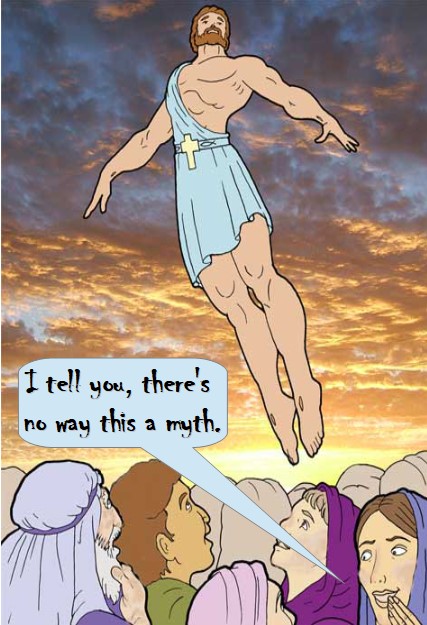
The Myth

Some people see the myth and think it’s true.

Others see the myth and believe it conveys deeper truths.

A few see the myth for what it is…

Myth, like all those other stories about dying and rising god-men.

Myth, like those stories about supernatural beings who never          actually existed.

Myth, like the stories in which real people undergo apotheosis after          their deaths.

Despite the contemporary Christian assertion that no-one in the ancient world considered the gospels to be myth, Justin Martyr, writing circa AD150, was moved to address the charge:

When we say that the Word, who is the first-birth of God, was produced without sexual union, and that He, Jesus Christ, our Teacher, was crucified and died, and rose again, and ascended into heaven, we propound nothing different from what you believe regarding those whom you esteem sons of Jupiter.” (Apology 21, my emphasis. You can read more here)

And how does Justin explain the similarities between the gospels and pagan myth?:

For when they say that Dionysus arose again and ascended to heaven, is it not evidence the devil has imitated the prophecy? (22:55, my emphasis)

The devil did it! It was ‘diabolical mimicry’!

Except we know it wasn’t. Early cultists created their own myth(s) using ‘prophecy’ from Jewish scripture and common mythical tropes to create their own god-man stories. Which isn’t to say Jesus didn’t exist – after all, Augustus existed, undergoing an imaginary apotheosis after his death – but it does mean gospel Jesus, the Son of God, the third person of the Trinity, is as much a fiction as all those other characters who were deified after their deaths. Which begs the question, why create a mythic character if Jesus was really so impressive to begin with? Unless of course he wasn’t.

Some people see the myth and think it’s true.

Others see the myth and believe it conveys deeper truths.

A few see the myth for what it is.

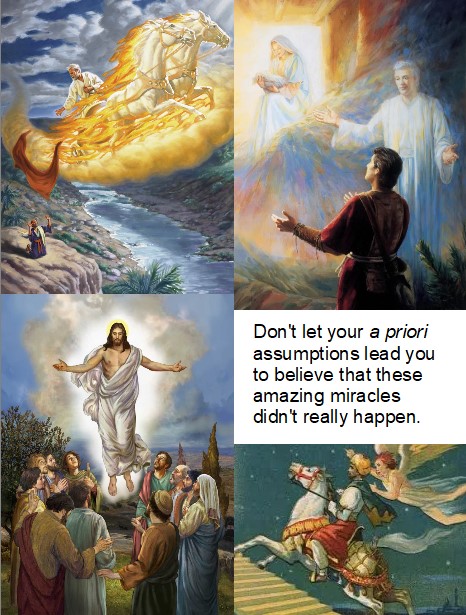
Either All True Or None True

About 2,500 years ago, a man called Elijah went up to heaven while still alive. He was taken through a whirlwind in a chariot of fire, pulled by horses of fire. This amazing event was witnessed by several other people who were profoundly affected by it. The story of this ascension was possibly relayed orally for many years until finally being written down in what is now 2 Kings 2.

Did any of this really happen?

Of course not. It’s a myth.

Some time in the 4th century BCE, the first king of Rome, Romulus, was taken, while still alive, to the dwelling place of the gods. From that time on he was worshipped as a god – some said he was eternal to begin with – with a temple being built in the very place from where he had ascended. Later he appeared to one of his followers, Julius Proculus who said the resurrected Romulus was larger and more beautiful than ever, armed with weapons shining like fire. Julius Proculus attested to this appearance of the resurrected Romulus, swore an oath to its veracity and relayed it faithfully to others.

Did any of this really happen?

Of course not. It’s a myth.

https://mythologymatters.wordpress.com/2019/04/18/easter-mythology-the-resurrection-as-modeled-on-greco-roman-myths/

It is not known when Mithras was born, if indeed he was. He emerged from a rock in the spiritual realm as a child or youth, ritually slaughtering a bull and sharing a banquet with the god Sol. He guided souls to the after-life, propelled as they were by the bull’s blood and flames. He was worshipped primarily by soldiers who saw him as their salvation from the bitterness of earthly life. There were rituals to be followed to become a true initiate and for Mithraic mysteries to be revealed. How Mithras made himself known to his acolytes is unknown, but in the first three centuries CE, his cult rivalled that of the Christians in popularity.

Did all of this really happen?

Of course not. It’s a fabrication, a myth.

In the 8th century CE, the prophet Muhammad flew from Mecca to Jerusalem on a winged equine. Once in Jerusalem he climbed a ladder to heaven. Once there he travelled through the various levels, having conversations with other lesser prophets, before entering Allah’s domain. His journey was later revealed to two early prophets who had known Muhammed when they were boys. They conveyed the details accurately until they were recorded, briefly at first in the Qur’an and later in more detail in its supplement, the hadith.

Did any of this really happen?

Of course not. It’s a fabrication, a myth.

In the early 19th century, Joseph Smith was visited by Jesus and his Father in a vision. They told him that he should not join any existing church because they were all in error. Later, a hitherto unknown angel named Moroni appeared to Smith and indicated to him where some gold plates were buried. He instructed Smith to dig up and translate the plates. Obediently, Smith did so, using a pair of seer stones for the translation. The resulting Book of Mormon was a revelation of Christ’s activities in North America following his resurrection. Smith wisely had a number of his associates witness, in writing, the existence of the gold plates as well as their supernatural provenance.

Did any of this really happen?

Of course not. It’s a fabrication.

In 1916 the Virgin Mary appeared numerous times to three poor Portuguese children, giving them instruction and prophesying to them. She also promised that she would perform a miracle at Fatima. Accordingly, between 30,000 and 100,000 people, including reporters and photographers, gathered at Fatima where many saw multi-coloured lights before the sun itself ‘danced’. It came closer to the Earth before zig-zagging back to its usual place in the sky. While not all of the attendees testified to the phenomenon of the dancing sun (some saw only the lights, others nothing at all) many did and testified to the effect the miracle had had upon them.

Did all of this really happen?

Of course not. It’s a fabrication based on hallucinations.

Around 30CE, a rabbi known as Jesus, who had been born of a virgin, gathered together 12 followers and went around Galilee preaching absolution from sin and the imminence of the Kingdom of God. He announced he was the Messiah who would rule the Earth when the kingdom arrived. The Jewish authorities took exception to his claims and petitioned the Romans to have him executed. This they did, only for Jesus to come back to life three days later, appearing in visions to his followers. He ascended to heaven, promising that those who believed in him would enjoy eternal life. Some of his disciples spread his message faithfully until it was eventually written down, first by a former Pharisee called Paul and then by four authors who accurately recorded what Jesus had said and done.

Did all of this really happen?

What do you think?

After the Gospels

None of the New Testament documents written prior to AD70 – those by Paul – contain any of the sayings, miracles or activities attributed to the Earthly Jesus in the later gospels. They don’t reflect anything of the oral tradition, first proposed in the 18th century. Those same gospels don’t reflect much of it either; the only ‘good news’ passed on by word of mouth was of a transcendent celestial Godman seen in visions. There is no evidence of any other. The later gospels incorporate the visions experienced by Cephas and others in their resurrection stories.

What then of the letters and books written after the appearance of the gospels? Do they reference, quote or base their teaching on the pre-crucifixion aspects of the Earthly Jesus of the gospels? Or do they, like Paul, concentrate solely on demonstrating the heavenly Jesus is the Messiah on the basis of what can be found in Jewish scriptures? You’d think that, with the gospels in circulation by then, that It’d be the former. But you’d be wrong.

Let’s make a quick survey of New Testament books post AD70. I’m taking their composition to be those listed here.

Hebrews (composed anywhere between 60 and 115 by unknown author[s])

Hebrews describes the Messiah as a heavenly high priest. Everything the writers ascribe to him is taken not from the gospels, nor an oral tradition on which the gospels are supposedly based, but from ancient Jewish writing; what we know as the Old Testament. Every single reference is from this source. Read the book for yourself and take note of the footnotes. Like gospel Jesus, Jesus the High Priest is constructed from snippets lifted from the Old Testament.

Revelation (composed anywhere between 70-110)

In Revelation, warrior Jesus has a lot to say, most of it quotations from the Old Testament. None of it is derived from the gospels nor the oral tradition on which the gospels are supposedly based. John’s ‘revelation’ is a fantasy constructed around ancient ‘prophecy’. Again, read the book for yourself and take note of the footnotes. Like gospel-Jesus, Jesus the Great Warrior is constructed from snippets lifted from the Old Testament.

1 Peter (70-100) and 2 Peter (125-150)

You’d think the letters purportedly written by the disciple Peter (or Cephas), the man who, according to the gospels spent three years with Jesus, would be full of his teaching, the mysteries he explained only to his closest followers, reports of his miracles or any of his other activities. But no. The best he can do across the two letters (written by two different people, decades apart, neither of them Peter the disciple) is this:

For we did not follow cleverly devised stories when we told you about the coming of our Lord Jesus Christ in power, but we were eyewitnesses of his majesty. He received honour and glory from God the Father when the voice came to him from the Majestic Glory, saying, “This is my Son, whom I love; with him I am well pleased.” We ourselves heard this voice that came from heaven when we were with him on the sacred mountain (2 Peter 1: 16).

Remarkably, this fake Peter recalls an event which never happened: when Jesus glowed like a lightbulb as two long-dead prophets beamed down from Heaven. It is, however, finally a reference to a gospel story. But then, doesn’t the author disparage ‘cleverly devised stories’ in this same passage? What else could he be referring to if not the gospels? We find a similar warning in 1 Timothy (and again in Titus 3: 9):

…command certain people not to teach false doctrines any longer or to devote themselves to myths and endless genealogies. Such things promote controversial speculations rather than advancing God’s work – which is by faith (1 Timothy 1: 4, written by a fraud pretending to be Paul).

These New Testament writers, even when they seem aware of gospel myths and their endless genealogies don’t approve of them. Perhaps that is why they prefer to ignore them, deriving proof of the Messiah from ancient Jewish scriptures instead. Every other reference to Jesus in the Peter epistles is from the Old Testament. How strange for someone pretending to know the man in the flesh.

We could go on to look at other books of the New Testament – for example, that written by ‘James’, supposedly Jesus’ brother – but this post is already too long. Rest assured if we did, we would see the same thing: none of the information about Jesus is derived from the gospels or the oral tradition on which the gospels are said by apologists to be based. There was no oral tradition, apart from stories of visions. The gospels are literary recreations – allegories – of those visions. They were not well received by the other writers of the New Testament who either ignore or disparage them. All that mattered to these early cultists were ‘revelations’ directly from the Lord and the Old Testament ‘prophecies’ that validated them.

No God and the Domino Effect

This a response to Don Camp’s comment on my post The Evil of Christianity, in which he tries to isolate ‘the crux’ of our disagreement about the Faith.

You start, Don, from the assumption that there is a God. I, on the other hand, have considered the evidence and concluded that in all probability there isn’t one. Certainly not the Christian God. There may be a god out there somewhere that has no interest in human beings and their affairs, though I doubt it. As far as we humans are concerned such a deity is as good as non-existent, being entirely hypothetical. If it is out there, it certainly won’t be offended at my saying so.

Once I realised some years ago that a personal God did not exist a number of other things followed (or rather, collapsed):

No God means no Son of God or God Incarnate, no Saviour or Christ.

No God means no resurrection (which Paul makes clear was a work of God).

No God means no Holy Spirit.

No Holy Spirit means no regeneration of individuals to become new creations in God (you only have to look at Christians today to see this is the case.)

No God means no grand Salvation plan.

No God means no Heaven, no Final Judgement, no Kingdom of Heaven of Earth, no Eternal Life.

No God means the universe can’t have been created by him.

No God means no manipulation of evolution, no intervention in human history and no prophecy of things to come.

No God means that the world would be just as we find it: messy, beautiful, dangerous, turbulent, indifferent.

No God means prophecy is man-made and comes to pass at no greater rate than chance allows (i.e. practically zero.)

No God means conversations with ‘him’, revelations from him and visions of him are all imagined, generated by and within the human brain, which works in mysterious ways.

No God means no God-given morality. Morality is, as you say, culturally determined and so may and does change over time. (You can see this in the Bible itself where morality supposedly handed down by God for all time evolves throughout the Old Testament and into the new.)

No God means there is neither Sin nor Righteousness. These are religious concepts. The whole spectrum of human behaviour, from destructive to altruistic, is demonstrated by believers and non-believers alike.

No God means assertions like ‘the issue turns on what I perceive as good for me versus what God declares is good for me’ are illusory. What is good for you is what you have worked out, even if you think God had a hand in it. A supernatural being who doesn’t exist cannot be responsible for your well-being, though your church and the bible undoubtedly contributed to your conditioning.

No God means individuals must work out their own meaning and purpose. Some do, some don’t, as you observe, Don. This is as true of believers as it is for non-believers. Many atheists have managed it, or not, without having it imposed by religion. And despite what you say, Christianity is a religion. It is the epitome of religion.

No God means none of the Abrahamic religions are true and therefore Christianity and its ‘holy’ book, being based on an invalid premise, must be false. Most of the posts on this here blog are about demonstrating this fact.

No God means all gods are man-made, not all gods except one.

The crux of the matter is you believe in God while I see how unlikely it is that there is one. I’d agree with you if I could, Don, but then we’d both be wrong.