Here Be Dragons

dragonChrist The White does battle with the dragon of Revelation 12

Over on Answers in Genesis, one of Ken Ham’s drones is arguing for the existence of dragons. They are, he or she tells us triumphantly, mentioned in the Bible, so they must really have existed.

As we already know, the Bible has more than its fair share of nonsense, but to insist it provides evidence of mythical creatures is to take its credibility to a new low. Don’t Christians care they do this to their magic book? After all, their faith relies almost entirely on the Bible, alongside their own emotional responses to it (no kiddin’, they say this is ‘the Holy Spirit’.)

Christians spend so much time arguing for the Bible’s daftest excesses – the world being created in six days, Jesus returning soon, homosexuality being just the worst sin ever and now dragons – that they haven’t any time left to read what it has to say about how they should be living their lives.

You mean forgiving others, feeding the hungry, giving everything away, not judging (in case you’re judged in return), being compassionate, going the extra mile, turning the other cheek, giving to all who ask and blessing your enemies is in the Bible? Jeez, I never knew.

Yeah, but it’s all secondary to dragons and damning others. ‘By their fruits shall ye know them,’ says Jesus of his followers in Matthew 7.16-20. Turns out there’s no fruit, just a wide assortment of nuts.

What would this world look like if there was no God?

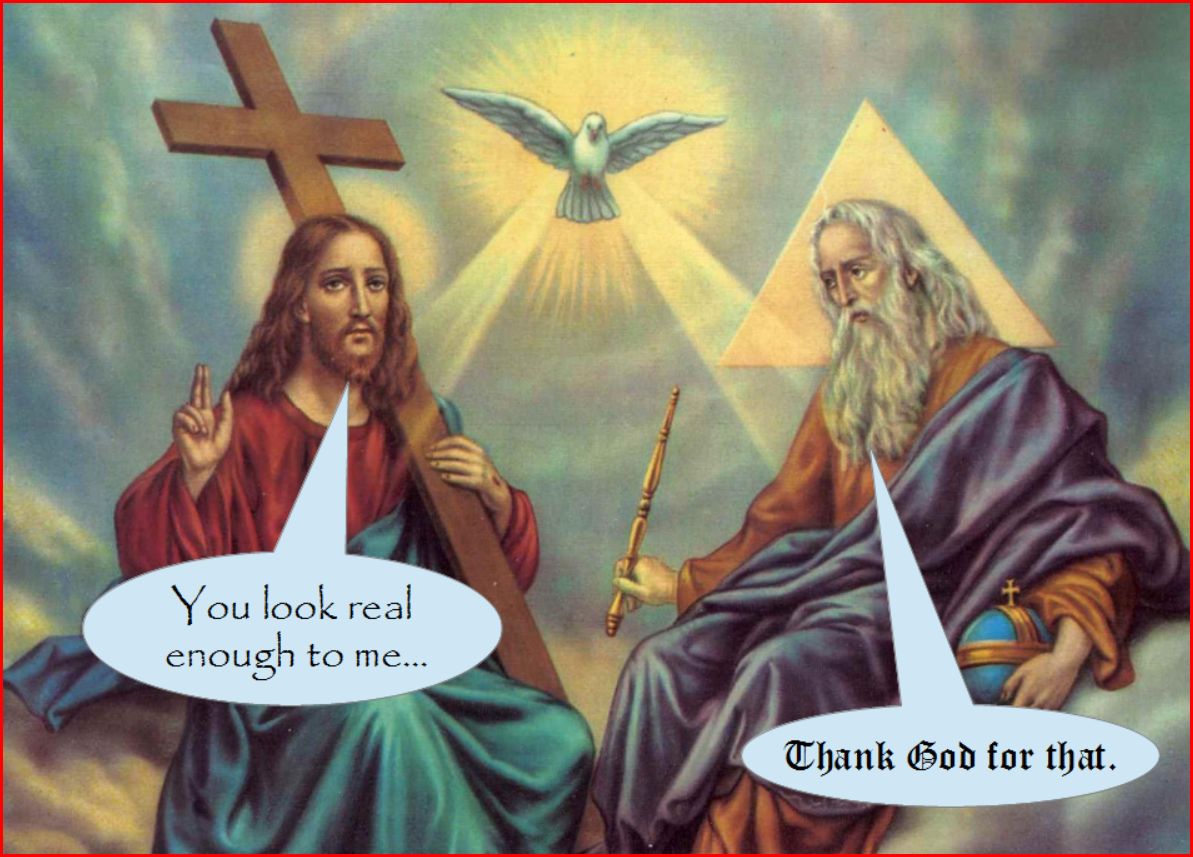
TrinityIf God did not exist –

Human beings would frequently behave like territorial primates;

Nature would be the result of a mindless and heartless process;

Sex and death would be the drivers of its development;

Life would be a cruel struggle for most living creatures, including many humans;

Disease and illness would be pervasive, except where humans themselves had eliminated them;

The world would be largely indifferent to human aspiration;

The brain would find pattern and impose order where none existed;

Progress would be due entirely to human endeavour;

People would adopt the beliefs of their culture and be entirely convinced they alone were right.

Hang on a minute! Isn’t this the world we already have? It’s just like Julia Sweeney says: ‘The world behaves exactly as you expect it would if there were no Supreme Being, no Supreme Consciousness, and no supernatural’. A world without God is exactly the world we’ve got. And the world we’ve got is evidentially a world without a God.

Surely that’s no bad thing.

Christians in denial

Trial

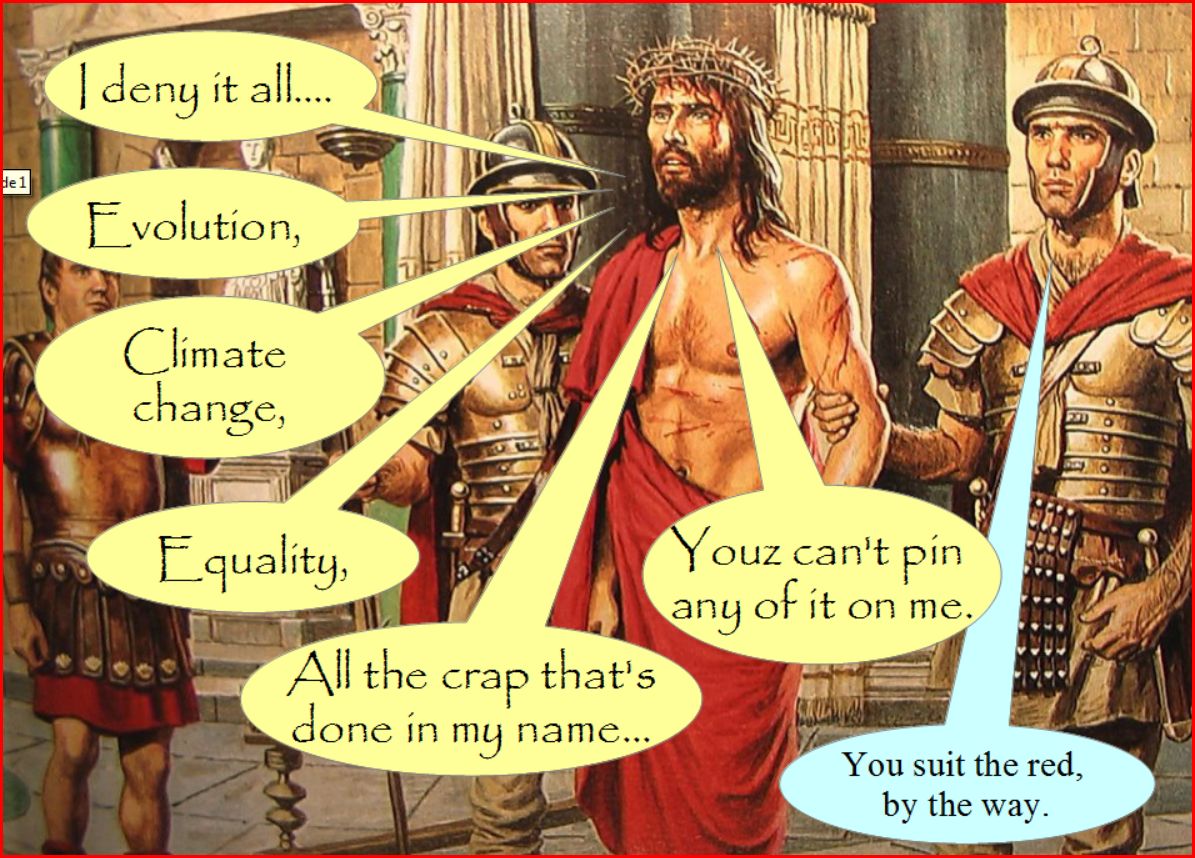
Deny yourself, deny your parents, deny your family. That’s what Jesus tells his followers they’ve to do. Today’s Christians can do better than that though! They’re in complete denial about everything, especially stuff for which there’s tons of evidence. Believing loads of made-up stuff is more their thing.

So, they deny climate change because God wouldn’t allow it (or something).

They deny that human beings contribute in any way to climate change because it’s not part of God’s plan.

They deny evolution because God created everything (in six days).

They deny how unpleasant, wasteful and cruel evolution is in order to believe that God used it to develop life here on Earth.

They deny that death existed before humans evolved because the Bible says it didn’t.

They want to deny gay people equality because the Bible says marriage is for one man and one woman (it doesn’t).

They seek to deny others their rights, often slanderously and viciously, but expect their ‘right’ to do so to be protected.

They deny that morality has anything to do with the way we treat other people and is really only about sex.

They deny that anyone can be moral or rational without believing in their God.

They deny that for most of us things are better than they’ve ever been and insist instead that things have only got steadily worse.

They deny the humanity of fellow human beings but believe in fantasy creatures like angels, spirits and demons.

They deny their own humanity, with its corresponding needs and limitations, and insist instead we’re designed to be spiritual creatures.

They deny most of what Jesus taught but tell everyone else they’re sinners.

They deny that Jesus said he’d be back in his disciples’ lifetime, and believe instead he’s still on his way.

They deny death and imagine they’re going to live forever in Heaven instead.


Christianity is a religion of negativity. Truth, reality and other people are the casualties of its life-denying efforts at self-preservation.


Christians’ Favourite Delusions 23: Jesus shows us how to live

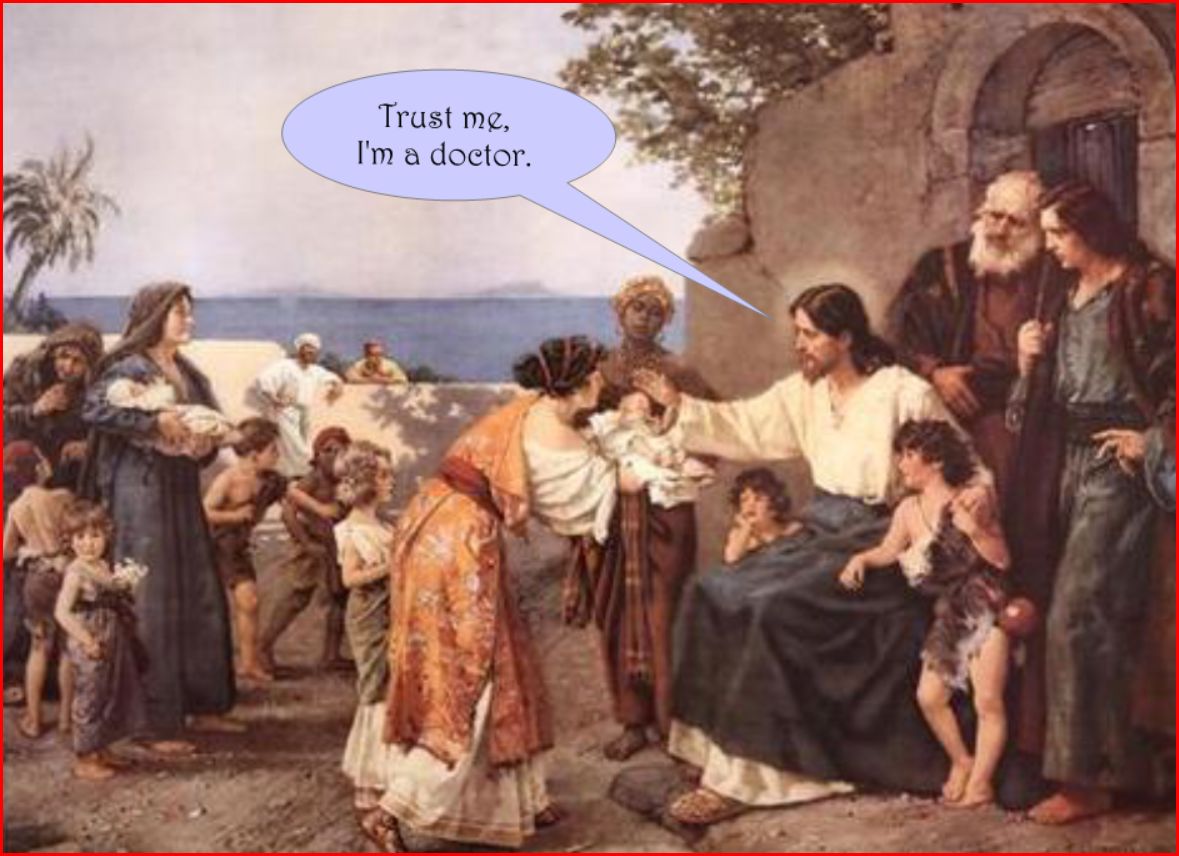
Doctor

Was JC a great moral teacher?

No, the best things he said – do unto others, love your neighbour – had already been said eons before he came along. Some of the other stuff he came out with was ridiculously impractical – give away all you have; live only for today; turn the other cheek – that his followers have been unable to do from day one.

Did what he said about God turn out to be right?

No. He said God would establish his Kingdom on Earth while the disciples were still alive.

Did he commit himself to long-term responsibility for others and their needs?

Another no.

Did he experience the infirmities and difficulties of old age?

Nope.

Did he suffer from any of the serious illnesses we mere mortals are prone to?

Apparently not.

Did he give over his entire life to raising children or taking care of elderly relatives?

Not that we know of.

Did he have to work each day to earn a living?

No. He sponged off gullible female fans (Luke 8.1-3).

Did he have any understanding of science and of how the world works?

Erm, no. He thought people became ill because of sin and demon possession and that Heaven was in the sky.

Was he interested in anything but his own futile ‘mission’?

Yet another no.

Apart from his last few days did he know suffering, the everyday frustrations of life or the daily struggle to make ends meet?

Not so’s you’d notice.

Did he, in short, know anything of the life as it was lived and is lived by ordinary people?

Emphatically not.

There was nothing marvellous about Jesus. He was out of touch with ordinary people and at loggerheads with those cleverer than he was. He was a failed prophet who was turned into a supernatural being by those who came along afterwards – mainly Paul, who’d never met him – and is worshipped today by those who ignore most of what he said.


Proof that God is real?

Thor

Christians – can you prove God exists? J. Lee Grady of Charisma magazine thinks he can and offers ‘7 Things That Prove God Is Real’. Leaving aside the fact that it shouldn’t be necessary to prove God is real – the God of the universe, Creator of Heaven and Earth, Father of Mankind should be more… apparent, shouldn’t he? – what are Mr Grady’s incredible proofs? Glad you asked. You can read the full article here, but to cut a long story short, they are:

Babies, thunderstorms, flowers, the Bible, the global spread of Christianity, Jesus and a personal friendship with God.

I hope you’re convinced. I know I am.

Problem is, all of these things are also evidence that God doesn’t exist.

Babies: Babies are miracles, according to Lee. We’ve evolved to find human babies cute and appealing even when they’re yelling, pooping and spewing – it helps us nurture them. But they’re not miracles; nearly 37,000 are born every day. What’s more, over a million of them die every year on the day they’re born. Which might just suggest God is not real at all.

Thunderstorms: Mr Grady says that because storms are powerful they put him in mind of God. This, however, is not proof of anything. Unless of course it’s Thor, god of thunder in Norse mythology and star of Marvel Comics. Is this who you mean, Lee?

Flowers: Lee says flowers are proof of God because they’re pretty. He seems to be unaware that their appearance is the result of natural selection; it has developed in order to attract insects and birds who then unwittingly assist in the plant’s reproduction. Yes, flowers are pleasing to the human eye as well, but their job is emphatically not ‘to simply make the world beautiful’, as Lee claims. They are evidence of evolution, not of a flower-arranging god.

The Bible: Lee trots out the false assertion that the Bible, in spite of having numerous authors over thousands of years, presents a consistent message. It doesn’t. There are, for example, at least nine different ways of being saved expressed by writers in the New Testament (some of whom, including the one Lee quotes, are forgers) – and they lived within a few decades of each other! A book cobbled together more than 300 years after the supposed main event, by men – not God – with a vested interest in its success, is not proof of the divine.

The global spread of Christianity: Human beings have worked hard throughout the ages to spread their own particular version of Christianity – often converting others on pain of death. There are today over 34,000 Christian groups, sects and cults, which is ‘proof’ that there is no one Mastermind behind it all. Other religions spread too, so perhaps that’s evidence their God is real as well (or instead), and so do diseases. The spread of an idea only illustrates human preoccupation with that idea.

Jesus: Really? His broken promises, failed prophecies, impossible morality and shabby treatment of those who didn’t buy into his mission somehow ‘prove God’? Maybe Lee means that Christ proves God. But ‘the Christ’ is an invention of Paul’s and has little to do with the man Jesus. In any case, one mythical figure does not prove another. Unless it’s Thor, of course, whose existence definitely proves there’s an Odin.

A personal friendship with God: What goes on in Lee’s head doesn’t prove anything, never mind the existence of God. A person’s feelings are subjective, solipsistic and entirely unverifiable. Thinking he’s got a relationship with God doesn’t mean that he has. Unlike my friendship with Thor. That’s really real.

So, seven proofs of God that are no proof at all. Anyone else care to take a turn?

Christians’ Favourite Delusions 20: The Lord God Made Them All

creation

The poster outside a church in my neighbourhood informs all who pass by that ‘the Earth is the Lord’s and everything that is in it’ (Psalm 24.1). Christians seem to think it’s important that their deity is the one who made the universe and life in this particular small part of it. Some even go so far as to say their God (though being Jewish he wasn’t their God back then, of course) made the world and all of its occupants including ourselves, literally within 6 days, about 6,000 years ago. I suppose that’s where you end up if your premise is that mythical beings, like ol’ Jehovah, actually exist. A third of Americans believe in Creation, innumerable web-sites insist an Intelligent Designer is responsible for life on Earth and street preachers are happy to tell you that evolution is a lie. ‘Were you there?’ asks Ken Ham of Answers in Genesis, as if this clinches the deal.

But let’s be generous. Let’s concede that we don’t know how life started on this planet – because we don’t – and let’s jump to the conclusion that therefore it must’ve been the Christian God. It’s not a very convincing line of reasoning, I know, but I’m being generous as I say. So let’s acknowledge that the Lord did indeed make hummingbirds and butterflies, roses and angel fish, lambs and tygers and all other bright and beautiful things, more or less in their present form.

But that means we’ll also have to concede that he made mosquitoes, flies, lice, ring-worms, parasites of all descriptions, E-Coli, pneumacoccus, all manner of harmful bacteria, viruses, AIDs, cancer – and on and on. The naturalist David Attenborough points out that Creationists are quick to give credit to their God for hummingbirds but that he himself sees ‘a little child in east Africa with a worm burrowing through his eyeball. The worm cannot live in any other way, except by burrowing through eyeballs. I find that hard to reconcile with the notion of a divine and benevolent creator.’

How do Christian creationists square their loving God with such harmful creatures?

There are only four possible ‘explanations’ available to them:

1. Harmful bacteria, viruses and parasites were ‘good’ when God first made them (Genesis 1.31). Then, like everything else, they become perverted when Adam and Eve ate some forbidden fruit.

But this creates more questions than it answers. What were these creatures like in their original forms? How did they live, when their ‘life-cycle’ depends on them infecting other forms? How did they change from being ‘good’ into the creatures they are today? It can’t have been by the process we know as evolution because, of course, evolution is a lie.

2. The Devil made them to plague mankind. He even made sure they survived Noah’s flood – no doubt in the bodies of Noah’s family and the animals supposedly on the Ark.

But if Satan did create them, doesn’t that make him as clever as God in his own way? (I know, I know, the devil doesn’t exist either but I’m trying to think like a Christian here). In any case, why would God let him? Ultimately, he’s responsible for his creation.

3. God made them because, even from the beginning, infections, infestations and disease were all part of what he considered ‘good’.

If this is the case, what an evil bastard he is, indistinguishable from Satan himself.

4. God, the Intelligent Designer just set things in motion at the beginning before leaving evolution to do his work for him.

But, as Darwin pointed out, evolution is a mindless, haphazard, wasteful process that relies heavily on sex and death. What is a supposedly loving, intelligent designer doing using it to bring about his creation? Did he forget that evolution is lie?

Which leaves us with the fact that if God designed and created all life intelligently, as many Christians want to believe, then much of his creation shows little sign of either his love or his intelligence. It does, however, show every sign of having come about as the result of a mindless, haphazard, wasteful process, in which all life-forms occupy their own particular niche to which they have adapted and have evolved, through an infinite amount of sex and death, into the life-forms we see today – hummingbirds and eye-burrowing worms included.

Christians’ Favourite Delusions 11: God is ours

preacher3

Apparently, you surrender any right to talk about or comment on God when you’re an atheist. Or so Christians would have it. ‘If you don’t believe in God, why don’t you just shut up about him? Why does it bother you that others believe?’ is the sort of line they take. You’ll find it in the comments on this blog and other sites that are critical of faith.

Like so much else, Christians are wrong about who can have an opinion about God. Unbelievers have as much right as believers, of whatever persuasion, to express views on the God-concept. It’s fair game for everyone.

So why do I bother? Six reasons.

1) I gave Jesus the best years of my life. Well, not really ‘Jesus’ because you can’t give anything to someone who’s been dead these past two millennia – but I was a Christian for twenty plus years and I complied with what the church and the Bible told me. It was a mistake; I denied myself, as I was told to do (in Matthew 16.24) and wasn’t able to be who I really am. I’m so much happier without being told what that should be.

2) I find the persistent proselytising by Christians to be thoroughly objectionable. It’s almost impossible to walk through the town centre where I live without being told by some street-preacher or other that without Jesus we’re all bound for Hell and that ‘evolution is lie’. (One of these claims is, that’s for sure.) If you get too near, a confederate will thrust a tract into your hand, replete with Bible quotations, spelling mistakes and dodgy grammar. And should you manage to avoid these particular desperadoes, you’ll then have to watch you don’t fall over the stands of Jehovah’s Witness literature, ‘manned’ by smiling ladies who think their brand of superstition is the truth.

3) Christians’ treatment of gay people is generally deplorable. ‘Hate the sin but love the sinner’ is the line frequently trotted out, even though it’s entirely unbiblical.  They may claim to love gay people but it’s a hollow claim when ‘in love’ Christians condemn gay people as sinners of the worst sort; ‘abominations’ is the word used in their holy book (and some Christians use worse language than this). Because of what the Bible says, many believers seek to deny same-sex couples the right to marry and resist attempts to grant them the same rights as everyone else. Christians insult us all by calling this love.

4) Christians’ uncritical adherence to superstition is incomprehensible. There are innumerable Christian web-sites, some of which I read (purely for research purposes, you understand) that are, variously, sources of hilarity and despair in equal measure. There has to be some counter-balance to the irrationality and evangelistic fervour of these sites and thankfully there is. Hopefully this blog makes some small contribution.

5) However much they preach at the rest of us, Christians fail to do as their saviour commands them. They think they’re ‘saved’ through St Paul’s magic formula but ignore everything Jesus says is required of them (see previous posts and my book Why Christians Don’t Do What Jesus Tells Them To …And What They Believe Instead.) It’s all specks and logs, to paraphrase JC himself; Christians enjoy pointing out everyone else’s sinfulness – and arguing about doctrine, of course – while blatantly ignoring Jesus’ commands. I feel obliged to point this out.

6) If, through this blog, I can lead people to question their beliefs, help them reflect critically on what they are told by church leaders and very selective reading of ‘God’s Word’, encourage them to think rationally about their belief in supernatural beings and, most of all, if I can be instrumental in rescuing one person from the Jesus cult, then I’ll be more than happy.

That’s why I bother.

Christians’ Favourite Delusions 9: The supernatural exists

Madeup

If you follow any Christian blogs, you’ll know that what many of them enjoy most is slagging off other brands of Christianity. They take the odd swipe at the heathen and at gay people, of course, but most of their bile is reserved for each other. They dispute the smallest matters of doctrine and principle that they are sure other groups of believers haven’t got quite as right as they have. To the outsider, it’s like arguing about whether the tooth fairy’s dress is pink or green while overlooking the fact that there is no tooth fairy.

It’s curious too because there are more similarities than differences between the varieties of Christianity. They have much more in common with each other than with the rest of us.

Most significantly, they all believe in supernatural beings. This, for me, is the greatest difference between myself and those who profess a faith. I see no evidence for supernatural creatures, places or events. The supernatural has no independent existence outside the human imagination. It is the human mind that, over the millennia, has constructed innumerable gods and their attendant mythologies, just as it has created more recently the inhabitants of Narnia, Middle-Earth and Hogwarts.

Being a Christian requires you believe in not one, but a myriad of supernatural beings, events and locations:-

While believers are adamant that there’s one God, they insist at the same time he is made up of three individuals: a Father, a Son and a Holy Spirit.

They believe in angels who wait upon God the Father in Heaven – a supernatural place they mistakenly believe they’ll be going to when they die – and who, some maintain, aid them here on Earth. How many angels are there? We are told in the Bible there’s a ‘host’ of them, which sounds like quite a lot.

There are also seraphim (Isaiah 6.2) and cherubim (Hebrew 9.5 etc), third-rate special-effects creatures who act as God’s heavies.

In addition to them, there are characters from the early days of Judaism – Moses and Elijah – who have survived death and hang about somewhere or other. They make a surprise return visit to Earth in Matthew 17.3. For some, Jesus’ mother, Mary, is another of this elite group of Eternals.

And what about all of the ordinary believers Christians say have already gone to Heaven? That’s millions of dead people who enjoy supernatural existence. Roman Catholics even believe you can chat with these heavenly ‘saints’ and they’ll argue your case for you with the Big Boss.

There’s the cast of characters from the dark-side too: God’s nemesis the Devil (aka Satan, aka Lucifer – though confusingly this last title is also used of Christ in Revelation 22.16) and his armies of demons and evil spirits who have nothing better to do than take over gullible human minds. This lot live in another supernatural place, Hell, though no-one seems to know where this is either (in Luke 10.15, Jesus implies it’s inside the earth, but it isn’t).

And last but not least are the supernatural events that supposedly took place in the real world: talking animals (Genesis 3.1; Numbers 22.28), sticks that turn into snakes (Exodus 4.3), corpses rising from graves (Matthew 27.52) and a man who magically beams up to Heaven (Luke 24.51), to name but a few.

So, Christians, argue all you like about what makes your version of Christianity better than others, but don’t forget all varieties of the faith depend on believing that these supernatural characters and events are real. In fact, they’re no more real than the pantheon of Greek gods and goddesses who inhabited Olympus, and at least they were interesting.