Omens and Portents

Hey guys, can you help me out a little? The last few weeks I’ve experienced an omen. Or maybe it’s an auspice. A sign. Could even be a miracle.

That’s the trouble, you see. I don’t know which. And even if, with your help, I manage to work it out, I still don’t know what it all means.

You see, there I was in my favourite coffee shop waiting for my cappuccino to cool a little. I happened to look over at it and saw two dead flies floating on the surface. So naturally, I called over the server and said – you know what’s coming – ‘waiter, there’s a fly or two in my drink’. Now whether the flies had been getting it on with each other and decided the froth on my coffee was a good place to do it, I don’t know, but it led to their demise: death by conjugal drowning.

I got a fresh coffee.

Skip forward a few days and I’m about to have a nice glass of Merlot in my favourite Italian restaurant. There on the top, just after it’s been poured, is a solitary swimmer, another of God’s blessed little creatures backstroking its way around my glass in ever erratic circles. After I paraphrase the old joke again, the waiter removes the glass, fishes out the drunken fly and returns my wine. Or maybe he poured a fresh glass. Who knows.

And then – yes, you know what’s coming – a few days after that I’m having another cappuccino in a third establishment when another of the little blighters tops itself in my drink. That’s three times in only a few days. I mean twice would be a coincidence but three times! As Ian Fleming almost said, ‘once is an accident, twice is a coincidence, three times is a pattern’. There was a pattern to my flysome encounters, and we know what a pattern means: it means a pattern maker! An intelligence behind this series of unfortunate events. But which? And what did they all mean? A pattern has to have meaning! What was the message I was being sent from the supernatural plane?

Was it an omen? A portent? A sign from above? Was God telling me something? If so what? Maybe you guys can help.

I just realised though that there’s a Lord of the Flies, Beelzebub, who might be trying to communicate with me. (Is there a Lord of the Slugs and a Lord of the Flatfish too? Logic dictates there should be… but I digress). In the Word of God (Mark 3:24 etc), Beelzebub is none other than the devil in disguise, an alter-ego of old pal Satan.

What’s Satan/Beelzebub trying to say to me by directing flies to land in my beverages? I really need to know. If only these all-powerful supernatural types could be a little clearer.

Spiritual Forces of Evil in the Heavenly Realms

Original AI image from Night Cafe 

For our struggle is not against flesh and blood, but against the rulers, against the authorities, against the powers of this dark world and against the spiritual forces of evil in the heavenly realms. (Ephesians 6:12)

…you followed the ways of this world and of the ruler of the kingdom of the air, the spirit who is now at work in those who are disobedient. (Ephesians 2:2)

the prince of this world now stands condemned. (John 16:11)

The first-century worldview of early Christian cultists was that somewhere above the Earth a battle raged between God and Satan. The powers of darkness – the devil and his demons – had in ages past launched an attack on the Lord and his angels. This war in the spiritual realm continued unabated up to the time when a cultist wrote Ephesians, pretending to be Paul. Paul himself had already alluded to Satan as the god of this age (2 Corinthians 4:4), while the authors of the fourth gospel would later refer to him as the archon – ruler and prince – of this world (John 12:31; 14:30).

Which just goes to show how the Almighty God they believed in was nothing of the sort. He had tussled with his arch-enemy for eons without quashing his rebellion and putting an end to his persistent attacks. The stand-off had gone on for millennia, and, according to today’s Christians, is still happening. A puny god it is who cannot get the better of one of his far less powerful creations.

And what are God and Satan fighting over? Us, apparently. The devil wants control of human beings.

Why? Who knows. In fact, according to Paul, Satan already has control over us. He enslaves us to sin, which in turn leads to death (Romans 5:12, 6:23). 

Not to worry though, Paul, fake Paul and the fourth gospel writers assure us that their enfeebled God has a cunning plan! He’ll allow a being who is precious to him – like a son, in fact – to be sacrificed so that anyone who believes in him will no longer be enslaved to Satan and sin and will be granted eternal life. How’s that for special magic!

Who shouted out from the back that that sounds like a cop-out? It’s a fantasy bordering on the insane. Like it or not, we are somehow embroiled in heavenly warfare, specially if we’re of the number who’ve bought into this malarkey.

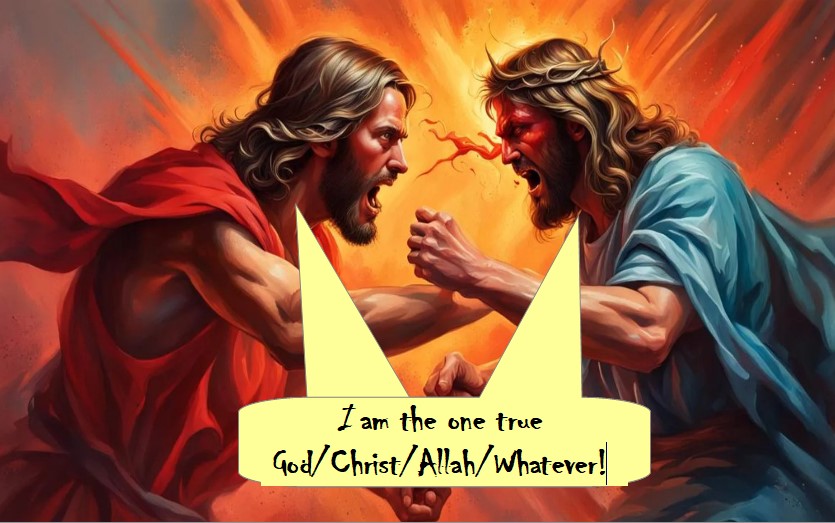
While we’re at it, have you noticed how so many of the wars and skirmishes currently afflicting the world have religion at their heart? YHWH is scrapping with Allah, Allah is up against the Great Satan while Jesus – no stranger to war-mongering himself – presides over it all, leading the world to Armageddon and his own ultimate ‘return’.

Here’s my suggestion. All the gods and demons need to get their act together. They should agree to an ultimate slug-fest, a final battle in the spiritual realm to decide who’s really the Supreme God – the last deity standing – and leave us humans out of it entirely. Surely, being gods, they’re up for finding out who can piss furthest up the wall.

A preposterous idea? Of course it is. None of these fantasy beings exist. There’s no YHWH, Allah, Heavenly Father, Jesus, Krishna, angels, archons, Satan or ‘spiritual forces of evil’ to duke it out. There’s no ‘heavenly plane’ where they can get to it. Everyone of these despotic characters is a human creation, as are the wars, disputes and skirmishes they underpin. It follows that none of them can be the supreme god and certainly none of them are worth fighting over. It’s time we grew up and put away all of our childish imaginary tyrants.

The Origins of Evil

Where does evil come from? The Billy Graham Organisation knows:

…the Bible does reveal two important truths about where evil comes from. First… evil comes from the Evil One — that is, from Satan… Satan is a powerful spiritual being who is absolutely opposed to God, and is far stronger than most of us realize. He isn’t equal with God, but is totally evil, and repeatedly works against God. Jesus called him “a murderer from the beginning…. a liar and the father of lies”.

No, not really. Evil is not a supernatural being cavorting around an unseen, undetectable spiritual realm while inflicting havoc on our reality (see here). Satan is not the embodiment of all evil for the simple expedient he and his minions do not exist.

What else does the Bible have to say about the origin of evil? Fake Paul in 1 Timothy 6: 9-10 claims that ‘…the love of money is the root of all evil’. He goes on to say, ’while some coveted after (money), they have erred from the faith, and pierced themselves through with many sorrows,’ which sounds suspiciously like a snipe at early Christians who refused to hand over their worldly goods to the cult.

Now, while greed and avarice can undoubtedly lead to wickedness, the love of money is not the root of all evil. Vindictiveness, spite, fear, ignorance, stupidity, hatred, lust for power, sexual lust, jealousy, coveting another’s property or territory, religious beliefs and deceit (take note, fake Paul): all can, and do, lead to evil.

Let’s give the Bible one last chance.

The author of Mark’s gospel has Jesus say:

What comes out of a man, that defiles a man. For from within, out of the heart of men, proceed evil thoughts, adulteries, fornications, murders, thefts, covetousness, wickedness, deceit, lewdness, an evil eye, blasphemy, pride, foolishness. All these evil things come from within and defile a man (Mark 7:20-23 NKJV).

While ‘Mark’ is talking about ritual purity in this bizarre mix of low-level immorality, religious offences and actual wickedness, he nails it as far as the source of evil is concerned. It emanates from human beings, most often, from men. While women are also capable of committing evil acts, and children too sometimes, most are perpetrated by men. 

It’s not easy finding evidence for this online, where misogynistic, religionist have taken over, claiming women are more evil than men on account of Eve eating the forbidden fruit. They also argue that women are more evil because they ‘hold a grudge longer’. However, a little digging dispels this ridiculous notion. Consider:

Are most dictators men or women? (Men, almost exclusively);

Are most genocidal acts initiated and carried out by men or women? (Men, almost exclusively)

Are most murderers men or women? (Men: 98% of murder convictions are of men);

Are most rapists men or women? (Men; 99% of convictions are of men);

Are rape gang members men or women? (Men, almost exclusively);

Are most child abusers men or women? (Men make up 88% of perpetrators);

Are most school shootings carried out by males or females? (Males, on a ratio of 145:4);

Are most terrorists men or women? (Men, on a ratio of 5:1);

Are most crime lords, drug barons and death-cult leaders men or women? (You already know the answer…)

Are most victims of sexual abuse male or female? (Female: 1 in 5 compared with 1 in 7 males)

Almost all malicious and unnecessary infliction of harm on others, nearly every evil act ever committed has been and is committed primarily by men. Only a small number are carried out by women. However, just because most evil is committed by men, not all men are evil. More than this, most human beings don’t commit ‘evil’. Neither do most Christians, though there does seem to be an inordinate number who are prepared to sexually abuse others. Nonetheless, many are happy to blame Satan for what evil there is, including their own. Attributing human evil to a malevolent fantasy figure is a duplicitous attempt to evade both responsibility and culpability.

In any case, according to true believers Satan’s main occupation is sowing the seeds of doubt in the minds of Christians, in an attempt to lead them away from Jesus (2 Corinthians 11:30). Satan is, when all is said and done, a pretty hopeless prop, not ‘a powerful spiritual being’ but an enfeebled metaphor for the evil that some humans engender.

Afterthought:

Where does goodness come from? That too is human. All compassion, kindness, consideration, empathy, helpfulness, love, joy and peace come from us.

Or not, as the case may be.

When A Child Is Born… Supernaturally

To what extent are the conflicting nativity stories in Matthew and Luke historical? That depends on whether or not you believe in the supernatural.

There is no evidence of a supernatural realm nor the beings who are said to inhabit it: God, heavenly Jesus, the Holy Spirit, angels and those they are constantly at war with: Satan and his demonic hordes. It is not as Jonathan Cahn describes it in The Serpent’s Prophecy:

Behind the perceivable realm lies another, beyond our ability to measure or quantify. Behind the history of this world lies another, unrecorded, unrecited, unknown. And behind that which moves and transforms the world lie unseen forces, causes, agents, undying and primeval (p3).

Cahn cannot possibly know any of this, any more than fake-Paul could when he wrote Ephesians 2,000 years ago (6:12). A reality that exists above and beyond nature – the meaning of supernatural – that is ‘unseen’, undetectable and ‘unknown’ is one that doesn’t exist, except in the imagination of a few fantasists.

Yet the supernatural is the basis of Christianity. Without it, its agents, as Cahn calls them, could not have interacted with the only reality there is. The Holy Spirit could not have impregnated Mary; angels could not have materialised to announce Jesus’s birth to a group of credulous shepherds; a divine being could not have communicated through dreams with Joseph and the Magi; a magic star could not have been manoeuvred into place over Jesus’ house. Most significantly, a non-existent God could not have sent his ‘son’ into this world.

It is futile to argue whether Matthew or Luke’s nativity narrative is the more historically accurate. Nor is there any point in trying to harmonise the two accounts. Neither is historical: the involvement of the supernatural rules out their being factual.

The inclusion of the supernatural in everything that follows is also fatal to claims made for the gospels’ historicity. The clues are there in the text: God’s pronouncements from the sky; the inexplicable miracles and healings; the presence of angels, demons and Satan; the dead rising; visions, prayers and prophecies. These tell us that what we’re dealing with is fantasy material. The creators of the gospels and other books of the New Testament had no more evidence than Cahn does that secretive super-beings existed, even if they did take them for granted. God and his interventions no more exist than Santa Claus and his magical Christmas deliveries.

Paul tells us that God raised Jesus from the dead (Romans 8:11). But there is no God, so he didn’t. There was no supernatural resurrection and without a resurrection there were no encounters, like those in the gospels, with a reanimated body.

Remove the supernatural from the Jesus story and there’s nothing left. Some wise advice lifted from Jewish scripture perhaps, plus a few cult rules, but that’s all. Paul’s experience of the risen Christ, like that of Cephas before him (described nowhere in the New Testament but allegorised in the gospels) and John of Patmos after him, were as Paul himself says, a ‘revealing’ in their own heads.

I hope none of this spoils Christmas for you. The Nativity isn’t a bad story, indeed it’s quite beautiful in places. But it is not historical. Like much in gospel Jesus’ life, and the resurrection itself, it is a fantasy generated by irrational and superstitious minds.

A very happy Christmas to both my readers.

Experiencing Jesus

Back in my students days, sometime in the Middle Ages, I was involved in the conversion of a couple of friends. I’d only just met them, after starting college a week or so earlier. I was training to be a teacher and the college thought it would be a good idea if their new recruits spent a couple of weeks travelling to a school miles away to observe how education was delivered there (pretty chaotically it turned out.)

Jan, Karen and I travelled to the school in Rob’s Triumph Herald car. Rob was a new friend too. He and I met the first day of college and hit it off straight away, both being evangelicals (his guitar was covered in Arthur Blessit ‘One Way’ stickers) and bonding over our mutual love of Larry Norman.

Rob had one such sticker on the dashboard of his car and one day, on our way back from the school, Jan and Karen asked about it and what it was like to be a Christian. We had somewhere taken an unintended detour and the journey back to the college was taking longer than usual so we had plenty of time to share our faith with them. It was a dream come true – what committed Christian didn’t look for opportunities to witness to non-believers, which we did with great enthusiasm.

Before going off to college I’d had a strange vision: a vivid scenario playing out in my head. In it, some people I hadn’t yet met came to my dorm room and asked me to lead them to Christ. While I hadn’t seen my room at this point it turned out to look exactly as I’d seen it in the vision. Lo and behold, after our chat in the car, Rob appeared at my door that evening and said Jan and Karen had arrived at his room saying they wanted to become Christians. We took them to the little prayer room in the back of the college chapel and there the Holy Spirit took over. We prayed with ‘the girls’ and introduced them to Jesus. The entire room was filled then with another powerful presence like a wind or tongues of fire as we sensed Jesus there with us.

It was a powerful experience and for the girls an overwhelming one. They left praising the Lord on an all-time spiritual high. Soon after, Jan had to go into hospital (I forget why) and used the time to read the Bible we gave her in its entirety. She was on fire for the Lord there in that hospital ward. Later she surrendered her yoga materials to us once we’d shown her how the practice was Satanic and, doing the Lord’s bidding, we destroyed it for her. Jan and Karen joined the Christian Union, coming to the twice weekly meetings and began to attend the local evangelical church every Sunday.

To this day, Jan remains a Christian. I haven’t seen her for many years but we share Christmas cards and very occasionally comment on Facebook posts. Karen abandoned her faith a few years after her conversion.

How to explain this amazing experience? Conditioning meets emotion. That it was life-changing for both Jan and Karen (for a while) and also for Rob and me, was the result of our own intense feelings. Neither Jesus nor his Spirit was present in that little prayer room. We thought he was and that was enough. We didn’t need to see him, it was enough to sense his powerful presence (in reality our own heightened emotions.)

Wasn’t this how it was for the earliest Christians? Those Paul told about Jesus never actually ‘saw’ him; they felt him among them. This is how the gospels say it works, not the sighting of a physical body but the sensing of a presence. Matthew makes his version of Jesus predict that this is exactly what will happen (in reality Matthew is reflecting what early cultists had been experiencing for decades when he came to write his gospel):

For where two or three are gathered together in my name, I am there among them (Matt 18:20).

In other words, a small group intent in their worship would experience the presence of their heavenly saviour. They would manifest a sense of his being there through their collective emotions, just as Jan, Karen, Rob and I did in that prayer room. As did those, like Cephas, who experienced him way back at the start of the Jesus movement, and as Paul did in his imagined encounters with the risen Christ.

No reanimated corpse required.

Presenting a well-thought through Christian Response*

If there’s one thing I love about writing this blog it’s the considered, articulate comments I get from loving Christians.

A brave anonymous commenter left one the other day on the 2015 post ‘Gentle Jesus – meek and mild?‘. Short on time and rhetorical skills, Brave Anon opted instead for a different range of tactics. Here’s what he(?) had to say:

I’m a little short on time, and i wish I wasn’t, because I could pick apart your post piece by piece for hours. I WILL say though, that I’d expect someone who has dedicated a whole site to this matter to have actually read the book he’s so dedicated to disproving. It’s pretty clear that you haven’t and only used quick Google searches to try to prove your point. The big thing that i’d really like to point out is that most of the scripture you quoted to try to prove your point is from the Old Testament. That means it was law BEFORE Jesus was born. Yes, some of them are pretty harsh. That is why Jesus whittled the 613 commandments in the OT down to 10 in the NT. The most important being, ”Love the Lord your God with all your heart, and with all your soul, and with all your mind.” The most important one, right behind that, is to, “Love your neighbor as yourself.” That is why I just prayed for you. I wish that people like you would get away from trying to disprove the Word and find something else (literally ANYTHING else) to spend your time doing. What do you have to gain by making this site? Do you have such little self worth that, as a grown adult (I assume, but maybe I’m wrong), you really need someone to pat you on the back and say, “WOW! You did a really good job! You get a gold star. That means, you get to pick out what toy you want to play with at recess first today!” Will, if that’s what you need, I ain’t the one to say it. Your arguments are weak, and you are clearly uninformed on the subject you’ve chosen to focus on. Why don’t you, at least, read the Bible (I mean cover to cover) before you speak on it. If you need a little motivation, why don’t you remember that Satan knows the Bible better than ANYONE here on Earth. I mean, even better than the POPE!!! Familiarize yourself so you can, at least, make an educated, organized, well informed, argument. You do that, and I’ll consider giving you a shred of respect. Otherwise, good luck on your day of reckoning. I hear it’s hot down there, so make sure you pack shorts!!

Let’s ‘pick apart’ the tactics in use here:

  1. Mind reading: Brave Anon knows that I have never read the Bible. Impressive. Wrong, but impressive. He uses his telepathy too to work out my motivation for writing: so I’ll be rewarded with praise. Thanks, Brave Anon; in the 12 years I’ve been blogging I’ve never realised this.

  2. Jumping to conclusions: Brave Anon decides all my information comes from Google. While it’s true I do use Google to verify sources and provide links to articles, when it comes to the Bible, I quote it directly. All those references in brackets are the clue that this is what’s going on. They look like this: (Matthew 7:1-3), (1 Corinthians 5:12). Brave Anon might want to look these two up on Google.

  3. Confused irrelevancy: Brave Anon is unhappy I ‘quoted… from the Old Testament’ in the post in question. Wait – didn’t he just say I’ve never read the Bible? Isn’t the Old Testament part of the Bible any more? The point made by the post is that Matthew’s very Jewish Jesus says that the Law – that’s the one in the Old Testament – will never pass away, not one jot or tittle of it. Wasn’t the Old Testament, under a different name of course, the only scripture Jesus knew? Maybe that’s why I quote it alongside the later stuff Matthew makes up for him to say.

  4. Intuition: Brave Anon intuits I’m a full grown adult. Brilliant. He could of course have read ‘The Author…’ above, which would have told him that, and would also have informed him of why I post what I do. Guessing is so much more effective though, don’t you think?

  5. Condescension: Brave Anon prayed for me. Nice. Nevertheless, he felt moved to send a derisory comment.

  6. Withholding his respect: Jeez, if I’d known this was going to happen I’d never have written the post. I’m positively bereft.

  7. More confused irrelevancy: Satan, the capitalised POPE… what the…?

  8. Desperation: ‘Just wait until the day of reckoning then you’ll regret criticising my buddy Jesus ‘cause you’ll be burning in hell!’ This threat is always a part of Christians’ comments. I’m thrilled Brave Anon remembered to include it.

Thanks for dropping by, Brave Anon, and for reminding me to pack my shorts.

*Not really.

Redeemed: From Slavery to… erm, Slavery

Thanks be to God, who delivers me through Jesus Christ our Lord! So then, I myself in my mind am a slave to God’s law, but in my sinful nature a slave to the law of sin. (Romans 7:25)

Do you not know that if you present yourselves to anyone as obedient slaves, you are slaves of the one whom you obey, either of sin, which leads to death, or of obedience, which leads to righteousness? (Romans 6:16)

(We are) justified freely by his grace through the redemption that is in Christ. (Romans 3:24)

When a slave had served sufficient time and had accumulated sufficient wealth or found a benefactor, he or she could buy their freedom. This seems particularly egregious when their servitude was already, in the case of debt, the means of paying back what was owed. In effect the enslaved individual was paying twice for their freedom. Be that as it may, the act of buying oneself out of slavery was known as redeeming oneself; redemption. Likewise, a third party buying your release was also known as redeeming. We still use the term in this sense today: a pawned item can be redeemed, bought back, for a greater amount of cash than the pawnbroker originally paid for it. The related term ‘ransom’, in Mark 10.45 has the same sense; paying money to secure the release of a captive.

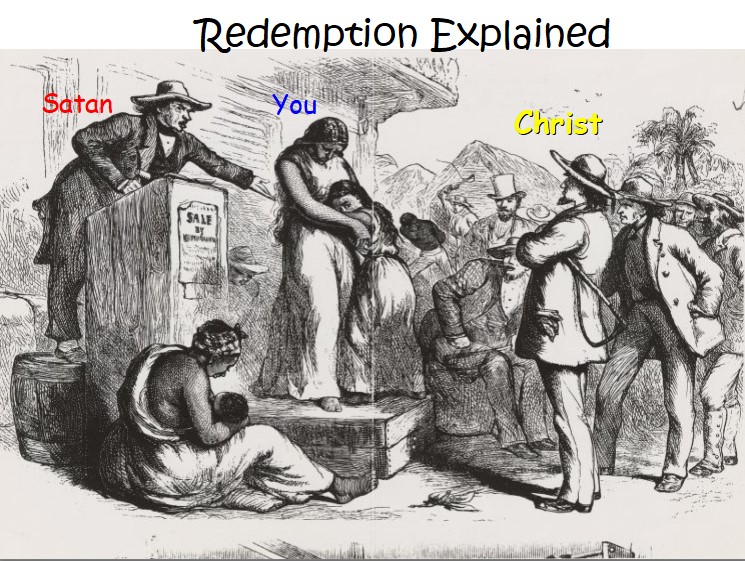
The principle of buying oneself out of captivity and slavery underscores the Christian idea of redemption. It is the analogy Paul and other New Testament writers use, to explain Christ’s paying the price, through his sacrificial death, for the slave’s release. He redeems (or will do at some future point depending on which fantasist you’re reading) in exactly the same way a slave was redeemed, from a life of captive slavery to sin/the Law/Satan and his minions. 

There’s a catch. If a slave was redeemed by a third party, he was likely to find himself not free at all but the property of whoever had redeemed him. His debt having been paid off to his first owner, he might very well find himself in hock to a new one. So it is with Christian redemption. Christ may have paid off your perceived debt to your original owner (sin, Satan or whoever) but now you’re indebted to him. You’re his slave, as we saw in the previous post.

To downplay slavery as it was practised in the centuries before the cult adopted it as an analogy, is to undercut redemption as Paul and early cultists perceived it. Arguing that slavery was a relatively benign practice removes the basis of Christian redemption; if being a slave wasn’t really too bad then neither can being a slave of sin/the Law/Satan be too serious either. There’s really no great need to be redeemed and what Paul says in Romans and elsewhere counts for nothing.

But we knew that anyway.


Where’s Jesus?

Not a rhetorical question. Christians keep telling us that he’s alive, so where is he exactly? If he’s alive he has to be some place. The old hymn, ‘I Serve A Risen Saviour’, which I sang many times in my younger days, thinks it knows:

He lives, He lives, Christ Jesus lives today!
He walks with me and talks with me along life’s narrow way.
He lives, He lives, salvation to impart!
You ask me how I know He lives?
He lives within my heart.

This isn’t much use though, is it. All it’s saying is ‘I’ve convinced myself Jesus is alive because I feel him inside me.’ That’s the extent of it, and this being so, it’s really no evidence at all that Jesus is alive in any sense the word is usually understood, let alone that he has an independent on-going existence.

Perhaps the bible will be of more use. Acts 7.55-56 has Stephen see Jesus alive in heaven, standing at the right hand of God. Well, that’s great. Now we’ve got two problems. Not only do we still not know where Jesus abides, we don’t know where God lives either. They’re both together somewhere, ‘heaven’ according to Acts says, but we’re no closer to knowing where this is either.

According to the preceding verse, Acts 7.54, Stephen is ‘looking up’ when he has his vision of heaven. This is significant because for early Christians, God’s abode – heaven – was in the sky. The New Testament speaks of different levels or realms of heaven, all of them up in the sky.

In 2 Corinthians 12, Paul claims to have visited the third (and highest?) level, while the Paul-imposter who wrote Ephesians helpfully explains that the lower level, the one nearest the earth, is occupied by demons and Satan’s minions whom he refers to as ‘the powers of the air’, ‘cosmic powers’ and ‘powers and principalities’. These are the very beings whom Paul claims in 1 Corinthians 2:8 killed Jesus (betcha thought it was the Romans) and 1 Peter 5:8 says seek to devour men’s souls.

Next is the heavenly realm inhabited by angels and the original perfect copies of everything here on Earth (Hebrews 9:22-24).

Then, finally, there’s the highest heaven (alluded to in Luke 2:14)) where dwells the CEO, God himself. If Jesus stands or sits at his right hand, then presumably that’s where he is too. But where is this highest heaven, or indeed any of the levels the early cultists believed existed? There’s no evidence for any of them.

In fact, the Bible’s heavenly hierarchy (which you can read about in detail here) is absolute drivel. Above us, as John Lennon was known to say, is mere sky – the stratosphere, mesosphere, thermosphere and the like – followed by the endless vastness of largely empty space. If Jesus is alive in an imaginary highest heaven somewhere out there, then he, like it, is similarly non-existent.

But let’s not write a living Jesus off just yet. It’s possible that he, his Father and all those lesser supernatural beings – the demons and devils, powers and principalities as well as the angels and snoozing saints – are hidden away in some other invisible and undetectable alternate dimension.

Other dimensions are, according to some scientists, theoretically possible. There may, they say, be as many as 11, but unfortunately for Jesus, none of the Bible authors knew of them. Those who wrote about heaven in the early days of the Jesus cult, were convinced it was overhead and, as ‘intellectual’ Christians are fond of pointing out, we need to read and interpret scripture as the ancients themselves did, not with a modern sensibility. Certainly not with an understanding of ‘dimensions’ derived from Star Trek.

Despite this, theologians have to work mighty hard to transplant such theoretical dimensions into the Bible in order to claim that heaven, and therefore Jesus, exists in one of them. And work hard they do, at what is little more than a god-of-the-gaps argument: ‘we know Jesus is not a few (or even many) miles up above us, therefore we must find a location for him somewhere that science appears to allow.’

(Interestingly, when it comes to the fine-tuning argument, apologists are quick to dismiss the idea of other dimensions, multiverses and parallel worlds; these make the earth less special, less ‘just right’ for life, less designed by God specially for us.)

Locating the living Jesus is like finding Wally/Waldo in one of those cluttered pictures, except this time he hasn’t been included. So tell us, Christians, where is Jesus? And where is the evidence he’s where you say he is?

Where’s The Harm?

So what does it matter if people believe in make-believe? It does no harm and might even do some good, right? I mean, if they want to believe in ghosts or horoscopes and that helps them make sense of life, then why not?

But with Christianity and other theistic religions it’s a different story. While they might provide their adherents with some coherence to their lives, they also equip them with a distorted and unhealthy view of other people. This is what compels local street preacher, Dale McAlpine, to pick up his megaphone and stand yelling at passers-bye in my local town centre. I took the picture above of him yesterday, when he invited me, like an evangelical Hannibal Lecter, to come closer. I declined.

Dale’s theme this time was, predictably, that evolution is a Satanic hoax, everyone is a wicked sinner and God requires a blood sacrifice for them to be saved. He no doubt had a swipe at LGBT folk too; he usually does. Dennis and I didn’t stop to listen to him but, along with everyone else, were lambasted with his ignorant BS as we passed. Such nasty stuff needs to be opposed and in the absence of my own megaphone, this is my way of doing it.

Those who believe planets millions of miles away control their lives don’t, as a rule, set themselves up on a soap box in the centre of town and threaten people with hell. Ultimately, though, there is no substantial difference between the baseless wishful thinking of astrology and Christianity. Today’s version of the faith owes its existence to Paul’s ‘revelation’ of an imaginary celestial being that sacrificed itself to restore our standing with an imaginary God. This makes as much sense as believing that the planets ‘in conjunction’ shape our destinies.

Would I, if it were in my power, ban the likes of Dale from spouting his ignorant, ugly version of Christianity? Probably not, as I’m a liberal at heart and cancel culture concerns me. I would, however, be pleased if he came to senses and of his own volition stopped spouting publicly his brand of theo-babble. I’d rather he spent his time tending to the sick, homeless, naked and imprisoned as his Saviour tells him to. I fear though that that kind of Christianity is too hard for the likes of Dale.

The Trouble With Atheists: A Christian Sets Us Straight

My friend Bruce Gerencser was good enough to repost my previous post on his blog. It prompted a comment from someone calling himself James Thompson, who Bruce says used a fake email address and quite possibly a false name. (These Christians; so fearless and honest in all their doings!) Here’s what ‘James’ had to say:

It’s because that’s what you live to do argue the truth. You’re not “atheists”. Antitheists yes. Agnosticism yes. A true atheist would not give a rip about the discussion on this blasphemous blog.

And atheists don’t go out seeking to remove Mickey Mouse from everything.

Or Buddha or Mohammed.

But they do Jesus Christ because Satan knows he is the only one who can bring salvation

I did respond to James on Bruce’s blog but wanted to address his garbled points, such as they are, more fully here. They’re typical of the low level thinking Christians and others use to defend their beliefs.

It’s because that’s what you live to do argue the truth.

Amazingly James has an uncanny insight into the minds of atheists; we live only to argue the truth, by which he means, presumably, critiquing his pet deity and magical saviour. Most of the time, most atheists barely give these two mythical beings a second thought; neither do I when I’m not blogging. I live for entirely different things.

You’re not “atheists”. Antitheists yes. Agnosticism yes.

But wait! People who don’t believe in his God aren’t, according to the omniscient James, atheists; they’re anti-theists. Okay, I concede; I am opposed to the notion that there’s a loving God somewhere out there who is interested in us and has made it possible for us to know him by, according to James and other deluded souls, making his only son a blood sacrifice. I dispute this silly idea, which has no evidence to support it, and is, as Jesus is made to say in Matthew 11.25, irrational and illogical. So yes, I’m an anti-theist. I’m also anti-theist because of what believers in the one true God (in his various guises) do terrible things to each other and to non-believers. And when they’re not doing that, they’re parading their ignorance, propagating their book of myths and spells, denying evolution, dumbing down children’s education, suppressing LGBT+ people and threatening everyone who doesn’t subscribe to their superstition with eternal damnation. I mean, what’s not to like?

 A true atheist would not give a rip about the discussion on this blasphemous blog.

And then James returns to his mind reading act. How does he know what a ‘true atheist’ might think of Bruce’s blog? There are plenty of atheists who comment there; whether they are ‘true’ atheists apparently only James knows.

And atheists don’t go out seeking to remove Mickey Mouse from everything.

It is true atheists (which we’re not, according to James) don’t seek to remove Mickey Mouse from everything, whatever this means. But then Mickey Mouse doesn’t start wars, condemn everyone as wicked sinners or try to control their sex lives. Disneyworld would quickly go out of business if he did. (That Donald Duck is a different kettle of fish however.)

Or Buddha or Mohammed.

James then scrapes the bottom of the cliché barrel: ‘You wouldn’t dare criticise the revered characters of other religions’. Yes, we would. As I said in my post, which evidently James didn’t read, there is no supernatural. All gods, ghosts, spirits, angels, demons, heaven and hells, from whichever religion or superstition they emanate, are figments of the imagination.

But they do Jesus Christ because Satan knows he is the only one who can bring salvation

These two as well. The Christ and his evil doppelganger, Satan, are human inventions. As fantasy figures they are open to as much ridicule and ‘removal’ as any other imaginary being. Perhaps more, given the damage they’ve caused and continue to cause.

James has been sold salvation snake-oil and thinks that because he’s been duped, everyone else should be too. Or at the very least should respect his delusion. Ain’t gonna happen, Jimmy boy. You need to grow up a little. And maybe also learn some grammar.