Like a Virgin. Or Not


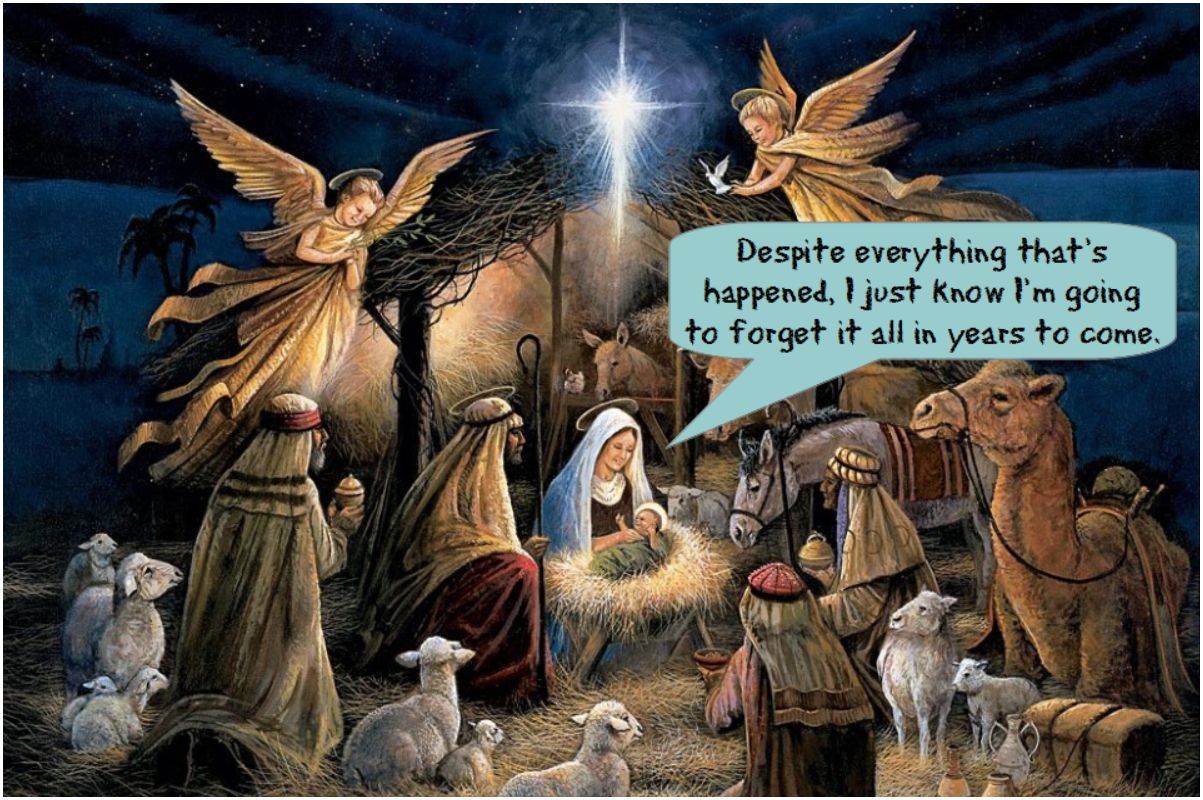
To arrive at the nativity story most of us grew up with and which your kids and grandkids might well be performing this Christmas (mine are), the one with a stable, shepherds and wise-men, involves some cunning sleight of hand, not to mention a liberal dollop of invention.

The biblical ‘account’ of the story is spread across two gospels, Matthew and Luke. Mark hadn’t heard of it when he wrote his gospel so you won’t find it there. In fact, Mark’s Jesus doesn’t become God’s son until his baptism. Paul, writing earlier still, thinks God adopts Jesus only at his resurrection. Paul has no knowledge either of the nativity myth. John has no time for it: his Jesus is an eternal being who has existed with God from the beginning.

For Matthew, however, Jesus comes into existence when the Holy Spirit impregnates a virgin. Luke likes the idea and so copies it into his gospel. And now we have a problem: the idea that a virgin will bear the Messiah is lifted from the Septuagint, the Greek translation of the Jewish scripture, which renders Isaiah 7:14 as –

Therefore YHWH himself will give you a sign: the virgin (almah) will conceive and give birth to a son, and will call him Immanuel.

In the Septuagint, the Hebrew word almah, meaning ‘young woman’, is translated as virgin. However, the word for virgin in Hebrew is betulah, an entirely different word. Isaiah 7:14 is not a prophecy that a virgin will bear a son: only that a young woman will do so; in other words, a commonplace event. Matthew allowed himself to be misled: in his eagerness to find prophecies of Jesus in Jewish scriptures, he alighted on a mistranslation. He wrote his story accordingly, riffing freely on the error. Luke picked up on it a decade later, adding his own embellishments.

Neither does Isaiah 7:14 suggest the child being talked about will be the Messiah, nor that he will appear hundreds of years in the future. As subsequent verses make transparently clear, a short period of time is all that is suggested; no more than a few years:

He (the child) will be eating curds and honey when he knows enough to reject the wrong and choose the right, for before the boy knows enough to reject the wrong and choose the right, the land of the two kings you dread will be laid waste. YHWH will bring on you and on your people and on the house of your father a time unlike any since Ephraim broke away from Judah – he will bring the king of Assyria (Isaiah 7:15-17).

These are all events contemporaneous with the writing of this part of Isaiah. All that is being said is that a young woman will become pregnant and produce a child in the near future. Even before this child properly knows right from wrong, YHWH will bring Israel’s enemies down upon it. (Because he’s such a caring God.)

None of this has anything to do with a virgin becoming pregnant, nothing to do with a Messiah, nothing to do with Jesus. It is not a prophecy about him, even if Matthew persuaded himself it was. Shamefully, almost all modern ‘translations’ of Isaiah retain ‘virgin’, when they know perfectly well it is not the word used, and that the context neither supports it’s use nor makes it necessary. They do so to maintain the lie that Isaiah 7:14 is about Jesus and to give credibility to Matthew and Luke’s ridiculous fiction that he fulfilled ‘prophecy’ by being born of a virgin. It’s a deception that will be repeated in church services around the world over the next couple of weeks.

The Anunciation: A Ghost Story for Advent

The Nativity in Matthew and Luke begins long before Jesus’ birth. Matthew introduces Mary and Joseph once the former has been impregnated with The Holy Sperm. He doesn’t go into any detail about how this happened, he just drops in, in Matt 1:18, that the deed is done. Mary has had sex with a ghost.

This isn’t good enough for Luke though, who after reading Matthew’s tall tale, decides it needs some expansion. A lot of expansion, in fact. He takes the story back to before Mary’s non-consensual encounter with the Holy Spirit and picks on Elizabeth and Zechariah, an elderly couple well past the age of having kids. All the same, they do enjoy a tumble in the sack every now and then, and the Lord – ever the voyeur – decides he’ll bless one such union with fruitfulness. (There is much wrong with the details of this unbelievable yarn, some of which I consider here; I won’t reiterate them now for fear of awakening any amateur theologians who might be lurking here in the wings.)

Suffice to say, Luke – for it is he, lest we forget, who is making this stuff up – decides that Elizabeth is a long lost cousin of Mary’s, like in one of those soaps where long lost relatives pop up all the time, usually to no good end. In this particular episode, however, all goes well and Mary visits Elizabeth, whose baby is, in a strange twist of fate, destined to be John the Baptist from the earlier two gospels. In this story his embryonic self jumps for joy inside his mother once he realises his uterine Saviour has come to visit.

But were getting ahead of ourselves. First Mary has to go through the rigmarole of getting pregnant. Obviously as a good Catholic girl she can’t have sex with her betrothed prior to their wedding and just when she’s considering when that might be, an angel appears unto her. It’s Gabriel who has quite a bit to do in the Nativity story as a whole. As angels do, he annunciates to Mary all about the pregnancy part of the plot and she acquiesces to the Lord getting her with child by magically transferring his seed into her womb. I’m guessing it was by magic. It’s possible some sort of actual rumpy-pumpy occurred but Luke delicately passes over the intimate parts. As apparently the Holy Spirit does too.

Mary is so overjoyed to be pregnant before her 13th birthday that she bursts into song on the spot and spontaneously produces a hymn based on the Psalms and the future teaching of the baby she has only just conceived. It’s hard to believe that no actual time travel was involved. It is instead, a miracle, as her impromptu ditty flourishes into the literary masterpiece now known as The Magnificat, which is not, it turns out, a feline super-hero. Fortunately, she can remember it all, word for word, decades later when Luke decides he needs to invent record it. Honestly, the whole thing puts Cole Porter to shame.

You’d think then Mary would dash off to tell her betrothed, Joseph, the wonderful news that she is pregnant without his or any other man’s assistance, but Luke makes no mention of it. Luckily, it’s covered by Matthew, where an angel drops in on Joseph, a person of great gullibility faith. On hearing what the angel has to say, he swallows the story hook, line and stinker.

Then it’s back to where we came in. Mary’s sets off down the road to see the cousin, the wonderful bearer of John. She pitches up there for three whole months, perhaps to avoid Joseph, who, it turns out, was not as gullible as she thought.

**********************************************

Honestly, this is really what happened. Would I lie to you? No, but someone would, and did. We’ll see what else he has in store in his over-worked imagination, next time.

**********************************************

PS. Don, I know you like indulging in a bit of biblical exegesis. If you’d like to borrow this totally respectful effort for your blog, get in touch and we’ll work something out.

Do You See What I See?

Christianity with its visions of God, angels and resurrected god-men, is not distinctive. It emerged from a culture in which such epiphanies were commonplace and highly esteemed. Appearances of deities, other supernatural beings and dead people were valued as genuine encounters with a reality on the other side of this mortal life. Paul was a Hellenised Jew and a Roman citizen (if Acts 17 can be believed); it was perfectly natural for him and his contemporaries to see and hear things that weren’t there.

Not only was the fledging Christ-cult influenced by the superstitious culture around it, but was born too of Judaism, itself awash with visions, apparitions and revelations. How could the new religion fail to be when its originators existed in such a milieu. One or other of these ‘visionaries’ believed they’d seen a resurrected Jesus. Of course they did. This is how gods manifested themselves then; everyone knew it. There were even those who hadn’t really had any inner-visions but wanted to be regarded as mystics themselves so would pretend they too had had direct contact with the deities.

The human mind has always been susceptible to illusions, to the potency of dreams and to misinterpreting what is going on around it. It’s also prone to a spot of fantasising now and then. This propensity didn’t cease once Christianity established itself. Muhammed claimed to have been visited by angels who revealed new truths about the nature of God – not least a change in name.

In the 19th century, a young farmer, Joseph Smith, living during a widespread and particularly intense religious revival, imagined (or pretended) he’d been visited by God and Jesus. Later, he said he’d been visited by a hitherto unknown angel with the unlikely name of Moroni. The result of course was multiple wives for Smith and the foundation of the Church of Jesus Christ of Latter Day Saints. Sufficient numbers of people believed Smith’s cockamamie stories about his alleged visions to commit to Mormonism. Smith wasn’t alone; others had visions of deities, including but not restricted to the Big Two, Jesus and his Father God. Hundreds recently saw the Virgin Mary hovering above New York City. They couldn’t all be wrong could they? Of course not, but they were all be deluded. Just like Joshua Mhlakela whom Jesus appeared to and told him the date of the Rapture was 22nd September, or possibly the 23rd, then with ‘billion percent’ certainty 7th October. Or maybe 8th…

This is how religions are made, changed and adopted: on a bed of illusory sand. If we need any further evidence that such experiences are illusory, created by the mind itself, then consider this: each time God, his angels or his Son appear in the religion-soaked brains of mystics and fraudsters, they reveal a message at odds with that revealed to previous visionaries. Each revelation has to be different of course. There would be no reason for such ‘visits’ otherwise.

Hence Abraham (or his script writer) imagining YHWH promising an eternal covenant and a new land.

Moses (or his script-writer) claiming YHWH had issued new laws while at the time commanding the slaughter of tribal enemies.

Cephas thinking he’d seen a risen Jesus who may or may not have told him of the imminent the End of the Age.

Jesus himself reportedly talking with his ‘Father’ about the necessity of his execution.

Paul flying to heaven so that Jesus could explain in great detail a new covenant, negating the original ‘eternal’ covenant with Abraham.

John of Patmos envisaging Jesus coming to Earth to slaughter the enemies he purportedly instructed his followers to love. (And Christians claim the Bible presents a unified message!)

All of these are manifestations of, and within, the minds of fantasists. Such manifestations are a naturally occurring malfunction of the brain.

And so it continues. Beware anyone who claims to have seen or heard from a deity of any sort. They, like their biblical counterparts, are deluded and almost certainly ill.

Conclusions

So what do we see when we arrange the books of the New Testament in chronological order?

  1. In all probability, Jesus was first experienced in visions experienced by a few Jewish zealots looking for the arrival of the Messiah. His name – Yeshua – is symbolic and means ‘The Lord is Salvation’.

  2. These visions led to ‘revelations’ that convinced these zealots that the Messiah would soon arrive on the Earth to set God’s plans in motion.

  3. A small number of Jews were convinced of the veracity of these claims and sought to spread the message that the Messiah/Jesus was soon to arrive on Earth.

  4. A few years later, a Hellenized Jew who called himself Paul, argued that the Messiah – ‘Christ’ in Greek – had died in the heavenly realm and been raised from the dead by God. His sacrifice, Paul insisted, was a propitiation for human sin, both Jew and Gentile.

  5. Also according to Paul, the Christ’s arrival would trigger the resurrection of the dead, prophesied in Daniel 12:1-3 and Isaiah 26:19-20, the final judgement (Daniel 7:22) and the establishment of God’s kingdom on Earth, governed by God’s Chosen (Daniel 7:27). Regrettably, he drew most of these conclusion from a book, Daniel, now known to be fake.

  6. Paul ‘proved’ that the Messiah-figure he’d seen in his visions really was the Messiah prophesied in Jewish scripture by quoting from them extensively.

  7. Soon after Paul died, the original group of visionaries, who had had their differences with Paul, were all but wiped out when the Romans destroyed Jerusalem.

  8. Around the same time, an unknown cultist took it upon himself to write an allegorical history of the Christ’s activities. He based this allegory on Paul’s teaching about the Christ as well as events from Jewish scripture. He set his story in Galilee some forty years earlier and has his fictional Christ, Jesus, prophesy the arrival on Earth of the real Messiah whom he calls the Son of Man, after Daniel 7:13-14.

  9. Two other cultists set about altering and improving this original history. One re-establishes the Christ’s Jewish credentials, and extending references to and allegorising aspects of Jewish scripture.

  10. A completely imaginary history of the early cult was created by one of these writers, smoothing over the differences between the beliefs of the earliest visionaries and Paul.

  11. Other writers, including some pretending to be the late Paul, continue to write of Jesus the Christ as a celestial saviour.

  12. A fourth history of the Christ was created, this time providing Jesus with a bodily resurrection (contrary to Paul) and discarding some of the cult’s earlier beliefs, the imminence of God’s kingdom on Earth included. The authors of this account imply that dead believers will awaken to new life in heaven (John 14:2)

  13. The idea that the Messiah will arrive imminently was, however, kept alive by other writers. One anticipated the Christ would soon purge the world of evil-doers and bring a holy, bejewelled Jerusalem down to Earth.

  14. Others soon abandoned the idea that any of this would happen soon. The arrival of the Christ was postponed indefinitely.

  15. The notion the Son of Man/Messiah/Jesus had yet to appear was also dropped as the church adopted the allegorical gospels as real history. It began to expel those who disputed the gospels’ veracity and denied that Jesus was the Christ incarnate.

  16. While the term is not used in the New Testament the Christ’s delayed arrival was, from the early second century, thought of as a second coming.

  17. The church, once well established went on to embellish doctrine, adding the Triune God; eternal life in Heaven; the elevation of Mary and the saints; the New Testament as the Word of God and the infallibility of the Bible as a whole. Some of these were, and are, in direct contradiction of the beliefs of the earliest Christians.

  18. Believers today, if they read the New Testament at all, take its traditional order at face value, which distorts the evolution of its ideas. They allow their preachers to smooth over what now appear to be random contradictions (hermeneutics).

  19. Today’s Christians believe primarily in the heavenly Christ, who forgives their sins and guides their lives from Heaven. They also hold on to the belief that he was manifested as a human, and vociferously oppose the idea he was and is only an imagined supernatural being.

  20. At the same time they prioritise Paul’s teaching about him over anything he is made to say in the gospels .

That how I see it anyway. The more time I spend looking at the New Testament books in their correct order, as well as what this reveals about the beliefs of early Christians, the more I’m driven to these conclusions. They’re the only ones that make sense of all that we find in their writings. I realise this is contentious. Mythicism is not widely accepted but it is the only position that explains the recorded facts as we have them. The original Jesus was seen (in the mind of the first visionaries and by many later) as a heavenly Messiah. While the gospels were generally accepted as historical many decades after they were written, they are anomalies in the expression of the early faith. They can only be seen as allegories of the living, dying and rising of a cosmic saviour, a sequence not uncommon in the mythologies of the ancient world.

I recognise too that there may well be other problems with this position, which I’ll get to soon.

Frankie Goes to Hollywood

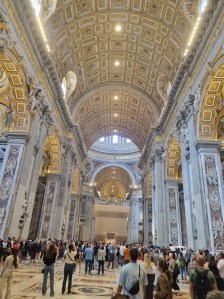
Dennis and I found ourselves in Rome last week, doing what I’m sure native Romans don’t do: the tourist trail. It’s a magnificent city.

As we were passing, we thought we’d call round at Frankie’s little place. We knew he wasn’t in, seeing as he was still on his world tour, just behind The Boss himself. He’s certainly got a great pad – Frankie that is, not Bruce – and after being frisked by hunky security guards we were admitted to St Peter’s Square. We felt moved, in the Pope’s absence, to grant an audience to the fairly thin crowd (it would get bigger later in the morning) and issue the benediction they so evidently craved. ‘Go, get a life,’ we offered from the steps of the Basilica. The faithful remained unmoved by this sage advice.

The Vatican is, I have to say, stunningly beautiful, a monument to human ingenuity and skill. But the cynic in me couldn’t help wonder what the majesty of it all had to do with the (supposed) teaching of Jesus in the Bible. I found myself playing a little game in my head along the lines of ‘how many ways does all of this contravene, contradict or downright ignore the beliefs of the earliest Christians, as expressed in what is now the New Testament?’ (Before any evangelicals tell me this is only to be expected of the Roman Catholic church, let’s not pretend that every other denomination doesn’t do the same thing.)

So, here are my suggestions for the Biblical admonitions that had to be ignored to create a religious monument on the scale of the Vatican. Feel free to make your own suggestions in the comments.

You shall not make for yourself an image in the form of anything in heaven above or on the earth beneath or in the waters below. (Exodus 20:40)

The statues of Paul and the apostles atop the buildings, the numerous images and carvings of saints, pious Marys and gruesome blood-spattered Jesuses certainly qualify as exalted images. The prohibition might not be New Testament but it is one of the Big Ten. The Vatican ditches it wholesale.

Jesus answered, “If you want to be perfect, go, sell your possessions and give to the poor, and you will have treasure in heaven. Then come, follow me.” (Matthew 19:21)

Like this ever happens!

Jesus said, ‘I am the way and the truth and the life. No one comes to the Father except through me (John 14:6)

And the Pope. And Mary. And the Saints. And the Church. And the Priests.

…the Most High does not live in houses made by human hands. (Acts 7:48)

So why build them for him? They may be meant to reflect his power and glory but they really only reflect that of the popes who had them built, plus the gullibility of their followers.

Do not store up for yourselves treasures on earth… But store up for yourselves treasures in heaven… For where your treasure is, there your heart will be also. (Matthew 6:19-21)

The Vatican’s tax free wealth, only some of which is on display around St Peter’s Square, is estimated to be between ten and fifteen billion dollars.

As I say, the Vatican is stunningly impressive; my photos don’t do it justice. If Christianity had never existed it would not have been created. But something equally impressive would have been, inspired by different ideals, deities or practicalities. Rome has stunning examples of these kinds of structures too. Nor am I getting at Catholicism per se. But you won’t find in it any expression of the beliefs, apocalyptic expectations and social reversals of the original Christian cult, nor in religion in general. Like all movements the cult had to evolve to survive, to the point it would be unrecognisable to its original quarrelsome adherents. Even if their images do look down on you from the roofs of beautiful buildings.

Real Christianity v Catholicism

I visited a Catholic cathedral in Santa Cruz, Tenerife, while on my latest adventure. Not, I hasten to add, as a worshipper but as a tourist. One of the Canary Islands, Tenerife is a Spanish territory with a long association with Catholicism. Its name means Holy Cross, reflecting its history and the pervasiveness of the church. The cathedral’s altar can be seen in the picture above, highly ornate and completely over the top, with a statue of Mary, the Holy Mother, as its centrepiece. .Her son, you’ll note, plays only a bit part in the picture above her.

Real Christians™ of course don’t regard Catholics as true Christians. They point to their reliance on the Pope, when Jesus himself says his followers should call no-one Father apart from God; the army of dead saints that intercedes in heaven when all people really need is Jesus; the need to confess sins to a priest and the worship of Mary as the immaculately conceived ‘Mother of God’, who works miracles on their behalf.

People – Catholics – who believe these things can never be part of the club. ‘Their ideas are as ridiculous as they are unbiblical. No-one in their right mind,’ Real Christians™ say, ‘should believe such fanciful stuff. Stick resolutely to what we know to be true: the resurrection of a dead man; the Virgin birth and the promise of eternal life. These things are biblical and as such we can know and trust them. Not rubbish about saints in… erm, heaven living forever, having to ask for our sins to be forgiven and thinking Mary was conceived free from the scourge of sin.’

It seems to me that it’s only a short hop from believing one lot of far-fetched rubbish to believing still more. Maybe the Catholic stuff isn’t strictly biblical (though at a stretch it could be said to have been drawn from the make-believe found there) but then there’s nothing particularly special, plausible or reasonable about that which has found its way into God’s Word. Just because something is in there doesn’t make it true. Those who invented Jesus’ Virgin birth, his resurrection and the promise of everlasting life were making it all up, just as those who, further down the line, created the phantasmagoria that is Catholicism.

Santa Cruz is nice though.


In which the Messiah loses his mind and his mother loses her memory

BlogXmas

So there it is; all the evidence you need that the nativity stories are pure invention, right there in the bible itself.

In Mark 3:20-21, Jesus’ family witness him spouting platitudes and setting himself up as a leader of his people. They think, not without reason, that he’s lost his mind.

When his family heard about this, they went to take charge of him, for they said, “He is out of his mind.”

As Bob Seidensticker says in a recent post, this could be because the writer of Mark’s gospel wanted to denigrate Jesus’ dumb old family in favour of Paul’s brand of Christianity. 

Luke 2:19, however, tells us that, back when she was still passing herself off as a virgin, Mary ‘treasured in her heart’ all the amazing things that happened at the time of her son’s birth.

Shouldn’t, then, Mark’s ‘out of his mind’ story be followed by something like this?:

And lo, when his brethren did decry Jesus, saying was out of his mind, Mary his mother did jump up and sayeth out loud, ”leave off, you bullies. I know from the way the Almighty impregnated me, from what Gabriel said and the miraculous things that on went on at his birth – wise men, armies of angels and magic stars – that my boy is the Messiah, the Son of God, maybe even God himself.”

And his brethren were amazed at this, because they’d never heard any of it, on account of those fanciful nativity stories not being invented for another fifty years.

I wonder why it isn’t?

A very happy Christmas to both my readers.


The Gods of Christianity

Blog366

Christians who argue that only their God is real and that life is futile without him, are like the person who jumps up and down on thin ice insisting the ground beneath him is solid.

The various forms of Yahweh belief have rarely been monotheistic. While Isaiah declares there is only one God, the Jewish scriptures also refer to ‘him’ as ‘Elohim’ and ‘Adonai’, plurals meaning ‘deities’ and ‘my lords’ respectively. Other gods abound, with Psalm 82.1 relating how Yahweh presides over an assembly of other deities. From the beginning – certainly the beginning of the bible – a belief in other supernatural agents has been a requirement; Satan and angels are both present in Genesis and throughout the Old Testament. There are also the cherubim and seraphim of Genesis 3.24 and Isaiah 6:1-8 who do Yahweh’s dirty work for him. All of these beings are supernatural entities of immense power; gods in everything but name.

And this is before we get to the New Testament where several new superhuman characters are introduced. Most notable, of course, is the Christ, the invention of cultist Paul. This eternal being is capable of rescuing human beings from the wrath of God and has the power to resurrect them after death. He is, in Paul’s eyes, on an equal footing with Yahweh himself, a god in his own right (Philippians 2.6-11). While the Christ himself has resided in heaven for the past two thousand years (or for eternity, give or take thirty years), his spirit haunts the Earth to this day, possessing members of the Christ cult. The three of them together – the Christ, the Spirit and Yahweh (re-imagined as ‘The Father’) – are the chief gods of Christianity. The church has spent almost two millennia trying to explain how there is only one god who is simultaneously three distinct deities. The Vatican declares the Trinity to be the greatest mystery of all, though of course it is only a mystery in the same way something that makes no sense whatever can be considered a mystery.

According to the gospels, Jesus himself believed in yet another collection of supernatural agents; demons who caused all manner of illness and mischief, opposing Jesus wherever he went. According to the writer of Ephesians (6.12), these ‘wicked spirits’ and ‘principalities’ rival God in terms of power, and are, together with their overlord, Satan, the real rulers of this world

For Catholics, this pantheon of three-in-one gods, angels, devils and demons is supplemented by another layer of super-beings. These are humans who have attained the status of divine immortality, and who are prayed to and worshipped by acolytes on Earth. Mary, the supposed ‘mother of God’ is the most significant, followed by ‘saints’ who have been translated to Heaven and now have free access to the chief gods, ‘interceding’ with them on behalf of ordinary mortals. While no doubt Catholics would dispute that these figures are themselves gods, it’s difficult to see how they are not: they’re immortal, eternal, possessed of great power and in direct communication with the Big Three. They are the equivalent of the Titans’ offspring in Greek mythology.

There is nothing monotheistic about Christianity (nor Judaism) despite the protestations of those who claim to follow the one true God. Christianity has, like most of its predecessors, a pantheon of gods. This not surprising when history repeatedly demonstrates the extent to which humans are inclined towards ensemble theistic imaginings.

So, beware those who tells us they know what the one true God wants, what he approves of and what he condemns: that ice is exceedingly thin and already cracked. It has been from the very beginning.

Why the Nativity reflects the fantasist mentality of those who created it.

Blog348Angels

The Nativity story tells us nothing about Jesus’ origins but plenty about the mindset of those who created it, decades after he lived.

They believed in angels. There are several visitations in the two versions of the story in Matthew and Luke: ‘Gabriel’ appears to Zechariah and strikes him dumb. Gabriel, again, manifests in front of Mary to tell her she hasn’t really been knocked up by a Roman soldier but that she’s going to be impregnated by the Holy Spirit. He then makes a lot of false promises too about how the boy will turn out. Later, a whole host of angels appear to some shepherds to tell them they’ll find a baby in a manger, news, that for some reason, they find amazing.

The creators of the gospels also believed that spirits were everywhere and that one of them was holy. Never mind that, according to John 14.16 & 16.7, the Holy Spirit doesn’t make its appearance until after Jesus’ ascension. In the nativity story, the Holy Spirit ‘speaks’ to Elizabeth, Simeon and Anna (how?) to tell them that Mary’s baby will be special.

The creators of the nativity myth also believed in dreams and visions. Joseph has a dream telling him to take his family to Egypt and the misnamed ‘wise men’ have a dream (just the one or did all of them have the same dream?) telling them not to go back to Herod. What a pity they didn’t ‘dream’ they shouldn’t call on him in the first place.

Angels, spirits and dreams are the context from which the gospel stories emerge: the gospel writers, and those who created their sources, believed implicitly that angels (and devils and demons) were real and that God communicated with them through dreams and visions. More than this, these same people accepted that the dead could return to life. According to the gospels, long-dead people could manifest themselves, and would appear and speak to the living (e.g: Matthew 17.1-3).

Incredibly, 1 in 3 people in the UK, a largely secular society, believes in angels. People with such a mentality were the ones who, 2000 years ago, claimed to have seen Jesus resurrected. Yet Christians insist they were stable, rational, reliable witnesses (never mind that the accounts of such appearances were written third, fourth, fifth hand, decades later.) Any such witnesses were neither stable nor reliable. They were the product of a pre-scientific culture that thought angels and devils populated the very air (Ephesians 6.12); that ancient celebrities could reappear in new bodies (Matthew 11.14; 14.1-2; 16.14); that without doubt that gods spoke to humans in dreams and that angels could and did appear bodily in front of favoured believers. People of such a culture, like Jesus himself, his early followers and the gospel writers, were fully primed, as a result, to have ‘supernatural’ encounters – or at least to interpret other experiences as such. They literally knew no better.

The stories that they wrote, with their supernatural beings and premonitionary dreams and visions – the Nativity, Jesus’ miracles and the Resurrection – are just that: stories, and the truth is not in them.

A happy Christmas to both my readers.

Man imagines he sees Jesus

Congregation

Just last Friday, a pastor saw the Risen Lord.

I wonder: how different is Pastor Stovell Weems’ sighting from those of the disciples and Paul? Would you say it was just as real? Less real? Completely inauthentic? How do we decide?

For me, his encounter is every bit as real as those experienced by the disciples. I defy anyone to demonstrate otherwise.

Of course, accounts of visions, hallucinations and dreams, however old or however new, are not evidence that the resurrection really happened. Paul happily admits that his experiences were in his head (Galatians 1.16). It is entirely reasonable to conclude that Pastor Weems’ encounter with an apparition-like Risen Lord is exactly the same as Paul’s, and identical to that experienced by Mary, Peter and John in the gospels. Like theirs it’s vague – “I could sense his personality”, “I didn’t see his face” – and dream-like.

There is a difference though: the nutty pastor recounts his hallucination first-hand. The disciples’ encounters were reported third, fourth, fifth… hand, decades down the line.