No True Christian

WeekendA favourite response of Christians to any criticism is, ‘it doesn’t apply to me. I’m not that sort of Christian. The people who do or believe or think those things are not true Christians.’ This the ‘no true-Scotsman‘ fallacy.

  • You get it when you point out how God’s People™ agitate in Africa and Europe to deprive LGBT people of rights, protection and safety (unless of course you’re talking to a Christian who thinks this is a loving thing to do.)
  • You get it when you challenge Christians about Westboro baptist church’s activities, (the latest of which is claiming that Ebola is God’s punishment for Obama, which must be why he’s smiting poverty-stricken Africans.)
  • You get it when you mention those Christians who believe mumbo-jumbo that’s slightly different from theirs.
  • You get it when you ask them about any of the other deplorable things Christians do in Jesus’ name.

‘These other people are not true Christians,’ they say. ‘Their theology isn’t the same as mine; they’re misinterpreting the Bible; I wouldn’t do those kind of things; you’re picking out extremists.’

And do you know, Christians, those very people you say are not true Christians would say the same about you.

So what defines a Christian? Isn’t it that you accept Jesus Christ as your Lord and Saviour, profess him as such, and avail yourself of the salvation you think he offers?

Indeed it is. And it’s precisely this that you have in common with the Westboro baptist church, with those who peddle the absurd, with those who seek to damage LGBT people, with those who use their positions to abuse others and those with different ideas about what being a Christian is really all about.

You and they have bought into the same fantasy: they, like you, have accepted Jesus; they, like you, have his Holy Spirit in their hearts. That they do things you don’t approve of, or regard as embarrassing or despicable, doesn’t alter that fact. You’re all in it together; they represent Jesus just as much as you do; are as much a part of the ‘bride of Christ’ as you are. The zealots, extremists and wackos are your brothers and sisters in Christ, and if you’re right about Jesus being your Saviour – which of course you’re not; I’m being generous here – you’re going to be spending all of eternity with them.

So time to knock the ‘no true Christian’ excuse on the head – it’s going to be so embarrassing for you when you get to heaven.

Is This It?

AlphaI was disappointed that my local church, when advertising the Alpha Course this year, didn’t use its usual poster. You know the one – and if you don’t it’s like the one above – that asks ‘Is this it?’, meaning both, ‘Is this all there is to life?’ and ‘Is this life all there is?’ Every year, I so much want to answer the question by scrawling ‘Yes’ on the bottom of the poster. I don’t, of course, because I’m too law-abiding to deface someone else’s property. But ‘yes’ really is the answer to the question ‘Is this it?’ and to the other two questions it suggests. This life is all there is. What you make of it is also ‘all there is’ (so better make the most of it).

Of course, the Alpha Course and Christians in general want to persuade you that this life isn’t all there is, that a better life awaits you after death. They want to tell you too that there’s a life that’s better than the one you’re currently living, however interesting, challenging, fulfilling or unhappy that might be. All you have to do to have this better life – and have it last forever – is to give yourself to Jesus. Oh, yes, and sign up for the Alpha Course too, of course.

Will your life really get better if you decide to believe in a mythical figure who magically sacrificed himself to himself to save you from yourself? It might, but not because you’ll have bought into this particular delusion. If it happens at all, life will be better because you’ll have become a member of a community (a church) and will enjoy the support of others who share the delusion. It might seem better too because your church will tell you what to think about particular issues – morality, abortion, homosexuality, evolution, for example – and you will be freed, should you want to be, from the burden of thinking for yourself.

But your life will not assume any cosmic significance, because nothing human beings do, say or believe ever has cosmic significance. Humans, whatever your church or the Alpha Course tells you, simply do not have cosmic significance. So, your decision to follow Christ won’t mean you’ll live forever (because, however much they might wish it, human beings don’t live forever.) It will not transform you into a ‘spiritual creature’; won’t make you beloved of the Creator of the universe; won’t transform you into the likeness of the mythical Christ. You will not have a hot-line to either the Creator nor to this Christ and so you won’t find them answering your prayers. You will not be part of any cosmic battle between God and the devil. You will not have God’s Son or the Son’s Spirit (which is it, Christians?) coming to make their home in you. You will no more be living in the End Times than you were before your conversion and the world will, though you will fail to recognise it, make even less sense than it does now.

What Christianity offers is pure fantasy, the same sort of fantasy that Mormons, Muslims, Moonies and all manner of other religious believers claim as their Truth. The only difference between your fantasy and theirs will be in the detail. Of course, as a Christian you’ll be told that your set of superstitions is the real and only Truth and that all of the others are false (or the lies of the devil, or whatever.) But in reality, yours will be just as absurd, just as impossible, just as disconnected from reality as theirs. And, what’s more, you’ll go on facing the same problems, the same joys, the same pain, the same short lifespan and the same opportunities that your culture offers you, that you’ve always had.

So give the Alpha Course a miss. Give Christianity a miss. Give all religion a miss. Give anything that tells you this life isn’t all there is a miss too, because this IS all there is. And thank God for that.

Idiotic Stuff Jesus Said 7: You Must Be Born Again

Born Again

Jesus answered him, ‘Very truly, I tell you, no one can see the kingdom of God without being born again (or ‘from above’).’ Nicodemus said to him, ‘How can anyone be born after having grown old? Can one enter a second time into the mother’s womb and be born?’ Jesus answered, ‘Very truly, I tell you, no one can enter the kingdom of God without being born of water and Spirit (John 3.3-5).

While John’s gospel isn’t the only source of Christian nuttiness, it’s certainly a mine of golden nuggets. This is mainly because it was made up so long after Jesus lived, by people who had, in all probability, never met him but who belonged to a sect led by someone who claimed he had.

Imagine, in a world without technology, photography and literacy, writing an account from memory (or from other people’s memories) of events that had occurred sixty years earlier. It would be like attempting to create today the history of a charismatic, back-water nobody who lived in the early 1950s – but without any reliable written records, pictures or sound recordings. How much faith would you have in such an account? How far would you trust, at such a distance, the account’s supposedly verbatim dialogue, especially when it conflicts on nearly all crucial points with the few other stories that circulate from the period? Of course you wouldn’t. And yet this is precisely what we have in ‘John’s gospel’, where we find the famous exhortation to be ‘born again’.

Let’s be clear at the outset; Jesus did not say ‘you must be born again.’ The point of the story is that he meant something else (equally ludicrous, but different nonetheless). Despite this, today’s Christians still insist he did say it and that to be truly saved you must indeed be ‘born again’.

But, as Bart Ehrman explains in Jesus, Interrupted (p 155), the misunderstanding central to this exchange, between ‘born again’ and ‘born from above’ occurs only in Greek. As Aramaic speakers, Jesus and Nicodemus would not, if they knew any, have resorted to Greek for this one conversation, just so this very confusion could be created.

The word in question is the Greek word anothen, which can mean both ‘again’ and ‘from above’, and it is this double meaning that prompts Nicodemus to ask if he is expected to crawl back into his mother’s womb so he can be born ‘again’. The contrivance allows Jesus to make a show of correcting him and to make his real point; ‘No, Nic, you dumbkoff. Not ‘born again’, but ‘born from above’. What do they teach you at synagogue school these days?’

So in a conversation he never had, depending as it does on a misunderstanding of the Greek he didn’t speak, ‘born again’ is not what Jesus means: his point, as the writers of John’s gospel make clear (in the Greek Jesus didn’t speak, but they did) is that one has to be ‘born from above’.

And why do people have to be ‘born from above’? Because that’s where the story’s creators believed heaven to be – above them, in the sky. Jesus himself would have believed this too, even though he didn’t utter a single one of the words attributed to him in this fabricated conversation.

Why_Christians_Don't_Cover_for_KindleThis post is adapted from my (five-star rated!) book Why Christians Don’t Do What Jesus Tells Them To …And What They Believe Instead, available from Amazon.co.uk and Amazon.com


Idiotic Stuff Jesus Said 6: The ‘I Am’ sayings

CampLet’s be clear from the outset here; Jesus never actually made any of the seven ‘I am’ claims put into his mouth in John’s gospel. You know the ones: ‘I am the Way, the Truth and the Life’, ‘I am the True Vine’, ‘the Good Shepherd’, ‘the Light of the World’ and so on. So it is a little unfair to lump them with all the idiotic things it’s more likely Jesus did say (see previous posts.)

How do we know he didn’t say them? Lots of reasons. Firstly, they’re not in the other three gospels all of which were written earlier than John’s, and are therefore closer to the time Jesus lived (though the earliest, Mark’s gospel, was probably put together thirty to forty years after Jesus lived.) If Jesus had really made all those grand ‘I am’ claims, wouldn’t the other gospel writers have recorded them too? Yet none of them mentions even one.

Secondly, in the synoptic gospels – Matthew, Mark and Luke – Jesus has a different message from the one given to him in John’s gospel. The earlier gospels have Jesus talk about himself only very rarely. Instead, he goes on at length about the coming of the Kingdom of God (or Heaven) and how y’all better get ready for it ’cause it’s a-coming soon. Was he wrong about that one! On the odd occasion he does refer to himself in the synoptic gospels, he often does it in a sort of coded way, calling himself ‘the son of man’. He hardly ever uses ‘I’, let alone makes grandiose claims about himself.

Thirdly, all three of the synoptic gospels rely on earlier sources, now lost to us, and none of those has Jesus make ‘I am’ statements either. How do we know? Because, again, they’re not there in any of the three accounts – Matthew, Mark or Luke – that are built up from them. Significantly, one of these sources is an early record of Jesus’ sayings; that’s a ‘sayings gospel’ that doesn’t relate any ‘I am’ sayings.

Fourthly, John’s gospel is late – at least sixty years after JC’s death and also after Paul’s supernatural Christianity had gained a foothold among the gullible. The Jesus of John’s gospel is a reworked version, more in-line with the ‘Christ’ that Paul preached and much less like the Jewish peasant who had lived and preached the Kingdom of God. Despite what Christians claim, John’s gospel is not another eye-witness report (none of the gospels is) that differs only in minor details from the other three accounts. It is total reworking of the story, with its central figure transformed into a sort of divine Superman, and the idea of the coming Kingdom relegated to a single mention. This change of agenda renders the fourth gospel utterly unreliable as an historical record of anything the earthly Jesus might have said.

Fifthly, Christians claim John’s gospel differs from the others because in it Jesus reveals special, secret truths about himself to ‘the disciple whom he loved’, traditionally the John whom the gospel is named after. But again, the problem with this explanation is that the synoptic gospels don’t mention Jesus favouring one particular disciple over the others (unless it’s Simon Peter). In these, John, a loud, brash fisherman, plays only a minor role. Why don’t the synoptics refer to the special, more intimate relationship that John’s gospel refers to? Largely because there wasn’t one – not until the fourth gospel came to be written and ‘John’, who led the community that produced it, wanted to bump up his part.

So, idiotic as it would have been for an itinerant Jewish preacher and ‘prophet’, whose mission ended in failure, to make these claims about himself, Jesus never did. He didn’t say he was ‘the Way, the Truth and the Life’. Or ‘the Vine’. Or ‘the Good Shepherd’. These are claims made for him long after he lived, by people who were persuaded by a snake-oil salesman that a God-man had mystically ‘saved’ them. They ‘re-imagined’ Jesus, sayings and all, to fit their idea of what he must have been like – and John’s gospel was born.

Its Jesus, if he was being honest, should really have said, ‘I Am… nothing but Pure Invention.’

Idiotic Stuff Jesus Said 5: Give to everyone who asks

Beggar

Give to everyone who asks you, and if anyone takes what belongs to you, do not demand it back. Do to others as you would have them do to you… Love your enemies, do good to them, and lend to them without expecting to get anything back. (Luke 6:30-35)

I’d really like to see this. I’d like to see Christians giving to anyone and everyone who asks them.

Asks them for what? Jesus implies in this ridiculous command that it’s ‘what belongs to you’. He’s talking about physical possessions – give your possessions to whoever asks, he says, and don’t try to get back any item that someone takes from you. There can be no making a metaphor out of this, or symbolising it away. Christians try to of course; see here and here for their lame attempts at explaining why Jesus doesn’t really mean they should give their stuff away. But he does mean it, and just in case Luke might’ve got it wrong, the writers of Mark’s and Matthew’s gospel record him saying much the same thing.

So how about it Christians? How about giving away all you’ve got? Even a little bit of it to everyone who asks of you? Should you own cars, property and businesses when there are charities asking you to give generously to the needy (‘give to all who ask’) and when there are people out there with nothing? Your Lord and saviour proposes you sell all you have and give the proceeds to the poor (Mark 10.21), so how about it? How about conceding (civil) same-sex marriage to gay couples, without making the shameful song and dance about it that you do? How about shouting less about the ‘rights’ you claim are being taken from you when your Lord specifically says not to? Why not try doing instead just what he commands?

Because you don’t really believe him. You prefer the super-hero Jesus, the ‘Christ’ that St Paul invented, who ‘saves’ you, guides you and doesn’t make demands like Jesus did when he was alive. That Jesus you don’t believe in. And who can blame you? He was a fanatic who believed the world was going to end very soon (Matthew 16.28). His idiotic demands, like this one, were for this soon-to-end system of things. You could give everything away when God was about to intervene and set up his own Kingdom in which you would be rewarded for your generosity. It’s this radical Jesus you reject; you don’t do what he says because he’s just too damned demanding.

Give to all who ask? Let others take things from you? Sell all you have?

Don’t be ridiculous.


Idiotic Stuff Jesus Said 4: Rivers Of Living Water

Or more precisely: Whoever believes in me, as Scripture has said, rivers of living water will flow from within them (John 7.38).

WoundMe: What does this even mean, this ‘rivers of living water’ stuff?

Christian: It’s a metaphor. Jesus means it symbolically.

Me: Symbolically, how? A metaphor for what exactly?

Christian: The wonderful life-giving message that is the gospel.

Me: Which gospel? Jesus’s or Paul’s?

Christian: Oh, you’re splitting hairs. They’re one and the same.

Me: They most certainly aren’t, but we’ll let that pass for now. So by ‘living waters’ you mean that death-obsessed, rag-bag of negativity that fails to deliver in any way? (See all previous posts).

Christian: Well, I wouldn’t put it quite like that, but when one is reborn of the Spirit, then this wonderful feeling takes hold of you. That’s what we mean by ‘living waters’.

Me: I see. So all it comes down to is how good it makes you feel inside. ‘Living waters’ is just a metaphor for feeling good.

Christian: Oh, no, it’s more than that. It’s the Love that compels us to share the good news with others – that’s really what Jesus means by rivers of living waters.

Me: So banging on about hell and how the world is doomed (because, you know, gay people) and how only you know the Truth, is letting your love flow, is it? Is that what we see on sites like this, and this and this? Living waters of love? Or running sores of bile?

Christian: Well, those sites and those people aren’t representative of true Christians.

Me: That’s funny. They say the same about you.

Christian: Now you’re being unfair.

Me: And what’s more, there’s no reference to ‘rivers of living water’ flowing inside people anywhere else in ‘Scripture’. That’s another bit of made-up nonsense.

Christian: Oh, no, you’re mistaken about that. You must be. Jesus wouldn’t get a thing like that wrong.

Me: You know, maybe none of you have rivers of living water sloshing around inside you. Maybe this is just another of those idiotic things Jesus said, or was made to say about a hundred years after he lived, that means absolutely nothing at all.

Christian: Ma! He’s persecuting me.

Let’s Suppose…

This article originally appeared as a guest post on Bruce Gerenscer’s U.S. blog, ‘The Way Forward’ a couple of months back. Bruce has since had to close his blog and as a result the article became inaccessible. I’ve rescued it, my little lost sheep among a hundred, and present it here for your delight and delectation. Or something.

While on ‘The Way Forward, the post generated quite a few comments from Bruce’s readers. Feel free to respond to it here in like manner – and indeed to any other posts. All comments, spam excluded, are published whether agreeing or disagreeing with what I have to say.

BlessedLet’s, for the sake of argument, suppose that Christians could prove that the universe was created by a supernatural agent.

Let’s further suppose that they could demonstrate conclusively that this supernatural agent is none other than their very own God, as opposed to, say, Allah or Atum or Marduk.

And then let’s say they are able to show us, with sundry proofs, that an itinerant Jewish preacher, generally known by the Greek name, Jesus – though he was never called that by those who knew him – was somehow a manifestation of this God on Earth.

Then let’s say we grant them, although it doesn’t seem it from reading Jesus’ story in the synoptic gospels (Mark, Matthew and Luke, all written between forty and sixty years after this man lived) that his death somehow or other bridged the gap between humanity and this very touchy deity.

And then let us suppose that, although he never met Jesus but only had some sort of hallucination about him, the man Paul was right to say that through magically invoking Jesus’ name, people could be reunited with God and completely remade.

Let’s further grant them that, although their book about Jesus and Paul doesn’t actually say so in so many words, they really are going to go and live in Heaven when they die.

Assuming all of this is true – even though Christians are unable to demonstrate even the first of these propositions (the one about the universe being made by a supernatural being) – why is it they disregard and otherwise ignore most of what their god-man, Jesus, tells them about how they should live their lives?

Why are they, for example, so cavalier about forgiving others when he says in order to be forgiven they must first forgive those who have offended them? (Matthew 6.14-15)

Why are they so harsh in their judgements of others when he tells them that how they judge others will be how they themselves will be judged? (Matthew 7.1-2 & Matthew 25.34-46)

Why are they so lacking in compassion, when he says the amount of compassion they’ll receive is directly related to the amount they show others? (Matthew 5.7 & Luke 6.38)

Why are they so vociferous in their condemnation of others when they should be dealing with their own ‘sins’ first? (Luke 6:42)

Why do so many of them fail to serve others sacrificially, without expectation of reward and with no ulterior motive? (Mark 9.35 & 10.43-44)

Why are they not known for selling their possessions, giving to all who ask and going the extra mile? (Luke 12.32, Matthew 19.21, Luke 6.38 & Matthew 5.41)

Why do they not turn the other cheek, bless and pray for those who abuse them, and treat others like they want to be treated themselves? (Luke 6.28-29 & Matthew 7.12)

Why do they not love their neighbour as themselves, and their enemies too? (Matthew 22.39 & Matthew 5.44)

Shouldn’t they be doing these things, and more, as if their eternal lives depended on it? Especially when Jesus says their eternal lives do depend on it (Matthew 25.37-40). Shouldn’t they be just so much more radical than they actually are, changing the world by serving others? (Matthew 25.34-40)

Yes, they should, but they’re not, and they never have. Deep down, they know that Jesus is too extreme, too demanding. They make excuses for themselves; he doesn’t really mean the things he says; he speaks in metaphor and uses hyperbole (specially when he’s saying something they don’t like the sound of) and they invoke the bumper-sticker theology of ‘we’re not perfect, just forgiven’, even when ‘perfect’ is the very thing Jesus tells them they must be (Matthew 5.48).

The only reasonable conclusion we can draw from all of this is that Christians don’t really believe the man they call God and Saviour. Their actions, or lack of them, speak far louder than their words. It’s so much easier to claim Paul’s magical incantation, looking heavenward and damning the rest of us, than it is to do what Jesus demands. Who cares what Jesus said anyway. What did he know?

The Great Escape

EscapingSometimes I miss my religion. I miss my days of thinking I knew what life was all about, of living in accordance with God’s will, of believing I was in a relationship with Jesus. It was comfortable and secure, and maybe a little bit anxiety inducing too: what was God telling me to sort out in my life now? What sin had I not confessed? How had I let him down this time?

My faith defined my life for me, set its parameters, told me what to believe about other aspects of life – like the role of men and the place of women, parenthood, abortion, homosexuality, evolution, the end of the world (always coming soon! You need to be ready for it!) – and defined my values. God would guide me when making decisions in life, which may be why I made so many bad ones, and even gave me a special set of spiritual words with which to talk about him. I don’t mean speaking in tongues, though there was that, but words like ‘saved’, ‘redeemed’, ‘born again’, ‘witness’ ‘rapture’, ‘seeking the Lord’. (Now there’s a blog post; the surrealism of Christian-speak.)

There was an entire sub-culture to enjoy too; Christian music (some of it – certainly not all of it – as good as anything in the ‘world’), hymns and choruses to sing, devotional books, Bible study notes to tell you what the scriptures really meant, magazines (Buzz, anyone?), conventions like Spring Harvest and Filey where you could go for a spiritual charge (buzz, anyone?) and hear what the Lord had to say to his people – usually that he expected more of them. Church too, of course, which was the means of reinforcing collective beliefs and ensuring conformity, and where there were friends and some really genuine people (some difficult people too, but they probably weren’t ‘real’ Christians.)

Most of all I miss the cosy, fuzzy feeling that came from being a Christian. This was generated by the sure and certain knowledge that I was saved and Jesus loved me. However things might appear, God was in control; everything happened for a reason, which he knew about even if I didn’t. What’s more, and best of all, he would welcome me and everyone else who was genuinely born-again into Heaven when we died. What more could I want?

How about:

  • a healthy dose of reality;
  • shedding a false persona to be the person I was meant to be;
  • using my brain to have views and values of my own;
  • recognising that the Bible is wrong about so much;
  • understanding we have relationships with living people not long dead ‘prophets’;
  • coming to terms with the fact that there’s no-one out there listening to our every thought and answering our prayers;
  • embracing the fact that life is gloriously random and messy;
  • accepting myself and everyone else as they are (also random and messy);
  • knowing this life is all there is, and
  • enjoying everything it makes possible.

Would I change any of this to return to the delusional comfort and stability of Faith? Certainly not. Any belief system that puts mythical beings ahead of real people and espouses principles that its adherents would kill or die for, is, I now see, inherently wicked. As we witness each and every day now, all of the world’s major religions – including Christianity – are inclined towards the heartless extremism that belief in the supernatural engenders. I want nothing to do with them, other than speaking out against them whenever and wherever possible.


Idiotic Stuff Jesus Said 3: Whoever Is Not With Me Is Against Me

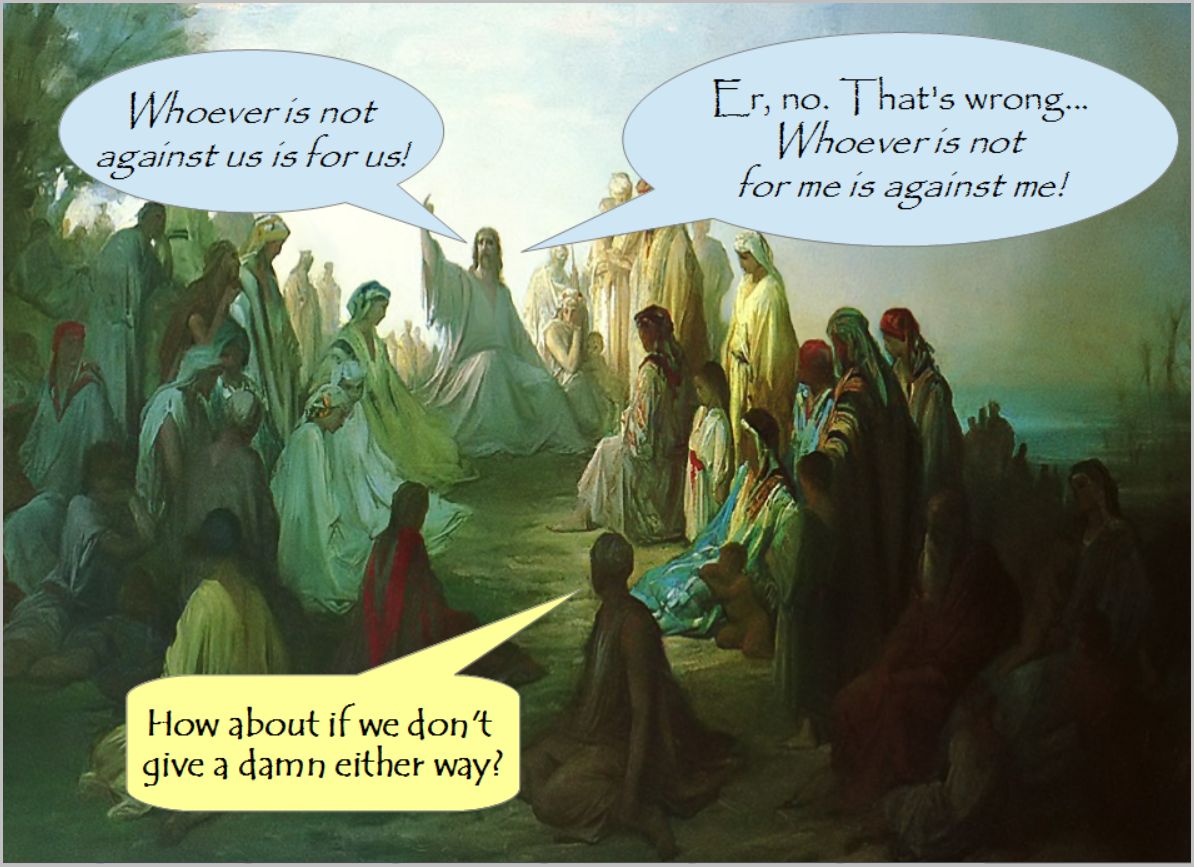
ForUsJesus is reported as saying both that ‘Whoever is not against us is for us’ (Mark 9.40)
and ‘Whoever is not with me is against me’ (Luke 11.23). What he doesn’t seem to realise is that these two statements, each ridiculous in its own right (there is always the third option of not caring either way), mean exactly the opposite of each another. The first is inclusive and relatively friendly. The second is hostile and exclusive; it says, in effect, ‘If you don’t give me your unquestioning devotion you are my enemy.’

This is not the claim of a fully-realised divine being, but of a paranoid megalomaniac. As with much of what he said – or is reported as saying (which is not the same thing) – Jesus reveals himself to be very human; flawed and completely egotistical.

He sets up, as all cult leaders do (and, indeed, as all human groups have a tendency to do) an ‘Us and Them’. Elsewhere, Jesus describes Insiders and Outsiders, with all the rustic charm of a first-century peasant, as the sheep and the goats (Matthew 25.32). It’s still a favourite pastime of Christians to segregate themselves and others into these two categories. They do it with real sophistication these days, of course (I mean, ‘sheep and goats’… c’mon) but it still comes down to Us and Them:

If you’re a mainstream evangelical you’re Saved, while those who don’t subscribe to your brand of Christianity are Lost or Of This World.

If you’re a Bible-believing fundamentalist you’re Regenerate but others are Unregenerate (or Degenerate).

If you’re a Jehovah’s Witness you’re one of the True Church; other believers are part of a False Christianity.

If you belong to the cult formerly known as the Children of God, you’re of The Family and everyone else is part of The System.

If you’re a Roman Catholic you’re the Only True Christians, while all others are Damned.

and so on, throughout all of the 34,000 different Christian sects and denominations.

It is an essential part of the Christian faith to regard yourself as belonging to the only True Church. Everyone else – from those who don’t buy into religion at all to every other faith group – is wrong. They’re an enemy of Jesus because, not being for him or with him in quite the right way (your way) they are, according to the warped logic he expresses here, against him.

The so-called Prince Of Peace proudly declares that he came to bring strife and division into the world (Luke 12.51), which, to this day, remains his greatest achievement. His idiotic words about being either for or against him have proven to be a gift to every sect, cult and church that has ever existed.

Our touchy Loving Father is pissed off (again)

DoctorIn 1665, the great plague overtook London and killed about a sixth of its population. The church and other authorities believed the plague was a punishment from God for the sins of those who lived in the city.

Such a view is understandable among people who lived in a pre-scientific era (just) and had no other way of explaining natural phenomena other than from a religious perspective. Their ignorance is perhaps forgiveable.

Speed forward to 2014 and the outbreak of the Ebola virus in Liberia and other parts of Africa. Ebola causes an incurable disease with a 90% fatality rate. And guess what? Those of arrested development, whose thinking is still stuck in the seventeenth century, attribute it to God. More than that, they predict a plague on a scale next to which the 1665 plague looks like little more than a minor skin irritation. And all because of the sins of other people (naturally). According to Liberian church leaders:

God is angry with Liberia. Ebola is a plague. Liberians have to pray and seek God’s forgiveness over the corruption and immoral acts (such as homosexualism, etc.) that continue to penetrate our society. As Christians, we must repent and seek God’s forgiveness.

The usual suspects – atheists, secularists, those pesky homosexuals, pornography, abortionists and women who have abortions – are bringing the judgement of God to Africa, and far more importantly, according to American evangelical leaders, to America itself. There’s an even a lunatic fringe there who welcome it:

Everybody who stands up and embraces sodomy, BE THOU CURSED WITH EBOLA! Cursed be ye for embracing this!’

rants Harlem Pastor James Manning.

As ever God’s judgement, if that’s what we’re dealing with, will be indiscriminate. It will strike down the weak, the elderly, the vulnerable, and, yes, Christian missionaries (the two American medics who have contracted the disease are just that.) Because God’s like that; when he’s in his Hulk-smash mode, he doesn’t care who gets in his way.

There is a cure though. Just as the scientifically illiterate in 1665 thought prayer would spare them from the plague, the way to survive the coming Ebola pandemic is, according to Pastor Rick Wiles, to be covered in the blood of Jesus:

Now this Ebola epidemic could become a global pandemic and that’s another name for plague. It may be the great attitude adjustment that I believe is coming. Ebola could solve America’s problems with atheism, homosexuality, sexual promiscuity, pornography, and abortion…
If Ebola becomes a global plague, you better make sure the blood of Jesus is upon you. You better make sure you been marked by the angels so that you are protected by God. If not, you may be a candidate to meet the Grim Reaper.

Yes, only true believers who have the blood of a long dead Jewish preacher ‘upon’ them, and angels hovering over their heads, will survive the coming plague (so those Christian missionaries are safe after all – they needn’t bother with the medical care they’re currently receiving back in the States).

This isn’t even seventeenth century thinking; it’s straight from the bronze age.

Will there be a world-wide Ebola plague? It seems unlikely, but who knows; life is more precarious than we sometimes like to admit. If there is, it won’t be because a vengeful, pissed-off God is inflicting it on us… because there’s no such entity. Nor is there a nice, loving, daddy God either – but then he doesn’t figure in this particular scenario anyway.

In spite of what the Bible promises (James 5.14-15), there’s no supernatural protection from Ebola, nor from any other disease. The poor souls who died of the plague in seventeenth century England found that out the hard way. Praying to God and sloshing about in the blood of Jesus, metaphorically or otherwise, protects no-one.