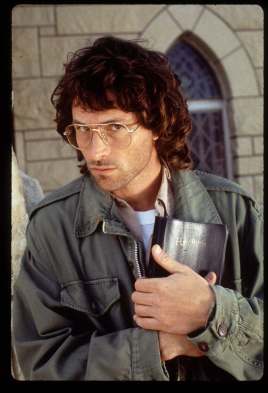
Jesus, Simon and me

Blog357a

It took me long time to accept who I was. Most of my life, in fact. When I was in my late teens, I had a relationship with a young man the same age as myself. This was illegal at the time as the age of homosexual consent in the UK was 21, remaining so until the late 1990s when it became 18. (In 2004 it was finally made the same as heterosexual consent: 16.) We didn’t care. We had a lovely time and I for one was very happy. I think Sam was too. We lost touch eventually as life took us down different paths.

Not long after, I fell in among Christians. A friend – let’s call him Simon – thought it would be a good idea if we started going to the YMCA. This was long before the organisation became synonymous with the Village People and hangin’ out with all the boys. The YMCA I encountered was markedly evangelical. Once we’d visited a few times we were ‘invited’ to one of their young people’s meetings. I can’t remember what snappy title these meetings went by, but essentially they were a mixture of worship, bible reading and ‘teaching’. Sometimes there’d be a guest speaker who would tell us all about their relationship with Jesus, which, in case we had any doubts, was just marvellous. Before long I was giving my life to Jesus too, though in the long run it turned out to be only a temporary loan.

Occasionally, one of these guest speakers would talk about relationships, those with other human beings, and sex. From them I learnt that sex was almost always wrong: sex before marriage, sex outside marriage, sex with yourself – all of them were sinful. Even imagining sex and fancying someone (which qualified as lust) were wrong too. Who knew? But the most sinful, wicked and sordid sex of all was sex with someone of the same sex.

It didn’t seem it to me. The encounters I’d had with Sam were far from sordid and not at all evil. On the contrary, they were a lot of fun! But these people, these Christians, seemed to know what they were talking about. And hadn’t I given my life to Jesus? He detested homosexuality, or God did anyway, so Jesus must’ve felt the same way (actually this was all in the present tense, Jesus being alive and monitoring us from Heaven and all; Jesus detests homosexuality, they’d tell us.) Sometimes they’d read verses from the bible that proved it.

And so I started to suppress my feelings. They’d kinda got me in trouble anyway, when my body betrayed me in the showers after gym at school. Other boys would torment me about it. I wasn’t actually ‘out’, as we’d say today, and terms like ‘queer’ and ‘poof’ (the British equivalent of ‘fag’) were bandied around as general insults – they didn’t necessarily mean anyone actually thought you were gay. Nonetheless, they came a little too close to comfort. All things considered, a retreat to the back of the closet (not that I knew this terminology then either) seemed the best option. It was what Jesus wanted, or so I thought. I started to deny myself for him, as he insists his followers do, and began a life of self-deception.

Which would’ve been fine, except it’s impossible to live a lie in isolation. Others invariably become involved.

Enter Jane…

Heaven’s Above

Blog356

I was struggling for inspiration this week with the homework assignment from my writing group. The title was ‘Heaven’s Above’ (or maybe ‘Heavens Above’, without the apostrophe) and possibly I was having difficulty with it because I don’t believe in a Heaven above, on account of there not being one.

The other night, in a local bar, this young guy came over to talk to my friends and me. He was a doctor from a nearby practice, and he started by asking how, when the time comes, we’d like to die. While perhaps not be the best way to start a consultation, his question provoked some interesting responses.

Then, having somehow detected that my friends and I had reached a certain level of maturity (we’re in our 60s), the young doctor asked what we felt was the point of life. He had, he said, a real need to know this, because having achieved all he wanted at 28, he was left wondering if there was any purpose beyond 30. I like to think we all gave him good answers. There’s life in these old dogs yet! For me, it was falling in love (yes, it happens to old people too) together with friends, lovers and other relationships, particularly those with my grown-up children and beautiful grandchildren. There’s also – though I didn’t bore him with the details – achieving authenticity, accepting yourself and living true to that self. Then there’s all the other things that make life worthwhile; being open to change, having new experiences, learning, helping others, reading, writing, conversation, music, walking… You will, I’m sure, have your own list.

I know that Sartre claimed that ‘Hell is other people’ and Lee Marvin thought much the same thing when he rumbled in Wand’rin’ Star that ‘Hell is in hello’, but Heaven is in these same things; in friendship and our other relationships. There may be some who think it’s easy for me to say all this. ‘After all,’ they say, without knowing me, ‘you have a good life. It’s pretty easy to feel positive about something that’s already going well,’ which is true. Except my life has had its share of traumas, problems and pains, and still does. But life is good and worthwhile in spite of these, and it’s purposeful too without recourse to God or Jesus. Who needs these two old frauds? We make our own Heaven here, now, in our own lives.

Am I saying count your blessings? Yes, I suppose I am, but not, I hope, in a glib way. There are so many good things in most of our lives; all we have to do is make them our own. ‘Lay hold on life,’ as the old hymn says, ‘and it shall be, thy joy and crown eternally.’ Maybe not eternally, but certainly beyond the age of 30.

How to spot a Christian

blog353cross2

What is being a Christian actually about? Do you qualify as a Christian if, like Paul seems to suggest, you believe a particular set of propositions; ‘right belief’ that ensures you’re saved and will go to heaven after you die? Do you have to sing songs about how marvellous Jesus is and how much you love him? Do you show you’re a Christian by defending God’s ‘standards’, which you know about from a very selective reading of the bible? Does being a Christian entail arguing vociferously that Jesus is God, that he rose from the dead and that the bible is God’s inspired word? Is it insisting, with all the loving aggression you can muster, that non-believers are bound for hell, that homosexuals are disgustingly evil and that these, like every other period in the past two millennia, are the end times?

This is what a modern Christian looks like. He or she does these kinds of things, and a whole lot more, that Jesus, as he’s portrayed in the synoptic gospels, wouldn’t recognise. His idea of a Christian (not that he’d know the term) is a very different animal. Here’s what Jesus expects of one of his followers –

They:

cut themselves off from their family – hate them, in fact – just to follow him (Luke 14.26);

deny everything about themselves (Matthew 16.24-27);

forsake home, job, wealth, status, credibility and comfort to help bring about God’s Kingdom on Earth (Mark 10.29-31 etc);

slave tirelessly in the service of others (Mark 10.43-44; Matthew 23.11 etc);

sell their possessions so that they can give the proceeds to the poor (Matthew 19.21; Luke 14.33);

turn the other cheek, repeatedly go the extra mile and give away the shirt and coat off their back – if they’ve still got them after giving everything away – (Matthew 5.38-40);

welcome the stranger, feed the hungry, clothe the naked and visit those in prison (Matthew 25.35-40);

forgive again and again and again (Matthew 18.21-22);

don’t judge others in case they’re judged in return (Matthew 7.1-3);

love their enemies (Matthew 5.44);

regard persecution and injustices done to them as blessings (Matthew 5.11);

do miracles even more impressive than Jesus’s own (Mark 16.17-18; John 14.12);

heal the sick, raise the dead and cast out demons (Matthew 10.7-8);

are granted whatever they ask for in prayer (Mark 11.24; Matthew 21.22);

don’t subscribe to a magic salvation-formula (found nowhere in the synoptic gospels).

Yes, Jesus was completely insane, demanding all this, and more, of those foolish enough to align themselves with him. But demand he did.

I’m sure there are Christians today who do everything he expected… somewhere, possibly… but I don’t know any. They’re all too busy enjoying their affluent, middle-class lives, singing songs at PraiseFests, judging others and squabbling about doctrine from behind their keyboards. It makes you wonder why they call Jesus their Lord when they don’t do a thing he tells them (Matthew 7.21).

Get your false Messiahs here…

blog351b

There was this guy who said he was the Son of God and the Messiah of his people. God appeared to him in a vision that enveloped him and changed him completely. Afterwards he discovered he had a knowledge of scripture that he previously hadn’t possessed and a invigorated sense of mission: God had appointed him to redeem his people. He changed his name and began to teach his people with power and a knowledge that all of them testified they had never experienced before. He brought them close to God and showed them how the world was coming to an end and how God would soon establish his Kingdom on Earth. He prophesied too, however, that he himself would die at the hands of the authorities, but that his followers should have no fear, because God would not forsake them: they would be part of the coming Kingdom.

And so it came to pass. At the age of 33, the Messiah died at the hands of the state.

And the name of this guy? Jesus, maybe? Well, it could be, but it wasn’t. Saul/Paul perhaps? Again, possibly… but no.

This guy’s name was David Koresh (real name Vernon Howell), leader of a Christian sect called the Branch Davidians. You may remember him from such massacres as the 1993 siege at Waco, where his church was based. He made all the claims above, just like Jesus and, to a lesser extent, Paul before him. None of his followers, it’s true, claimed to see him after his death, but some of those who survived the siege believe still that he will be resurrected and will return to lead them personally into the Kingdom of God.

I was watching a programme about him recently, a Storyville documentary originally broadcast in the States last year, which showed how easily we create our Messiahs and Saviours. The recipe, it turns out, is easy:

Take one charismatic individual who thinks he’s speaking for God;

Mix in an obsession with scripture;

Add some absurd self-promotion, and

Bake for a few years in the over-heated adulation of some desperate sycophants.

So – Jesus, Paul, Koresh. What’s the difference?

blog 351

*Actually, the quote in the picture up top is not Jesus at all; its Koresh, from an interview with the FBI (see first link above.) John 14.6 says ‘No-one comes to the Father except by me,’ which is much the same.

Woe to you hypocrites!

blog350

Independent Fundamentalist Baptist pastor, Donnie Romero, an associate of Steven Anderson’s, resigned from his church this week after he was discovered paying prostitutes for sex, smoking weed and gambling.

Well, who cares really what such a pathetic little man gets up to in his spare time – apart, maybe, from his wife – except that Romero, like Anderson, is virulently anti-gay. He preaches that LGBTQ people are filthy animals who prey on children and calls for the state-sanctioned execution of all ‘homos’. He rejoiced when LGBT people were killed in the Pulse shooting a few years ago.

Christians can argue all they like that the bible is the Word of God™, that Jesus really did rise from the dead and that he was the Son of God come to save us, but even if all this were true, which it isn’t, it makes not the slightest bit of difference. Romero and his predilection for ‘sin’ demonstrate, once again, that Christianity does not work.

According to the bible, those who are born again are washed in the blood of the lamb (Revelation 1.5) and are cleansed and purified (1 John 1.7). They cannot sin (1 John 3.6), being possessed by the Holy Spirit (1 Corinthians 6.19- 20) who changes their nature (John 3.3–7; Titus 3.5) and gives them victory over sin (Romans 6.1–10). So how do Christians explain believers like Romero, and the multitude of others who fornicate, abuse, steal, bear false witness and even, sometimes, resort to murder? Were such people ever really Christians in the first place?

IFB doctrine says they were; once a Christian always a Christian. Despite what Romero has done, he will be going to heaven.

Others say not; a Christian who visits prostitutes is not and never has been a real follower of Jesus, because visiting prostitutes is not something a real follower, one who has the indwelling Holy Spirit would do. Yet Paul admonishes some of the early church (1 Corinthians 6.15-18) for doing just this, without, strangely enough, tell them they were never true believers. Looks like Christians with prostitutes has been a problem from the very start.

Perhaps believers who cheat and fornicate are redeemed a second time, once they’ve sought forgiveness for their trespasses. The comments on the YouTube version of Romero’s resignation speech speak of how noble he is for confessing his sins, making him ‘a true man’ according to one. They seem to miss the fact that he does nothing of the sort. He leaves fellow zealot Anderson to explain what has happened. Is it scriptural that a believer can fuck up (literally) as many times as he likes, and so long as he admits it he’ll still be one of the Chosen? Hardly. Still, there’s got to be a free get-out of jail card for today’s fornicating minister, and this is as good as any. How long until Romero is back in front of a gullible and duped forgiving congregation? In the meantime his place has been taken at the ironically named ‘Stedfast church’ by an ignorant jerk who is every bit as hate-filled.

By their fruits shall ye know them, Jesus is made to say. I can’t help but think that prostitute sex, cannabis, gambling, homophobic rants and bare-faced hypocrisy weren’t quite what he had in mind.


Love and Kindness

Blog349

I’m sometimes I asked what, given I don’t believe in Jesus, I do believe in. I always find this an odd question, presuming as it does that Christianity is really the only thing worth believing in. Implicit in it too is an acknowledgement that faith in the supernatural is irrational, and that sceptics are just as prone to irrationality as believers themselves: ‘you too have faith in any number of unprovable propositions, just like us misguided Christians!’ The question is often an attempt to show that sceptics are just as gullible as Christians.

Recently, Jimoeba said on his blog, The Common Atheist, ‘I believe passionately in nothing,’ meaning, I think, he doesn’t believe in any sort of supernatural nonsense. It set me thinking about what, in fact, I believe in. Do I still have some irrational, unfounded beliefs? Certainly I don’t believe – can’t believe – in Jesus and his support cast of mythical entities, who live in Heaven or just out of sight or wherever they’re meant to be. The same applies to their counterparts in other religions. It’s not that I hold this as a matter of faith; there simply isn’t the evidence to support the existence of gods, angels, demons, eternal beings, heaven and hell (as I discuss here and here.)

In any case, I prefer to know things rather than believe in them. Where there is evidence, there is no need for ‘belief’ or ‘faith’. Yet I still have a suspicion I believe in some things; things that seem intuitively right (never a good measure, I know, of what actually is true) but for which the evidence isn’t as substantial as I’d like. Things like love and kindness. I do believe in these, however cliched it may be to say, ‘I believe in love’. I do. I feel and, I hope, demonstrate love for my family, specially my children and grandchildren. Also to my friends and partners. It seems to me love matters a great deal. There are no doubt good evolutionary reason why we feel particularly strong affection for our offspring; taking care of them increases their – and the genes we share – chances of survival. But subjectively it is more than that. I believe it’s more than that anyway.

I find , try as I might, however, that I can’t extend that love to people I don’t know. Jesus’ command (not that I’m under any obligation to follow it) to love one’s neighbours and enemies is an impossibility, another example of his not knowing what he was talking about. It’s possible to feel compassion for those who suffer, or pity or sympathy, but these, while they’re perhaps components of love, are not completely love in any of its forms. So that’s why I believe in kindness too. ‘Be kind to your neighbour, to strangers and to those you encounter in daily life’ would have been, and is, a far more realistic expectation.

There are other things I believe in too – trying to steer people away from irrational belief in deities, saviours and magic books, obviously – and I’m not always consistent in my application of love and kindness. But I do try to be. I know they’re not absolutes, nor even universal values; they’re not delivered from on high because no values are, being entirely humanly derived, and they’re not practised by everyone either, not even aspired to by some. There’s no need to go around preaching about love and kindness, nor do they need a mythology created around them. Nevertheless, they’re what matter – to me, anyway.

I believe in them.

The Incarnate Deity?

Blog347Nativity

Veiled in flesh the Godhead see; Hail th’incarnate Deity,

Pleased with us in flesh to dwell, Jesus our Emmanuel.

This, according to Charles Wesley’ hymn, ‘Hark! The Herald Angels Sing’, is what Christmas is all about: God manifesting himself on Earth as a child and subsequently a man.

What a disaster this whole idea is. The stories of Jesus’ birth do serious damage to two key elements of the Christian message:

First, they detract significantly from the good news the adult Jesus proclaimed and which survives to some extent in the synoptic gospels: the Kingdom of God was coming to the Earth very soon and people – Jewish people – should mend their ways accordingly. Instead, the nativity stories, which occur only in Matthew and Luke, are a reflection of what had happened to the faith by the time these gospels were written. The message had changed. It was less about what Jesus had to say and more about how he himself should be worshipped. He had, after all, as early Christians had started to believe, come from Heaven to save everyone from their sins.

Second, the nativity stories negate the resurrection. If a mortal Jesus rose from the dead, then we might conceivably have a miracle on our hands. But for an ‘incarnate deity’ to have accomplished the same thing – well, that’s no big deal. It’s what gods do all the time. The resurrection experiences, whatever they were, are invalidated by the gospel writers when, at the start of his story, they suggest Jesus is somehow divine. (John is even more emphatic; Jesus is the eternal Word made flesh.) So there’s nothing special about the resurrection, it’s just a god doing what gods do.

The nativity stories represent the confusion within early Christianity. Its adherents wanted it both ways, to have their cake and eat it. Maybe today’s believers can help us out of the dilemma: is it Jesus’ birth – his incarnation – that matters, or is it his death? Because it cannot be both. If Jesus was God in human form from the very beginning, then there’s nothing particularly special about his death and resurrection. Gods can’t really die, especially when none of them, including Yahweh, are alive in the first place.

Jesus: Speak not clearly did he

Blog345JC

Why did Jesus not speak clearly? If he came from God, or was God in some way, why didn’t he express himself directly and with precision? Why did he obscure what he had to say with hyperbole, riddles and demands that even he couldn’t meet?

Don Camp, light-weight apologist and C. S. Lewis aficionado, has been giving me a little lecture over in the comments section of Debunking Christianity. He’s been providing the basics in how some of Jesus’ remarks in the gospels are hyperbolic and are therefore not to be taken literally. I am, of course, already aware of Jesus’ tendency to exaggerate (how far does this qualify as false witness, I wonder?) but Don and I were specifically discussing Matthew 5.29-30 where Jesus advises those who lust after a woman to pluck out their right eye and cut off their hand. Don asserted that obviously this is an exaggeration, to be understood figuratively, not literally. I asked him how one distinguishes between the two.

Don responded by saying one should look for clues in the scriptures (the bible as Murder, She Wrote); clues that might reveal how early Christians responded to Jesus’ assertions. If they ignored what Jesus said (while most did disregard his more extreme commands, such as the self-mutilation statements, there is evidence that some did indeed take him literally), then we can safely do the same. If, on the other hand (no pun intended) they acted on what he said, then it’s fair to assume it’s okay for today’s Christians to do the same. Sounds simple right? But it still doesn’t help anyone decide what is hyperbole and what is meant literally.

For example, Christians largely ignore Jesus’ commands to go the extra mile, give the shirts of their back to those who ask for them, turn the other cheek, love their enemies, disavow wealth, sell all they have, give no concern for the future and do all they can for the homeless, sick, naked and displaced. There isn’t a lot of evidence that even early followers did these things. Does their disregard for these commands mean that Jesus must have meant them figuratively? That there is spiritual truth to be discerned from them but that no practical action is expected or required?

Where do Jesus’ apparent assurances that his followers would heal the sick, raise the dead (Matthew 10.8) and do ‘works’ even greater than his (John 14.12) fit? Are these hyperbole or are they intended to be taken literally? Given early Christians serve as Don’s yard-stick for what is hyperbole and what is literal, what did they think? We don’t actually know, though evidently some considered the promises significant enough to include in the gospels. Among today’s believers, there are those – and not just on the fringe – who accept them as literal, while others scoff at the idea of taking them at face value.

What about Jesus’ promises that God’s Kingdom was imminent and that he would rise from the dead? Aren’t these just hyperbole too? Don says no, because people at the time didn’t ignore them (as they did his ‘obvious’ hyperbole) but believed they would happen. Therefore, they must have been meant literally. Unfortunately, Don fails to take into account that the promises of a resurrection were applied retrospectively; Jesus didn’t actually predict his own return from the dead (for reasons discussed here.) The Kingdom of God, meanwhile, failed to materialise when Jesus said it would. The extent to which early Christians believed these promises hardly demonstrates their literal truth. In any case, is ultimate truth to be determined by how ordinary, largely uneducated, superstitious back-water folks responded to what they heard or read? What a spurious and unreliable way to decide.

Which brings me back to my original question. Couldn’t Jesus have been a lot clearer about what he meant? Instead, he dressed up a lot of what he said in what might, or might not be, hyperbole. He issued other ‘truths’ in parables that he didn’t intend the hoi-polloi to understand (Mark 4.12). He offered advice that is of no practical use, some of it positively detrimental. He was neither systematic nor consistent and contradicted himself. So much of what he said is open to interpretation, to the extent that there are now thousands of Christian churches, cults and sects, all at odds with one another because they disagree about what he meant.

The New Testament as a whole too is a muddle of conflicting ideas and advice… though that’s a discussion for another time.

According to the Scriptures (not)

Blog344Jonah

Christ died for our sins according to the Scriptures. He was buried (and) was raised on the third day according to the Scriptures…

This is Paul’s claim in 1 Corinthians 15.3-4, where he is probably quoting an early Christian creed. He uses the phrase ‘according to the scriptures’ twice, meaning that what he’s claiming fulfils prophecy from the Jewish scriptures. He is not referring to the gospel accounts of Jesus’ death and resurrection as these ‘scriptures’ had yet to be written at the time of 1 Corinthians (circa 54/55AD.) Mark’s gospel was still fifteen or so years away.

So where in the Jewish scriptures – the Christian Old Testament – is there any prophecy that the Messiah would die for the sins of the people? Where the prediction that he would rise from the dead on the third day?

As Michael J. Alter notes, there is no prophecy either that the Messiah would die for the sins of the people nor that he would then rise from the dead. Not one. Passages that are pressed into service by Christians ancient and modern to demonstrate that Jesus’ death and resurrection were presaged in the Old Testament are either not prophecy or they don’t have any bearing on either Jesus’ death or supposed resurrection.

Let’s look at a couple:

In Matthew 12.40, Jesus is made to equate his time in the grave – three days and three nights – with the time Jonah spent in the belly of a great fish. But the Jonah story has nothing to do with events hundreds of years later. It is an ancient fable, not a prophecy delivered by one of the Old Testament’s recognised prophets. In any case, in the story Jonah is being disobedient and is running away from his God-given mission. Jesus, according the gospels, doesn’t do either of these things. Moreover, Jonah does not have to die to spend three days in a fish. He does not resurrect when the fish spews him out. The only aspect the two stories have in common is the period of three days and nights, which as we have seen, bear little relation to how long Jesus was actually in the tomb. Matthew has press-ganged an irrelevant story into service, in an attempt to show that Jesus really was the Messiah. Why does he do this? Because he can’t find any ‘scripture’ that points incontrovertibly to the Messiah dying and resurrecting. Jonah is literally the best he can do.

Modern Christians like to tell us that Isaiah 53 is a prophecy that Jesus would die as a sacrifice for sin. Significantly, none of the New Testament writers attempt to make Isaiah’s ‘suffering servant’ narrative fit Jesus. This is because the suffering servant it describes is the beleaguered Jewish nation; earlier chapters say so several times. To insist that Isaiah 53 describes Jesus’ death and resurrection is to render it incompatible with all the Old Testament prophecies that are actually about the Messiah. For those who created these scriptures, this figure was a warrior, a human who would route the enemies of Israel and usher in the Messianic age. Isaiah 53 is about how the rulers of the kingdoms of this world will stand in awe of this feat. Jesus does not fulfil this role; he was not a warrior, he did not redeem the Jewish nation, he did not route its enemies, he did not bring about the Messianic age. Jesus died an ignoble death and was ‘seen’ afterwards in visions; he was as far from the anticipated Messiah as could be envisaged.

Jesus’ death and resurrection did not happen ‘according to the scriptures’. There are no prophecies in the Old Testament that pertain to Jesus, no foreshadowing of what happened to him. Christian can try to retrofit selected scriptures as much as they like to make it seem as if there are, but none hold up under scrutiny.

Why Jesus can’t possibly have known he’d ‘rise from the dead’.

Blog340JC&Peter

I said at the start of this series of posts about the date of Jesus’ crucifixion that the gospel writers perhaps felt unable to exclude Jesus’ predictions about rising from the grave after three days because these were too well-known. On reflection, it seems more likely that Jesus didn’t make any such prophecies. It is more probable that the gospel writers introduced them into their stories about him decades later.

I’ve written before about how the Resurrection appearances were nothing more than visions and dreams. Paul’s experience of the risen Jesus most certainly was – he says so himself – and Mary’s encounter with angels, telling her Jesus was no longer in his tomb, is described as ‘a vision’ in Luke 24.23. The subsequent accounts of Jesus’ post-mortem appearances also bear all the hallmarks of hallucinations; he disappears at will; passes through closed doors; isn’t always recognisable, drifts up into the sky and so on.

These mystical experiences, those that really happened anyway (it’s safe to say some – the Emmaus story, for example – are complete inventions: see Alter, pp536-8) quickly became a conviction among Jesus’ early followers that he had somehow risen from the grave. By the time of Luke’s and John’s gospel, 50 to 70 years later, this idea had evolved into a full-blown bodily resurrection.

The question is, did Jesus know that this was what was going to happen? Could he have had foreknowledge that he would be seen again after his death? Could he, during his life, have predicted he would rise bodily from the grave?

Christians will tell you that as God or God’s Son, Jesus was omniscient and therefore of course he knew these things in advance. There are, however, several good reasons why we can be sure he didn’t:

  • According to Paul, it was the resurrection that elevated Jesus to his god-like status, not his divinity that enabled the resurrection. Christians who argue that Jesus rose from the dead because he was divine have it back to front. Paul says clearly that Jesus ‘was appointed the Son of God in power by his resurrection from the dead‘ (Romans 1.4; my italics). Without the resurrection, Jesus was, Paul argues, of no great significance (1 Corinthians 12.15-19). However, the only ‘evidence’ for the resurrection is the contradictory, incompatible accounts offered by only three of the gospel writers and by Paul himself. So implausible is this evidence that we can safely conclude, with Michael J. Alter, that there was no such event. How, then, could Jesus possibly ‘know’ he’d rise from the dead when in fact he didn’t?
  • While he suffered from the delusion that he was going to rule God’s imminent Kingdom, it is unlikely Jesus thought he would have to die and be resurrected in order to do so. There was nothing in the Jewish scriptures to suggest either the Son of Man (a figure from Daniel with whom Jesus appears to have claimed some affinity) or the Messiah would be put to death only to rise again. This wasn’t what these characters were about and it wouldn’t have been how Jesus thought.
  • The Kingdom of God did not come about in the way Jesus believed. His death therefore did not bring about the apocalypse, judgement and rule of God he predicted and anticipated. In fact, his death took his cult off in a completely different direction, thanks mainly to Paul’s intervention. Jesus, and to a significant degree, the synoptic writers appear to have little awareness of this seismic shift. The Jesus they portray has little cognisance of events following his demise. Any suggestion he foresaw the creation of the Church is anachronistic, written back retrospectively into the accounts of his life. This was not what his ‘good news’ was about.

  • From their reactions preserved in the gospels, Jesus’ execution evidently came as a shock to both himself and his followers. None of them appear to have been expecting anything like a resurrection. Immediately following his death and burial, not a single one of his followers recalled his supposed predictions of his resurrection, nor did they express the sure and certain hope he would be returning. Even the discovery of the empty tomb (if it happened at all) failed to elicit such an expectation, nor any recollection of his words. The gospels say all those who witnessed the empty tomb were ‘frightened’, ‘astonished’ or ‘amazed’ that the body was missing, but not that they believed he must have risen from the dead. All those who witnessed the empty tomb behaved as if they’d never heard Jesus’ predictions that he’d be returning – probably because they hadn’t

  • It wasn’t until the ‘visions’ started that some of them began to consider the possibility that Jesus had ‘risen’. Not all were convinced, however. Matthew 28.16 notes how a number ‘doubted’ that the apparition they were seeing was Jesus. Significantly, at no point do any of those who think they’re seeing the risen Jesus say, ‘I remember him predicting this would happen.’ On every occasion, either angels or the risen Jesus himself has to explain it to them. (Of course, it’s the gospel writers doing the explaining for those hearing these stories decades later.)

All of this points to the fact that, while he was alive, Jesus didn’t make any predictions about rising from the grave on the third day, after three days, or after three days and nights; these prophecies, incompatible with each other and with the synoptic timeline, were created later, probably much later, after belief in the resurrection had become a central plank – the central plank – of the new cult. They were subsequently written back into the gospels, and placed on Jesus’ lips on the basis to show that of course he knew he’d rise again and knowing would have spoken about it.

The circle was thus complete; his early followers created the myth of Jesus’ return while later ones invented the ‘prophecies’ to bolster the belief that Jesus must have known he would. He said so, didn’t he?