New series! Idiotic stuff Jesus said!

This one’s gonna run and run!
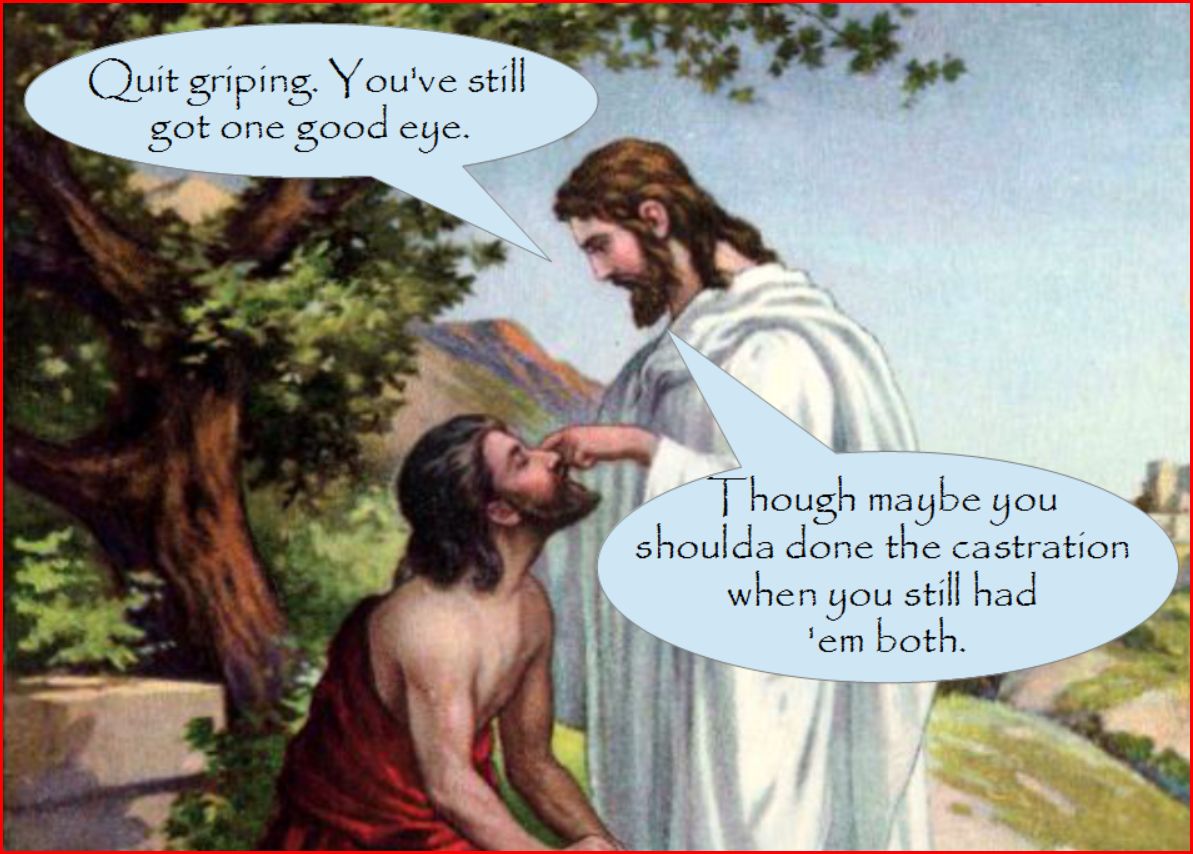
EyesYou hear the one about the blind Christian bloke with only one hand and no balls? And he did it all to himself! Cut off his hand, gouged out his eyes and castrated himself. When asked why he’d done it the man explained, ‘I’m a follower of Jesus and when he tells me to do something, I do it. My self-mutilation is my witness to what a great guy he is. He wouldn’t steer me wrong.’

Sure enough, the normal people who heard him were incredulous, until one of them looked in the Bible and found the very instructions to which the eyeless, testicle-free, one-handed believer referred.

In Matthew’s gospel chapter 5, Jesus is talking about lusting after a woman, which in his eyes (he still had both of his) is as bad as having sex with her. Course it isn’t, not by a long way, but he tells his followers, ‘If your right eye causes you to sin, tear it out and throw it away; it is better for you to lose one of your members than for your whole body to be thrown into hell’ (Matthew 5.29).

A bit drastic perhaps, but there it is; the Son of God is clear about how to avoid the sin of checking out a member of the opposite sex. That’s why you see so many one-eyed Christians around the place because they all take his admonition very seriously.

Except… you don’t. Either Christians ignore him entirely on this one or they never look at the opposite sex with an eye to sexual congress. We all know they’re like the rest of us in this respect – some, as Jimmy Carter once famously did, are honest enough to admit it – and some even act on it; the divorce rate among Christians is not the same as it is for everyone else just because they get tired of being married.

Perhaps though Jesus is being metaphorical when he proposes that gouging out one’s eyes is the best way to deal with lust. Not surprisingly, Christians prefer this possibility. In The Method and Message of Jesus’ Teachings, Robert Stein argues that:

what Jesus was seeking to convey to his listeners by this use of overstatement was the need to remove from their lives anything that might cause them to sin… Jesus is saying in effect, “Tear out anything in your life that is causing you to sin and keeping you from God”.

If that was his intention, Jesus might have actually used these words. If he wants to say ‘in effect’ that the believer should jettison anything from his life that causes him to sin then why doesn’t he?

But eyes are not enough. You gotta get rid of that wanking* hand too (the context of Jesus’ comments is specifically sexual and entirely male orientated throughout these verses): ‘And if your right hand causes you to sin, cut it off and throw it away; it is better for you to lose one of your members than for your whole body to go into hell’ (Matthew 5.30). This must be why we see so many one-handed Christians…

The difficulty with interpreting these and other verses metaphorically is that Christians want to claim that the Bible is the literal ‘word of God’ and then want select parts of it to be metaphorical – and guess who they think should do the selecting. But they can’t have it both ways. Even if they could, how would they know which parts to interpret literally and which symbolically? Perhaps the Holy Spirit tells them, or maybe, and more likely, it’s just their personal preferences. After all, who wants to lose eyes and hands just for being human?

If that’s not enough, Jesus encourages other mutilations for the sake of his Kingdom when he reveals in Matthew 19.12 that ‘there are eunuchs who have made themselves eunuchs for the sake of the Kingdom of heaven. Let anyone accept this who can’. No Christians today seem able to ‘accept’ this recommendation, either; what a truly feeble bunch they are, putting their testicles before the Kingdom!

It seems likely that, given he believed the end of the age was fast approaching, Jesus actually meant what he said, counting on the probability (as he saw it) that anyone who followed his ridiculous suggestions would not be eyeless or handless for long. They would, at the resurrection, be fully restored to live in the Kingdom where, according to Matthew 22.30, they would not be troubled by either impure thoughts or marriage itself (and so wouldn’t need those testicles anyway).

Whichever way you cut it (off) – literally or metaphorically – Jesus words in these verses are remarkably idiotic. Throughout history there have been some individuals, like the dude we started with, who have indeed made themselves eunuchs for the cause. But the vast majority of male Christians have always dismissed this advice or have decided JC was only speaking metaphorically (as he always is when they don’t like what he’s telling them to do).**

So next time True Believers start thundering on about the evils of same-sex marriage and gay sex, tell them to get their own house in order first. A little amputation is all that the Lord requires.


* ‘Jerking off’, for any Americans reading.

**Read more in my (five star reviewed!) book Why Christians Don’t Do What Jesus Tells Them To …And What They Believe Instead, available from Amazon.


 

Here Be Dragons

dragonChrist The White does battle with the dragon of Revelation 12

Over on Answers in Genesis, one of Ken Ham’s drones is arguing for the existence of dragons. They are, he or she tells us triumphantly, mentioned in the Bible, so they must really have existed.

As we already know, the Bible has more than its fair share of nonsense, but to insist it provides evidence of mythical creatures is to take its credibility to a new low. Don’t Christians care they do this to their magic book? After all, their faith relies almost entirely on the Bible, alongside their own emotional responses to it (no kiddin’, they say this is ‘the Holy Spirit’.)

Christians spend so much time arguing for the Bible’s daftest excesses – the world being created in six days, Jesus returning soon, homosexuality being just the worst sin ever and now dragons – that they haven’t any time left to read what it has to say about how they should be living their lives.

You mean forgiving others, feeding the hungry, giving everything away, not judging (in case you’re judged in return), being compassionate, going the extra mile, turning the other cheek, giving to all who ask and blessing your enemies is in the Bible? Jeez, I never knew.

Yeah, but it’s all secondary to dragons and damning others. ‘By their fruits shall ye know them,’ says Jesus of his followers in Matthew 7.16-20. Turns out there’s no fruit, just a wide assortment of nuts.

What would the world look like if Jesus had been right?

NewEarth

If everything Jesus promised had come true, then:-

Jesus and his twelve mates – or maybe it’s eleven, what with one of them pissing on the parade – would have been running the world for 2,000 years by now (Matthew 24.34 & Matthew 19.28).

All the undesirables – that’s me and, in all probability, you – would’ve been consigned to Hell and the Righteous would’ve been living on the New Earth, working miracles all day long, not getting married, enjoying eternal life and definitely not having sex (Matthew 13.43, Luke 20.34-35, Matthew 25.46, Matthew 13.41-42).

But seeing how none of that has happened yet, what does the world-according-to-Jesus look like while we wait for the Kingdom to arrive?

Well, duh, look around you; this is how it is:

True Believers go around curing the sick, the blind and the lame, just by touching them or using magic saliva. There’s no need for hospitals, medicine, doctors or heath care. Jesus did this sort of thing and he said his followers would too, to an even greater extent. That’s why Christians can even help amputees grow back missing limbs (Mark 16.18 & John 14.12).

By the same principle, True Believers regularly raise the dead. Okay, so there’s not going to be any death in God’s Kingdom on Earth, but it’s a handy power to have all the same (Matthew 10.8).

Hunger is a thing of the past. When anyone feels a bit peckish – an entire continent, say – Christians feed them using whatever scraps they’ve got lying around, like left-over sardines and burnt toast with Jesus’ face on it (Matthew 14.13-21).

True Believers supply everyone with as much wine as they want, too. They simply pour out some water and change it into alcohol with their water-into-wine superpower. If their beneficiaries turn out to be tee-total, the Righteous change it into something else for them, like coffee or Kool-Aid or cyanide. Of course, cyanide is the beverage of choice for God’s Chosen. He makes sure no harm comes to those who imbibe it (John 2.1-11, Mark 16.18).

Christians are regularly to be seen playing with poisonous snakes, because, like Superman they’re practically invulnerable (Mark 16.18).

Transport is transformed in Jesus’ new world too. No need for ships or ferries; Believers travel overseas by walking over seas. Conditions a bit choppy? The Almighty calms things down for them; all they have to do is ask. (Matthew 14.22-33 & Mark 4.35-41).

Mountains getting in the way? They can just be lifted out of the way using the Power of Faith, and thrown into the sea. Or, if that’s likely to cause problems for those out for a stroll on the oceans, the mountains can be rearranged to make a passage through. Very neat and tidy (Mark 11.23-24).

Best of all, True Believers can ask God for anything at all and whatever they ask for he provides. No questions asked. He does it (Matthew 7.7 & 21.22, Mark 11.24 etc).

Thanks to Jesus’ followers, this is how it is in the world, while they wait for God’s Kingdom to arrive. And when it does, it’ll be even better. Hard to imagine it could be any better than it is, I know, but Jesus guarantees it. What a blessing it is to live, here and now, in such a transformed reality.

Except of course we don’t. None of these things happen. Not the miracles, the healings, the living forever. This is not the world we live in, even though Jesus said it would be. His Kingdom didn’t come; his followers don’t do miracles like his (and certainly don’t do better ones); no-one lives forever. They never have and never will.

Instead his Followers spend their time squabbling between themselves, judging others and living – and dying – pretty much the same way we all do.

Funny that.


Christians’ Favourite Delusions 24: We stand for biblical truth!

Judge

Christian commentator Tony Perkins demands that Christians defend ‘biblical truth without compromise.’ What he really means – because he only ever uses it in this specific context – is that Christians should use the bible to condemn gay people.

He’s not so hot on standing up for the ‘biblical truths’ that say you should turn the other cheek. Or go the extra mile. Or that you should sell all you have and give the proceeds to the poor. No sir. Those are biblical truths that demand something of Christians themselves so of course they feel perfectly at liberty to disregard them.

And what about ‘judge not that you be not judged’? Christians will tell you that this doesn’t mean they shouldn’t judge others, just that they should do it according to those same ‘biblical truths’.

This is not what Jesus is saying here though. He clearly means ‘do not judge others unless you’re prepared to be judged yourself’, which, we can only conclude, Christians are happy to have happen to them. They judge others and in so doing open themselves up to judgement; Jesus is very fond of this kind of yin and yang, measure-for-measure arrangement:

Judge not that you be not judged. For with the judgement you pronounce you will be judged, and the measure you give will be the measure you will get (Matthew 7.1-2).

It could also be the case that Jesus is referring here to God’s ultimate judgement as well, in which case those condemnatory Christians who believe that being ‘saved’ allows them to escape the final judgement are in for quite a shock. Still, they can always use the ‘I was only defending biblical truths’ excuse.

Christians ignore Jesus

Optional

Christians are commanded to ‘take up their crosses’ to follow Jesus (Luke 9.23). That means, amongst other things, doing what he commands. Yet Christians don’t just fail to do as he tells them, they replace his agenda with their own and completely ignore him. Being a Christian, according to Jesus – and you’d think he’d know – is not about pointing out the failings of others, nor about defending God’s honour (as an omnipotent being he’s more than capable of doing that himself) and it isn’t about condemning those you don’t agree with. It’s about treating others as you’d like to be treated, loving your enemies… things like these, in fact –

Do not judge, so that you may not be judged. For with the judgement you make you will be judged, and the measure you give will be the measure you get (Matthew 7.1-2).

Yet Christians judge relentlessly and tell us they’re justified in doing so: ‘you’re a sinner’, ‘you’re going to hell’, ‘gay people are of the devil’, ‘you’ve got the wrong set of beliefs’. We can only suppose they’ve don’t have a problem with the judgement they themselves will face as a result (because they don’t really believe there’ll be any such judgement.)

But I say to you, love your enemies and pray for those who persecute you (Matthew 5.44).

What Jesus really meant to say here, surely, was ‘criticise those you don’t like, claim they’re infringing your rights, sue them if need be’. Yes, that’s it.

Give to everyone who begs from you, and do not refuse anyone who wants to borrow from you (Matthew 5.42).

Really? Let’s give it a go. Beg a Christian to pay off your mortgage or ask to borrow the cash for new car. See how far that gets you. The problem here, as with all of these commands, is that Jesus really has no idea. No wonder Christians ignore this one.

How can you say to your neighbour, ‘let me take out the speck in your eye,’ when you yourself do not see the log in your own eye? You hypocrite, first take the log out of your own eye, and then you will see clearly to take the speck out of your neighbour’s eye’ (Luke 6.42).

Another ‘don’t judge’ command, to which Christians respond, ‘What log? Your speck is more of an eyesore than my log. My log doesn’t impede my vision at all. It’s you who can’t see.’

If anyone strikes you on the cheek, offer the other also; and from anyone who takes away your coat do not withhold even your shirt (Luke 6.28).

Yeah, right.

Do to others as you would have them do to you (Luke 6.31).

From which we can only conclude that Christians really must want to be treated as shabbily as they treat others (see links above)  

So how about it Christians? Maybe if you were doing what Jesus commands instead of judging the rest of us, we might take you a little more seriously. And, assuming he’s up in Heaven watching you – though even you know he isn’t or else you’d be doing as he tells you – so would Jesus himself.

As he says in Luke 6.46: ‘Why do you call me “Lord, Lord,” and don’t do what I tell you?’

Why_Christians_Don't_Cover_for_Kindle

For more on this topic – Christians’ failure to take any notice of Jesus’ commands – see my book Why Christian Don’t Do What Jesus Tells Them To …And What They Believe Instead, available from Amazon.

Is your marriage a Bible-based marriage? Find out in this simple quiz.

Marry

1. If you’re male, have you got more than one wife? If female, has your husband got other wives as well as you?

If you answer ‘yes’, score 20 points: all the heroes of the Old Testament had multiple wives: Abraham, Esau, Jacob, Moses, Gideon, David, Solomon… Clearly, polygamy is acceptable in the sight of the Lord (Exodus 21.10). Even Jesus approves of it (Matthew 5.17-18 & 25.1-13). Well done if this is you! No points for a ‘no’ answer – you’ve a lot of catching up to do.

2. Are you married to your brother/sister?

20 for yes, nothing for no. God approves of this kind of marriage in Genesis 16.1-3 and as we know, the answer’s always in Genesis.

3. Ladies, were you a virgin on your wedding night?

Score 20 if you were. Otherwise, get your husband to have you stoned to death on your dad’s doorstep, like Deuteronomy 22.13-21 says he should.

4. Were you under-age when you married?

No problem. In fact, the minimum age for marriage in the Jesus’ time was 12 for girls, 13 for boys so award yourself 25 bonus points if you were still a child when you married. Nothing though if you were ancient… like say, 20.

 5. Have you taken a slave as a partner?

Another 30 points if you have. God’s quite happy with this arrangement. The slave might not be, but who cares? Not God, that’s for sure (Numbers 31.17-18).

6. Men, did you buy your bride off her father? Ladies were you bought?

To really qualify as a bible-based marriage, this how it should be. You gonna argue with Genesis 34.12 and Exodus 22.16-17? Score 50 if money changed hands. Nothing if it you did it all for love: that’s not biblical at all.

7. Have you married your brother’s newly widowed wife?

70 points if you did – it’s what God expects (Genesis 38.9 & Deuteronomy 25.5-10). Just don’t spill your semen on the ground on the wedding night because, as Onan discovered, sex-obsessed Yahweh will smite thee if thou doest.

 8. Do you frolic naked round a garden with your partner without bothering with a formal marriage service?

Score 50 if this Adam-and-Eve arrangement is for you – they didn’t bother with marriage either. You get nothing if you keep your clothes on while gardening.

9. Do you hate your spouse (and children and your father and mother)?

Jesus says you should, in Luke 14.26, so that you can follow him more zealously. If you really can’t stand the person you’ve married to, score 100 points. You get nothing if you’re soppy and still love your wife or husband.

10. Christians, have you shunned marriage altogether?

Your Saviour says you should (Luke 20.34-35) otherwise you’re not worthy of a place in his Kingdom (offer good only in the first century, admittedly). Award yourself 200 points if you’ve been obedient, nothing if you decided this instruction wasn’t for you and you went ahead and got married anyway!

11. Have you castrated yourself for Jesus’ sake?

He thinks you should, you know; see Matthew 19.12. Score 500 (though not much else) for taking this final step. You get nothing for deciding – again! – that this isn’t for you. What are you? A man or a wimp?

12. Have you divorced your partner and married another?

True, Jesus doesn’t approve of divorce, but more ‘bible-believing’ Christians divorce in the USA than non-believers (32% compared with 30%) and they can’t all be wrong. What does Jesus know anyway? Add an extra 100 points to your score for every additional wife or husband you’ve had.

So how did you do?

0. Forget it. You marriage is worthless in the eyes of the Lord.

5-100: What must God think? You’ve really let him down. He offers you all these attractive, biblical options – multiple wives, slaves, siblings  – and you’ve not gone for any of them. For shame.

100-199: Get serious! You think biblical marriage is negotiable?

200 and 499. Pretty good. You’ve avoided marriage, just like JC says you should.

Over 500: You’ve definitely got a bible-based marriage. Or rather, you haven’t, and no balls either.

Why God is always a no-show

Peter&Paul

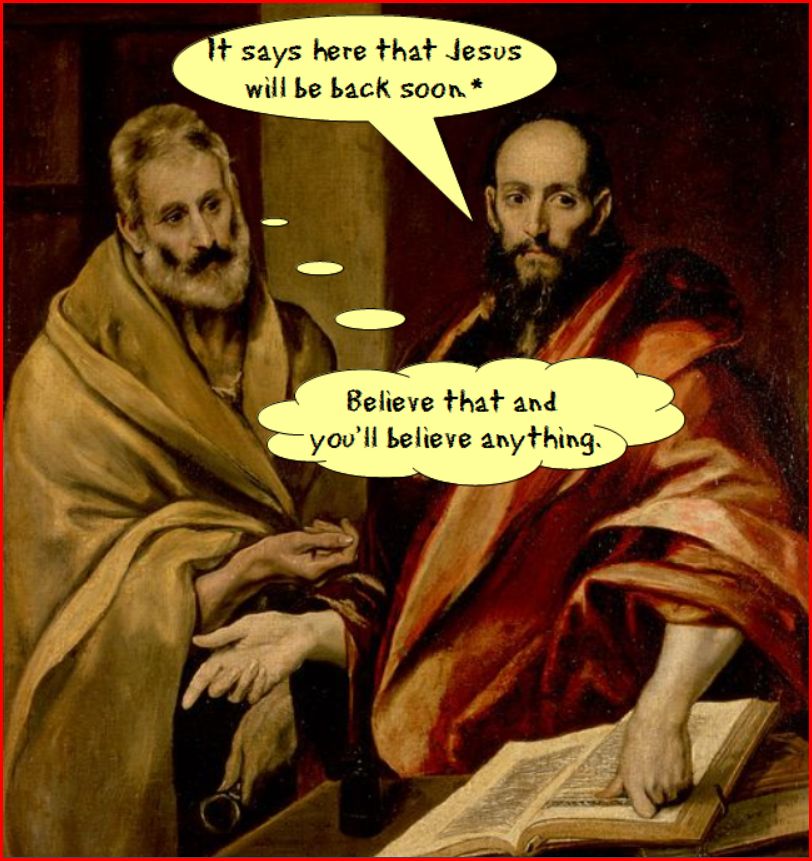
* And he should know; he wrote it in 1 Thessalonians 4:17, 5:23 and elsewhere.

When Jesus thought his world had got into such a bad way, he felt sure God would intervene and turn things around. But God didn’t and Jesus was executed instead.

When St Paul became convinced things couldn’t go on as they were, he told everyone that God was going to send Jesus back to Earth to sort it all out. But God didn’t and Paul was executed instead.

When people were accused of witchcraft in the middle ages, they waited for God to intervene and save them. But God was a no-show, again, and 100,000 were tortured or killed as a result.

When millions of Jews were taken to concentration camps in the second world war, they too prayed for God to save them. Once more, he failed to make an appearance and instead over six million men, women and children were exterminated by the Nazis.

When right-wing Christians today complain that the world has abandoned God (because, you know, gay marriage) they feel sure that God will intervene to judge us all and put things ‘right’. So far, he’s conspicuous by his absence.

God is always a no-show, despite the pleas of his followers, despite the earnest belief of his alleged son, despite the plight of his chosen people, despite those today who claim to know his will. Could this be because he has no existence outside the imaginations of human beings?

It surely could; a being that has failed to show himself throughout the history of mankind is a being that doesn’t exist.

Notes:

1) Jesus says God will intervene: Matthew 24:27, 30-31, 34, Luke 21:27-28 etc.

2) Witchcraft figures from An Atheist’s History of Belief:Understanding Our Most Extraordinary Invention by Matthew Kneale, p198

3) While I’ve linked one site that reflects modern Christian belief, there are thousands more of the same sort. Google ‘God will judge America’ for an unhealthy sample.

Christians – Jesus commands you be perfect. So why are you not?

Despot

‘Be perfect, therefore, as your heavenly Father is perfect’ is how he puts it. He even tells you in the verses that precede this one how to go about it: you have to turn the other cheek; give untiringly to anyone who asks (including to those who would sue you); constantly go the extra mile and show only love to your enemies (Matthew 5.38-48).

It is often claimed, even by those who don’t believe in him as their saviour, that Jesus offered great moral teaching. C. S. Lewis though cautions against seeing Jesus as simply ‘a great human teacher’ when, in Lewis’s eyes, he was far more besides. I would, however, invite Christians to consider whether the moral guidance Jesus provides here in Matthew’s gospel – how to be perfect – is in any sense ‘great’. If you think it is, because Jesus is Lord, a perfect being and possibly God himself, then you need to explain why it is never followed by Christians, and never has been. You need to explain why you yourself do not apply it in your life, because as sure as poached eggs is poached eggs, you do not. You do not give to all who ask; you do not invite insult after insult and violence on top of violence; you do not give away valuable and essential possessions when threatened with legal action – you are actually more likely to do the suing. And lest you think I am advocating a far more exacting morality for Christians than I would from anyone else, you will bear in mind, won’t you, that is not I who insists on it, but your Saviour. It’s not unreasonable under the circumstances to expect to see you obeying him.

As it is fairly safe to assume you don’t, I would further invite you to consider whether instead of being ‘great’, Jesus’ teaching is in fact unreasonable, unrealistic and impractical. If you are honest, you will acknowledge that it is all of these things, not great or timeless at all, and that is why you, and all other Christians worldwide, disregard it. Jesus’ moral teaching is no more than a series of reckless suggestions, a formula that applied can lead only to poverty and abuse, not perfection. You are probably wise to ignore it and to spend your time instead opposing gay marriage and judging the rest of us.

Revised from ‘Be Perfect’ in my book, Why Christians Don’t Do What Jesus Tells Them To …And What They Believe Instead, available from Amazon.

Notes: C. S. Lewis on Jesus as ‘great human teacher’: Mere Christianity (1952) William Collins & Sons, Glasgow, p52.

An experiment in Christian morality

Forget

Time for a little experiment: some data gathering for ourselves that will demonstrate the extent to which Christians are willing to comply, without cynicism or irony, with their Saviour’s peculiar requirements. While the Bible assures us it is wrong to put the Lord God to the test (Deuteronomy 6.16, etc), rest assured the same does not apply to believers themselves.

Our experiment is a cruel one to be sure, but given Jesus’ command in Matthew 5.42, that believers should ‘give to everyone who begs from you, and do not refuse anyone who wants to borrow from you’, we would be within our rights to test their adherence to the principle. After all, Jesus specifies that his followers must oblige ‘everyone’ and ‘anyone’ who asks, which is accommodating enough to include any sceptics conducting an experiment. He doesn’t stipulate either that those doing the asking have to have genuine need; indeed the entire thrust of his teaching in this section of Matthew is about responding sacrificially to unreasonable demands. We won’t be unreasonable – so no slapping of cheeks – and we will do our best to ensure our request is designed to meet as genuine a need as we can create.

For any experiment we need a hypothesis, so I propose that for this particular one we go with something like ‘Christians will not give to those who beg from them nor lend to those who ask to borrow’. If you want to amend this to suit your own circumstances, by all means do. You can choose too whether you’re going to beg, which means you get to keep anything you are given, or to borrow, in which case you won’t and you’ll need to pay it back at a later date.

Next, you’ll need to select your subject: you can choose an individual – they must of course be a card-carding, Spirit-filled Christian – or an institution: a church, say, or Christian organisation like Christian Voice or Focus on the Family. Whichever you opt for, you’ll need to ensure they are capable of meeting your request – we’re not going to pick on Christians of more modest means – and decide what you will ask for. I suggest that if your subject is a renowned evangelist or the pastor of a so-called mega-church you could reasonably ask him or her to lend you the money to pay off your mortgage, for example, or to meet medical expenses. I’m sure he or she will agree that these qualify as truly genuine needs, though you don’t necessarily have to tell them why you want the money, given there’s no mention of the beggars in Jesus’ instructions explaining themselves. On the other hand, if you think it will go some way to help disprove the hypothesis, you can and perhaps should be clear about why you want the cash.

Right. You should be all set. Be sure to let me know how you get on and whether your Christian subject demonstrates the hypothesis or refutes it. I’ll collate the data.

What’s that you say? You’re not going to bother because it’s a foregone conclusion that most Christians, whether prominent individuals, churches, organisations or ordinary believers won’t give to anyone and everyone who asks?

You could well be right, because, although Christians do give generously to causes close to their hearts, they baulk at the idea of giving to just anybody, in spite of what Jesus says. Maybe Christian readers of this blog can explain why; why don’t you do what Jesus tells you in this and many other respects? You cannot be his disciple, he says in Mark 10.25, unless you give away all that you have and he won’t recognise you as a follower unless you obey him entirely (Luke 6.46). So how about it?

Christians’ Favourite Delusion 7: What a friend we have in Jesus

James

So you’ve decided to follow Jesus and from here on in, Christians tell us, you’ll share real intimacy with your Saviour.

There are many permutations of this belief: having Jesus in your heart; walking daily with the Lord; enjoying a loving relationship with him; letting him speak to you. All rely on the premise that the post-mortem Jesus is an eternal, supernatural being who is able, somehow, to stroll, chat and administer one-on-one therapy. The old spiritual, still much beloved in Christian circles, declares ‘what a friend we have in Jesus’, while Mary Stevenson’s modern parable insists that his footprints are beside the believer’s in the sand – except, that is, when he has to carry them.

However, the concept of Jesus as bosom buddy and occupier of right and left ventricles is nowhere to be found in ‘God’s word’. Yes, there’s the possibility of feeling Jesus’ presence when with other believers; the shared delusion of Matthew 18.20 that over time would morph into ‘the Holy Spirit’. And it’s true too that Paul decides in 1 Corinthians 6.14 that believers’ bodies are sanctuaries or temples of this same Spirit. But these are both a long way from a Jesus who lives within the believer’s heart and, as another old hymn has it, ‘walks with me and talks with me along life’s narrow way’.

The Jesus of the gospels is not looking for people to be his chums. He does say in John 15.14, ‘you are my friends if you do what I command you’, but this is hardly what we’d call ‘friendship’ – ‘you can only be my friend if you do exactly what I say’ is the unreasonable demand of playground bullies and manipulators everywhere. It certainly isn’t friendship in the sense we normally understand it. But even if you’re taken in by this offer, do you do what he says? It’s highly unlikely, given that he insists you sell all you have and give to the poor, turn the other cheek and transform yourself into a slave, working selflessly and sacrificially to bring about the Kingdom of heaven:

…whoever wishes to be great among you must be your servant, and whoever wishes to be first among you must be your slave; just as the Son of Man came not to be served but to serve… (Matthew 20.26-28)

When you’ve turned yourself into a lifetime servant of others, surely then you can expect Jesus to be your best mate? Like the disciples before you, who also wanted to be part of God’s circle of favourites, you miss the point of what it was, and is, to be a slave; to work ceaselessly in demanding conditions with no reward, no wages and no acknowledgement. The most any servant of God can expect, Jesus tells us, is that he will say ‘well done, good and trustworthy slave; you have been trustworthy in a few things, I will put you in charge of many things; enter into the joy of your master’ (Matthew 25.23). That’s it – that’s the extent of your ‘reward’: he’ll recognise your position as a slave and tell you you’ve pleased him, your slave-master. And that’s what you call friendship?

Jesus is not your loving buddy. He never said he would be and you’re just confusing him with James Taylor if you think he did. Even if you want to ignore what the Bible says about being a slave – and I’m betting you do – you can’t have a relationship with someone who has been dead for 2,000 years.

Face facts, Christians: your ‘friendship’ with Jesus, your entire concept of him, is no more than the product of your own imaginations.