Who wrote the Bible?

According to Christians, Moses wrote the first five books of the Bible; Genesis to Deuteronomy are widely known as ‘the books of Moses’. There is little evidence Moses had anything to do with them and plenty that he didn’t. The narrative, for example, is never once in the first person; it’s all ‘Moses ordered this slaughter, Moses ordered that slaughter’, never ‘I was the bastard who ordered all the genocide.’ Maybe he was embarrassed about it or – much more likely – it was written by someone else..

In fact, the books were compiled from a range of sources, including stories from other cultures. They reached the form in which we know them around 600-400BC, a mere eight hundred to a thousand years after Moses was supposed to have lived. The events and folk-heroes they describe are demonstrably mythical.

Moses2

Christians like to say that King David wrote many of the Psalms. While David’s name is attached to 73 of the 150, there is no reason to conclude he wrote them. It is more likely ‘of David’ serves as a dedication to a revered (and long dead) figure and may, indeed, have been added much later. The Psalms were actually created over an extended period of time – as much as five hundred years – by a wide range of unknown composers.DavidBelievers attribute much of the book of Proverbs to King Solomon, the fruit of David’s loins. Again, this is highly unlikely. The sayings are largely traditional and the attribution ‘is likely more concerned with labeling the material than ascribing authorship.’

Palin

Christians believe four blokes called Matthew, Mark, Luke and John wrote the New Testament’s gospels. They didn’t. The gospels were written anonymously and did not have the traditional names attached until a century or so after their composition. None is by an eye-witness. There is no evidence that the writer of Mark was a disciple of Peter’s, nor that ‘Luke’ was a companion of Paul’s (and even if he was, this wouldn’t make him an expert on the historical Jesus), nor that ‘John’ was a bona fide disciple. The fourth gospel was written between 90 and 110CE when the disciple would have had to be between 80 and 100 years old, or, much more likely given life-expectancy in the first century, dead. There are several hands at work in ‘John’, as the gospel itself concedes (John 21.24).

 Beatles

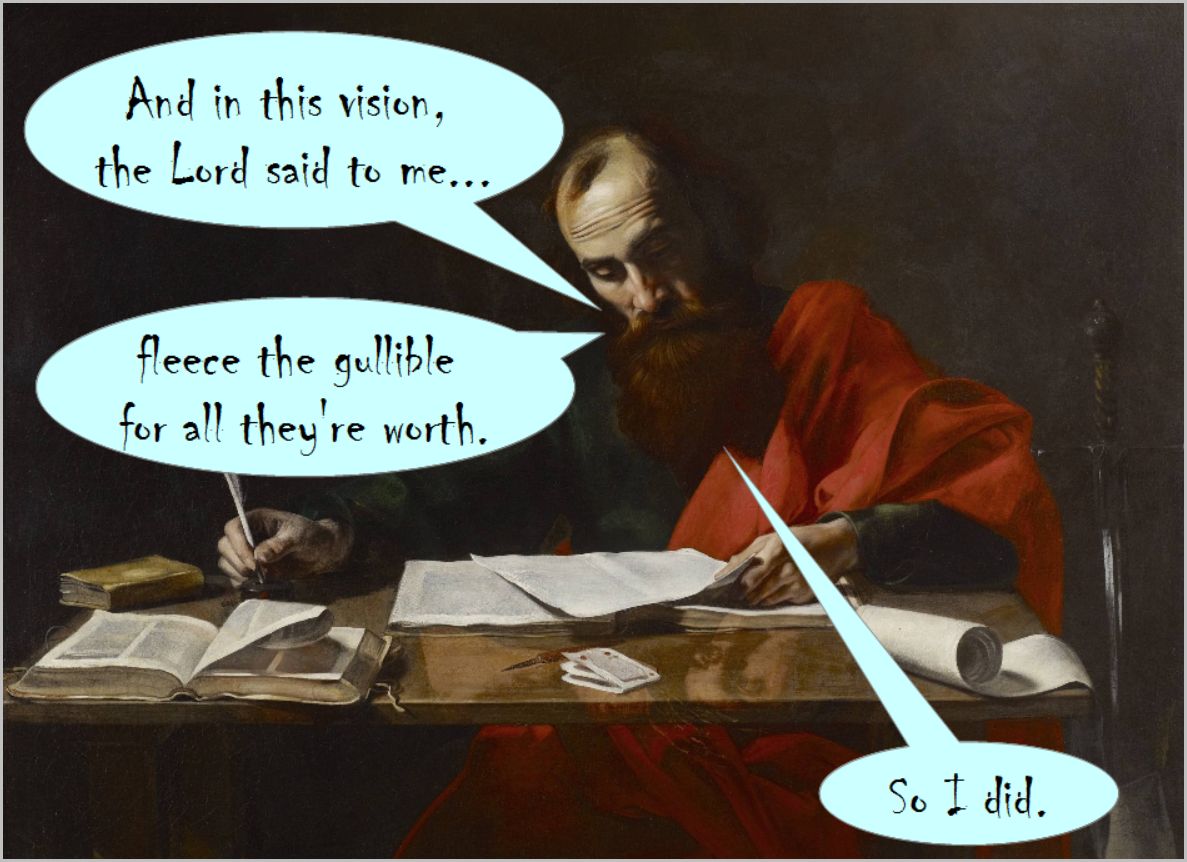
Christians insist that all of the letters attributed to Paul in the New Testament were written by him. However, despite the fact they say they’re by Paul, Colossians, Ephesians, 2 Thessalonians, 1 & 2 Timothy and Titus are not; they are forgeries. They were composed long after Paul’s death, which occurred some time around 64CE. The earliest of the forgeries, Colossians, is thought to be circa 75CE, while the ‘pastoral’ letters to Timothy and Titus may be as late as 150CE. All of the forgeries contradict the ideas expressed in Paul’s genuine letters.

PaulPeter wrote the letters that carry his name, or so god-botherers claim, but according to the Bible itself, Peter was an illiterate Galilean fisherman (Acts 4.13). The Greek of the letters supposedly by him is accomplished and the theology well developed. Did Peter have time to learn Greek and polish its written form to perfection while busy preaching the gospel to all nations? Even if he did, how did he manage to write a letter (2 Peter) concerned with conditions in the church more than a century after his time with Jesus?

Anderson3

Jesus’ brothers James and Jude, we’re told, wrote the letters carrying their names. Again, they didn’t. The letter of James may have originated in the early Jerusalem church presided over by James the Just, but there’s no evidence this was Jesus’ brother. Jude is plagiarised from 2 Peter – word-for-word in places – which is itself a forgery. Would someone who knew Jesus as intimately as a brother need to steal what he had to say from an illegitimate source? Jude would have had to be well over a hundred years old to pull this one off.

Robertson2When all else fails – and it does – Christians fall back on that most implausible of last resorts, ‘the Holy Spirit’. The very breath of God, they insist, presided over the creation of the Bible from start to finish. If it did, it made a staggeringly bad job of it; misattribution, mistakes and forgeries are the hallmarks of ‘God’s precious Word’.doveAnd on this unstable foundation, this tissue of lies, rests the entire edifice that is Christianity.

(It is difficult to find online sources on the authorship of the Bible. Christians have taken over the Internet with innumerable sites insisting the Bible was written by whoever they say it was. I’ve had to fall back on Wikipedia here (the articles are pretty comprehensive) but if you don’t think it reliable enough, I recommend Bart D. Ehrman’s Forged: Writing in the Name of God – Why The Bible’s Authors Are Not Who We Think They Are.)


Sweet and sour, nasty and nice

or, whatever happened to Luke 18.11-14?

prayer2Why is it when people are emotionally blackmailed into becoming followers of Jesus, does their conversion make them sweet and sour, nasty and nice at the same time? The sweet and nice parts are what their new experience does for them. They get a new start of sorts, are introduced to like-minded friends in the church and become compelled to share their new joy with everyone else, whether they want to hear it or not, about how much they’ve changed because of Jesus. It’s nice for them. Deluded too, but if it makes them happy then why not?

This is why not. What they don’t tell you, not at first anyway, is how sour and nasty they have also become; how they must now defend God’s standards, because, as everyone knows, the omnipotent God of all creation is incapable of defending them himself. Being born again and morphing into ‘a new creation’ involves, without exception, becoming judgemental of others, condemnatory, inflammatory, bigoted and spiteful.

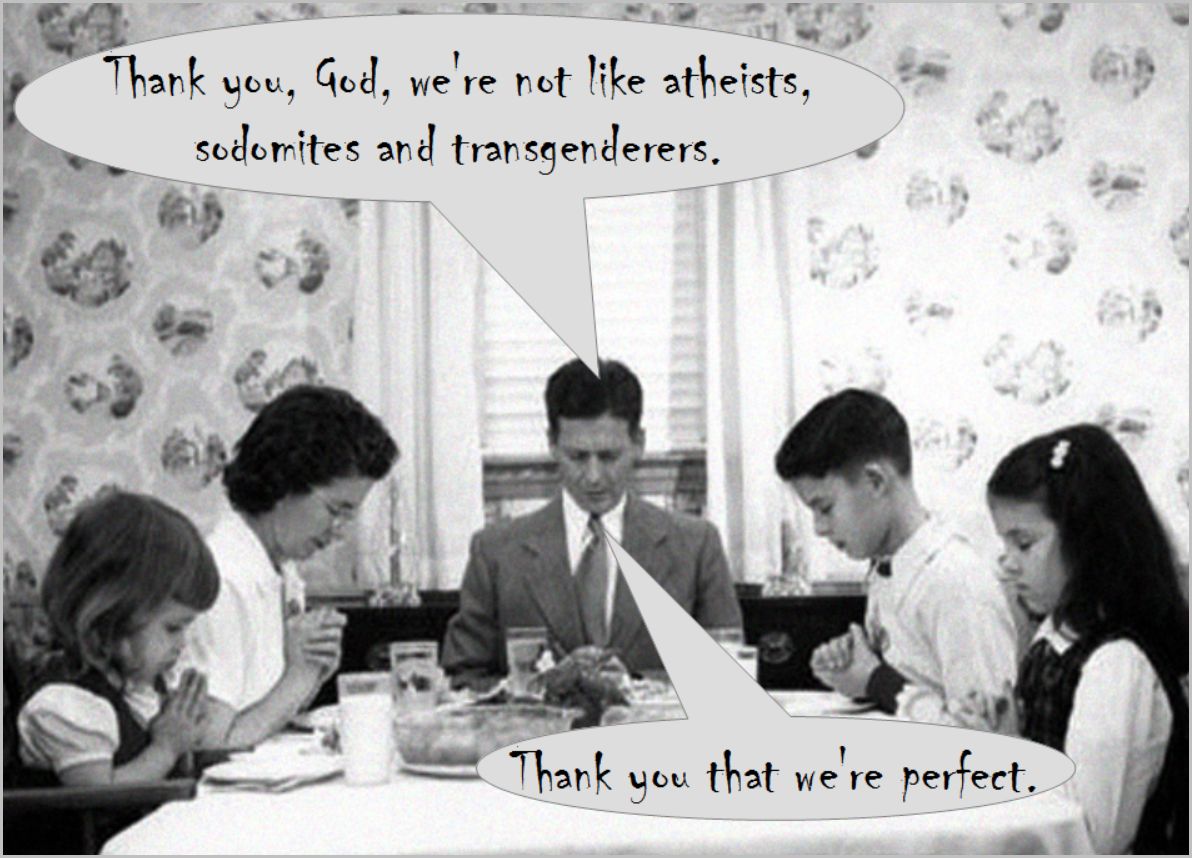
You think not? Then you haven’t heard what these same Christians think about abortion and women who have them. Homosexuality and those who are gay. Transgenderism and those born in the wrong body. Science and those who value evidence. Atheism and those of us who see through believers’ sad delusion.

Christians don’t, as some of them profess, hate the sin but love the sinner. They despise those who have philosophies different from them, those who live differently from them, those who are different from them.

A recent BBC poll asked if the world wouldn’t be more peaceful without religion. Here’s the results as of 14th July 2016:

Poll

I don’t know how many people this represents nor where they’re from – the site doesn’t say – but it would seem that most of us would think we would be better off without religion. It’s long past time we were able to be; religion has nothing to offer. It’s time we stopped giving it special treatment because some of it is sweet and nice. Its sour, nasty aspects are just as much a part of it, inseparable from whatever positives its adherents say it has. I’ll be looking soon at how we might push back against religion’s pervasive and poisonous influence in society.

Effective Preachin’ (Part Two)

Sheep

Reverend M. T. Vessal of the Church of The Raised Up here again, with the second part of my guide to Effective Preachin’. In case you missed it, repent! (The first part’s here.)

Now we’re really gonna get going, praise the Lord! The tools you’re gonna need for your talk proper are:

Lots of anecdotes (make up ’em up if you don’t know any true ones), specially ones about life- and-death situations. Stories about encounters with people on planes always go down well, as there’s always the chance the plane will too, and accounts of foolish follk who hear the gospel and ignore it, only to die in a terrible accident soon after.

Cod-psychology. That’s the stuff about God-shaped holes, how only Christ can forgive sin and meet all our needs, even though he doesn’t and never said he would. You can add something in here slagging off atheists and anyone else you disagree with.

Conviction. This is crucial. Sound as if you mean whatever it is you’re spouting. Sound as if you really know what the Bible says. Make it sound like it’s relevant and meaningful, even though it isn’t.

Modulation, otherwise known as shouting and dropping your voice. Shout when the argument is weak (and they’re all weak – you’re making this stuff up, remember)) and drop your voice almost to a whisper so that people know you’re being really, really sincere.

Drama. Pace up and down, like ‘Bishop’ T. D. Jakes, and mop your brow a lot. Wave your arms about, like Joseph Prince and show you really mean it. Maybe you could use props, like Beth Moore does, though you run the risk then of diverting the attention away from yourself. Better is to demonstrate what a cool guy you are, even if you’re not a guy, by sitting on the edge of the altar steps or, if you’re in a really cool church like Steve Furtrick’s, the Stage. This shows the congregation/audience just how cool you are.

Whipped up emotion. This is optional but if you lay it on thick about what Jesus has done for the spiritually inferior, how their sin caused those nails to be driven in, then you’re on to a winner. Aim for some arm waving from ’em, babbling in jibberish speaking in tongues and maybe even some crying. Don’t forget to tell ’em that whatever they’re feeling is the Outpouring of the Holy Spirit. Definitely nothing to do with your manipulating their already fragile emotions. No sir. This here frenzy is divinely inspired.

Finally, get to the challenge bit of your sermon/talk/self-promotion. This can involve an appeal for money. Correction: this will involve an appeal for money. The God who supplies everything doesn’t supply money so you’ll need to lay a guilt trip on your fans/congregation to provide you with the cash to maintain your lavish lifestyle continue the Lord’s work. But it’s not only about money; remember to pressurise/inspire the congregation/audience/fans to go out and harrass their neighbours so maybe they and their wallets will come to church next week. As the Lord Jesus himself said, ‘the harvest is plentiful but the labourers are few’!

Above all, though, let everyone leave feeling that they’ve had a good time. Like kettles, they should have had a real great Outpouring and feel well and truly Blessed. Leave ’em feeling ready for more, same time, same place next Sunday.


Angels with anuses

Lot

Of the many tawdry stories in the Bible, the tale of Sodom and Gomorrah (Genesis 19.1-29) is one of the most sordid and ludicrous.

In case you don’t know it, two angels visit Lot in the first of these ‘two cities of the plain’ where the local men express a desire to rape the pair. Unbelievable, right? All the men (19.4) wanted to rape two other men? It would appear so, but only because the story, designed to explain the demise of the two cities, is a fabrication by a rabidly homophobic scribe, intent on expressing his own prejudices and sexual fantasies. There is little evidence the cities really existed.

Anyway, Lot offers them his daughters instead, telling the local rapist mob that the gals are virgins, though in fact they have husbands (19.12 & 14). Lot’s rampaging neighbours don’t seem to know this but all the same decline his generous offer. So, to cut a long story short, God destroys both Sodom and Gomorrah allowing only Lot and his family to survive. Then, for no plausible reason, his nameless wife dies as they flee and Lot has drunken sex with his not-so-virginal daughters (19.33-38). As a result of the incest, the two of them give birth to genetically compromised offspring.

So this Lot – I’m tempted to say ‘this Bad Lot’ – who lies, offers his daughters to hormonally charged thugs, fucks the gals himself and has children by them, is declared by God to be a ‘righteous’ man (Genesis 18 and 2 Peter 2.7-8). The bar was set very low in them good Old Testament days.

Over on National Catholic Register’s blog, Thomas L. McDonald tries to explain what this seedy little story really means. (Steve Wells responds to his desultory efforts here). Central to it, are the so-called angels. What sort of beings are these? The term means ‘messengers’ and this pair at least are very mundane; they are incapable of defending themselves against rape threats (Lot has to defend them) and while they claim they are about to destroy the two cities (19.13), it is in fact God who does so (19.24). Later angels are more like the X-Men; they have grown increasingly grotesque (Daniel 10.5-6) and have developed superpowers like flight (Isaiah 6.2) and invisibility (2 Kings 6.17). The Sodom pair though are mere prototypes. There is nothing supernatural about them because the concept of the angel as a supernatural emissary of the divine was in its infancy when this story was written. They are simply human messengers.

Which is how they are capable of being raped. If they were the ‘evolved’ angels of later fantasy it would be inconceivable that they could be overcome and abused in this way. That these two can be potentially is because they are human males with human male anatomy. The bottom line is, if you’ll forgive the pun, they have anuses, without which they could not be anally raped. The story blithely assumes this to be the case even though all subsequent exegesis consistently ignores it.

This ugly, homophobic, semi-pornographic story has led to untold damage to innumerable people throughout the ages. It has given us the disparaging terms ‘sodomy’ and ‘sodomite’, even though no ‘sodomy’ takes place in the story and isn’t, in any case, routinely practised by same-sex couples. It has served as the prototype for the blaming of LGBT people for (always unrelated) natural and man-made disasters, from earthquakes to tsunamis and 9/11. The moral usually taken from it – even though it lacks any morals at all – that being gay is evil, has led to, and provided ‘justification’ for, the persecution and destruction of gay people right up to the present day. Perhaps, given the same story is referenced in the Qur’an, its influence can even be seen in last week’s massacre in Orlando. 

That the prejudiced and ignorant today continue to be influenced by this unimaginative, tawdry little tale is the lasting legacy, the real tragedy, of Sodom and Gomorrah.


What does God think about the Orlando massacre?

Orlando

Let’s see what he’s saying through his spokesmen here on Earth:

According to a minister from the cathedral in my home town, who conveyed this message from the Lord at a vigil on Monday night,

God is just as confused as we are. All the same, he’s full of compassion for those who died and for their loved ones.

Makes you wonder though, if he’s so compassionate, why he didn’t do anything to prevent the murders in the first place. Still, he is sympathetic, which is something.

Oh wait! That isn’t how God feels at all, not according to Pastor Steven Anderson, who knows exactly what the Lord thinks:

…in Leviticus 20:13, God’s perfect law, he put the death penalty on murder, and he also put the death penalty on homosexuality. That’s what the Bible says, plain and simple. So, you know, the good news is that at least 50 of these pedophiles are not gonna be harming children anymore. The bad news is that a lot of the homos in the bar are still alive, so they’re gonna continue to molest children and recruit people into their filthy homosexual lifestyle.

Right. So now we know.

Hang on, though. Christian Today tells us something different again. According to this guy, what God really wants his followers to know is that,

true believers should pray for everyone involved in the terrible events of the weekend and ‘not miss a huge opportunity to build bridges and demonstrate our saviour’s love.’

Phew, glad that’s finally sorted.

Or maybe not, because God has changed his mind again: Pastor Roger Jimenez has this straight from the Lord himself:

The tragedy is that more of them didn’t die… the Bible paints the picture that these are wicked people. These are evil people. God gave them up to their vile affections… they’re not natural… they received a reward for their error… God almighty says, ‘there’s nothing I can do for (homosexuals).’

All these mixed messages, and all supposedly from the same Person! Compassion, punishment, love, abandonment; that truly is one confused, mixed-up deity you worship, Christians. You’d be confused too, I guess, if one nutjob after another put words into your mouth. Just who’s the ventriloquist here and who the dummy?

When, Christians, are you going to stop deluding yourselves that arses like Anderson and Jimenez know anything about what God thinks? When are you going to stop pretending that anyone knows what he thinks? When are you going to recognise that a God who ‘speaks’ so inconsistently through simple-minded ‘intermediaries’ is not God at all?  When are you going to stop deluding yourselves that there even is a God?

Christianity: always winter but never Christmas

Spot the difference:Shore

Christians are hot on evidence.

There isn’t enough for evolution, they say, even though there’s an abundance.     

None, they claim, that the Earth is billions of years old, but only 6 thousand.

Not enough that climate change is man-made, when there’s considerable evidence it is.

None that there’s a genetic component to homosexuality when science reveals that there is.

But, as far as the resurrection of the body, judgement and eternal life in either Heaven or Hell are concerned, these they believe in, no evidence required.

I recently challenged Christians on Charisma magazine’s blog-site to provide or point me to evidence that any one of the 107 billion people who has ever lived who after they had died had gone on to enjoy either eternal life in Heaven or eternal punishment in Hell. Unfulfilled promises from magic books weren’t admissible, because a promise of something happening is not the same as it actually doing so. Jesus didn’t count either, as there are no eye-witness accounts of his bodily resurrection, only stories written decades after the supposed event. In any case he was half Vulcan or something, not an ordinary mortal.

Alas, my challenge went unanswered. You won’t find it on the Charisma site now because it has been removed by the moderator there. Expecting evidence from Christians for what they believe is patently unreasonable. After all, who needs evidence when you can exercise your licence to believe whatever you’re told?

Of course, there is no evidence of any resurrection nor of anyone who has gone on, post-mortem, to enjoy everlasting life. Have you noticed how everything about Christianity is either invisible – God, the Holy Spirit, Heaven, angels, demons – or lies permanently in the future; the Second Coming, the resurrection of the body, the Kingdom of God, judgement and eternal life? All of them always just that little bit further on. This year, next year, sometime, never. Just not now.

Yet Jesus, Paul, Revelation’s John and most other New Testament luminaries believed God’s Kingdom, the resurrection and judgement were coming within their own lifetimes.* Not one of them entertained the thought that 2000 years down the line none of these miraculous events would have materialised.

Small wonder then, that at the start of the second century, believers began to lose hope in the Second Coming, the Kingdom’s arrival and an earthly resurrection of the dead. Maybe, some of them began to think, eternal life would be not be here on Earth, as Jesus and Paul had promised, but in Heaven with God, which they most definitely hadn’t. This way, everything that hadn’t happened here on Earth would happen instead after death (we can see this transition taking place in the very late gospel of John). All of which was fortunate, because it dispensed with the need for confirmation and evidence; no-one could prove – apart from the fact nobody has ever survived their own extinction – that believers didn’t go to Heaven when they died. Equally, no-one could provide evidence they did.** How neat and convenient.

So if any Christians reading this would like to like to show us some evidence for the resurrection of the dead, post-mortem judgement, Heaven, Hell, God’s Kingdom on Earth – any of it – I’m sure we would all like to see it. Until then, I will go on regarding all of these assurances as empty promises – pie in the sky – that believers cling to desperately, while calling their desperation ‘faith’.

* See Matthew 16.27-28 & 24.27, 30-31, 34; Luke 21.27-28, 33-34; 1 Corinthians 15.51-52; 1 Thessalonians 4.15-17; 1 John 2:17-181; Peter 4.7; Revelation 1.1 & 21.2-4

** Psychics claim to commune with the dead of course, or at least with their spirits; more hokum from the minds of the deluded. Even if it weren’t, this isn’t the kind of resurrection Christians envisage for themselves. They dismiss psychics’ ‘evidence’ of life-after-death as so much demonic deception.

Believing is Seeing

Fish

Have you noticed how the risen Jesus seems only to have appeared to those who were already primed to see him? Of course, the accounts of the resurrection are inconsistent, unreliable and constructed long after the supposed event, but just for now, let’s take them at face value. Jesus appears first, according to Matthew, Luke and John, to his female followers – maybe one on her own (in John), maybe two (Matthew), maybe several (Luke) – but to women who would be mourning him and would be longing to see him again. And lo and behold, they do! He’s not quite substantial and not quite recognisable – every bit the hallucination, in fact – but he appears.

Next he is said to have shown himself to the disciples – maybe one (Luke), maybe two (Luke again), maybe several (Matthew) – men who have been thrown into complete disarray by Jesus’ death but who believed in him and his mission to inaugurate the Kingdom of God, and were looking forward to ruling it with him. So naturally they see him in their midst. Never mind he walks through walls and disappears at will, just like an apparition – he appears! As Acts 1.3 puts it, ‘he presented himself alive to them after his suffering by many proofs’.

Wait – ‘by many proofs’? What does that mean? That he had to prove he’d come back to life? Could they not see that for themselves? Couldn’t they recognise the man with whom they’d spent the last three years? Or if they could, weren’t they convinced he’d returned from the dead so that he felt he had to prove it? How? How did he prove it? With a death certificate? By letting them poke his holes? And this took forty days? Isn’t it more likely they were subject to group hysteria and some sort of hallucination (they’d had hallucinations before – see Matthew 17:1-9) and they then had to convince each other that what they’d experienced was really Jesus? No wonder it took forty days to concoct a ‘plausible’ story, to arrive at ‘the many proofs’ that Acts speaks of. Whichever it was, Jesus’ gullible old pals convinced themselves they’d seen him.

During these same forty days – though in his gospel Luke implies it’s a much shorter time (24.40-53) – Jesus fits in a guest appearance at a rock concert in front of 500 believers – believers, note. Not people who were converted as a result of this miraculous appearance, but people who were already part of the Jesus cult when they experienced this vision. Or so Paul tells us in 1 Corinthians 15.3-8. He wasn’t actually there, but he heard about it from a friend of a friend of a friend so it must be true.

And finally he appeared also to Paul himself (1 Corinthians 15.5). Not as a physical body but as a beam of light in Paul’s head. I’m not getting into how this was, as Paul himself admits, no more than an inner vision (he too is prone to hallucinations – see also Acts 16:9-10 and 2 Corinthians 12.1-7) because you can read about that here. Rather, I’m going to argue that Paul, arch-enemy to this point of all things to do with the Jesus cult, is just as primed for a sighting of the Lord as all those other people who think they saw him… next time.

to be continued.

Are You Doing What Jesus Christ Says?

Billboard

Dale McAlpine, sometime commenter here and fanatical street-preacher in these parts, has posted a tasteful little video on his web-site – that’s the smugly named Repent.com if you’re interested – called Are You Doing What Jesus Christ Says? Take a look at it over on Repent.com or on YouTube; it’s ludicrously melodramatic and wonderfully over the top. You’re sure to enjoy its typos and spelling mistakes too.

What’s remarkable about it apart from these things is that, despite its title, it makes little reference to what Jesus is supposed to have said. Instead, it’s all about how you’ll go to hell if you don’t repent and accept him as your saviour; but Jesus never said this. It says you’re a ‘vile, wretched, hell-deserving son or daughter of Adam’ – Jesus didn’t say this either. It also insists you should let his cross ‘disrupt the very centre and citadel of your life of self’ (whatever that means) and guess what? This wasn’t part of Jesus’ teaching either. In fact, none of these claims were part of his ‘good news’.

Of the things Jesus did say – go the extra mile, sell all you have to give to the poor, turn the other cheek, avoid judging so you won’t be judged, give to all who ask, give away your shirt as well as your coat, feed the hungry, visit the sick, clothe the naked and love your enemies – the video makes no mention. Funny that. Maybe that’s why we don’t see Christians doing them very often.

So, Christians – and Dale too – are you doing what Jesus said or are you, like the video, only interested in pointing out others’ supposed sins and shouting about how they need to join you in your delusional mumbo-jumbo?

Yes. Thought so.

The Stuff Christians Say… (part two)

Balaam

Atheists don’t behave as evolution says they should: This ridiculous accusation is often slung at atheists by Christians who seem to see it as some sort of stinging rebuke. Answers In Genesis is very fond of it; the Hamster’s drones and other Christians seem to believe – without ever thinking it through (plus ca change) that because those who acknowledge the veracity of evolution don’t behave according to its principles they are somehow inconsistent in their ‘beliefs’ – hypocritical even. They seriously propose that because natural selection and the survival of the fittest (not one of Darwin’s phrases) are cruel, uncaring processes, then that is how, for the sake of consistency, atheists ought to behave too. We shouldn’t care, they say, when a child develops cancer or someone dies. We shouldn’t attempt to cure illness or work to prevent suffering because these are nature’s way and part of the mechanism of evolution.

While it’s true they are, it’s been a long time since our behaviour, our existence and continued success as a species has been solely determined by what nature does. Humans regularly override its mechanisms, natural selection included; every time we use birth control, show compassion for the weak, heal the sick, develop medicines, engineer genes and preserve life. And so we should.

Christians seem unable to comprehend that evolution is not a pattern to be followed. It is not a set of instructions for living, a prescription or a set of (a)moral guidelines. It is the best explanation, supported by considerable amounts of evidence, of how life developed on the Earth. As such it makes no ethical claims nor does it demand that its principles be blindly followed (that’d be religion). Are Christians truly unable to detect this difference?

Atheists have no reason to be moral: I’ve looked at this ignorant claim before. Of course we have reason to behave morally. We’re human, we live in human society. Morals help us do so while doing the least damage to ourselves and others. They may also enable us to bring some happiness or comfort to those around us. Atheists don’t look to an imaginary God to tell us how to be good; our morals come from our culture, upbringing and education. Christians’ morals do too, whatever else they may claim. They certainly don’t get them from that most immoral of books, the Bible.


to be continued…

The stuff Christians say… (part one)

Jesus-Facepalm

On the day Christians remember the time Jesus allegedly spent being dead and buried (that’s one day, if you’re counting; what happened to the three he promised?) by going shopping or watching sport, let’s take a look at some of the nonsense they spout about atheists:

Atheism/humanism is of Satan: Given there’s no evidence for any supernatural beings, there can be no devil, Satan, Lucifer – or whatever other name Christians come up with for this fantasy figure. (Bizarrely, it’s Jesus who’s called Lucifer in Revelation 5.5) The devil is a creation of the human mind, intended to explain the nasty stuff in life and to let a supposedly good God off the hook. It follows that an imaginary being can’t make human beings be anything. The devil therefore does not make people atheists nor direct them in their ways.

Humanists/atheists set themselves up as God: Every manifestation of the god(s), including those that happen to be popular at present, is of human origin. Like all the others, the Christian God is a product of the human imagination that is made manifest only through human behaviour. So who is it who sets themselves up as God? Those who recognise that this creation of the human mind has no external reality, or those who claim an intimacy with the ‘Supreme Being’, believe his Holy Spirit lives within them and delude themselves into thinking they speak for him? No prizes.

Humanists/atheists worship man as God: Atheists don’t do this either. We are well aware of humans’ fallibility, inconsistency and capacity to bugger things up. However, we’re all we’ve got. There’s no God going to come and save us or solve our problems. We have to do it ourselves (or, as the case may be, not). Nor do atheists regard other people as wicked sinners who have no good in them – a particularly unhealthy viewpoint favoured by the religious – but this hardly constitutes ‘worship’.

Atheists hate God: Only to the same extent we ‘hate’ Santa Claus, Poseidon and Ra. You can’t hate (or rebel) against something that doesn’t exist. We do get very tired though of Christians foisting their views on us, insisting we should believe what they believe. And we get angry when they disparage others and attempt to curtail their freedom because they alone know what Jesus would want. But being angry about Christians’ unreasonableness is not the same as hating something that doesn’t exist.

To be continued