A Special Christmas Bible Study

An angel of the Lord appeared to (the shepherds), and the glory of the Lord shone around them, and they were terrified.

But the angel said to them, “Do not be afraid. I bring you good news that will cause great joy for all the people. Today in the town of David a Saviour has been born to you; he is the Messiah, the Lord. This will be a sign to you: You will find a baby wrapped in cloths and lying in a manger.”

Suddenly a great company of the heavenly host appeared with the angel, praising God and saying, Glory to God in the highest heaven, and on earth peace to those on whom his favour rests.” (Luke 2:9-16)

Another chunk of scripture that will be proclaimed from pulpits and in nativity plays again this year. Let’s take a closer look at the scenario Luke creates. Does it bear any relation to something that might occur in reality?

First, an angel. Doesn’t this tell us from the outset that we’re in the realms of fantasy fiction? You can’t fault Luke for trying though, he does his best to impress by adding a whole host of them. You can hear him thinking that ‘a great company of angels’ should convince all but the most hardened of hearts. He’s inventing freely, throwing in the tropes of the genre with abandon. Doesn’t he know angels are fierce, two-faced, six-winged creatures (Ezekiel 14:18; Isaiah 6), not handsome youths in glowing white robes? There’s a reason they prefaced their every appearance, including this one, with ‘Do not be afraid’.

Good news that will cause great joy for all the people: All? Even as Luke wrote this paean to wishful thinking he knew that the Jesus myth had not brought joy to ‘all people’. Most had rejected the claims of the new cult and joy was hardly the prevalent emotion in some of the churches Paul wrote to.

This will be a sign to you: You will find a baby wrapped in cloths and lying in a manger. A baby wrapped in cloths, as was the custom, and lying in an animal feeding trough is a ‘sign’? A sign that the Messiah had arrived? Really? Granted a manger is not a conventional place for a new-born but it’s hardly miraculous. And what if by the time the shepherds had abandoned their flocks to the night and its marauding wolves, Mary had, say, picked up the child or found a better place for it? Imagine the confusion! Sorry, Luke but this is a very poorly constructed story. You just didn’t think it through.

As for the angels’ last proclamation, what does it really mean?

Glory to God: this of course is fawning to a God whose ego is more inflated and fragile than Donald Trump’s. He demands continual praise not only from his heavenly messengers but from those here below, or else he’ll go off on one. You really want to spend eternity with such a tyrant, Christians?

…in the highest heavens: a reference to the fact that early Christians believed in different layers of heaven; Paul writes about them too. God resides, as acknowledged here, in the highest, the top floor executive suite. No-one ever gets to go up there. Emails are sent down from on high.

And on earth peace to those on whom his favour rests: what sort of peace? Certainly not the absence of conflict or war. We’ve now had two more millennia of these, some in the past initiated by Christians themselves. Do people who are at peace with themselves start wars? Peace within then. Do Christians know greater peace than anyone else? Hard to say when it’s not something that can be measured but I’m sure Christians will claim it’s so.

On whom his favour rests: who exactly is this? Who enjoys the favour of a capricious deity? How do they know when he visits all manner of trials and tribulations, testing and tempering on those who count themselves as his. I’m sure the early Christians who helped write the angels’ speech thought it was they who enjoyed the Lord’s favour. Today’s Christians probably think the same. YHWH has always played favourites. Everyone else can go to hell.

So, the heralds of Jesus’ birth didn’t exactly bring good news, did they. Not even in Luke’s imaginary, completely invented, never-happened-in-reality and isn’t-even-a-decent-metaphor scenario.

There May Be Trouble Ahead…

Prophets, from left to right: Elijah, Julie Stephens,
Cindy Jacobs and er... Ed Miliband

Prophets don’t exist. A bunch of people intoxicated by religious fervour who think God has given them a special message that they must deliver to whoever will listen, are not prophets; they are a collection of extremists intoxicated with religious fervour.

We know this because no God exists. He can’t, as a result, drop messages, special or otherwise, into the heads of fanatics.

That’s it, really. No more to be said.

But so-called prophets exert quite an influence on our modern world. According to Abraham (I know, he’s a mythical figure but bear with me), God selected an ancient Jewish tribe to be his favourite buddies, so long as they did whatever he demanded of them, including hacking off their foreskins and that of their sons. What sort of prophet – what sort of God – comes up with this kind of lunatic fetishism?

Later the creators of a new prophet, whom they called Moses, came up with a story in which their hero encountered God in a bush (the symbolism is lost on us today.) This time he wanted his special buddies to invade their neighbour’s territory, slaughter them and take their land for themselves. This his favourite, de-foreskinned tribe did (modern genetic analysis of the peoples in the region suggests this isn’t what happened.)

After these fictional madmen came some potentially real fanatics who thought God had assigned them to lambast their fellow Jews for their shortcomings. These prophets promised the rubes rewards if they behaved as the prophets thought they should. These guys also came up with the idea that God would send a warrior Messiah to help his special little tribe take over the world. This is what happens when fanatics are allowed to get a hold of things.

A couple of centuries later, another self-proclaimed prophet turned up (or is invented) who seemed to think he’s the most special-est of all the prophets so far. This guy, called Yeshua (meaning ‘salvation’, so obviously not in any way symbolic) prophesied that the Messiah would be arriving real soon to sort the world out. He’d then hand it over to the Jewish people to manage. This guy’s script writers weren’t sure if Yeshua was talking about himself or some other supernatural character called the Son of Man. It doesn’t matter really. Nothing he prophesied happened when he confidently predicted it would: there was no Messiah who flies down from heaven, no final judgment, no great reset for the Earth. He was an absolute failure as a prophet; evidence, if more is needed, that those who claim to speak for God don’t know what they’re talking about. Don’t worry, though, this guy was recast as a resurrected Godman, just like the ones in pagan myths.

A few other prophets appeared around about the same time. In fact, the extremist who changed his name to Paul seemed to think that just about anyone could become one so long as they ‘edified’ the brethren. It was a few years though before the next really big so-called prophet came along.

In the 8th century, a guy called Muhammad said he was told by an angel who represented a different version of God that, amongst other things, Islam would spread worldwide and there would be an increase in senseless murders. These rather nebulous and self-fulfilling predictions are even now coming to pass. Muhammad’s future followers are indeed spreading Islam across the globe while senseless murders continue being committed, a good many of them by Muslims themselves.

While Muslims have made it clear that Muhammad is the final prophet, history has blessed us since with a few more. Joseph Smith in the 1880s was commanded by a different God (or maybe by the same one who’s changed his mind again) to start a new church and to obliterate anyone who stood in his way. He was successful in this enterprise, despite managing to get himself killed in the process.

You’d think, wouldn’t you, that given their abysmal success rate and the number of people who have suffered or perished as a result of their endeavours that we’d have had enough of prophets. While churches cannot agree on whether ‘genuine’ prophecy still exists, the prophets keep coming. Fanatics the world over, every bit as barmy as their predecessors, appoint themselves some deity’s spokesperson, and the ‘prophetic’ pronouncements begin: meaningless theobabble spattered across the Internet.

Who Has Seen The Wind, Or Cause and Effect

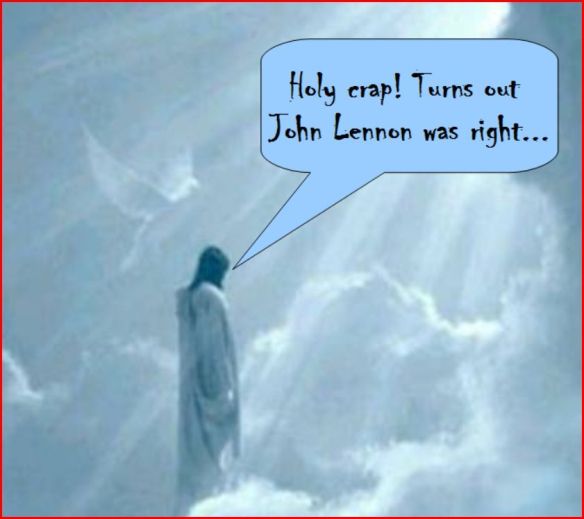
The first time I encountered this poem was when Yoko Ono intoned it, as only she could, on the B-side of John Lennon’s Instant Karma!, back in 1970.

I noticed at the time (because I always read such things, while playing the B-sides of singles) that the poem’s composer was someone called ‘Rossetti’. Back then I knew nothing about him or her. Years later, I came across Dante Gabriel Rossetti, the Pre-Raphaelite artist but it turned he didn’t write the poem either. His sister Christina did.

Christina Rossetti was profoundly religious. She set about helping fallen women: ‘fallen’ according to the sexual mores of the day. A number of these young girls may well have been ‘led into sin’ in the first place by her hell-raiser brother, Dante. Her poem Who Has Seen The Wind, written in 1847, is an allegory of the work of the Holy Ghost: as the wind itself can never be seen, only detected by its effects, so too the Holy Ghost can be sensed only by its invisible workings in the real world. It’s an old argument, hinted at in Psalm 19:1, which says the heavens declare the handiwork of the Lord. Modern versions of the argument exist, based on the philosophical assertion that every effect must have a cause, including one that equates God with a murderer, 

It’s a terrible idea in all its forms. First, we know the wind, and murderers too, exist. The wind can be measured and the processes involved in creating winds of various strengths are well understood. Likewise murderers (as tempting as it is to equate God with a callous killer.) The inference that the cause of any given effect must be supernatural – a Ghost, a god, an angel – is mere primitive instinct. Even more unjustifiable is the leap that says this supernatural cause is The First Cause, which itself has no cause. A further leap into the absurd is the assumption that this uncaused First Cause is a God who was first imagined by middle-eastern tribesmen and later reshaped by early Christians and the church.

Which brings us to God: The Science, the Evidence, a new book by a Christian scientist, Olivier Bonnassies and industrialist Michel-Yves Bolloré, proposing that because we don’t fully understand how the universe came into being, it must have been God. Bonnasaries explains how they arrived at this conclusion:

It’s the fact that this (piece of paper) exists. And that because it exists, it needs a cause, and that (cause) needs another cause, and at the end, you need what we call a primary cause in order that everything exists. Because nothing can exist by itself.

Except, apparently, that cause designated, without evidence, the First Cause: God.

It is this, Bonnasaries and Bolloré claim as a scientific hypothesis. Bonnasaries must surely know as scientist that it is far from scientific. ‘God did it’ is a conclusion, arrived at without evidence; there is nothing observable, testable or measurable about it. It is philosophical conjecture at best, theology at worst. Christina Rossetti put it so much better, all those years ago (but still she got it wrong).


You don’t have to imagine: there is no Heaven

From an Anonymous commenter:

How do you know there is no Heaven or an afterlife? I have no proof Heaven or an afterlife exists either, but where is your proof that they don’t? I don’t think I will ever understand how atheists can be so certain of something that they can’t prove any more than I can understand fundamentalist Christians who say if you don’t accept Jesus Christ as savior you’re doomed to hell. You’ve got something in common. 

And my response:

Thanks for the comment, Anonymous. I’ve copied it here from the old post you added it to.

First, it isn’t up to those of us who question the existence of things like Heaven to ‘prove’ they don’t exist. It’s up to those who claim they do exist to demonstrate that this is the case. A negative proposition such as ‘there is no Heaven’ or ‘there’s no such thing as unicorns’, can’t be ‘proven’ as such, simply because its impossible to present evidence for a no-thing. A positive assertion, however, such as ‘there is a Heaven’, is theoretically demonstrable. But this particular claim never has been. No one has demonstrated where Heaven is (it has to exist somewhere, right?) No-one has ever returned from Heaven with empirical evidence of its existence. No-one has ever survived death to experience Heaven. No evangelical seems to understand that Heaven is exclusively God’s abode and no human will be resurrected into eternal life until the Final Judgement. That’s the Final Judgement Paul and Jesus said was just round the corner but which has never arrived.   

The problem is worse than this, however. There is so little evidence that a god exists, and even less the Christian God (see my previous post, as well as here and here). If there’s no God – and it is highly likely there isn’t – then all contingent beliefs are wiped out: there’s no Heaven, Saviour, Resurrection, Final Judgement, Hell or Eternal Life.

So this is how I know there is no Heaven: it all comes down to probability. The probability there is a Heaven is so infinitesimally small – its highly improbable in fact – that it’s to safe to assume there isn’t one.

Despite first impressions suggesting this view has a lot in common with evangelical belief, I think you’ll find it is actually the opposite. While evangelicals accept on faith that Heaven must exist – because the Bible says so – the fact that its existence is both highly improbable and indemonstrable allows for the 99% certainty that it does not.

Finally, Anonymous, no-one other than mathematicians and lawyers deal in proof. Scientists most certainly don’t: they are concerned with evidence and demonstrating something is or is not the case. You’d do best to drop ‘proof’ from your arguments. Unless you can prove something mathematically, you’re not going to provide or find proof, certainly not when contending with religions. Second, how about giving yourself an online name? Commenting as ‘Anonymous’ suggests you don’t have the courage of your convictions and also adds you to the numerous other Anonymous commenters who pop up on blogs. There’s no way of distinguishing between you.  


The Daft Things Christians Say (the Sequel)

The return of an old favourite (of mine if no-one else’s)!

Dennis and I were in the States a couple of weeks ago and had the dubious pleasure of watching American news channels. I noticed on more than one, the presenters signed off with ‘God Bless’. As well as undermining what little objectivity they have left, the phrase rang hollow and made those using it, for whatever reason, as vapid and insincere.

It’s a phrase that many ordinary Christians and the nominally religious use (a waitress serving us lobster also came out with it, as if the lobster would magically be granted extra flavour.) It seems to me it’s a remnant from the days of incantation and magic. ‘May God bless you’ as opposed to ‘Let the devil smite thee’ or some such. ‘Goodbye’ has survived from these times too, originally ‘God be with you’, and is equally meaningless. Meaningless because if a God existed he would presumably be with you if he felt like it, or not as the mood took him. Attempting to summon his presence with an incantation of well-wishing is hardly going to influence him. Similarly with ‘God Bless’. Doesn’t the Bible say that God blesses whom he will (Romans 9:18)? No imperative will change that. Might it make the declarer of God’s presence of blessing feel more smugly self- righteous while the intended recipient might feel better, he or she convincing themselves they are actually ‘blessed’? Maybe, but God would have nothing to do with either state of mind.

Likewise that magic phrase Christians like to add to the end of prayers: ‘we ask this in Jesus’ name’. Will God not listen to their supplications if they don’t add it? Will he grant their requests if they do? I think we all know the answer. Why should it make any difference to Almighty God whether they add magic words to their pleas? If it does, what sort of God is it who must have exact words used, like a Hogwarts spell? The addition of a ‘just’ before the word ‘ask’, meaning ‘this is really a modest little request, your worshipfulness, we don’t want to bother you,’ doesn’t make it any more meaningful. From within the faith, as without, the phrase couldn’t possibly make any difference, apart from possibly allowing the supplicant feel better, more self-satisfied, like the child who adds a pretty picture to the end of their writing. ‘We (just) ask this in Jesus’ name’ another empty and vacuous magic spell.

Omens and Portents

Hey guys, can you help me out a little? The last few weeks I’ve experienced an omen. Or maybe it’s an auspice. A sign. Could even be a miracle.

That’s the trouble, you see. I don’t know which. And even if, with your help, I manage to work it out, I still don’t know what it all means.

You see, there I was in my favourite coffee shop waiting for my cappuccino to cool a little. I happened to look over at it and saw two dead flies floating on the surface. So naturally, I called over the server and said – you know what’s coming – ‘waiter, there’s a fly or two in my drink’. Now whether the flies had been getting it on with each other and decided the froth on my coffee was a good place to do it, I don’t know, but it led to their demise: death by conjugal drowning.

I got a fresh coffee.

Skip forward a few days and I’m about to have a nice glass of Merlot in my favourite Italian restaurant. There on the top, just after it’s been poured, is a solitary swimmer, another of God’s blessed little creatures backstroking its way around my glass in ever erratic circles. After I paraphrase the old joke again, the waiter removes the glass, fishes out the drunken fly and returns my wine. Or maybe he poured a fresh glass. Who knows.

And then – yes, you know what’s coming – a few days after that I’m having another cappuccino in a third establishment when another of the little blighters tops itself in my drink. That’s three times in only a few days. I mean twice would be a coincidence but three times! As Ian Fleming almost said, ‘once is an accident, twice is a coincidence, three times is a pattern’. There was a pattern to my flysome encounters, and we know what a pattern means: it means a pattern maker! An intelligence behind this series of unfortunate events. But which? And what did they all mean? A pattern has to have meaning! What was the message I was being sent from the supernatural plane?

Was it an omen? A portent? A sign from above? Was God telling me something? If so what? Maybe you guys can help.

I just realised though that there’s a Lord of the Flies, Beelzebub, who might be trying to communicate with me. (Is there a Lord of the Slugs and a Lord of the Flatfish too? Logic dictates there should be… but I digress). In the Word of God (Mark 3:24 etc), Beelzebub is none other than the devil in disguise, an alter-ego of old pal Satan.

What’s Satan/Beelzebub trying to say to me by directing flies to land in my beverages? I really need to know. If only these all-powerful supernatural types could be a little clearer.

Live Backwards

I wanted in this post to think about the source(s) of evil, given it cannot be supernatural. However, defining evil isn’t as straightforward as I anticipated. The Oxford English Dictionary offers ‘Profoundly immoral and wicked’ while Merriam Webster goes for ‘morally reprehensible: sinful, wicked.’ Other dictionaries also mention both immorality and wickedness, replacing one concept in need of explanation with two. ‘Wicked’, it seems to me, is synonymous with evil, which doesn’t get us any closer to defining it. There are problems with ‘immorality’ too, as what constitutes immorality is frequently culturally determined.

Evangelicals, for example, regard same-sex relationships as immoral (so that’s me told) as is sex outside marriage. When I was involved in the church, dancing, drinking and listening to rock music (with all its backward messages!) were anathema. In some countries today many of these behaviours attract the attention of so-called morality police and are punishable by death (how moral is that!) Then there are those who fail to keep their word. Within months of being elected, the UK government under Keir Starmer has reneged on almost every promise they made prior to the election. Everyone expects politicians to lie so perhaps allowing ourselves to be duped by them means they’re not entirely responsible. Let’s not forget too that for some, eating meat is immoral, as is using fossil fuels. Our eating meat and our burning fossil fuels, that is.

So, are the practitioners of such relatively low-level, and disputed immoral acts – being gay, having non-marital sex, drinking and dancing, lying, using oil, eating meat – actually evil? Are women who have abortions, and the people who carry them out, evil? Of course not. It’s debatable whether some of these behaviours are immoral to begin with, but even if they are, immorality does not always equate with evil. I would argue that while all truly evil acts must, by definition, be immoral, not all (supposed) immorality is evil. Somehow personal immorality lacks the scale and awful consequences of true evil.

The Sanford Encyclopaedia of Philosophy is much nearer the mark when it comes to defining evil:

Evil must involve harm, and it must be serious enough to damage its victims’ capacity to function normally… Furthermore, the harm must be unjustified…

I’ll adapt and paraphrase this as ‘the malicious and unnecessary inflicting of harm on others’ to give us a working definition of evil.

So, who qualifies? Hitler obviously. Putin certainly. Other oppressive regimes. Murderers. Hamas. Child abusers. The gangs who have raped very young girls in numerous UK cities. How about the God of the Old Testament? He orders the cruel deaths of Israel’s enemies (Deuteronomy 7), promotes the smashing of babies’ heads against rocks (Psalm 137:9) and orders the taking of prison-of-war virgins as sex slaves (Numbers 31: 17-18). Later, Jesus – like father, like son – relishes the opportunity to put his enemies to the sword (Luke 19:27) and orders those who don’t believe in him be consigned to hell where they’ll be tortured forever (Matthew 25: 41-46). This is evil by any definition.

So, given there isn’t a God nor a heavenly Jesus, from where does evil originate? I’ll get to that, at last, in the next post.

When A Child Is Born… Supernaturally

To what extent are the conflicting nativity stories in Matthew and Luke historical? That depends on whether or not you believe in the supernatural.

There is no evidence of a supernatural realm nor the beings who are said to inhabit it: God, heavenly Jesus, the Holy Spirit, angels and those they are constantly at war with: Satan and his demonic hordes. It is not as Jonathan Cahn describes it in The Serpent’s Prophecy:

Behind the perceivable realm lies another, beyond our ability to measure or quantify. Behind the history of this world lies another, unrecorded, unrecited, unknown. And behind that which moves and transforms the world lie unseen forces, causes, agents, undying and primeval (p3).

Cahn cannot possibly know any of this, any more than fake-Paul could when he wrote Ephesians 2,000 years ago (6:12). A reality that exists above and beyond nature – the meaning of supernatural – that is ‘unseen’, undetectable and ‘unknown’ is one that doesn’t exist, except in the imagination of a few fantasists.

Yet the supernatural is the basis of Christianity. Without it, its agents, as Cahn calls them, could not have interacted with the only reality there is. The Holy Spirit could not have impregnated Mary; angels could not have materialised to announce Jesus’s birth to a group of credulous shepherds; a divine being could not have communicated through dreams with Joseph and the Magi; a magic star could not have been manoeuvred into place over Jesus’ house. Most significantly, a non-existent God could not have sent his ‘son’ into this world.

It is futile to argue whether Matthew or Luke’s nativity narrative is the more historically accurate. Nor is there any point in trying to harmonise the two accounts. Neither is historical: the involvement of the supernatural rules out their being factual.

The inclusion of the supernatural in everything that follows is also fatal to claims made for the gospels’ historicity. The clues are there in the text: God’s pronouncements from the sky; the inexplicable miracles and healings; the presence of angels, demons and Satan; the dead rising; visions, prayers and prophecies. These tell us that what we’re dealing with is fantasy material. The creators of the gospels and other books of the New Testament had no more evidence than Cahn does that secretive super-beings existed, even if they did take them for granted. God and his interventions no more exist than Santa Claus and his magical Christmas deliveries.

Paul tells us that God raised Jesus from the dead (Romans 8:11). But there is no God, so he didn’t. There was no supernatural resurrection and without a resurrection there were no encounters, like those in the gospels, with a reanimated body.

Remove the supernatural from the Jesus story and there’s nothing left. Some wise advice lifted from Jewish scripture perhaps, plus a few cult rules, but that’s all. Paul’s experience of the risen Christ, like that of Cephas before him (described nowhere in the New Testament but allegorised in the gospels) and John of Patmos after him, were as Paul himself says, a ‘revealing’ in their own heads.

I hope none of this spoils Christmas for you. The Nativity isn’t a bad story, indeed it’s quite beautiful in places. But it is not historical. Like much in gospel Jesus’ life, and the resurrection itself, it is a fantasy generated by irrational and superstitious minds.

A very happy Christmas to both my readers.

Encounters with God

I had a couple of encounters with God on a recent trip to the Baltic states of northern Europe. Both were in churches, the first in Helsinki, Finland. The Lutheran Temppeliaukio Kirk (above) is a remarkable structure hewn from solid rock into a stunning enormous cavern. The choir was practising when our tour guide took us there. The singing was sublime, amplified and enhanced by the acoustics of the cave. Listening to the ‘heavenly’ voices was a truly spiritual experience. After the performance, the choir leader dedicated their performance to the glory of God.

The second church was the protestant St Nikolai’s in Kiel, Germany where, local legend has it, a miracle occurred during the second world war. When the town was in danger of being bombed, church officials had all of the church’s historic pews removed and safely stored. The massive suspended crucifix, however, was too big to take down and had to be left in place. Some parishioners quickly became unhappy standing for services and started bringing their own seats, including quite a few sofas. When the town and the church were eventually bombed, the huge crucifix fell from its height and crashed down. While the church itself was all but destroyed, the crucifix survived with only minimal damage, thanks to the sofas on which it landed. A miracle!

The cross suspended again in the restored St Nikolai church

Singing that reflects the glory of God and a miracle in which Christianity’s holy symbol is preserved. Presumably today’s attendees at both churches (St Nikolai’s interior was rebuilt) believe these events to be the work of God. Our tour guide that day expressed his scepticism, as did I, inwardly at least. The singing in the cave church was a tribute not to God but to the human ability to create beauty. It spoke too of the skill of the church’s architects and engineers who provided the building with its stunning acoustics. Human ingenuity, creativity and, I would guess, hours of practice produced the sublime sound.

The crucifix ‘miracle’ was a remarkable convergence of coincidence. A good story to be sure, but not an event that requires any God.

I drew the same conclusion from the two experiences: human beings are prone to give credit to their deities for things they achieve themselves – beautiful singing and stunning architecture included – and to attribute chance events and coincidences to their gods. We should take credit for our achievements (as well as responsibility for our bad behaviour.) The gods have no part to play. There are no gods.

Deconversion


In the late 1980s I reach a crisis point in my life. I pray for God’s guidance . I pray for wisdom. I don’t pray to ask him to resolve the situation (not of my making). The heavens, however, are as brass. I begin to entertain the idea that rather than God ignoring me or expecting me to sort the problem (which eventually led to me having a breakdown) he might not – gasp – exist! I had gone from being someone who heard God speaking clearly in my head – telling me I should ‘witness’ to some ‘lost’ soul or other – to someone contemplating whether I’d imagined it all.

What at first seemed like a possibility began over time to feel more like a probability. I borrowed books from my local library written not by evangelical authors but by secular scholars (if bishops can be regarded as such) – John Robinson’s Honest to God, Morton Smith’s Jesus the Magician Resurrection: Myth or Reality? John Shelby Spong’s A Bishop’s Search for the Origins of Christianity, and later still Bart Ehrman’s many books.

I began a journey of discovery, exploring what it was I had believed when a committed Christian. Irrationally perhaps, I clung to a belief in God longer than I did other aspects of Christianity. After all, God is kind of generic and could conceivably exist and operate independently of Christianity. I reasoned that God must, by definition, be superior to the anthropomorphic concepts of the Bible. I held on to this idea of a generic God for another decade or so. It gave me a sort of comfort, I suppose. I was aware he wasn’t compatible with all the Jesus stuff I’d once believed. Would a god who created the universe really require a human sacrifice to make peace with his own creation? It seemed unlikely.

My friendly but distant god sat comfortably in the back of my mind while I got on happily with life without him and without thinking about him very much either. Until one day, walking home from work, I suddenly wondered why I was bothering. Why was I sustaining the idea of a god? Any god: generic, biblical or comfort blanket. I didn’t need to. I didn’t need him (nor, if we pretend he really exists, he me.) Everything about life, the universe and everything was, in any case, more than adequately explained by science, evolution, astronomy, psychology (in which I have a qualification). In something like a revelation, I realised that no God existed. Not the YHWH variations in the Bible and not my nicer version of him. In that instant I stopped believing in God, god and gods. One second I was a believer (of sorts), the next I wasn’t.

It was liberating. I didn’t have to work out what God was really about, didn’t have to please him, ask his forgiveness, seek his grace, or any of the other convoluted nonsense that goes along with ‘him’.

  • Was this revelation as emotional as my original conversion? I don’t think so. It was the culmination of years of thinking, reading and challenging myself. My ultimate deconversion from god-belief was a rational process.

It had repercussions of course, which I’ll deal with next time. In the meantime, how does my deconversion compare with yours, those of you who’ve had the good fortune to have one?