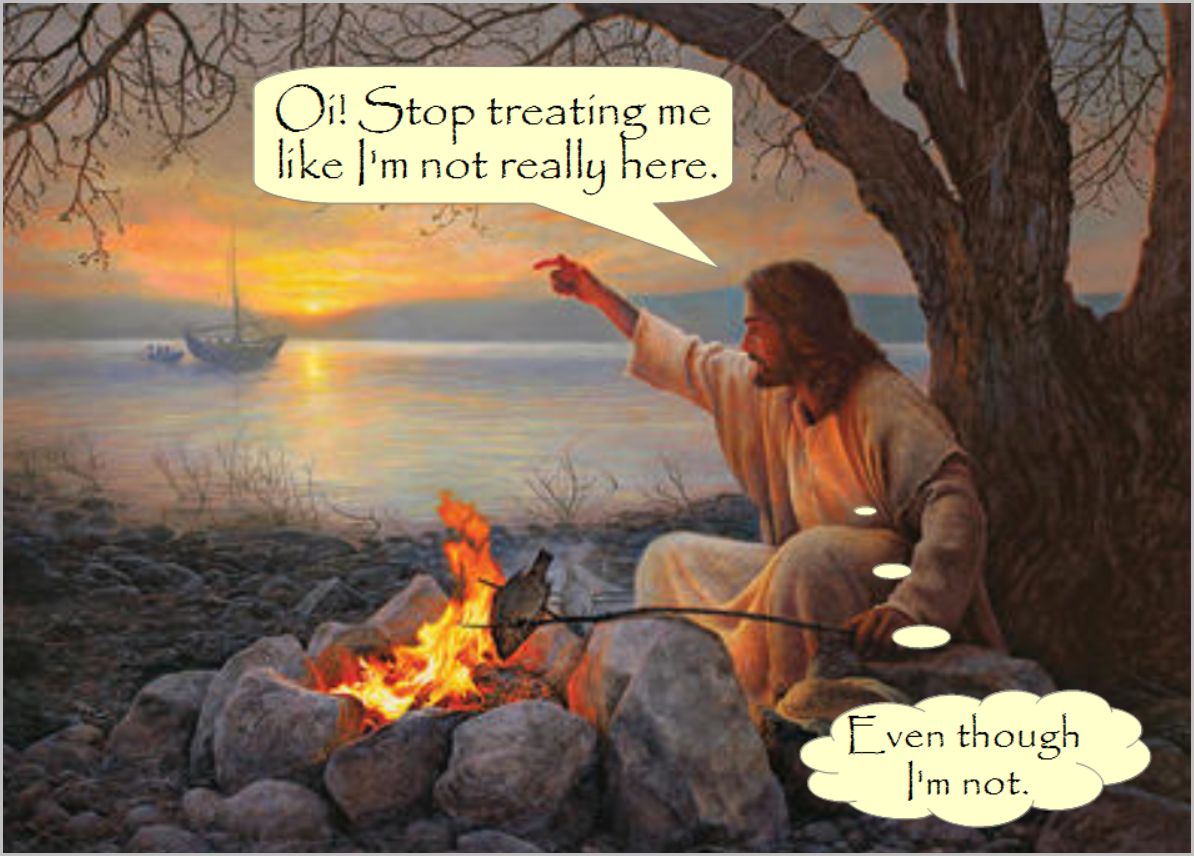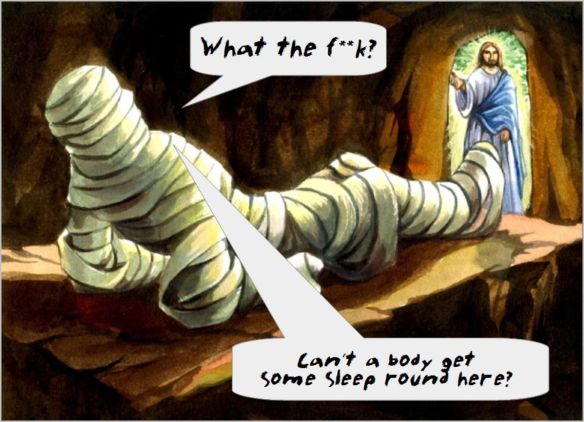
I Know What It’s Like To Be Dead

lazarus

And you do too.

We experienced what it was like last night and, you know, it really wasn’t too bad.

We entered, at some point, a deep, dreamless sleep (we dream for only a quarter of the time we’re asleep and even then often can’t remember what we’ve dreamt about) and the rest of the time we were, as far as subjective experience was concerned, dead to the world. During that deep sleep, our conscious mind was completely switched off; we did not experience anything while we were in this state and as far as awareness is concerned, we did not exist. And when we woke this morning we were none the worse for our period of non-existence. We booted up reasonably satisfactorily and the memories we had yesterday, before our deep sleep, were restored and the entity we call our self began to interact with the day.

This period of deep sleep, this unconscious oblivion, is precisely what it is like to be dead. Of course, in death we switch off permanently; there’s with no reboot afterwards, either in our beds, our graves or in heaven. The oblivion that is death is permanent. But, and this is my point, being dead is no more painful or unendurable, and no more to be feared, than the deep sleep you had last night and that you will enjoy tonight. We might not much like the idea that once we fall into the ultimate sleep there will be no waking up, but that is only a concern, if it’s a concern at all, of the living. I guarantee that it does not cross the minds of those who are already dead. They have no minds, the same as you didn’t last night, for it to cross.

Being dead, to paraphrase Mark Twain, does not trouble us at all. Its prospect, while we remain on this side of it, should encourage us to enjoy life and live it to the full. It shouldn’t cause us to worry about being dead, because there’s nothing we can do about it and, in any case, it’s no worse than being in deep sleep. Nor should we be concerned about whether we’ve subscribed to the right incantation, appeased the right God in the right way or lived a good enough life, in order to avoid death. There’s no avoiding death and the promises of religions that we can if only we believe the right magic, are utterly false. Understandable perhaps, but false.

Oh death, where is thy sting, says Paul in 1 Corinthians 15.55. Well, death still has its sting. It has it in its inevitability – every organic creature, of which we are one, must die – and it has it, depending on your perspective, in our individual obliteration. (Though, frankly, why anyone should think their own personal bundle of thoughts, impulses and prejudices merits everlasting existence is a mystery). Most significantly, however, it has it in the dying process, which for many of us can be debilitating and painful. This is the way of it for all of us, including those who believe religions’ false promises. They are not spared the suffering, even though modern medicine can help alleviate much of it. Christians, Muslims and Hindus, despite their belief that a deity smiles benevolently upon them, are not guaranteed a comfortable passage from this life to non-existence.

Death is the great leveller; we all experience dying in much the same way and we none of us experience anything after it. One of these – maybe both if we’re lucky – isn’t too bad. Just like deep sleep in fact.

Until then, we should make the most of life while we still have it.

Sleep well.
 

Smash! Kill! Destroy!

handsofgod

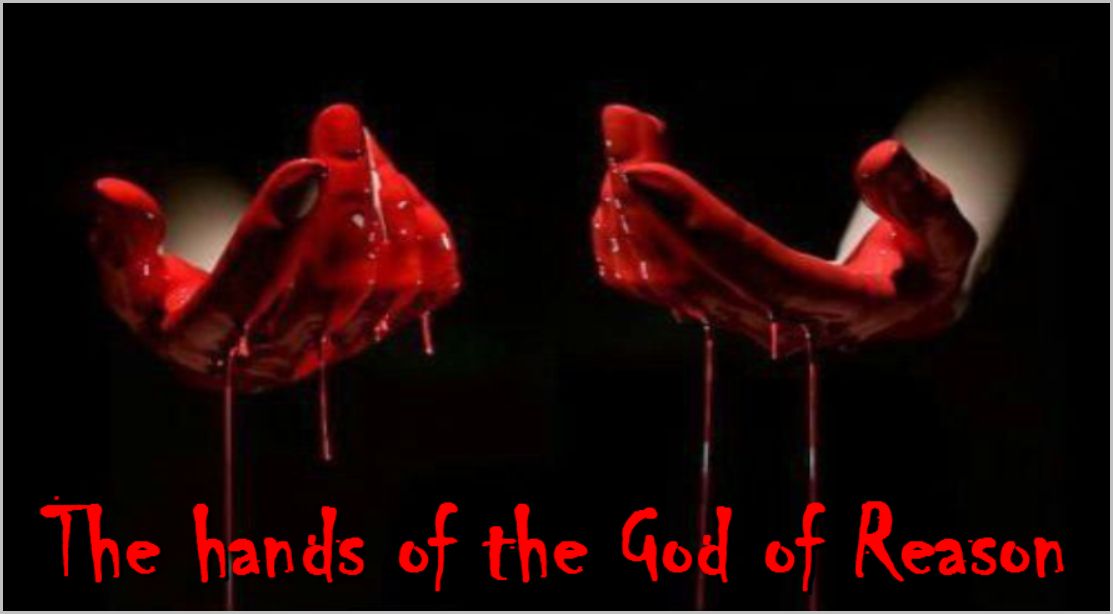
So how has the great God of Reason done so far?

We’re still not out of Genesis and he’s –

Trashed his entire creation just because a couple who didn’t know how touchy he is managed to upset him;

Destroyed two towns and almost everyone in them because he found the locals offensive;

Drowned everyone in existence (except for an old piss-head and his family) because – you guessed it – they offended him;

Engineered a spot of child-abuse;

Decided the best way for people to show him they’re his bestest buddies is to have them disfigure their genitals.

Now, honestly, Christians, how can you say any of this is rational or logical, reasonable or considered? Your God’s response to everything is Smash! Kill! Mutilate! Destroy! – never as a last resort, always as his first reaction. He’s the Hulk, Godzilla and ISIS all rolled into one. Not once does he apply reason or logic. Smash! Kill! Mutilate! Destroy! And not only in Genesis but throughout the Old Testament:

His chums want the land occupied by other tribes? Smash! Kill! Destroy!

They don’t show him enough love? Smash! Kill! Destroy!

They break one or other of his mostly petty rules? Smash! Kill! Destroy!

They offend him in some remarkably trivial way (collecting sticks, teasing a bald bloke, doing sex wrong)? Smash! Kill! Destroy!

Over and over again.

Until, at last, he has another big idea! Another Master Plan! The Master Plan to end all Master Plans! (His fourth at least.) And guess what? It’s all Smash! Kill! Destroy! Especially Kill! This is a dude who really can’t think outside the box.

Here’s how it goes: the Lord gives up on his previous Master Plan, which he’d told some selected desert marauders was forever and ever, and decides its time to have another go at sorting out mankind that he helped screw-up in the first place. His idea this time is to come to Earth himself as a sort of clone, which he creates by raping a young woman, just like all the other gods of old. When he grows up this clone/avatar tells everyone how God wants them to behave so they don’t upset the version still in Heaven quite so much. The clone then gets himself murdered at the hands of the very people he’s come to visit – the same ones the Lord promised to take care of forever and ever in his previous Master Plan – which magically allows anyone who repeats a special incantation to join an exclusive club. Everyone else he plans to torture and murder for all eternity, because that’s what he likes doing best. Of course, the version of himself he sends to Earth won’t actually make any of this clear – that’ll be left to someone else to make up afterwards – but, in the best illusion yet, he’ll come back to life before beaming up to Heaven to cosy up to his other self, the one preoccupied with death, destruction and mutilation.

This time it’s foolproof: a well-thought through, logical, rational and reasonable plan.

Except… not really. It’s bullshit. There’s no reasoning here, just a lot of stuff made up as people went along. None of it makes sense. The copy seems to have no idea what’s going on and certainly no inkling that his death has cosmic significance. On top of that, no-one really knows how the magic works – everyone who mentions it has a different idea – and the record of it all is scrappily cobbled together donkeys’ years after it all was supposed to have happened. Still, the main thing is it all involves a lot of killing – the clone first; then the poor sap manipulated into ‘betraying’ him; a couple who don’t want to give away all their belongings; some of the dudes who believe the magic is for real then, after they’ve really pissed off the Romans, lots more of them and finally, once the nutjobs get the upper hand, loads and loads of other people – which must really have pleased the God of Death Reason.

If this is the best he can do, then we’re in trouble deep. If our ability to reason comes from him, as Christians claim, it’s no wonder we can be irrational, illogical, unreasonable and unreasoning. Which of course is why he is, because he’s a reflection of the beings  that created him – us. Human emotions and cognitive capabilities came first and were projected onto the gods we created, including, eventually, the monotheistic monster, Yahweh. It was he primitive tribesmen decided must be responsible for natural disasters and the brevity and brutality of life. Such things had to be punishments, hadn’t they? And if punishments, then there had to be One doing the punishing. One who must be appeased if he was ever to stop. Hence sacrifices, behaving in ways that might please him, killing those who don’t, worship. All futile, like pleading with one’s own reflection in a mirror.

The God created by this kind of thinking only reflected back at his makers the worst of themselves; jealousy, anger, intolerance, belligerence, petulance, vengefulness and violence. Hardly ever Reason. 

And so does he still.


Imagine… no religion

Jimenez2People say, like, you know, “Aren’t you sad that 50 superstitious nut-jobs died?” Here’s the problem with that. It’s like the equivalent of asking me, you know, what if you asked me, “Hey, are you sad that 50 Christians were killed today?” Um, no, I think that’s great! I think that helps society! You know, I think the world is a little safer tonight!…

The tragedy is that more of them didn’t die… because these people are predators! They are abusers! They take advantage of people! And look, as Rationalists, we need to take the stand that it is not our job to sit there and say, “Oh, this is a tragedy” or “Oh, this is something we mourn.” Look, everything tells us these are deluded, wicked people. These are evil people.

… People sometimes will say, “You guys are advocating violence!” We’re not advocating violence! We’re not saying we should go do this! But we’re just saying this: If we lived in a rational nation with a rational government, then the government should be taking them… I wish the government would round them all up, put them up against a firing wall, put a firing squad in front of them, and blow their brains out. If we lived under a truly secular government that loved rationality and loved children, and wanted to protect them, that’s what we’d do.

Hate speech? Certainly. But not mine. The original, which you can find here, is about the Orlando shootings a few weeks ago, and is directed at gay people. I’ve simply replaced gentle ‘Pastor’ Jimenez’s use of ‘sodomite’ and ‘paedophile’, which he disingenuously uses interchangeably, with ‘Christians’ and ‘religious nut-jobs’, and his use of ‘God’ and ‘righteous’ with ‘superstition’ and ‘rational’. Jimenez, emissary of a religion of love (Matthew 5.44 etc), would like to see his government exterminate LGBT people.

But, you know, maybe there’s also a case to be made for eliminating the superstitious and irrational from among us. Those of us who have adopted a rational basis for our lives would be happy to see the end of religion and superstition, the removal from the Earth of the religious and the superstitious (I use the terms interchangeably). After all, what do believers in mumbo-jumbo add to the world that is any way positive? What can those who are unable to engage with reality without the crutch of make-believe possibly have to give? On top of their general uselessness, they’re also dangerous and predatory.

Maybe there is a case to be made. But I’m not making it. Any philosophy, ideology or religion that preaches the extermination of other people is wrong, debased, corrupt (you’d think, wouldn’t you, that we’d have learnt that by now.) If you subscribe to such a view – be it from a Christian, Islamic or Jewish perspective – you are wrong. No-one, whatever magic books may say about them, merits death simply because those magic books say so (ratified, of course, by the dim-witted prejudices of those who subscribe to them). Rationality and a secular perspective, on the other hand, eschew hatred and are philosophically opposed to harming those who might not agree with them. Yes, even the religious.

In this way it is vastly superior to religion – your religion, whatever that happens to be.

Sweet and sour, nasty and nice

or, whatever happened to Luke 18.11-14?

prayer2Why is it when people are emotionally blackmailed into becoming followers of Jesus, does their conversion make them sweet and sour, nasty and nice at the same time? The sweet and nice parts are what their new experience does for them. They get a new start of sorts, are introduced to like-minded friends in the church and become compelled to share their new joy with everyone else, whether they want to hear it or not, about how much they’ve changed because of Jesus. It’s nice for them. Deluded too, but if it makes them happy then why not?

This is why not. What they don’t tell you, not at first anyway, is how sour and nasty they have also become; how they must now defend God’s standards, because, as everyone knows, the omnipotent God of all creation is incapable of defending them himself. Being born again and morphing into ‘a new creation’ involves, without exception, becoming judgemental of others, condemnatory, inflammatory, bigoted and spiteful.

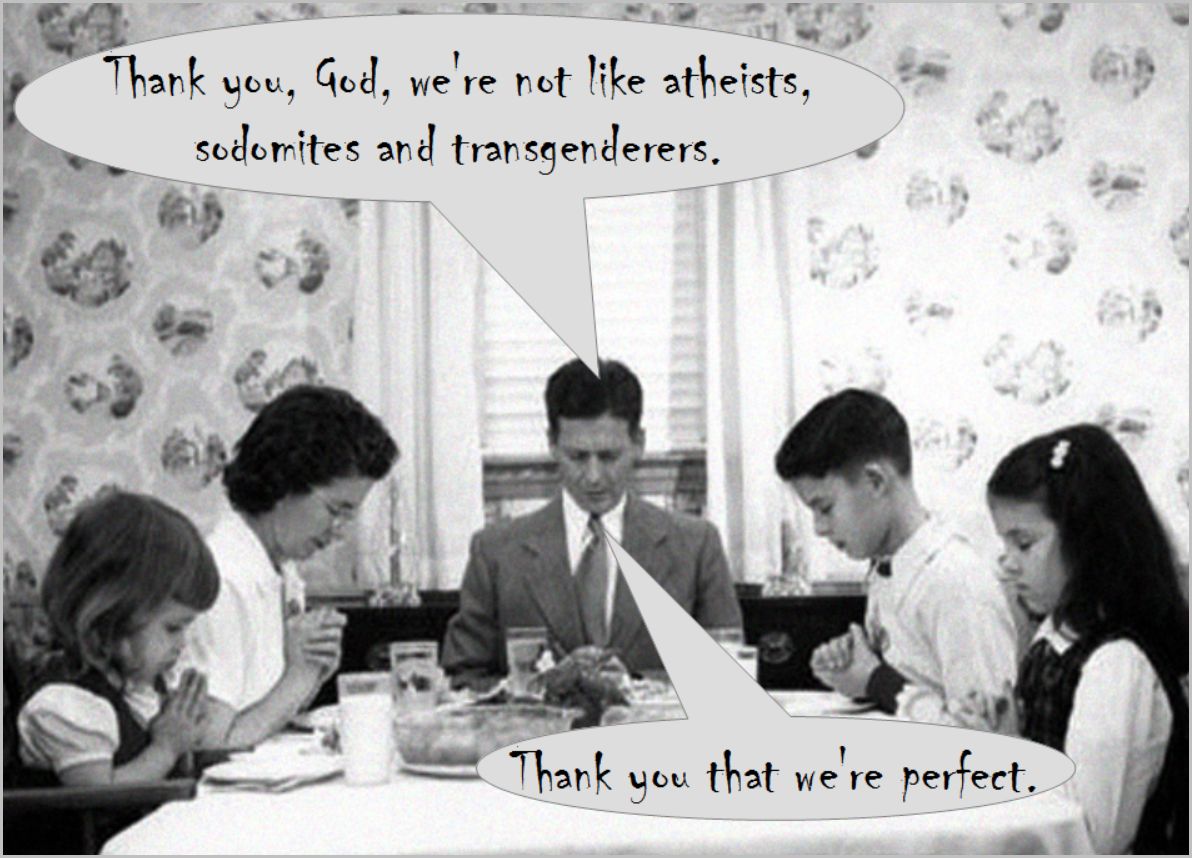
You think not? Then you haven’t heard what these same Christians think about abortion and women who have them. Homosexuality and those who are gay. Transgenderism and those born in the wrong body. Science and those who value evidence. Atheism and those of us who see through believers’ sad delusion.

Christians don’t, as some of them profess, hate the sin but love the sinner. They despise those who have philosophies different from them, those who live differently from them, those who are different from them.

A recent BBC poll asked if the world wouldn’t be more peaceful without religion. Here’s the results as of 14th July 2016:

Poll

I don’t know how many people this represents nor where they’re from – the site doesn’t say – but it would seem that most of us would think we would be better off without religion. It’s long past time we were able to be; religion has nothing to offer. It’s time we stopped giving it special treatment because some of it is sweet and nice. Its sour, nasty aspects are just as much a part of it, inseparable from whatever positives its adherents say it has. I’ll be looking soon at how we might push back against religion’s pervasive and poisonous influence in society.

Religion poisons the well. Again.

dye

The shooting in Orlando of people in a gay night club (50 dead, 53 wounded) is yet another example of religion as the antithesis of human flourishing. Not Christianity this time, of course, but that other ‘great’ religion, Islam, the religion of peace. But Christians cannot distance themselves from atrocities like this, carried out in the name of God, when the influence of even moderate religion is a pervasive, unhealthy presence in our society.

It’s true that Christians don’t, as rule, rampage in the streets or fly planes into buildings but they do contribute to the medium in which more extreme forms of religion grow:

Westboro Baptist Church, for example, with its own peculiar brand of Bible-based homophobia – ‘God hates fags’ and all the rest – is, like it or not, an expression of Christianity;

Right-wing evangelicals who interfere in the churches and governments of Africa and South America, actively encouraging them to take a homophobic stance and to pass anti-LGBT laws, are equally culpable; Scott Lively, Pat Robertson, Sharon Slater, you too are people filled with hate;

Likewise, those Catholic bishops who use their influence to denounce gay and transgendered folk as ‘mentally disordered’;

Christian bloggers who trot out the old, ‘Woe to those who call evil good and good evil’ (Isaiah 5.20) and misapply it to homosexuality, together with those who quote Leviticus 18.22 (‘abominations!’) and Romans 1.26-27 (‘unnatural and indecent!’)…

All of these contribute to the animus directed towards fellow human beings whose ‘sin’ is merely to be different. Religions, or more specifically their adherents, contribute significantly to the levels of misery in the world today, though Christians will cry ‘foul’ here (or ‘persecution’ even, because how they love claiming they’re being persecuted when asked to demonstrate some empathy and a little love.) After all, it wasn’t a Christian who gunned down the people in the Pulse nightclub this weekend. No it wasn’t. But every time religious bigots –

tell others what despicable sinners they are,

misrepresent and denigrate minorities,

promote ‘gay cures’,

attack same-sex marriage,

add quotation marks around the words gay and gay marriage, as if they’re somehow not real,

assert homosexuality and transgenderism are synonymous with ‘moral decay’,

claim natural disasters are God’s response to gay people’s very existence,

boycott businesses that support equality,

‘take a stand’ against transgendered people using the appropriate restroom and

refuse to serve gay couples –

every time, in short, they say LGBT people are evil, sick or worthless, the self-righteous prepare the ground for individuals like Omar Mateen to do what he did in Florida on Sunday. Religious leaders condemning such atrocities after the event is too little, too late, when they’ve failed to take charge of their acolytes and  do nothing to stem the tide of hatred flowing from their churches, mosques and temples. 

To those of us on the outside, religions are all of a kind; harmful superstitions. If a ‘faith’ entails belief in supernatural beings and puts allegiance to such imaginary figures above fellow human beings, it is without merit. It is the evil among us.

Dear Christian

Christians

Dear Christian,

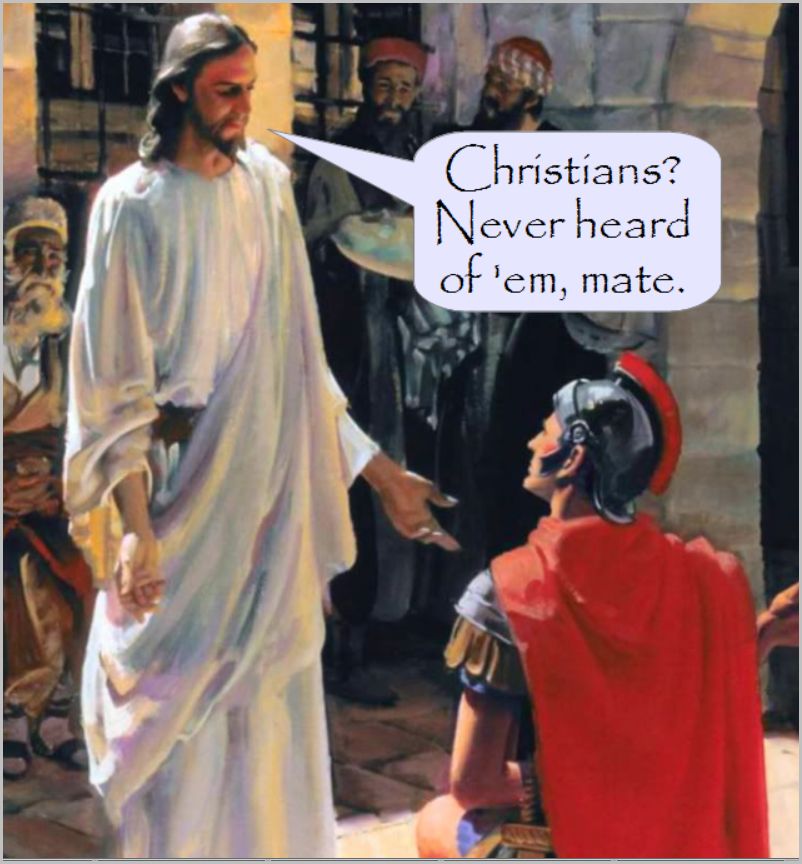
Jesus said treat others as you like to be treated (Matthew 7:12) so why do you treat them with abuse and unpleasantness?

Blog191(2)

Jesus said turn the other cheek (Luke 6:29) so why do you respond with insults?

Blog191(1)Jesus said don’t judge unless you want to be judged (Matthew 7:1) so why do you constantly judge and condemn?

Blog191(5)

Jesus said love your enemies (Luke 6:27) so why doesn’t it happen?

Blog191(11)

Jesus said don’t call anyone a fool (Matthew 5.22) so why do you call them far worse than that?

Blog191(4)

Jesus said don’t pray in public (Matthew 6.5) so why do you pray in public?

Blog191(7)

Jesus said sell all you have and give the money to the poor (Luke 18.22) so why don’t you?

Jesus said you cannot serve God and money (Luke 16.13) so why are some of you so obscenely rich?

CrouchHinn'sJet

Jesus said deny yourself (Matthew 16.24) so why do you indulge and promote yourself above all things?

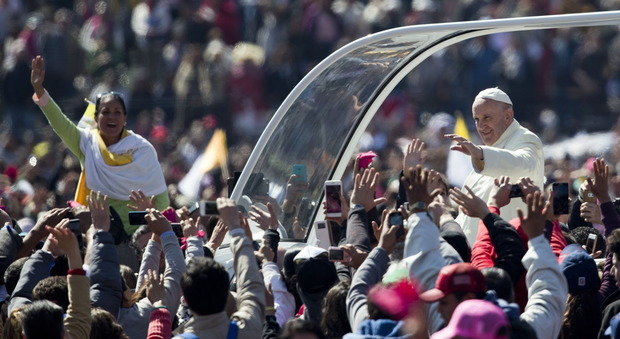
Blog191(8)OsteenPope Francis waves to the crowd, aboard the popemobile in Mexico City's main square, the Zocalo, Saturday, Feb. 13, 2016. Pope Francis kicks off his first trip to Mexico on Saturday with speeches to the country's political and ecclesial elites. The pontiff's five-day visit will include a very personal prayer at the Virgin of Guadalupe shrine. (AP Photo/Moises Castillo)

Jesus said ‘be perfect’ (Matthew 5.48) so why don’t we see you trying?

Sick

Jesus asked why you call him ‘Lord, Lord’ and yet don’t do what he tells you (Luke 6.46). Evidently he didn’t understand, as you do, just how many of his commands are optional. Thank goodness you know better than he did.

Believing is Seeing

Fish

Have you noticed how the risen Jesus seems only to have appeared to those who were already primed to see him? Of course, the accounts of the resurrection are inconsistent, unreliable and constructed long after the supposed event, but just for now, let’s take them at face value. Jesus appears first, according to Matthew, Luke and John, to his female followers – maybe one on her own (in John), maybe two (Matthew), maybe several (Luke) – but to women who would be mourning him and would be longing to see him again. And lo and behold, they do! He’s not quite substantial and not quite recognisable – every bit the hallucination, in fact – but he appears.

Next he is said to have shown himself to the disciples – maybe one (Luke), maybe two (Luke again), maybe several (Matthew) – men who have been thrown into complete disarray by Jesus’ death but who believed in him and his mission to inaugurate the Kingdom of God, and were looking forward to ruling it with him. So naturally they see him in their midst. Never mind he walks through walls and disappears at will, just like an apparition – he appears! As Acts 1.3 puts it, ‘he presented himself alive to them after his suffering by many proofs’.

Wait – ‘by many proofs’? What does that mean? That he had to prove he’d come back to life? Could they not see that for themselves? Couldn’t they recognise the man with whom they’d spent the last three years? Or if they could, weren’t they convinced he’d returned from the dead so that he felt he had to prove it? How? How did he prove it? With a death certificate? By letting them poke his holes? And this took forty days? Isn’t it more likely they were subject to group hysteria and some sort of hallucination (they’d had hallucinations before – see Matthew 17:1-9) and they then had to convince each other that what they’d experienced was really Jesus? No wonder it took forty days to concoct a ‘plausible’ story, to arrive at ‘the many proofs’ that Acts speaks of. Whichever it was, Jesus’ gullible old pals convinced themselves they’d seen him.

During these same forty days – though in his gospel Luke implies it’s a much shorter time (24.40-53) – Jesus fits in a guest appearance at a rock concert in front of 500 believers – believers, note. Not people who were converted as a result of this miraculous appearance, but people who were already part of the Jesus cult when they experienced this vision. Or so Paul tells us in 1 Corinthians 15.3-8. He wasn’t actually there, but he heard about it from a friend of a friend of a friend so it must be true.

And finally he appeared also to Paul himself (1 Corinthians 15.5). Not as a physical body but as a beam of light in Paul’s head. I’m not getting into how this was, as Paul himself admits, no more than an inner vision (he too is prone to hallucinations – see also Acts 16:9-10 and 2 Corinthians 12.1-7) because you can read about that here. Rather, I’m going to argue that Paul, arch-enemy to this point of all things to do with the Jesus cult, is just as primed for a sighting of the Lord as all those other people who think they saw him… next time.

to be continued.

The Stuff Christians Say… (part three)

DoorToDoorAtheists are aggressive/militant/unreasonable: The Christians might’ve got us on this one. After all, it is incredibly irritating when we atheists start preaching in the town centre or invade others’ events to tell them what to believe or dish out loony pamphlets or turn up at people’s doors when they’re just about to have their tea. And what about all those meeting places we have, on just about every corner of the city, with smart-arse posters about Adam and Steve on the board outside? And let’s not forget our readiness to blow up ourselves and others in the name of our great cause. Now that’s ‘militant’! Yes, we atheists really do have too much freedom to push our views on others. No wonder we’re so insufferable. (Note to self: check you’ve got this right.)

It takes more faith to be an atheist than a Christian: It takes no faith to recognise there are no supernatural beings. It takes no more faith not to believe in God – or to acknowledge that there is no God to believe in – than it does not to believe in Santa Claus, Poseidon or Ra. Christians themselves require no great abundance of faith to dismiss these characters. Is it so difficult to understand that atheists disregard the Christian pantheon of fantasy figures in exactly the same way? Or are believers practising their dishonesty-for-Jesus again? There is no faith involved in being an atheist. On the other hand, believing in an omnipotent but suspiciously inactive God, a super-hero Saviour, a magic Spirit, angels, cherubim, seraphim, demons, Satan, resurrected saints, Heaven, Hell and all manner of powers and principalities – this requires faith in delusional quantities. No atheist could possibly compete. Nor would they want to.

Pick and Mix

Kiss2If the Bible is the Word of God™ why, Christians, are you so selective in your use of it? I’ve previously considered how you dismiss much of what Jesus said as well as how you ignore the brutality of the Old Testament and the rest of the New Testament isn’t immune from your selectivity. You disregard, for example, verses like these:

Women should remain silent in the churches. They are not allowed to speak, but must be in submission, as the law says. (1 Corinthians 14.34)

I do not permit a woman to teach or to assume authority over a man; she must be quiet. (1 Timothy 2.12)

For if a woman does not cover her head, she might as well have her hair cut off; but if it is a disgrace for a woman to have her hair cut off or her head shaved, then she should cover her head. (1 Corinthians 11.6)

Wives, submit yourselves to your husbands, as is fitting in the Lord (Colossians 3.18)

Slaves, obey your earthly masters with deep respect and fear. Serve them sincerely as you would serve Christ. (Ephesians 6:5)

Let everyone be subject to the governing authorities, for there is no authority except that which God has established. (Romans 13:1)

Your beauty should not come from outward adornment, such as elaborate hairstyles and the wearing of gold jewellery or fine clothes. (1 Peter 3.3)

Greet one another with a holy kiss. (Romans 16.16)

Why don’t you obey these commands? You should if the Bible really is the Word of God, like you say it is. I’d suggest you don’t because like the rest of us, you derive your morals and values from the culture around you. As these change so too do your Christian beliefs; always much more slowly than the rest of society and with much resistance and tantruming, but eventually your views evolve and catch up with the rest of society. Provided you’re not part of the lunatic fringe (in which case I doubt you’d be reading this), you now generally accept values and practices that were unthinkable in the relatively recent past:

You don’t support the idea women should keep silent in church;
You accept them as preachers, ministers and bishops;
You don’t insist they keep their hair covered;
You don’t promote the idea they should be subservient to men.

You don’t see a man’s hair style as having anything to do with his faith or place among you.

You don’t endorse slavery.

You do oppose governments and authorities when you think they’re denying you your rights.

As for holy kisses… not so much.

You excuse yourself from adhering to the Biblical position on these matters by saying that here (and here alone) its teaching is culturally bound. These stipulations, and these only, you say, stem from views of women, conduct and practices at the time Paul and others were writing. As such, you claim, they are not binding today. You’re right of course, but then you insist that other of the Bible’s pronouncements, many of which, like its invective against gay people, are equally insupportable, are absolutes and binding for all time. How, I wonder, do you know which is which?

I’m confident that you don’t research the Graeco-Roman culture of the first and second centuries to determine where the New Testament’s writers are reflecting the mores of their day and where they’re providing eternal truths. No, what you do is decide arbitrarily, occasionally with the help of ‘experts’ who know no more about it than you do, which of the teaching you will accept and which you won’t.

It all comes down to a matter of taste, personal biases and what is compatible with your particular culture’s values. This is why you will, before long, come round to accepting gay people – unless you live in a part of the world that still reviles homosexuality, in which case your views will continue to reflect that of your culture. You can then go on claiming, for a little while longer, that your prejudice is derived from the scripture.

But let’s have no more insistence that the Bible is the Word of God offering eternal values and absolute standards. You don’t believe it yourself; if you did, you would apply all New Testament values and standards consistently and completely in your own life and within your church. You don’t. To paraphrase Paul Simon, you believe what you want to believe and disregard the rest.

What Does Atheism Have To Offer? (Part Three)

Celia17. Atheism offers knowledge instead of belief
‘But you must,’ Christians have said to me, ‘believe in something greater than yourself’ and ‘You can’t deny your spiritual needs.’ Well of course there are things greater than me and of all of us. The universe for a start; love, beauty, friendship, music, great art, nature, the night sky – sex even. Who hasn’t had a spiritual experience through their appreciation of these things? The fact they exist though, makes ‘belief’ in them redundant. We only need ‘believe’ in those things for which there is no evidence – which is why you can’t ‘believe’ in evolution; you can only know it as fact. Similarly, atheists know there are greater things than themselves. They don’t, as a rule, worship them, but appreciate them, often in awe and wonder, for what they are. As for such experiences being ‘spiritual’, we do not, of course, have ‘spirits’ either to nurture or express. We are emotional creatures and the value we find in those things greater than ourselves often stimulates sublime emotional responses. Nothing wrong with that, of course, but our responses reflect conditions within us, not the supernatural without.

8. Atheism offers the embrace of reality
Part of the inherent honesty of atheism is its recognition that this life is all there is. Atheism faces up to the fact that we are organic beings and like all organic beings our lives come to an end; there is nothing in us, no part of us, that survives death. Knowing heaven and eternal life are impossibilities atheism promises neither. Religions do, of course, and that is their great selling point but no-one, apart from atheists, seems to notice that they never actually deliver what they promise (because they can’t.)

Christians also tell atheists that it takes more faith not to believe in God than it does to believe in him. They need only look to their own experience to realise this cannot be so: they don’t need faith not to believe in Allah, Santa Claus or any number of other mythical beings. Equally atheists don’t exercise any faith at all not believing in Yahweh.

9. Atheism offers, unfortunately, an unsatisfactory name
One thing I wish atheism made possible but doesn’t – not yet anyway – is a better term for one who is unencumbered by gods, the supernatural and superstition. I have no wish to be defined by what I’m not, which is how ‘atheist’ works. It also implies that being a theist is somehow the default position and that any other is an aberration. I quite like ‘humanist’, but that doesn’t quite capture it either, but I’m not keen at all on Richard Dawkins’ suggestion of ‘bright’. The tide is turning though and once absence of belief becomes the norm, the right name for the true default will present itself.

10. Atheism offers a sense of well-being
Happiness, tranquility, peace perhaps don’t come from atheism per se, but they do stem from it: the opportunity for the consciousness I think of as ‘me’ to experience life in the here and now. I know many are not able to enjoy being here to the same extent that I and many in the west are able to, but this only makes it more important that we all do something to help improve the lot of others. As the nineteenth-century atheist Robert Ingersoll expressed it, ‘the time to be happy is now, the place to be happy is here, and the way to be happy is to make others so,’

As I write, Queen’s ‘Who Wants To Live Forever?’ is playing on the radio. It hardly matters who wants to; we can’t and we don’t. And – same group, different song – it’s true that ‘nothing really matters’. Really, it doesn’t, and so we are free to get on with living instead of trying to impose our beliefs on others, exterminating those we don’t like or squandering our one and only life because we think there’s a better one waiting. Atheism is far from nihilistic – it allows us to see the value of this life and helps us live it to the full.

So, what has atheism to offer? Freedom, honesty, meaning, contentment. Or, to put it another way, and to paraphrase what somebody or other once said, atheism really is the truth that can set you free.