Spiritual Forces of Evil in the Heavenly Realms

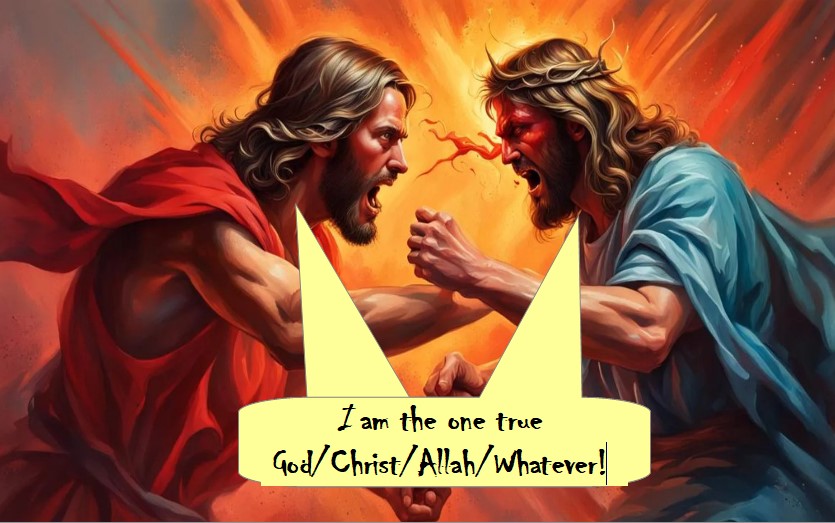
Original AI image from Night Cafe 

For our struggle is not against flesh and blood, but against the rulers, against the authorities, against the powers of this dark world and against the spiritual forces of evil in the heavenly realms. (Ephesians 6:12)

…you followed the ways of this world and of the ruler of the kingdom of the air, the spirit who is now at work in those who are disobedient. (Ephesians 2:2)

the prince of this world now stands condemned. (John 16:11)

The first-century worldview of early Christian cultists was that somewhere above the Earth a battle raged between God and Satan. The powers of darkness – the devil and his demons – had in ages past launched an attack on the Lord and his angels. This war in the spiritual realm continued unabated up to the time when a cultist wrote Ephesians, pretending to be Paul. Paul himself had already alluded to Satan as the god of this age (2 Corinthians 4:4), while the authors of the fourth gospel would later refer to him as the archon – ruler and prince – of this world (John 12:31; 14:30).

Which just goes to show how the Almighty God they believed in was nothing of the sort. He had tussled with his arch-enemy for eons without quashing his rebellion and putting an end to his persistent attacks. The stand-off had gone on for millennia, and, according to today’s Christians, is still happening. A puny god it is who cannot get the better of one of his far less powerful creations.

And what are God and Satan fighting over? Us, apparently. The devil wants control of human beings.

Why? Who knows. In fact, according to Paul, Satan already has control over us. He enslaves us to sin, which in turn leads to death (Romans 5:12, 6:23). 

Not to worry though, Paul, fake Paul and the fourth gospel writers assure us that their enfeebled God has a cunning plan! He’ll allow a being who is precious to him – like a son, in fact – to be sacrificed so that anyone who believes in him will no longer be enslaved to Satan and sin and will be granted eternal life. How’s that for special magic!

Who shouted out from the back that that sounds like a cop-out? It’s a fantasy bordering on the insane. Like it or not, we are somehow embroiled in heavenly warfare, specially if we’re of the number who’ve bought into this malarkey.

While we’re at it, have you noticed how so many of the wars and skirmishes currently afflicting the world have religion at their heart? YHWH is scrapping with Allah, Allah is up against the Great Satan while Jesus – no stranger to war-mongering himself – presides over it all, leading the world to Armageddon and his own ultimate ‘return’.

Here’s my suggestion. All the gods and demons need to get their act together. They should agree to an ultimate slug-fest, a final battle in the spiritual realm to decide who’s really the Supreme God – the last deity standing – and leave us humans out of it entirely. Surely, being gods, they’re up for finding out who can piss furthest up the wall.

A preposterous idea? Of course it is. None of these fantasy beings exist. There’s no YHWH, Allah, Heavenly Father, Jesus, Krishna, angels, archons, Satan or ‘spiritual forces of evil’ to duke it out. There’s no ‘heavenly plane’ where they can get to it. Everyone of these despotic characters is a human creation, as are the wars, disputes and skirmishes they underpin. It follows that none of them can be the supreme god and certainly none of them are worth fighting over. It’s time we grew up and put away all of our childish imaginary tyrants.


Jettisoned

It’s all very well discussing how the gospels came to be, but are they true and do Christians adhere to what Jesus purportedly tells them there? Let’s take a look at one of his instructions from Matthew 23.8-10:

But you are not to be called ‘Rabbi,’ for you have one Teacher, and you are all brothers. And do not call anyone on earth ‘father,’ for you have one Father, and he is in heaven. Nor are you to be called instructors, for you have one Instructor, the Messiah. 

Context: Matthew’s cult community is moving away from synagogue worship and so supplies Jesus with words condemning Pharisaic practices. Instead, because the new cult at this point is egalitarian, they have him endorse its practice. One teacher: the heavenly Christ. One church: the brotherhood. One Father: God in heaven. One Instructor: the heavenly Christ again.

How quickly the church jettisoned this advice! By the time of Ephesians (written in the late 1st or early 2nd and certainly not by Paul who was long dead) the church is awash with ‘the apostles, the prophets, the evangelists, the pastors and teachers, (given by Christ) to equip his people for works of service, so that the body of Christ may be built up (Ephesians 4.11-12)

A little later still, 1 Timothy – again, not written by Paul – speaks of hierarchical structures of overseers (‘bishops’), leaders, teachers and instructors (the two words have the same meaning), while later in the first century, and in direct contravention of Jesus’ admonition, the Roman church started calling its priests ‘father’. The Pope, – the term means Father or Papa – soon became the Father of all fathers.

Did the early church not really believe that Matthew 23.8-10 recorded the words of Jesus? (They’d be correct if so.) Or did they think that they didn’t matter; were, in fact, optional? (Parenthetically, what is it with gospel-Jesus habitually referring to saviour-figures in the third person? He does it here – ‘one instructor: the Messiah’ – and when he refers to ‘the Son of Man’. Why should we suppose he means himself when he does this? He’s not afraid to talk at length in the first person about himself in John’s gospel, but in the synoptics he’s apparently too timid to do so and feels compelled to use the third person and hide behind alter-egos. Unless of course fictional gospel-Jesus, or his script writers, regards ‘the Messiah’ and ‘the Son of Man’ as beings other than himself.) 

Then there’s the modern church, with its pastors (‘shepherds’), bishops (‘overseers’), teachers, instructors and priests (‘elders’). Does it too consider that gospel truths about brotherhood, no father but God and no teacher except the Christ, to be optional – insignificant even? Apparently so.

Which other words of Jesus do believers feel free to jettison? We’ll take an occasional look in the weeks ahead.


Where’s Jesus?

Not a rhetorical question. Christians keep telling us that he’s alive, so where is he exactly? If he’s alive he has to be some place. The old hymn, ‘I Serve A Risen Saviour’, which I sang many times in my younger days, thinks it knows:

He lives, He lives, Christ Jesus lives today!
He walks with me and talks with me along life’s narrow way.
He lives, He lives, salvation to impart!
You ask me how I know He lives?
He lives within my heart.

This isn’t much use though, is it. All it’s saying is ‘I’ve convinced myself Jesus is alive because I feel him inside me.’ That’s the extent of it, and this being so, it’s really no evidence at all that Jesus is alive in any sense the word is usually understood, let alone that he has an independent on-going existence.

Perhaps the bible will be of more use. Acts 7.55-56 has Stephen see Jesus alive in heaven, standing at the right hand of God. Well, that’s great. Now we’ve got two problems. Not only do we still not know where Jesus abides, we don’t know where God lives either. They’re both together somewhere, ‘heaven’ according to Acts says, but we’re no closer to knowing where this is either.

According to the preceding verse, Acts 7.54, Stephen is ‘looking up’ when he has his vision of heaven. This is significant because for early Christians, God’s abode – heaven – was in the sky. The New Testament speaks of different levels or realms of heaven, all of them up in the sky.

In 2 Corinthians 12, Paul claims to have visited the third (and highest?) level, while the Paul-imposter who wrote Ephesians helpfully explains that the lower level, the one nearest the earth, is occupied by demons and Satan’s minions whom he refers to as ‘the powers of the air’, ‘cosmic powers’ and ‘powers and principalities’. These are the very beings whom Paul claims in 1 Corinthians 2:8 killed Jesus (betcha thought it was the Romans) and 1 Peter 5:8 says seek to devour men’s souls.

Next is the heavenly realm inhabited by angels and the original perfect copies of everything here on Earth (Hebrews 9:22-24).

Then, finally, there’s the highest heaven (alluded to in Luke 2:14)) where dwells the CEO, God himself. If Jesus stands or sits at his right hand, then presumably that’s where he is too. But where is this highest heaven, or indeed any of the levels the early cultists believed existed? There’s no evidence for any of them.

In fact, the Bible’s heavenly hierarchy (which you can read about in detail here) is absolute drivel. Above us, as John Lennon was known to say, is mere sky – the stratosphere, mesosphere, thermosphere and the like – followed by the endless vastness of largely empty space. If Jesus is alive in an imaginary highest heaven somewhere out there, then he, like it, is similarly non-existent.

But let’s not write a living Jesus off just yet. It’s possible that he, his Father and all those lesser supernatural beings – the demons and devils, powers and principalities as well as the angels and snoozing saints – are hidden away in some other invisible and undetectable alternate dimension.

Other dimensions are, according to some scientists, theoretically possible. There may, they say, be as many as 11, but unfortunately for Jesus, none of the Bible authors knew of them. Those who wrote about heaven in the early days of the Jesus cult, were convinced it was overhead and, as ‘intellectual’ Christians are fond of pointing out, we need to read and interpret scripture as the ancients themselves did, not with a modern sensibility. Certainly not with an understanding of ‘dimensions’ derived from Star Trek.

Despite this, theologians have to work mighty hard to transplant such theoretical dimensions into the Bible in order to claim that heaven, and therefore Jesus, exists in one of them. And work hard they do, at what is little more than a god-of-the-gaps argument: ‘we know Jesus is not a few (or even many) miles up above us, therefore we must find a location for him somewhere that science appears to allow.’

(Interestingly, when it comes to the fine-tuning argument, apologists are quick to dismiss the idea of other dimensions, multiverses and parallel worlds; these make the earth less special, less ‘just right’ for life, less designed by God specially for us.)

Locating the living Jesus is like finding Wally/Waldo in one of those cluttered pictures, except this time he hasn’t been included. So tell us, Christians, where is Jesus? And where is the evidence he’s where you say he is?

Saved by Faith Alone

For it is by grace you have been saved, through faith – and this is not from yourselves, it is the gift of God – not by works, so that no one can boast (Ephesians 2:8-9).

Hi!

I heard this fabulous new speaker last night and have given my life to Jesus. All the things I’ve said and written critical of God, Jesus and the Bible, I take back and repent of. Jesus now lives in my heart. Through God’s grace I am saved, and his grace alone. I have done nothing to save myself. The speaker explained I am saved by faith alone through the atoning blood of Christ. Hallelujah! Saved from sin, from the wrath I merit and from death and hell. I am going to live forever in heaven with God.

There’s nothing I need to do. God has done it all.

There was a wonderful Christian lady, Donna, whom I spoke to afterwards. She knew everything about God and Jesus, she really did. She’s been saved for most of her life. Amazing! Anyway, Donna told me it was really important I should start to work out my salvation. I wasn’t sure what she meant when the speaker had said faith was all I needed, but I will try. Donna also said that now I’m a Christian, the devil will increase his attacks on me. I never really thought about the devil before but now I know he’s real, I’ll be on the lookout for him. Satan and his demon hordes rule the world, but only because God lets them. Of course there’s the angels too, taking care of us, which makes up for Satan’s wickedness.

Donna said I should talk with Jesus as much as I can. He’s always listening and will guide me in my walk with him. She said I will hear him speaking to me. He wants to give me anything I ask for, which is just amazing. Or maybe it’s God who does that. I’ll have to check. She also said that I need to join a church and gave me the addresses of some locally. It’s important, she told me, to worship Jesus on a regular basis and to thank him for saving me. I must make sure I take part in the Lord’s supper too, sharing his body and blood, till he comes back to Earth to take us all to heaven. ‘Us’ just means those who believe in Jesus, obviously.

Donna said it was vital I read my bible as well because it’s the Word of God and is full of his Truth. I’m should get to know more about what the Lord requires of me in my daily walk with him. She recommended I join a bible study group, so I’m going to do that. I asked her about the stuff in the Bible that says to give money to anyone who asks and to forgive people loads of times, but she said that that was all metaphorical and I needn’t bother with it.

She told me I have to tell everyone I can that I now belong to Jesus. I’m never going to be ashamed of proclaiming his holy name and telling others how they can be saved, through his precious blood alone.

She told me my life should reflect the fact that I now belong to Jesus, so no more swearing, smoking or drinking for me! Not that I did those much anyway.

Which brings me to why I’m sending you this message, apart from telling you how wonderful it is to be saved by faith alone, of course. Donna was, I have to say, a little taken aback when I mentioned I was gay. She explained very patiently that it’s a sin God really, really doesn’t approve of. She said Jesus would help me defeat it and as a start I really, really couldn’t live with someone of the same sex any longer, not if I wanted to claim my inheritance from the Lord. I have to turn away from sin, especially that one. Donna says it seriously offends God and he’d never let me into the Kingdom of Heaven as, well… you know, as an abomination. So I’m giving up my previous life.

I know you’ll be a little upset by this, but it’s really why I’m writing. By the time you see this, I’ll have moved out. I still love you, course I do, but it’s for the best. I have to make all the sacrifices I need to preserve my salvation. And think of it this way, it’ll help you give up your life of sin too, so you can be redeemed.

Well, that’s it. Remember, you too can be saved by faith alone and the blood of Jesus and all those other things I’ve mentioned. Simple really. I hope and pray you’ll give your heart to Jesus soon.

Love in Christ who saves us,

Sam

Don’s Dynamic Lie-Detector

But you have an anointing from the Holy One, and all of you know the truth. I do not write to you because you do not know the truth, but because you do know it and because no lie comes from the truth.

1 John 2:20-21 as quoted by Don Camp.

Our resident, regularly banned God-botherer, Don Camp, claims that he has a special way of reading and interpreting spiritual writing. No, he hasn’t got a pair of magic rocks, but an inner ‘anointing’ with what Don calls his ‘lie-detector’. (You might have a similar device yourself, known more commonly as a bull-shit detector. Its alarm may well have been a-ring-a-ding-dinging when you read Don’s comment.)

Anointing, if you’re interested, is the ancient Jewish custom of initiating a king or priest by daubing oil on their head. Don has no evidence that he has been inwardly ‘anointed’ by an unseen spirit that helps him understand scripture better than anyone else. There is no evidence, outside of subjective feelings and one tautological bible verse, that any religious believer has had this done to them. (Read 1 John 2.20-21 again, Don, and you’ll see that a tautology is what it is: ‘the truth is the truth is the truth,’ is really all it says.)

On the contrary, we find that different Christians interpret given scriptures in a variety of different ways (I’ll get to examples in a minute). They differ too on which bits of the Bible are relevant to them and their church or sect. They disregard or explain away verses that don’t suit their purposes.

Don does this himself. His anointing Spirit doesn’t lead him to interpret verses like Matthew 16:27-28; 24:27, 30-31 & 34, Romans 13, 11 & 12, 1 Peter 4:7, 1 John 2:18, Revelation 22.20 etc at face value. He cannot countenance the fact that Jesus, Paul, John and all those other early fanatics were wrong about when the end of the age would happen – they are all very clear they thought it was imminent – so he reinterprets what they say to mean something they clearly and unequivocally do not. Don’s interpretation has them meaning, despite what they say, that the end of the age and all that goes with it would be thousands of years in their future. Should you challenge him on this, Don tells you that how you see it is wrong because you don’t have the special anointing he has. As he puts it in his comment, you’re lacking the right ‘dynamic’ (ring-a-ding-ding!) and as a result, you are incapable of interpreting scripture in the right way (i.e. his way).

In fact, Don does not have a way of understanding scripture that he can call his own. Rather, he interprets it with preconceptions he’s acquired elsewhere; that it is God’s Word, that it is Truth, that the spiritual world it describes is real, that it relates an historical resurrection, and so on. He comes to it with these presuppositions that he has learnt from preachers, teachers, commentaries, devotional books and other Christian propaganda he’s been exposed to. He is completely unable to take a step back to look at what he’s reading objectively. He knows what it says before he reads it – ‘truth’ as far as the Bible is concerned, ‘lies’ when it’s the Book of Mormon – and imposes that meaning onto it. This ‘dynamic’ enables him too to smooth over all of the Bible inconsistencies and allows him to see it as one seamless garment when it evidentially is not. He’s not alone in doing this, of course. Most evangelical (‘anointed’) Christians do it. I know I did.

Now for those examples, and a challenge for Don:

1. A few days ago, Holy Spirit anointed, preacher Dillon Awes used his dynamic lie-detector to interpret the Bible’s declarations about homosexuality like this:

What does God say is the answer, is the solution, for the homosexual in 2022, here in the New Testament, here in the Book of Romans (1:26-27)

That they are worthy of death! These people should be put to death!

Every single homosexual in our country should be charged with the crime, the abomination of homosexuality, that they have. They should be convicted in a lawful trial. They should be sentenced with death. They should be lined up against the wall and shot in the back of the head! That’s what God teaches. That’s what the Bible says.

2. Similarly, over the weekend, Ken Ham interpreted Genesis 1 to mean that dinosaurs and humans lived at the same time. After all, he ‘reasoned’, Genesis says God created ‘everything’ in those first six days, so that must include dinosaurs as well as Adam and Eve.

3. Pastor Douglas Wilson who featured recently on Bruce Gerencser’s blog, interpreted the assertion in Ephesians 5:22-24 that wives should be submit to their husbands, even if it entails rape:

…We have forgotten the biblical concepts of true authority and submission, or more accurately, have rebelled against them… However we try, the sexual act cannot be made into an egalitarian pleasuring party. A man penetrates, conquers, colonizes, plants. A woman receives, surrenders, accepts. This is of course offensive to all egalitarians, and so our culture has rebelled against the concept of authority and submission in marriage.

My question to you, Don, is: do you interpret Romans 1:26-27, Genesis 1 and Ephesians 5:22-24 the same way as these other Holy Spirit directed interpreters of scripture? If not, why not, when it’s the same Holy Spirit that equips you with your dynamic lie-detector, that also leads them into all truth?

These is not a rhetorical question; we all want to know. But be warned, Don, our bullshit detectors are primed and ready.


Fakin’ It

Here’s my dilemma. I got this letter from a group of students at the university of Selcuck in Turkey. Well, when I say I received the letter, it was addressed to Professor Paulson who was head of the Philosophy department here in the 90s. He’s been dead now over 20 years of course, so when I picked up the letter, I thought I’d just write back and tell them that and that they’d have to work out their problems for themselves. Then I thought, ‘well, hang on a minute, the Professor was your tutor back in the day. You know how he thought and how he’d address these particular problems. Hell, you’ve even got some of his old papers locked away in your filing cabinet. You could take one or other of those and with a bit of tweaking, concoct a reply yourself. That’d be perfectly legitimate wouldn’t it?’ I mean I occupy the chair he once did so I am in effect his replacement.

So that’s what I do. I take one of Professor Paulson’s papers and I use it as the basis of a letter. Of course, matters in philosophy have moved on a bit since the Professor’s time so I add quite a bit of my own stuff, which is all pretty good and in line with what he might have thought, had he lived this long. After all, I studied under him in the ’80s so I have a pretty good idea of what he might think today, if he were still with us. If I do say so myself, it’s pretty good stuff. Nobody could tell Paulson didn’t write it.

Now, I do consider admitting at the start of the letter, or maybe the end of it, that I wrote the letter and not the Prof. But then I think, well, these folk don’t know he’s no longer with us so what’s the harm? I’ll just send it and they can reach their own conclusions. I mean, it wouldn’t be my fault, would it, if they jumped to the wrong conclusion. And then I think, well, if they’re going to do that I might as well sign it as if it is from the Professor. I mean, who’s to know? And maybe I could add that bit at the beginning suggesting it was from him. Suggesting? Saying it is from him. That’s what I do, and off it goes.

I hear later, on the grapevine, it’s gone down pretty well. They like what it says and are convinced it’s from Paulson. Everybody’s happy.

And then I find out, a couple of months down the line, that it’s been published. The Selcuck students have had it published, in an influential journal no less, and the academic world is celebrating the final lost paper of Professor Paulson’s. And here’s my dilemma: it’s not, is it. It’s me. I’ve taken his old paper, embellished it and sent it out into the world as if it’s his. What do I do? What would you do? Confess it’s not what it seems? Or bask in the knowledge that what I’ve written is as good as anything he wrote in life? A fake, yes, for sure, but a damn good one that, with a bit of luck, no-one’s ever going to spot. Do you know, I think I’ll leave it, say nothing. The joke’s on them.

Of course such a thing could never happen. Or could it? The letter to the Ephesians in the New Testament claims to have been written by Paul. It starts with this greeting:

Paul, an apostle of Christ Jesus by the will of God, To God’s holy people in Ephesus, the faithful in Christ Jesus: Grace and peace to you from God our Father and the Lord Jesus Christ.

and ends with some vaguely autobiographical details.

But it wasn’t written by Paul. Scholars think it was created in the 80s, about twenty years after Paul died. Much of the letter is a reworking of Colossians, the authorship of which is similarly disputed. Here’s the opening of Colossians:

Paul, an apostle of Christ Jesus by the will of God, and Timothy our brother, To God’s holy people in Colossae, the faithful brothers and sisters in Christ: Grace and peace to you from God our Father.

The Ephesians opening is a direct lift. None of Paul’s genuine letters follow this format. The letter itself has a style and vocabulary unlike that in the genuine Pauline letters and there are significant differences in theology too. Here’s how Bart Ehrman summarises the problem (though note he is not the only scholar who disputes Paul’s authorship of Ephesians; it is the consensus view): 

Ephesians does not resemble Paul’s writing style and the letter contains an inordinate number of words that Paul does not use in any of his undisputed letters. As in Colossians, Ephesians suggests that the believer has already been raised with Christ-a view that contradicts Paul’s undisputed writings. The author of Ephesians, moreover, uses the term “works” differently than Paul. For Paul, “works” refers to adherence to the Jewish law, actions that cannot save. The author of Ephesians, however, understands “works” to mean those actions that demonstrate one’s faith.

Some generously describe Ephesians and other letters attributed to Paul that aren’t by him, as Deutero-Pauline: ‘in the tradition of Paul’. Some speculate that they were written by one of Paul’s disciples but there’s no way of knowing this for sure. Others prefer the term Pseudepigrapha, literally ‘false inscription or writing’, which is nearer the mark.

The author of Ephesians, like those of other pseudepigraphical letters, such as the pastorals (1 and 2 Timothy and Titus) claims explicitly to be Paul knowing full well he is not. This is not some disciple trying to express the views of the master, this is someone passing themselves off as someone else, pretending they are the more well-known, revered and authoritative figure. Even if they were someone familiar with Paul’s teaching (the differences in theology suggest otherwise) would it be legitimate for him to claim he is Paul?

Like my fictional individual above, the author of Ephesians is a deceitful impostor, his work a forgery, designed possibly to ‘correct’ Paul’s position on certain issues. And yet here is his letter in the New Testament; God’s Holy Word no less. While there is a very human history of how works were selected for inclusion in the New Testament, how on Earth did God, in the guise of the Holy Spirit, allow this and other forgeries to become part of the canon?

Of course, God had nothing to do with it. The author of Ephesians duped not only the letter’s original audience, but also the later believers who included it in the Bible. He continues to deceive the faithful down to this day.  I know: I was one. 

Responding to a Christian

I responded to comments by our resident cultist, Don Camp, who replied with the following (and more: see comments). I want to pick up (in blue) on some of the points he makes:

I originally asked Don: why is it that whenever anyone asks you to provide evidence for your beliefs, or to confirm what those beliefs actually are, you invariably side-step the issue.

Don: That seems to be the procedure (your procedure, Don?) here and on most atheist blogs, I might add. I really think that I have answered that question clearly enough to be understood (you’ve responded to some questions but have provided evidence for very little of what you’ve claimed. Bible quotes are not evidence.) If not, there is my blog post. But I would ask the same and have of all of you. What do you believe to be true about life and reality? And why or what evidence do you have to support that belief?

Don, there’s ten years’ worth of blog posts on Rejectingjesus, many of which are about what I believe and the evidence I have for those beliefs. I’m not going to reiterate all of them here for your benefit. If you’re interested you could read the posts here, here, here, here and here. I suspect you’re not though; this is just another tactic to deflect the question away from yourself. Don’t you think it reasonable when you launch your sermonettes on other people’s blogs that they ask you to supply evidence for the beliefs you’re promoting? 

Don: I usually get what, I believe, Ark said when I asked about his evidence for Materialism: Everything we know has natural causes, so to presume that the whole universe has a natural cause reasonably follows. (My paraphrase) That is honest and clear. But that is the very same kind of evidence I’ve provided for my worldview. You, Neil, have not provided even that much. Usually I get something like: Atheism, is about what we don’t believe, and we don’t believe there is evidence for God. The trouble is that is negative that conveniently sidesteps the question.

So you do get answers to your questions (so what you moaning about?) I concur with Ark. However, you do not provide the same sort of evidence. You generally rely on the argument from incredulity: I can’t see how something so amazing as the universe could have come into existence on its own, therefore God must’ve done it.’ This is not evidence. You then make the further unfounded claim that this God must be your God who magically created everything via the agency of his Son. Whatever this means, it is not evidence. (Before you say you don’t do this, just check out your further comment below.)

Neil: How about answering my question: do you subscribe to Paul’s first century view that ‘the world’ is governed by wicked powers and principalities that hover around us causing all sorts of mayhem…

Don: No and Yes. No, I don’t think that people are governed by those powers, but they are influenced by them. Yes, I believe there are powers that influence people. And I believe that people can so give themselves to that influence that I would say they are governed by them. (my emphasis). So no prevarication here then! Now how about answering mine. Do you believe that reality is purely material? See above and the posts I directed you to. There is no evidence for the supernatural.

Neil:  Could only a blood sacrifice, in God’s eyes ameliorate (the effects of these demons)?

Don: No. Those powers do not cause sin. We do. (And that I believe is really Paul’s view.) Right. So you know what was really Paul’s view, which, it turns out, is not the one expressed in Ephesians 2:1-3 & 6.11-13. (Addendum: it’s widely acknowledged that Paul didn’t actually write Ephesians. It’s a later forgery based on Colossians.)

Don: No. I believe that only forgiveness can ameliorate sin. The sacrifice of the Lord Jesus is the act of forgiveness made visible. Does your believing make it so? Where does the bible actually say this?

Neil: where is your evidence that this (Paul’s worldview) is reality?

Don: I am not sure what “this” means. There are too many possible referents. If you replace that with a specific, I’ll answer.

It’s clear and specific, Don. We were discussing Paul’s worldview. I asked if you believed it and if so, what evidence you had that ‘this’, Paul’s demon-infested world, was real. You’re side stepping again. 

Me: Or how about answering Ark’s question about whether you believe Jesus was the creator of the universe and what evidence there is for such a belief?

Don: I don’t recall that question exactly (!) But the answer is I believe that God created the universe through the agency of his Son and the earth within it. (And I think that is the crux of our differences). You’re not kidding. 

Don: Evidence “succinctly” is, to use a metaphor, his fingerprints are all over it. Is a metaphor evidence? I don’t think so. It’s a literary device. In any case, every other religion that claims a creator God says the same thing. 

HOW DO YOU THINK THE UNIVERSE CAME TO BE, AND WHAT EVIDENCE IS THERE FOR SUCH A BELIEF? AND HOW DO YOU ACCOUNT FOR THE DYSFUNCTION OF HUMANITY THAT CAUSES ALL THE CHAOS AND DESTRUCTION MORALLY AND SOCIALLY? AND FINALLY, WHAT IS THE REMEDY?

My God. You’re gone all caps lock. In answer to your very important questions, see my response above. To summarise:

It is largely irrelevant what I THINK about the origin of the universe. It’s possible, however, that the universe has always existed in some form. You claim this for your God when there’s no evidence he exists; assuming those same qualities for something that does is a more realistic prospect. It is indeed what a number of scientists think. (I expect you’ll know better).

The ‘dysfunction of humanity.’ Is it dysfunctional? Many of us are kind and decent. Humanity is what it is, and it is what it is because we’re evolved primates.

The remedy for what, Don; for what we are? It’s quite likely there isn’t one. Jesus certainly isn’t it. History teaches us that Christianity has only provided some of us with an excuse to behave even more reprehensibly (Putin claims to be a Christian albeit a Catholic; he says one of the reasons he’s invaded Ukraine is to impose traditional Christian values on the country.)  If anything is going to improve us, it’s education; it has civilised us to a significant extent but still has a lot to overcome. 

That’s it. Now go and read those old posts before writing your next sermonette. 

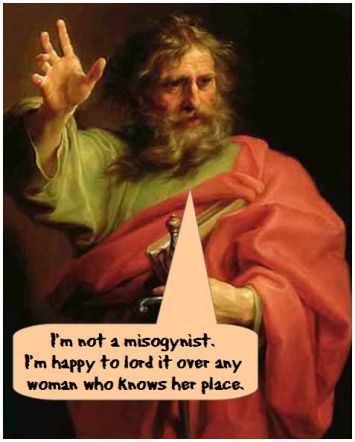
Can you be a Christian and… a Woman?

Blog391Bi

…women should adorn themselves in respectable apparel, with modesty and self-control, not with braided hair and gold or pearls or costly attire, but with what is proper for women who profess godliness—with good works… Let a woman learn quietly with all submissiveness. I do not permit a woman to teach or to exercise authority over a man; rather, she is to remain quiet… she will be saved through childbearing—if they continue in faith and love and holiness, with self-control (1 Timothy 2:9-10; 13-15).

The women should keep silent in the churches. For they are not permitted to speak, but should be in submission, as the Law also says. If there is anything they desire to learn, let them ask their husbands at home. For it is shameful for a woman to speak in church (1 Corinthians 14:34-35).

But I want you to understand that the head of every man is Christ, the head of a wife is her husband, and the head of Christ is God (1 Corinthians 11:3).

Wives, submit to your own husbands, as to the Lord. For the husband is the head of the wife even as Christ is the head of the church, his body, and is himself its Saviour. Now as the church submits to Christ, so also wives should submit in everything to their husbands (Ephesians 5:22-24).

Wives, submit to your husbands, as is fitting in the Lord (Colossians 3.18).

(Women should) be self-controlled, pure, working at home, kind, and submissive to their own husbands, that the word of God may not be reviled (Titus 2:3-5).

So according to the cult handbook, women must be –

submissive, quiet, silent, submissive, under a man’s authority, modest and… submissive. They should work at home, do nothing that might embarrass their husbands and have no authority over any men.

If a woman wants to be a Christian this is the behaviour she must assume. Above all, she must be submissive to the men God has placed above her, from her husband to… well, every other male.

What self-respecting woman is going to submit herself to this?

But wait, I can already hear liberal, enlightened Christian women approaching, all set to tell me that these New Testament admonitions are no longer relevant because they’re ‘culture bound’. They were devised, by men, in a first century milieu and therefore they don’t apply today! Which is odd, given they were applicable for almost all of the previous two thousand years, well beyond the time and context in which they were written. Not until the twentieth century, when the church’s power began to wane and women began to demand equal treatment with men, was the Bible’s misogyny questioned. Less than a hundred years have passed since women’s rights were reluctantly acknowledged by western society, even less since parts of the church caught up.

Many evangelical churches today still subscribe to the ‘commands’ of Paul and the imposters that followed in his wake. They expect their women to be silent, modest, under men’s authority and submissive. Witness the number of Christian blogs that traduce women, many written by women who regard themselves as ‘godly’ wives. Look at the frequent attacks by fellow evangelicals on female preachers like Beth Moore and Joyce Meyer, who ‘presume’ to teach men. (I can’t stand either of them personally, but not because they’re women.)

Liberal churches, however, know better. They safely consign the New Testament views of women to history; curios that provide an insight into how first century cultists thought, none of which are binding on today’s women. The world has moved on. Indeed it has; western culture has changed its views on women and their rights and roles, with little help from the church. While this is a very good thing, aren’t Christians told not to conform to ‘the world’? They are (Romans 12.2). Clearly this is yet more biblical teaching that can be ignored when it suits.

So, can you be a woman and a Christian? Evidently so, though it involves either compromising yourself as a woman to comply with the Bible’s warped ideas of what you should be and how you should behave – or compromising the Bible’s directives in order to respect and be yourself. But is compromise really what Christianity is about? Paul and his fellow fanatics didn’t seem to think so.

What have reason and logic to do with faith?

Blog355

Last time I considered the Christian claim that reason and logic can only derive from God, and that non-believers’ use of them is nothing more than a illicit hijacking of powers supplied by the God they deny. Why is it important to modern day Christians to attribute reason to their God? After all, the bible only ever speaks disparagingly of reason. It is, it says, the path to self-delusion; Proverbs 3.5 warns ‘trust not in your own understanding,’ while faith, according to Paul far surpasses the limitations of reason and rationality. More than this, as I discuss here, the God of the bible is far from reasonable and logical himself. His response to every issue is the death penalty, mass murder and blood sacrifice.

According to Christians, human reasoning makes no sense if it is ‘merely’ the product of evolution. A random and undirected process cannot produce a reliable rationality on its own. Naturally, they are never entirely clear why this is the case; evolution has, after all, led to other distinctly human characteristics on which we regularly depend, imperfect though they may be: language, memory, social bonding and creativity among them.

However, having singled out reason and dismissed evolution as its cause, Christians then jump to the conclusion that the human capacity to think must come from God. According to Tim Keller, rationality is a ‘clue’, planted in every human being, to God’s existence.* It has evidently never occured to Keller that, by the same token, the human capacity for unbounded irrationality is likewise a ‘clue’ to the non-existence of any rational deity.

Human reasoning – and there’s no other kind – is, like every other evolved characteristic, flawed. It is only as secure as the premise from which it proceeds. Get that wrong, by adopting a premise with an insufficiency of evidence (such as ‘God is a God of Reason’) and human cognition will only ever abandon us in the blind alley of faith.

*The Reason For God, p141

On being free

chains

Commenter Rebecca responded at length recently to my post ‘Why God Could Not Possibly Have Created The Universe (pts 4 & 5)’. There was so much in her response, that I thought it best to reply to her in a full length post rather than with a brief comment:

Hi Rebecca,

I won’t be able to respond to all of your points as there are so many, but will attempt a few.

I’m glad you find your faith beneficial. You’ve obviously thought about the whole incarnation/sacrifice/reconciliation issue, but I wonder whether you’ve ever asked yourself what it is you need saving from and reconciled with? What is it that means you personally need to avail yourself of the sacrifice Jesus supposedly made (however you interpret that)? I guess evangelicals, of which you seem to say you are not one, would claim it’s because of sin; the alienation from God that our very existence seems to cause.

Is that really the case though? Isn’t it rather that ancient superstitious peoples needed some explanation for why life was so difficult, short and brutish? They reasoned that surely it couldn’t be the fault of the creator God, so his tendency to treat them badly must be entirely their fault. Consequently, they had to do something to appease this god, to make him smile upon them again as they felt he must once have done. They thought the way to do this was, variously, through sacrifice and/or righteous living, by murdering those they felt offended him the most, and through praise and supplication.

There is no getting away from the fact, however, that the primary way they sought to reconcile themselves with their deity was through blood sacrifice. The New Testament’s interpretation of the death of Jesus is expressed in just such terms:

In Him we have redemption through His blood, the forgiveness of our sins, according to the riches of His grace (Ephesians 1.7).

This is not just an evangelical perspective; it is the major theme of much of the New Testament.

I’d like to ask you, Rebecca: are you really so steeped in sin that you need to avail yourself of a bloody human sacrifice in order to be reconciled with God? I have to say it seems extremely unlikely.

I didn’t leave faith behind because of how repugnant this idea is, however. I experienced an epiphany while walking one day, after many years of thinking about such things, and realised with conviction that there was no god: no god to appease, be reconciled with or commune with. He simply didn’t and doesn’t exist (see here for why I think this is the case). Of course, there being no god means there’s no son of god either.

I then started living my life on the basis of the fact there is no god, and I have to tell you it became a whole lot better. I didn’t have the constant feeling I had to come up to some impossible standard; I didn’t feel guilt for the most trivial of ‘sins’; I no longer worried that not getting my beliefs quite right would result in the loss of my eternal life; I stopped worrying about eternal life because it was obvious there was no such thing; I stopped thinking hell and heaven were real; I started living in the here and now; I stopped thinking I had to respond to others’ needs by telling them about Jesus (and started relating to them as people); I no longer had to subjugate whatever intellect I have to force myself to believe things that were clearly nonsense; the self-loathing I felt about my sexuality began to slip away. I could be me, and what a massive relief that was. I think I became a better person as a result. I certainly became a happier one.

You say the bible contains many deep truths – perhaps – but it also includes much that is cruel, spiteful, damaging and just plain wrong. I lost interest in sifting the wheat from the chaff because there was just too much chaff (a free biblical analogy for you there.)

The secrets of life, whatever they may be, Rebecca, are not in the bible, nor in any convoluted explanation of what Jesus stood for (he was just another failed apocalyptic preacher). They do not lie in Christianity or in any religion. Life is more than any of these ultimately dead things.

Thank you for writing. It can only be a good thing that you’re thinking about these issues. You will I’m sure find your way out into the light. I hope what I post here can help you with that.