Christians’ Favourite Delusions 21: Jesus Keeps His Promises

Promises

Jesus keeps his promises? Let’s see…

‘I’ll be back while my disciples are still alive’.

For the Son of Man is going to come in his Father’s glory with his angels… I tell you the truth, some who are standing here will not taste death before they see the Son of Man coming in his Kingdom. (Matthew 16:27-28)

Oops. He got that wrong. Two thousand years later and his followers are still waiting. Despite what today’s believers claim, he didn’t say he’d reappear over two thousand years into his future. Safe to assume he’s not going to make it at this late date

‘Anything you ask for will be yours… whatever you ask.’

Very truly, I tell you, if you ask anything of the Father in my name, he will give it to you. (John 16.23)

Truly I tell you, if you say to this mountain, “Be taken up and thrown into the sea”, and if you do not doubt in your heart, but believe that what you say will come to pass, it will be done for you. So I tell you, whatever you ask for in prayer, believe that you have received it, and it will be yours. (Mark 11.24; also Matthew 21.21-22)

Christians hedge round this one by saying God answers prayers in his own time and in his own way. His answer might be ‘no, you can’t have that’. But that’s not what Jesus says. He says ‘Whatever you ask… anything… will be yours.’ What is this if not a false promise?

‘My followers will do even greater miracles than I have.’

Very truly, I tell you, the one who believes in me will also do the works that I do and, in fact, will do greater works than these, because I am going to the Father. I will do whatever you ask in my name, so that the Father may be glorified in the Son. If in my name you ask me for anything, I will do it. (John 14.12-14)

Believers regularly walk on water, turn water into wine, and – slightly less frivolously – raise the dead. Except… no they don’t. It doesn’t happen. They should be doing even more startling things than this too – Jesus promises ‘greater works’ than his – but again, two thousand years on and they haven’t even mastered basic mountain throwing. What a let down. What hokum.

‘You’ll be able to do the impossible.’ 

These signs will accompany those who believe:…. they will pick up snakes in their hands, and if they drink any deadly thing, it will not hurt them; they will lay their hands on the sick, and they will recover. (Mark 16.17)

Which is why, I guess, we have no need of hospitals, because Christians can heal everyone; why members of those fanatical snake-handling churches in America, who take Jesus at his word… erm… regularly die from snake bites. And not even these true believers are crazy enough to drink poison. There’s a limit to how much faith even gullible Christians have in Jesus’ empty words.

‘Don’t bother working or earning a living. God will provide.’

Therefore do not worry, saying, “What will we eat?” or “What will we drink?” or “What will we wear?” For it is the Gentiles who strive for all these things; and indeed your heavenly Father knows that you need all these things. But strive first for the Kingdom of God and his righteousness, and all these things will be given to you as well. (Matthew 6.25-7.1)

Yeah, right. His followers recognise how useless this one is too; they do strive to make a living and provide for their families. None of them wait for God to provide because they’d be dead before he got round to it.

‘God will look after your hair (because you’re worth it).’

But even the hairs of your head are all counted… You will be hated by all because of my name. But not a hair of your head will perish. (Luke 12.7 &  21.12-19)

Oh, come on. Now he’s just being silly.

And that’s only a few of them… Jesus’ promises. All as worthless as the proverbial chocolate fire-guard. Christians, of course, know this well. They neither trust in his promises nor demonstrate them in their lives. As it is, how they live is indistinguishable from everyone else; completely devoid of miracles and lacking in any supernatural provision. They tell themselves (and us) that Jesus is special but then disregard most of what he said – and who can blame them from that? Anyone else who made the sort of ludicrous promises Jesus did would be dismissed as a fool and a charlatan. It’s way past time we recognised Jesus as just that.

Unbelievable: Why, despite everything, Christianity makes absolutely no sense whatsoever.

Spufford2

There’s no real reason to believe in God.

 
Who says so? Francis Spufford in his book Unapologetic: Why, Despite Everything, Christianity Can Still Make Surprising Emotional Sense. Francis does believe though, because sometimes when he’s alone – specially after a tiff with his wife or while sitting quietly in church – he gets a funny feeling. And this feeling is so funny, as in weird, that it can only be God. Or so Frank says, slipping in as many four letter words as he can, just to show he’s not a namby-pamby sort of believer. (He’s especially proud of his new term for ‘sin’: ‘the Human Propensity to Fuck things Up’, or HPtFtU for short.)

 
What’s more, even though there are a hundred and one reasons to think there isn’t a God, at least not one who cares about us (think pain, suffering, death, evolution and his complete lack of interest in his creation, all of which Frank’s acknowledges) he nevertheless wants to say that he does believe because, you know… feelings.

 
That’s not all. This God Frank’s decided to believe in as result of feeling funny, is the Christian God. He could’ve turned out to be Allah or Zeus or Ra, but he isn’t, because Frank feels he’s the Christian God, for no other reason than he wants him to be. Then, in a final leap of faith, he decides that Yeshua, as he insists on calling Jesus, is the walking embodiment of this God, and he rewrites the gospel story so that it fits with the funny feeling that kick-started his delusion in the first place.

 
And so we have it from the horse’s mouth; a Christian who’s proud to admit there’s nothing remotely rational or empirical about believing in God. Faith, he confirms, is no more than some very human, very peculiar feelings that lead you merrily down whichever garden path you choose to take.

Which Christians won’t be resurrected after they die?

Robertson

All of these well-known Christians are unworthy of the Kingdom of God and won’t live again after they’ve died. See if you can work out why:

Billy Graham, Justin Welby (Archbishop of Canterbury), Desmond Tutu, Pat Boone, Mel Gibson, John Sentamu (Archbishop of York), Stephen Green (Christian Voice), Bono, Her Majesty the Queen, Sarah Palin (politician), Pat Robertson (700 Club), Joyce Meyer (evangelist), Bryan Fischer (outspoken radio broadcaster), Rick Warren (pastor of US mega-church), Rob Bell (ditto), George W. Bush, Tony Blair, Cherie Blair (barrister), Graham Kendrick (songwriter), Tony Perkins (anti-gay preacher), Scott Lively (ditto), Matt Barber (ditto), Peter LaBarbera (ditto), Tom Wright (theologian), Fred Phelps (late of Westboro church), Joni Eareckson Tada (writer), Mike Ratcliff (minister and blogger), Kirk Cameron (actor)… and, in all probability, your local pastor  – and maybe even you yourself, Christian reader.

They’re not worthy of God’s Kingdom nor are they likely to be resurrected because they’re married. And who says this makes them unworthy? Not me… Jesus:

those who belong to this age marry and are given in marriage; but those who are considered worthy of a place in that age (of God’s Kingdom on Earth) and in the resurrection from the dead neither marry nor are given in marriage (Luke 20.34-35).

So next time one of these famous Christians or some other married believer tells you you’re not saved, tell them that they’re not either. Jesus says so.

They won’t care, of course, because they pick and choose the bits of the Bible they believe. They’re more than happy to pretend this tricky bit doesn’t exist or doesn’t apply to them. Obviously, or they wouldn’t be married. Naturally this doesn’t stop them going on about about God’s plan for marriage even though it’s one they’ve made up themselves that flies in the face of what Jesus says.

Which means these same believers also have to ignore Jesus when he says, ‘Why do you call me “Lord, Lord”, and do not do what I tell you?’, which is a very good question.

Christians’ Favourite Delusions 19: We’re living in the End Times

Chicken licken

The belief that things are worse now than they’ve ever been before, is, ironically, a conviction that has been around for a very long time. Every generation, it seems, has held the view that it was all so much better back in some ill-defined time in the past and the likes of today’s wickedness and degeneration has never before been seen. With things as bad as they are, it can only mean one thing: God is going to intervene pretty soon to put things right.

This is how religions start. It’s what Jesus thought (Mark 8.38 and 13) and Paul (Roman 13) and most of the other New Testament writers (e.g. Ephesians 5; 2 Timothy 3). Many of today’s Christians believe it too:

There is no doubt whatsoever, that the signs of the end of the world in the Bible are pointing to our generation. Anyone can see the great moral degeneration that has happened over the past 50+ years. The moral depravation of this world has reached such a point that we are now like Sodom and Gomorrha just before God destroyed that city with fire … 2 Peter 2:6 …’And turning the cities of Sodom and Gomorrha into ashes, condemned them with an overthrow, making them an example unto those that after should live ungodly.’

But really, things today are no worse than they were back in the primitive past and in many ways they’re a great deal better. In general terms, we live longer, healthier lives and more of us are literate and educated. Many of us enjoy a very comfortable existence. There are fewer wars and violence is decreasing. Equality and opportunity exist in many parts of the world for all kinds of people; we are more welcoming of difference and by and large we treat each other better. Of course there are problems, but there always have been. Life in the first century, when Jesus lived and died, was short, brutish and insanitary. The culture he found himself in was paternalistic, maintained by slavery and ruled over by invaders who were cruel and violent. Who can blame him for thinking it couldn’t get any worse? It did, of course, mainly thanks to his legacy, but it also got better. Either way, God did not intervene.

What’s more, he won’t be doing any time soon, no matter the strength of conviction of those who feel he will or should.

He’s prevented from doing so chiefly by the fact he doesn’t exist (quite an impediment, I’d have thought) but also because for those in the affluent west – who are usually those who shout most about how dreadful things are – everything is pretty damn good.

As Jesus discovered (or was it Chicken Licken? I get confused) portents of doom do not bring about the end of the world. We might, one day, actually manage to destroy ourselves and this beautiful planet we live on, but if we do, it won’t be because our morals have changed for the better nor because we’re teaching evolution in schools (another sign of the end, apparently). And it certainly won’t have anything to do with a vengeful God.

If you stop thinking the world is going to hell in a hand-cart, you’ll very soon see that it isn’t.

Christians’ Favourite Delusions 17: You get saved by being washed in the blood of the lamb (Romans 5.9 etc)

Sermon

Not according to Jesus you don’t. And you’d think he being the Son of God – not to mention ‘the lamb’ in question – he’d be in a position to know. So how does Jesus say you find salvation? No magic formula for him; no quick-fix like the one Paul invents after Jesus’ death.

So how does Jesus reckon you get right with God? For once, he couldn’t be clearer:

If you want to receive God’s forgiveness, first you have to give it:

For if you forgive men their trespasses your heavenly Father also will forgive you; but if you do not forgive neither will your Father forgive your trespasses. (Matthew 6.14)

If you want to avoid God’s judgement… then don’t judge others:

Judge not that you be not judged. For with the judgement you pronounce you will be judged, and the measure you give will be the measure you get. (Matthew 7.1-2)

If you want God to show you mercy, first show mercy yourself:

Blessed are the merciful, for they shall obtain mercy. (Matthew 5.7)

If you want to experience God’s riches and blessings, first you have to be generous yourself:

Give and it will be given to you; good measure, pressed down, shaken together, running over, put into your lap. For the measure you give will be the measure you get back. (Luke 6.38)

If you want God to show you compassion, first be compassionate yourself:

The King will say to those at his right hand… I was hungry and you gave me food, I was thirsty and you gave me drink, I was a stranger and you welcomed me… Then the righteous will answer him, ‘Lord when did we see the hungry and feed thee or thirsty and give thee drink? And when did we see thee a stranger and welcome thee?… And the King will answer them, Truly I say to you, as you did it to one of the least of these my brethren, you did it to me’.

Then he will say to those at his left hand, ‘Depart from me, you cursed, into the eternal fire prepared for the devil and his angels, for I was hungry and you gave me no food, I was thirsty and you gave me no drink, I was a stranger and you did not welcome me… Truly I say to you, as you did it not to one of the least of these my brethren, you did it not to me’. (Matthew 25.34-46)

That’s right, Jesus sees being saved as a ‘measure for measure’ arrangement and uses that exact term repeatedly in order to get the message across. According to the ‘Son of God’, you get what you give. And, what’s more, his death has nothing to do with it. He starts preaching his ‘gospel’ message long before he’s crucified (Mark 1.14) and it most definitely doesn’t include any mystical piggy-backing on a death that hasn’t happened yet in order to gain God’s favour. Even Matthew, Mark and Luke don’t add it to their stories of Jesus, even though they wrote them after he died and after Paul’s invention of his magic salvation formula.

Jesus’ ‘measure-for measure’ gospel is very different from Paul’s – the two are incompatible in fact, though Christians refuse to see this. Jesus’ gospel is practical and moral: the way to God’s heart, he says, is through treating others, even those who might despise us, with kindness and compassion.

This, though, is too hard for Christians. They find Paul’s spiritualised, self-centred version of salvation much more to their taste.

Christians ignore Jesus

Optional

Christians are commanded to ‘take up their crosses’ to follow Jesus (Luke 9.23). That means, amongst other things, doing what he commands. Yet Christians don’t just fail to do as he tells them, they replace his agenda with their own and completely ignore him. Being a Christian, according to Jesus – and you’d think he’d know – is not about pointing out the failings of others, nor about defending God’s honour (as an omnipotent being he’s more than capable of doing that himself) and it isn’t about condemning those you don’t agree with. It’s about treating others as you’d like to be treated, loving your enemies… things like these, in fact –

Do not judge, so that you may not be judged. For with the judgement you make you will be judged, and the measure you give will be the measure you get (Matthew 7.1-2).

Yet Christians judge relentlessly and tell us they’re justified in doing so: ‘you’re a sinner’, ‘you’re going to hell’, ‘gay people are of the devil’, ‘you’ve got the wrong set of beliefs’. We can only suppose they’ve don’t have a problem with the judgement they themselves will face as a result (because they don’t really believe there’ll be any such judgement.)

But I say to you, love your enemies and pray for those who persecute you (Matthew 5.44).

What Jesus really meant to say here, surely, was ‘criticise those you don’t like, claim they’re infringing your rights, sue them if need be’. Yes, that’s it.

Give to everyone who begs from you, and do not refuse anyone who wants to borrow from you (Matthew 5.42).

Really? Let’s give it a go. Beg a Christian to pay off your mortgage or ask to borrow the cash for new car. See how far that gets you. The problem here, as with all of these commands, is that Jesus really has no idea. No wonder Christians ignore this one.

How can you say to your neighbour, ‘let me take out the speck in your eye,’ when you yourself do not see the log in your own eye? You hypocrite, first take the log out of your own eye, and then you will see clearly to take the speck out of your neighbour’s eye’ (Luke 6.42).

Another ‘don’t judge’ command, to which Christians respond, ‘What log? Your speck is more of an eyesore than my log. My log doesn’t impede my vision at all. It’s you who can’t see.’

If anyone strikes you on the cheek, offer the other also; and from anyone who takes away your coat do not withhold even your shirt (Luke 6.28).

Yeah, right.

Do to others as you would have them do to you (Luke 6.31).

From which we can only conclude that Christians really must want to be treated as shabbily as they treat others (see links above)  

So how about it Christians? Maybe if you were doing what Jesus commands instead of judging the rest of us, we might take you a little more seriously. And, assuming he’s up in Heaven watching you – though even you know he isn’t or else you’d be doing as he tells you – so would Jesus himself.

As he says in Luke 6.46: ‘Why do you call me “Lord, Lord,” and don’t do what I tell you?’

Why_Christians_Don't_Cover_for_Kindle

For more on this topic – Christians’ failure to take any notice of Jesus’ commands – see my book Why Christian Don’t Do What Jesus Tells Them To …And What They Believe Instead, available from Amazon.

It’s time you all believed in my religion!

Reblog

Picture reblogged from GodlessEngineer via Friendly Atheist.

My God doesn’t like people who don’t worship Him in the right sort of way (the way I do).

My God thinks people – except people like me – don’t behave properly.

My God has sent a special book to me and my mates his chosen people. It’s a bit muddled but non-believers ignore it at their peril.

My God says followers of all other religions have got it wrong.

My God says Christians need to be cured of their unhealthy behaviour.

My God says Christians shouldn’t be allowed to ‘marry’ because they don’t do sex right (the way I do).

My God says it’s not hateful to say these things. The fact I’m telling you shows how loving I am, pointing out how everyone else has got the wrong beliefs, the wrong morals and doesn’t do sex right. If you’ve any sense, you’ll start to believe in my God and then you’ll be saved like me.

And when you do that, my God will like you too.

Christians’ Favourite Delusions 15: The Bible is the ultimate standard for morality

Plucking

Jesus claimed that his morality came from the only scriptures he knew, those Christians now refer to as the Old Testament. Here’s how he puts it in Matthew 5.18 & 19: 

Do not think that I have come to abolish the law or the prophets; I have come not to abolish but to fulfil. Whoever breaks one of the least of these commandments, and teaches others to do the same, will be called least in the Kingdom of heaven; but whoever does them and teaches them will be called great in the Kingdom of heaven’.

Today’s believers like to pretend that they too derive their morality from the Bible. One Christian web-site tells us that ‘the Bible becomes our source of morality because the Bible is the very Word of God in written form.’ Overlooking the fact, for now, that the Bible is not, for a whole host of reasons, ‘the Word of God’, what sort of moral guidance does it provide us with? Here’s a small sample:

Stone to death anyone who works on the Sabbath. (Exodus 35.2 and Numbers 15.32-36)

A slave is his master’s property; if you beat him so severely that he takes a day or two to die, you won’t be punished. (Exodus 21. 20-21)

Kill publicly children who dishonour their father or mother. (Leviticus 20.9);

Stone to death anyone who blasphemes the name of the Lord. (Leviticus 24.16);

Execute a married couple who have sexual intercourse during the woman’s period. (Leviticus 18.19);

Put to death those involved in adultery. (Leviticus 20.10);

Execute any man who lies with another man, as with a woman. (Leviticus 20.13)

Stone to death at her father’s door any woman who is not a virgin on her wedding night. (Deuteronomy 22.13-14 and 20-21).

Cut off ‘without pity’ a woman’s hand if, during a fight, she seeks to rescue her husband by grabbing his opponent’s testicles. (Deuteronomy 25.11-12)

Isn’t this just the kind of ‘morality’ promoted by the Taliban? Well, the good news is Jesus approves! And he’s got some corkers of his own. How about these for great moral teaching?

Wherefore if thy hand or thy foot offend thee, cut them off, and cast them from thee: it is better for thee to enter into life halt or maimed, rather than having two hands or two feet to be cast into everlasting fire. And if thine eye offend thee, pluck it out, and cast it from thee: it is better for thee to enter into life with one eye, rather than having two eyes to be cast into hell fire. (Matthew 18.8 & 9 AV).

So, no, very few Christians today get their morality from the Bible. Their moral sense has evolved, like that of the rest of us, without the Bible’s assistance and without any reference to god. Thank goodness for that, even if there are some who would like to see a return to the kind of moral barbarism the Bible, and Jesus, promote.

Today in Christian Love…

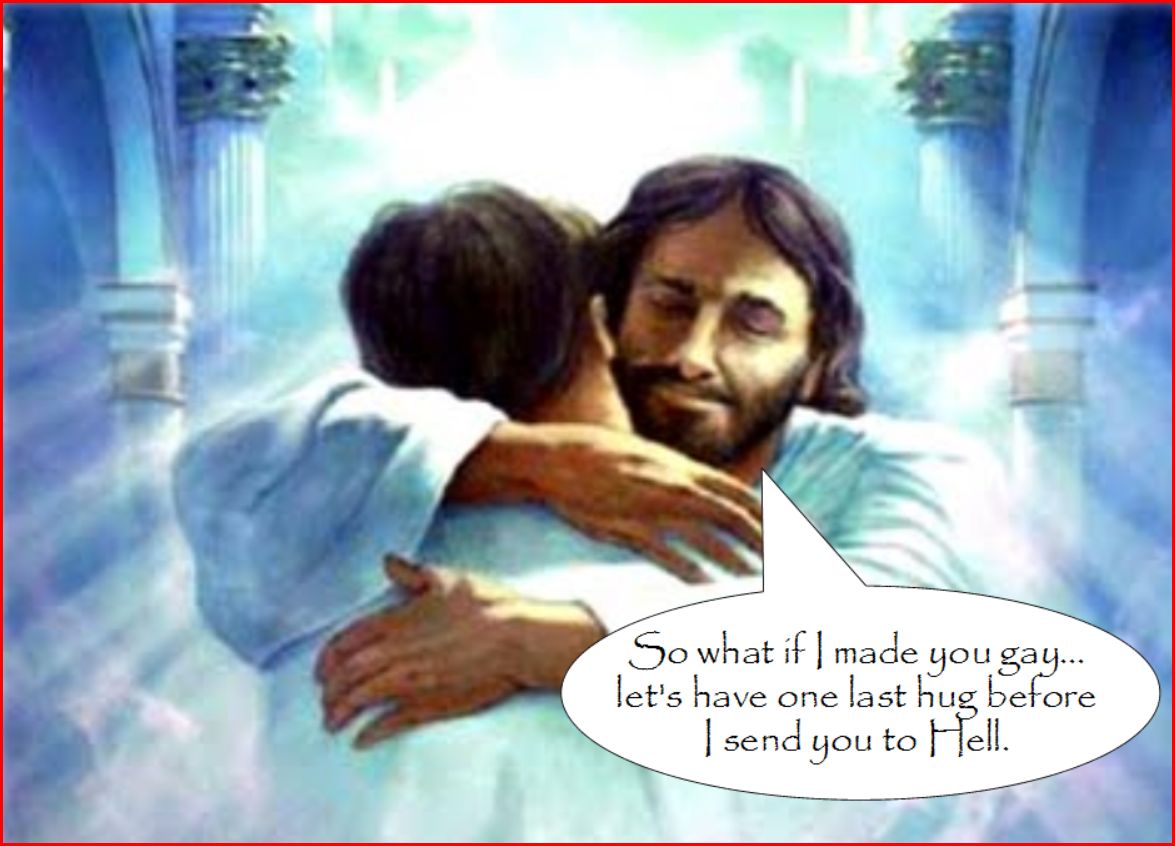
HugChristians, what do you do when you’re required to provide a service, say the photos or the food, at a gay wedding? It’s a tricky one, isn’t it, when the Bible tells you that homosexuality is an affront to God and you feel honour-bound to uphold his standards.

Well, Dan Reuter, pastor and attorney-at-law in Bloomington, Indiana has the perfect solution! Here’s what ol’ Danny-boy suggests:

The Christian purveyor of pictures or food should tell the sodomite couple:

Of course, I will provide my stuff for your wedding. I serve, and am required to serve, everyone, whether or not I approve of what he is doing. However, you do understand that if I am at your so-called ‘wedding,’ I will consider it my duty to call attention to God’s view of what you are doing. I will consider it my obligation to warn the guests of the danger they are running and of the harm all of you are doing to your own lives as God observes them. So, I will be distributing literature that explains all this.

And I thank you for the opportunity to reach people who otherwise might never hear this message that I believe they desperately need to hear.

What a neat suggestion! I know it’s neat because most of the comments on the site say so.

Christian love in action – a wonder to behold.

PS. Don’t forget, everyone else, to have some literature handy in your job so you can demonstrate how belief in Old Testament codswallop is an affront to your principles of tolerance and rationality. It’s a message the faithful desperately need to hear.

Hat tip to Steve Wells at http://dwindlinginunbelief.blogspot.co.uk/

The picture caption is not mine this time (they usually are) but I can’t locate the original source.

Christians’ Favourite Delusions 8: Atheists can never be moral or happy

moral

Christians regularly exercise these dishonest sound-bytes; here, here and here, for example.

There’s no need to argue with them. All we need to do is look at the evidence:

Good, moral atheists

Immoral Christians

Happy atheists

Miserable Christians

(click all of the above for examples)

If it’s true that only those with a direct line to God can be good and happy, then we shouldn’t see any of these categories. Christians should be supremely happy all, or at least most, of the time – St Paul says that believers are characterised by love, joy, peace, kindness and generosity (Galatians 5.22) – but they’re not. They should be moral and good all the time too – after all, Jesus commands them to be ‘perfect’ and tells them how to achieve it (Matthew 5.43-48) – but they’re not.

According to Christians moral, happy atheists shouldn’t exist. And yet they do. Christians, when they achieve it, are only good and only happy because they think God is watching over their shoulder. When atheists are good and happy it’s because they can be.