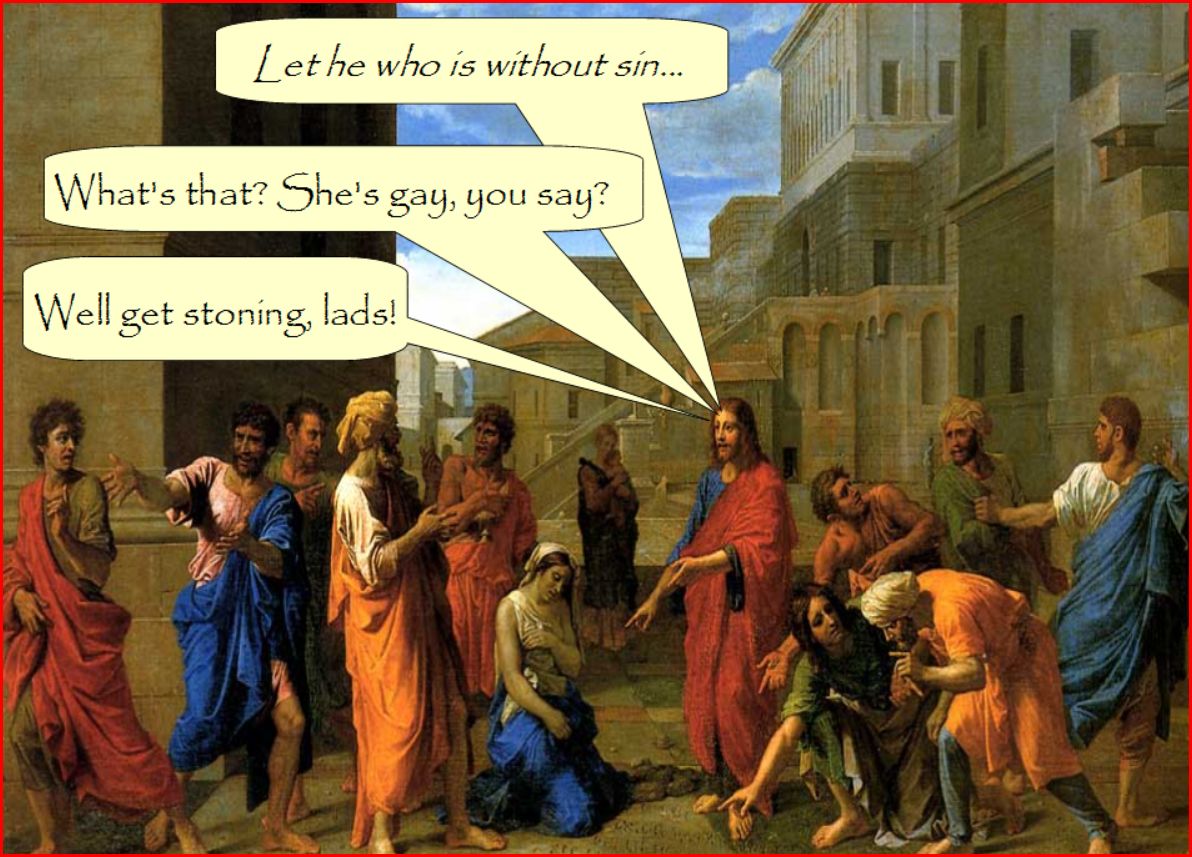
Which Christians won’t be resurrected after they die?

Robertson

All of these well-known Christians are unworthy of the Kingdom of God and won’t live again after they’ve died. See if you can work out why:

Billy Graham, Justin Welby (Archbishop of Canterbury), Desmond Tutu, Pat Boone, Mel Gibson, John Sentamu (Archbishop of York), Stephen Green (Christian Voice), Bono, Her Majesty the Queen, Sarah Palin (politician), Pat Robertson (700 Club), Joyce Meyer (evangelist), Bryan Fischer (outspoken radio broadcaster), Rick Warren (pastor of US mega-church), Rob Bell (ditto), George W. Bush, Tony Blair, Cherie Blair (barrister), Graham Kendrick (songwriter), Tony Perkins (anti-gay preacher), Scott Lively (ditto), Matt Barber (ditto), Peter LaBarbera (ditto), Tom Wright (theologian), Fred Phelps (late of Westboro church), Joni Eareckson Tada (writer), Mike Ratcliff (minister and blogger), Kirk Cameron (actor)… and, in all probability, your local pastor  – and maybe even you yourself, Christian reader.

They’re not worthy of God’s Kingdom nor are they likely to be resurrected because they’re married. And who says this makes them unworthy? Not me… Jesus:

those who belong to this age marry and are given in marriage; but those who are considered worthy of a place in that age (of God’s Kingdom on Earth) and in the resurrection from the dead neither marry nor are given in marriage (Luke 20.34-35).

So next time one of these famous Christians or some other married believer tells you you’re not saved, tell them that they’re not either. Jesus says so.

They won’t care, of course, because they pick and choose the bits of the Bible they believe. They’re more than happy to pretend this tricky bit doesn’t exist or doesn’t apply to them. Obviously, or they wouldn’t be married. Naturally this doesn’t stop them going on about about God’s plan for marriage even though it’s one they’ve made up themselves that flies in the face of what Jesus says.

Which means these same believers also have to ignore Jesus when he says, ‘Why do you call me “Lord, Lord”, and do not do what I tell you?’, which is a very good question.

Christians’ Favourite Delusions 18: We’re the ones being persecuted!

Persecution

You think Christians don’t say they’re persecuted? Take a look at a recent entry on Christian Voice, where the claim is made that Christianity itself is being ‘criminalised’ in the UK. Visit American Christian blogs where they insist they’re being persecuted. Listen to the former Archbishop of Canterbury, George Carey, complain ad nauseam that Jesus’ followers today are marginalised and mistreated.

And why do they feel this way? Usually because they don’t like being told they should stop persecuting gay people. It’s their religious right, they tell us, to ‘live according to conscience’ and to bash (if only verbally in this country at least) a maligned minority. And any attempt to stop them from doing so, they say, is an infringement of religious liberty. Hatred of homosexuality has become such an integral part of the Christian faith these days.

Suggest to Christians in the West that they’re not experiencing persecution at all, but only a fair and reasonable attempt to make them treat others as they themselves would be like to be treated (didn’t Jesus say that?) and they respond, as a Christian Voice supporter did the other day, by sending you a link to the site of the Christian Liberty Council. Here’s the proof that Christians are really the victims! Go to the link and what you get is, yes, a list of believers who’ve been cautioned for abusing LGBT people. It’s so unfair! And that’s it, that’s their evidence.

If Christians were prevented from gathering together for worship, imprisoned for their belief in Jesus, stopped from talking about their faith, denied the means of praying together and so on, then perhaps they could reasonably say they were being persecuted. As it is, they’re the ones doing the sniping – and whining when they’re chastised for it.

In fact, their saviour tells them in Matthew 24.9 what to expect when any real persecution or ‘criminalisation’ comes along. They should, he says, whinge about it at length, even if it’s only a very remote possibility.

Oh, no wait, that’s not it; see it as a gift, he tells them, and pray for those doing the persecuting (Mark 10.30 etc). Problem solved! As ever though, they choose to ignore him. They much prefer to hang on to their prejudices and see themselves as the real victims.

Picture shows, clockwise:

Pat Robertson, US TV evangelist, who says gay people want to destroy marriage and the church itself.

Yoweri Museveni, Ugandan president and evangelical Christian who this week approved a bill toughening penalties and punishments for gay people.

George Carey, former Archbishop of Canterbury, who complains about how dreadfully Christians are treated in Britain.

Scott Lively, American evangelist currently facing a lawsuit for ‘crimes against humanity’. Influenced the anti-gay laws recently introduced in parts of Africa and, possibly, in Russia.

Pope Francis, leader of the Roman Catholic Church, which officially condemns homosexuality, whatever conciliatory noises Frankie himself appears to make.

Stephen Green, operator of Christian Voice, which insists Christians in the UK are being criminalised for their intolerance.

Caption suggested by an article on the excellent Joe.My.God blog.

Christians ignore Jesus

Optional

Christians are commanded to ‘take up their crosses’ to follow Jesus (Luke 9.23). That means, amongst other things, doing what he commands. Yet Christians don’t just fail to do as he tells them, they replace his agenda with their own and completely ignore him. Being a Christian, according to Jesus – and you’d think he’d know – is not about pointing out the failings of others, nor about defending God’s honour (as an omnipotent being he’s more than capable of doing that himself) and it isn’t about condemning those you don’t agree with. It’s about treating others as you’d like to be treated, loving your enemies… things like these, in fact –

Do not judge, so that you may not be judged. For with the judgement you make you will be judged, and the measure you give will be the measure you get (Matthew 7.1-2).

Yet Christians judge relentlessly and tell us they’re justified in doing so: ‘you’re a sinner’, ‘you’re going to hell’, ‘gay people are of the devil’, ‘you’ve got the wrong set of beliefs’. We can only suppose they’ve don’t have a problem with the judgement they themselves will face as a result (because they don’t really believe there’ll be any such judgement.)

But I say to you, love your enemies and pray for those who persecute you (Matthew 5.44).

What Jesus really meant to say here, surely, was ‘criticise those you don’t like, claim they’re infringing your rights, sue them if need be’. Yes, that’s it.

Give to everyone who begs from you, and do not refuse anyone who wants to borrow from you (Matthew 5.42).

Really? Let’s give it a go. Beg a Christian to pay off your mortgage or ask to borrow the cash for new car. See how far that gets you. The problem here, as with all of these commands, is that Jesus really has no idea. No wonder Christians ignore this one.

How can you say to your neighbour, ‘let me take out the speck in your eye,’ when you yourself do not see the log in your own eye? You hypocrite, first take the log out of your own eye, and then you will see clearly to take the speck out of your neighbour’s eye’ (Luke 6.42).

Another ‘don’t judge’ command, to which Christians respond, ‘What log? Your speck is more of an eyesore than my log. My log doesn’t impede my vision at all. It’s you who can’t see.’

If anyone strikes you on the cheek, offer the other also; and from anyone who takes away your coat do not withhold even your shirt (Luke 6.28).

Yeah, right.

Do to others as you would have them do to you (Luke 6.31).

From which we can only conclude that Christians really must want to be treated as shabbily as they treat others (see links above)  

So how about it Christians? Maybe if you were doing what Jesus commands instead of judging the rest of us, we might take you a little more seriously. And, assuming he’s up in Heaven watching you – though even you know he isn’t or else you’d be doing as he tells you – so would Jesus himself.

As he says in Luke 6.46: ‘Why do you call me “Lord, Lord,” and don’t do what I tell you?’

Why_Christians_Don't_Cover_for_Kindle

For more on this topic – Christians’ failure to take any notice of Jesus’ commands – see my book Why Christian Don’t Do What Jesus Tells Them To …And What They Believe Instead, available from Amazon.

Christians’ Favourite Delusions 16: Christians treat others as they themselves would like to be treated (Luke 6.31).

Gun

Jesus promised his followers, back when he was alive, that they would take over the world when God’s new Kingdom arrived: ‘Blessed are the meek,’ he’s reported as saying in Matthew 5.5, ‘for they shall inherit the earth.’ He failed to tell them that this inheriting wouldn’t be any time soon, even though he himself thought it would be (Mark 13.26-30). Even so, Christians today fully expect JC to return any day now to vindicate them and turn the world over to them. Then, the meek – assuming that Jesus meant ‘Christians’ when (and if) he used the term – will inherit the Earth, whatever that actually means.

Back in the early 1980’s, when I was a Christian myself, I campaigned, in a very small way, for persecuted believers in the pre-Gorbachev Soviet Union. Together with others in my church, I spoke out against the clampdown of Christian worship, restrictions on the availability of the Bible and the harsh punishments meted out for exercising faith. Certainly believers in Russia were meek and humble then, because they had no other choice.

How things have changed in the intervening thirty years. Now in Russia, under Putin, faith is supported and encouraged and formerly persecuted Christians have the upper hand. They have the ear of the Kremlin and are influential in deciding policy especially in so far as it relates to ‘morals’.

And do those Christians, having known the scourge of persecution, say, ‘we cannot support the persecution of others; we disliked it when it was done to us and, in the words of our saviour, we recognise we should treat others as we ourselves would wish to be treated’ (Luke 6.31)?

What do you think? You think the meek, having found acceptance themselves and inherited positions of respectability and influence, use their new prominence to defend other minorities who are now being persecuted?

Of course not. The church in Russia endorses, supports and influences the policies of state that have lead to the persecution of people who have ‘non-traditional’ relationships; LGBT people and those who support them. Watch the Channel 4 Dispatches programme ‘Hunted’ (on 4 On Demand, with clips on YouTube) to see how gay people in Russia are hunted, tortured and humiliated. Witness a so-called Christian proudly relate how he shot a young gay man in the face with a ‘non-lethal weapon’ because he was carrying a rainbow flag. See Father Sergei Rybko from the Russian Orthodox Church demonstrate true Christian love when he says:

Even cattle don’t engage in this (homosexuality). I just consider them spiritually and morally ill. Something is not right here (in their heads)… they’ve started to plant the idea in young people’s minds that this is normal, that they are just a bit different… Well excuse me, paedophiles and sex offenders are just different too. Murderers and thieves are just different – so we should also give them freedom to do what they want? Where gays are allowed, paedophilia will soon flourish. Permitted evil gives rise to more evil. Paedophiles, gays and people like this are basically serving the Devil.

Church condoned persecution of homosexuals is what we can expect when God’s Gentle People inherit the Earth. We know this because it’s happened before, many times in history. When Christians get the upper hand, others suffer, whether they’re Jews, womenchildren accused of witchcraft or LGBT people.

Mercifully, Jesus was wrong, as he was about so much, when he promised the meek would inherit the Earth: they will never hold sway over the entire globe and for that, we should all be eternally grateful.

An experiment in Christian morality

Forget

Time for a little experiment: some data gathering for ourselves that will demonstrate the extent to which Christians are willing to comply, without cynicism or irony, with their Saviour’s peculiar requirements. While the Bible assures us it is wrong to put the Lord God to the test (Deuteronomy 6.16, etc), rest assured the same does not apply to believers themselves.

Our experiment is a cruel one to be sure, but given Jesus’ command in Matthew 5.42, that believers should ‘give to everyone who begs from you, and do not refuse anyone who wants to borrow from you’, we would be within our rights to test their adherence to the principle. After all, Jesus specifies that his followers must oblige ‘everyone’ and ‘anyone’ who asks, which is accommodating enough to include any sceptics conducting an experiment. He doesn’t stipulate either that those doing the asking have to have genuine need; indeed the entire thrust of his teaching in this section of Matthew is about responding sacrificially to unreasonable demands. We won’t be unreasonable – so no slapping of cheeks – and we will do our best to ensure our request is designed to meet as genuine a need as we can create.

For any experiment we need a hypothesis, so I propose that for this particular one we go with something like ‘Christians will not give to those who beg from them nor lend to those who ask to borrow’. If you want to amend this to suit your own circumstances, by all means do. You can choose too whether you’re going to beg, which means you get to keep anything you are given, or to borrow, in which case you won’t and you’ll need to pay it back at a later date.

Next, you’ll need to select your subject: you can choose an individual – they must of course be a card-carding, Spirit-filled Christian – or an institution: a church, say, or Christian organisation like Christian Voice or Focus on the Family. Whichever you opt for, you’ll need to ensure they are capable of meeting your request – we’re not going to pick on Christians of more modest means – and decide what you will ask for. I suggest that if your subject is a renowned evangelist or the pastor of a so-called mega-church you could reasonably ask him or her to lend you the money to pay off your mortgage, for example, or to meet medical expenses. I’m sure he or she will agree that these qualify as truly genuine needs, though you don’t necessarily have to tell them why you want the money, given there’s no mention of the beggars in Jesus’ instructions explaining themselves. On the other hand, if you think it will go some way to help disprove the hypothesis, you can and perhaps should be clear about why you want the cash.

Right. You should be all set. Be sure to let me know how you get on and whether your Christian subject demonstrates the hypothesis or refutes it. I’ll collate the data.

What’s that you say? You’re not going to bother because it’s a foregone conclusion that most Christians, whether prominent individuals, churches, organisations or ordinary believers won’t give to anyone and everyone who asks?

You could well be right, because, although Christians do give generously to causes close to their hearts, they baulk at the idea of giving to just anybody, in spite of what Jesus says. Maybe Christian readers of this blog can explain why; why don’t you do what Jesus tells you in this and many other respects? You cannot be his disciple, he says in Mark 10.25, unless you give away all that you have and he won’t recognise you as a follower unless you obey him entirely (Luke 6.46). So how about it?

Throwing stones

WomanNew laws in Putin’s Russia have seen a wave of persecution directed at gay people. Christian websites have been quick to condemn the torture, beatings and murders that have taken place in recent weeks, pointing out that this isn’t the way to treat others (Matthew 7.12) or to show love for one’s neighbour (Mark 12.31) or to support a minority group (Matthew 25.45).

Oops. I interrupt this post for a reality check.

Needless to say, no Christian website has done this. Some have come out in support of Russia’s punitive new laws, because – well – God hates all that gay stuff, and, as we know, the odd Bible verse that grumbles about it trumps anything Jesus had to say about being nice to each another. Other Christian sites have ignored the subject entirely.

Our very own Christian Voice, while avoiding any mention of the Russian situation, has posted yet another anti-gay piece. Two thirds of their posts are on the subject, because this is what ‘the gospel’ is really all about. Upset that same-sex marriage is now law – even though they prayed really, really hard to the baby Jesus to stop it – Stephen Green’s sidekick, Robin (had to be really) points out that our bodies matter and, though it will come as some surprise to them, gay people don’t understand this.

You can read the full thing here, where you’ll note C.V. tries to avoid the word ‘gay’ and always puts inverted commas around same-sex ‘marriage’; pathetic doesn’t even begin to describe it .

I’ve attempted to comment on the article on the Christian Voice site, but so insecure are the dynamic duo in their faith, they can’t bring themselves to publish dissenting views. So here, with some slight amendment, are the points I made:

Oh, if only those pesky homosexuals were more like heterosexuals – always monogamous, faithful and never divorcing or remarrying.

If only all gay people were Christians, then the morality you espouse – but which not all Christians live by – might apply to them. As it is, it doesn’t.

If only they could have an encounter with Jesus then they’d be cured of their same-sex attraction.

If only there was some proof of this magical cure or that homosexuals need to be ‘cured’ in the first place.

If only gay people could be celibate, because that worked out so well for the Catholic Church.

If only they’d marry a person of the opposite sex and involve them in living a lie.

These are the options. So what is it you want homosexuals to do, Robin?

What indeed? I suspect he and the other Christians who rant about gay people would be happy only if they disappeared from the face of the Earth or if the great Jehovah were to smite them out of existence. What so many Christians seem unable to do is accept and show the love to their gay brothers and sisters that Jesus demands of them.

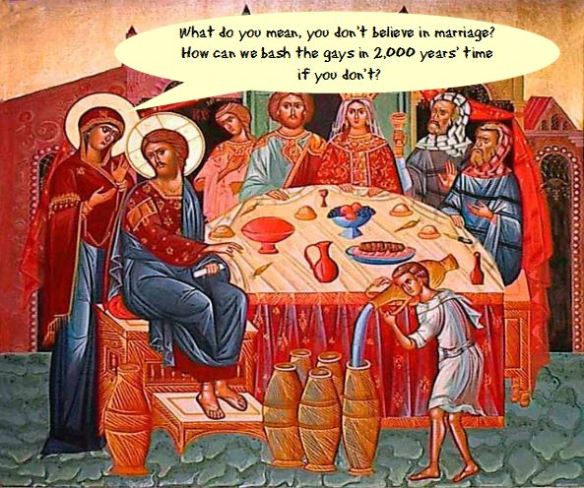
Jesus Doesn’t Approve of One Man One Woman Marriage

WeddingWhat does Jesus really have to say about marriage? It’s not what you think.

It is almost impossible to visit a Christian website these days and not find it making pronouncements about gay marriage, same-sex relationships and the ‘evil’ of homosexuality. Some, like Christian Voice, seem to think that the gospel is about nothing else. Elsewhere, Bishop John Quinn of Minnesota, a celibate, single male and thus an expert in matters matrimonial, writes that ‘from the beginning, the church has taught that marriage is a lifetime relationship between one man and one woman… It is a sacrament, instituted by Jesus Christ to provide the special graces that are needed to live according to God’s law and to give birth to the next generation”. Alas, the bishop doesn’t know his Bible, nor his Lord’s teaching. He is not alone in superimposing his own views of marriage on the Bible; it is a common practice among Christians today.

Should you be inclined to do so, you will once again search in vain either for Jesus ‘instituting’ modern marriage or for the early church promoting it. Those who claim he does usually cite Jesus’ apparent endorsement of Genesis 2.24 from Matthew 19.5-6:

a man shall leave his father and mother and be joined to his wife, and the two shall become one flesh”. So they are no longer two, but one flesh. Therefore what God has joined together, let no one separate.

In context, though, Jesus is actually discussing divorce, not marriage, and is making the point that Jewish law permits divorce only because men and women are weak. This prompts the disciples to observe that ‘if such is the case of a man with his wife, it is better not to marry’, with which Jesus agrees, adding,

not everyone can accept this teaching, but only those to whom it is given. For there are eunuchs who have been so from birth, and there are eunuchs who have been made eunuchs by others, and there are eunuchs who have made themselves eunuchs for the sake of the Kingdom of heaven. Let anyone accept this who can. 

In other words, Jesus thinks it is better to be sexless than to marry, the better to pursue the interests of God’s Kingdom. He emphasises the point in Luke 20.34-35:

Jesus said to them, ‘Those who belong to this age marry and are given in marriage; but those who are considered worthy of a place in that age [i.e. that of the Kingdom] and in the resurrection from the dead neither marry nor are given in marriage. 

This is even less ambiguous in its denigration of marriage; it is for this world only, for those who will not be part of the Kingdom, who will not survive death. Those who live in anticipation of the Kingdom, who would be resurrected from the dead, will have nothing to do with marriage in this life, as in the next. Far from ‘instituting’ marriage as Bishop Quinn claims, Jesus heralds the end of the institution.

The Kingdom, however, didn’t come when Jesus said it would. Newly formed groups of believers found themselves having to decide what to do about marriage in a world that was lasting longer than he’d promised. Consequently, ‘from the beginning’, the early church’s position was that marriage would do if believers couldn’t manage to control their sexual urges. But, Paul declares in 1 Corinthians 7.8-9, it is better to remain celibate and not to marry at all:

to the unmarried and the widows I say that it is well for them to remain unmarried as I am. But if they are not practising self-control, they should marry. For it is better to marry than to be aflame with passion.

While it is true Paul assumes any marriage will be between a man and woman, this is hardly the ringing endorsement of marriage we might expect from the assertions of today’s Christians. For Paul, the leaders of the early church and Jesus himself there was no point to marrying when they lived in the end times. As Paul says in 1 Corinthians, 7.28-29:

But if you marry, you do not sin, and if a virgin marries, she does not sin. Yet those who marry will experience distress in this life, and I would spare you that. I mean, brothers and sisters, the appointed time has grown short; from now on, let even those who have wives be as though they had none…

Paul is not sanctioning marriage because he anticipated that any marriage could only be short-lived and traumatic; as he goes on to explain in 1 Corinthians 7.32-34, marriage is little more than a distraction from ‘the affairs of the Lord’. He is not therefore promoting ‘life long’ commitment in the sense Bishop Quinn, Christian Voice’s Stephen Green and Christians who don’t know their Bible claim, because those to whom Paul writes are not, in his view, going to continue in their existing lives for very much longer.

Above all, Jesus and Paul are most definitely not establishing rules for marriage for the rest of time, simply because, for them, there was no ‘rest of time’.

My creed (sort of)

Image

I was asked recently by a good Christian friend, now I’m no longer a believer myself, what I ‘place my faith in’ these days. Despite the claim from some Christians – Ken Ham of Answers In Genesis, for example – that atheism itself is a religion, we atheists generally don’t have ‘faith’ in anything; we are much more interested in knowing, in evidence and in not accepting on trust whatever self-appointed authorities might tell us. Nor do we have ‘faith’ in the ‘goodness’ of man as Christian Voice’s Stephen Green tells me we do. Though we might recognise that the only way to solve the many problems we face is going to be through human endeavour; there is no god who is going to bail us out.

So in these liberating post-Christian days, my world-view differs from my friend’s and other believers’ in a number of crucial ways. This post looks at the first three of these and there’ll be three more next time. Together, these make up something of a creed for me, even if some, like these first three, are expressed as negatives:-

There are no supernatural beings.

There is no empirical evidence that supernatural beings exist. There is, however, plenty of evidence that such ‘beings’ are the creations of the human imagination. It follows from this that are no fairies, ghosts, demons, spirits (holy and otherwise), angels, Santa Claus, Satan, Zeus, Osiris, Baal, Allah, Yahweh, resurrected Christ, or God of any sort ‘out there’.

And, no, books written by human beings are not evidence of the external, independent existence of any of these characters. Such inventions bring us back squarely into the realm of the human imagination.

Neither, as Romans 1:20 claims, is the natural, physical universe evidence of a supernatural realm. To argue that it is is the same as saying that because there is an Athens there must be a Zeus, or that the existence of tea-shops proves Bertrand Russell’s celestial teapot must really be orbiting the sun. That which is material, visible and natural can never be proof of something that is invisible, immaterial and supernatural. And in the end, there is no difference between something that is invisible, immaterial, supernatural and unprovable – and that which is non-existent.

Faith is no substitute for evidence (and wishful thinking doesn’t work).

Declarations, statements and views that begin ‘I believe’ are suspect and not to be trusted. They usually mean the person uttering them has no evidence for their belief. Otherwise, why believe? Wouldn’t you ‘know’ if you had evidence? ‘Believing’ does not make the object of your belief a reality. ‘Believing’ that you have eternal life won’t enable you to live forever. Hoping you’re going to Heaven when you die doesn’t mean heaven exists nor will it get you there in the future. Having ‘faith’ in Jesus will not make you right with God for all sorts of reasons. In short, wishful thinking doesn’t work.

Science, not religion, offers the best explanations of life, the universe and everything.

Religionists (wilfully?) misunderstand the scientific use of the word ‘theory’; they insist it is a synonym for guesswork or argue that because some scientific theories, like evolution, cannot be replicated in the laboratory they are therefore null and void (see Answers in Genesis again with its battle cry of ‘were you there [when the world was made]?’ No, and neither was Ken Ham, nor the writers of Genesis, nor any deity; see above). But a scientific theory offers an explanation which can be tested against observable phenomena and processes. It asks ‘is this what we might expect if the theory (explanation) is accurate?’ If yes, the theory is validated, repeatedly. If no, the theory has to be modified to fit the facts or completely reformulated, again so it accurately mirrors what is observed. The scientific principle of actively seeking out evidence that might refute a given theory, or aspects of it, ensures a process that can be trusted. Note though, that having such trust in science is not a matter of faith: it is about considering the evidence and developing knowledge from it.