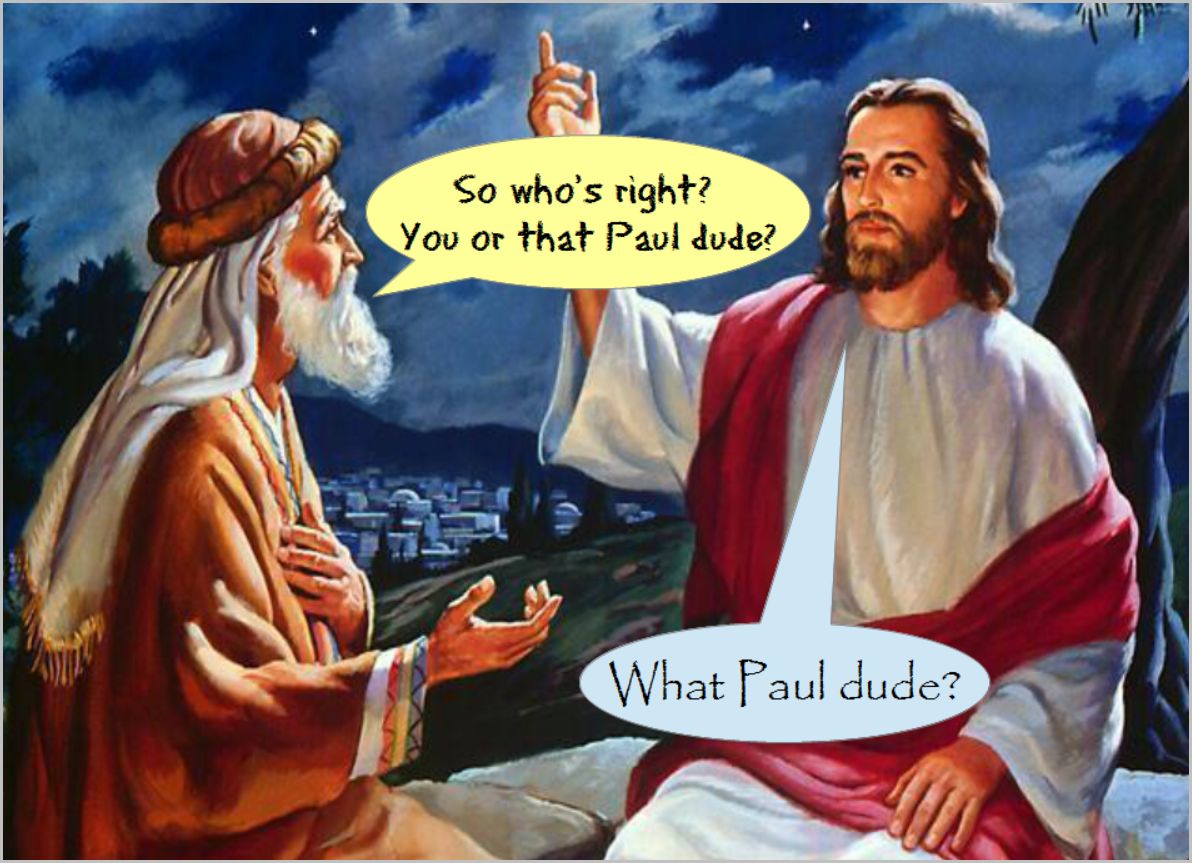
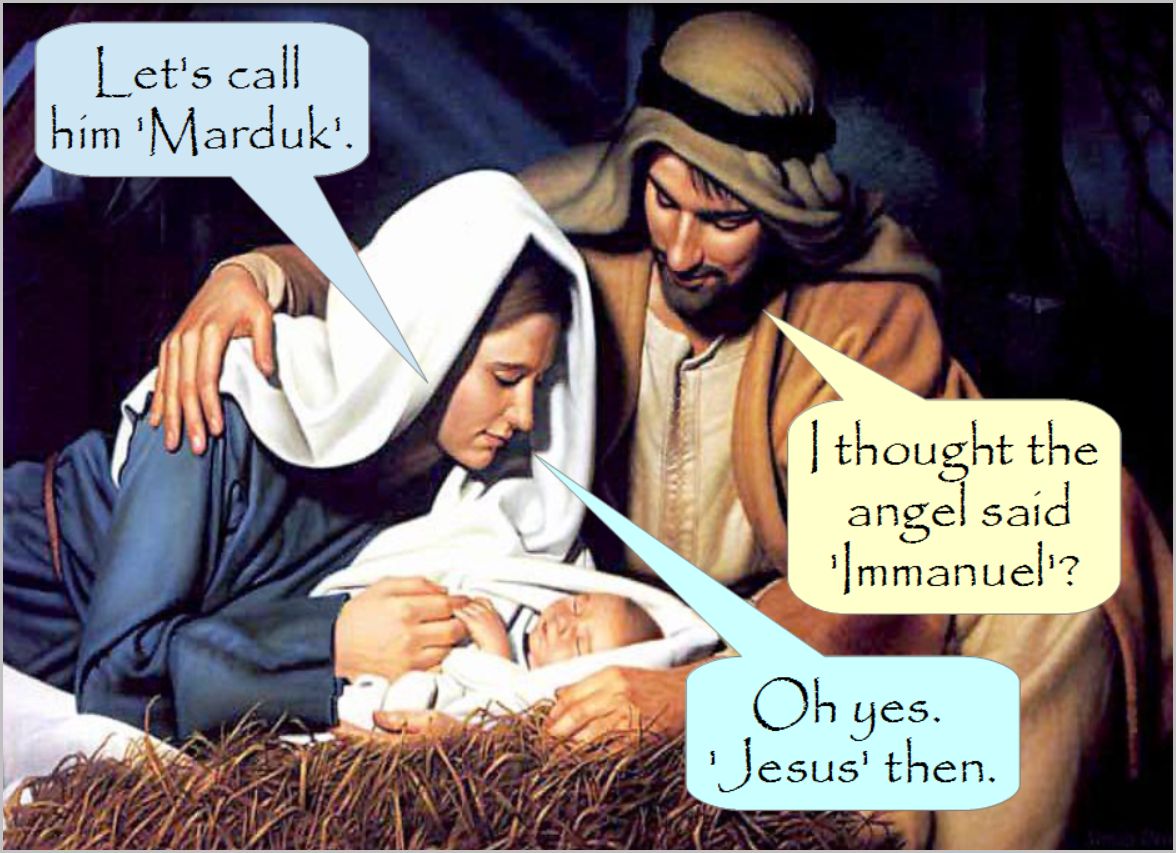
Jesus or Paul?

Nicodemus

Jesus is asked a few times in the gospels about how a person can find eternal life – like that’s the most obvious things to ask a travelling snake-oil salesman. Maybe it is, I don’t know. It was in the first century anyway, if the gospels are to be believed.

Jesus gives a variety of answers in the three earliest gospels: in Matthew 19.17 it’s ‘keep the commandments’ – those terrible, brutal laws I talked about last time. In Mark 12.30-31 he says the way to eternal life is to love God with all your heart and soul, and your neighbour as yourself. In other places he tells his audience that if you want to be forgiven by God then first you must forgive others (Matthew 6.14); if you want God’s compassion then first you must be compassionate (Matthew 25:31-46); if you don’t want to be judged, then you shouldn’t judge others (Luke 6.37).

Jesus is particularly fond of this kind of measure-for-measure salvation; it’s the lynch-pin of his good news – do unto others as you would have God do unto you. And almost every time he mentions it, he connects it with the Law and commandments.

Never does he say, anywhere in the gospels, that if you want to gain eternal life, or find favour with God, or be saved, then what you have to do is believe in the redemptive power of his own imminent death. Even when he could have done so, when he could have worked a little bit of Christian dogma into his teaching, he doesn’t. And that’s strange really, when you consider that Paul’s brand of Christianity – the one that’s come down to us today – is built entirely on the idea that the death and resurrection of Christ is the only thing can save us from God’s wrath.

Paul’s alternative gospel, which is expounded in Romans and summarised in Galatians 3.10-13, goes something like this:

Paul looks at the old Jewish Law and says, ‘actually it’s impossible. None of us can keep it. We’re all under a death sentence for some tiny infringement of it, because any and all infringements lead to the death penalty. But,’ he goes on, ‘Christ has taken that penalty for us by dying in our place. So although the law demands we should die and then suffer for eternity, we won’t, because he died for us. Then he rose again, just as those who believe in him will.’ That last bit – about believers rising from the dead – really doesn’t follow from his premise that the Law is impossible, but this is Paul talking, a man with only a passing acquaintance with logic. He doesn’t, either, have any evidence that Jesus took the penalty for the rest of humankind – he made that bit up too.

And that, in a nutshell – I do mean nut shell – is Paul’s ‘good news’. It bears no relation to the good news that Jesus preaches in the synoptic gospels. Admittedly, the Jesus who wanders his way through the first three gospels is for the most part a pre-death Jesus. You could argue, as a result, that he wouldn’t talk about redemption through his death before it had happened… but then again, why not? He talks about all sorts of other things he thinks are going to happen after he dies and rises again; he’s going to return pretty damn soon in a blaze of glory, through the clouds with an army of angels; heaven and earth are going to pass away; God is going to unleash his kingdom on the new earth.

But in spite of these mad speculations, he doesn’t mention even once in the synoptic gospels that people can be saved merely by accepting that he has paid – or will pay – the penalty for their infringements of the law, their sins if you will. Never. All the more odd when you consider that Mark, Matthew and Luke were putting their gospels together long after Paul preached his particular brand of salvation. Yet they don’t put this message into Jesus’ mouth, nor do they add it to the narrative.

It’s just not there.

So… were the gospel writers not aware of it? If they did know of it, was it that they didn’t like it? Did they know, in fact, that Paul’s formula didn’t square with what Jesus himself had said, or what they at least believed he’d said?

Whatever it was, the result is there are two conflicting versions of the ‘good news’ in the New Testament: Paul’s and Jesus’. One is easier than the other; in Paul’s plan all you have to do is believe. The other is difficult (and if we’re honest, really only designed for Jesus’ fellow Jews); it entails things like forgiving repeatedly, showing compassion, putting others first, turning the other cheek and, especially, following the six hundred and odd commandments that make up the Law.

So guess which one Christians today prefer.

Here’s a clue: it’s not Jesus’ gospel – the one without the magical incantation but with the barbaric Jewish law. But if, as Christians believe, Jesus was the Son of God – maybe even God himself – then why do they always accept Paul’s reinterpretation over and above everything their Lord said? Why do they disregard all that Jesus demands of those who would follow him, and take instead Paul’s easy path?

In the end, though, what Jesus and Paul (as well as the gospel writers and different factions of the early church) are in dispute about is the highly improbable and the absolutely impossible. It doesn’t matter whether they thought you could gain ‘eternal life’ by obeying the commandments or by letting someone else take your punishment for you; humans do not live forever. Just because a zealous first-century preacher thought they could does not make it so. Just because a different fanatic from roughly the same time believed it doesn’t make it happen either. There’s no evidence any human has ever, after this brief earthly existence, gone on to live forever. Equally, there’s no evidence that a deity exists, so those rules that are so important, in different ways, to Jesus and Paul can’t have originated with him. They’re man-made too.

So, with no God and no eternal life, Jesus and Paul might as well have been discussing whether the tooth fairy wears a pink dress or a green dress. What does it matter when she doesn’t exist?

How much more were they wrong about?

How long you got?

All gods must pass

MardukIf human beings were suddenly wiped from the earth through, say, an Ebola pandemic, what would be left of us? What would become of all the things we’ve invented and created? What would happen to language, mathematics, science, literature, medicine, art, agriculture, architecture, democracy, industry, capitalism, civilisation, education, marriage, religion?

They’d all cease, most of them immediately. Remnants of others would survive for a little while before being reclaimed by nature. The surviving flora and fauna, the weather, climates, oceans, land masses would carry on just as before. Indeed, without humans around to abuse it both carelessly and deliberately, the rest of nature would flourish. Reproduction, evolution and the great cycles of life would continue unimpeded.

Which tells us what? That all of our accomplishments and preoccupations, from language and mathematics to marriage and religion are entirely human-made. When we go, they go. And nothing left behind will care. Our religions, all 4,200 of them, will disappear over night and with them their gods; Yahweh, Allah, Vishna will no longer exist, just as Marduk, Anu and Enlil no longer exist.

You’ve never heard of Marduk, Anu and Enlil? Of course not; this particular holy trinity were among the gods of ancient Babylon, a civilisation that existed two thousand years before the Christian God was even thought of. Their worshippers believed in them as enthusiastically as some people now believe in Jesus. For Babylonians, Anu, Enlil and Lord Marduk, the King of the Gods, were just as real, powerful and caring as Christ and Allah are for believers today.

But Enlil, Anu and Marduk have gone. From our vantage point we know they didn’t exist in the first place. They were nothing more than the product of ancient people’s imaginations. That didn’t stop those same people from having real faith in the three of them, praying to them and knowing in their hearts that they were being watched over by them. But as their civilisation fell, the Babylonians discovered that Marduk and company weren’t there to defend and preserve them. When, in 539 BCE, Babylon finally ceased to exist, so too did its mighty gods.

And so will the mighty gods of our own era. Either when a pandemic destroys us or when we destroy ourselves, or even when – as unlikely as it might seem – we come to our senses and abandon belief in made-up things.

However it happens, there will be no repercussions. Yahweh, Christ, Allah and Vishnu will not smite the Earth in their wrath at our abandonment of them. They will, instead, pass silently from history just as Marduk, Anu, Osiris, Zeus and Woden did before them.

If you still cling to human-made deities – and they’re all human-made – why wait? Why not be ahead of the game and let go of them now? Allow your pet god to go gently into that good night. You’ll not miss him, and he certainly won’t miss you. How can he? He’s not real, after all.

 
This post was prompted by Sapiens: A Brief History Of Humankind by Yuval Noah Harari.


Predictions for 2015

BrideMy predictions prophecies for the year ahead:

1. There’ll be no Second Coming in 2015.
Jesus won’t be back this year. Just like he wasn’t back in 2014, 2013, 2012… 1985… 1914… 1868… 1497… 1000… 446… 35. Just think of all those years – count ’em, nearly two thousand – when he’s failed to return so far. Actually, he promised he’d be back while his disciples and those daft enough to listen to him were still alive – around AD30 or thereabouts (Matthew 16:27-28; Matthew 24:27, 30-31, 34; Luke 21:27-28, 33-34). Safe to say he’s not coming back at all now, just like dead people don’t. Not in 2015, not ever.

2. Christians will go on insisting Jesus is going to return any time soon.

3. There’ll be no natural disasters or human calamities as a result of same-sex marriage.

4. Christians will claim natural disasters and human calamities are the result of same-sex marriage. Shaking our fists at God… the wrath of the Almighty… sign of the End Times… blah, blah, blah.

5. More than one prominent Christian will call for the execution of gay people.

6. Christians in the west will claim they’re being persecuted when they’re being expected to treat others fairly and equally, and not to discriminate against them.

7. Christians will respond to criticism with clichés like ‘they wouldn’t dare say that about Muslims’… ‘Christians are the last group who are fair game’… ‘It’s time for Christians to speak out’… ‘Stand up for God’s standards…’ etc.

8. Christians will continue to dismiss and disparage anyone who doesn’t share their views, especially atheists. Look out for ‘atheists have no morality’, ‘the fool hath said in his heart there’s no God’ and ‘atheists want to oppress Christians’ occurring with tedious regularity.

9. There will be more revelations about the abuse of children by church ministers.

10. Church hierarchies will attempt to cover up the abuse of children by their ministers.

11. There will be the usual manufactured ‘war on Christmas’.

12. These predictions have far more chance of coming to pass than any of the so-called prophecies of Bible. I’ll return to them at the end of the year so we can see.

A happy new year to you all!


Original picture: Ursula Klawitter / zefa / Corbis

Answers to this year’s all-new Christmas Quiz

saving-christmas-posterGod save us all from this, this Christmas time.

1. Where does the word ‘Christmas’ come from?
The answer is b, the name comes from the Catholic Mass held on the supposed date of Jesus’ birth. So all you anti-Catholic Christians need to find a new name for it fast.

2. When was Christ born?
a) is the answer here: Christ wasn’t born. Maybe Jesus was, but ‘the Christ’ is an invention of later Christians (Paul, for example, in Romans 8.3 and John’s gospel, written up to a century after Jesus lived.) The Christ is a mythic, supernatural being who’s always existed. He bears little relation to the itinerant Jewish preacher Yeshua who wasn’t born on 25th December or in the year 0.

3. Which gospel writers didn’t think the nativity story worth including in their accounts?
Mark and John (b & c) don’t bother including it. Did they not know it? The two gospels that do have bits of the story – Luke and Matthew – contradict each other.

4. How well attested are the events surrounding the birth in historical documents of the time?
a) Not at all. You’d have thought the Romans, who were pretty good at keeping records (lots of which have survived) would have noted Herod’s massacre of little boys or the appearance of a new, magic star in the sky – they were, after all, a superstitious lot. Not even Josephus, who, in the late first century, acknowledges the existence of Christians, sees fit to mention any of it.

5. Following the miraculous events of Jesus’ birth, what did Mary do?
According to Luke 2.19, she treasured them in her heart. However, the answer is c) because only a few verses further on, she hasn’t a clue about what her son is up to (Luke 2.48). Later still, she is part of the family’s efforts to ‘restrain him’ (Mark 3.21 & 31). Why, on these occasions, doesn’t she recall his miraculous beginning and think, ‘oh yes, I remember now. He behaves like a lunatic because he’s the son of the Most High.’ She certainly didn’t write down the details of his miraculous birth for later use in the gospels. No-one did. On account of them not really happening. Just sayin’.

6. How many times does Jesus refer to his miraculous birth?
a) Never. Strange that.

7. How many times does the rest of the New Testament refer to Jesus’ miraculous birth?
c) Never, even more strangely. Evidently the story hadn’t been invented when the rest of the New Testament was written.

8. When did Christians first start celebrating Christmas?
a) hundreds of years later.

9. Which of these Christmas traditions originate in the Bible?
None of them. Despite what Kirk Cameron might think, Christmas trees, kissing under the mistletoe and giving presents all have pagan origins. The giving of gifts did not come about because the wise men did it first. The tradition pre-dates Christianity.

10. Which of these groups has benefited the most from Jesus’ birth?
Yes, you’re right; none of them. Not women, not black people and not LGBT people. Christianity has a history of oppressing all three groups.

Speaking of which…
11. What does Pastor Steven Anderson want for Christmas?
c) he’d like to see the execution of all homosexuals so that AIDS – which, as far as the reverend understands it (I use the term loosely) only gay people get – might be wiped out. Peace and joy to you too, Stevie.

12. How will Christians celebrate Christmas this year?
The answer is a, b and c: by fighting the War On Christmas, putting the Christ back into Christmas and by telling us that Jesus is the Reason for the Season. Just like they do every year. As you can see, Kirk Cameron’s disaster of a movie, Saving Christmas, has two of these blessed clichés on its promotional poster alone.

So how did you do?
If you scored –
between 10-12: well done. Betcha don’t believe in Santa Claus either.
Between 7-10: your cynicism needs a little work. Order my book for Christmas – it’ll help.
Between 4-6: oh dear. You’re new around here, aren’t you. There’s hope for you though, so stick around. Oh yeah, and order my book for Christmas – it’ll definitely help.
Between 1-3: Like Christmas, you are in need of saving, my friend. May the scales fall from your eyes this holiday period. Amen.

This Year’s All-New Christmas Quiz!

SantaBack by popular demand (well, mine anyway), try this year’s all-new Christmas quiz!

Answers in the Bible or not, as the case may be. Real answers next time.

1. Where does the word ‘Christmas’ come from?
a) the Bible
b) the Catholic Mass held on the supposed date of Jesus’ birth
c) the Greek, meaning to pull the wool over people’s eyes

2. When was Christ born?
a) he wasn’t
b) 25th December
c) in the year 0

3. Which gospel writers didn’t think the nativity story worth including in their accounts?
a) Luke
b) Mark
c) John

4. Following the miraculous events of Jesus’ birth, what did Mary do?
a) she remembered them all in her heart
b) she wrote them down for later use in the gospels
c) she forgot all about them

5. How many times does Jesus refer to his miraculous birth?
a) never
b) twice
c) he doesn’t shut up about it (well, would you?)

6. How many times does the rest of the New Testament refer to Jesus’ miraculous birth?
a) repeatedly, showing how important it was
b) only when making an important theological point
c) never

7. How well attested are the events surrounding Jesus’ birth in historical documents of the time?
a) not at all
b) quite substantially
c) as you’d expect when mass murder and strange astronomical events are involved, they’re mentioned everywhere

8. When did Christians first start celebrating Christmas?
a) hundreds of years after the event
b) not long after Jesus died
c) immediately

9. Which of these Christmas traditions originate in the Bible?
a) Christmas trees
b) kissing under the mistletoe
c) giving presents

10. Which of these groups has benefited most from Jesus’ birth?
a) women
b) black people
c) LGBT people

11. What does Pastor Steven Anderson want for Christmas?
a) his two front teeth
b) peace and joy
c) the execution of all homosexuals

12. How will Christians celebrate Christmas this year?
a) by fighting the War On Christmas
b) by telling everyone that Jesus is the Reason for the Season
c) by putting the Christ back into Christmas


Picture from memegenerator.net


Is This It?

AlphaI was disappointed that my local church, when advertising the Alpha Course this year, didn’t use its usual poster. You know the one – and if you don’t it’s like the one above – that asks ‘Is this it?’, meaning both, ‘Is this all there is to life?’ and ‘Is this life all there is?’ Every year, I so much want to answer the question by scrawling ‘Yes’ on the bottom of the poster. I don’t, of course, because I’m too law-abiding to deface someone else’s property. But ‘yes’ really is the answer to the question ‘Is this it?’ and to the other two questions it suggests. This life is all there is. What you make of it is also ‘all there is’ (so better make the most of it).

Of course, the Alpha Course and Christians in general want to persuade you that this life isn’t all there is, that a better life awaits you after death. They want to tell you too that there’s a life that’s better than the one you’re currently living, however interesting, challenging, fulfilling or unhappy that might be. All you have to do to have this better life – and have it last forever – is to give yourself to Jesus. Oh, yes, and sign up for the Alpha Course too, of course.

Will your life really get better if you decide to believe in a mythical figure who magically sacrificed himself to himself to save you from yourself? It might, but not because you’ll have bought into this particular delusion. If it happens at all, life will be better because you’ll have become a member of a community (a church) and will enjoy the support of others who share the delusion. It might seem better too because your church will tell you what to think about particular issues – morality, abortion, homosexuality, evolution, for example – and you will be freed, should you want to be, from the burden of thinking for yourself.

But your life will not assume any cosmic significance, because nothing human beings do, say or believe ever has cosmic significance. Humans, whatever your church or the Alpha Course tells you, simply do not have cosmic significance. So, your decision to follow Christ won’t mean you’ll live forever (because, however much they might wish it, human beings don’t live forever.) It will not transform you into a ‘spiritual creature’; won’t make you beloved of the Creator of the universe; won’t transform you into the likeness of the mythical Christ. You will not have a hot-line to either the Creator nor to this Christ and so you won’t find them answering your prayers. You will not be part of any cosmic battle between God and the devil. You will not have God’s Son or the Son’s Spirit (which is it, Christians?) coming to make their home in you. You will no more be living in the End Times than you were before your conversion and the world will, though you will fail to recognise it, make even less sense than it does now.

What Christianity offers is pure fantasy, the same sort of fantasy that Mormons, Muslims, Moonies and all manner of other religious believers claim as their Truth. The only difference between your fantasy and theirs will be in the detail. Of course, as a Christian you’ll be told that your set of superstitions is the real and only Truth and that all of the others are false (or the lies of the devil, or whatever.) But in reality, yours will be just as absurd, just as impossible, just as disconnected from reality as theirs. And, what’s more, you’ll go on facing the same problems, the same joys, the same pain, the same short lifespan and the same opportunities that your culture offers you, that you’ve always had.

So give the Alpha Course a miss. Give Christianity a miss. Give all religion a miss. Give anything that tells you this life isn’t all there is a miss too, because this IS all there is. And thank God for that.

Idiotic Stuff Jesus Said 6: The ‘I Am’ sayings

CampLet’s be clear from the outset here; Jesus never actually made any of the seven ‘I am’ claims put into his mouth in John’s gospel. You know the ones: ‘I am the Way, the Truth and the Life’, ‘I am the True Vine’, ‘the Good Shepherd’, ‘the Light of the World’ and so on. So it is a little unfair to lump them with all the idiotic things it’s more likely Jesus did say (see previous posts.)

How do we know he didn’t say them? Lots of reasons. Firstly, they’re not in the other three gospels all of which were written earlier than John’s, and are therefore closer to the time Jesus lived (though the earliest, Mark’s gospel, was probably put together thirty to forty years after Jesus lived.) If Jesus had really made all those grand ‘I am’ claims, wouldn’t the other gospel writers have recorded them too? Yet none of them mentions even one.

Secondly, in the synoptic gospels – Matthew, Mark and Luke – Jesus has a different message from the one given to him in John’s gospel. The earlier gospels have Jesus talk about himself only very rarely. Instead, he goes on at length about the coming of the Kingdom of God (or Heaven) and how y’all better get ready for it ’cause it’s a-coming soon. Was he wrong about that one! On the odd occasion he does refer to himself in the synoptic gospels, he often does it in a sort of coded way, calling himself ‘the son of man’. He hardly ever uses ‘I’, let alone makes grandiose claims about himself.

Thirdly, all three of the synoptic gospels rely on earlier sources, now lost to us, and none of those has Jesus make ‘I am’ statements either. How do we know? Because, again, they’re not there in any of the three accounts – Matthew, Mark or Luke – that are built up from them. Significantly, one of these sources is an early record of Jesus’ sayings; that’s a ‘sayings gospel’ that doesn’t relate any ‘I am’ sayings.

Fourthly, John’s gospel is late – at least sixty years after JC’s death and also after Paul’s supernatural Christianity had gained a foothold among the gullible. The Jesus of John’s gospel is a reworked version, more in-line with the ‘Christ’ that Paul preached and much less like the Jewish peasant who had lived and preached the Kingdom of God. Despite what Christians claim, John’s gospel is not another eye-witness report (none of the gospels is) that differs only in minor details from the other three accounts. It is total reworking of the story, with its central figure transformed into a sort of divine Superman, and the idea of the coming Kingdom relegated to a single mention. This change of agenda renders the fourth gospel utterly unreliable as an historical record of anything the earthly Jesus might have said.

Fifthly, Christians claim John’s gospel differs from the others because in it Jesus reveals special, secret truths about himself to ‘the disciple whom he loved’, traditionally the John whom the gospel is named after. But again, the problem with this explanation is that the synoptic gospels don’t mention Jesus favouring one particular disciple over the others (unless it’s Simon Peter). In these, John, a loud, brash fisherman, plays only a minor role. Why don’t the synoptics refer to the special, more intimate relationship that John’s gospel refers to? Largely because there wasn’t one – not until the fourth gospel came to be written and ‘John’, who led the community that produced it, wanted to bump up his part.

So, idiotic as it would have been for an itinerant Jewish preacher and ‘prophet’, whose mission ended in failure, to make these claims about himself, Jesus never did. He didn’t say he was ‘the Way, the Truth and the Life’. Or ‘the Vine’. Or ‘the Good Shepherd’. These are claims made for him long after he lived, by people who were persuaded by a snake-oil salesman that a God-man had mystically ‘saved’ them. They ‘re-imagined’ Jesus, sayings and all, to fit their idea of what he must have been like – and John’s gospel was born.

Its Jesus, if he was being honest, should really have said, ‘I Am… nothing but Pure Invention.’

Idiotic Stuff Jesus Said 5: Give to everyone who asks

Beggar

Give to everyone who asks you, and if anyone takes what belongs to you, do not demand it back. Do to others as you would have them do to you… Love your enemies, do good to them, and lend to them without expecting to get anything back. (Luke 6:30-35)

I’d really like to see this. I’d like to see Christians giving to anyone and everyone who asks them.

Asks them for what? Jesus implies in this ridiculous command that it’s ‘what belongs to you’. He’s talking about physical possessions – give your possessions to whoever asks, he says, and don’t try to get back any item that someone takes from you. There can be no making a metaphor out of this, or symbolising it away. Christians try to of course; see here and here for their lame attempts at explaining why Jesus doesn’t really mean they should give their stuff away. But he does mean it, and just in case Luke might’ve got it wrong, the writers of Mark’s and Matthew’s gospel record him saying much the same thing.

So how about it Christians? How about giving away all you’ve got? Even a little bit of it to everyone who asks of you? Should you own cars, property and businesses when there are charities asking you to give generously to the needy (‘give to all who ask’) and when there are people out there with nothing? Your Lord and saviour proposes you sell all you have and give the proceeds to the poor (Mark 10.21), so how about it? How about conceding (civil) same-sex marriage to gay couples, without making the shameful song and dance about it that you do? How about shouting less about the ‘rights’ you claim are being taken from you when your Lord specifically says not to? Why not try doing instead just what he commands?

Because you don’t really believe him. You prefer the super-hero Jesus, the ‘Christ’ that St Paul invented, who ‘saves’ you, guides you and doesn’t make demands like Jesus did when he was alive. That Jesus you don’t believe in. And who can blame you? He was a fanatic who believed the world was going to end very soon (Matthew 16.28). His idiotic demands, like this one, were for this soon-to-end system of things. You could give everything away when God was about to intervene and set up his own Kingdom in which you would be rewarded for your generosity. It’s this radical Jesus you reject; you don’t do what he says because he’s just too damned demanding.

Give to all who ask? Let others take things from you? Sell all you have?

Don’t be ridiculous.


Christians’ Favourite Delusions 27: The Bible Is The Ultimate Authority On All Things

Biblereader* Mark Twain

Since writing my posts about the Bible, I’ve stumbled across a few assertions out in Blogland that the Bible is the ‘ultimate authority’ on some subject or other. ‘The ultimate authority on the issue of homosexuality is the Bible’ says Tim Brown, while Marsha West claims ‘the Bible’s the final authority in all matters of faith’ and the snappily titled ‘Ethics & Religious Liberty Commission of the Southern Baptist Convention’ insists that ‘as Christians we must affirm our commitment to divine revelation, the written Word of God— the Bible—as our ultimate authority base.’ 

You might wonder how a book, written largely by bronze and iron-age tribesmen and first-century zealots who thought their world was going to end any day soon, could produce anything authoritative. Especially when these men (and they were all men) get it wrong about –

How the world was created. Genesis 1 tells us how Yahweh formed the Earth pretty much as it is today. In this made up explanation, light, night & day and plant life all precede the creation of the sun, and the order in which animal life appears is completely wrong.

How humans came into beingas fully formed adults. No messy evolution here. Moreover, woman is created from man, even though all foetuses are female to begin with and male comes always from female.

How the world got to be the mess it’s in. Sin, apparently; this first couple fucked the whole thing up. There was no death before they ate some fruit. After, there was.Move along. No understanding of evolution here.

How old the Earth is. The Bible’s genealogies imply the Earth is now 6000 years old or thereabouts. Actually it’s about 4.5 billion, but that doesn’t stop Ken Ham and other wingnuts insisting it can’t be, because, you know, the Bible.

How important the Israelites were. They weren’t; they were a relatively obscure and insignificant tribe. Their only ‘achievement’ seems to have been creating the idea of there being only one God, and even that took time to develop. Little of what the Torah/Old Testament claims for them has been supported by archaeological and other evidence, and much has been soundly refuted.

How the Israelites were slaves in Egypt. There is no evidence at all that they were. Moses and the whole of the ‘let my people go’ story appear to be complete fabrication.

How the world really works. According to Bible animals can sometimes talk (Genesis 3.1; Numbers 22. 23-30); humans once lived to be well over a hundred years old (Genesis 7.6;, 23.1 etc); the sun goes round Earth (Ecclesiastes 1.5); the sun can be stopped in the sky (Joshua 10.12-13); the Earth is flat (Isaiah 40.22 etc); Heaven is in the sky (Psalm 103.11 etc) and Hell is under the Earth (Psalm 63.9 etc)

How God’s Kingdom was going to come to the Earth in the first century. You’ve probably spotted that it didn’t. Yet the belief that it would drove both Jesus and Paul, and accounts for the very existence of Christianity (see previous posts). How wrong can you get?

How believers would never ‘perish’ (John 3.16). From the very first convert to the Christians who will die today, every believer has ‘perished’. There is no evidence whatsoever that any of them has been resurrected or that they enjoy eternal life. Like the end of the rainbow, this promise is perpetually out of reach, always somewhere in the future – even though Jesus and Paul were telling their followers 2000 years ago that it was all going to happen real soon.

How Jesus was coming back any minute. See above. Always going to happen just about now. Never does.

And so it goes.

That’s some ‘authority’, I’m sure you’ll agree. The Bible is wrong about practically everything, except when a preacher needs it to support his bigotry and/or prejudices. Then, miraculously, it’s the ultimate authority.

Christians’ Favourite Delusions 23: Jesus shows us how to live

Doctor

Was JC a great moral teacher?

No, the best things he said – do unto others, love your neighbour – had already been said eons before he came along. Some of the other stuff he came out with was ridiculously impractical – give away all you have; live only for today; turn the other cheek – that his followers have been unable to do from day one.

Did what he said about God turn out to be right?

No. He said God would establish his Kingdom on Earth while the disciples were still alive.

Did he commit himself to long-term responsibility for others and their needs?

Another no.

Did he experience the infirmities and difficulties of old age?

Nope.

Did he suffer from any of the serious illnesses we mere mortals are prone to?

Apparently not.

Did he give over his entire life to raising children or taking care of elderly relatives?

Not that we know of.

Did he have to work each day to earn a living?

No. He sponged off gullible female fans (Luke 8.1-3).

Did he have any understanding of science and of how the world works?

Erm, no. He thought people became ill because of sin and demon possession and that Heaven was in the sky.

Was he interested in anything but his own futile ‘mission’?

Yet another no.

Apart from his last few days did he know suffering, the everyday frustrations of life or the daily struggle to make ends meet?

Not so’s you’d notice.

Did he, in short, know anything of the life as it was lived and is lived by ordinary people?

Emphatically not.

There was nothing marvellous about Jesus. He was out of touch with ordinary people and at loggerheads with those cleverer than he was. He was a failed prophet who was turned into a supernatural being by those who came along afterwards – mainly Paul, who’d never met him – and is worshipped today by those who ignore most of what he said.