On Being An Agnostic Atheist

GodSo, no evidence offered by Christians – and I know quite a few read this blog – that human beings can, as their religion promises, live forever. No surprise there. Dave did comment, on Facebook, that he knows, because of faith, that he’s promised eternal life, but as I said last time, faith is not evidence.

Moving on. Over at his Northier Than Thou blog, Daniel Walldammit notes how often he comes across apologist sites that say, ‘I don’t believe in atheists.’ I’ve noticed similar statements online and in the hands of street preachers: ‘atheism is a temporary condition’ (quite clever that one, if somewhat overused), ‘atheists are just in rebellion against God‘ and ‘there’s no such thing as an atheist‘.

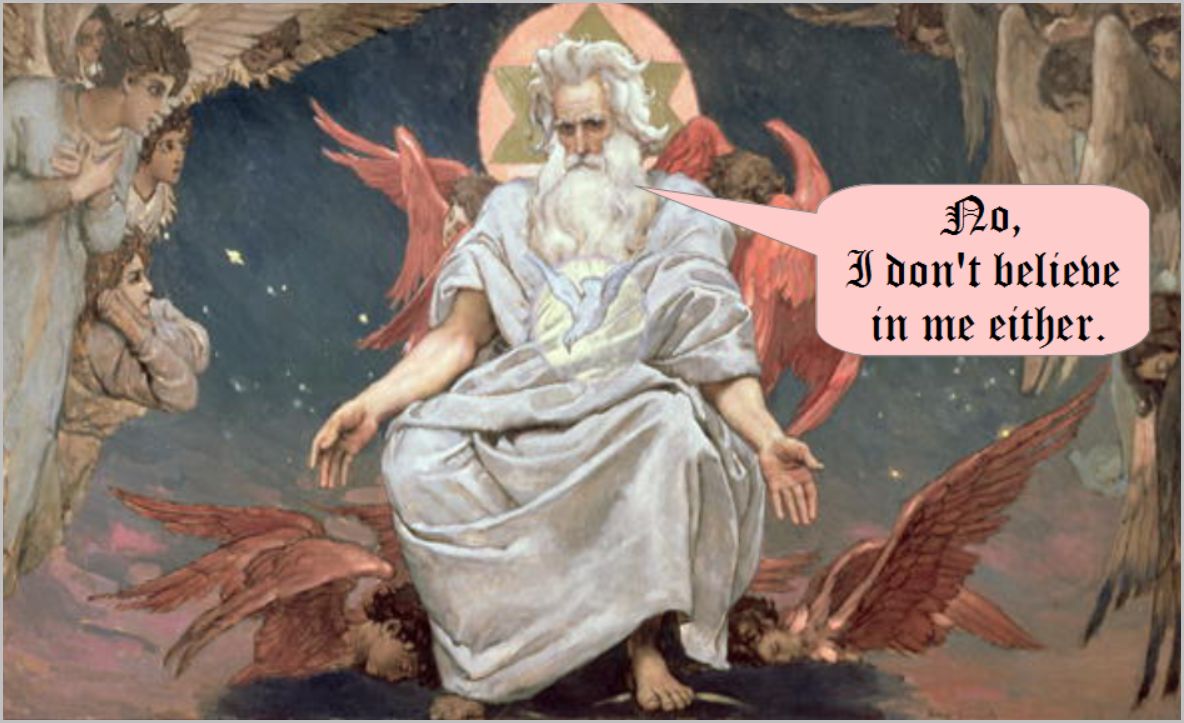
atheism-1Given that atheism exists whether Christians condescend to believe in it or not, I want to explain how you can be both an atheist and agnostic.

Theism is the belief in a personal god, one that was involved in the creation of the world, has taken an interest in its development and who relates to his principal creation, humankind. This theist god has a personality of his own (they are almost all ‘male’), is hands-on, intimately concerned with people and their behaviour. I see no evidence for this type of god, for reasons I’ve explored here and here. As a result, I am an a-theist, one who denies the existence of such an imaginary being.

‘But,’ say some critics of this argument, ‘absence of evidence is not evidence of absence.’ Not so, as Irving Copi demonstrated long ago:

in some circumstances it can be safely assumed that if a certain event had occurred, evidence of it could be discovered by qualified investigators. In such circumstances it is perfectly reasonable to take the absence of proof of its occurrence as positive proof of its non-occurrence.

Without evidence there is no existence either for my pet dragon nor for the multitude of gods that humans have imagined for themselves throughout history. To claim that ‘absence of evidence is not evidence of absence’ is an appeal to faith and wishful thinking (they’re the same thing). It says in effect that just because I can’t prove my God (or Santa Claus or my dragon) exists, doesn’t mean he doesn’t. But evidence is all: an entity which cannot be demonstrated evidentially does not exist independently from the human imagination that conceives it.

For my part, I’m also an anti-theist, which does not mean, as Christians like to claim it does, that I’m in rebellion against God – just as Christians themselves are not ‘in rebellion’ against Allah, Vishnu or Santa Claus. It isn’t possible to rebel against fictional characters. It is possible, however, to oppose the mumbo-jumbo that has accumulated around them and the irrational belief and unreasonable behaviour which that engenders. This is what it means to be anti-theist.

Deism is the belief in an impersonal god. It is a hypothetical entity that may or may not exist and is entirely unknowable, which is why I use ‘it’ to describe it because it would be impossible to know, if it does exist, whether it is male, female or something else entirely. While there is an absence of evidence for this type of god too, it is more difficult, because of its hypothetical nature, to demonstrate in the same way as for a personal god, that it doesn’t exist. It easier to refute the supposedly known features of a theist god, than it is the unknown qualities of the unknowable. So, I concede this impersonal deity may exist somewhere. I’m almost entirely certain it doesn’t, because absence of evidence is, after all, evidence of absence, but it could and I have to acknowledge that remote possibility. In this minimalist sense I am agnostic. I don’t, I stress, believe in this only remotely possible god; it is so hypothetical and inconsequential it might as well not exist, if it in fact it does. The concession I make that it may have a presence in some distant part of the universe, or possibly out of it, makes no difference to my life, beliefs or behaviour.

So, it is possible to be an agnostic atheist; to deny the existence of personal gods like Yahweh and Allah on the grounds that there is no evidence for them, while admitting to not knowing whether an unknowable god exists.

Even though it doesn’t.


When it’s Gone, it’s Gone

JudgementAs you’ll see in comments to previous posts, Christians like to encourage gambling. Recycling Pascal’s wager, they say things like ‘if I am wrong then I have based my life on a false premise and have ceased to exist. I won’t even have the opportunity to express regrets. However, if you are wrong, having rejected Christ, you, sadly, will have quite a while to weep, wail and gnash your teeth.’

The old faith-as-insurance-policy argument. Rather like the Chance card in Monopoly that lets you avoid jail, it offers you the chance to escape hell, where all this gnashing is supposed to occur, by the simple expedient of holding a particular set of beliefs in your head.

Surely this hedging of bets doesn’t impress God, the supposed creator of the universe, Father of mankind and judge of all the Earth. He won’t really be taken in, will he, on that great and dreadful Judgement Day when we admit, ‘actually, I only believed in you so you wouldn’t send me to hell’? Maybe he will, being a God without discernment or insight. It’s certainly all that evangelical Christianity has to offer – just ask my preacher friends – a Get Out Of Hell Free card. Which is a long way from what Jesus taught about the coming Kingdom and how to be part of it; not, in his case, by believing the right things but by doing them (Matthew 25.31-36).

What if I am wrong, though, as Christians think? Then I could be in trouble. But so might they; they could find they’ve gambled on entirely the wrong God (curse you Pascal for not thinking of that!) and find themselves up before Allah or Vishnu once they’ve miraculously survived death. ‘Wrong God, mate,’ Allah will have to tell them: الله خطأ، تتزاوج . What then?

And given that they think eternal life awaits them, why are so many Christians fearful of leaving this life? Could it be because they’re not convinced that the gamble is going to pay off? They know intuitively that this life is the only life they’ll be getting – and that when it’s gone it’s gone, as it says in Poundland. That will be why they mourn their brothers and sisters in Christ who ‘pass away’; “sorry to hear about your loss,” they say, when according to their magic betting slip it’s no loss at all but an immortal gain.

So I’m confident I’m not wrong. The odds are in my favour; the evidence is on my side. Consider, if you will, Christians:

  • Every single human who has ever lived has died, or will die, and has ceased to be in their entirety;
  • No human has ever lived again after death (not even Jesus who wasn’t, according to you, properly human anyway and so doesn’t qualify.)
  • No human has ever lived forever;
  • There’s nothing on the other side – no judgement, no Heaven, no Hell, no eternal life – because there is no ‘other side’.

If any of you would like to demonstrate that these assertions are wrong, please do. All I ask is that you bear in mind that insisting they’ll happen at some point in the future because the Bible says so, is not evidence; it’s wishful thinking. Which is pretty much where we came in.

All is vanity.

Idiotic Stuff Jesus Said 12: My words will never pass away

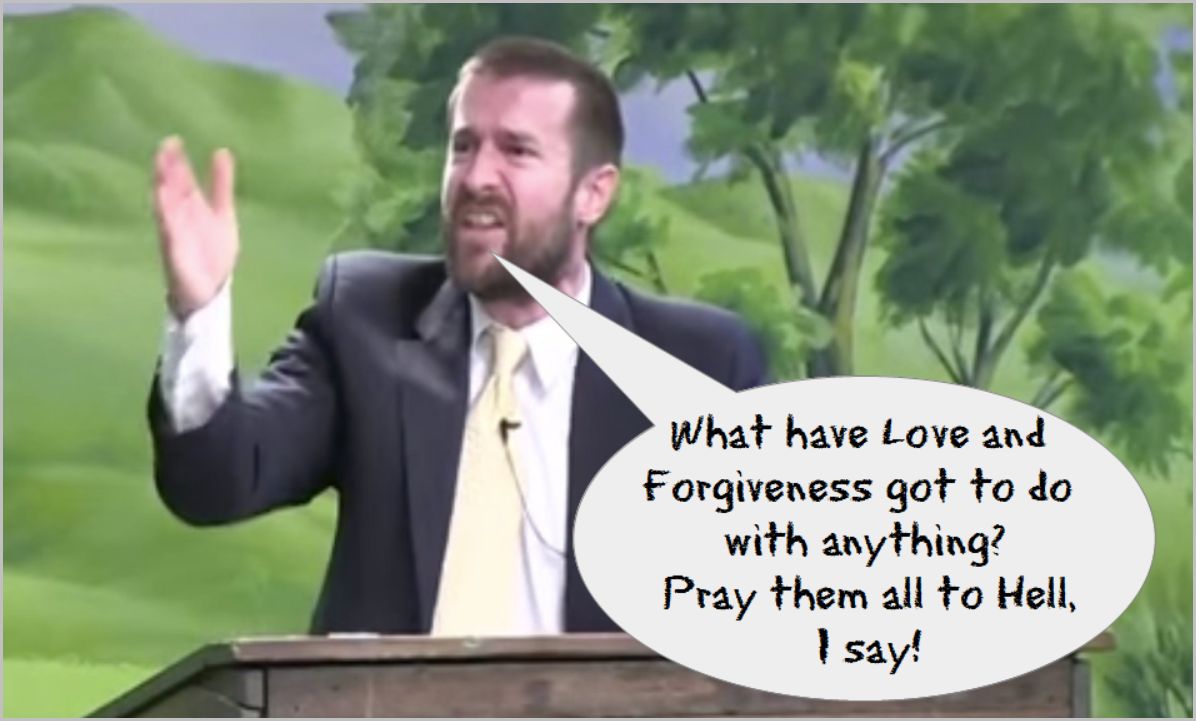
AndersonThe premise of my first ‘Jesus’ book* is that while Christians profess to believe in Jesus, they choose to ignore most of what he taught while he was alive. While they claim a vapid super-hero Christ as personal saviour, they replace what the human Jesus had to say with words of their own choosing. In reality, they have about as much time for Jesus’ ‘eternal words’ as the average non-believer or atheist. You don’t have to look very far to see how much his words have already ‘passed away’:

Jesus said, ‘Don’t judge so that you won’t be judged’ (Matthew 7.1). Our representative Christian says, ‘LGBT people are filthy and wrong.’

Jesus said ‘Love your enemies, pray for those who persecute you’ (Matthew 5.44). Our representative Christian says, ‘I’m gonna pray a transgender person dies and goes to Hell.’

Jesus said, ‘Love your neighbour as yourself’ (Mark 12.31). The Christian says, ‘The way to show love is to tell other people they’re going to Hell.’

Jesus said, ‘sell all you have and give to the poor’ (Mark 10.21). The Christian is concerned about where to buy jewellery: ‘…somewhere other than Tiffany’s, because Tiffany’s is gay friendly.’

Jesus said, ‘Forgive those who sin against you so you can be forgiven yourself’ (Matthew 6.14). Our believer rants, ‘LGBT people should be executed.’

Jesus said, ‘Don’t commit adultery and don’t get divorced’ (Matthew 5.27-28 and 19.9). Significant numbers of Christians , including our own Stephen Green, say, ‘that doesn’t apply to me.’

See what I mean? Christians regard the words of their saviour, not as having everlasting value, but as if they’re nothing more than worthless bits of fluff. Even if God were real, every word of the Bible true, every aspect of the Great Salvation Plan genuine, it wouldn’t change the fact that believers treat as optional almost everything Jesus commanded and live as if he never had.


* Why Christians Don’t Do What Jesus Tells Them To …And What They Believe Instead is available from Amazon worldwide (UK here, US here) but not, alas, from Tiffany’s.

The picture shows the deplorable Pastor Steven Anderson (linked above). He knows better than Jesus ever did.


Christians’ Favourite Delusions 34: Atheism is a Religion

NoGodChristians like to claim atheism is a religion. It’s their way of saying, ‘look – atheists are as daft as we are. They believe in bullshit just like we do, except, of course, they’re wrong and we’re right.’ You can see them saying just this here and here and here.

But atheism isn’t a religion, any more than not collecting stamps is a hobby, as Penn Jillette puts it. It isn’t a religion because it is the absence of belief – primarily in a god, but also in any other kind of supernatural being. The atheist knows there are no saviours, angels, devils, demons, ethereal saints or eternal prophets, and no heaven and hell to house them either. Atheism is devoid of any sort of worship of imagined supernatural beings; nor does it address them, commune with them or otherwise revere them. It does not recognise the authority of ‘holy’ books nor that of self-appointed spiritual authorities, including popes, pastors, preachers, imams, mullahs and rabbis. It doesn’t regard anything as sacred, including its own experts; neither Darwin nor the so-called New Atheists are above criticism. (Try that with those who think they represent God’s Truth™!)

Where religionists build their belief systems on the insubstantial foundation of faith, atheists accept nothing on trust. Instead, they look for evidence to support their knowledge and value reason, not dogma – things that are anathema to religion.

Given, then, that atheism is the antithesis of religion and that atheists don’t do what religion demands, it is intellectual dishonesty to insist that atheism is a religion. Those who do so are false witnesses; mistaken at best, liars for sure.

Christians’ Favourite Delusions 33: Atheists know in their hearts that God exists

DenyTwo tried cliches trotted out by evangelising (i.e. aggressive) Christians are that ‘atheism is a religion‘ and that in their ‘heart of hearts atheists know there really is a god’. Ken Ham of Answers In Genesis is fond of both assertions, as are other equally desperate promoters of unsupportable beliefs. We’ll come to the first in a later post, but here’s how Ham expresses the second:

They (atheists) know in their hearts that God exists, but they are actively suppressing this belief in unrighteousness (Romans 1:18). They fight so hard against a God that they claim doesn’t even exist because they know that He really does! We need to pray that, instead of fighting against God, these lost individuals will repent and put their faith and trust in Christ and in what He did for them.

Romans 1.18 that he cites says: For the wrath of God is revealed from heaven against all ungodliness and wickedness of those who by their wickedness suppress the truth.

Assuming Paul is saying here what Ham claims he is (it’s doubtful from this verse alone) both he and his hero are demonstrably wrong – as they are about so much. The evidence suggests that while young children look for meaning and assume agency, they do not necessarily attribute these to a god until they are taught to do so by others. The god they then come to acknowledge is the one already prevalent in their social environment. In a predominantly Christian context, they will come to be acquainted with – and may go on to develop a full-blown belief in – the interpretation of the Christian God common within their particular culture.

It is the same for conversion generally. You are more likely to be a Mormon in Salt Lake City, a Roman Catholic in East Timor. If raised in a Jewish environment, it’s more likely you’ll subscribe to YHWH; in an Islamic one, an interpretation of Allah; Buddha – not strictly speaking a god – in a Buddhist one. Statistically, those who adopt a religion and a belief in a god, almost always opt for that which is prevalent in the society into which they are born. This is not god ‘writing a knowledge of himself’ in their hearts, it is a cultural, human phenomenon.

Ham and others see this as evidence for their belief that we all have some sort of ‘god-shaped hole‘ in our psyche that we can just as easily fill with false gods as with the real one (theirs). But this is a shift in the argument; it’s not now that God makes himself known to everyone but that we all find a need for a god. This is not the same thing, nor is it true. Certainly humans have a history of creating gods to explain the strange, magnificent and sometimes hostile universe in which we find ourselves; but this does not mean these many gods exist, as Ham would be the first to admit (c’mon, there’s only one real God – his.) It means only that the human brain seeks pattern and meaning, and has often drawn the wrong conclusions in its quest for them. The gods – and God – are part of these wrong conclusions.

And what of Ham’s assertion that atheists deny their awareness of God because of ‘unrighteousness’ – because, he implies, we just want to live a life of rampant ‘sin’? Well, I admit, I like a bit of a sin as much as the next man, but that’s not why I’m an atheist. I’m an atheist because, like most others, I find no evidence for gods or God either in my ‘heart’, nor in the way the world works nor in collections of iron age stories. Morality doesn’t come into making this assessment. In any case, those who buy into a god don’t have a monopoly on ‘righteousness’, as their weak morals, judgemental attitudes and destructive behaviour regularly demonstrate. More than this, and as Ham admits, Christians are only concerned about others because the Bible says they should be: ‘The reason I care about poverty,’ he says, ‘is because God’s Word instructs me to care, and all humans are made in the image of God as God’s Word tells me.’ This is not righteousness, nor a morality that comes from any real concern for fellow human beings.

Finally, atheists don’t, as Ham claims, ‘fight so hard against’ a non-existent God that we secretly believe in. We oppose Christians and other purveyors of supernatural nonsense when they try to impose their irrational beliefs on others, when they condemn fellow human beings, seek to control them and try to limit their rights in the name of God and the cause of ‘righteousness’.

So, no, don’t condescend, Christians, to tell us we all know that there’s a God that we wilfully ignore. You’re wrong, and I’ll show you even more reasons why you are, next time.

For God So Loves The World

NepalFor God so loves the world he let an earthquake and its many aftershocks kill up to 10,000 people in Nepal.

For God so loves the world he stood by while up 100,000 more people lost everything, including their homes, because of the same earthquake.

For God so loves the world he drowned 900 refugees fleeing the terrors of war in their own countries.

For God so loves the world he allowed 250 individuals to be killed by a rogue pilot who flew the plane they were on into the side of a mountain.

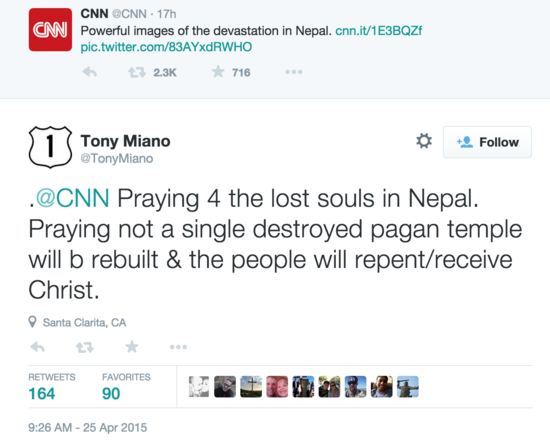
But wait! One particular Christian preacher knows why this kind of thing happens. He can explain how these catastrophes, particularly the devastation caused by the earthquake, are compatible with a God of love. Here’s what it’s really all about:
Tweet

That’s right. God only allowed these terrible things to happen so that more people – excluding the ones he murdered, obviously – would have the chance to turn to Christ. Isn’t that marvellous? And Tony Miano, who is the same lunatic street preacher arrested in London in 2013 for sharing God’s ‘love’ for LGBT people, is not alone. German pastor Wolfgang Wegert said much the same thing of those who died on Germanwings Flight 9525: ‘A plane crash is a reminder of our own mortality. By that, God wants to make people repent, so that we (can) be saved by Jesus.’

And, do you know, they’re right. No, really, they are. There is no other response available to the Christian who wants to explain events that involve the terrible loss of life. That’s because the Christian God, the one who purports to love us so much, as well as all the other versions, is conspicuous by his absence. He’s always absent, always powerless to prevent such disasters, too remote to want to. Which might just suggest he doesn’t exist (which of course he doesn’t) leaving those who feel the need to cling to belief in him to explain his actions or, rather, the lack of them. So they supply him with an ulterior motive. And why not? A fabricated being needs a fabricated excuse. But this being the real world, the options are limited. So what we get is this; God is only trying to draw people to him. How truly loving. The equivalent of a human father murdering several of his children so that those he spares might love him more. A monstrous and preposterous idea for a monstrous and preposterous God.

And so it falls to human beings of all persuasions to show compassion and to help the survivors of earthquakes, the relatives of plane crashes, the misplaced and grieving refugees. We might be flawed, fallible and – according to the self-righteous – ‘sinful’, but we can at our best, demonstrate the love so lacking in their absent deities. And unlike the many meaningless gods, from Yahweh and Jesus to Allah and Vishnu, we can be present too, because we are real.


You can donate to the Nepal earthquake appeal here.

There Is No God. And Here’s Why

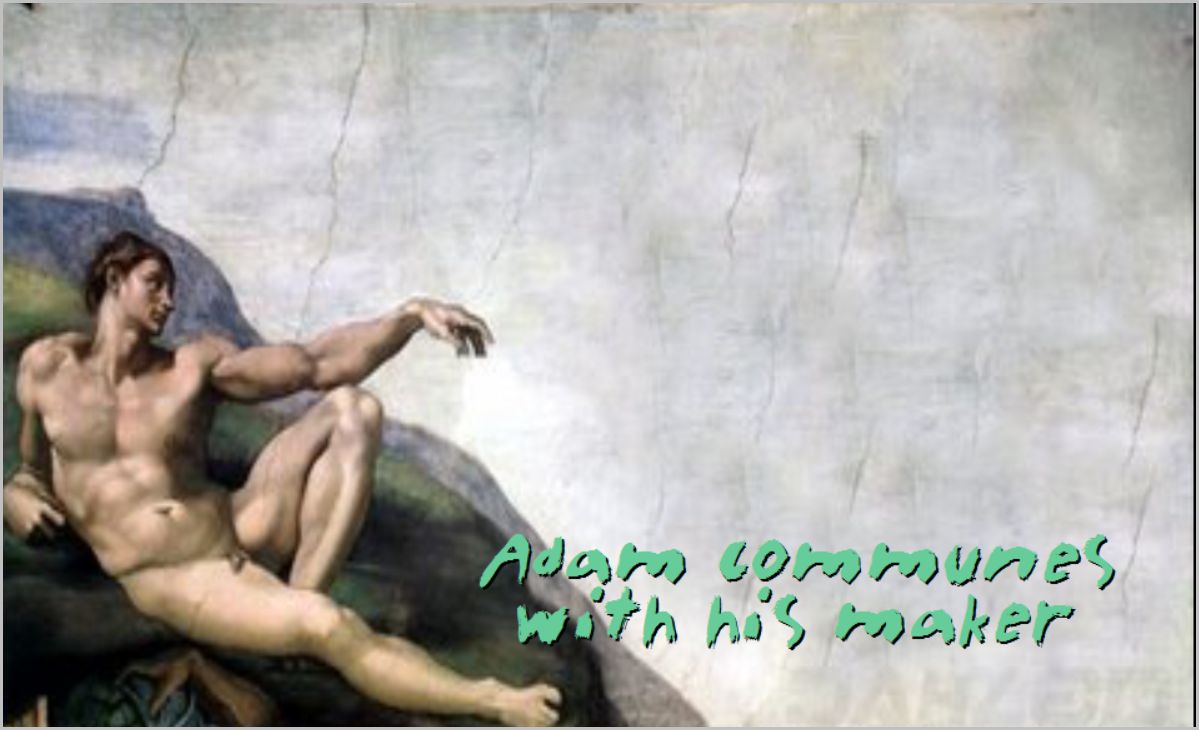
adamSometimes I wonder why I continue writing this blog. There seems to be little that can shake believers from their delusions; what I write here doesn’t appear to be it. When they do respond it’s to tell me that I’m in for a shock when, after my death, I stand in front of the the throne of God and have to give an account of myself. I’ll not be smiling then, they tell me. They’re right, I won’t be. Not because of any ‘judgement’, but because dead people don’t smile. Not of their own volition anyway.

Christians can’t seem to see the ludicrousness of their post-mortem proposals. Religion, all religion, is wrong about most things at most levels; it denies death, which does exist, and replaces it with fantasies about supernatural beings, eternal life and judgements, none of which does. Christianity offers false promises, failed prophecies and an impossible morality, which Christians themselves can’t even manage. By and large they don’t even try to (see previous posts on all of this) yet they stick uncritically, unthinkingly, blindly to the fantasy elements of their ‘faith’ because they’re frightened of their own extinction and want to live forever. Christianity deceitfully promises them that they will – the ultimate false promise.

So let’s cut to the chase. There is no God. This is an indisputable fact, though believers will dispute it anyway. Even now, any Christians who are reading this will be muttering something about the fool saying in his heart there is no God; another tired, cliched response, which I’ve already considered here. But there is no God, not because of any foolishness on my part but because of the evidence. Or rather the absence of it. There is no evidence there is anything other than the physical universe or that life came about as the result of anything other than physical processes (it is not the case that scientists do not know how life emerged from non-life; they do and it did) or that humans evolved by any means other than blind, mindless natural selection. God is not required to explain any of this; not necessary to explain anything at all to do with life, the universe and ‘why there is something rather than nothing’. That being the case, we can know for certainty that he wasn’t in any way involved.

Let’s take a more down-to-Earth parallel to illustrate the point: we do not need to resort to stories of the tooth fairy to explain dentistry. I’m guessing that even Christians would agree with this; the tooth fairy has no part in matters of dental hygiene, orthodontist training or even the payment sometimes made by indulgent parents when their child’s tooth falls out. Trying to force the tooth fairy into any of these scenarios is not only entirely unnecessary, it’s erroneous and unhelpful. Dentistry is far better explained without reference to a mythical sprite. The tooth fairy not being needed, we can safely conclude that she doesn’t actually exist; she is a figment invented for children intended to take the away the pain of tooth loss, nothing more.

So it is with God in explanations into which he too is shoe-horned. He’s not needed, he’s superfluous to requirements. That being so, we can similarly conclude that he isn’t real either. A being that isn’t needed to explain anything is one that doesn’t exist.

This is not, note, a rejection of a figure who, even now, is sitting up in the sky somewhere feeling sad or angry because we’re ‘shaking our fist’ at him. If that’s what you’re seeing, you’re still believing in God, even if it is one you might be in the process of rejecting. It’s worse than that, Jim (or better): there is no super-being in the sky, or anywhere else. The universe is devoid of gods and of God; it always has been and always will be. There are none to be found because there are none there; not your pet god, nor those of other faiths, ancient or modern. None. There is only the physical universe itself and for the brief time we are here in it, we are lucky to be here in it. Which is more than any god has ever managed.

All gods must pass

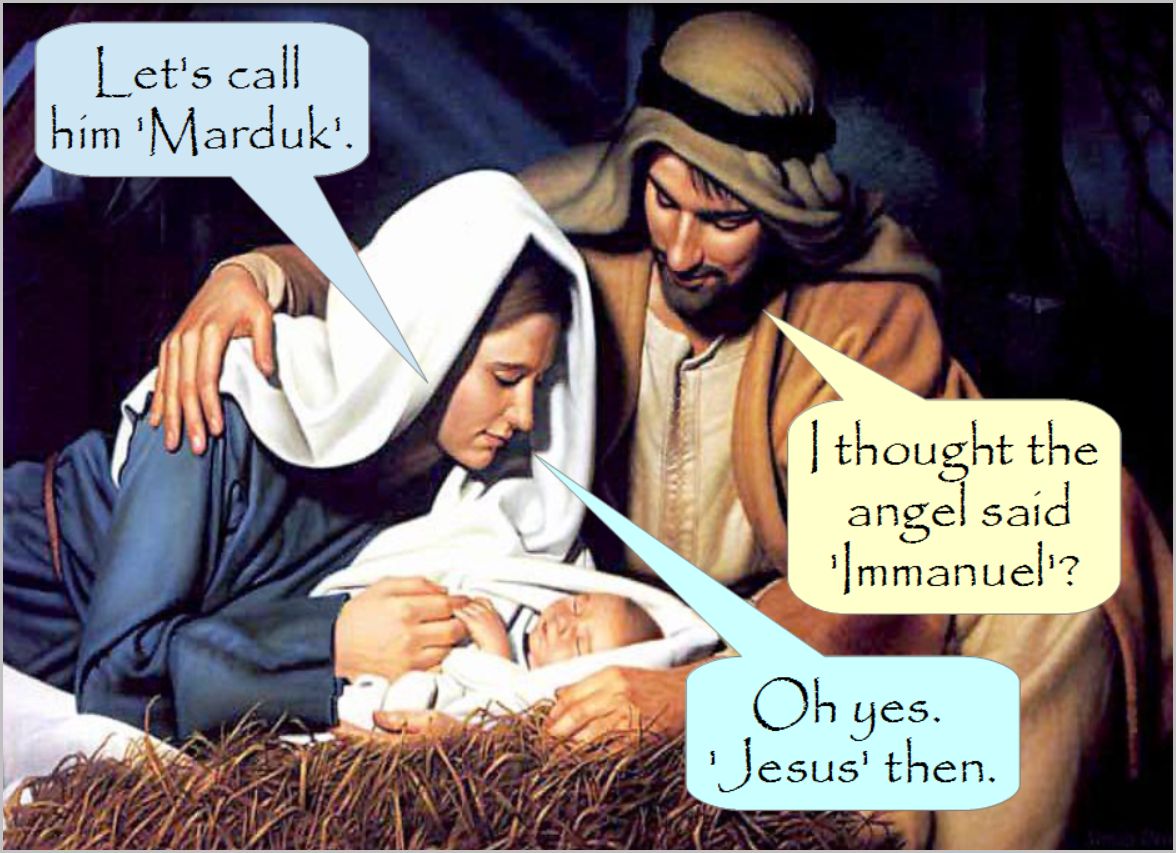
MardukIf human beings were suddenly wiped from the earth through, say, an Ebola pandemic, what would be left of us? What would become of all the things we’ve invented and created? What would happen to language, mathematics, science, literature, medicine, art, agriculture, architecture, democracy, industry, capitalism, civilisation, education, marriage, religion?

They’d all cease, most of them immediately. Remnants of others would survive for a little while before being reclaimed by nature. The surviving flora and fauna, the weather, climates, oceans, land masses would carry on just as before. Indeed, without humans around to abuse it both carelessly and deliberately, the rest of nature would flourish. Reproduction, evolution and the great cycles of life would continue unimpeded.

Which tells us what? That all of our accomplishments and preoccupations, from language and mathematics to marriage and religion are entirely human-made. When we go, they go. And nothing left behind will care. Our religions, all 4,200 of them, will disappear over night and with them their gods; Yahweh, Allah, Vishna will no longer exist, just as Marduk, Anu and Enlil no longer exist.

You’ve never heard of Marduk, Anu and Enlil? Of course not; this particular holy trinity were among the gods of ancient Babylon, a civilisation that existed two thousand years before the Christian God was even thought of. Their worshippers believed in them as enthusiastically as some people now believe in Jesus. For Babylonians, Anu, Enlil and Lord Marduk, the King of the Gods, were just as real, powerful and caring as Christ and Allah are for believers today.

But Enlil, Anu and Marduk have gone. From our vantage point we know they didn’t exist in the first place. They were nothing more than the product of ancient people’s imaginations. That didn’t stop those same people from having real faith in the three of them, praying to them and knowing in their hearts that they were being watched over by them. But as their civilisation fell, the Babylonians discovered that Marduk and company weren’t there to defend and preserve them. When, in 539 BCE, Babylon finally ceased to exist, so too did its mighty gods.

And so will the mighty gods of our own era. Either when a pandemic destroys us or when we destroy ourselves, or even when – as unlikely as it might seem – we come to our senses and abandon belief in made-up things.

However it happens, there will be no repercussions. Yahweh, Christ, Allah and Vishnu will not smite the Earth in their wrath at our abandonment of them. They will, instead, pass silently from history just as Marduk, Anu, Osiris, Zeus and Woden did before them.

If you still cling to human-made deities – and they’re all human-made – why wait? Why not be ahead of the game and let go of them now? Allow your pet god to go gently into that good night. You’ll not miss him, and he certainly won’t miss you. How can he? He’s not real, after all.

 
This post was prompted by Sapiens: A Brief History Of Humankind by Yuval Noah Harari.


Respect?

HebdoI could so easily take offence at this. (The caption reads ‘But who wants the English in Europe?’)

How far should we respect religious beliefs? I would suggest, not at all. The multitude of religions that exist in the world, not least the big five – Christianity, Islam, Buddhism, Hinduism and Judaism – are all built on mythologies that require belief in supernatural beings, highly improbable events and meaningless rituals. There is no evidence these beings exist or have ever existed, no evidence the improbable events ever occurred and none that the rituals lead to results of any sort.

Most religions have their revered teacher, prophet or saviour who died centuries or millennia ago, and about whom stories are told that cannot possibly be true. How can any thinking person respect the idea that one of these figures rose from the dead? Or that another flew to heaven on a winged horse? Or another grew a jewel tree from a toothpick? These stories deserve as much respect as other ancient tales – like the one about the man who killed a one-eyed giant or the dude who returned to life after being hacked to death and eaten. The preposterous stories told by today’s religions are of the same order.

For this reason, as well as many others – not least how religion causes some of its adherents to act and relate to others – religion is not above criticism. Indeed, there is a moral imperative to criticise world views based on far-fetched stories, especially when they cause some who subscribe to them to discriminate against others, advocate murder and  take it upon themselves to carry out executions like the ones we’ve seen in Paris this week. I’ve written before about how, while most religious believers are not themselves extremists, it is moderate believers who sustain the culture responsible for those who are. Fanatics, extremists and terrorists do not spontaneously create themselves; they emerge from mosques, churches, synagogues and temples. As Bill Maher said about Islam this week, ‘when there’s this many bad apples, there’s something wrong with the orchard.’

While some have argued that the magazine Charlie Hebdo provoked Muslim extremists to attack it with its satirical drawings of Muhammed (among many other religious ‘leaders’) it is absurd to suggest that publishing provocative pictures automatically leads to murder, as if the perpetrators have no choice in the matter. Of course they do. Caricatures of the pope have also appeared on the magazine’s cover and, as bizarre as the Catholic church is, it has not responded to these depictions with violence.

There is, in any case, a good argument to be made that offence can’t be given, only taken. While no doubt there are Muslims who don’t find rather poorly drawn, largely unfunny cartoons of Muhammed offensive, there are those who choose to. (Just like I could choose to take offence at the cover above.) But provocation, whatever the context, is no defence and no excuse for the slaughter, violence or incarceration of those with whom we’re offended.

The religious need to grow up and put away childish things; to stop taking offence so readily, insisting they’re being persecuted when they’re not and constantly assuming they and they alone have the right to mete out punishment. Is the god each religion claims for itself so weak and feeble he cannot look after himself, his standards and his reputation?

Well of course he can’t, because he doesn’t exist. Every god there has ever been, from Osiris to Christ, from Zeus to Allah has been a human invention. And if no god exists, then neither do his standards and reputation, nor his prophets and teachers, his Sons and emissaries; they’re all largely made up too. No-one should be punished for failing to respect the figments of primitive people’s imagination. It is beholden on all of us who have indeed put away such childish things, to disregard the sensibilities of those who subscribe to and peddle puerile nonsense and point out as often as we can that not only does the Emperor have no clothes but there’s not even an Emperor. Only then can the world work towards being free from the tyranny of religion.

Simplistic maybe, but the alternative is to continue tolerating the intolerable. And look where that’s getting us.

Predictions for 2015

BrideMy predictions prophecies for the year ahead:

1. There’ll be no Second Coming in 2015.
Jesus won’t be back this year. Just like he wasn’t back in 2014, 2013, 2012… 1985… 1914… 1868… 1497… 1000… 446… 35. Just think of all those years – count ’em, nearly two thousand – when he’s failed to return so far. Actually, he promised he’d be back while his disciples and those daft enough to listen to him were still alive – around AD30 or thereabouts (Matthew 16:27-28; Matthew 24:27, 30-31, 34; Luke 21:27-28, 33-34). Safe to say he’s not coming back at all now, just like dead people don’t. Not in 2015, not ever.

2. Christians will go on insisting Jesus is going to return any time soon.

3. There’ll be no natural disasters or human calamities as a result of same-sex marriage.

4. Christians will claim natural disasters and human calamities are the result of same-sex marriage. Shaking our fists at God… the wrath of the Almighty… sign of the End Times… blah, blah, blah.

5. More than one prominent Christian will call for the execution of gay people.

6. Christians in the west will claim they’re being persecuted when they’re being expected to treat others fairly and equally, and not to discriminate against them.

7. Christians will respond to criticism with clichés like ‘they wouldn’t dare say that about Muslims’… ‘Christians are the last group who are fair game’… ‘It’s time for Christians to speak out’… ‘Stand up for God’s standards…’ etc.

8. Christians will continue to dismiss and disparage anyone who doesn’t share their views, especially atheists. Look out for ‘atheists have no morality’, ‘the fool hath said in his heart there’s no God’ and ‘atheists want to oppress Christians’ occurring with tedious regularity.

9. There will be more revelations about the abuse of children by church ministers.

10. Church hierarchies will attempt to cover up the abuse of children by their ministers.

11. There will be the usual manufactured ‘war on Christmas’.

12. These predictions have far more chance of coming to pass than any of the so-called prophecies of Bible. I’ll return to them at the end of the year so we can see.

A happy new year to you all!


Original picture: Ursula Klawitter / zefa / Corbis