Stories about Jesus

Our resident Christian implied recently that I disputed that stories about Jesus existed prior to the gospels being written. I don’t – this was another of Don’s straw man arguments – and told him that of course there were earlier stories about Jesus. But then I got to thinking: where exactly are those stories? How do we know they existed? How can we distinguish them from later embellishments?

Let’s take a look at the evidence*, starting with the earliest Christian writing that we have:

Paul

Paul doesn’t refer to a single event from Jesus’ life outside a barebone account of the crucifixion and resurrection. He doesn’t mention, for example, the nativity, the virgin birth, Jesus’ time in the wilderness, his chat with the devil, his baptism, John the Baptist, the miracles, the amazing things Jesus is reputed to have said, the parables, the Sermon on the Mount and Beatitudes, the I Am sayings, the healings, Lazarus, the arrival in Jerusalem, the cleansing of the Temple, the agony in the Garden of Gethsemane, the arrest, Judas, Pontius Pilate, Jesus’ trial, the mockery of the soldiers, Peter’s denial, the words Jesus spoke on the cross, Joseph of Arimathea, the rolled away stone, the empty tomb, Mary Magdalene, Doubting Thomas or the physical Ascension. Neither does he refer to any incidents or episodes from stories that didn’t eventually make it into the gospels. Not one of them. (He does create a narrative of his own that later finds its way there: the ritual of sharing bread and wine which Paul lifts from Pagan ceremonies. We’ll return to it in a later post.)

Apologists like to say that these serious omissions are no more than Paul’s assumption that his readers would already know the stories about Jesus.  He does not need to reiterate them. But no-one is suggesting he should or would have recounted them in full. What is odd and awkward is that Paul doesn’t even allude to them in his teaching. He could clinch many an argument by referring to a particular saying or miracle of Jesus’, but he never does.

When talking about obeying the (Roman) authorities, for example, in 1 Corinthians 15:12 &13, he could have said, ‘Recall that the Lord told us we should render unto Caesar that which is Caesar’s,’ but he doesn’t. He could have alluded to Thomas when explaining the importance of having faith without evidence; talked about the empty tomb when discussing Jesus’ resurrection; mentioned the raising of Lazarus as an example of the dead being resurrected; commented on Jesus turning water into wine when arguing that the Law had been superseded by a new covenant. He might even have quoted something Jesus said from a story in circulation that didn’t later end up in one of the gospels.

He doesn’t. Ever.

Paul claims he received none of his information about Jesus from any human being. He insists he received all he knew through revelation – the Lord speaking to him from heaven. Apparently, the Lord neglected to convey any of the details of his life on Earth. The apostles kept equally schtum. Paul was no more knowledgeable about the life of Jesus once he’d he met them than he had been before. Was he not inquisitive? Did he not ask the right questions? Did they dislike him so much they withheld every detail of Jesus’ activities on Earth? Did they not in fact have that kind of information? Whichever it was, Paul seems not have known any of the stories about Jesus that predated the gospels or even that later appeared in them. It’s possible, I would say likely, he did not know of them because they had yet to be created. Many of the stories about Jesus were ten or more years away.

But we mustn’t jump to conclusions. Next time we’ll take a look at other possible sources of these elusive stories.


*I read Bart Ehrman’s Jesus Before The Gospels a few years back. I hope I’m not merely reiterating what he says there. While there were some points I found less persuasive than others, Ehrman nevertheless does a good job of showing how stories about Jesus changed and evolved over the years.

The Evolution of Jesus II: from Life Giving Spirit to God the Son and beyond.

A couple of decades after the first visions of a risen Jesus, a Jewish zealot called Saul decided he’d seen him too. He came to imagine a vision he’d had in his head was this same Jesus, who then revealed to Saul – all entirely within his head as he admits – what his death and return from the dead really meant. Paul, as he renamed himself, announced that God had decided Jesus was a good man and returned him to life after his execution. In doing so, God made Jesus his Son (you can read all this poppycock in Romans 1:3-4). Jesus was now a life-giving spirit, the Saviour Christ: 1 Corinthians 15:45. (Maybe though Jesus always had been this; it’s kind of confusing, but in Philippians 2:6-8 Paul seems to think Jesus was some sort of quasi-divine being from the get-go. Take your pick. Whatever.)

Memetic selection ensured the survival and perpetuation of Paul’s bizarre idea, one that was, after all, not unfamiliar to the Hellenised people of the first century. The superstitious embraced and transmitted it without knowing a thing about any itinerant Jewish preacher. 

The next stage of Jesus’ evolution came twenty or so years later, when a believer we now know as Mark decided to write a back story for this Christ. He created his story using Jewish scripture, Paul’s ideas and the rules of the sect to which he belonged. Who knows if Mark believed Jesus had ever been a real person who trudged around Palestine preaching the good news about the end of everything, but in Mark’s story he had him do just that. He decided, crucially, that he wouldn’t have Jesus become God’s adopted son at the time of his spiritual resurrection. Instead, Mark had him become God’s son at his baptism (Mark 1.10-11).

This wasn’t quite good enough for the next two cultists who attempted a Jesus narrative. While they plagiarised much of Mark’s story, they changed details and made up more for Jesus to say and do. Importantly, where Mark had avoided suggesting Jesus’ resurrection appearances had occurred in the real world, Matthew and Luke showed no such reticence. Their Jesus(es) showed himself not in visions but in the flesh. It’s likely Matthew at least knew he was creating a symbolic, literary representation of others’ visions.

At the other end of the story, Matthew and Luke invented largely incompatible birth stories for their hero. For Matthew, Jesus was the Messiah from the time he was born, fulfilling all the prophecies Matthew borrowed to create his nativity story (he doesn’t: the Messiah, according to the very ‘prophecies’ Matthew manipulates is not divine but a human warrior).

Luke, on the other hand, is determined to push Jesus’ divinity even back further. For Luke, Jesus became divine when God magically made Mary pregnant; Luke’s Jesus is quite literally God’s son (Luke 1.35). Unfortunately, Mary forgot all about being impregnated by the Holy Semen Spirit later on in Luke’s ridiculous story. Nevertheless, Jesus’ status had evolved again; he’d become God’s son from the very moment of conception.

Even this was not good enough for the next version of the Jesus’ story. The writers of the fourth gospel decide to make him eternal and part of God himself. Plundering Greek philosophy and Paul’s ruminations from Philippians, they declare Jesus the ‘Logos’; the Word or aspect of God responsible for the creation of everything (John 1:1-5). And despite this being as far from an itinerant peasant preacher as it’s possible to be, even more gullible folk came to believe it.

Jesus’ evolution was still not complete, however. The council of Nicaea in 325 decided that Jesus was ‘begotten not made’ (whatever that means) – but couldn’t quite decide whether being the Logos and the Son of God actually made Jesus God Incarnate. It wasn’t until the Council of Constantinople in 381 that a collection of bishops decided Jesus was, after all, officially part of the Godhead. The apocalyptic preacher from the backwoods finally became God the Son, a mere 350 years after he lived (if indeed he did).

Jesus has continued to evolve ever since, becoming all things to all people; a God pliable enough to be whatever his followers want him to be: Roman Catholic, Greek Orthodox, Russian Orthodox, Evangelical, Mormon, fringe cult. He’s evolved into a schizophrenic deity capable of being both meek and mild and bellicose; best buddy and chief executioner; Christian Nationalist, socialist and capitalist, gay and anti-gay, pro-family and anti-family; anti-abortion and pro-gun; environmentalist and iconoclast; the one who promotes a prosperity gospel and the ‘One True God’ known (only) to a select few. Every contradictory manifestation is supported by the Bible, the Church or tradition. Every one is non-existent and ultimately pointless.

That’s some evolution.

The Evolution of Jesus I: from Itinerant Preacher to Death-Defying Vision

Image by Doppler, from YouTube video The Evolution of Jesus Christ.


Everything evolves. Not just Life, but the Mind, Personality, Morality and Culture. This is the thesis of Matt Ridley’s book, The Evolution of Everything: How Small Changes Transform Our World, in which he demonstrates that everything, from the Economy and Technology to Government and Education, were originally, and to some extent remain, bottom up phenomenon. Each emerged because of the developments that had preceded them; for this reason, they couldn’t arrive before they did, but their arrival, when it came, was inevitable. The time was right. Once each did arrive, it embarked on an inexorable process of change. It evolved.

‘Everything’, of course, includes Religion. As Ridley says (p259):

Further evidence for the man-made nature of gods comes from their evolutionary history. It is a little-known fact, but gods evolve. There is a steady and gradual transformation through human history not only from polytheism to monotheism, but from gods who are touchy, foolish, randy and greedy people, who just happen to be immortal, to disembodied and virtuous spirits living in an entirely different realm and concerned mainly with virtue. Contrast the vengeful and irritable Jehovah of the Old Testament with the loving Christian God of today.’

This is undoubtedly the case (Ridley presents his evidence); religion is an entirely human enterprise that developed from the bottom up. It too evolved. As Ridley shows, there is no other way.

While Ridley doesn’t discuss it, this evolutionary process applies to Jesus too. This seems to me apparent, rather than a little-known fact. He didn’t spring from nowhere; the time was right for him. By the start of what is now the first century, an apocalyptic brand of Judaism had emerged, inspired in part by the book of Daniel and other late Old Testament prophecy. It was whipped to fever pitch during the Roman occupation. People were anticipating that the Messiah would soon rescue them by force; the time was right for him to appear. And appear he did, in multiple forms, all of them eliminated by the Romans. Jesus was one of these.

He began either as an itinerant preacher with delusions of grandeur or he was an imaginary being whom a few people thought miraculously appeared to them. It doesn’t matter which; even if he existed, he very quickly evolved into a supernatural being. As an itinerant preacher he would have wandered around a small part of Palestine with a handful of followers, mouthing platitudes and predicting that God’s Kingdom would soon be arriving, and that he would be its king. Instead, he was executed for insurgency. Shortly afterwards, a couple of his followers swore they’d seen him alive again. With this claim Jesus made an evolutionary leap, from troublesome Jewish preacher to death-defying vision.

His evolution was underway.

To be continued…

Only The One Book

Some years ago I visited friends where another of their guests told me he had been reading a remarkable book. It was he said, about Atlantis and demonstrated beyond any doubt that the ancient city had really existed and had sunk beneath the ocean where it still waited to be found. I asked him how he knew this (a polite way of asking what his evidence was.) He looked at me incredulously. ‘Because the book says so,’ he explained.

It’s the same with all the claims made about Jesus: that he was the Saviour, the Messiah and the Son of God. All such claims are found only in one book written by people who already believed such things about him.

Outside of this book there’s nothing: no Roman records of his death and subsequent resurrection; no reports of post-resurrection visits by witnesses who weren’t already invested; no contemporary, independent accounts of his remarkable miracles; nothing from historians of the day about his return from the dead and subsequent ascent into the sky; no mention of him at all in any documentation for the first 80+ years of Christianity outside of this one book. The Son of God appears on Earth and nobody but a handful of superstitious zealots notice.

Not very convincing, is it? 

How The Trick Was Done

Mark 15 tells the story of the trial, crucifixion and burial of Jesus. Here’s how it was constructed from parts of the Old Testament:

Isaiah 53:7 is rewritten in Mark 15: 60-62 as the trial before Pilate

He was oppressed and afflicted, yet He did not open His mouth. He was led like a lamb to the slaughter, and as a sheep before her shearers is silent, so He did not open His mouth.

So Pilate questioned him, “Are You the King of the Jews?” You have said so,” Jesus replied. And the chief priests began to accuse him of many things. Then Pilate questioned him again, “Have you no answer? Look how many charges they are bringing against you!” But to Pilate’s amazement, Jesus made no further reply.

(Oops! Looks like we are expected to overlook the fact that Jesus does speak! Mark obviously had trouble shoe-horning this one in!)

——————————–

Isaiah 53.5 becomes Mark 15:15:

He was crushed for our iniquities; the punishment that brought us peace was upon him, and by his stripes we are healed.

Pilate had Jesus flogged and handed him over to be crucified.

——————————–

Isaiah 50:6 and 53:16-20 are rewritten as Mark 15:16-20:

He was despised and rejected by mankind, a man of suffering, and familiar with pain. Like one from whom people hide their faces he was despised, and we held him in low esteem.

Then the soldiers led Jesus away into the palace (that is, the Praetorium) and called the whole company together. They dressed him in a purple robe, twisted together a crown of thorns, and set it on his head. And they began to salute Him: “Hail, King of the Jews!” They kept striking his head with a staff and spitting on him. And they knelt down and bowed before him. After they had mocked him, they removed the purple robe and put his own clothes back on Him. Then they led Him out to crucify Him.

——————————–

Psalm 22:18 becomes Mark 15:24

They divide my clothes among them and cast lots for my garment.

And they crucified him. Dividing up his clothes, they cast lots to see what each would get.

——————————–

Isaiah 53:12 is used for Mark 15:27:

He poured out his life unto death, and was numbered with the transgressors.

Along with Jesus, they crucified two robbers, one on His right and one on His left.

——————————–


Psalm 22:7-8 becomes, verbatim in places, Mark 15:29:

All who see me mock me; they hurl insults shaking their heads: He trusts in the Lord; let the Lord rescue him. Let him deliver him, since he delights in him.

Those who passed by hurled insults at him, shaking their heads and saying, “So! You who are going to destroy the temple and build it in three days, come down from the cross and save yourself!”

——————————–

Psalm 22:1 ‘My God, my God why have you forsaken me?is lifted straight into Mark 15:34.

——————————–

Isaiah 53:5 becomes the underpinning of the whole of this chapter and Mark 15:6-15 in particular: the story of Barabbas.

Surely he took up our pain and bore our suffering, yet we considered him  punished by God, stricken by him, and afflicted. But he was pierced for our transgressions, he was crushed for our iniquities; the punishment that brought us peace was on him, and by his stripes/wounds we are healed.

The verses are not alluded to directly, but Jesus is made to stand in for Barabbas (literally, ‘son of the father’) who has deservedly been sentenced to death, or so Mark would have us believe. The story is patently invented to make this point. No such tradition existed and Pilate would never have been so placatory. The other made up story in Mark 15, the tearing of the temple veil, symbolises that the old way of accessing God, though the temple system, had now been superseded by… who else? Jesus. Ironic really when Mark plunders that old system’s scriptures for his purposes.

——————————–

Isaiah 53:9 is written up as Mark 15.43-46

He was assigned a grave with the wicked, and with the rich in his death,
though he had done no violence, nor was any deceit in his mouth.

Joseph of Arimathea, a prominent member of the Council, who was himself waiting for the kingdom of God, went boldly to Pilate and asked for Jesus’ body... Pilate gave the body to Joseph. So Joseph bought some linen cloth, took down the body, wrapped it in the linen, and placed it in a tomb cut out of rock.

——————————–

Mark 15: all of it constructed from the OT or just plain made up. You could, like gullible Christians, insist that Mark didn’t invent his story using fragments of scripture. You could say instead that these fragments were really prophecies of incidents that were to happen in the life of an itinerant preacher many years in the future. You could argue that the probably non-existent creator of the universe was all the time controlling events, dropping into ancient scriptures veiled references to tenuously connected incidents centuries later. But then you’d have to concede that not one of them is precise enough to name Jesus or indicate he’d die by crucifixion or would return from the dead after a day and a half.

Which seems to you more likely? That imprecise ‘prophecies’, which really weren’t prophecies in the first place, came true in Jesus’ life; or that Mark lifted scriptures which suited his purpose and crafted his Jesus story around them?

For me, it’s always a case of ‘seek ye first the human contrivance’, by far the most plausible and persuasive explanation of scenarios such as this.


Inventing Jesus

What do we know about the gospels?

  • The stories they tell aren’t history; none of the gospel writers cites their sources, none refers to other independent accounts of Jesus’ life.
  • None of the versions of the story are eyewitness accounts; none of the writers claims to be an eyewitness; the gospels are anonymous despite the names that were attributed to them in the second century.
  • The gospels were created decades after the events they purport to relate; there is no evidence of an oral tradition that preceded them, no guarantee such a tradition would, if it existed, be reliable.
  • None of the gospels are independent; all of them are based to one extent or another on ‘Mark’. There really is only one story with three, sometimes markedly different versions.
  • The gospels are frequently contradictory where the later writers altered or embellished Mark’s story. They are often geographically and historically incorrect, and include anachronisms.
  • Each writer presents a different Jesus, the fourth radically so; there is no way of knowing which, if any, is the most historically reliable.
  • It is unlikely the actual words of Jesus would have been preserved accurately for 40 years or more; the fact the different authors freely alter them whenever it suits their purpose tells us they did not.
  • None of the gospel writers could possibly have known exactly what was done and said in private, for example, when Jesus communed with Satan in the desert, when he was hauled off to be flogged; when he was interviewed by Pilate.
  • The authors evidently invented episodes and events; the wandering star; Herod’s massacre of Innocents; zombie ‘saints’ wandering around Jerusalem; angels at Jesus’ tomb; the resurrection itself.
  • The gospels are literary creationsstories – as their structure, editing, use of myth, tropes, symbolism, metaphor and aphorisms attest.

This is what we’re working with. So, just where did the details of Jesus’ life, as we have them in the gospels, come from? We know Matthew, Luke and John found them to differing extents in Mark’s story. Other details they invented or took from Paul. Matthew in particular followed Mark’s lead and drew even more heavily on the Jewish scriptures, the Old Testament (OT). Both Mark and Matthew rewrote sections of the OT to create most of their Jesus stories. Next time, we’ll take look at Mark 15, relating, for the very first time, Jesus’ trial, crucifixion and burial to see how it was done.

Jesus Reveals Himself To Me

A true story:

I used to have recurrent dream – at least I think it was recurrent; it may just been that when I dreamt it I also dreamt I’d dreamt it before – that I was prevented from getting home by an oversized lion that blocked my path. It did this not by baring its teeth and confronting me, but by simply lying down in front of my garden gate, apparently asleep. I was always afraid to disturb the sleeping lion in case, once awake, it attacked and ate me. Instead, I would gingerly step round it and walk on, away from my house. In a variation of the dream (I think), I’d turn around and head back the way I’d come.

Evidently, the large lion symbolised something, though I couldn’t understand what it was. Perhaps, I thought, it represented my psychic inability to be myself. After all, I experienced this dream before I came out. It was equally possible the lion was the devil, as described in 1 Peter 5:8, and Satan had invaded my dreams, was blocking access to my heavenly home. Maybe it was – shudder – the demon of homosexuality, which I knew existed because Christians said it did, driving me off the straight and narrow.

A then came the moment of revelation! Jesus is referred to as the Lion of Judah in Revelation (5.5), yea, the Kings of Kings who roars like a mighty lion (Amos 3:8). That’s when I realised that my dream lion was Jesus, protecting my eternal salvation and heavenly home from the attacks of the devil and my very own sinful nature! Why else must I take a different path or turn back, which is one meaning of repentance?

Jesus himself, the Lion of Judah, the King of Kings made himself known unto me in this dream, not once but many times. Praise the Lord! In revealing himself, the Risen Jesus was telling me that the only way to salvation was through Him and Him alone. Only He guards the way. How blessed I am to have had His very real presence in my dreams. He truly lives and has appeared to the very least of his followers – me.

There can be no other explanation for my dream experience.

Can there?

A Christian’s Circular Reasoning

Don asks:

Why is it not possible for people to see immaterial things? We see with the mind as much or more than with then eyes. If the mind can conceive of immaterial things we can see them. Often skeptics declare that what Paul saw was a hallucination. If so, he saw something that was not material. We all dream. When we do we see things that are not material. If there are immaterial beings such as spirits, why would it not be possible to see them?

Why is it not possible for people to see immaterial things? Because ‘immaterial things’ by their very nature cannot be seen. Moreover, in the sense you’re talking about – supernatural beings and places – there is no evidence they have independent existence outside the human imagination.

We see with the mind as much or more than with then eyes. The mind processes what the eyes see. Sometimes it produces, imagines, ‘sights’ for itself, as in hallucinations or dreams, but this doesn’t mean these sights are real. Indeed, they are not.

If the mind can conceive of immaterial things we can see them. You mean like ghosts, spirits from the Greek underworld and Norse gods? Of course you don’t,  though your argument applies equally to these. You mean only Christian immaterial things: heaven and hell, angels and demons and the risen Christ. This is merely special pleading.

Your assertion is patently untrue. It begs the question, ‘if the mind can conceive of ’immaterial things’ does this mean these things are real?’ To which the answer must always be ‘no’.

what Paul saw was a hallucination. If so, he saw something that was not material. Yes and yes. Paul hallucinated on more than one occasion, seeing figures and places that were not real. His seeing them did not make them real.

We all dream. When we do, we see things that are not material. A statement of the bleedin’ obvious, but yes, we all dream. Does this make what we see in those dreams real? Again, no.

If there are immaterial beings such as spirits…There aren’t. As you keep stating while failing to recognise it, they are merely figments of the imagination.

why would it not be possible to see them? Because as figments of the imagination, they don’t exist. Here’s where your ‘reasoning’ is entirely circular: the human mind can conceive of immaterial beings and places and these things can be ‘seen’ ((in dreams and hallucinations); because they can be seen they must be real. Therefore, we know they’re real because they can be seen. Can you not ‘see’ the absurdity of your position, Don?  

My 3+ year old granddaughter can distinguish between reality and figments of the imagination, fantasy and dreams. It is really is time you could too.

Redemption Songs

I was listening to some Bob Marley the other day and was struck by a line in his song ‘Get Up Stand Up’: ‘Almighty God is a living man’. He was not of course referring to Jesus but to Haile Selassie, the Emperor of Ethiopia who was still alive when ‘Get Up Stand Up’ was recorded in 1973. Rastafarians like Marley believed the Emperor would redeem African-descended Jamaicans and restore them to Africa from where their ancestors had been taken.

Rastafarians saw and still see themselves as modern day Israelites, like those in the Bible stories of Egyptian slavery and Babylonian captivity. Their perspective is reflected in songs like ‘Exodus’, by Marley, ‘The Israelites’ (Desmond Dekker) and ‘Rivers Of Babylon’ (The Melodians). Selassie himself denied being divine (‘why do you call me good, when only God is good?’) but that didn’t stop those who believed in him from making a saviour god of him. When, inevitably, he died (in 1975), some Rastas left the movement while others reinterpreted his role:

Some Rastas believed that Selassie did not really die and that claims to the contrary were Western misinformation… Another perspective within Rastafari acknowledged that Haile Selassie’s body had perished, but claimed that his inner essence survived as a spiritual force. A third response within the Rastafari community was that Selassie’s death was inconsequential as he had only been a “personification” of Jah rather than Jah himself.

It all sounds rather familiar doesn’t it? The saviour didn’t really die/his inner essence survived/his death was inconsequential. Where have we heard all that before?

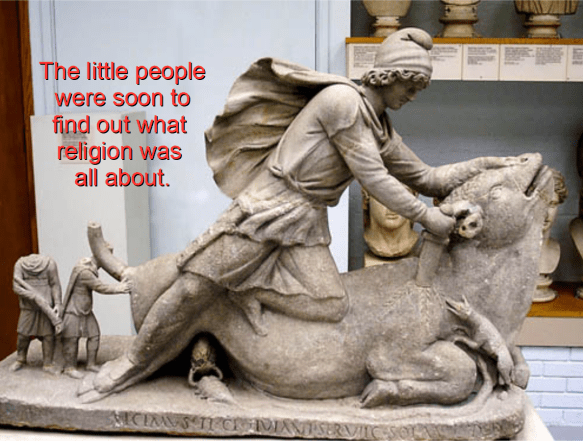
This put me in mind of a cult that for a long time rivalled that of Christianity. Indeed, in the early days of Jesus belief, it boasted more members, all of them men. Unlike Christianity and Rastafari, this cult believed in a saviour whom adherents knew had never existed as a human on Earth. Mithras was a celestial being whose salvific work, which involved the symbolic slaughter of a bull, was carried out in the heavenly realm:

Mithras is the guide of souls which he leads from the earthly life into which they had fallen back up to the light from which they issued… It was not only from the religions and the wisdom of Orientals and Egyptians, even less from Christianity, that the notion that life on earth was merely a transition to a higher life was derived by the Romans. Their own anguish and the awareness of senescence made it plain enough that earthly existence was all hardship and bitterness. Mithras-worship became one, and perhaps the most significant, of the religions of redemption in declining paganism. (Jacob Burckhkart)

Eventually, in the fourth century, Christians suppressed Mithraism to the extent that its adherents, along with its ritualistic texts, were wiped from history. Only its deserted, underground temples remained.

What both examples tell us – and there are hundreds more – is that people have always been willing and eager to make gods of revered figures, both real and imagined. They are ready to believe them capable of impossible feats and to trust in them for whatever form of redemption they feel in need of. There can be no doubt Jesus belief sprang from this same sort of wishful thinking; Jesus being cast as a divine figure with the power to lead believers into the light and/or the promised land of eternal life. It hardly matters whether he existed or not. Like Mithras, an imaginary/imagined figure could just as easily fulfil the role as a real person, like Selassie, who had others’ unrealistic expectations thrust upon him.


Jesus And The Resurrection Metaphor

While choosing Jesus quotes to use in an earlier post, it struck me how the risen Jesus never declares his resurrected status. He doesn’t say, ‘I am risen’ or indeed anything similar. Instead it’s left to others to claim, ‘He is Risen!’ That’s because the resurrection is a declaration of those others’ visionary experiences and their subsequent faith in those visions. Rather than have him declare himself risen, the Jesus in the (much later) gospels goes about ‘proving’ his reappearance is ‘in accordance’ with scripture (Luke 24:25-27; Acts 1:3 etc).

For those who insist Jesus resurrected physically, this is a bizarre turn of events: Jesus having to ‘prove’ he’s alive again by referencing bits of scripture? In fact, this is the biggest clue we’re dealing with a made-up story. ‘Proving convincingly’ over forty days that he’s risen because it somehow fits with a few unrelated quotes from scripture is an attempt by the gospel writers to ‘prove’ to those in the early Jesus cult that the visions of its founders were completely kosher: ‘visions they might have been, but they really were Jesus, honest: scripture says so!’ If Jesus had really risen in his physical body, he would have had no reason to ‘prove’, convincingly or otherwise, he had resurrected. Eye-witnesses would have seen him in the miraculous flesh. All the ‘proof’ needed, surely.

In fact, the gospel authors knew Jesus’ resurrection was nothing more than inner-visions experienced by a few fanatics. We know this was the case for Paul and John of Patmos. The risen Jesus’ real world appearances were invented by Matthew, Luke and John (Mark of course doesn’t even attempt it) and retain the visionary nature of those original spiritual ‘encounters’. In the stories they created for him, risen Jesus is frequently unrecognisable, even by those who supposedly knew him in life, appears as if by magic in locked rooms, vanishes at will and levitates into the sky.

The gospel authors were well aware they were fleshing out, literarily, the visions of those with overactive imaginations. Nonetheless, despite having him eat fish and inviting others to poke his wounds, they stop short of making Jesus declare explicitly he had returned in the flesh. They knew he had not. The point of the resurrection appearances was to bring to life those visions and to connect them with Old Testament ‘prophecies’. It was not to recount an actual event.

The resurrection is a literary trope, a metaphor intended to illustrate supposed Old Testament prophecies; literature begetting literature. Except in people’s heads, nothing else happened.