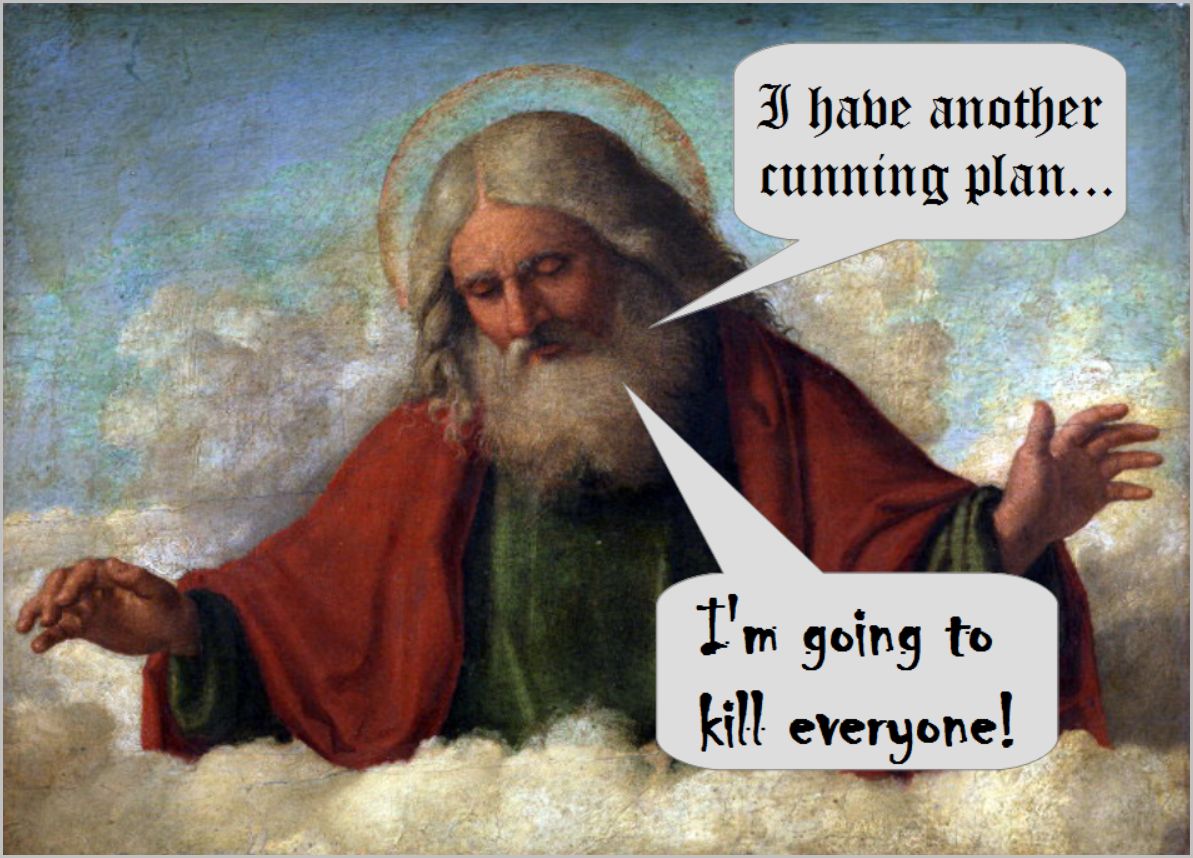
The God of Reason

god4

The next three posts will look at the claim Christians make for their God being the God of Reason. The fact that he is, they say, demonstrates how inconsistent those who see no evidence for a deity are when we use his very attributes – reason, logic and rationality – to make a case against him. Here’s Dr Jason Lisle on Answers In Genesis:

…there is an absolute standard for reasoning; we are to pattern our thoughts after God’s. The laws of logic are a reflection of the way God thinks… Laws of logic are God’s standard for thinking. Since God is an unchanging, sovereign, immaterial Being, the laws of logic are abstract, universal, invariant entities. In other words, they are not made of matter—they apply everywhere and at all times. Laws of logic are contingent upon God’s unchanging nature. And they are necessary for logical reasoning. Thus, rational reasoning would be impossible without the biblical God.

The materialistic atheist can’t have laws of logic. He believes that everything that exists is material—part of the physical world. But laws of logic are not physical… The atheist’s view cannot be rational because he uses things (laws of logic) that cannot exist according to his (Godless viewpoint).

Similarly, Tim Keller in his book The Reason for God argues that the fact humans can reason is evidence both of God’s existence (because reason has to come from somewhere) and of our being made in his image.

According to Christians then, God is the only reason we can think rationally at all.

But then where did God’s rationality come from? Is he pure reason or is reason an attribute he acquired or evolved over time as we did? As Richard Dawkins has pointed out, the only reasoning intelligence we know of is our own, and it is the product of evolution. If God’s ability to reason also evolved – and we know of no other way it could have developed – then he must intially have been incomplete. He could not have been the supreme intelligence Christians claim he is now. If, on the other hand, God is and always has been pure reason, there should be plenty of evidence for it. Let’s take look:

We first encounter God in the opening chapters of Genesis, where he puts two naked humans in a garden and tells them not to eat the fruit of a tree labelled ‘The Tree of the Knowledge of Good and Evil’.* He sets this tree right where they can see it and then he leaves. The two people, who have no concept of right and wrong (that’s the point of the tree) each take a bite of its fruit. While taking his evening stroll in the garden, God discovers what they’ve done and is not best pleased. (I hope you’re getting just how logical all of this is.**)

This deity, who, according to Dr Lisle and Tim Keller is the epitome of logical reasoning, doesn’t then take the trouble to explain to his creations, ‘Look, I’m sorry I made you without a sense of right and wrong; I’ll put that right. But you’ve got to promise me you’ll do as I say from now on because you won’t like me when I’m angry.’ No, he doesn’t do this; instead he throws a hissy fit. He punishes the couple, who until they’d tried the fruit had no idea disobeying him was wrong, and, just for good measure, he trashes the rest of Creation too – forever. Because of a single act committed by two naive individuals who didn’t know any better, he ruins everything and then, irrationally, blames the humans for the mess he’s made. That’s his reasoned, reasonable and rational response to their upsetting him – which, if he was the omniscient being Christians tell us he is, he’d have known was going to happen anyway.

Of course the whole set up and God’s reactions are not rational, reasonable or logical at all. They’re not considered, proportionate or insightful either. The God of Reason, the God who is Reason according to Answers in Genesis and Tim Keller, scores on this, his first outing, zero points on the scale of reasoned, reasoning reasonableness.

Maybe though God was just having an off day and he improves later on, once his intelligence has evolved a bit more. We’ll find out next time.


* All my examples of God’s great thinking skills and ‘reasonableness’ are drawn from the Bible; there are, however, simply too many to reference throughout this series of posts. I would be happy to supply them to any who feel the need to see them.

** Yes, I’m aware it’s a myth but a) many Christians don’t and b) even as a myth the story seeks to address how humans became alienated from God, ironically by developing the capacity to think for themselves. 


Idiotic Stuff Jesus Said

JC&ManJust what did Jesus say? The Jesus Seminar and other scholars* conclude that only about 18% of the words attributed to him in the gospels are authentically his. They reach this conclusion because so much of what Jesus ‘said’ – 82% of his utterances – is demonstrably derived from elsewhere.

There were four major sources for his words, which I’ll discuss briefly here, providing an example of each. Bear in mind also that whatever the derivation of Jesus’ words, those we have today have been subject to, in their earliest days, an unreliable oral tradition, repeated copying and deliberate and accidental alteration. The earliest surviving ‘words of Jesus’ (a few fragments of the fourth gospel) date to a century after he lived.

1. The early church created a good deal of the Jesus narrative, making him say what was important to them. For example, ‘take, eat, this is my body,’ and ‘take, drink, this is my blood that is shed for you,’ is clearly a post-crucifixion perspective. While it appears in arguably the most Jewish of the gospels (Matthew’s) the idea of drinking blood, even symbolically, would have been, and remains, anathema to Jews, whose scriptures forbid it (Leviticus 17.10 -16). Jesus was an orthodox Jew; it was the Hellenised Paul who transplanted the pagan ritual into nascent Christianity. He relates in 1 Corinthians 11.23-26, written about 15 years before the first gospel, how his wholly imaginary ‘Christ’ told him of this bizarre activity. Once established in the early church, Jesus then had to be made to endorse it and it was written back into the gospels.

2. The gospel writers (or others) invented dialogue for him. His entire conversation with Pilate, for example, is invented not once but four times, the encounter being rendered differently in all four gospels. It is probable that the entire scenario is fiction, given the likelihood the excessively cruel Roman governor would even entertain the idea of questioning a seditious nobody himself. And then there’s the ‘I am’ statements of John’s Jesus that I considered here.

3. The gospel writers altered difficult sayings into something more palatable. For example, in Matthew 15.24 Jesus says he was ‘sent only to the lost sheep of Israel’ (my italics). By the end of the same gospel, as well as in Luke and John, this has become a commandment to ‘make disciples of all nations, baptising them in the name of the Father, the Son and the Holy Spirit’ (Matthew 28.19). So which was it? Was the message exclusively for Jews or was it for all? It suited early churches, filled with non-Jews, that the gospel was for everyone, just as Paul had argued. Jesus’ words to the contrary – even if they were sufficiently widely known to have had to be included in Matthew’s original account – needed to be amended. Who amended them and when we shall never know, but it was certainly after the idea of the Trinity had taken hold.

4. Statements Jesus actually made. The Jesus Seminar regards as authentic sayings such as:

If anyone strikes you on the right cheek, turn the other also (Matthew 5.39)

If anyone wants to sue you and take your coat, give your cloak as well (Matthew 5.40)

Love your enemies (Luke 6.27)

Blessed are you who are poor for yours is the Kingdom of God (Luke 6.20) [changed in Matthew’s gospel to the less radical ‘poor in spirit’!]

If anyone forces you to go one mile, go also the second mile (Matthew 5.41)

As inspiring as these might initially appear, they actually mean very little; they’re either prophecies that didn’t come to pass, impractical moral expectations or pseudo-spiritual homilies. And how much of this advice, these admonitions, do today’s Christians follow? You’d be hard pushed to find many that do. After all, following Jesus doesn’t entail doing what he says.

* I have used Robert W. Funk et al‘s The Five Gospels (HarperOne, 1997), Simon Loveday’s The Bible For Grown-Ups (Iconbooks, 2016) and Mark Allan Powell’s rather less impartial The Jesus Debate (Lion, 1998) for this post

Recent Encounters of the Religious Kind

3. Prophecy Fulfilled

DB&JC

Back in January I predicted that David Bowie’s demise would lead to his apotheosis. And so it comes to pass.

First there’s this, from the Guardian‘s Suzanne Moore:

The theory that it was in fact, David Bowie’s presence in the universe that was holding everything together is one I find hard to resist, given how awful everything has been of late…

Second is Paul Morley’s new Bowie biography, the cleverly titled The Age of Bowie: How David Bowie Made a World of Difference, with its abundance of publicity including Radio 4’s broadcast ‘book of the week’. It is probably worth a look if you’re at all interested in the Thin White Duke and his various incarnations.

Two aspects of the biography stand out: first, Morley’s admission that he’s had to invent some details of Bowie’s life because either there is a lack of information – about his pre-fame period, for example – or, there are too many contradictory reports of certain events (often from Bowie himself) – or, a biography is so much more interesting when ‘facts’ are reorganised, again as Mr Bowie himself was wont to do when it suited him.

Second, the tone is uncritical to the point of sycophancy. Morley’s evident respect and admiration for Bowie translate into an adulation that elevates the late star to a priestly, semi-divine status. Within the first few pages Bowie is described as someone who manipulates time (xii); has a voice that pierces straight to the heart (p2); possesses the wisdom of the ages (p8); is capable of rearranging others’ minds (p8); can recreate the cosmic order (p8); symbolises the future (p8); dramatically splits reality wide open and penetrates time itself (p9); hunts for kindred spirits ready to surrender to his ways (p11); is obsessed with the deeper truths of existence (p14) and is a kind of teacher (p15) who proclaimed, ‘look how amazing this is. I am never, ever going to die’ (p20). Bowie would surely have been amused by most of these claims.

Written only a matter of months, perhaps weeks, after the singer’s death, in a time when, after his initial success in the 1970s, his every word, note, movement, metamorphosis, transformation, declaration and pronouncement was seized upon, broadcast and preserved for posterity, it is remarkable how much of the biography has to be constructed. Remarkable too how much it reflects Morley’s own experience of Bowie, how he writes about his Bowie, or series of Bowies.

Imagine if he were writing this same biography 40 or more years from now, with no personal or direct experience of the Bowie phenomenon, when no-one who had first-hand experience of it was alive, or if they were, had to rely on shaky memories of events that had happened – or maybe not – in their youth. How much more would the author have had to invent, even if he had access to archive material, about the impact the subject had, the effect of his music, his presence, his vision(s), his theatricality, his changes, his highs, his lows, his philosophy, his influence, the contribution he made to popular music and to art, the difference he made to ordinary individuals’ lives…

Now: imagine there are no reliable archives; no recordings, no film, no contemporaneous newspaper reports. Imagine too the author is not a twenty-first century journalist and musician, but has, like all those around him, including his audience, little or no scientific understanding of the world. Rather, he has a mind-set dominated by God, angels and devils, and is prone to superstition and the possibility people can and do rise from the dead. How much more readily would the half-forgotten charismatic of this ‘biography’ be elevated to god-like status. How much more miraculous the behaviour attributed to him. How much more a priest and saviour than any modern day icon.

And so the gospels came to be.

Recent Encounters of the Religious Kind

2. Maria and the Evil One

devil

Maria comes to the door again. She’s very personable but wasting away her life as a Jehovah’s Witness. She wonders if I’ve read the leaflet she left last time. I have, and have filled in the answers to its questions, including, ‘does the Bible have the answers to life’s big questions?’ Maria doesn’t seem very happy about my answer.

She insists on showing me a video on her iPad. It is slick and includes some clever CGI. She tells me afterwards that the ‘Evil One’ is in control of this world which is why it is in such a mess. I tell her that any mess is our own doing, we humans. She asks if I know the Bible; I say I do. She tells me that Jehovah’s Witnesses are the only ones who interpret it correctly. It doesn’t, she says, tell us that believers will go to heaven when they die (she’s right about this; it doesn’t). It promises rather that Jesus will be coming back to set up God’s Kingdom on Earth (right again). Except, I remind her, it has him promise that he will return within the lifetime of those listening to him, the Kingdom scheduled to appear within his own generation (Matthew 16:27-28; Matthew 24:27, 30-31, 34; Luke 21:27-28, 33-34). Maria concedes the point and then tries to say a generation is longer than we think. Maybe so, I say, but not 2,000 years.

Maria says she learnt something about this problem in a class recently. She appeals to her confederate for help, but he can’t remember what the elders said either. She decides now retreat is the better part of proselytising but promises to return once she has the answer.

But there is no answer; at least not one that sees Jesus’ megalomanic fantasies realised two millennia in his future.

I feel certain that, unlike Jesus, Maria will be back soon.


Recent Encounters of the Religious Kind

1. The kindly street preacher

preacher4

A bad-tempered looking man is standing next to a sign that announces that ‘Evolution is a Lie’ and ‘Jesus is Lord’. He – the grumpy man, not Jesus – is giving out some sort of glossy card. I do my best to sidestep him but he approaches and gives me one. It is entitled God Commands: 4 Things That God Commands, at least half of which is redundant. I notice that a group of Jehovah’s Witnesses have set up stall next to him (or perhaps he set up next to them).

‘So,’ I ask, ‘who’s right? You or them?’

They,’ he growls, ‘are of the devil.’

What a problem Christianity has. Islam too: so many damn different versions, all of which lay claim to being the one and only Truth. The Center for the Study of Global Christianity reports that there are now 45,000 different churches, denominations, sects and cults within Christianity, every one of them insisting that they – and they alone – represent God’s Truth, only they have got it right. There are as many Christian web-sites out there slagging off other Christians – Apostate! Wolves in Sheep’s Clothing! Doing the devil’s work! False teachers! – as there are sites ‘reaching out’ to the ‘lost’.

What’s more, every one of them knows they alone have the Truth because the Bible itself says so. They quote from it to prove how right they are and how wrong everyone else is. Which just goes to show what a damnable, scurrilous load of tosh the Bible really is. If God is not, as it says in 1 Corinthians 14.33, the author of confusion then he can’t have had anything to do with it.

Of course we know he didn’t; it’s human through and through, every mean-spirited, self-righteous verse of it.

Who wrote the Bible?

According to Christians, Moses wrote the first five books of the Bible; Genesis to Deuteronomy are widely known as ‘the books of Moses’. There is little evidence Moses had anything to do with them and plenty that he didn’t. The narrative, for example, is never once in the first person; it’s all ‘Moses ordered this slaughter, Moses ordered that slaughter’, never ‘I was the bastard who ordered all the genocide.’ Maybe he was embarrassed about it or – much more likely – it was written by someone else..

In fact, the books were compiled from a range of sources, including stories from other cultures. They reached the form in which we know them around 600-400BC, a mere eight hundred to a thousand years after Moses was supposed to have lived. The events and folk-heroes they describe are demonstrably mythical.

Moses2

Christians like to say that King David wrote many of the Psalms. While David’s name is attached to 73 of the 150, there is no reason to conclude he wrote them. It is more likely ‘of David’ serves as a dedication to a revered (and long dead) figure and may, indeed, have been added much later. The Psalms were actually created over an extended period of time – as much as five hundred years – by a wide range of unknown composers.DavidBelievers attribute much of the book of Proverbs to King Solomon, the fruit of David’s loins. Again, this is highly unlikely. The sayings are largely traditional and the attribution ‘is likely more concerned with labeling the material than ascribing authorship.’

Palin

Christians believe four blokes called Matthew, Mark, Luke and John wrote the New Testament’s gospels. They didn’t. The gospels were written anonymously and did not have the traditional names attached until a century or so after their composition. None is by an eye-witness. There is no evidence that the writer of Mark was a disciple of Peter’s, nor that ‘Luke’ was a companion of Paul’s (and even if he was, this wouldn’t make him an expert on the historical Jesus), nor that ‘John’ was a bona fide disciple. The fourth gospel was written between 90 and 110CE when the disciple would have had to be between 80 and 100 years old, or, much more likely given life-expectancy in the first century, dead. There are several hands at work in ‘John’, as the gospel itself concedes (John 21.24).

 Beatles

Christians insist that all of the letters attributed to Paul in the New Testament were written by him. However, despite the fact they say they’re by Paul, Colossians, Ephesians, 2 Thessalonians, 1 & 2 Timothy and Titus are not; they are forgeries. They were composed long after Paul’s death, which occurred some time around 64CE. The earliest of the forgeries, Colossians, is thought to be circa 75CE, while the ‘pastoral’ letters to Timothy and Titus may be as late as 150CE. All of the forgeries contradict the ideas expressed in Paul’s genuine letters.

PaulPeter wrote the letters that carry his name, or so god-botherers claim, but according to the Bible itself, Peter was an illiterate Galilean fisherman (Acts 4.13). The Greek of the letters supposedly by him is accomplished and the theology well developed. Did Peter have time to learn Greek and polish its written form to perfection while busy preaching the gospel to all nations? Even if he did, how did he manage to write a letter (2 Peter) concerned with conditions in the church more than a century after his time with Jesus?

Anderson3

Jesus’ brothers James and Jude, we’re told, wrote the letters carrying their names. Again, they didn’t. The letter of James may have originated in the early Jerusalem church presided over by James the Just, but there’s no evidence this was Jesus’ brother. Jude is plagiarised from 2 Peter – word-for-word in places – which is itself a forgery. Would someone who knew Jesus as intimately as a brother need to steal what he had to say from an illegitimate source? Jude would have had to be well over a hundred years old to pull this one off.

Robertson2When all else fails – and it does – Christians fall back on that most implausible of last resorts, ‘the Holy Spirit’. The very breath of God, they insist, presided over the creation of the Bible from start to finish. If it did, it made a staggeringly bad job of it; misattribution, mistakes and forgeries are the hallmarks of ‘God’s precious Word’.doveAnd on this unstable foundation, this tissue of lies, rests the entire edifice that is Christianity.

(It is difficult to find online sources on the authorship of the Bible. Christians have taken over the Internet with innumerable sites insisting the Bible was written by whoever they say it was. I’ve had to fall back on Wikipedia here (the articles are pretty comprehensive) but if you don’t think it reliable enough, I recommend Bart D. Ehrman’s Forged: Writing in the Name of God – Why The Bible’s Authors Are Not Who We Think They Are.)


Effective Preachin’ (Part One)

church3Reverend M. T. Vessal of the Church of The Raised Up here, with the first of my special guest posts for all you wannabe preachers out there. I’m gonna be telling you on how to preach the Good News of Salvation and win souls for Christ.

Right. First off, remember to use the words ‘Blessings’, ‘Sanctify’ and ‘Outpouring’ in your preamble or opening prayer. ‘Course no-one will know what these mean as you haven’t provided any context and they’re pretty meaningless anyway – apart from ‘Outpourings’ which is something kettles do. But it’ll get the folks worked up to expect something real good. Folks in church go for things like Blessings, Sanctifying and Outpourings, believe me.

Next, repeat the title of your sermon – or, if you’re part of a cool modern church like Steve Furtick’s, your talk, or, if you’re really honest (and let’s face it you wouldn’t be doing this if you were really honest) your spot of self-promotion – three times. This is a useful tip for any point of your sermon/talk/self-promotion; if you can’t remember what you were going to say next, say the last thing you can remember saying three times over, putting the emphasis on a different word each time. So, for example, ‘Twelve ways to receiving the Lord’s blessings’ would be: ‘Twelve ways to receive the Lord’s blessings’, then ‘Twelve ways to receive the Lord’s blessings’, and finally, ‘Twelve ways to receiving the Lord’s blessings‘, though feel free to alter this as suits. Saying it three times like this makes it sound like you’ve just come out with something real deep and profound, when you’ve done nothing of the sort. Plus, people sit up and listen to things said in threes. It’s kinda hypnotic.

I said, ‘it’s kinda hypnotic.’

‘It’s kinda hypnotic.’

See? It works.

Next make a joke. Say something like, ‘if you’ll switch on your Bibles’, just to show how with-it and up-to-date you are, knowing most folks bring their iPads to church these days. That way they can shop on Amazon or send an offensive tweet when your sermon gets really boring (and it will get really boring).

Now quote the verse you’re gonna preach about and let the folks follow along; you won’t need to quote it accurately because they’ll all be using different translations, so accuracy’s not important. Unless, of course, you’re one of those churches that only accepts the Authorised Version, the one with all the errors in it that right-royal homosexual James I… well, authorised. (One of the advantages of the KJV is you can  drop in words like ‘lieth’ and ‘unto’ which sound like you really know what you’re talking about.) So, yes, it’s okay to paraphrase the verse your talk is gonna be tenuously connected to because, let’s face it, it’s not going to have much to do with the verse in any case. It’s going to be more about you than whatever’s in the Bible. The exception is if you’re planning on having a rant about homosexuals, in which case you’ll want to stick pretty closely to Leviticus 20.13 and Romans 1.26.

A word on choosing your Bible verse: make it one of Paul’s or something from John. The other stuff, about loving your neighbour and your enemy and going the extra mile isn’t the kind of thing you want to have to talk about. You’re gonna concentrate on Blessings, Sanctification and Outpourings, remember, things that are exclusively for Christians. If you’re feeling really adventurous though you can try a story from the Old Testament. Maybe one of those blood-baths it has a lot of. You can show how all that bronze-age inter-tribal slaughter was really about how much Jesus loves Christians in the twenty-first century.

Right. You’re all set. Next time, I’ll tell you how to preach so that you can make a name for yourself truly reflect the glory of Jesus.

Did Jesus Exist? (part two)

WaterIf Matthew, Mark and Luke were creating a Messiah from scratch, or, more probably, recording the invention of believers who went before them, then it is unlikely they would have arrived at the loser preserved in their accounts. The Jesus we find there is nothing like the Messiah anticipated in Jewish scripture nor by Jews at the time.

He is a false prophet, his good news about the imminent arrival of the Son of Man and the Kingdom of God being patently unfulfilled. His ministry is a failure, ending as it does in ignoble execution. This is not the Messiah anyone would create if they were inventing one to satisfy the longings of a thwarted people. In particular, God’s emissary would not lose control of the situation in the way the Jesus of the synoptic gospels does. He would not allow himself to be executed by the occupying forces in the manner the gospels record. (All the surviving sources attest to his death by crucifixion; we can be fairly certain he died in this way.)

A created Messiah, on the other hand, would surely have announced the arrival of the Son of Man/Kingdom of God before leaving the stage of his own volition – ascending to heaven perhaps as some of the gospel writers eventually have him do – to await the unfolding of the events he had proclaimed. Of course, the death of a godman is a recurrent theme in the mythologies of the ancient world, so it is possible that an unpleasant death would be invented for an imaginary Jesus so that he complied with the trope. But, as I’ve already suggested, the central figure of the synoptic gospels is noticeably ungodmanlike. We only see him as such through the distorting prism of Paul’s theology; without this, we can see that the gospels of Mark, Matthew and Luke really don’t portray him like this at all.

It seems much more likely, therefore, that what the synoptic writers are conveying are distorted memories of an individual who actually lived. A man who promised much but whose mission went drastically wrong but which would, his earliest followers believed, be completed by God himself in the near future. This latter part is, as we now know, pure invention, the gospels conveying only an imaginative interpretation of this man. It would seem, nonetheless, to be an interpretation of someone – a charismatic Jewish preacher and failed heir-presumptive – who had actually lived some years before.

As I said at the beginning of this two-part post, I don’t really care whether Jesus existed or not. The end result is the same; millions of people seduced by a significance he did not have, either as a real person or as an imaginary construct. On balance, for the reasons I’ve touched on in these posts, it seems to me Jesus – Yeshua bar Yosef – did once exist. Like we all must, he died and others set about interpreting his life in their various, incompatible ways. These interpetations are all ultimately meaningless; we can be absolutely certain that, whatever the Bible and Christians today tell us, Jesus, whether he lived two thousand years ago or not, does not exist now in any shape or ethereal form.

Did Jesus Exist? (part one)

Cross3

I want to say at the outset that I don’t think it matters whether Jesus existed or not. Even if he lived, it is highly unlikely he said much that is attributed to him or that he performed the miracles ascribed to him. Neither would it be the case that he rose from the dead or became a supernatural godman afterwards. All of these supposed attributes would be, for an individual who actually existed, later accretions. The man underneath them, the so-called historical Jesus, is difficult to detect. It hardly matters to Christians; they’re really only interested in the accretions, the later add-ons, the myth the man became.

Those who think Jesus never existed raise a number of interesting points, chief of which is that what I’ve referred to as accretions, being central to subsequent Christian belief, actually came first. The accounts of Jesus’ life – the gospels – they see as later attempts to provide the myth with a ‘realistic’ back story based in history. Certainly the gospels came after Paul had had his vision and had set about interpreting it to arrive at his convoluted theology about ‘the Christ’. Jesus-belief certainly existed decades before the first gospel account, Mark’s, and was as a result entirely independent from it. In this scenario, therefore, the myth came first and the stories of Jesus were crafted afterwards as supplementary fiction.

For me, however, as problematic as the gospels are, the synoptic accounts – Matthew, Mark and Luke – are largely at odds with Paul’s theology. If they were written to bolster the myth of a supernatural godman, they don’t do it very well. John’s gospel, on the other hand, is much more successful in portraying a mythical being, which is why its implausible ‘Word became flesh’ is not very much like the Jesus of the synoptic gospels.

The synoptics of course have their own agendas and do not represent accurate biographies of Jesus either – there are too many contradictions and anomalies to claim they do – but, to varying degrees, they do not present a Jesus who is the embodiment of Pauline theology. The synoptic Jesus doesn’t, for example, promote a salvation plan involving his own death or say that faith is the means by which one enters the Kingdom of God. These are ideas of Paul’s, as are notions of grace, election, sanctification, redemption, substitutionary atonement, imputation, gifts and fruits of the Spirit and even more mumbo-jumbo besides.

The good news of the synoptics’ Jesus, however, is that God’s Kingdom is coming to Earth soon and to be part of it one must become ‘righteous’ both by serving others and relating to them in a ‘measure for measure’ way: forgiving in order to be forgiven, being compassionate to be shown compassion, giving in order to receive, not judging so as to avoid being judged. This Jesus and his gospel are, moreover, predominantly Jewish; Matthew’s version in particular is virulently anti-Gentile. All of this is totally at odds with the magic formula of salvation-available-to-all of Paul’s make-believe. If this came first, it is difficult to see why the synoptic gospels would not present, as John does, a Jesus who is more compatible with it.

Either the synoptic gospel writers got much wrong in providing the Christ’s supposed back story or they were representing other traditions, ones that were different from and possibly even older than Paul’s interpretation. Belief in Jesus as teacher, prophet and, possibly, Messiah predates Paul (he refers to it himself while Matthew and Luke make use of an earlier sayings gospel known as ‘Q’) and it seems likely that Mark and Matthew in particular reflect these traditions, untainted by Paul’s fantasies. Of course these traditions too could have been invented, just as Paul’s theology is, but if that is the case, then, once again, the gospel writers – Mark and Matthew especially – make a decidedly bad job of it.

Next: what this ‘bad job’ tells us about the existence of Jesus.

Angels with anuses

Lot

Of the many tawdry stories in the Bible, the tale of Sodom and Gomorrah (Genesis 19.1-29) is one of the most sordid and ludicrous.

In case you don’t know it, two angels visit Lot in the first of these ‘two cities of the plain’ where the local men express a desire to rape the pair. Unbelievable, right? All the men (19.4) wanted to rape two other men? It would appear so, but only because the story, designed to explain the demise of the two cities, is a fabrication by a rabidly homophobic scribe, intent on expressing his own prejudices and sexual fantasies. There is little evidence the cities really existed.

Anyway, Lot offers them his daughters instead, telling the local rapist mob that the gals are virgins, though in fact they have husbands (19.12 & 14). Lot’s rampaging neighbours don’t seem to know this but all the same decline his generous offer. So, to cut a long story short, God destroys both Sodom and Gomorrah allowing only Lot and his family to survive. Then, for no plausible reason, his nameless wife dies as they flee and Lot has drunken sex with his not-so-virginal daughters (19.33-38). As a result of the incest, the two of them give birth to genetically compromised offspring.

So this Lot – I’m tempted to say ‘this Bad Lot’ – who lies, offers his daughters to hormonally charged thugs, fucks the gals himself and has children by them, is declared by God to be a ‘righteous’ man (Genesis 18 and 2 Peter 2.7-8). The bar was set very low in them good Old Testament days.

Over on National Catholic Register’s blog, Thomas L. McDonald tries to explain what this seedy little story really means. (Steve Wells responds to his desultory efforts here). Central to it, are the so-called angels. What sort of beings are these? The term means ‘messengers’ and this pair at least are very mundane; they are incapable of defending themselves against rape threats (Lot has to defend them) and while they claim they are about to destroy the two cities (19.13), it is in fact God who does so (19.24). Later angels are more like the X-Men; they have grown increasingly grotesque (Daniel 10.5-6) and have developed superpowers like flight (Isaiah 6.2) and invisibility (2 Kings 6.17). The Sodom pair though are mere prototypes. There is nothing supernatural about them because the concept of the angel as a supernatural emissary of the divine was in its infancy when this story was written. They are simply human messengers.

Which is how they are capable of being raped. If they were the ‘evolved’ angels of later fantasy it would be inconceivable that they could be overcome and abused in this way. That these two can be potentially is because they are human males with human male anatomy. The bottom line is, if you’ll forgive the pun, they have anuses, without which they could not be anally raped. The story blithely assumes this to be the case even though all subsequent exegesis consistently ignores it.

This ugly, homophobic, semi-pornographic story has led to untold damage to innumerable people throughout the ages. It has given us the disparaging terms ‘sodomy’ and ‘sodomite’, even though no ‘sodomy’ takes place in the story and isn’t, in any case, routinely practised by same-sex couples. It has served as the prototype for the blaming of LGBT people for (always unrelated) natural and man-made disasters, from earthquakes to tsunamis and 9/11. The moral usually taken from it – even though it lacks any morals at all – that being gay is evil, has led to, and provided ‘justification’ for, the persecution and destruction of gay people right up to the present day. Perhaps, given the same story is referenced in the Qur’an, its influence can even be seen in last week’s massacre in Orlando. 

That the prejudiced and ignorant today continue to be influenced by this unimaginative, tawdry little tale is the lasting legacy, the real tragedy, of Sodom and Gomorrah.