Making Excuses for Jesus

jesus-jw

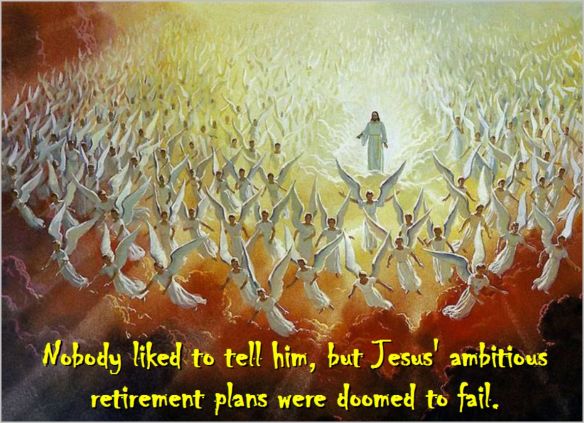
Excuse 5. When Jesus said the ‘Kingdom of God is coming soon’, what he meant to add was ‘but only in heaven and then in 1874. Or 1878. 1914? Er… 1975. After 2017?’

So say the Jehovah’s Witnesses. In 1897 they claimed that Jesus had started on his comeback tour in 1874:

Our Lord, the appointed King, is now present since October 1874, A.D., according to the testimony of the prophets, to those who have ears to hear it: and the formal inauguration of his kingly office dates from Apr 1878, A.D. Studies in Scriptures Series IV (p.621)

and

The year A.D. 1878 … clearly marks the time for the actual assuming of power as King of kings, by our present, spiritual, invisible Lord… The Time is At Hand (1911 ed) p.239

When there was no sign this had happened – and goodness knows what sort of sign there could possibly be – the JWs changed their minds again and said the real date for the start of the ‘full’ kingdom was to be 1914:

In view of this strong Bible evidence concerning the Times of the Gentiles, we consider it an established truth that the final end of the kingdoms of this world, and the full establishment of the Kingdom of God, will be accomplished near the end of A.D.1914. Studies in the Scriptures Series 2: The Time is at Hand (1889 ed) p.99

and

October, 1914, will witness the full end of Babylon, “as a great millstone cast into the sea,” utterly destroyed as a system. Watch Tower (Jun 15 1911) p.190

Alas, over a century later there’s no sign of the Kingdom’s ‘full establishment’, while the old, corrupt system (Babylon) carries on as normal. So, after another change of heart, and a quick, futile stab at 1975 as the right date, Jehovah’s Witnesses came up with a revised plan. Here’s how it looks:

Jesus will return while the generation alive in 1914 is still around, when he will finally get the Kingdom underway. This is the ‘generation’ to which he refers in his prophecies in the bible; his return and the Kingdom coming to the earth will definitely happen while the 1914 generation  is still alive.

But hang on! A person born in 1914 – and there are some still around – is now 103, while those who were already adults in 1914 are long dead. In other words, the 1914 generation has almost gone and there’s still no sign of Jesus or his Kingdom. Either he’s going to return real soon, before the last of the 1914 generation depart, or he’s going to miss the deadline yet again (Guess which it’s going to be).

But worry not, Jehovah’s Witnesses have this one covered too! When Jesus referred to ‘this generation’ he didn’t just mean one generation, but to the generation that ‘overlaps’ with that generation. There’s nothing biblical about ‘overlapping generations’, of course. Jesus didn’t say, ‘the Kingdom will come while this generation and those that overlap with it are still alive,’ but like mainstream Christians, Jehovah’s Witnesses need to give Jesus and themselves an excuse if they’re to avoid admitting that he and they have got it wrong.

So, an overlapping generation would be one like my own, whose grandparents were children in 1914. But we can extend this – and we can be sure JWs will once Jesus fails to return on time – because, using the same ‘reasoning’, my grandchildren’s generation ‘overlaps’ with my grandparents’ through me. My grandchildren’s grandchildren too will be connected with all previous generations, including that from 1914, because of those who have preceded them… and on and on, ad infinitum. In fact, Jesus could come back at any time in the future so long as someone is alive who can trace their ancestry back to 1914.

But he’s not going to. He wasn’t talking about a ‘generation’ almost 2000 years after he lived. He was certain the Kingdom of God was coming to his time and his people. All of these convoluted and ultimately unconvincing explanations of what he ‘really’ meant when he preached an imminent heavenly Kingdom on earth simply won’t do. While mainstream Christians mock Jehovah’s Witnesses for their silly conjecturing about Jesus’ return, they share the belief Jesus is coming back. Most won’t venture a date (though there have been plenty who have) because, they will tell you, Jesus also said ‘no-one knows the precise day or hour’ when the Son of Man and the Kingdom will appear (Mark 13.32). Nevertheless, they remain certain that Jesus will return: this year, next year, sometime… any time other than that which he actually predicted.

While evangelical Christians and others insist that the bible, where all Jesus’ failed prophecies appear, is the literal and infallible word of God, they refuse to take literally his pronouncements about the coming of the Kingdom. While he might have said he didn’t know exactly when it would arrive, he was certain it would be while his own generation lived. As he is made to say in Matthew 16.28, ‘some who are standing here will not taste death before they see the Son of Man coming in his kingdom’.

All of which is a problem for Christians: if these predictions are not to be ignored, then they must be interpreted, explained and, eventually, explained away. The last thing believers want to do is accept them for what they are; the demonstration of Jesus’ failure. The Kingdom didn’t arrive when he said it would and, given how far it is past its sell-by date, it’s certainly won’t be now.

Making Excuses for Jesus

Excuse 2. When Jesus said ‘Kingdom of God’ what he really meant was ‘the church’.

Kingdom

So if not the transfiguration, then what? Christians can’t accept that Jesus was wrong in all he prophesied, and must invent some other explanation. How about the church – the body of believers who saw, and still see, Jesus as their saviour? The church must be the Kingdom! Yes, that’s it surely.

But then they’re left to explain why the church, even in its early days, bore no resemblance to what Jesus said the Kingdom would look like. Where was the Son of Man descending through the clouds? The hosts of angels in full view of ‘the tribes of the Earth’? The disciples judging and ruling the twelve tribes of Israel (Matt 19.28)? The last becoming first and the first last? The meek inheriting the Earth? The righteous being rewarded for their good deeds, while the unrighteous are sent to outer darkness?

Even if we were to overlook the absence of these characteristics, all of which Jesus predicted would define the Kingdom, then isn’t the-church-as-Kingdom just a tiny bit, well… disappointing? It doesn’t embody either any of the conditions of the Kingdom that the Old Testament prophets promised it would (Micah 4.1-7 & Isaiah 11.6): nations continue to wage war, the lamb and the wolf don’t co-exist peacefully and God singularly fails to rule the earth from Mount Zion.

Instead, the church is all too human, riven with conflict and division. Despite the whitewash given to it by the author of Acts, Paul’s letters – 1 & 2 Corinthians, Romans and Galatians in particular – serve as a permanent reminder of the dispute and strife that have characterised it since its earliest days. It has also a shameful history of persecuting those with whom it disagrees and produces its fair share of criminals and abusers. Today, it is split into 45,000 different factions and, according to some of its own, is awash with ‘false doctrine’.

One thing it is good at – the very thing Paul insists it shouldn’t be (1 Corinthians 5.12) – is judging the rest of us.

The Kingdom of God it is not.

How to argue like a Christian (part two)

Street-preachers

Five more ‘arguments’ offered by Christians in defence of their insupportable beliefs:

You’re not entitled to speak because you have no objective basis for your morality; morality comes only from God/the Bible.

Except it doesn’t, of course; moral codes existed long before the Bible or even the invention YHWH, who is, in any case, morally bankrupt. This ‘most unpleasant character in all fiction’ ‘wallows’, if I might borrow the term, in genocide (1 Samuel 15.2-3 etc) and slavery (Leviticus 25.44-46; Exodus 21.20-21 ); he relishes the death penalty for the most minor infringements of his petty rules (Leviticus 24.16; Deuteronomy 21.18-21, etc ad nauseam); fails to keep his promises (Genesis 17.7; Mark 11.24); does nothing to relieve human or animal suffering and lets millions of children die needlessly, year in, year out. It just doesn’t suit his mysterious ways, apparently, to behave like any halfway-decent human being would.

And even if he were the morally-upright paragon of virtue Christians delude themselves into thinking he is, they would ignore his moral guidance at every turn, just as they do now. Ministers, priests, evangelists as well as run-of-the-mill believers are convicted every day of the most despicable of crimes (Bruce Gerenscer keeps a tally on his blog-site) and that’s before we get to the more exacting moral demands Jesus makes. Going the extra mile (Matt 5.41), loving neighbour (Mark 12.31) and enemy alike (Luke 6.27), giving to all who ask (Luke 6.30) – these most Christians simply ignore. ‘We’re forgiven, not perfect,’ they whimper, even though ‘perfect’ is precisely what their unreasonable saviour tells them to be (Matt 5.48). But then I’m probably quoting out of context again… or something.

You’ve been hurt in the past.

This weak, ad hominem response is the converse of the charge that you’re immoral; good cop as opposed to bad cop. The Christian who says this is all-seeing and all-knowing and is able to evaluate your entire psychology and personal history from a single comment you’ve made. They can tell that you’re only disputing an aspect of Christianity because obviously at some point in your past a Christian – who wasn’t really a true Christian – hurt you. Or maybe it was a church you once belonged to that let you down. Well, you’ve every right to feel hurt! But that doesn’t mean there’s anything wrong with the True Faith™ or those who subscribe to it! And so your point is neatly invalidated; you’re only responding emotionally and you’ll get over it.

If there’s no God then life is meaningless.

Used extensively by some Christian blog-sites, this non-sequitur translates as, ‘I’m not going to address anything you say. My neediness demands there’s some point to life and I’ve decided that it comes from the fantasy I’ve bought into.’ Questions of whether that fantasy is actually true (which by definition it can’t be) and whether life is meaningless without it, are never considered. Believers’ need for the delusion to be true, their fear of working out meaning for themselves and their subsequent investment in Christianity’s empty promises, compel them to hide behind what is an essentially… er, meaningless solipsism.

Unbelievers have no right to criticise those who belong to Jesus.

Haven’t we? We put up with all the nonsense Christians spout, their attempts to influence everything from elections to what we can see on TV, from their opposition to gay rights, same-sex marriage, women’s rights, abortion and adoption issues to the restrooms people can or can’t use and their judging of the rest of us as hell-bound sinners. In return, we unbelievers are perfectly entitled to hold Christians accountable. At the risk of repeating myself, do they do what Jesus tells them to? Do they turn the other cheek (Matt 5.39)? Sell their possessions to give to the poor (Mark 10.21)? Give more than is demanded of them (Matt 5.40)? Avoid judging others so they’re not judged in return (Matt 7.1-3)?

What do you think?

You’re of the devil/an enemy of the cross/wilfully blind/apostate/a troll.

If all else fails (and it will) the faithful resort to an insult carefully selected from the extensive bank of Christian cliches. That way, there’s no need to engage the brain at all. God love ’em!


How to argue like a Christian

Argue

If you’ve ever tried discussing matters of faith with a True Believer™, you’ll know how difficult it can be; like wrestling with a jellyfish – and just about as poisonous.

So here’s a guide for the unwary; 10 of their favourite lines (5 this time, 5 next), all of which I’ve experienced more times than I care to remember.

“You don’t know your Bible!”

Point out that Jesus’ ‘good news’ was nothing like Paul’s or that they were both wrong about the Kingdom arriving in the first century and this old canard gets trotted out. Even if you quote chapter and verse, a clear indication you do know the Bible, they still produce it. What they mean is ‘how dare you quote the bits of the Bible we true believers don’t like and prefer not to acknowledge.’

“You’re quoting out of context.”

I’ve posted about this one before. Seemingly as a sceptic you have no discernment when it comes to selecting Bible verses. How ever many you reference – one or a hundred – they will tell you it’s not enough; that you’ve not, somehow, caught the true meaning of what the Bible is saying, which is, naturally, what they say it means. Unsurprisingly. quoting isolated verses is something the Righteous themselves like to do all the time…

“The bible says…”

It doesn’t matter what point you make, this will appear somewhere in the Christian’s response, followed, of course, by some random verse from the book in question. Christians seem to regard it as the ultimate clincher, the way to silence any opponent, as if quoting the bible to those who recognise neither its credibility nor its authority persuades anyone of anything.

“You’ve no right to criticise Christianity when you can’t ‘prove’ how something came from nothing/how life arose/evolution.”

It’s unlikely anyone can explain these biggies in 140 characters or a Facebook comment, but we can direct those issuing the challenge to scientific works that offer viable theories soundly based on the evidence available. Needless to say our Christian smart-Alec is unlikely to read them, claiming instead that one’s inability to comprehensively explain the Big Bang or evolution ‘proves’ it must have been – watch the sleight of hand here – YHWH.

“‘People like you’ only want to wallow in your own sin (which is why you won’t let me have my own way).”

Now I like to wallow as much as the next man, but outside the Christian bubble, ‘sin’ is a fairly meaningless concept, designed only to induce guilt in others. Which means the point of this unpleasant finger pointing is to side-step any discussion and to dismiss whatever point you might want to make. What this retort really means is ‘you have an ulterior motive for saying what you’re saying and, in any case, your inherently evil nature doesn’t entitle you to have an opinion.’

More next time…

The Eye-witness Fallacy

MaryM2

The falsehood that the gospels are in some way eye-witness reports just won’t go away. There is no evidence they are or even that they are based on reports by eye-witnesses. Scholars speak of ‘sources’ for all elements of the gospels (Mark, Q, M & L); these were almost certainly pre-existing written and oral traditions from before the gospels’ creation.

This really is problematic for those propagating the idea that the gospels are eye-witness accounts. If they were even so much as based on eye-witness reports, then why would they need to rely so heavily on other traditions? If, as is claimed here, the scattered gospel communities who wrote them were in some sort of immediate contact with the fanned-out eye-witnesses, then they would have no need to use sources and traditions from elsewhere. Yet they do; Matthew and Luke borrow extensively from a shared source (Q) and also from Mark, particularly for their resurrection stories.

This is akin to someone today interviewing witnesses to John F. Kennedy’s assassination, – a similar interval to that between Jesus and the gospels of Matthew, Luke and John – and then, before publication, replacing what the eye-witnesses say they saw with the more far-fetched elements of Oliver Stone’s movie JFK. If there were eye-witnesses to hand, there wouldn’t be any need to do this. It doesn’t make the slightest sense that the gospel writers would do so. Yet they do.

As far as the stories of the resurrection are concerned, it is much more likely they are based, not on any eye-witness accounts, but on the scant mentions of the mystical, risen Christ of the kind we find in Paul’s letters, filtered, primarily, through Mark. As such, they are a fleshing out (almost literally) of hearsay reports of a limited number of visions that, by the time the gospels came to be written, had embedded themselves in the traditions of the early church.

Ken Ham’s ‘Five Evidences that the Bible is True’

cut

Yes, that’s what he says: ‘evidences.’ Good use of English there, Kenny. Actually, the article is anonymous, but as it’s on Kenny’s site, and as it features inside his Noah’s Ark vanity-project, we can safely assume he authorised and approved it. That being the case, he can take responsibility for it.

Anyway, here are those ‘evidences’. Be prepared to be underwhelmed:

1. The Bible Is God’s Word

The ‘reasoning’ here is that God inspired the writers so, ipso facto, the Bible must be God’s words.

How do we know God inspired the Bible? Because the Bible appears to say so. But how do we know we can trust what the Bible claims about this and everything else? Duh… because God inspired it. Circular reasoning that gets us nowhere.

But wait, more ‘evidence’ from Kenny: ‘the Bible is authoritative in every subject it addresses’. I guess that’s so long as you exclude all the areas where it isn’t, like those that are scientifically, historically and geographically inaccurate, including the early chapters of Genesis that Kenny loves so much. Then there are those parts that are evidently myth, legend or fantasy.

Yes, apart from all those bits, the Bible is accurate and authoritative.

Isn’t it?

2. The Bible is Unique and Unified

Two claims in one. The Bible is far from unique; there are many religious texts in the world – the Qur’an, the Vedas, the Pali Canon, the Book of Mormon… many with evidence of several authors at work in them. Neither is the Bible unique because it is ‘unified.’ It is not unified. It is contradictory and inconsistent: the so-called ‘new covenant’ cuts across the ‘everlasting’ agreement God allegedly made with the Jews and YHWH himself evolves, even having a personality transplant somewhere between the Old and New Testaments. Most significantly, for what is supposedly its central message, the Bible offers several, frequently mutually exclusive, ways to salvation.

3. The Bible Has Been Faithfully Passed Down.

This is empirically, demonstrably false. Many books of the Bible were written decades, even centuries, after the events they purportedly describe; the oral tradition is an unreliable means of transmission; texts were altered both by accident and on purpose; some books are patent forgeries; ninety percent of surviving manuscripts were created 800 years or more after the originals, and none of these ‘autographs’ survive for anyone to determine how ‘faithful’ later copies might be.

4. The Bible Contains Fulfilled Prophecy

It does? Where? Is it in the gospels where Jesus prophesies that the Son of Man will, in the lifetime of his listeners, return through the clouds to judge the tribes of the Earth and establish God’s Kingdom? Is it in the contrived symbolic events imposed on Jesus’ life to make it look like he fulfilled prophecy, even when the earlier ‘prophecies’ were not prophecies at all? Is it in Paul’s letters where he promises the rapture will be coming while those in his churches still live? Is it in the many prophecies that were written after the events they were supposedly predicting? Is it in the innumerable prophecies that didn’t come to pass?

That’s right; not one of these bits of malarkey constitutes ‘fulfilled prophecy’.

5. The Bible Holds the Key To Eternal Life

No, it doesn’t because there’s no such thing. This is the great swindle at the heart of Christianity; a fantasy dreamed up by fanatics, fantasists and psychotics, and preserved in the Bible. Christians are singularly unable to provide any evidence that anyone has ever gone on to have a life after death, nor that they ever will. We know now, as we may always have suspected, that when the body dies ‘we’ die with it. End of.

So, every one of Ham’s ‘evidences’ is false; a sham like his beliefs and the book from which they spring. You’ll struggle to tell him so, however, because like so many Christian web-sites, there’s no posting of comments; Kenny broaches no dissent. That’s how confident he is of his case. Best not to entertain any views other than your own weak, unfounded assertions.


The disciples would not have died for a lie (part two)

Rule

As we have seen, the available evidence does not support the idea that Jesus’ original followers subscribed to a miraculous physical resurrection. It suggests instead that their beliefs centred on the promises Jesus had made about returning from heaven as ‘the Son of Man’ to establish God’s Kingdom on Earth, which they would then rule with him.

Elements of this promise survive in the gospels as we have them, even if there are, in all four, obvious concessions to Paul’s Christ figure; the gospels were, after all, written after Paul’s version of Christianity had begun to take hold. Significantly, the promise of the triumphant appearance of the Son of Man ‘within this generation’ is present in Q, the source of many of the sayings common to both Matthew and Luke’s gospels that they didn’t get from Mark. It’s also there in the sources (L and M) peculiar to each of the gospels. Obviously L, M and Q pre-date the gospels that later made use of them. Scholars think Q could have been written as early as 40CE, a few years after Jesus’ death, with some sayings earlier than that. It pre-dates Paul too and reflects a tradition that has nothing to do with him or his convoluted theology.

Q, in fact, has no sayings attributed to the resurrected Jesus, nor anything from his trial, the crucifixion or resurrection.1 How can that be? Were they not important to the early believers who compiled it? The answer can only be, no, they weren’t. For the creators of Q what mattered was what Jesus said – his ethical teaching and his promise to return as the Son of Man, within his hearers’ lifetime, to inaugurate the Kingdom of God on Earth in which the disciples would reign alongside him (Matthew 19:28). To be part of this Kingdom, people had to become righteous, not have it gifted to them (Matthew 5.20 & 48). This was the ‘good news’ for Jesus’ earliest followers, the gospel as it is preserved in the Q source.2 The lie that the disciples were to rule the world with Jesus inspired them to spread the news of the coming Kingdom; they demonstrate little interest in a reanimated dead man or a magical salvation formula.

So, did the disciples die for their faith in the Risen Jesus? Highly unlikely. They don’t seem, despite the later stories in which they feature, to attach any importance, at least in Q, to visions of a resurrected god-man.

How did they die, then? The simple answer is that, for most of them, we don’t know. They could have met their end when the original church community in Jerusalem was annihilated by the Romans in 70CE. The Romans didn’t particularly care what a minority group of fanatics believed – they were rebellious Jews who needed to be taught a lesson.

If not slaughtered by Romans in their capture of Jerusalem, then perhaps the disciples died for their seditious belief in the imminent arrival of the Kingdom of God, just as Jesus had before them. The Bible records the deaths of only two of them: Judas, who appears to have committed suicide using two different methods depending on which account you believe (Matthew 27:5-8 or Acts 1:18-19), and James, brother of John, who, according to Acts 12.1-2 was executed by Herod Agrippa 1. By the time Acts was written, however, somewhere between 80-90CE, the beliefs of the original followers had been swallowed up by Paul’s alternate version of the faith; we have no way of knowing how accurate the report of James’ death is. It’s hard to believe it was merely because he thought an old pal had risen from the dead. It is hard to believe this of any of them. For the other disciples there are only traditional accounts of how they died ‘for their faith’ with nothing to corroborate these legends.

It is quite possible Jesus’ original followers died for reasons unconnected with their outlandish beliefs in an imminent supernatural kingdom. They could just as easily have died of natural causes. One thing seems probable – they did not die because they believed in a resurrected Messiah. It’s not that they didn’t believe in a physical resurrection – they did – but they were convinced it would only happen with the arrival of God’s Kingdom on Earth, as prophesied in Daniel 12.1-4.

That it had already happened to their former leader did not figure in their beliefs, their writing or even their thinking.


1 Bart D. Ehrman, Jesus Before the Gospels, p279-280

2 ‘But for Q, Jesus was indeed principally remembered as a teacher of great wisdom and high moral demands, as an apocalyptic prophet anticipating the imminent end of the age, and one whose miraculous activities showed that the day of judgement was soon to come. For the author of Q, Jesus’ teachings provided the goal of the Christian life. Followers of Jesus are those who adhere to his directives for how to live, in anticipation of the coming kingdom of God.’ Bart. D. Ehrman, Jesus Before the Gospels, p280

Updated to include link to Matthew Ferguson’s celsus blog.


The disciples would not have died for a lie (part one)

SonOfMan

The disciples would not have died for a lie, or so Christians like to argue.

Would they not?

Fanatics today do and it is more than likely the disciples believed their lie was true, if indeed they died for it at all. There’s not much evidence that they did. But if they did, maybe the lie they believed to be true was not the one today’s Christians think it was.

There is no evidence anywhere that Jesus’ original followers were martyred because of their faith in a physically resurrected Jesus – for their beliefs, maybe, but not necessarily because they believed Jesus had returned in bodily form from the dead. On the contrary, the evidence suggests that they holed up in Jerusalem to await his return through the clouds as the Son of Man, with a phalanx of hostile angels by his side (Heaven was, after all, just on the other side of those clouds). This was the crux of their beliefs.

How do we know?

There was significant tension between the disciples and Paul, which Paul himself relates, not only because he was convinced his message should be taken to the Gentiles but because of the very nature of that message. Paul and the disciples meant different things by ‘the gospel’. Paul’s irritation that others were preaching a different gospel is apparent in 2 Corinthians 11 & 12 where he calls the original disciples, ‘false apostles, deceitful workers, disguising themselves as apostles of Christ’ and bitterly refers to them as ‘the most eminent apostles’. He is arrogant enough to suppose, and to proclaim, that he has it right and they are wrong.

Paul’s good news was about the resurrected Christ of his visions, who magically made those who put their faith in him righteous in God’s eyes. As he puts it in 2 Corinthians 5:21, ‘God made him who had no sin to be sin for us, so that in him we might become the righteousness of God.’ Paul also believed this supernatural being would soon descend from the skies when he would give believers new bodies (Philippians 3.20) but this is a very different figure, and agenda, from the Jesus known to the disciples.

What then of Paul’s insistence, in 1 Corinthians 15.5 (written circa 55CE), that ‘the Twelve’ experienced the Risen Christ in much the same way he did? Firstly, of course, we have only Paul’s word for this. We have no first-hand corroboration (just the opposite in fact) and Paul had a vested interest in showing how significant his own experiences were. What better way to do so than by claiming Jesus’ original followers had had the same sort of hallucinations? Secondly, we don’t know what these ‘visions’, if they had them, meant to the disciples. Their belief would undoubtedly have been in a physical, bodily resurrection (cf: Daniel 2.12; Matthew 27.52), not in the beam-of-light manifestation of hallucination; this was much more Paul’s thing. Perhaps this is why any words uttered by vision-Jesus (for surely he would have spoken to his old chums) were not considered significant enough to be included in the earliest written record, ‘Q’.

The fully-realised resurrection appearances found in the gospels, then, in which Jesus declaims ‘blessed are they that have not seen, and yet have believed’ and ‘go and make disciples of all nations,’ are very clearly later developments, based, not on Q but on the visions suffered by Paul and others of influence and ‘written back’ into the gospel accounts.

Despite claiming that the Twelve experienced the Risen Christ in much the same way he did, Paul is critical of the disciples for preaching a different gospel, a different Jesus even, from the magical salvation-formula gospel he expounds. So what did the disciples believe – what was this other gospel that Paul disparaged so much?

We’ll see next time.


Still more of the Bible written sdrawkcab

The first mention of the Last Supper and the ritual established at it is in Paul’s first letter to the Corinthians (11.23-26):

For I received from the Lord that which I also delivered to you, that the Lord Jesus in the night in which he was betrayed took bread; and when he had given thanks, he broke it and said, “This is my body, which is for you; do this in remembrance of me.” In the same way he took the cup also after supper, saying, “This cup is the new covenant in my blood; do this, as often as you drink it, in remembrance of me.” For as often as you eat this bread and drink the cup, you proclaim the Lord’s death until he comes.

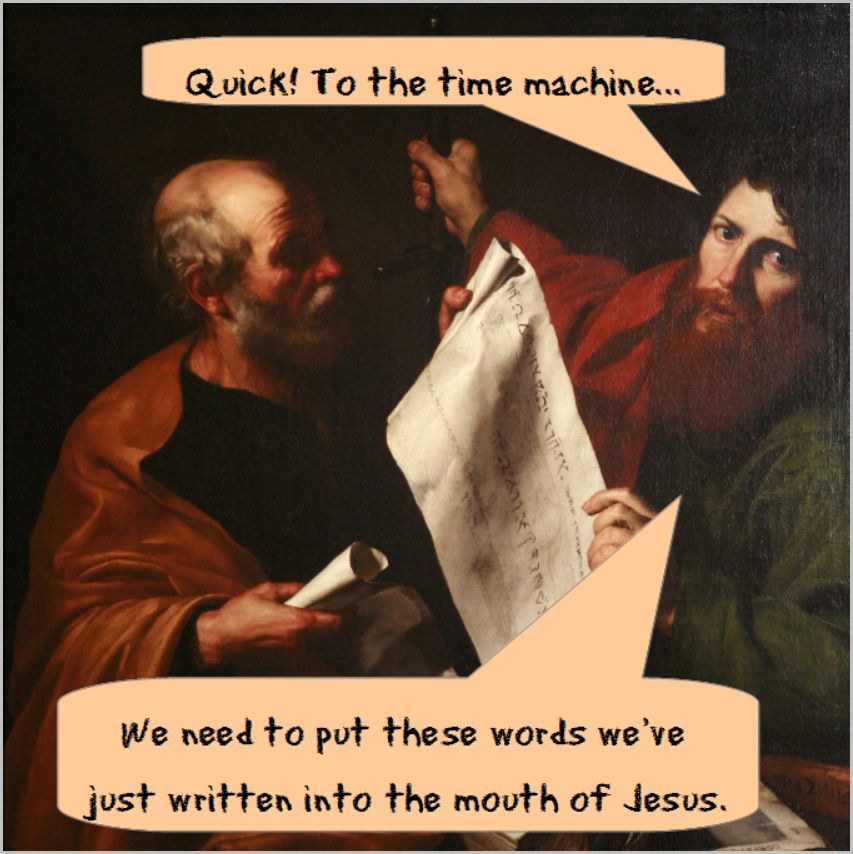
As David Madison points out, Paul happily admits he invented this – or, rather, he worked it up from one of his hallucinations. He certainly didn’t hear it from the people who’d known Jesus when he was alive; it’s unlikely they would have subscribed to such barbarity. As Madison shows, the idea of consuming blood, even symbolically, would have been anathema to most Jews (Deuteronomy 12.23 etc); it’s a ritual that originates in pagan worship. It’s there, for example, in Mithraism, which flourished in, among other places, Tarsus, where Paul came from. Evidently, celebrating Christ’s sacrifice by eating his body and drinking his blood took hold in the churches Paul established and by the time the gospels came to be written, its origin story was sent back in time to be part of them. This kind of thing happens in comic books all the time.

It’s quite possible that the stories of the resurrection developed the same way. We know that later followers of Jesus had visions that they interpreted as being of ‘Christ’. We know this because Paul refers to his experience a few times and also implies that other people had visions similar to his own. Were these hallucinations the only ‘sightings’ of the Risen Christ? We have no first-hand, eye-witness accounts of any other sort. Given that bodies don’t ever rise from the grave, especially not after a couple of days, it is more than likely they were all imaginary. It looks suspiciously like later encounters of Christ – all entirely within people’s heads – were written back into the gospel accounts to become the resurrection. Some of these were ‘firmed up’ to seem like encounters with a real person, which led to the invention of the empty-tomb, while others weren’t; a number make little attempt to convey an encounter with a real flesh-and-blood individual.

Bur wait, you say. There were believers in the resurrection before Paul. Surely the original followers of Jesus – the disciples, Mary Magdalene – saw the Risen Jesus. That’s why they believed in him, why they gave their lives to his cause, why they were prepared to die for their faith.

Well, no. We don’t know that this is what the original followers of Jesus thought or experienced. Why don’t we? Because:

  • The original followers left no records (or did they?)
  • Their community was wiped out by the Romans in 70CE.
  • Their brand of the faith, whatever it was, was obliterated by Paul’s Christ cult.
  • They had plenty of other reasons for believing in Jesus.

Seemingly Jesus told them he’d be back soon, bringing God’s Kingdom with him (Matthew 16.27-28 etc). And then, as he promised, the meek would inherit the Earth and his original followers would the rule the planet with him (Matt 19.28). Good enough – though completely daft reasons – why, after his death, these same followers holed-up in Jerusalem to await his re-appearance (through the clouds no less). The unlikely resurrection scenario, if they were even aware of it outside of their difficult meetings with Paul, must have seemed a poor second to the possibility of ruling the world in the here and now alongside their returned Lord and Master.

So, it’s entirely plausible that the resurrection, like Jesus’ prophecy of the temple’s destruction and the body-and-blood ritual of the Last Supper were invented decades after he lived by those in the Christ cult. It has long been known that the experiences of those in the early church, particularly those promoted by Paul, were written back into the gospels when they came to be created years after Jesus’ and the disciples’ deaths. Much of what you read there is fiction, propaganda served up, and believed to this day, as history.


How much of the Bible was written backwards?

We know for a fact the book of Daniel was. The term for creating a prophecy after the event it purportedly predicts is Vaticinium ex eventu (Latin for ‘devious sleight of hand’). The creators of the Book of Daniel in the Old Testament were rather fond of Vaticinium ex eventu. Daniel’s prophecies, supposedly written in the sixth century BCE during the Babylonian exile about events that would occur later – much later – were actually created during the second century BCE. This was, of course, after most of them had occurred, which is how Daniel manages to predict most of them with reasonable accuracy. The remaining prophecy, however, written before the events it purportedly predicts is hopeless, completely way off; it foresees the resurrection of God’s people and the establishment of his Kingdom on Earth in the early part of the first century. As we know, this didn’t happen, though Daniel’s madcap ideas influenced the creators of the Jesus cult who all thought they were living in the end times. Jesus’ term for himself, ‘Son of Man’, is lifted straight from Daniel.

This is how most prophecy in the Bible works; it’s either written after the event, Vaticinium ex eventu style, or, when it’s genuinely written beforehand, doesn’t – surprise, surprise – ever come to pass.

Which bring us to Jesus own predictions of the destruction of the Jewish Temple in Jerusalem. He explains to his disciples in some detail in Mark 13 what to expect. He suggests too that soon after the destruction, the Son of Man will arrive through the clouds to establish God’s Kingdom on Earth, once and for all (well, maybe not all – just for ‘righteous’ Jews). It is no coincidence that Mark’s gospel was written about 70CE, just after the temple was destroyed, which makes it easy for Jesus to outline in some detail what the event would like, describing, as he is, what it was like.

Did I say Jesus? No, not Jesus, but the anonymous author of ‘Mark’s’ gospel who implants his knowledge from 70CE back to 30CE and on to Jesus. He – the gospel writer – also has Jesus refer to the opposition some believers were experiencing in the 70s and to the ‘reader’ of his warning. As David Madison notes in Ten Tough Problems in Christian Thought and Belief , ‘reader’ is an anachronism too; Jesus had no ‘readers’ when he was alive. The whole prophecy is later fabrication. Its author is typically less successful – completely unsuccessful in fact – in his prediction that soon after the events he describes, the Son of Man would return to put everything right (Mark 13.26-27). So, as we might expect, there is a reasonable degree of accuracy from the bit of the ‘prophecy’ written after the event, but none at all when it genuinely looks to the future.

But it’s not just prophecy this affects. It looks very much that key episodes in the Jesus story were invented (long) after his death, assuming he existed in the first place, and were added into the gospel stories many more years later. John’s gospel is almost entirely like this. The Jesus of the fourth gospel bears no relation to that in the synoptic gospels; in John he has morphed into the Christ of late first-century Christian belief, spouting fantastical gibberish about himself, like ‘I am the Way, the Truth and the Life’ and ‘I and the Father are One’. The Christ of faith is superimposed on the itinerant Jewish peasant executed for sedition.

It happens in the synoptic gospels too. In Matthew 28.19, the post-mortem Jesus commands his followers to ‘Go therefore and make disciples of all the nations, baptising them in the name of the Father and the Son and the Holy Spirit,’ undoubtedly quoting a later liturgical formula; the notion of the Trinity explicitly referenced here was unknown in Jesus’ own time and indeed in Paul’s. Similarly, the disputes with the scribes and Pharisees represent the writing back into the gospels of later Christians’ difficulties with the religious hierarchy.1 Jesus’ Sermon on the Mount meanwhile is demonstrably a later creation, not translated from Aramaic but written in Greek.2 Other absolutely crucial aspects of the Jesus story – it is easy to see how a case can be made for his not having existed at all – are also retrospective additions. We will come to them next time.

__________________________________________________________________

1 ‘Perhaps the best way to explain Matthew’s extensive criticism of the Jewish authorities is to say that his own community continued to experience opposition from non-Christian Jews, especially influential scribes and rabbis of the local synagogue(s), who accused them of abandoning Moses and the Law, of becoming apostate from the Jewish religion through their ill-advised faith in Jesus.’ Bart D. Ehrman, chapter 6, The New Testament: A Historical Introduction to the Early Christian Writings.
2 Richard Carrier, On the Historicity Of Jesus, pp 465-466, cited in Madison, p300